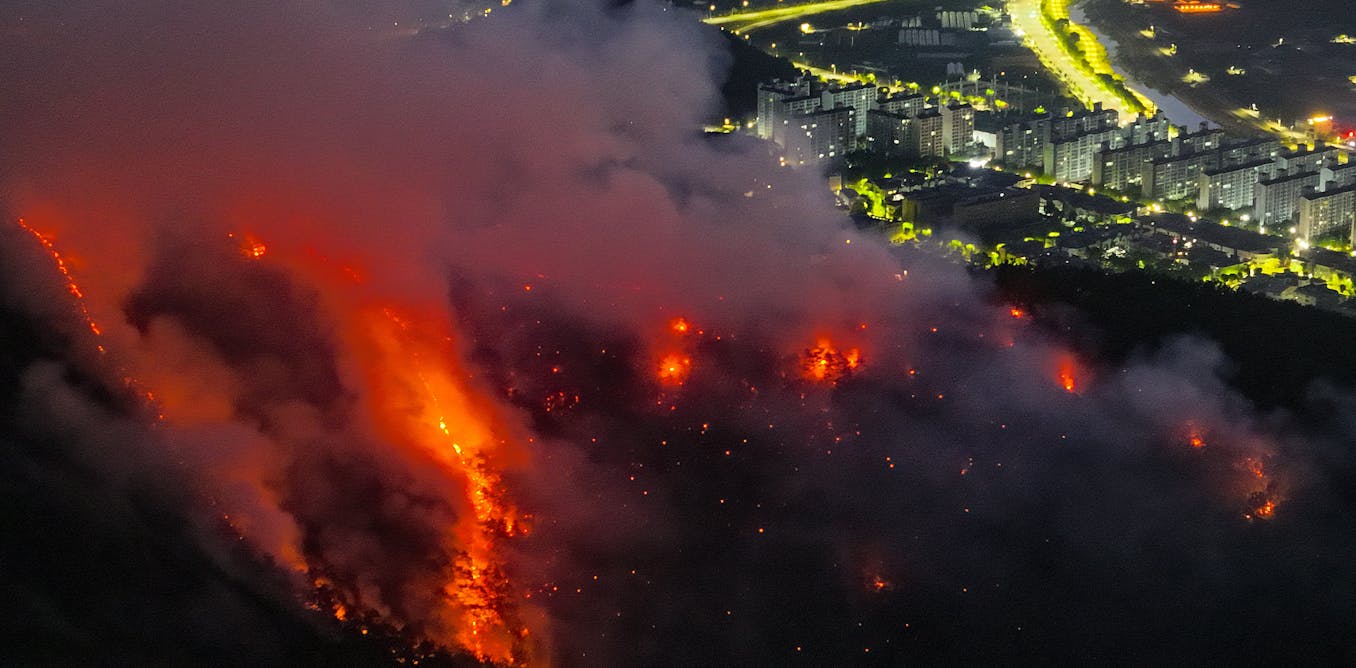
LA fires show the human cost of climate-driven ‘whiplash’ between wet and dry extremes

Spread the love
Allison Dinner / EPA

Doug Specht, University of Westminster

October to April is normally considered to be the wet season in California, yet this January, the region is experiencing some of the most devastating fires it’s ever seen.

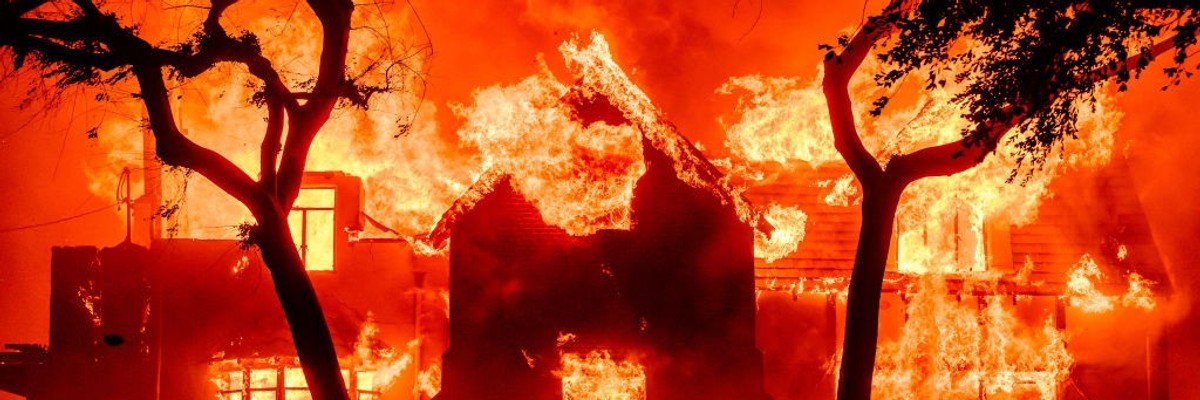
As of January 10, five major fires in and around Los Angeles have burned over 29,053 acres, leading to the evacuation of more than 180,000 people, the destruction of over 2,000 buildings (mainly homes), and an estimated damage cost of at least US$52 billion (£42.5 billion). Ten lives have been lost, and these numbers are expected to rise as the fires continue to burn.

The exact causes of each fire are still under investigation. However, several factors have contributed to their rapid spread and intensity.

The seasonal Santa Ana winds are particularly strong this year, bringing low humidity, dry air and high wind speeds. Southern California has received less than 10% of its average rainfall since October 2024, creating dry conditions that make the area highly vulnerable to fire.

Unusually wet winters in both 2022-23 and 2023-24 led to increased vegetation growth, providing more fuel for the fires. This cycle of wet and dry extremes, known as “hydroclimate whiplash”, is part of the increasingly intense climate cycles caused by climate change.

Hydroclimate whiplash can occur virtually anywhere. These cycles can cause extreme wildfires, such as those in California, where rapid vegetation growth is followed by drying. They can also exacerbate flooding when unusually heavy rains hit the dry-baked ground, then run off over the land rather than seeping in, leading to flash flooding.

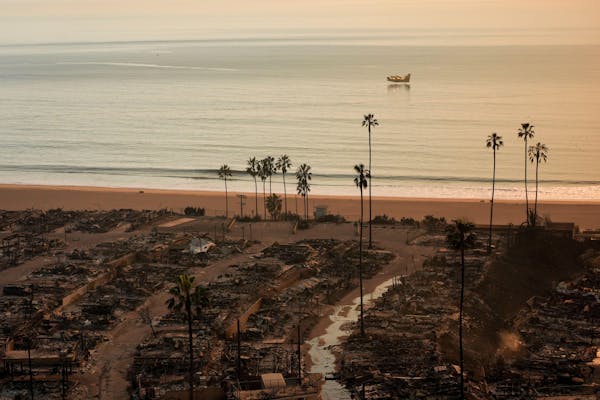
In Los Angeles, some neighbourhoods have been almost entirely destroyed. Jae C. Hong / Alamy

The human impact of hydroclimate whiplash

Rapid transitions between extreme wet and dry conditions have significant and wide-ranging impacts on people, a focus of my academic research, affecting everything from public health to economic stability and social equity.

As we have seen in California, there is the immediate impact of loss of life, property and livelihoods. We have also seen this during whiplash-induced floods and landslides, such as those experienced across California in 2023 and east Africa in 2024, when years of drought were followed by weeks of rain.

Fires exacerbate respiratory and cardiovascular diseases through their polluting smoke. Flooding creates conditions for waterborne illnesses such as cholera, leptospirosis or norovirus to rip through populations. Extreme swings in temperature can also create more heat-related illnesses, as human bodies struggle to adapt quickly. It is estimated that the health-related impacts of climate change will cost US$1.1 trillion by 2050.

But this number pails into insignificance against the projected US$12.5 trillion in economic losses worldwide due to climate change by 2050. Critical infrastructure, including water supply systems, wastewater treatment plants and transportation networks, is at risk of damage or destruction. Food insecurity and scarcity will also increase during hydroclimate whiplash events.

And these impacts are not evenly distributed. While this month’s wildfires are affecting some of the richest communities in the US, it is generally low-income communities and vulnerable populations that are disproportionately affected, with limited resources to prepare for or recover from extreme events. Across the world, poorer populations are experiencing a 24%-48% increase in drought-to-downpour events, exacerbating their vulnerability and widening the health equity gap.

All these events and concerns also lead to mental health issues such as anxiety, depression and post-traumatic stress disorder (PTSD), resulting from displacement and trauma. Such human impacts are harder to measure, and often under-reported.

Adaptation and resilience

As climate change intensifies hydroclimate whiplash events, the human impacts are expected to grow more severe. Addressing these challenges will require coordinated efforts across multiple sectors, with a focus on both mitigation and adaptation strategies to protect human health, economic stability and social equity.

Governments and local authorities will need to implement co-management approaches for both drought and flood risks, alongside developing more flexible water management systems and infrastructure. Investing in natural infrastructure to enhance biodiversity and ecosystems will reduce risks to humans, both by restricting the effects of climate change and lowering the risks of fire and flooding.

As individuals we can often feel powerless, but environmental campaigns and movements have been highly successful in changing government policies. In the UK, the 2008 Climate Change Act and the net zero by 2050 legislation were the direct result of citizen lobbying and action, and the same can be said for numerous renewable energy transition policies around the world.

In California, we have seen the devastating effect of hydroclimate whiplash – and this won’t be the last we see. By calling on our governments to produce adaptation and resilience strategies that recognise climate change as a long-term human and economic risk factor, we can be more prepared for these events.

Doug Specht, Reader in Cultural Geography and Communication, University of Westminster

This article is republished from The Conversation under a Creative Commons license. Read the original article.

Continue ReadingLA fires show the human cost of climate-driven ‘whiplash’ between wet and dry extremes

Critics Say Trump Got ‘Nothing Right’ About Causes of LA Wildfires

Spread the love

Original article by Brett Wilkins republished from Common Dreams under Creative Commons (CC BY-NC-ND 3.0).

Then-U.S. President Donald Trump speaks during a briefing on wildfires with local and federal fire and emergency officials in Sacramento, California on September 14, 2020. (Photo: Brendan Smialowski/AFP via Getty Images)

One observer blasted MAGA’s “conflagration of lies and disinformation.”

Progressive critics were left shaking their heads this week as Republican U.S. President-elect Donald Trump and his MAGA allies absurdly blamed the Los Angeles County wildfires on everything from an ichthyophile governor to diversity policies—while ignoring what experts say is the true cause of the deadly infernos.

On Wednesday, Trump took to his Truth social media platform to falsely accuse Democratic California Gov. Gavin Newsom—whom he repeatedly called “Newscum”—of refusing “to sign the water restoration declaration put before him that would have allowed millions of gallons of water… to flow daily into many parts of California, including the areas that are currently burning in a virtually apocalyptic way.”

Newsom’s office responded to Trump’s accusation by correctly noting that “there is no such document as the water restoration declaration.”

Trump also accused Newsom of wanting “to protect an essentially worthless fish called a smelt, by giving it less water,” a red herring and false statement given that the state’s plan to protect the endangered delta smelt actually involved increasing the amount of fresh water flowing into its habitat.

Jeffrey Mount, a water policy expert at the nonpartisan Public Policy Institute of California, toldMSNBC newsletter editor Ryan Teague Beckwith on Thursday that Trump got “nothing right” in his post.

Summarizing his interview with Mount, Teague Beckwith wrote:

Without getting into too much detail, here’s what did happen… During Trump’s first term, his administration sought to divert some of the water coming into a river delta near San Francisco to farmers in the San Joaquin Valley, among others. They came up with a plan for the water, which Newsom challenged in court. The Biden administration later negotiated a new plan with California on how to divvy up the water.

This is basic stuff, so the fact that Trump describes this as Newsom refusing to sign some kind of document that never existed should give you a sense of how disengaged he is with his own policy.

Meanwhile, MAGA acolyte and soon-to-be Department of Government Efficiency co-leader Elon Musk used his X social media network—formerly Twitter—to amplify racist posts disparaging Democratic Los Angeles Mayor Karen Bass, an antisemitic diatribe by defamatory conspiracy theorist Alex Jones, implicitly sexist and homophobic attacks on Los Angeles’ fire chief, and his own frequent aspersions of diversity, equity, and inclusion (DEI) policies.

https://twitter.com/mikey_biz/status/1877417097615044718?ref_src=twsrc%5Etfw%7Ctwcamp%5Etweetembed%7Ctwterm%5E1877417097615044718%7Ctwgr%5E537fbddc0da64a570956ccbd3e213e91345fba37%7Ctwcon%5Es1_c10&ref_url=https%3A%2F%2Fwww.commondreams.org%2Fnews%2Ftrump-california-wildfires

Slate web editor Nitish Pahwa condemned MAGA’s “conflagration of lies and disinformation.”

“Just one day after Mark Zuckerberg announced that Facebook and Instagram would no longer be fact-checking informational posts, and mere months after nonstop online hoaxes obstructed federal efforts to assist North Carolinians in the recovery from Hurricane Helene, we’re getting an early-year preview of how the United States is going to experience and respond to these rampaging climate disasters throughout the near future,” Pahwa said.

“In the vacuum left by mainstream TV networks that did not at all mention climate change in their fire coverage, bad-faith digital actors swooped in with their own takes,” Pahwa added. “Climate change doesn’t just boost record weather events—it boosts the snake-oil salesmen, too.”

Climate experts and defenders weighed in with science-based explanations for the increase in extreme weather events like the Los Angeles County wildfires.

As Common Dreamsreported earlier Thursday, Aaron Regunberg, Public Citizen’s Climate Program senior policy counsel, noted that “a recent study found that nearly all of the observed increase in wildfire-burned area in California over the past half-century is attributable to anthropogenic climate change.”

“This devastation is the direct result of Big Oil’s conduct,” Regunberg asserted.

As Fossil Free Media director Jamie Henn said, “This is exactly the sort of disaster that Exxon’s own scientists predicted more than 50 years ago, but they spent billions to keep us hooked on fossil fuels.”

According to the U.S. National Park Service, the area burned annually by California wildfires has increased fivefold since the 1970s.

Original article by Brett Wilkins republished from Common Dreams under Creative Commons (CC BY-NC-ND 3.0).

Continue ReadingCritics Say Trump Got ‘Nothing Right’ About Causes of LA Wildfires

As Apocalyptic Fires Torch LA, Climate Campaigners Say ‘Big Oil Did This’

Spread the love

Original article by Jake Johnson republished from Common Dreams under Creative Commons (CC BY-NC-ND 3.0). 

A home is engulfed in flames during the Eaton fire in the Altadena area of Los Angeles County, California on January 8, 2025. (Photo: Josh Edelson/AFP via Getty Images)

“The fires in Los Angeles aren’t just a tragedy, they’re a crime.”

As massive wildfires continued ripping through Los Angeles on Thursday, leaving utter devastation in their wake, climate campaigners said blame for the infernos ultimately lies with the mega-profitable oil and gas giants that have spent decades knowingly fueling the crisis that made the emergency in southern California possible.

“Los Angeles is burning. Entire neighborhoods have been wiped off the map. We are devastatingly unprepared for the climate that fossil fuel greed is creating,” the youth-led Sunrise Movement wrote on social media as several mostly uncontained fires wreaked havoc, supercharged by roaring winds and abnormally dry conditions.

“Oil and gas CEOs know they’re responsible for these disasters,” the group added. “But still, they choose to fight investments in renewable energy, spread propaganda, and bribe politicians into supporting $757 BILLION in fossil fuel subsidies.”

With appalling speed, the Los Angeles fires have so far scorched tens of thousands of acres, destroyed thousands of homes, and killed at least five people—a death toll that’s expected to rise.

“It’s like Armageddon,” said one resident, a sentiment echoed by a CNN reporter in Los Angeles.

“Everyone keeps saying ‘apocalyptic,'” said CNN‘s Leigh Waldman. “But that doesn’t begin to cover it.”

https://twitter.com/i/status/1877006247020388717

Sorry, this content could not be embedded.
X

The Palisades fire, the largest of five blazes currently ravaging Los Angeles County, has already been deemed the most destructive in LA history.

Early estimates indicate the total economic damage of the Los Angeles fires could exceed $50 billion.

With a Thursday social media post featuring footage of the raging fires and damage in Los Angeles, Warren Gunnels, staff director for Sen. Bernie Sanders (I-Vt.), wrote: “They say the Green New Deal is expensive. Compared to what?”

https://twitter.com/GunnelsWarren/status/1877185320250179654?ref_src=twsrc%5Etfw%7Ctwcamp%5Etweetembed%7Ctwterm%5E1877185320250179654%7Ctwgr%5E69ff850d9a136ae650aa731c618c4a174d411dd9%7Ctwcon%5Es1_c10&ref_url=https%3A%2F%2Fwww.commondreams.org%2Fnews%2Fclimate-los-angeles-fires

Ben Jealous, executive director of the Sierra Clubsaid in a statement Wednesday that “these fires have taken lives and destroyed homes, livelihoods, and landscapes.”

“We are holding those affected by this disaster close in our hearts and appreciate the first responders who are bravely working to contain the fires. It is essential that federal and state authorities continue to provide these communities with all the resources and support they need to recover and heal,” said Jealous. “Barely a week into the new year, and fire season is here. This is not normal.”

“Time and again, we are witnessing fossil fuel-driven climate change heighten extreme weather, making wildfires increasingly common and increasingly destructive,” he continued. “We cannot be passive. We cannot elevate misinformation about what is needed to confront the worsening crisis. Leaders must take the action necessary to fund and support the home-hardening efforts that make our communities resilient.”

People watch smoke and flames from the Palisades Fire on January 7, 2025 in Los Angeles, California. (Photo: Tiffany Rose/Getty Images)

The Los Angeles fires come as states and localities across the United States are suing oil and gas companies for climate damages as extreme weather becomes increasingly frequent and destructive on a warming planet.

According to the Center for Climate Integrity, more than one in four Americans currently live in a community taking legal action against Big Oil, “underscoring the rapidly growing wave of calls to hold the oil and gas industry accountable for its decades-long climate deception and the harms it has caused.”

Aaron Regunberg, an attorney who is helping build a legal case against the fossil fuel industry, wrote Wednesday that the Los Angeles crisis “didn’t just happen.”

“A recent study found that nearly all of the observed increase in wildfire-burned area in California over the past half-century is attributable to anthropogenic climate change,” Regunberg, senior policy counsel with Public Citizen’s Climate Program, wrote on social media. “This devastation is the direct result of Big Oil’s conduct.”

Did you know that California has a law that makes it a crime to "recklessly cause a fire," as well as a victim restitution statute requiring those conficted of crimes to pay their victims for their economic losses?Big Oil did this. Prosecute them and make them pay.

Aaron Regunberg (@aaronregunberg.bsky.social) 2025-01-08T23:48:21.696Z

Jamie Henn, director of Fossil Free Media, offered a similar assessment, writing that “the fires in Los Angeles aren’t just a tragedy, they’re a crime.”

“This is exactly the sort of disaster that Exxon’s own scientists predicted more than 50 years ago, but they spent billions to keep us hooked on fossil fuels,” Henn added. “It’s time to make polluters pay.”

Original article by Jake Johnson republished from Common Dreams under Creative Commons (CC BY-NC-ND 3.0). 

Continue ReadingAs Apocalyptic Fires Torch LA, Climate Campaigners Say ‘Big Oil Did This’

‘This Is Unprecedented’: Several Horrific Wildfires Ravage Los Angeles

Spread the love

Original article by Jake Johnson republished from Common Dreams under Creative Commons (CC BY-NC-ND 3.0).

Flames from the Palisades fire burn homes on January 7, 2025 in the Pacific Palisades neighborhood of Los Angeles, California. (Photo: Eric Thayer/Getty Images)

“There is no ‘firefighting’ in these kinds of conditions,” said one meteorologist. “There is only saving as many lives as possible and getting the heck out of the fire’s way.”

Several major wildfires burned out of control in California’s Los Angeles County on Wednesday as roaring winds fueled the rapid spread of the blazes, forcing tens of thousands to evacuate as state, local, and federal officials mobilized resources to confront the emergency.

Los Angeles Mayor Karen Bass wrote on social media late Tuesday that the city is “working aggressively” to stem the wildfires, which scientists and government officials characterized as uniquely devastating.

“Emergency officials, firefighters, and first responders are all hands on deck through the night to do everything possible to protect lives,” California Gov. Gavin Newsom said early Wednesday. The governor noted that more than 1,400 firefighting personnel have been deployed to “combat these unprecedented fires.”

The PalisadesEaton, and Hurst fires broke out on Tuesday. It quickly exploded amid what the National Weather Service described as “extremely critical fire weather,” with wind gusts up to 99 mph propelling the devastating blazes. The extreme winds forced emergency crews to ground aircraft that were working to contain the fires.

“For some context, fire crews are up against near hurricane-force winds occurring mid-winter in rugged terrain during a drought at night,” wrote meteorologist Eric Holthaus. “There is no ‘firefighting’ in these kinds of conditions. There is only saving as many lives as possible and getting the heck out of the fire’s way.”

“The emergence of extreme wintertime wildfires in California presents one of those classic ‘this is climate change’ moments.”

The Eaton fire, which broke out Tuesday evening in the Pasadena area, “spread so rapidly that staff at a senior living center had to push dozens of residents in wheelchairs and hospital beds down the street to a parking lot,” The Los Angeles Times reported.

“The residents waited there in their bedclothes as embers fell around them until ambulances, buses, and even construction vans arrived to take them to safety,” the newspaper added.

The three fires have together burned thousands of acres so far and destroyed or endangered tens of thousands of homes and buildings, according to Newsom’s office. So far, at least 19 school districts have announced complete or partial closures due to the fires.

Video footage posted to social media showed residents watching in horror as flames surrounded their homes:

https://twitter.com/i/status/1876845562328146405

Sorry, this content could not be embedded.
X

Another video shows residents attempting to salvage as many belongings as possible before fleeing:

https://twitter.com/i/status/1876845004745748780

Sorry, this content could not be embedded.
X

“There has been a recent massive increase in wildfires in California but really, a fire this big in January? This is unprecedented,” scientist Hayley Fowler wrote on social media. “One of many extreme events fueled by the climate crisis.”

Holthaus wrote Tuesday that Southern California is “facing a rare and dangerous juxtaposition of extreme winds and midwinter drought,” the meteorologist described as “a worrying example of the state’s expanding wildfire threat as climate change worsens.”

“The National Weather Service defines ‘extremely critical’ fire weather as sustained winds over 30 mph and relative humidity of less than 10% in drought conditions and temperatures warmer than 70 degrees,” Holthaus observed. “This is the first time in history these criteria have been met anywhere in the United States during January.”

“The emergence of extreme wintertime wildfires in California,” he added, “presents one of those classic ‘this is climate change’ moments: A specific set of weather conditions are now occurring in such a way to produce the potential for rare disasters to become much more common.”

Original article by Jake Johnson republished from Common Dreams under Creative Commons (CC BY-NC-ND 3.0).

Continue Reading‘This Is Unprecedented’: Several Horrific Wildfires Ravage Los Angeles

Amid Soaring Temps, Heat-Related Deaths Have More Than Doubled Since 1999

Spread the love

Original article by Jessica Corbett republished from Common Dreams under a CC licence.

A sign says, “Stop: Extreme Heat Danger,” at the Golden Canyon Trailhead in Death Valley, California on July 9, 2023.
 (Photo: Tayfun Coskun/Anadolu Agency via Getty Images)

“It is likely that continued increases in average temperatures, the number of ‘hot days,’ and the frequency and intensity of heatwaves could be playing a role,” said one researcher.

As 55 million people in the U.S. Midwest faced heat alerts on Monday, research published in the peer-reviewed Journal of the American Medical Association showed that heat-related deaths in the country rose 117% between 1999 and 2023.

“The current trajectory that we’re on, in terms of warming and the change in the climate, is starting to actually show up in increased deaths,” lead author Jeffrey Howard, an associate professor of public health at the University of Texas at San Antonio, told USA Today. “That’s something that we hadn’t had measured before.”

Using a U.S. Centers for Disease Control and Prevention platform, Howard and co-authors from Pennsylvania State University and the Uniformed Services University of the Health Sciences analyzed all deaths from those 25 years coded for “hyperthermia of newborn,” “effects of heat and light,” or “exposure to excessive natural heat” as either a contributing or underlying cause of death.

They found 21,518 deaths for the full period, with 1,069 in 1999. The lowest annual figure was in 2004 (311) and the highest was in 2023 (2,325). Last year was the hottest on record globally and scientists are already warning that this year is expected to continue that trend.

“As temperatures continue to rise because of climate change, the recent increasing trend is likely to continue.”

Last year broke the record that was set in 2016—a year that’s also significant in the new study: “The number of heat-related deaths… showed year-to-year variability, with spikes in 2006 and 2011, before showing steady increases after 2016.”

Howard told CBS News that “it is likely that continued increases in average temperatures, the number of ‘hot days,’ and the frequency and intensity of heatwaves could be playing a role” in the rise since 2016.

“There is also a social and behavioral component as well,” he added, “including differences in access to air conditioning, outdoor work, the number of unhoused individuals, and things like that.”

The researcher noted that Arizona, California, Nevada, and Texas had the highest heat-related deaths—which he said is “not terribly surprising because we know that these are some of the hottest regions in the country, but it does reinforce that the risk varies regionally.”

The paper warns that “as temperatures continue to rise because of climate change, the recent increasing trend is likely to continue. Local authorities in high-risk areas should consider investing in the expansion of access to hydration centers and public cooling centers or other buildings with air conditioning.”

The authors also acknowledged limitations of their research—including “the potential for misclassification of causes of death, leading to possible underestimation of heat-related mortality rates; potential bias from increasing awareness over time; and lack of data for vulnerable subgroups”—meaning the true death toll could be higher.

A legal memo published in June by the watchdog Public Citizen detailed how local or state prosecutors could bring criminal charges against oil and gas companies for deaths from extreme heat made more likely by the fossil fuel-driven climate emergency.

“These victims deserve justice no less than the victims of street-level homicides,” said Aaron Regunberg, senior policy counsel for the group. “And this memo shows that prosecutors have a path to secure that justice, if they choose to pursue it.”

Original article by Jessica Corbett republished from Common Dreams under a CC licence.

Continue ReadingAmid Soaring Temps, Heat-Related Deaths Have More Than Doubled Since 1999