This isn’t just an attack on the environment. It’s an attack on every state.
The White House is once again defying the will of the people.
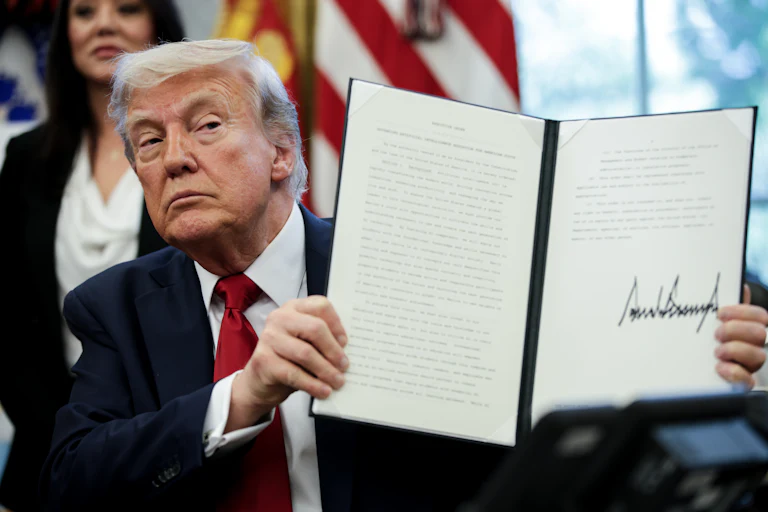
Donald Trump moved to overturn California’s electric vehicle mandate Thursday, marking the second instance this week in which the president has stretched his authority to advance his political agenda in the state.
California mandated a phaseout of gas vehicles and diesel trucks by 2035, citing benefits to public health and the environment. Eleven other states and Washington, D.C., followed suit. The plan required at least 35 percent of 2026 model vehicles sold within state bounds to be emissions-free, with that percentage growing to 68 percent by 2030 and 100 percent by 2035.
The Golden State passed the laws under the authority of the 1967 Clean Air Act, on the basis that the state needed more power to handle its highly polluted air and car-dependent cities. But each state requires a waiver from the Environmental Protection Agency before the rules can actually take effect.
Trump’s signature on the congressional resolution revokes three of those waivers, issued during the Biden administration, effectively erasing the mandate.
Elon Musk urges you to be a Fascist like him, says that you can ignore facts and reality then.Neo-Fascist Climate Science Denier Donald Trump says Burn, Baby, Burn.
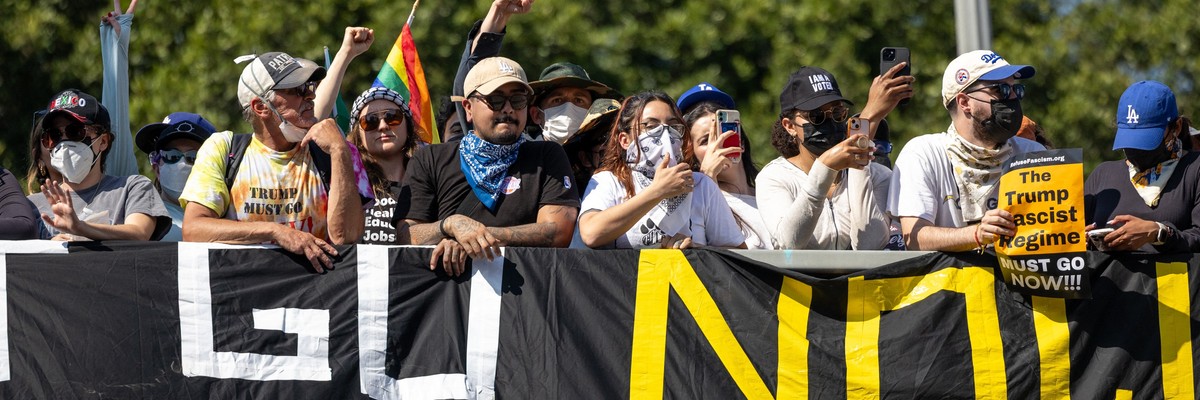
Protesters hold a large banner during an anti-ICE protest in downtown Los Angeles, California, on June 8, 2025. (Photo: Benjamin Hanson/Middle East Images/AFP via Getty Images)
“We’ll rise together and say: We reject political violence. We reject fear as governance. We reject the myth that only some deserve freedom,” wrote the coalition behind “No Kings” rallies planned for June 14.
U.S. President Donald Trump on Saturday ordered the deployment of National Guard troops to quell anti-U.S. Immigration and Customs Enforcement protests in Los Angeles, prompting a response from the coalition behind upcoming nationwide protests planned to counter Trump’s Washington, D.C. military parade on June 14.
The coalition organizing the “No Kings” national day of action accused the Trump administration of “escalating tensions” in a statement released Sunday.
Generally, the U.S. military is not supposed to take part in civilian law enforcement except in times of emergency. Trump on Saturday invoked a federal law that, according to The Guardian, empowers the president to call part of California’s National Guard into federal service. California’s Democratic Gov. Gavin Newsom objected to this move.
Protests began on Friday following reports that federal immigration agents were carrying out raids in Los Angeles.
In their statement, the coalition denounced Trump’s decision to call National Guard members into federal service, and wrote that “people are peacefully and lawfully protesting the administration’s abuses of power and the abduction of their neighbors by ICE.”
“Instead of listening, the Trump administration is escalating tensions,” the coalition wrote. “Against the guidance of local leaders, they are deploying military force to suppress free speech. They do not care about our safety—it’s about silencing opposition. It’s a blatant abuse of power designed to intimidate families, stoke fear, and crush dissent.”
Law enforcement has acted with force against protestors, including using tear gas and flash bangs, according to CNN. And according to the Los Angeles Times, overnight into Monday businesses were vandalized and burglarized, capping a period of unrest that saw protestors set cars on fire, in addition to other acts of vandalism.
Los Angeles Mayor Karen Bass on Sunday denounced the lawbreaking, but also laid blame on the Trump administration, according to the LA Times.
“What we’re seeing in Los Angeles is chaos that is provoked by the administration,” Bass said, according to the outlet. “When you raid Home Depot and workplaces, when you tear parents and children apart, and when you run armored caravans through our streets you cause fear and you cause panic.”
In concluding their statement about Trump’s deployment of the National Guard, the coalition behind “No Kings” struck a defiant tone. “From major cities to small towns, we’ll rise together and say: we reject political violence. We reject fear as governance. We reject the myth that only some deserve freedom,” they wrote.
The groups say that more than 1,800 rallies are planned for Saturday and that the events are guided by a commitment to nonviolent protest. In the statement, the group also said that organizers with “No Kings” are trained in de-escalation tactics and plan to work closely with local partners to ensure actions are peaceful.
Leah Greenberg, co-executive director of Indivisible, one of the groups behind “No Kings,” has said that the aim is to “create contrast, not conflict.”
Over 150 progressive organizations, watchdogs, climate groups, and other entities are partners on the “No Kings” rallies.
See the full list of planned events and locations here.
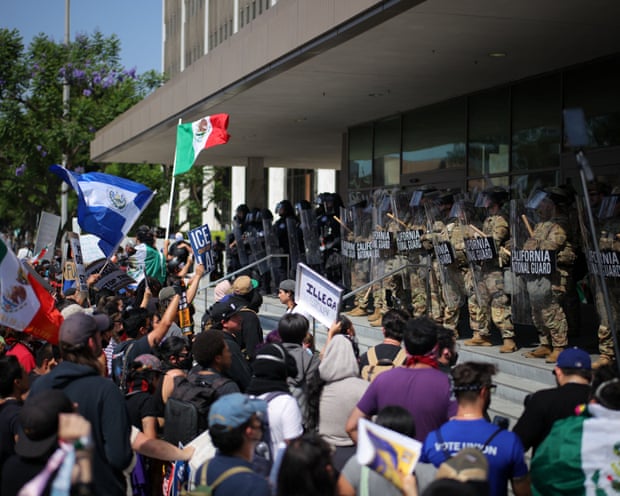
California national guard troops keep watch, as protests against immigration sweeps continue, in Los Angeles, California, on Monday. Photograph: Daniel Cole/Reuters
As many demand the release of loved ones, Trump’s ‘border czar’ admits some were arrested without criminal records
…
The Department of Homeland Security (DHS) said that 118 immigrants were arrested this week, and released the names of some of those in its custody, alleging criminal violations. But the administration’s border czar, Tom Homan, also admitted that the agency was arresting people without criminal records.
The raids at workplaces – pushed by Homan and by White House deputy chief of staff, Stephen Miller – come amid a broader push to speed up arrests and deportations. Homan said the LA area is likely to see more enforcement this week, even as thousands of national guard deployed to the city prepared to quell protests against the raids.
Lawyers from the Immigrant Defenders Law Center (ImmDef), found that immigrants apprehended in LA were initially detained in the basement of a federal immigration building. “As attorneys, we are disgusted by DHS’s blatant betrayal of basic human dignity as we witness hundreds of people held in deplorable conditions without food, water, or beds for 12-plus hours,” said Lindsay Toczylowski, president of ImmDef. “This is an urgent moment for our country to wake up to the terror Ice is inflicting on communities and take action.”
The American Civil Liberties Union (ACLU) held a rally in downtown Los Angeles demanding the “humane treatment and access to lawyers for all detainees”.
…
The workplace raids were especially brazen, lawyers said, after a federal judge in April issued a preliminary injunction forbidding warrantless immigration stops. The injunction applied to a wide swath of California, and came after CBP conducted similar raids in California’s agricultural Kern county in January.
“You can’t just racially and ethnically profile people and arrest them and ask questions later,” said Reyes Savalza, noting that many of those arrested had no criminal history and could apply for various forms of immigration relief if they were allowed to contact attorneys.
Elon Musk urges you to be a Fascist like him, says that you can ignore facts and reality then.Neo-Fascist Climate Science Denier Donald Trump says Burn, Baby, Burn.
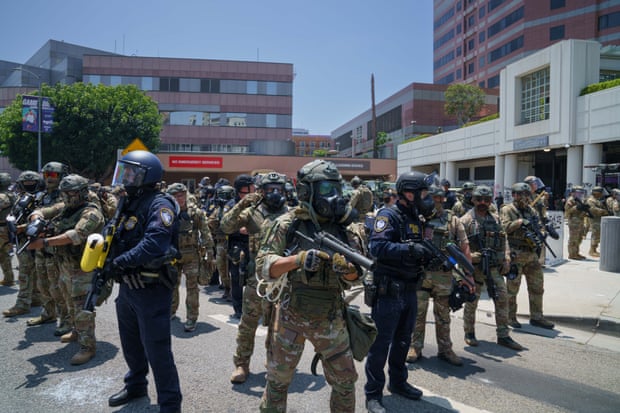
Members of the California national guard and other law enforcement at a protest in Los Angeles on Sunday. Photograph: Daniel Powell/ZUMA Press Wire/Shutterstock
Lawsuit claims administration ‘trampled’ on states sovereignty by bypassing Governor Gavin Newsom
The state of California will file a lawsuit against the Trump administration for “unlawfully” federalizing the state’s national guard and deploying its troops to quell immigration protests, the attorney general Rob Bonta said on Monday.
Previewing the lawsuit, Bonta claimed the Trump administration “trampled” on the states sovereignty by bypassing the governor Gavin Newsom – a move he said was “by definition, illegal” and escalated what began on Friday as scattered protests and erupted into unrest.
“This was not inevitable,” Bonta said of the demonstrations that built over the weekend following immigration raids across Los Angeles, adding: “There was no risk of rebellion, no threat of foreign invasion. No, inability for the federal government to enforce federal laws.”
Elon Musk urges you to be a Fascist like him, says that you can ignore facts and reality then.Neo-Fascist Climate Science Denier Donald Trump says Burn, Baby, Burn.
Protesters oppose Trump’s policies in Los Angeles on Sunday. Photograph: Étienne Laurent/AFP/Getty Images
Thousands take to LA streets to protest against Ice raids and president’s deployment of national guard troops
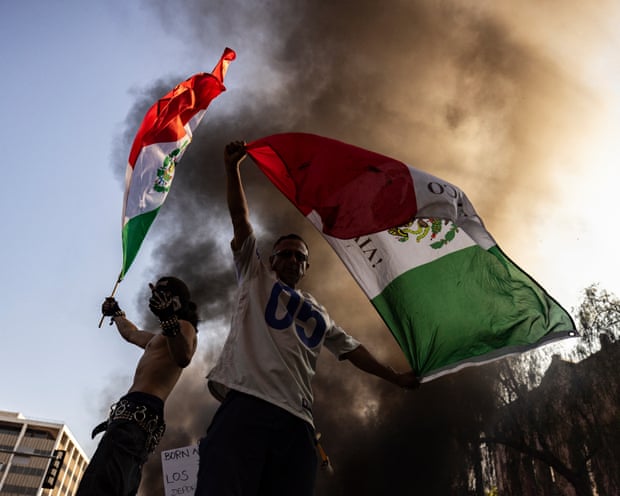
Federal agents clashed with demonstrators in Los Angeles on Sunday as police used teargas and “less-lethal munitions” to disperse massive crowds of people protesting against Donald Trump’s immigration crackdown and his deployment of the California national guard against the will of the state’s elected leaders.
Thousands of Angelenos swamped the streets around city hall, the federal courthouse and a detention center where protesters arrested in days before are being held. They also brought a major freeway to a standstill.
Vocal and boisterous, the crowd for large parts of the day was mostly peaceful. But tensions flared several times. On Sunday afternoon, police used teargas to disperse groups of protesters gathered near the detention center. And in the evening, officers fired round after round of flash-bangs in an attempt to push the protesters back up the freeway off-ramps. Los Angeles police leaders said officers had been shot at with commercial grade fireworks, and had rocks thrown at them.
Trump’s decision to deploy national guard troops into Los Angeles, against the wishes of state and local officials, has sent shockwaves through American politics. California’s governor, Gavin Newsom, and other Democratic governors have sharply criticized the move, describing it as an “alarming abuse of power”. Newsom has called on the administration to rescind the “unlawful” deployment.
“This is a serious breach of state sovereignty – inflaming tensions while pulling resources from where they’re actually needed. Rescind the order. Return control to California,” Newsom said.
Trump ordered the deployment of 2,000 national guard on Saturday night following two days of clashes between demonstrators and US immigration authorities.
The decision marked a stunning escalation in a broad crackdown on immigrants following raids across the country, which have triggered protests.
Elon Musk urges you to be a Fascist like him, says that you can ignore facts and reality then.Neo-Fascist Climate Science Denier Donald Trump says Burn, Baby, Burn.