Tag: California

  • ‘This Is Unprecedented’: Several Horrific Wildfires Ravage Los Angeles

    Spread the love

    Original article by Jake Johnson republished from Common Dreams under Creative Commons (CC BY-NC-ND 3.0).
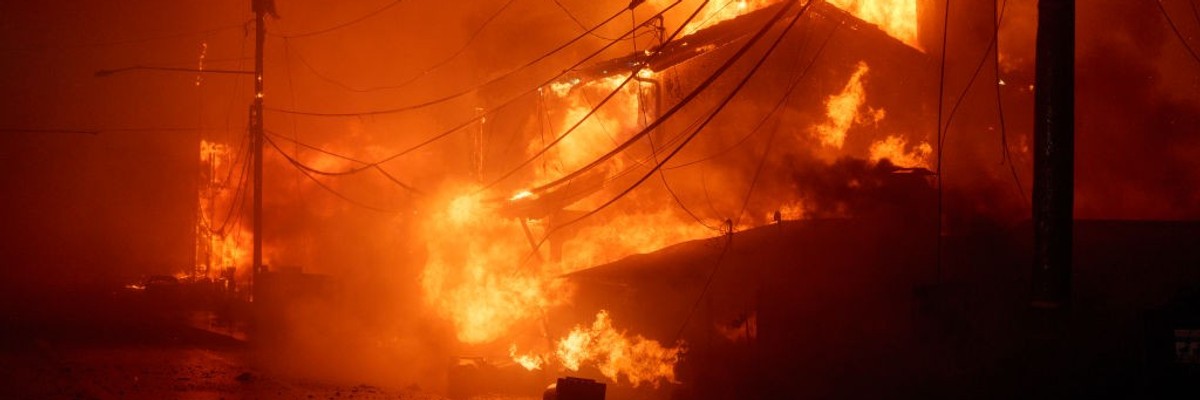
    Flames from the Palisades fire burn homes on January 7, 2025 in the Pacific Palisades neighborhood of Los Angeles, California. (Photo: Eric Thayer/Getty Images)

    “There is no ‘firefighting’ in these kinds of conditions,” said one meteorologist. “There is only saving as many lives as possible and getting the heck out of the fire’s way.”

    Several major wildfires burned out of control in California’s Los Angeles County on Wednesday as roaring winds fueled the rapid spread of the blazes, forcing tens of thousands to evacuate as state, local, and federal officials mobilized resources to confront the emergency.

    Los Angeles Mayor Karen Bass wrote on social media late Tuesday that the city is “working aggressively” to stem the wildfires, which scientists and government officials characterized as uniquely devastating.

    “Emergency officials, firefighters, and first responders are all hands on deck through the night to do everything possible to protect lives,” California Gov. Gavin Newsom said early Wednesday. The governor noted that more than 1,400 firefighting personnel have been deployed to “combat these unprecedented fires.”

    The Palisades, Eaton, and Hurst fires broke out on Tuesday. It quickly exploded amid what the National Weather Service described as “extremely critical fire weather,” with wind gusts up to 99 mph propelling the devastating blazes. The extreme winds forced emergency crews to ground aircraft that were working to contain the fires.

    “For some context, fire crews are up against near hurricane-force winds occurring mid-winter in rugged terrain during a drought at night,” wrote meteorologist Eric Holthaus. “There is no ‘firefighting’ in these kinds of conditions. There is only saving as many lives as possible and getting the heck out of the fire’s way.”

    “The emergence of extreme wintertime wildfires in California presents one of those classic ‘this is climate change’ moments.”

    The Eaton fire, which broke out Tuesday evening in the Pasadena area, “spread so rapidly that staff at a senior living center had to push dozens of residents in wheelchairs and hospital beds down the street to a parking lot,” The Los Angeles Times reported.

    “The residents waited there in their bedclothes as embers fell around them until ambulances, buses, and even construction vans arrived to take them to safety,” the newspaper added.

    The three fires have together burned thousands of acres so far and destroyed or endangered tens of thousands of homes and buildings, according to Newsom’s office. So far, at least 19 school districts have announced complete or partial closures due to the fires.

    Video footage posted to social media showed residents watching in horror as flames surrounded their homes:

    https://twitter.com/i/status/1876845562328146405

    Sorry, this content could not be embedded.
    X

    Another video shows residents attempting to salvage as many belongings as possible before fleeing:

    https://twitter.com/i/status/1876845004745748780

    Sorry, this content could not be embedded.
    X

    “There has been a recent massive increase in wildfires in California but really, a fire this big in January? This is unprecedented,” scientist Hayley Fowler wrote on social media. “One of many extreme events fueled by the climate crisis.”

    Holthaus wrote Tuesday that Southern California is “facing a rare and dangerous juxtaposition of extreme winds and midwinter drought,” the meteorologist described as “a worrying example of the state’s expanding wildfire threat as climate change worsens.”

    “The National Weather Service defines ‘extremely critical’ fire weather as sustained winds over 30 mph and relative humidity of less than 10% in drought conditions and temperatures warmer than 70 degrees,” Holthaus observed. “This is the first time in history these criteria have been met anywhere in the United States during January.”

    “The emergence of extreme wintertime wildfires in California,” he added, “presents one of those classic ‘this is climate change’ moments: A specific set of weather conditions are now occurring in such a way to produce the potential for rare disasters to become much more common.”

    Original article by Jake Johnson republished from Common Dreams under Creative Commons (CC BY-NC-ND 3.0).
  • Amid Soaring Temps, Heat-Related Deaths Have More Than Doubled Since 1999

    Spread the love

    Original article by Jessica Corbett republished from Common Dreams under a CC licence.

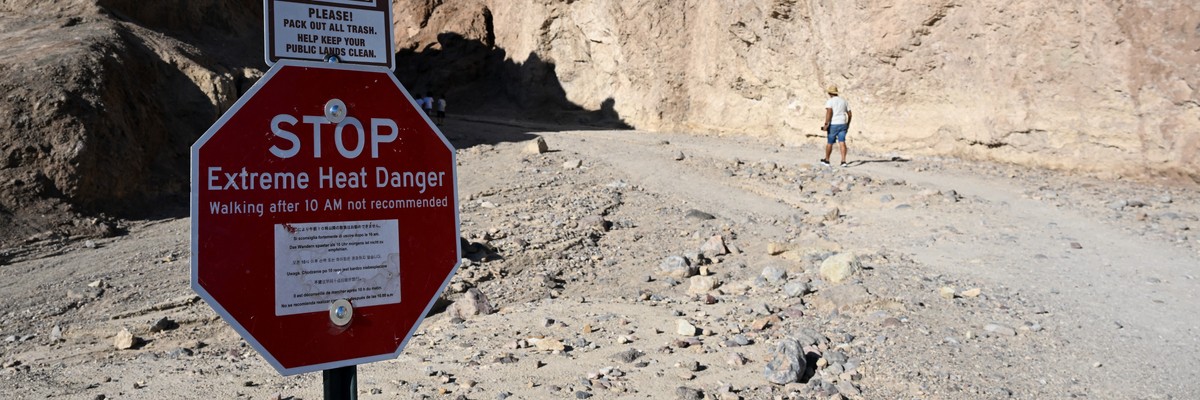
    A sign says, “Stop: Extreme Heat Danger,” at the Golden Canyon Trailhead in Death Valley, California on July 9, 2023.
     (Photo: Tayfun Coskun/Anadolu Agency via Getty Images)

    “It is likely that continued increases in average temperatures, the number of ‘hot days,’ and the frequency and intensity of heatwaves could be playing a role,” said one researcher.

    As 55 million people in the U.S. Midwest faced heat alerts on Monday, research published in the peer-reviewed Journal of the American Medical Association showed that heat-related deaths in the country rose 117% between 1999 and 2023.

    “The current trajectory that we’re on, in terms of warming and the change in the climate, is starting to actually show up in increased deaths,” lead author Jeffrey Howard, an associate professor of public health at the University of Texas at San Antonio, told USA Today. “That’s something that we hadn’t had measured before.”

    Using a U.S. Centers for Disease Control and Prevention platform, Howard and co-authors from Pennsylvania State University and the Uniformed Services University of the Health Sciences analyzed all deaths from those 25 years coded for “hyperthermia of newborn,” “effects of heat and light,” or “exposure to excessive natural heat” as either a contributing or underlying cause of death.

    They found 21,518 deaths for the full period, with 1,069 in 1999. The lowest annual figure was in 2004 (311) and the highest was in 2023 (2,325). Last year was the hottest on record globally and scientists are already warning that this year is expected to continue that trend.

    “As temperatures continue to rise because of climate change, the recent increasing trend is likely to continue.”

    Last year broke the record that was set in 2016—a year that’s also significant in the new study: “The number of heat-related deaths… showed year-to-year variability, with spikes in 2006 and 2011, before showing steady increases after 2016.”

    Howard told CBS News that “it is likely that continued increases in average temperatures, the number of ‘hot days,’ and the frequency and intensity of heatwaves could be playing a role” in the rise since 2016.

    “There is also a social and behavioral component as well,” he added, “including differences in access to air conditioning, outdoor work, the number of unhoused individuals, and things like that.”

    The researcher noted that Arizona, California, Nevada, and Texas had the highest heat-related deaths—which he said is “not terribly surprising because we know that these are some of the hottest regions in the country, but it does reinforce that the risk varies regionally.”

    The paper warns that “as temperatures continue to rise because of climate change, the recent increasing trend is likely to continue. Local authorities in high-risk areas should consider investing in the expansion of access to hydration centers and public cooling centers or other buildings with air conditioning.”

    The authors also acknowledged limitations of their research—including “the potential for misclassification of causes of death, leading to possible underestimation of heat-related mortality rates; potential bias from increasing awareness over time; and lack of data for vulnerable subgroups”—meaning the true death toll could be higher.

    A legal memo published in June by the watchdog Public Citizen detailed how local or state prosecutors could bring criminal charges against oil and gas companies for deaths from extreme heat made more likely by the fossil fuel-driven climate emergency.

    “These victims deserve justice no less than the victims of street-level homicides,” said Aaron Regunberg, senior policy counsel for the group. “And this memo shows that prosecutors have a path to secure that justice, if they choose to pursue it.”

    Original article by Jessica Corbett republished from Common Dreams under a CC licence.

  • 7 Green Groups That Didn’t Back Biden Just Endorsed Harris as ‘Our Only Choice’

    Spread the love

    Original article by JESSICA CORBETT republished from Common Dreams under Creative Commons (CC BY-NC-ND 3.0). 

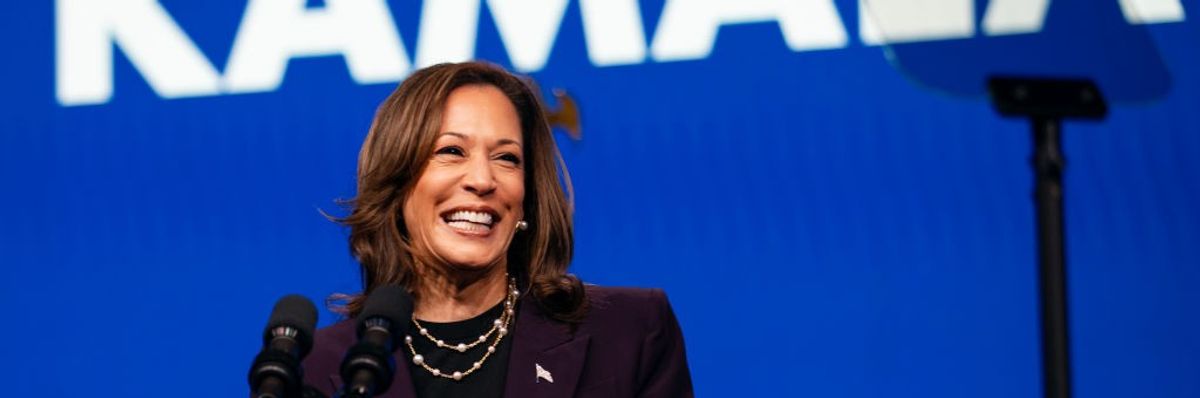
    Vice President Kamala Harris speaks at the American Federation of Teachers’ 88th National Convention on July 25, 2024 in Houston, Texas. (Photo: Montinique Monroe/Getty Images)

    “With a President Harris, we will have a chance to build the political power to move the bold climate initiatives we need.”

    Progressive climate and environmental advocacy groups on Wednesday stressed the threat posed by the Republican presidential ticket and endorsed Vice President Kamala Harris, the presumptive Democratic nominee for the November election.

    One coalition of six groups—350 Action, Center for Biological Diversity Action Fund, Clean Water Action, Climate Hawks Vote, Food and Water Action, and 350 Action, Center for Biological Diversity Action Fund, Clean Water Action, Climate Hawks Vote, Food and Water Action,350 Action, Center for Biological Diversity Action Fund, Clean Water Action, Climate Hawks Vote, Food and Water Action, and Friends of the Earth Action—cited Harris’ record as vice president and a U.S. senator from California.

    Despite his months as the presumptive Democratic nominee, none of the organizations had endorsed President Joe Biden before he dropped out of the race and backed Harris earlier this month.

    “Vice President Harris is a visible leader in the Biden-Harris administration’s successful work to address environmental injustice, tackle the climate crisis, hold polluters accountable, reduce water pollution, and ensure clean drinking water for all,” said Clean Water Action president and CEO Jeff Carter, emphasizing that her actions “have made a real difference in people’s lives.”

    Jeff Ordower of 350 Action highlighted that in addition to being “part of the administration that invested in renewable energy through the historic Inflation Reduction Act,” Harris “has a history of taking on Big Oil and advocating for environmental justice.”

    “As a global climate movement, we know Harris represents not just the ability to make progress in the U.S., but globally as well,” he added. “For those… who care about democracy, climate, and decreased corporate capture of our government, Kamala Harris is our only choice.”

    “For those… who care about democracy, climate, and decreased corporate capture of our government, Kamala Harris is our only choice.”

    Kierán Suckling, president of the Center for Biological Diversity Action Fund, similarly urged “everyone who cares about our planet, environmental justice, women’s rights, civil rights, and our democracy to get out and vote for Kamala Harris to be our next president.”

    Suckling also took aim at former President Donald Trump, the Republican nominee, declaring that “Harris will lead us toward a brighter future for our children and grandchildren, and put the nightmare of Trump behind us.”

    Trump—who earlier this month announced Big Oil-backed Sen. JD Vance (R-Ohio) as his running mate—has vowed to “drill, baby, drill” and roll back the Biden-Harris administration climate policies if fossil fuel executives pour money into his campaign.

    Although the U.S. is among five wealthy countries that have led a global surge in oil and gas development this year, Harris’ campaign has warned that “oil barons are salivating” over Trump’s potential return to the White House.

    A March study found that Trump’s plans for a second term would lead to 4 billion more tons of carbon dioxide being released into the atmosphere by 2030 when compared with the policies of Biden—who has passed the torch to Harris, whose online nomination process is set to start on Thursday.

    “Kamala Harris’ record provides a stark contrast with Donald Trump and the far-right, pro-polluter Project 2025,” said Wenonah Hauter, founder and executive director of Food and Water Action. “Of course, much more needs to be done, and Harris’ positions do not yet go far enough to tackle the existential threats to our food, water, and climate.”

    “But with a President Harris, we will have a chance to build the political power to move the bold climate initiatives we need,” Hauter emphasized. “Four more years of Trump and Project 2025 will further accelerate an already escalating climate crisis and eviscerate important protections for our food and water.”

    The six groups that backed Harris but not Biden were among the campaigners and scientists angered by the president supporting the Willow project and Mountain Valley Pipeline, continuing fossil fuel lease sales, skipping last year’s United Nations summit, and declining to declare a national climate emergency.

    As HEATED, which scooped the endorsement news, reported late Tuesday:

    Harris has already received endorsements from the so-called “Big Green” groups—the political arms of the League of Conservation Voters, the Natural Resources Defense Council, the Sierra Club, and Clean Energy for America. But those weren’t much of a surprise, as each group had already backed Biden’s reelection bid, and are traditionally loyal to Democratic Party politicians.

    The groups endorsing Harris on Wednesday, however, had so far held off on throwing their support behind Biden while he was running for reelection—in part because of the sitting president’s mixed record on climate policy.

    “It was very much a debate” on whether to endorse Biden, said one of the group’s staffers, who spoke on background because the Harris announcement is not yet public. But with Harris, the calculus has changed.

    “Because of her work in California and when she was a senator—a lot of us worked with her on creating the Environmental Justice for All Act—it gives us hope,” the staffer said. “She’s just a different person [than Biden], and has a stronger track record.”

    “Friends of the Earth Action is excited to endorse Kamala Harris for president of the United States,” the group’s president, Erich Pica said Wednesday. “We are not going back to an era dominated by fossil fuel interests, corporate greed, and disenfranchisement. Instead, we’re looking forward to building a healthy and just future with Vice President Harris.”

    For Climate Hawks Vote, this is the organization’s first presidential endorsement since its founding over a decade ago.

    “We’re breaking our usual rule of not endorsing in presidential elections, given our strong history with Kamala Harris (we endorsed her in her 2016 Senate race), her track record in taking on Big Oil and holding polluters accountable, and the extraordinary moment of this election,” explained RL Miller, the group’s president. “We are climate hawks who vote, and we’ll be flocking together for Kamala Harris.”

    The Green New Deal Network—which also never endorsed Biden—separately threw its support behind Harris on Wednesday.

    “What the Green New Deal really is, is understanding that everything’s connected,” the network’s national director, Kaniela Ing, toldInside Climate News. “Making sure our tax dollars aren’t just going to kill children abroad, but to build schools and hospitals here at home… Local control of resources, self-determination of our communities. That’s the vision Kamala Harris, given her background—being bused to schools, really being a product of a lot of our social programs—really understands.”

    One group that has not yet endorsed Harris but has certainly been attentive to both major party tickets is the youth-led Sunrise Movement. The organization warned earlier this month that the Republicans would cause “catastrophic and irreversible damage” to the climate if elected, and some members were arrested for a Monday protest Vance’s Senate office on Capitol Hill.

    That same day, Sunrise rallied outside of the Democratic National Committee headquarters in Washington, D.C. to urge Harris “to put forward a comprehensive plan on the economy and climate.”

    Sunrise is also part of a youth-led coalition—which includes Gen-Z for Change, March for Our Lives, and United We Dream Action—that wrote to Harris last week, “This is your chance to energize young people and our communities to vote, mount one of the greatest political comebacks in decades, and deliver a resounding defeat to the far-right agenda of Trump and Vance.”

    Original article by JESSICA CORBETT republished from Common Dreams under Creative Commons (CC BY-NC-ND 3.0). 
  • Park Fire Doubles in Size, Becomes Sixth-Largest in California History

    Spread the love

    https://www.ecowatch.com/park-fire-california-wildfires-2024.html

    Firefighters set a backfire on the eastern front of the Park Fire, spanning 360,141 acres and 12% contained on July 28, 2024 near Chico, California. David McNew / Getty Images

    Thousands of firefighters in California are battling the Park Fire in northern California after it doubled in size within 24 hours, reported Reuters.

    The massive wildfire is the sixth-largest in the state’s history, having burned 370,000 acres since it started on Wednesday, The New York Times reported. It had also destroyed more than 100 structures and threatened thousands more.

    “It looked like a volcano,” said Paul Mozzino, who had evacuated his Humboldt Highlands home, “like something out of ‘Hellraiser,’” as reported by The New York Times.

    The fire was 12 percent contained, but evacuation orders or warnings remained for Butte, Plumas, Tehama and Shasta counties, CNN reported.

    …

    https://www.ecowatch.com/park-fire-california-wildfires-2024.html

  • Thousands Evacuated Amid Northern California Wildfire and Heatwave

    Spread the love

    Original article by BRETT WILKINS republished from Common Dreams under Creative Commons (CC BY-NC-ND 3.0).

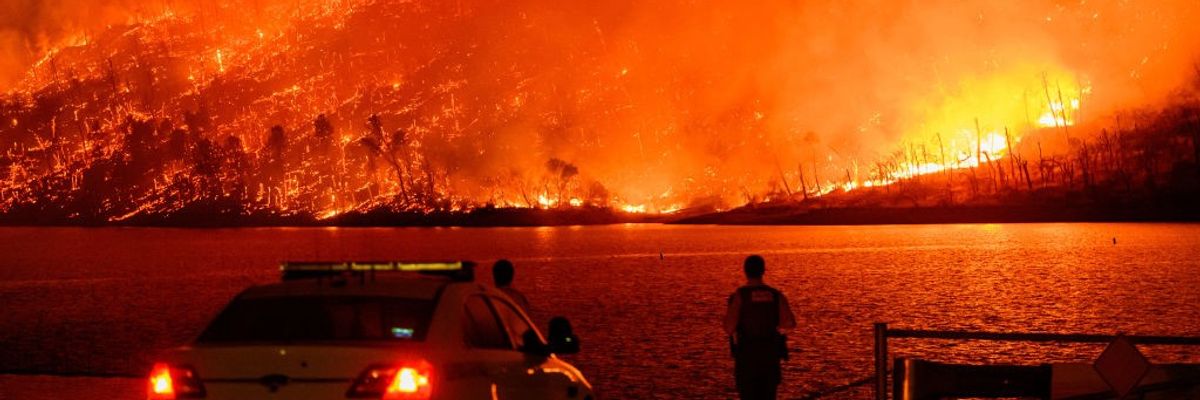
    Law enforcement officers watch as the Thompson Fire burns over Lake Oroville in Oroville, California on July 2, 2024.  (Photo: Josh Edelson/AFP via Getty Images)

    “It cannot be stressed enough that this is an exceptionally dangerous and lethal situation,” the National Weather Service warned.

    California Gov. Gavin Newsom on Wednesday declared a state of emergency in a northern county where a major wildfire has burned thousands of acres and forced the evacuation of thousands of residents amid near-record heat throughout much of the Golden State fueled by human-caused global heating.

    The California Department of Forestry and Fire Protection (CAL FIRE) said shortly after noon local time Wednesday that the Thompson Fire, which began Tuesday morning in Butte County, had burned 3,568 acres with no containment in and around the city of Oroville, home to more than 20,000 people.

    Citing an “imminent threat to life,” Newsom, a Democrat, issued an emergency declaration and said that “we are using every available tool to tackle this fire and will continue to work closely with our local and federal partners to support impacted communities.”

    CAL FIRE said that more than 1,400 firefighters using 199 engines, 46 dozers, eight helicopters, and other equipment are battling the blaze. More than 28,000 Oroville area residents have been evacuated.

    Red flag conditions are being exacerbated by low humidity and near-record temperatures throughout California. Oroville is expected to hit a high of 110°F on Wednesday, with daytime highs forecast to remain in the 110s through the holiday weekend. Dozens of daily, monthly, and all-time records could be broken throughout the state.

    “It cannot be stressed enough that this is an exceptionally dangerous and lethal situation,” the National Weather Service’s (NWS) San Francisco Bay Area branch cautioned as it extended the red flag warning through Friday while preparing the public for the possibility of further extensions.

    Daniel Swain, a climate scientist at the University of California, Los Angeles, said during a video briefing, “I’m not so sure that really any of us will have seen this many days at this sustained level of heat, both daytime and most importantly nighttime heat.”

    Commenting on the wildfire and heatwave, Fossil Free Media director Jamie Henn said on social media that “we need the California Legislature to pass their climate superfund bill NOW to #MakePollutersPay for these fossil-fueled disasters.”

    Introduced in April by California state Sen. Caroline Menjivar (D-20) but shelved the following month, S.B. 1497—the Polluters Pay Climate Cost Recovery Act—would require major fossil fuel producers to pay for their historic carbon emissions.

    The NWS said that as of Wednesday, more than 110 million people across the United States were facing either a heat advisory, watch, or warning. So far, 2024 has been the hottest year on record. Climate Central, a nonprofit news organization focusing on the worsening planetary emergency, said climate change has made the current California heatwave at least five times likelier.

    Original article by BRETT WILKINS republished from Common Dreams under Creative Commons (CC BY-NC-ND 3.0).