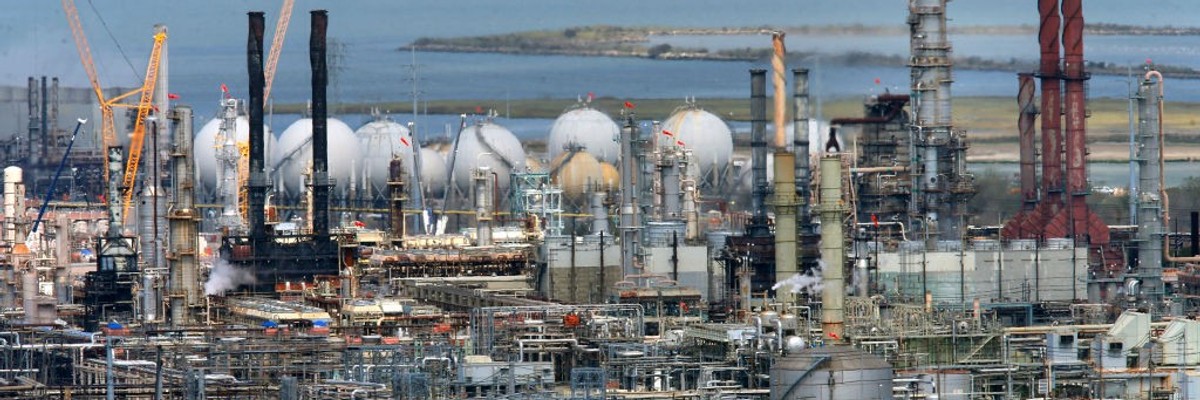
A Chevron refinery in Richmond, California is seen on September 12, 2017. (Photo: Michael Macor/The San Francisco Chronicle via Getty Images)
“These oil companies knew their products were dangerous, yet they did nothing to mitigate those dangers or warn any of us about them, for decades,” said the chairwoman of the Shoalwater Bay Indian Tribe.
Two Indigenous tribes in Washington state said Wednesday that they intend to force several oil giants “to help pay for the high costs of surviving the catastrophe caused by the climate crisis,” as they filed lawsuits in the state’s largest trial court.
The Makah Indian Tribe and Shoalwater Bay Indian Tribe filed two separate complaints in King County Superior Court against ExxonMobil, Shell, Chevron, BP, ConocoPhillips, and Phillips 66, saying the defendants must be held “accountable for their deceptive and unfair conduct, and pay for the damage their deceptive conduct has caused and will cause for decades to come.”
The lawsuits—among dozens filed against Big Oil since 2017—detail the extent to which the companies have long known that their fossil fuel extraction would drive planetary heating and the resulting sea-level rise, extreme weather, public health crises, and other impacts of the climate crisis, which now costs the U.S. roughly $150 billion per year just in damages from hurricanes and other weather disasters.
“We are seeing the effects of the climate crisis on our people, our land, and our resources. The costs and consequences to us are overwhelming,” said Timothy Greene Sr., chairman of the Makah Tribal Council. “We intend to hold these companies accountable for hiding the truth about climate change and the effects of burning fossil fuels.”
“We are facing hundreds of millions of dollars in costs to relocate our community to higher ground and protect our people, our property, and our heritage. These companies need to be held accountable for that.”
Newly uncovered documents revealed earlier this year that scientists at Shell warned executives of the climate impact of the company’s products in the 1980s, and an analysis published in Science in January showed that 63-83% of the global warming projections documented by Exxon scientists between 1977 and 2003 were accurate.
“These oil companies knew their products were dangerous, yet they did nothing to mitigate those dangers or warn any of us about them, for decades,” said Charlene Nelson, chairwoman of the Shoalwater Bay tribe. “Now we are facing hundreds of millions of dollars in costs to relocate our community to higher ground and protect our people, our property, and our heritage. These companies need to be held accountable for that.”
The tribes said in their complaints that they are “particularly vulnerable” to rising sea levels because their reservations are adjacent to the Pacific Ocean, and they have already incurred “significant costs” as they try to mitigate its risk by preparing to build and move housing and government buildings to higher ground.
The tribes accused the companies of creating a “public nuisance” and violating Washington’s Products Liability Act by misrepresenting and intentionally concealing the risks involved in their fossil fuel extraction activities. They asked the court for jury trials and requested that the court order the companies to fund “an abatement fund to be managed by the tribe[s] to remediate and adapt [their] Reservation lands, natural resources, and infrastructure.”
Demonstrators demanding a Gaza cease-fire protest outside Penn Station in New York City on December 18, 2023. (Photo: caren/X)
“We must stand up and not be silent to this injustice,” said one rabbi taking part in the demonstration.
A coordinated wave of demonstrations against what activists called Israel’s genocidal war on Gaza targeted New York City transit hubs Monday afternoon, with protesters demanding an immediate cease-fire as heavy Israeli bombardment of the besieged strip pushed the death toll from 73 days of attacks to nearly 20,000.
Protesters marched from Grand Central Station to the Port Authority Bus Terminal and then on to Penn Station, where at least hundreds of activists gave police the slip and occupied Moynihan Hall. Many participants prayed for peace before leaving the station.
“We must stand up and not be silent to this injustice,” Rabbi Yisroel Dovid Weiss toldamNewYork Metro outside Grand Central Station. “We hurt and cry with the people who are dying and suffering under the stranglehold of the Zionist occupation. We want the world to know that we hurt because we are Jews, we will not be silent because we are Jews.”
#BREAKING Pro-Palestinian Protesters rushed the entrance of Penn Station as cops ran closely behind them, they are now occupying Moynihan Hall inside.
Independent photojournalist Katie Smith followed the entire demonstration—which was coordinated by the group Within Our Lifetime—documenting incidents including police “violently engaging with protesters” and a confrontation between the actor Alec Baldwin and activists.
According to Smith, activists later marched to a building in Greenwich Village where a fundraiser for the Israel Defense Forces was reportedly being held.
Monday’s actions followed recent protests in New York, including a Manhattan march led by artists remembering the life and work of Refaat Alareer—a Gaza poet and professor killed last week in an Israeli airstrike—and calling on Israel to free political prisoners including the members of Freedom Theater recently arrested in Jenin in the illegally occupied West Bank.
In recent days, large protests for Gaza have also taken place in U.S. cities including Houston, Los Angeles, and Washington, D.C., as well as in cities in countries including the U.K., Canada, France, Belgium, Norway, and Germany.
In California, workers at Google and allies held a Thursday die-in at the tech giant’s San Francisco office “to demand the company stop powering Israel’s genocide of Palestinians in Gaza” through the $1.2 billion Project Nimbus cloud computing contract.
More protests are planned for this week, including a nationwide action by Mennonites on Tuesday and a rally by over 80 groups on Capitol Hill in Washington, D.C. that same day.
Sponsored by the Action Center on Race and Economy, Adalah Justice Project, Grassroots Global Justice Alliance, and the U.S. Campaign for Palestinian Rights, Tuesday’s D.C. event is being held to “demand a permanent cease-fire in Gaza and oppose the Biden administration’s proposed military aid package sending billions of taxpayer dollars to Israel, U.S. southern border militarization, and immigration enforcement.”
The milestone, one campaigner said, should “give hope to folks that we are making an impact.”
An earlier version of this story said that 16,000 institutions had divested. The correct number is 1,600 and it has been updated to reflect that.
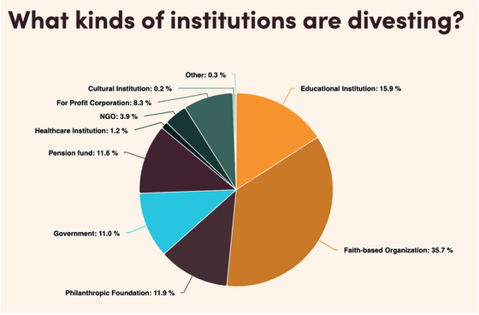
More than 1,600 institutions like universities, pension funds, and governments that hold more than $40.6 trillion in assets have now divested from fossil fuels, the Global Fossil Fuel Divestment Movement announced Friday.
The announcement comes days after the 28th United Nations Climate Change Conference wrapped with a call for “transitioning away from fossil fuels” but stopped short of agreeing to the stronger “phaseout” of oil, gas, and coal backed by climate advocates and frontline communities.
“This number is huge,” Amy Gray, Stand.earth climate finance associate director and coordinator of the Climate Safe Pensions Network, told Common Dreams. To put it in perspective, $40.6 trillion is equal to a little less than half of global gross domestic product.
The scale of the divestments to date, said Gray, “should show and give hope to folks that we are making an impact and we are making a difference and changing things for the better, regardless of these elitist events where the everyday person and the folks in the Global South and other places are discounted.”
A Decade of Divestment
Friday’s update to the Global Fossil Fuel Divestment Commitments Database reflects around a decade of organizing, Gray said. Organizers at 350.org started tracking divestment commitments when Gray and current Stand.earth climate finance director Richard Brooks worked there. When the pair moved to launch a climate finance team at Stand.earth, they brought the database with them.
While the divestment movement has seen ups and downs over that decade, Gray said it had picked up momentum over the last five or six years. In less than two years, the number of institutions divesting jumped by 120, holding a combined $1.4 trillion in assets.
“We’ve definitely seen a massive increase in divestment commitments as the divestment movement has built itself out and gotten stronger,” Gray said.
“This milestone follows years of attempted shareholder engagement, now a proven futile strategy, with fossil fuel corporations hell-bent on our destruction.”
Notable victories in 2023 included PMT, the largest private pension in the Netherlands; New York University, the National Academy of Medicine, and the Church of England.
The Church of England divestment was especially notable, Gray said, because of the statement that accompanied it. The church emphasized that it had tried to engage with the oil and gas companies it was invested in and urged them to adopt policies in line with the Paris agreement, but the companies did not change.
“The decision to disinvest was not taken lightly,” Alan Smith, first church estates commissioner, said at the time. “Soberingly, the energy majors have not listened to significant voices in the societies and markets they serve and are not moving quickly enough on the transition. If any of these energy companies come into alignment with our criteria in the future, we would reconsider our position. Indeed, that is something we would hope for.”
Gray remembered thinking at the time that it was the best divestment statement she’d ever read.
“It was really powerful,” she said.
The Church of England wasn’t the only institution that thought it could persuade Big Oil to change its ways without divesting.
“This milestone follows years of attempted shareholder engagement, now a proven futile strategy, with fossil fuel corporations hell-bent on our destruction,” Brooks said in a statement. “Instead of financing climate chaos-causing fossil fuels, violence, and extraction, financial institutions like big banks and pension funds must protect people and planet alike, cutting ties with fossil fuels and reinvesting in proven community-led climate-safe solutions.”
People vs. Fossil Fuels
The success of the divestment movement has been driven by “people power, 100%,” Gray said.
This includes larger organizations like Stand.earth or the Sierra Club and big-name activists like Bill McKibben or former New York Comptroller Tom Sanzillo, but ultimately comes down to smaller grassroots efforts.
“It’s the little group in Wisconsin that’s working on divesting their pension fund,” Gray said. “It’s a small group in the Bay Area who is pressuring Citi or one of the big banks, and it’s the kids at the colleges.”
“Oil companies are finding it increasingly difficult to raise financing amid rising ESG and sustainability concerns.”
There’s evidence that all this activism is making a difference for the industry. The “cost of capital” for funding new fossil fuel projects has risen steeply in the last decade, from 8% to 10% to around 20% as of 2021, according to Bloomberg.
During the same time, the cost for financing renewables has dropped from that same 8% to 10% to between 3% and 5%.
Bloomberg Intelligence analyst Will Hares laid the divergence at the feet of the push for environmental and social governance (ESG) in investing.
“Oil companies are finding it increasingly difficult to raise financing amid rising ESG and sustainability concerns, while banks are under pressure from their own investors to reduce or eliminate fossil-fuel financing,” Hares said.
Gray also added that Indigenous-led movements such as the Wet’suwet’en struggle against the Coastal GasLink pipeline in Canada have had a material impact on the industry.
The pipeline’s costs have more than doubled during that time from an estimated $6.6 billion to $14.5 billion, CBC News reported this month.
At the same time, divesting from fossil fuels is actually a financial win for pension funds and other institutions: A study released this year by the University of Waterloo found that six U.S. pension funds would actually be $21 billion richer today if they had quit fossil fuels 10 years ago.
The Next 1,600
In the context of a disappointing outcome at COP28, President Joe Biden’s greenlighting of drilling projects, and the specter of a second Trump presidency, the success of the divestment movement offers hope that climate campaigners can shift the world away from fossil fuels without needing to rely on international agreements or national legislation.
“It’s not necessary to enact the change we need to see,” Gray said. “We can change these systems of oppression from within.”
Looking ahead to 2024, Gray thinks there’s a good chance that California will finally pass legislation to divest its two pension funds, CalPERS and CalSTRS, from fossil fuels. The two funds, the largest public pensions in the country, control a total of $685 billion, including more than $42 billion in fossil fuels.
“Even the person with the smallest amount of investments can get involved.”
If California does pass the legislation, it will “cause a massive ripple effect,” Gray said.
“If we’re able to divest the two largest pension funds in the country, there’s nothing we can’t divest.”
Another thing Gray expects to see is more coordination between the efforts to divest from both fossil fuels and the weapons industry, as more and more people react with shock watching U.S.-made and -funded arms devastating the people of Gaza.
“War is a climate issue,” Gray said.
For people not yet involved in the divestment movement, Gray recommends signing up for email updates from Stand.earth or the Climate Safe Pensions Network and looking up local climate groups and going to a meeting.
“Even the person with the smallest amount of investments can get involved,” Gray said. “Anybody can join the climate movement, and we’re always ready to help folks take that step.”
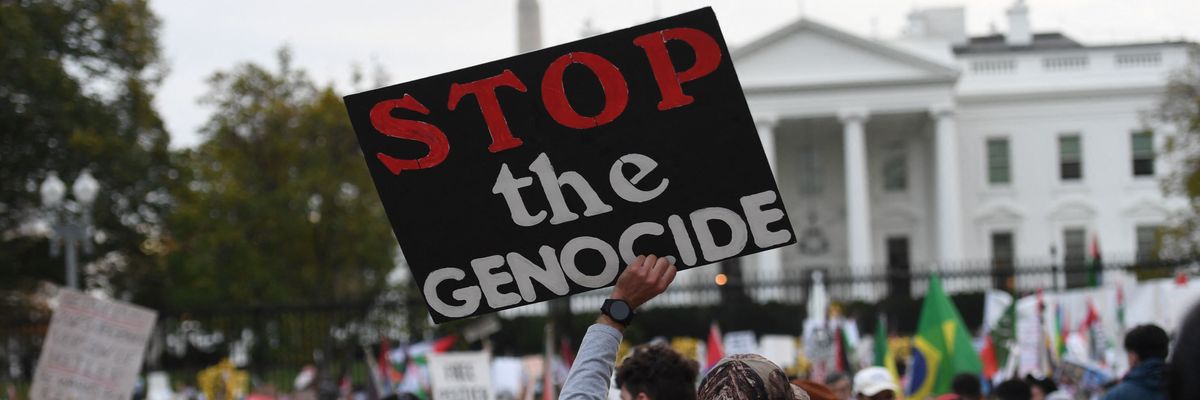
Demonstrators gathered in front of the White House during a rally in support of Gaza in Washington, D.C. on November 4, 2023. (Photo: Oliver Doulliery/AFP via Getty Images)
“We came here to let our voices be heard,” said one demonstrator in Washington, D.C. “Every human is entitled to basic human rights, not killing kids, not torturing people.”
This is a developing story… Please check back for possible updates…
Huge crowds of protesters filled the streets of Washington, D.C. and other U.S. cities on Saturday to demand a cease-fire in Israel’s war on Hamas, which has killed and wounded thousands of Palestinian civilians in the Gaza Strip over the past month.
“We came here to let our voices be heard and our hearts and hoping we’ll change the way people see this conflict,” 70-year-old Manar Ghanayem toldThe Washington Post in the nation’s capitol, where demonstrators gathered in and around Freedom Plaza.
“Every human is entitled to basic human rights, not killing kids, not torturing people,” added Ghanayem, who traveled from North Carolina to march in D.C. with more than a dozen friends and family members, including young grandchildren.
Ghanayem also said that she voted for U.S. President Joe Biden in 2020 but was outraged by his response to the war. As she put it, “I can’t believe Biden is turning a blind eye to this and gave Israel the green light.”
Rather than advocating for a cease-fire, the Biden administration has pushed for “humanitarian pauses” in what critics are calling Israel’s “genocidal” air and ground assault of Gaza—launched after a Hamas-led surprise attack on Israel on October 7.
After speaking with Israeli Prime Minister Benjamin Netanyahu at the beginning of the war, Biden said that “my administration’s support for Israel’s security is rock solid and unwavering.” He quickly asked Congress for $14.3 billion for the Israeli war effort, on top of the typical $3.8 billion in annual U.S. military aid.
“Americans do not support the genocide in Palestine, we do not support the occupation, yet we are being robbed of our own resources in order to fund this oppression,” said CodePink organizer Nour Jaghama earlier this week. Her anti-war group is a part of a broad coalition that supported Saturday’s demonstrations in the United States.
“We need to show our government that we are outraged at them for forcing us to participate in such a disgusting and devastating attack on humanity,” Jaghama continued. “As Americans, we have a responsibility to our brothers and sisters in Palestine to fight for them however we can.”
Jaghama also delivered a speech on Saturday. According to CodePink:
“One of the most prominent questions we need to ask ourselves is: Why we can hear these words and firsthand accounts from Gaza yet the genocide still continues? Why do only 18 representatives and ONLY ONE senator support a cease-fire? And why does President Biden insist on funding Netanyahu’s genocide?” she asked the crowd…
She then aimed her questions directly at President Biden: “Is this how you want to be remembered? A genocidal, destructive, warmonger? Shame! Look at this crowd, clearly the American people do not agree with your genocidal plans. You must call for a cease-fire now or solidify your position as one of the most inhumane presidents in American history. The American people demand a cease-fire, an end to the occupation, and the full liberation of Palestine.”
Demonstrators in D.C. carried signs with messages like “Stop U.S.-funded genocide,” “Cease-Fire Now,” and “Let Gaza Live!”
Sharing a photo from the D.C. gathering on social media, Rep. Ayanna Pressley (D-Mass.) said: “Solidarity with the hundreds of thousands of people nationwide who marched in support of a #CeasefireNOW. Our pro-peace, pro-humanity movement is strong and it is growing daily.”
St. Louis DC South Korea Germany Norway South Africa Puerto Rico England Japan & so many more places
The Saturday actions followed weeks of protests at places including congressional offices and major transit stations. Jewish Voice for Peace noted Monday that “Jewish people all throughout the United States are protesting in unprecedented numbers against Israel’s destruction of Gaza and the United States’ unwavering support.”
Protesters, supporters, and journalists shared updates on social media.
— Professor Kamel Hawwash بروفيسور كامل إسحق الحواش (@kamelhawwash) November 4, 2023
Olympia, Washington:
Really incredible turnout in Olympia, WA today. It was POURING all morning. Some of the streets leaving Seattle looked like literal lakes. Didn’t matter. The people are here, demanding a #ceasefireNOW. #FreePestine#ceasefirepic.twitter.com/q7oFXzJaqW
Officials in Israel say Palestinian militants are holding around 240 hostages and more than 1,500 Israelis have been killed over the past four weeks. According to the Gaza Health Ministry, Israel’s war on the besieged enclave has killed over 9,400 Palestinians. Amid a surge in settler violence, 133 Palestinians have been killed in the West Bank.
Israel has faced global criticism for cutting off the people of Gaza from food, water, fuel, and medicine as well as bombing homes, schools, medical facilities, religious buildings, and a refugee camp. Some citizens of Israel have joined in worldwide demands for International Criminal Court action on “escalating Israeli war crimes and genocide.”
Pro-Palestinian protests were also held around the world on Saturday, including in Berlin, Germany; Dhaka, Bangladesh; London, England; Paris, France; Milan, Italy; Santiago, Chile; and Tokyo, Japan. Scientist and organizer Lucky Tran said on social media that “we are witnessing the biggest global anti-war protests since the Iraq War in 2003.”
In the United Kingdom, tens of thousands of people blocked London’s Oxford Circus and Piccadilly Circus, then marched to Trafalgar Square. Al Jazeera reported that “protesters held ‘Freedom for Palestine’ placards and chanted ‘cease-fire now’ and ‘in our thousands, in our millions, we are all Palestinians.’”
One of the many occasions UK Prime Minister Rishi Sunak uses a private jet.
Political leaders owe their citizens the truth about the costs and the challenges of the energy transition on a warming planet. Last week, UK Prime Minister Rishi Sunak failed – and California Governor Gavin Newsom passed – that test.
…
If Sunak had mustered the courage to tell Brits the truth, rather than throwing up flack about excessive costs and burdens, he could have taken a cue from Newsom and said this instead: “The cost-of-living crisis is a fossil fuel crisis. Inflation persists. It’s not complicated. It’s not complicated. It’s the burning of oil. It’s the burning of gas. It’s the burning of coal – and we need to call that out.”
“The rise in energy prices started last winter, when many countries experienced low gas stocks, leading to a rise in gas prices. Russia’s invasion of Ukraine and volatile market conditions led to further price hikes,” wrote van Halm. European gas prices peaked in August 2022 at more than €300 per megawatt-hour (/MWh), she noted, when before the Covid-19 pandemic and Russia’s invasion of Ukraine, European gas prices were regularly around €10–20/MWh.
Image of InBedWithBigOil by Not Here To Be Liked + Hex Prints from Just Stop Oil’s You May Find Yourself… art auction. Featuring Rishi Sunak, Fossil Fuels and Rupert Murdoch.