Tag: Carbon Brief

  • Factcheck: Nine false or misleading myths about North Sea oil and gas

    Spread the love

    Original article by Daisy Dunne, Josh Gabbatiss, Molly Lempriere & Simon Evans republished from Carbon Brief.
    Credit: Joe Goodman

    The Iran war has triggered another fossil-fuel energy crisis, with surging global prices and increasing concerns over energy security.

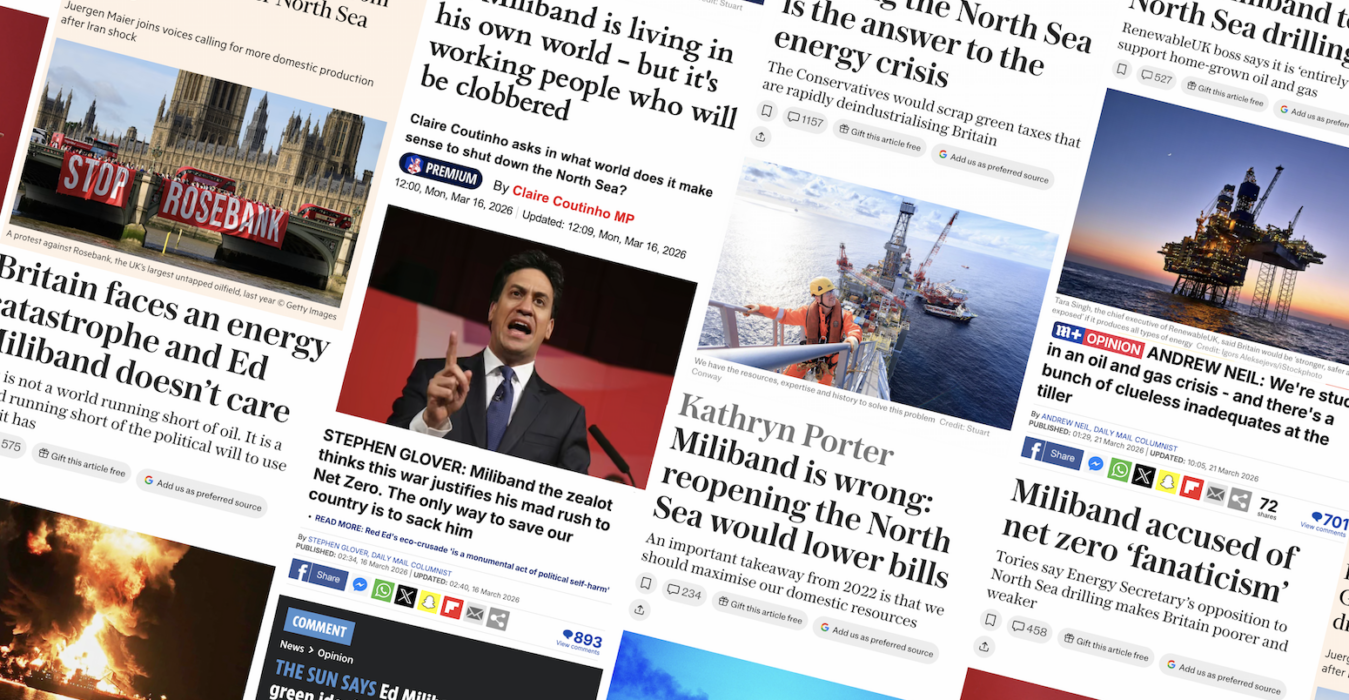
    In the UK, many newspapers, opposition politicians and other public figures have used the crisis to argue in favour of issuing more licences for oil and gas drilling in the North Sea.

    These arguments have also been amplified in AI-generated posts on social media, shared by fake accounts that usually post anti-immigrant and anti-Muslim content.

    However, many of these arguments rest on false or misleading claims about the impact that further drilling could have on the UK’s bills, energy security, emissions and tax revenue.

    The North Sea is a “mature basin” where production has been falling for decades, because most of the oil and gas it once contained has already been extracted.

    While it would be possible to slow the rate of decline in oil and gas output from the North Sea, the quantities that would be economic to extract are disputed.

    Overall, the transition to clean-energy supplies is expected to be far more effective at boosting UK energy security and reducing reliance on imports.

    Moreover, the climate-change arguments for limiting fossil-fuel production, which have been made by scientists, the UN secretary general and even the Pope, remain as valid as ever.

    Below, Carbon Brief factchecks some of the most common claims about North Sea oil and gas.

    FALSE: ‘Reopening the North Sea would lower bills’

    Many right-leaning newspapers and commentators have falsely argued that opening up new oil and gas fields in the North Sea would lower energy bills in the UK.

    There is no evidence to support such claims. Indeed, numerous experts have explained that new drilling would make no difference to bills in the UK. 

    For example, the Daily Express carried fact-free assertions from the hard-right, climate-sceptic Reform party on its frontpage under the headline: “Get drilling to stop bills soaring.” Despite the UK not using oil to generate power, it claimed:

    “Open[ing] up the UK’s biggest oil field [would] stop power bills soaring.”

    At the beginning of March, US president Donald Trump told the Sun that his advice to UK prime minister Keir Starmer would be: 

    “Open up the North Sea. Immediately. Your energy prices are through the roof.”

    In the Daily Telegraph, an “energy consultant” called Kathryn Porter, who has authored “papers” for climate-sceptic lobbyists, listed why she thinks more drilling could cut energy bills under the headline: “Reopening the North Sea would lower bills.”

    On Twitter, Reform said the Labour and Conservative governments had “failed the British people” by “refusing to drill in the North Sea”. It added that more drilling would make “Britain energy independent once again” and “bring down bills”. 

    Contrary to these claims, numerous experts have said that further drilling in the North Sea would do nothing to cut bills, because UK energy prices are set on international markets.

    In 2022, the Climate Change Committee (CCC) wrote that increased UK extraction was not expected to “materially affect global oil or gas prices, as the UK energy market is highly connected to international markets and the potential supply [is] relatively small”.

    It added that, even if all proven UK reserves and resources of gas from new fields were extracted, this would only meet about 1% of European demand each year up to 2050.

    Jack Sharples, senior research fellow at the Oxford Institute for Energy Studies (OEIS), tells Carbon Brief that “you’re not going to bring prices down versus the current level, because you’re not going to be able to produce very much more [from the North Sea]”.

    The Labour government has made similar arguments, saying in a “factsheet” on the Iran crisis that the UK is a “price-taker…not [a] price-maker”. It said:

    “Future exploration in the North Sea is too marginal to make a difference to the overall supply in an international market…New licences to explore new fields wouldn’t make any difference to the prices set by international markets and paid by UK billpayers.”

    Even shadow energy secretary Claire Coutinho, who has advocated strongly for further drilling, admitted in 2023 that new licenses “wouldn’t necessarily bring energy bills down”.

    The North Sea is a “mature basin”, with around 90% of what it contained “already drained dry”. Most of what is produced for the basin is now oil, around 80% of which is exported.

    In addition, oil and gas reserves are owned by private companies once licences are issued and the fuel is sold at international rates. Therefore, whether it is produced in the North Sea or elsewhere, its price is driven by the global market.

    Moreover, the limited quantity of gas left in the ageing North Sea basin would do little to impact international markets and, thus, little to impact international prices.

    https://www.youtube.com/embed/cfoXB1i9riI?feature=oembedClimate YouTuber Simon Clark discusses whether more North Sea oil and gas drilling could lower energy bills in the UK.

    Recent analysis by the Smith School at the University of Oxford found that, even if the UK maximised North Sea oil and gas and used all revenues from the sector to subsidise lower energy bills, the impact would be limited. Under this unlikely scenario household bills could fall between £16 and £82 per year, or 1-4.6% a year. 

    The fact that further oil and gas production in the North Sea would have a limited impact on energy bills has been noted repeatedly, even by those in favour of drilling in the North Sea.

    For example, in a separate comment piece in the Daily Telegraph calling on the UK to “max out on both renewables and North Sea oil and gas”, world economy editor Ambrose Evans Pritchard wrote: 

    “Reopening the North Sea would not make any difference to the current crisis, nor any difference to gas and petrol prices in the UK, since the volumes are too small to shift the traded global market.”

    As such, the UK Energy Research Centre (UKERC) explained in a recent note:

    “Squeezing additional oil and gas production from the UK may be technically possible, but it will have [a] negligible impact on the UK cost of living”.

    Back to top

    MISLEADING: ‘Energy from the North Sea generates a lot less CO2’

    Many North Sea advocates argue that drilling more in the basin would mean lower carbon dioxide (CO2) emissions, due to the high emissions from imported fossil fuels.

    This is a line often used by the oil-and-gas industry, with the trade body Offshore Energies UK (OEUK) stating that “LNG cargoes…are four times more carbon intensive than homegrown gas”.

    Additionally, it is an argument that is sometimes used by commentators who – in other circumstances – would not be making the case for low-carbon policies. 

    For example, in a Mail on Sunday column, the climate-sceptic journalist Andrew Neil wrote that “giving the North Sea a new lease of life” would:

    “Even lower carbon emissions (because piping in energy from the North Sea generates a lot less CO2 than importing it).”

    Conservative shadow energy secretary, Claire Coutinho, has also used this approach to question the government’s supposed opposition to North Sea drilling, writing in the Daily Telegraph:

    “Doing so in the name of climate change when our own gas has four times fewer emissions than the LNG we’ll need to import instead? Unforgivable.”

    The claim that UK gas from the North Sea produces “a lot less CO2” – and particularly the commonly cited “four times fewer emissions” figure used by Coutinho and OEUK – is misleading.

    It references the fact that imported LNG has higher overall emissions than North Sea gas, due to the energy-intensive processes needed to liquify, transport and regasify it. 

    However, as the chart below shows, the vast majority of emissions from gas result from burning it to produce energy. 

    When CO2 from gas combustion is taken into account, North Sea gas emissions are not four times lower than LNG emissions, but 15% lower.
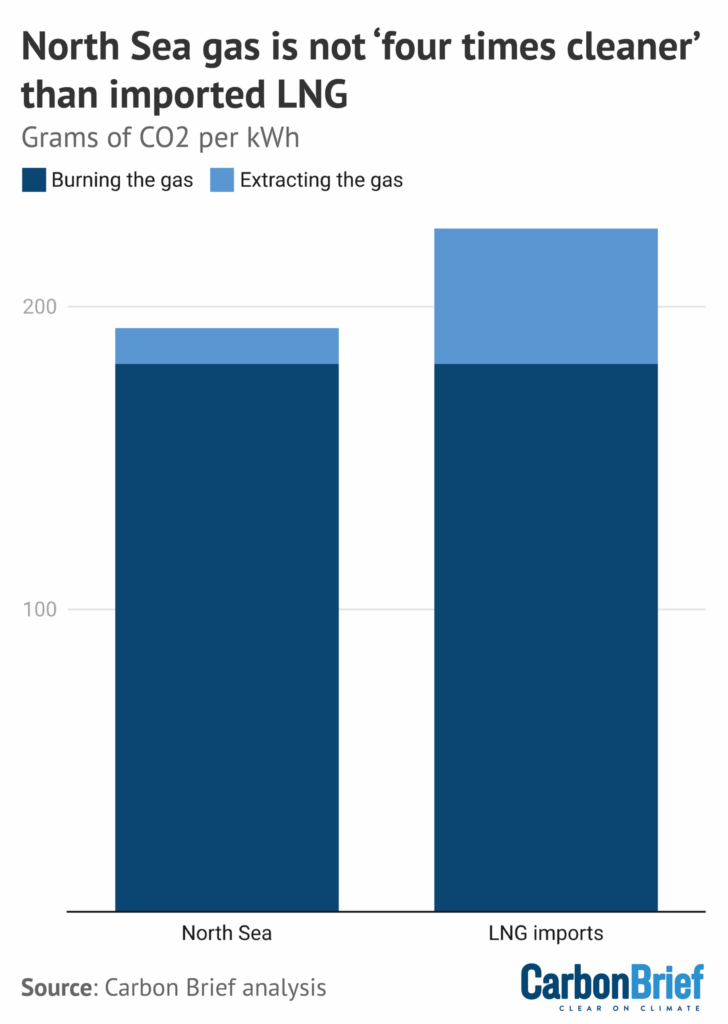
    Emissions (grams of CO2 per kilowatt hour) from North Sea gas v LNG imports.
    Emissions (grams of CO2 per kilowatt hour) from North Sea gas v LNG imports. Source: Carbon Brief analysis

    The UK is reliant on LNG imports from a handful of countries, notably the US and Qatar. However, at present these imports make up only around 15% of the UK’s gas. 

    Of the remaining gas used in the UK, roughly half is produced domestically and the rest comes via pipeline from Norway. Norwegian pipeline gas has even lower emissions than UK supplies.

    More broadly, analysis by the Climate Change Committee in 2022 found that, despite the small “emissions advantage” of UK domestic production replacing imports, this could be wiped out if increased UK production led to more fossil-fuel production overall.

    Back to top

    FALSE: ‘Britain is a resource-rich nation that has chosen dependency’

    One frequent false claim is that the UK has “chosen” to become reliant on fossil-fuel imports, as a result of policy decisions made by successive governments.

    In fact, import dependency has primarily increased because most of the oil and gas in the North Sea has already been used up. It is a “mature basin” with falling output.

    In the Daily Telegraph for example, Diana Furchtgott-Roth, former climate director at the Heritage Foundation, a US-based climate-sceptic lobby group, stated that the UK has “chosen dependency”. She wrote:

    “[The UK] is not a resource-poor nation forced to depend on foreign suppliers. It is a resource-rich nation that has chosen dependency through planning rules, regulatory obstruction and a net-zero framework that treats domestic oil and gas production as a moral failing rather than a strategic necessity.”

    It is true that the UK has become increasingly reliant on fossil-fuel imports. The country was a net energy exporter in 2000, but, by 2010, was dependent on imports for 30% of its energy supplies. On the same metric, the UK’s net import dependency reached 44% in 2024.

    This is largely because UK fossil-fuel production peaked decades ago. Gas production in the North Sea fell by 74% between 2000 and 2025, while oil output fell by 75%.

    Gas production is set to fall to 99% below 2025 levels by 2050 and oil is set to fall 94%, according to the government’s North Sea Transition Authority (NSTA). Even with further drilling, the NSTA expects gas output to fall by 97% and oil by 91%, as shown below.
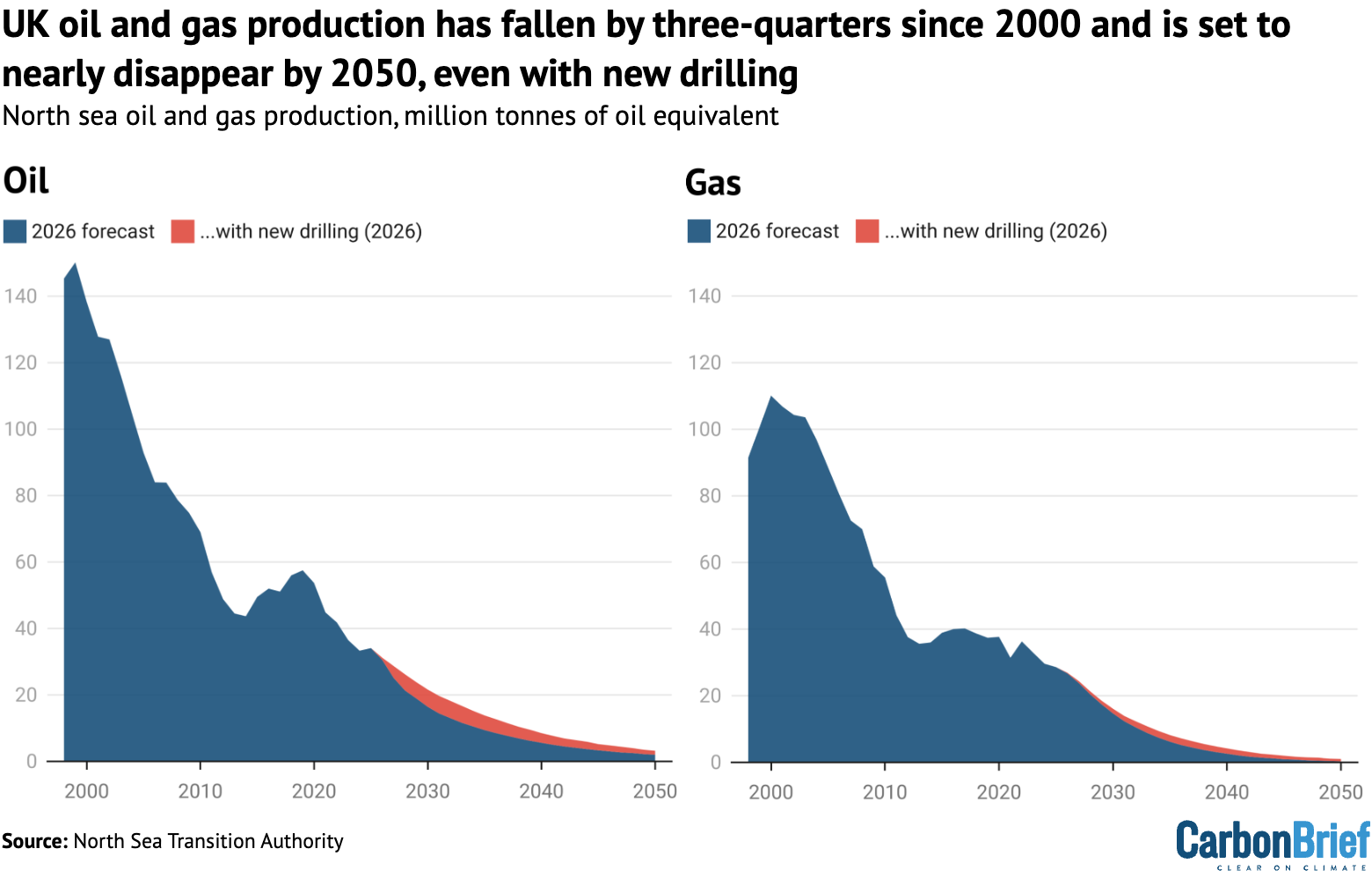
    North Sea oil (right) and gas production (right), million tonnes of oil equivalent, under the baseline NSTA projection or with further drilling.
    North Sea oil (right) and gas production (right), million tonnes of oil equivalent, under the baseline NSTA projection or with further drilling. Source: NSTA.

    Production has been in an inexorable decline for decades despite strongly supportive government policy through most of the period, including tax breaks and new licensing.

    Contrary to the narrative that rising import dependency has been a policy choice, the main reason why production is falling is that the North Sea is a “mature basin”. In other words, most of the oil and gas it once contained has already been extracted and burned.
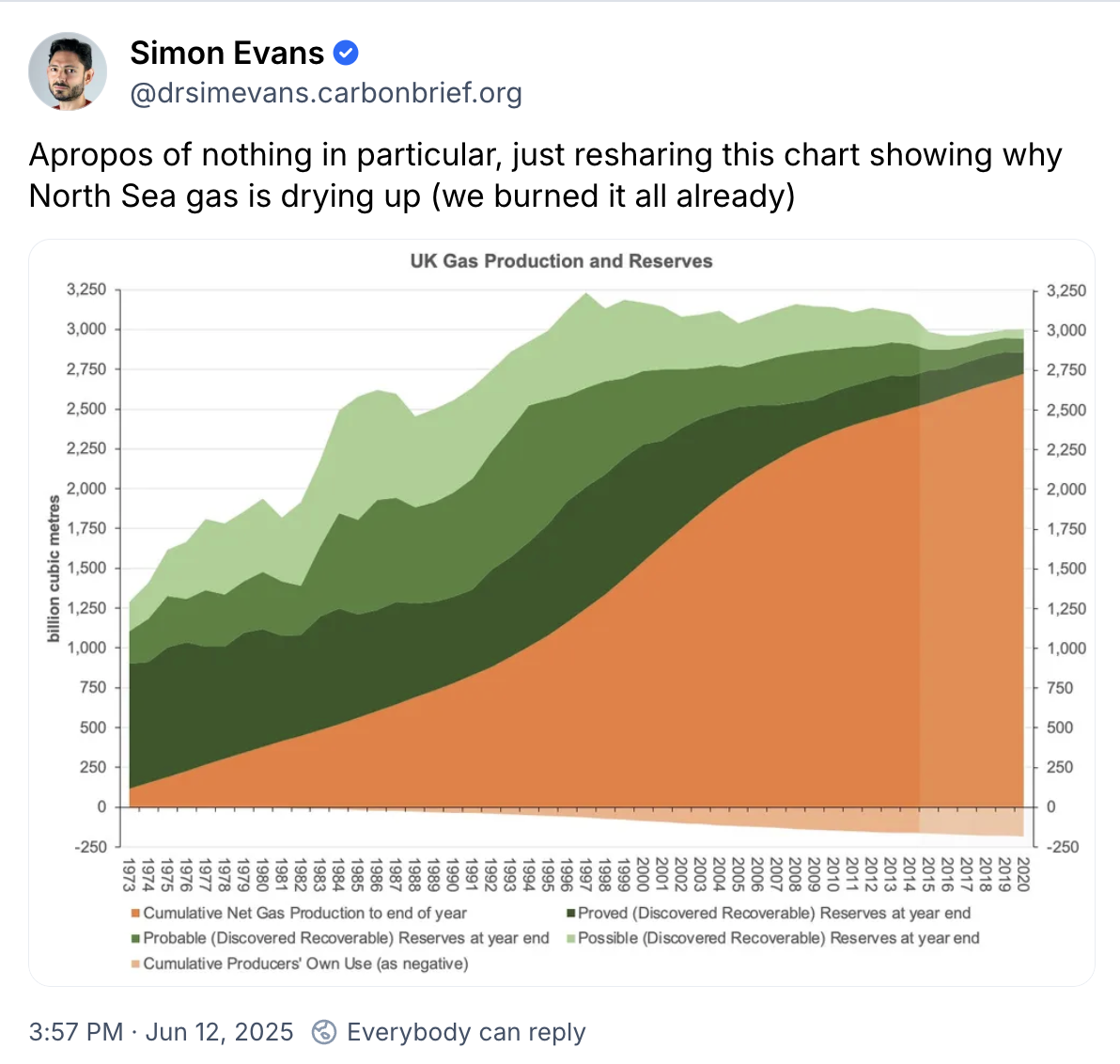
    Simon Evans on Bluesky: Apropos of nothing in particular

    According to the thinktank Energy and Climate Intelligence Unit (ECIU), around 90% of the oil and gas that is likely to be produced from the North Sea has already been burned.

    A related argument, aired on Sky News in mid-March 2026, is that the NSTA projections have been revised downwards over time, as a result of government policy. The idea is that there is more oil and gas available, but the government has “chosen” to ignore it.

    Yet for gas, there is little difference between the NSTA projections published before and after the government’s 2024 election win and its decision to ban new licensing, as shown below.
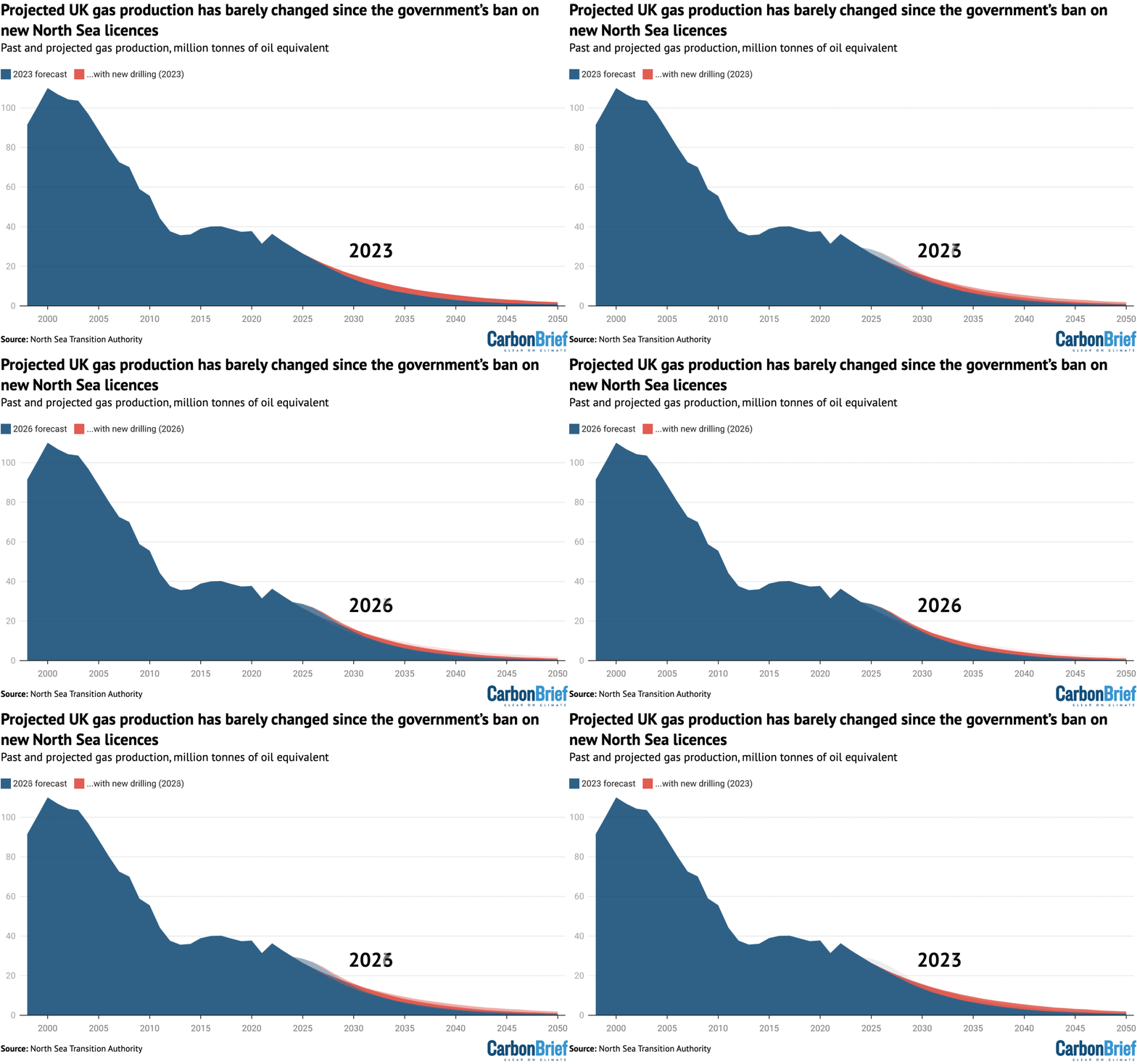
    Past and projected North Sea gas output, million tonnes of oil equivalent
    Past and projected North Sea gas output, million tonnes of oil equivalent, under the NSTA baseline or with new drilling. Left: 2023 projection. Right: 2026 projection. Source: NSTA.

    While the NSTA projections for oil have shifted more noticeably between 2023 and 2026, this largely relates to output from existing fields, rather than the potential from new drilling.

    There are a variety of other reasons why the NSTA projections have changed, notably including the economic viability of North Sea production.

    Until the recent Iran war, UK oil prices had been declining steadily since the highs seen in the wake of Russia’s invasion of Ukraine in 2022.

    This will have eroded the economics of North Sea production, particularly as the cost of extraction has gone up by roughly 40% since 2019.

    A final claim relating to government policy choices is that the UK has, in the words of a recent Sun editorial, become “heavily dependent on imported energy because of unreliable wind and solar, and the government’s obsession with net-zero”.

    This makes no sense – it is the opposite of the truth. Wind and solar generated more than 100 terawatt hours (TWh) of electricity in the UK last year, meeting a third of total demand.

    Carbon Brief analysis shows that generating the same electricity from gas would have required around 200TWh of fuel, equivalent to three-quarters of UK imports of liquified natural gas (LNG).

    In other words, without its fleet of what the Sun calls “unreliable wind and solar”, the UK would have needed to nearly double its LNG imports.

    Back to top

    FALSE: North Sea is ‘best way to protect us from volatility and provide energy security’

    The effective closure of the Strait of Hormuz has triggered the worst energy crisis since the 1970s and has reignited debate over how best to ensure the UK’s energy security.

    Many politicians, newspaper editorials and comment articles have argued that getting more oil and gas out from under the North Sea would cut UK fossil-fuel imports and boost energy security.

    Some have gone so far as to argue that the North Sea is the “best way” or “the” answer to ensuring UK energy security. This is clearly false. So too is the idea – promoted by the hard-right, climate-sceptic Reform party – that the UK could become “energy independent” by expanding North Sea production.

    For example, Conservative leader Kemi Badenoch wrote a comment piece for the Sunday Telegraph under the headline: “Drilling the North Sea is the answer to the energy crisis.”

    Meanwhile, Enrique Cornejo, energy policy director at North Sea industry trade association Offshore Energies UK (OEUK), told the Times:

    “Current events demonstrate that the best way to protect us from volatility and provide energy security is to maximise our homegrown energy resources.”

    The potential for extra oil and gas output is disputed, but not even the North Sea oil and gas industry claims that it could reverse the decades-long decline in production.

    Analysis by the National Energy System Operator (NESO) shows that the transition to clean energy would boost UK energy security by significantly reducing fossil-fuel imports. In contrast, it says that imports would rise if the UK boosts domestic oil and gas production but fails to decarbonise.

    The UK has been increasingly reliant on energy imports since 2003. This is because UK oil and gas production from the North Sea has fallen by roughly three-quarters since 2000. (See: FALSE: “Britain is a resource-rich nation that has chosen dependency.”)

    The UK’s reliance on fossil-fuel imports is set to increase even further, as North Sea production continues to decline. The NSTA says oil output will fall to 94% below 2025 levels by 2050 – or 91% with new drilling. For gas, the figures are 99% and 97%, respectively.

    OEUK and other advocates for the oil and gas sector dispute these figures, claiming that higher production would be possible if there are changes in government policy.

    For example, a report commissioned by OEUK put forward a “high case” for North Sea production over the coming decades, predicated on what it calls “significant changes to tax, licensing and regulatory approvals”. Notably, this still showed steep declines in output.
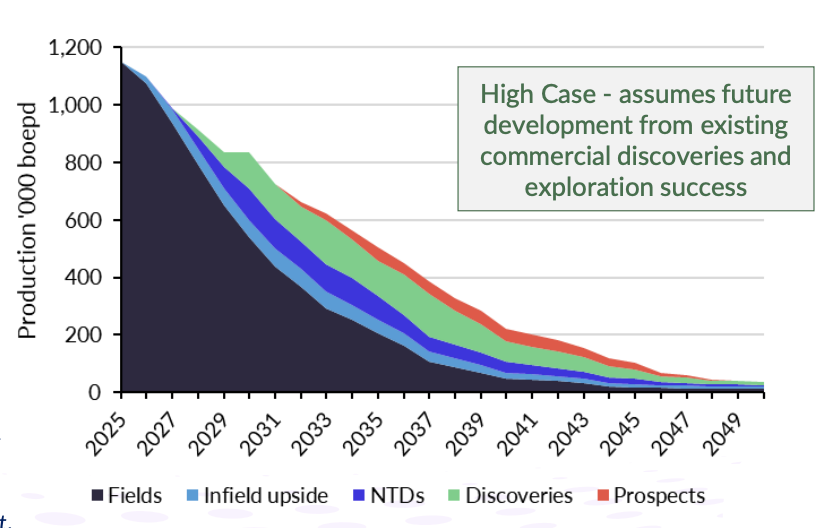
    North Sea oil and gas production under an industry-backed “high case”, thousands of barrels of oil equivalent per day.
    North Sea oil and gas production under an industry-backed “high case”, thousands of barrels of oil equivalent per day. Credit: Westwood Energy.

    The OEUK-commissioned report also looked at an even more optimistic “no constraints” case for higher North Sea. However, the report authors, consultancy Westwood Energy, described this as “beyond realistic assumptions”. It said:

    “The ‘no constraints’ case is considered to be beyond realistic assumptions given the current regulatory and fiscal conditions and investor sentiment. For this case to be realised, major industry change would be required.”

    Similarly, OEUK has published a scenario for North Sea gas production that it calls “upside potential”, in which output is held close to current levels for the next decade.

    It has used these scenarios to argue that the decline in North Sea gas output is “not inevitable”. However, the details behind these claims are opaque.

    The “upside potential” scenario is based on what OEUK describes as “data provided by OEUK members” and it assumes that the government immediately scraps the “energy profits levy” (EPL, known as the windfall tax, see below).

    OEUK claims that this scenario is “not speculative” and that it “clearly demonstrate[s] that the decline in potential supply indicated by NSTA forecasts is the result of policy choices”.

    On this point, it is worth reiterating that the NSTA forecasts for gas barely changed in response to the election of the current government in 2024, as illustrated above.

    Ultimately, while it is clear that most of the oil and gas that was once under the North Sea has already been burned, significant resources do remain.

    The key question is how much of this remaining oil and gas is both technically and economically recoverable under current policies and prices – and if policies were changed.

    OEIS’s Jack Sharples tells Carbon Brief that the North Sea is a “very mature basin” and that “nobody’s talking about increased production versus current levels”. He continues:

    “Even if licences were to be made available for further exploration and production, that would result in a little bit of extra supply over the next 12 months, let’s say, but obviously not a huge amount…We’re just talking about slowing down the rate of decline.”

    Sharples adds that, nevertheless, he thinks it is “worth maximising whatever we can produce in the North Sea”.

    Recent Carbon Brief analysis found that expanding clean-energy supplies would have a larger impact on UK gas imports than an increase in North Sea drilling, as shown below.

    (This analysis was based on NSTA projections of possible extra North Sea gas output, which amounted to 16TWh in 2030. If the OEUK “upside potential” scenario could be realised, the extra gas would amount to further 108TWh, equivalent to around 90 LNG tankers.)
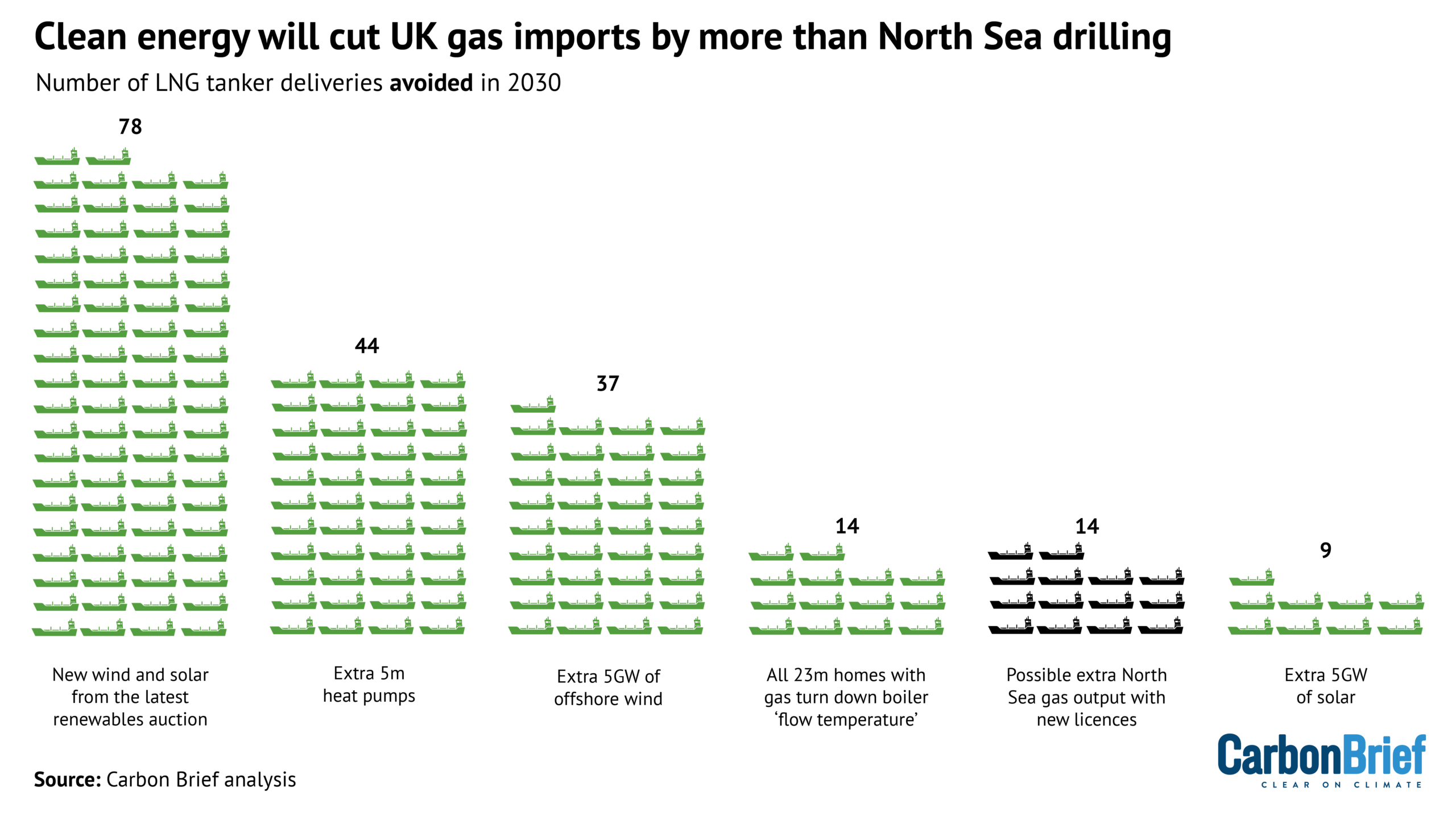
    The number of LNG tanker deliveries of gas that could be avoided in 2030, either due to clean technologies replacing the gas or by additional North Sea supplies replacing the imports
    The number of LNG tanker deliveries of gas that could be avoided in 2030, either due to clean technologies replacing the gas or by additional North Sea supplies replacing the imports. See below for methodology. Sources: Carbon Brief analysis of data from the North Sea Transition Authority and the Department for Energy Security and Net Zero.

    An additional aspect to this relates to timescales. It takes an estimated 28 years for new licenses to result in new oil and gas production, according to official figures.

    The industry says fields that already have licenses, such as Rosebank and Jackdaw, could be developed more quickly, if they receive planning consent. The previous Conservative government had consented to these fields being developed, but this was overturned in the courts. The Labour government is in the process of considering whether to approve them.

    (The new wind and solar projects from the latest renewable auction, which concluded in February 2026, are set to be operating by or around 2030.)

    In a March 2026 note, the UK Energy Research Centre (UKERC) said that drilling for oil and gas “will not reduce bills or deliver energy security”. Instead, it said that “demand reduction should be a core focus of UK gas security”.

    In the longer term, the National Energy System Operator (NESO) says that meeting the UK’s net-zero target would cut the country’s dependency on imported gas to 78% below current levels, whereas failing to decarbonise would see imports rising by a third as production falls.

    At a recent parliamentary hearing, Miliband told MPs that this illustrated why “decarbonisation is essential for energy security”. He added that turning away from net-zero would leave the UK “really, really exposed”.

    Octopus boss Greg Jackson said in a recent government press release: “Every solar panel, heat pump and battery cuts bills and boosts Britain’s energy independence.”

    Back to top

    MISLEADING: ‘The head honchos of the green lobby say we should drill’

    Numerous media outlets have picked up on supportive comments from what the Daily Telegraph has called “net zero’s champions”, backing the use of North Sea oil and gas. 

    Writing in the Daily Telegraph, shadow energy secretary Claire Coutinho said: 

    “From the wind lobbyists at RenewableUK to the chair of Great British Energy (Miliband’s ‘clean energy’ propaganda outfit), the head honchos of the green lobby say we should drill.”

    This point was similarly made in an editorial in the Sun, which stated that “Octopus energy chief Greg Jackson…and even the head of RenewableUK have called for North Sea reserves to be reopened urgently”.

    These comments were in reference to a handful of specific interventions that, in reality, were far more nuanced than simply calling for more drilling. Indeed, some of the so-called “net-zero champions” have clarified that they are not calling for new licenses at all.

    In the Daily Telegraph, Tara Singh, chief executive of RenewableUK, wrote that “it is entirely sensible to support continued domestic oil and gas production in the North Sea”.

    Similarly, Jackson wrote in the Daily Telegraph that “we should use what’s available from the North Sea”.

    The Daily Telegraph published news stories to accompany both of these articles with the headlines “wind industry chief urges Miliband to restart North Sea drilling” and “Miliband must reopen the North Sea, Octopus boss says”.

    On LinkedIn, Juergen Maier, chair of the government’s publicly owned, clean-energy company Great British Energy, set out several arguments in favour of more North Sea production.

    These included slowing job losses in the region, the lower carbon intensity of North Sea oil and gas compared with imports and extra production supporting tax revenues. 

    His comments were picked up by the Financial Times and the Daily Telegraph, with the latter saying the comments from “Miliband’s clean-energy tsar” will “raise eyebrows”. 

    However, neither Singh, Jackson nor Maier called for new oil and gas licences – and they stressed that North Sea oil and gas will not bring down energy bills. 

    In fact, their position is similar to that of the UK government, which sees domestic fossil fuels playing an “important and valuable role” into the future.

    Singh wrote: “Being serious about the UK’s important role in gas also means being honest about its limitations. The North Sea is a mature basin, not a limitless national asset.”

    She added that politicians should not imply that more domestic drilling would bring down energy bills, as “it will not”. Instead, she wrote that new renewable generation offers “better value” for consumers, both when gas prices are normal and at “crisis levels”. (See: FALSE: “Reopening the North Sea would lower bills.”

    Expanding on her piece on Twitter, Singh clarified “we don’t represent the [oil and gas] sector and we’re not arguing for or against new licences”, adding: 

    “Before anyone gets too excited: I’m calling for a depoliticised conversation about energy in the UK – not an overhaul of policy to favour oil and gas.”
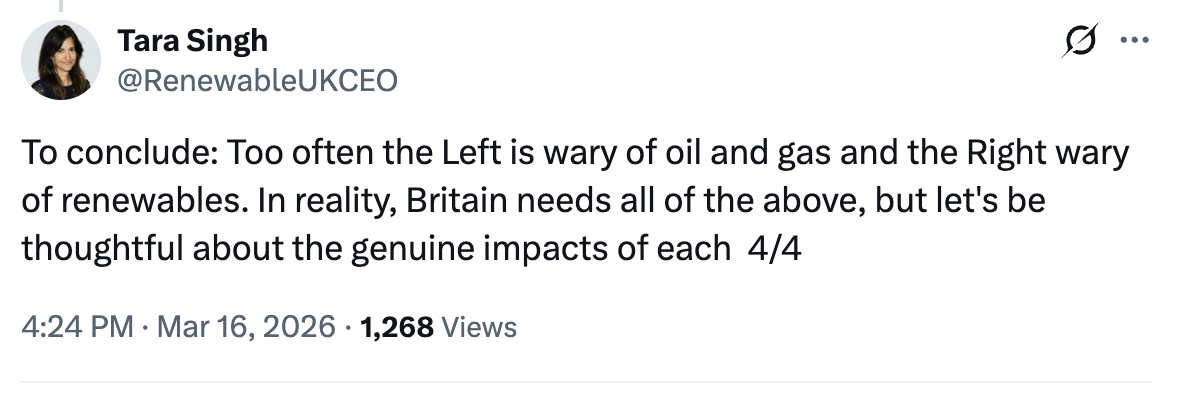
    Tara Singh on X: To conclude

    In his comment for the Daily Telegraph, Jackson added

    “We’re kidding ourselves if we think this is a panacea – it’s 20 years since the North Sea could meet all our needs – we’ve depleted the most abundant reserves and the remainder will be less productive and more expensive. But it makes sense to use what we have whilst we’re so dependent on gas.”

    His article, titled “My plan to safeguard Britain’s energy supplies”, only briefly mentioned the North Sea and stressed the importance of “reduc[ing] our dependency on gas”.

    He continued to set out other potential steps for increasing energy security and bringing down bills, including building nuclear efficiently, cutting energy waste, reforming the electricity market, rolling out domestic renewable generation and breaking the link between gas and electricity that “lets global chaos dictate our prices”.

    In a follow-up interview with Jackson in the Independent, which emphasised these alternatives, he added that the UK was “deluding” itself if it thinks it can “get enough out of the North Sea and in a market where the price is set internationally”. 

    For his part, Maier clarified on LinkedIn that he was a supporter of a “ managed energy transition” making use of all available energy sources, but adding that this includes “the end game being mostly renewable energy generation”.

    He also explicitly rejected the notion that more North Sea oil and gas would bring down bills, noting: “It doesn’t; indeed, energy costs are rising at this very moment because of fossil fuels.” Again, this mirrors the view expressed by government ministers.

    Maier also subsequently pushed back against the media coverage of his original comments, writing in a follow-up post on LinkedIn that the claim he was pressuring Miliband over North Sea drilling was “wrong” and that he is “fully supportive of the government position”. He added: 

    “I see this as consistent with an ‘all energy’ approach to the transition. That the end game is renewables and that we need to give supply chain companies enough time to transition. I have said this numerous times in many speeches and posts here.”

    Back to top

    FALSE: ‘The UK is the only country in the world banning new oil and gas licenses’

    On LinkedIn, Conservative politician and shadow energy secretary Claire Coutinho claimed that the “UK is the only country in the world banning new oil and gas licenses”.

    Her comment was made in response to a post about Denmark, which, in 2020, made a landmark decision to stop issuing new oil and gas licences and end all fossil-fuel extraction by 2050.

    The post noted that Denmark is now considering “extending one or more production licenses” in the Danish North Sea, in response to the energy crisis.

    However, as Coutinho surely knows, this is not the same as issuing new licences – and is more comparable to Labour’s move to allow some additional “tieback” drilling at existing fields, announced in 2025.

    Denmark and the UK are not the only countries to end new oil and gas licences. Other nations to do so include IrelandFrancePortugal and Colombia.

    In fact, there is an international coalition of nations that have pledged to end new oil and gas production, known as the Beyond Oil and Gas Alliance (BOGA).

    This group is helping to convene the first meeting of nations that want to take immediate action to phase out fossil fuels, which is taking place in Santa Marta, Colombia, in April. Around 40-80 nations are expected to attend.

    Carbon Brief understands that the UK will have a senior representative at the conference. 

    Despite showing its support for BOGA, the UK is currently not a member. A senior official once told Carbon Brief that this is because the UK does not currently meet the required end date for stopping all fossil-fuel production.

    Back to top

    MISLEADING: ‘With new North Sea licences would come thousands of jobs’

    Addressing parliament in March, Nigel Farage, the leader of the hard-right, climate-sceptic Reform UK party, claimed that with new North Sea oil and gas licences “would come thousands of jobs”, according to the Herald.

    As noted above, the issuing of new exploration licences would only make a small difference to future production in a basin that is in irreversible decline.

    Official statistics show the decline of the basin caused direct jobs in oil and gas production to fall by a third between 2014 and 2023. Indeed, according to the government, more than 70,000 jobs have been lost in the last decade alone.

    This decline has occurred despite the previous Conservative government, which was in power from 2010-24, holding six new licensing rounds and issuing hundreds of new licences.

    The Norwegian oil-and-gas company Equinor has claimed that, if approved, its large oil project, Rosebank, could create up to 1,600 jobs while at the height of its construction phase. (Rosebank has a licence, but has not yet obtained final consent from the government.)

    However, analysis by the North Sea non-profit Uplift says that this figure is “inflated” and that the project would only create 255 jobs over its lifetime.

    As part of its “North Sea future plan” announced in 2025, the current Labour government has pledged to establish the “North Sea jobs service” – a national employment programme offering support for oil and gas workers seeking new opportunities in clean energy, defence and advanced manufacturing.

    However, campaigners have warned that the plan does not go far enough.

    In 2023, the UK’s Climate Change Committee (CCC) published an analysis of how jobs might change as the country strives for its legally binding net-zero target.

    Its review of available data suggested that the gradual phase-down of high-emitting sectors, such as oil and gas production, could lead to there being 8,000-75,000 workers “whose jobs cannot continue in their current form”. (It notes that the wide range is due to “much uncertainty in these estimates”.)

    But it added that this would be outweighed by “extensive job creation”. It estimated that there could be between 135,000-725,000 new jobs created by the transition to net-zero, in sectors such as renewable energy generation, retrofitting and electric vehicles.

    This job creation is not “guaranteed” and is dependent on the government implementing measures to support and upskill its workforce on the journey to net-zero, the CCC noted.

    report published this week by the Renewable Energy Association, the UK’s largest renewables trade body, found that jobs in renewable energy in the UK now outstrip those in oil and gas.

    According to the figures, there were 145,000 jobs in the renewable energy sector in 2025, compared with 115,000 in oil and gas.

    Back to top

    MISLEADING: North Sea drilling ‘would secure a rush of revenue into the Treasury’

    One common argument in favour of more North Sea drilling is that the sector provides an important source of tax revenue for the government.

    An editorial in the climate-sceptic Daily Telegraph claimed that “tapping” new North Sea oil and gas “would not resolve the problem of high energy prices”, but would “secure a rush of revenue into the Treasury and provide households and businesses struggling under current circumstances with a helping hand”.

    The tax revenue argument is often made by North Sea proponents who try to position themselves as being even-handed and moderate, as illustrated in recent columns in the Guardian and Observer.

    However, the idea that new projects would usher in significant revenue is highly misleading.

    The Office of Budget Responsibility (OBR), the UK’s independent fiscal watchdog, in March forecast that total UK oil and gas revenues are expected to fall from £6bn in 2024-25 to just £0.1bn by 2030-31. (This is at baseline prices that do not consider the current energy crisis.)

    Part of this decline comes from the expected end of the windfall tax, a levy first introduced by the Conservative government in 2022 in response to soaring oil-and-gas company profits fuelled by the end of Covid restrictions and Russia’s invasion of Ukraine. 

    (Many proponents of North Sea oil and gas have repeatedly called for an end to the windfall tax, while also frequently talking up the tax benefits from oil-and-gas production.)

    However, the downgraded OBR forecast also reflects the decline of production in the basin as resources dry up, a shrinking tax base and falling prices, says Daniel Jones, head of research, policy and legal at the campaign group Uplift. He tells Carbon Brief:

    “Even the windfall receipts generated during a genuine price crisis are temporary and price-dependent. At normal prices, the basin contributes very little. The structural decline continues regardless of the spike.”

    As old oil and gas assets reach the end of their lives, the companies behind them are able to access significant tax relief for decommissioning costs, “further reducing the net contribution to the public finances”, says Jones.

    (In some years, this tax relief has meant that far from being a source of revenue, certain oil and gas companies have been paid money by the exchequer.)

    In addition, new developments “tend to be smaller and more expensive than the fields they replace”, Jones says, leading to the government offering large tax deductions for exploration, drilling and construction costs from 2014 onwards. He continues:

    “These deductions can wipe out any taxable profit for years, meaning the Treasury collects nothing until investment costs have been fully offset. By the time a new field generates net tax receipts, it may be well into its production life – if prices and production hold up long enough to get there at all.”

    An analysis by Uplift and NGO WWF Norway in 2025 found that the Rosebank oil field currently seeking development consent from the government could, in a “base-case scenario”, lead to £258m in net losses for the UK, due to the reasons set out above.

    Back to top

    FALSE: Ed Miliband is an ‘anti-North Sea’ climate change ‘fanatic’

    A huge amount of the criticism of the UK government’s position on North Sea oil and gas has been personally levelled at one man: Ed Miliband.

    The energy secretary has been repeatedly labelled by opposition politicians and their media allies as “dangerous” and a “fanatic” with a “cult-like conviction”, because of his reported opposition to more drilling in the North Sea. 

    Miliband’s Conservative counterpart, Claire Coutinho, wrote in the Daily Telegraph:

    “As the world gets more dangerous, [Miliband’s] anti-North Sea fanaticism is making Britain weaker and poorer.”

    As with much of the criticism aimed at Miliband in right-leaning media, these attacks are often highly personal. The Sun’s US editor-at-large, Harry Cole, referred to Miliband as a “Greta [Thunberg]-loving Marxist, who has never seen a market he doesn’t want to destroy”. 

    In fact, Miliband is simply the energy minister in a government that has explicitly prioritised climate policies and transitioning away from fossil fuels.

    Labour’s 2024 manifesto for the general election in which the party won an overwhelming victory and, hence, mandate stated:

    “We will not issue new licences to explore new [North Sea] fields because they will not take a penny off bills, cannot make us energy secure and will only accelerate the worsening climate crisis.”

    While the government has repeatedly ruled out new licences, it is considering approving several new projects at sites that have already received licences, but not consent to begin development.

    It has also announced new “transitional energy certificates”, which will allow new oil and gas production at or near existing sites.

    As for Miliband, his views are far more moderate than the “fanatical” ones portrayed by his detractors. 

    The energy secretary has been clear that he expects the UK to continue producing oil and gas even as it transitions to net-zero, writing in a recent Observer article:

    “As we build our clean-energy future, North Sea production continues to play an important and valuable role, which is why we are keeping existing oil and gasfields open for their lifetime.”

    Arguing against more expansion, Miliband noted that the North Sea is a “maturing basin” and that “new exploration licences are simply too marginal to have a meaningful impact on levels of oil and gas production”.

    Original article by Daisy Dunne, Josh Gabbatiss, Molly Lempriere & Simon Evans republished from Carbon Brief.

  • Chris Stark: The economics of clean energy ‘just get better and better’

    Spread the love

    Nigel Farage urges you to ignore facts and reality and be a climate science denier like him and his Deputy Richard Tice. He says that Reform UK has received £Millions and £Millions from the fossil fuel industry to promote climate denial and destroy the planet.
    Nigel Farage urges you to ignore facts and reality and be a climate science denier like him and his Deputy Richard Tice. He says that Reform UK has received £Millions and £Millions from the fossil fuel industry to promote climate denial and destroy the planet.
    Donald Trump urges you to be a Climate Science denier like him. He says that he makes millions and millions for destroying the planet, Burn, Baby, Burn and Flood, Baby, Flood.
    Donald Trump urges you to be a Climate Science denier like him. He says that he makes millions and millions for destroying the planet, Burn, Baby, Burn and Flood, Baby, Flood.
    Elon Musk urges you to be a Fascist like him, says that you can ignore facts and reality then.
    Elon Musk urges you to be a Fascist like him, says that you can ignore facts and reality then.
  • Analysis: The climate papers most featured in the media in 2025

    Spread the love

    Original article republished from Carbon Brief under a CC license

    The year 2025 saw the return to power of Donald Trump, a jewellery heist at the Louvre museum in Paris and an engagement that “broke the internet”.

    Amid the biggest stories of the year, climate change research continued to feature prominently in news and social media feeds.

    Using data from Altmetric, which scores research papers according to the attention they receive online, Carbon Brief has compiled its annual list of the 25 most talked-about climate-related studies of the past year. 

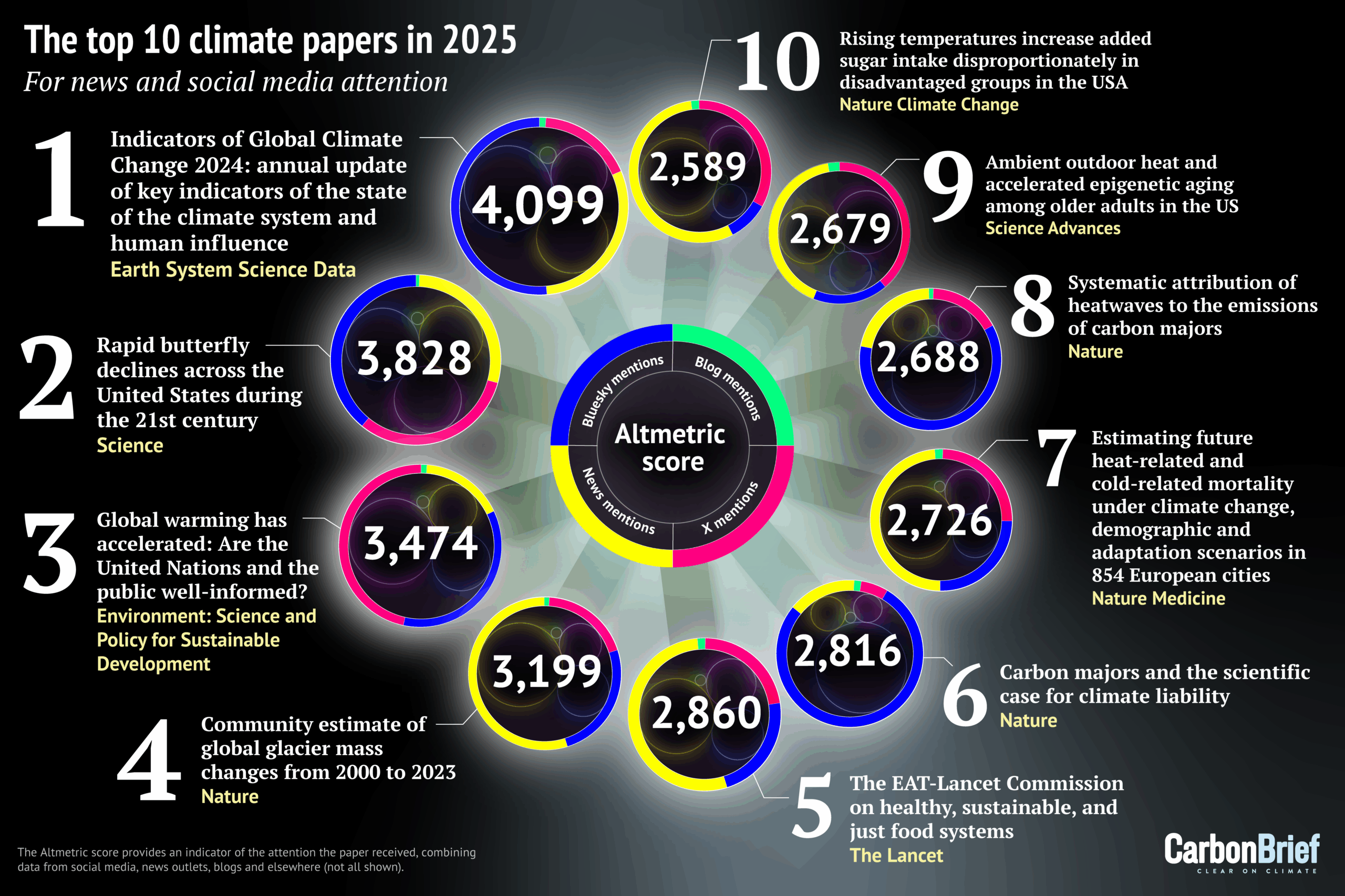
    The top 10 – shown in the infographic above and list below – include research into declining butterflies, heat-related deaths, sugar intake and the massive loss of ice from the world’s glaciers:

    1. Indicators of Global Climate Change 2024: annual update of key indicators of the state of the climate system and human influence
    2. Rapid butterfly declines across the US during the 21st century
    3. Global warming has accelerated: Are the UN and the public well informed?
    4. Community estimate of global glacier mass changes from 2000 to 2023 
    5. The EAT-Lancet Commission on healthy, sustainable and just food systems 
    6. Carbon majors and the scientific case for climate liability 
    7. Estimating future heat-related and cold-related mortality under climate change, demographic and adaptation scenarios in 854 European cities 
    8. Systematic attribution of heatwaves to the emissions of carbon majors 
    9. Ambient outdoor heat and accelerated epigenetic aging among older adults in the US 
    10. Rising temperatures increase added sugar intake disproportionately in disadvantaged groups in the US

    Later in this article, Carbon Brief looks at the rest of the top 25 and provides analysis of the most featured journals, as well as the gender diversity and country of origin of authors.

    New for this year is the inclusion of Altmetric’s new “sentiment analysis”, which scores how positive or negative a paper’s social media attention has been.

    (For Carbon Brief’s previous Altmetric articles, see the links for 202420232022202120202019201820172016 and 2015.) 

    Global indicators

    The top-scoring climate paper of 2025, ranking 24th of any research paper on any topic, is the annual update of the “Indicators of Global Climate Change” (IGCC) report.

    The report was established in 2023 to help fill the gap in climate information between assessments of the Intergovernmental Panel on Climate Change (IPCC), which can take up to seven years to complete. It includes the latest data on global temperatures, the remaining carbon budget, greenhouse gas emissions and – for the first time – sea level rise. 

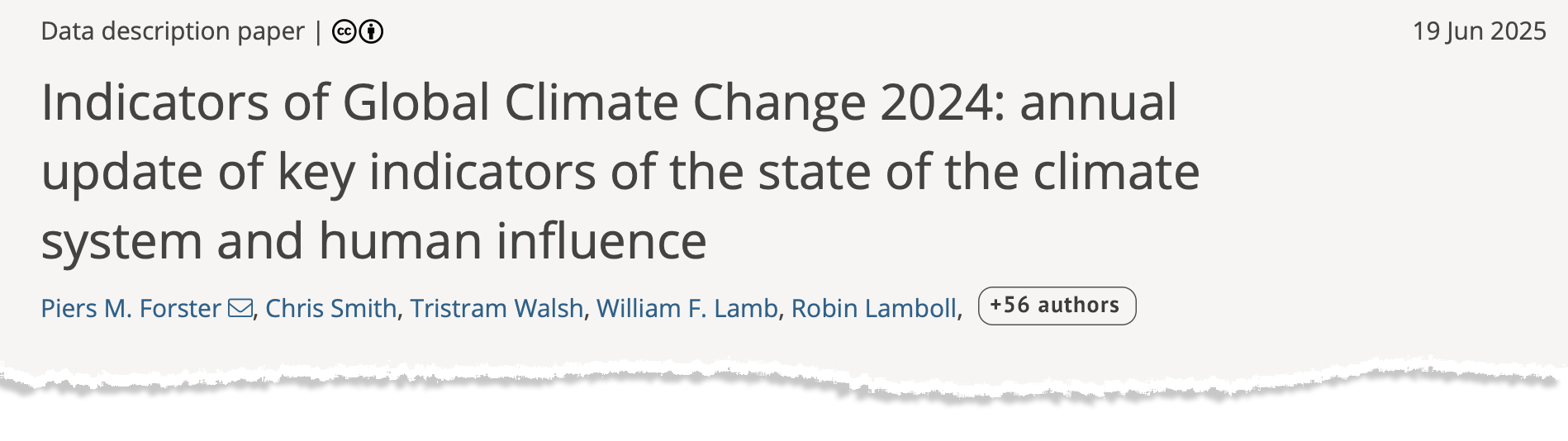
    Ragout: Indicators of Global Climate Change 2024: annual update of key indicators of the state of the climate system and human influence

    The paper, published in Earth System Science Data, has an Altmetric score of 4,099. This makes it the lowest top-scoring climate paper in Carbon Brief’s list since 2017.

    (An Altmetric score combines the mentions that published peer-reviewed research has received from online news articles, blogs, Wikipedia and on social media platforms such as Facebook, Reddit, Twitter and Bluesky. See an earlier Carbon Brief article for more on how Altmetric’s scoring system works.)

    Previous editions of the IGCC have also appeared in Carbon Brief’s list – the 2024 and 2023 iterations ranked 17th and 18th, respectively.

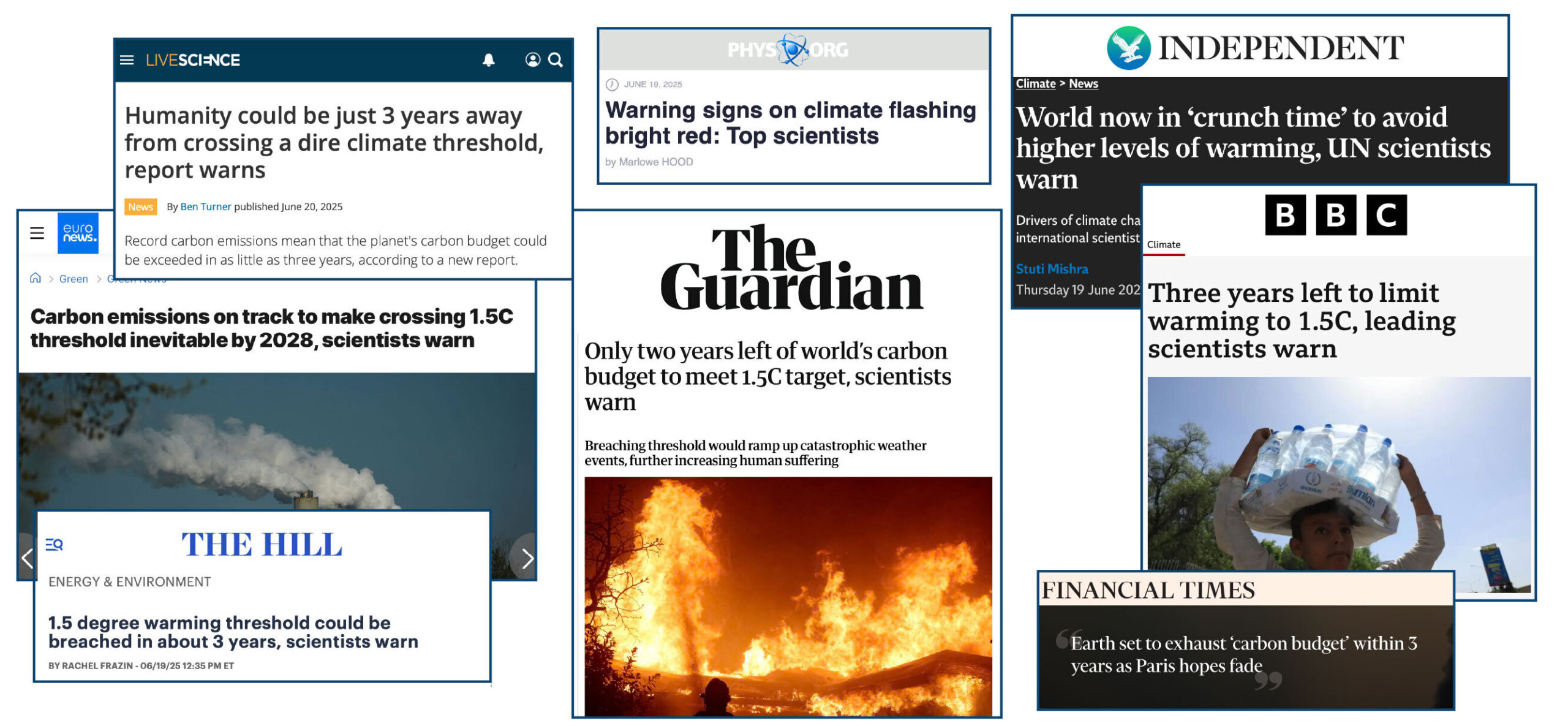
    This year’s paper was mentioned 556 times in online news stories, including in the Associated PressGuardianIndependentHill and BBC News

    Many outlets led their coverage with the study’s findings on the global “carbon budget”. This warned that the remaining carbon budget to limit warming to 1.5C will be exhausted in just three years if global emissions continue at their current rate.

    Headline_Montage

    In a Carbon Brief guest post about the study, authors Prof Piers Forster and Dr Debbie Rosen from the University of Leeds wrote:

    “It is also now inevitable that global temperatures will reach 1.5C of long-term warming in the next few years unless society takes drastic, transformative action…Every year of delay brings reaching 1.5C – or even higher temperatures – closer.”

    Forster, who was awarded a CBE in the 2026 new year honours list, tells Carbon Brief that media coverage of the study was “great” at “putting recent extreme weather in the context of rapid long-term rates of global warming”. 

    However, he adds:

    “Climate stories are not getting the coverage they deserve or need at the moment so the community needs to get all the help we can for getting clear consistent messages out there.”

    The paper was tweeted more than 300 times and posted on Bluesky more than 950 times. It also appeared in 22 blogs. 

    Using AI, Altmetric now analyses the “sentiment” of this social media attention. As the summary figure below shows, the posts about this paper were largely positive, with an approximate 3:1 split of positive and negative attention.

    Altmetric’s AI-generated summary of the sentiment of social media posts regarding the Forster et al.
    Altmetric’s AI-generated summary of the sentiment of social media posts regarding the Forster et al. (2025) paper. Totals may add up to more than 100% because of rounding. Source: Altmetric

    Butterfly decline

    With an Altmetric score of 3,828, the second-highest scoring climate paper warns of “widespread” declines in butterfly numbers across the US since the turn of the century.

    The paper, titled “Rapid butterfly declines across the US during the 21st century” and published in Science, identifies a 22% fall in butterfly numbers across more than 500 species between 2000 and 2020.

    (There is a higher-scoring paper, “The 2025 state of the climate report: a planet on the brink”, in the journal BioScience, but it is a “special report” and was not formally peer reviewed.)

    Ragout: Rapid butterfly declines across the United States during the 21st
century

    The scale of the decline suggests “multiple and broadly acting threats, including habitat loss, climate change and pesticide use”, the paper says. The authors find that “species generally had stronger declines in more southerly parts of their ranges”, with some of the most negative trends in the driest and “most rapidly warming” US states.

    The research was covered in 560 news articles, including the New York TimesGuardianAssociated PressNPREl País and BBC News. Much of the news coverage led with the 22% decline figure.

    The paper was also mentioned in 13 blogs, more than 750 Bluesky posts and more than 600 tweets.

    The sentiment analysis reveals that social media posts about the paper were largely negative. However, closer inspection reveals that this negativity is predominantly towards the findings of the paper, not the research itself. 

    For example, a Bluesky post on the “distressing” findings by one of the study’s authors is designated as “neutral negative” by Altmetric’s AI analysis.

    In a response to a query from Carbon Brief, Altmetric explains that the “goal is to measure how people feel about the research paper itself, not the topic it discusses”. However, in some cases the line can be “blurred” as the AI “sometimes struggles to separate the subject matter from the critique”. The organisation adds that it is “continuously working on improving our models to better distinguish between the post’s content and the research output”. 

    Altmetric’s AI-generated summary of the sentiment of social media posts regarding the Forster et al.
    Altmetric’s AI-generated summary of the sentiment of social media posts regarding the Forster et al. (2025) paper. Totals may add up to more than 100% because of rounding. Source: Altmetric

    On the attention that the paper received, lead author Dr Collin Edwards of the Washington Department of Fish & Wildlife says that “first and foremost, people care about butterflies and our results are broad-reaching, unequivocal and, unfortunately, very concerning”. 

    Edwards tells Carbon Brief he hopes the clarity of the writing made the paper accessible to readers, noting that he and his co-authors “sweat[ed] over every word”. 

    The resulting news coverage “accurately captured the science”, Edwards says: 

    “Much as I wish our results were less consistently grim, the consistency and simplicity of our findings mean that even if a news story only provides the highest level summary, it isn’t misleading readers by skipping some key caveat or nuance that changes the interpretation.”

    Warming ‘acceleration’

    In third place in Carbon Brief’s list for 2025 is the latest scientific paper from veteran climatologist Dr James Hansen, former director of the NASA Goddard Institute for Space Studies and now adjunct professor at Columbia University’s Earth Institute.

    The paper, titled “Global warming has accelerated: Are the UN and the public well-informed?” was published in the journal Environment: Science and Policy for Sustainable Development. It generated an Altmetric score of 3,474.

    Ragout: Global Warming Has Accelerated: Are the United Nations and the Public Well-Informed

    The study estimates that the record-high global temperatures in the last few years were caused by a combination of El Niño and a reduction in air pollution from international shipping

    The findings suggest that the cooling effect of aerosols – tiny, light‑scattering particles produced mainly by burning fossil fuels – has masked more of the warming driven by greenhouse gases than previously estimated by the IPCC.

    As efforts to tackle air pollution continue to reduce aerosol emissions, warming will accelerate further – reaching 2C by 2045, according to the research.

    The paper was covered by almost 400 news stories – driven, in part, by Hansen’s comments in a press briefing that the Paris Agreement’s 2C warming limit was already “dead”. 

    Hansen’s analysis received a sceptical response from some scientists. For example, Dr Valerie Masson-Delmotte, an IPCC co-chair for its most recent assessment report on climate science, told Agence France-Presse the research “is not published in a climate science journal and it formulates a certain number of hypotheses that are not consistent with all the available observations”.

    In addition, other estimates, including by Carbon Brief, suggest new shipping regulations have made a smaller contribution to warming than estimated by Hansen.

    Hansen tells Carbon Brief that the paper “did ok” in terms of media coverage, although notes “it’s on [scientists] to do a better job of making clear what the core issues are in the physics of climate change”.

    With more than 1,000 tweets, the paper scored highest in the top 25 for posts on Twitter. It was also mentioned in more than 800 Bluesky posts and on 27 blogs. 

    The sentiment analysis suggests that these posts were largely positive, with just a small percentage of negative comments.

    Altmetric’s AI-generated summary of the sentiment of social media posts regarding the Hansen et al.
    Altmetric’s AI-generated summary of the sentiment of social media posts regarding the Hansen et al. (2025) paper. Totals may add up to more than 100% because of rounding. Source: Altmetric

    Making the top 10

    Ranking fourth in Carbon Brief’s analysis is a Nature paper calculating changes in global glacier mass over 2000-23. The study finds glaciers worldwide lost 273bn tonnes of ice annually over that time – with losses increasing by 36% between 2000-11 and 2012-23.

    The study has an Altmetric score of 3,199. It received more news coverage than any other paper in this year’s top 25, amassing 1,187 mentions. with outlets including the GuardianAssociated Press and Economic Times

    At number five, with an Altmetric score of 2,860, is the EAT-Lancet Commission on healthy, sustainable and just food systems.

    Carbon Brief’s coverage of the report highlights that “a global shift towards ‘healthier’ diets could cut non-CO2 greenhouse gas emissions, such as methane, from agriculture by 15% by 2050”. It adds:

    “The findings build on the widely cited 2019 report from the EAT-Lancet Commission – a group of leading experts in nutrition, climate, economics, health, social sciences and agriculture from around the world.”

    Also making the top 10 – ranking sixth and eighth – are a pair of papers published in Nature, which both link extreme heat to the emissions of specific “carbon majors” – large producers of fossil fuels, such as ExxonMobil, Shell and Saudi Aramco,.

    The first is a perspective, titled “Carbon majors and the scientific case for climate liability”, published in April. It begins:

    “Will it ever be possible to sue anyone for damaging the climate? Twenty years after this question was first posed, we argue that the scientific case for climate liability is closed. Here we detail the scientific and legal implications of an ‘end-to-end’ attribution that links fossil fuel producers to specific damages from warming.”

    The authors find “trillions (of US$) in economic losses attributable to the extreme heat caused by emissions from individual companies”.

    The paper was mentioned 1,329 times on Bluesky – the highest in this year’s top 25. It was also mentioned in around 270 news stories.

    Published four months later, the second paper uses extreme event attribution to assess the impact of climate change on more than 200 heatwaves recorded since the year 2000.

    The authors find one-quarter of the heatwaves would have been “virtually impossible” without human-caused global warming. They add that the heatwaves were, on average, 1.7C hotter due to climate change, with half of this increase due to emissions stemming from the operations and production of carbon majors. 

    This study was mentioned in almost 300 news stories – including by Carbon Brief – as well as 222 tweets and 823 posts on Bluesky.

    In seventh place is a Nature Medicine study, which quantifies how heat-related and cold-related deaths will change over the coming century as the climate warms. 

    A related research briefing explains the main findings of the paper:

    “Heat-related deaths are estimated to increase more rapidly than cold-related deaths are estimated to decrease under future climate change scenarios across European cities. An unrealistic degree of adaptation to heat would be required to revert this trend, indicating the need for strong policies to reduce greenhouse gases emissions.”

    The paper was mentioned 345 times in the news, including in the Financial TimesNew ScientistGuardian and Bloomberg.

    The paper in ninth place also analyses the health impacts of extreme heat. The study, published in Science Advances, finds that extreme heat can speed up biological ageing in older people. 

    Rounding out the top 10 is a Nature Climate Change study, titled “Rising temperatures increase added sugar intake disproportionately in disadvantaged groups in the US”. 

    The study finds that at higher temperatures, people in the US consume more sugar – mainly due to “higher consumption of sugar-sweetened beverages and frozen desserts”. The authors project that warming of 5C would drive additional sugar consumption of around 3 grams per day, “with vulnerable groups at an even higher risk”.

    Elsewhere in the top 25

    The rest of the top 25 includes a wide range of research, from “glacier extinction” and wildfires to Amazon drought and penguin guano.

    In 13th place is a Nature Climate Change study that finds the wealthiest 10% of people – defined as those who earn at least €42,980 (£36,605) per year – contributed seven times more to the rise in monthly heat extremes around the world than the global average.

    The authors also explore country-level emissions, finding that the wealthiest 10% in the US produced the emissions that caused a doubling in heat extremes across “vulnerable regions” globally. 

    (See Carbon Brief’s coverage of the paper for more details.)

    In 15th place is the annual Lancet Countdown on health and climate change – a lengthy report with more than 120 authors.

    The study warns that “climate change is increasingly destabilising the planetary systems and environmental conditions on which human life depends”.

    This annual analysis from the Lancet often features in Carbon Brief’s top 25 analysis. After three years in the Carbon Brief’s top 10 over 2020-23, the report landed in 20th place in 2023 and missed out on a spot in the top 25 altogether in 2024. 

    In 16th place is a Science Advances study, titled “Increasing rat numbers in cities are linked to climate warming, urbanisation and human population”. The study uses public complaint and inspection data from 16 cities around the world to estimate changes in rat populations.

    It finds that “warming temperatures and more people living in cities may be expanding the seasonal activity periods and food availability for urban rats”.

    The study received 320 new mentions, including in the Washington PostNew Scientist and National Geographic.

    In 21st place is a Nature Climate Change paper, titled “Peak glacier extinction in the mid-21st century”. The study authors “project a sharp rise in the number of glaciers disappearing worldwide, peaking between 2041 and 2055 with up to ~4,000 glaciers vanishing annually”.

    Completing the top 25 is a Nature study on the “prudent planetary limit for geological carbon storage” – where captured CO2 is injected deep underground, where it can stay trapped for thousands of years. 

    In a Carbon Brief guest post, study authors Dr Matthew Gidden and Prof Joeri Rogelj explain that carbon dioxide removal will only be effective at limiting global temperature rise if captured CO2 is injected “deep underground, where it can stay trapped for thousands of years”. 

    The guest post warns that “geological carbon storage is not limitless”. It states that “if all available safe carbon storage capacity were used for CO2 removal, this would contribute to only a 0.7C reduction in global warming”. 

    Top journals

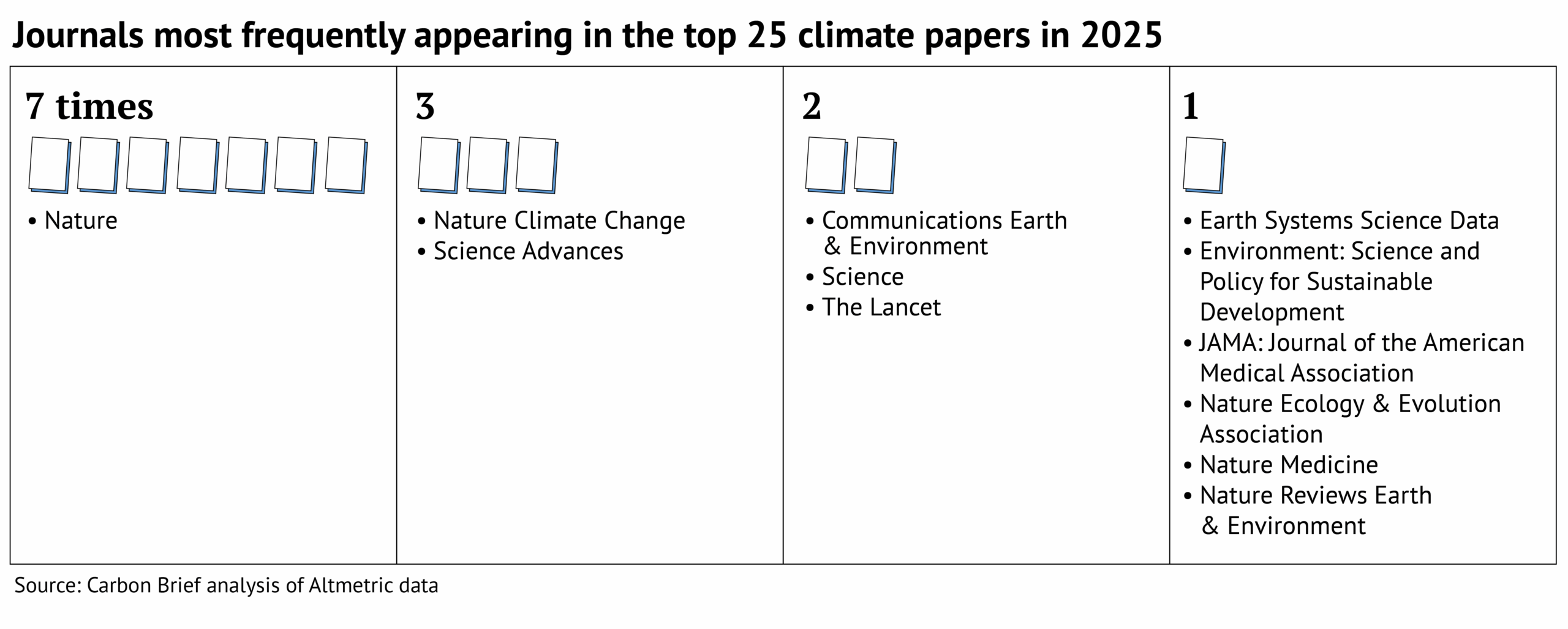
    The journal Nature dominates Carbon Brief’s top 25, with seven papers featured.

    Many other journals in the Springer Nature stable also feature, including Nature Climate Change (three), Communications Earth & Environment (two), as well as Nature Ecology & Evolution, Nature Medicine and Nature Reviews Earth & Environment (one each).

    Also appearing more than once in the top 25 are Science Advances (three), Science (two) and the Lancet (two). 

    This is shown in the graphic below.

    Graphic: Journals most frequently appearing in the top 25 climate papers in 2025

    All the final scores for 2025 can be found in this spreadsheet.

    Diversity in the top 25

    The top 25 climate papers of 2025 cover a huge range of topics and scope. However, analysis of their authors reveals a distinct lack of diversity.

    In total, the top 25 includes more than 650 authors – the highest number since Carbon Brief began this analysis in 2022.

    This is largely due to a few publications with an exceptionally high number of authors. For example, the 2025 report of the Lancet Countdown on health and climate change has almost 130 authors alone, accounting for almost one-fifth of authors in this analysis. 

    Carbon Brief recorded the gender and country of affiliation for each of these authors. (The methodology used was developed by Carbon Brief for analysis presented in a special 2021 series on climate justice.)

    The analysis reveals that 88% of the authors of the climate papers most featured in the media in 2025 are from institutions in the global north. 

    Global South: The “global south” is a term used to broadly describe lower-income countries in regions such as Africa, Asia and Latin America. It is often used to denote nations that are either in… Read More

    Carbon Brief defines the global north as North America, Europe, Japan, Australia and New Zealand. It defines the global south as Asia (excluding Japan), Africa, Oceania (excluding Australia and New Zealand), Latin America and the Caribbean.

    The analysis shows that 53% of authors are from European institutions, while only 1% of authors are from institutions in Africa.

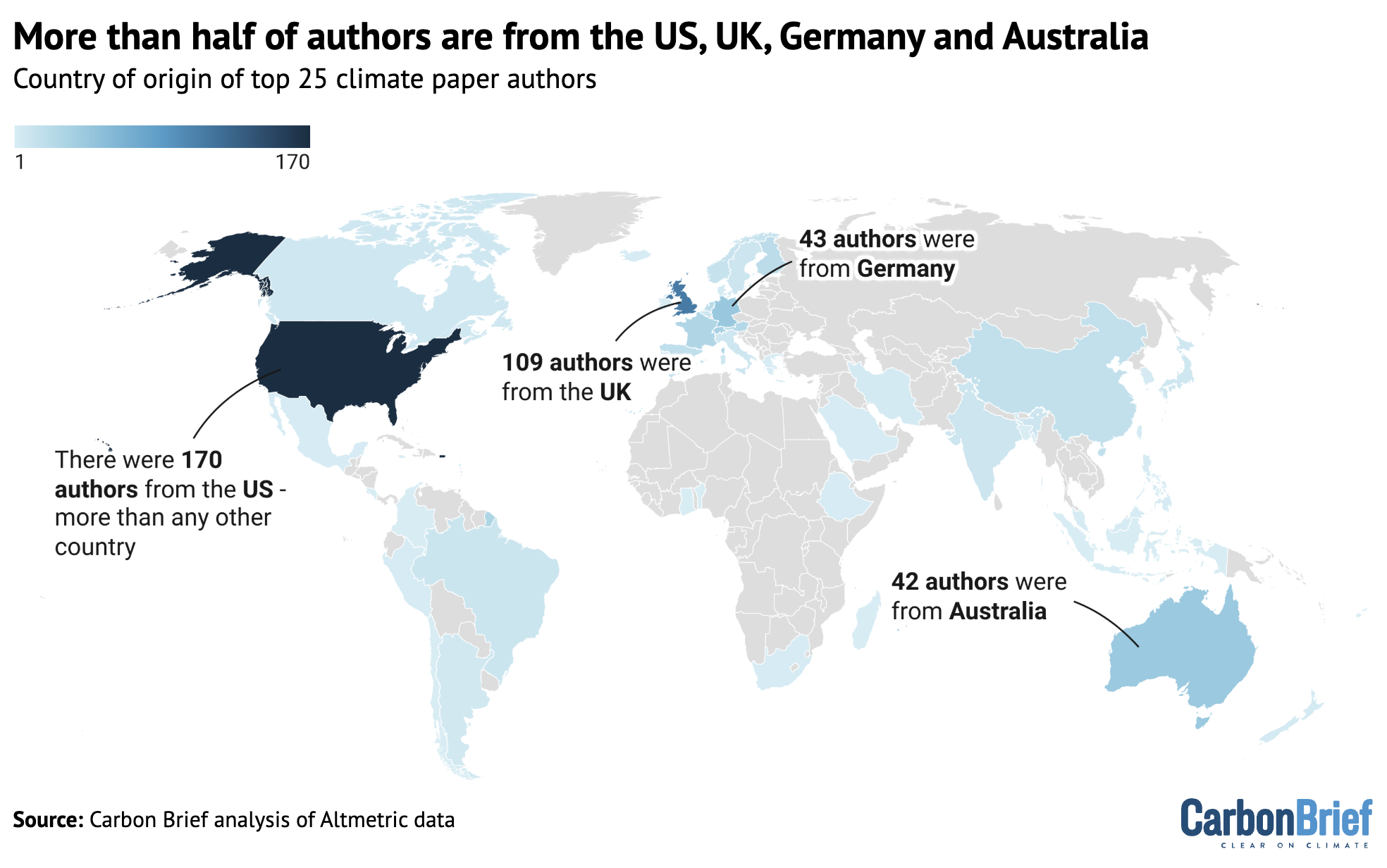
    Further data analysis shows that there are also inequalities within continents. The map below shows the percentage of authors from each country, where dark blue indicates a higher percentage. Countries that are not represented by any authors in the analysis are shown in grey.

    The number of all authors from the climate papers most featured in the media in 2025.
    The number of all authors from the climate papers most featured in the media in 2025. The designations employed and the presentation of the material on this map do not imply the expression of any opinion whatsoever on the part of Carbon Brief concerning the legal status of any country, territory, city or area or of its authorities, or concerning the delimitation of its frontiers or boundaries. Map by Carbon Brief using Datawrapper.

    The top-ranking countries on this map are the US and the UK, which account for 26% and 16% of the authors, respectively.

    Carbon Brief also analysed the gender of the authors. 

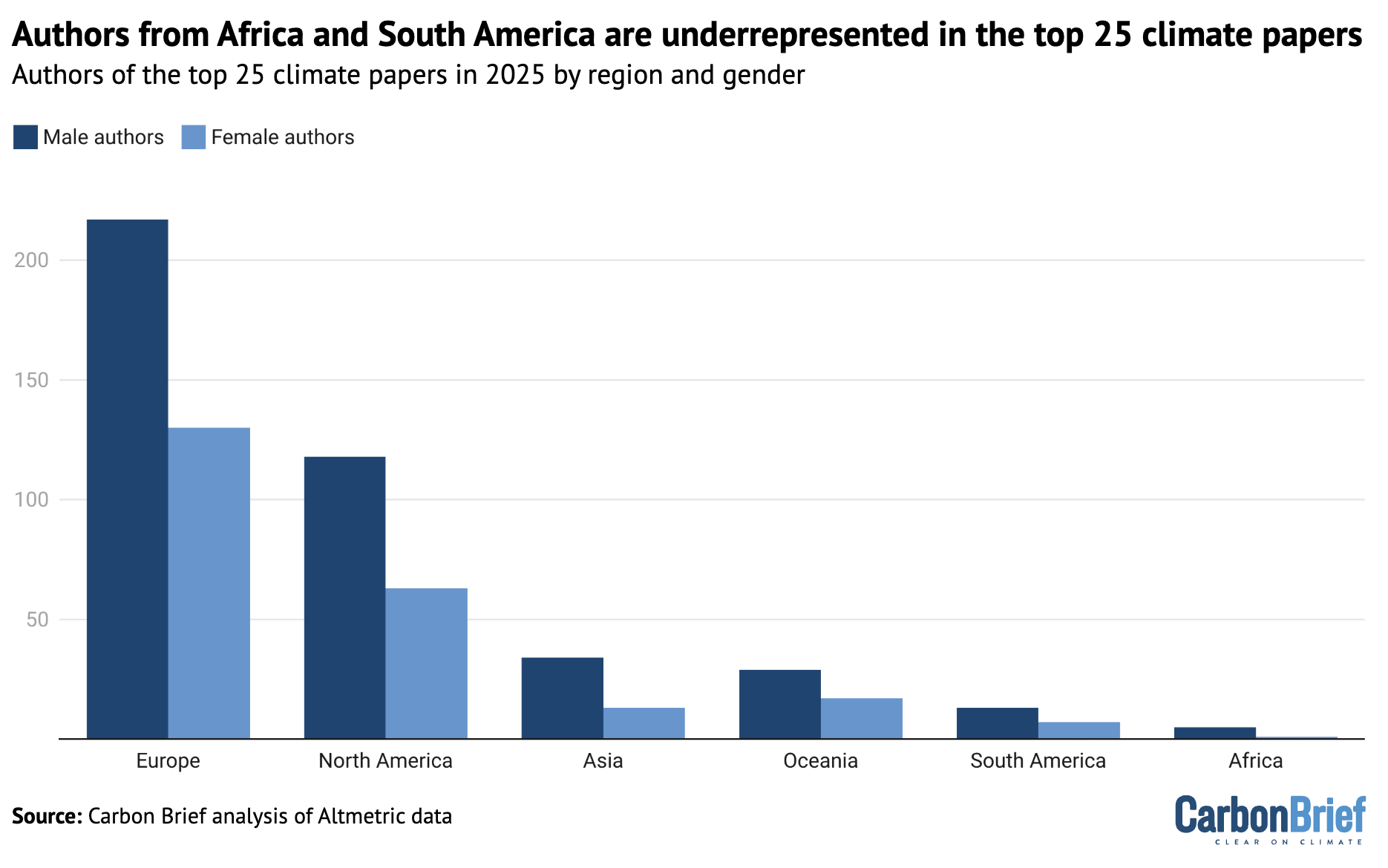
    Only one-third of authors from the top 25 climate papers of 2025 are women and only five of the 25 papers list a woman as lead author.

    The plot below shows the number of authors from each continent, separated into men (dark blue) and women (light blue).

    The number of men (dark blue) and women (light blue) listed as authors in the climate papers most featured in the media in 2025, shown by continent.
    The number of men (dark blue) and women (light blue) listed as authors in the climate papers most featured in the media in 2025, shown by continent. Chart by Carbon Brief using Datawrapper.

    The full spreadsheet showing the results of this data analysis can be found here. For more on the biases in climate publishing, see Carbon Brief’s article on the lack of diversity in climate-science research.

    Elon Musk urges you to be a Fascist like him, says that you can ignore facts and reality then.
    Elon Musk urges you to be a Fascist like him, says that you can ignore facts and reality then.
    Donald Trump urges you to be a Climate Science denier like him. He says that he makes millions and millions for destroying the planet, Burn, Baby, Burn and Flood, Baby, Flood.
    Donald Trump urges you to be a Climate Science denier like him. He says that he makes millions and millions for destroying the planet, Burn, Baby, Burn and Flood, Baby, Flood.
    Orcas discuss Donald Trump and the killer apes' concept of democracy. Front Orca warns that Trump is crashing his country's economy and that everything he does he does for the fantastically wealthy.
    Orcas discuss Donald Trump and the killer apes’ concept of democracy. Front Orca warns that Trump is crashing his country’s economy and that everything he does he does for the fantastically wealthy.

    Original article republished from Carbon Brief under a CC license

  • Analysis: World’s biggest historic polluter – the US – is pulling out of UN climate treaty

    Spread the love

    Original article by Simon Evans republished from Carbon Brief under a CC license

    Satellite image of US at night. Credit: Delphotos / Alamy Stock Photo

    The US, which has announced plans to withdraw from the global climate treaty – the UN Framework Convention on Climate Change (UNFCCC) – is more historically responsible for climate change than any other country or group.

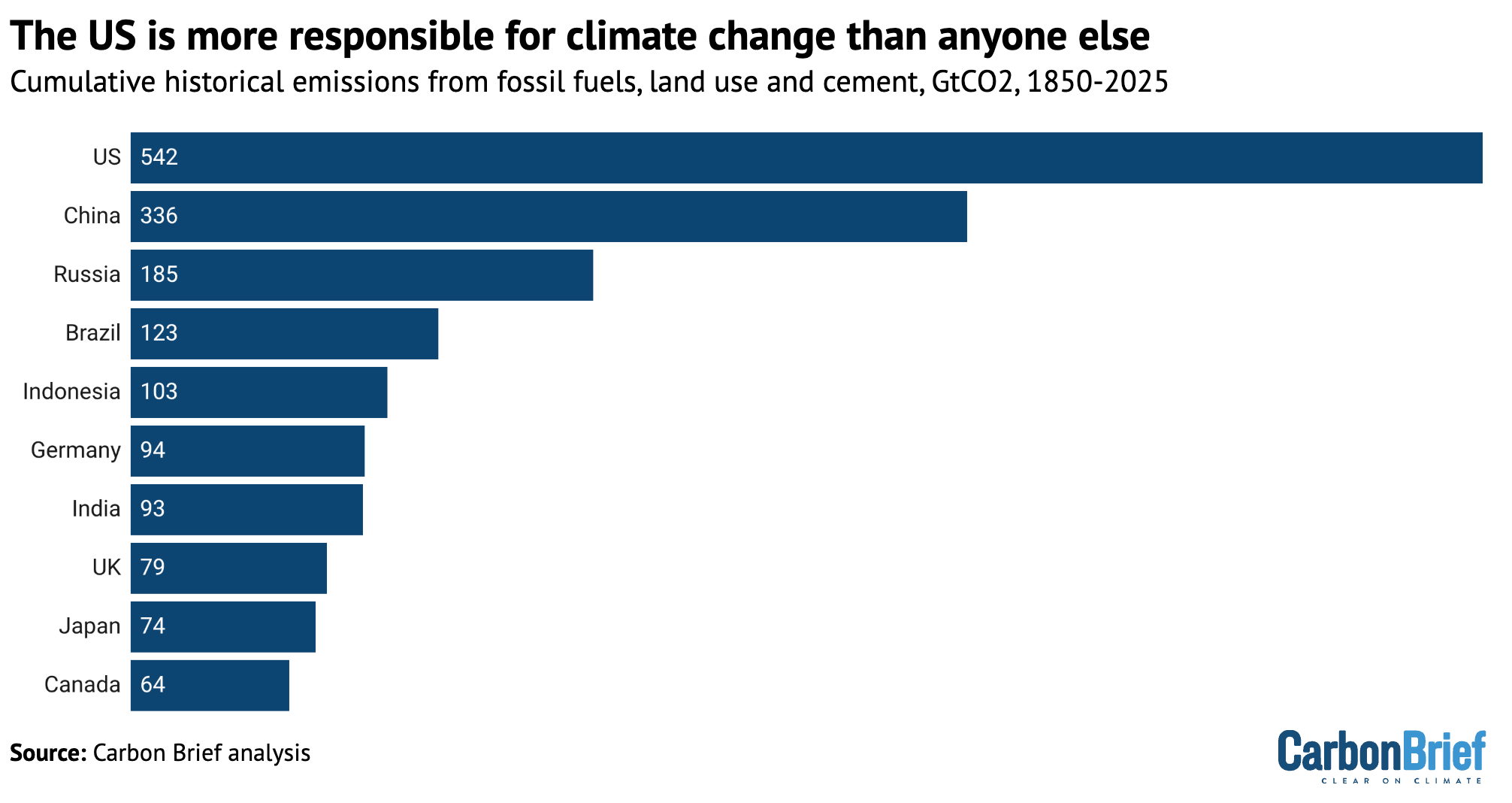
    Carbon Brief analysis shows that the US has emitted a total of 542bn tonnes of carbon dioxide (GtCO2) since 1850, by burning fossil fuels, cutting down trees and other activities.

    This is the largest contribution to the Earth’s warming climate by far, as shown in the figure below, with China’s 336GtCO2 significantly behind in second and Russia in third at 185GtCO2.

    Chart showing that the US is more responsible for climate change than anyone else
    Top 10 countries in terms of their cumulative historical CO2 emissions from fossil fuels, cement, land use, land use change and forestry, 1850-2025, billion tonnes. Source: Source: Carbon Brief analysis of figures from Jones et al (2023), Lamboll et al (2023), the Global Carbon ProjectCDIACOur World in Data, the International Energy Agency and Carbon Monitor.

    The US is responsible for more than a fifth of the 2,651GtCO2 that humans have pumped into the atmosphere between 1850 and 2025 as a result of fossil fuels, cement and land-use change.

    China is responsible for another 13%, with the 27 nations of the EU making up another 12%.

    In total, these cumulative emissions have used up more than 95% of the carbon budget for limiting global warming to 1.5C and are the predominant reason the Earth is already nearly 1.5C hotter than in pre-industrial times.

    The US share of global warming is even more disproportionate when considering that its population of around 350 million people makes up just 4% of the global total.

    On the basis of current populations, the US’s per-capita cumulative historical emissions are around 7 times higher than those for China, more than double the EU’s and 25 times those for India.

    The US’s historical emissions of 542GtCO2 are larger than the combined total of the 133 countries with the lowest cumulative contributions, a list that includes Saudi Arabia, Spain and Nigeria. Collectively, these 133 countries have a population of more than 3 billion people.

    See Carbon Brief’s previous detailed analysis of historical responsibility for climate change for more details on the data sources and methodology, as well as consumption-based emissions.

    Additionally, in 2023, Carbon Brief published an article that looked at the “radical” impact of reassigning responsibility for historical emissions to colonial rulers in the past.

    This approach has a very limited impact on the US, which became independent before the vast majority of its historical emissions had taken place.

    Original article by Simon Evans republished from Carbon Brief under a CC license

    Donald Trump urges you to be a Climate Science denier like him. He says that he makes millions and millions for destroying the planet, Burn, Baby, Burn and Flood, Baby, Flood.
    Donald Trump urges you to be a Climate Science denier like him. He says that he makes millions and millions for destroying the planet, Burn, Baby, Burn and Flood, Baby, Flood.
    Orcas discuss Donald Trump and the killer apes' concept of democracy. Front Orca warns that Trump is crashing his country's economy and that everything he does he does for the fantastically wealthy.
    Orcas discuss Donald Trump and the killer apes’ concept of democracy. Front Orca warns that Trump is crashing his country’s economy and that everything he does he does for the fantastically wealthy.
  • IEA: Fossil-fuel use will peak before 2030 – unless ‘stated policies’ are abandoned

    Spread the love

    Original article by Simon Evans and Ho Woo Nam republished from Carbon Brief.

    The giant Kooragang Coal Loader at Port Newcastle Australia. Credit: IconsAustralia / Alamy Stock Photo

    The world’s fossil-fuel use is still on track to peak before 2030, despite a surge in political support for coal, oil and gas, according to data from the International Energy Agency (IEA).

    The IEA’s latest World Energy Outlook 2025, published during the opening days of the COP30 climate summit in Brazil, shows coal at or close to a peak, with oil set to follow around 2030 and gas by 2035, based on the stated policy intentions of the world’s governments.

    Under the same assumptions, the IEA says that clean-energy use will surge, as nuclear power rises 39% by 2035, solar by 344% and wind by 178%.

    Still, the outlook has some notable shifts since last year, with coal use revised up by around 6% in the near term, oil seeing a shallower post-peak decline and gas plateauing at higher levels.

    This means that the IEA expects global warming to reach 2.5C this century if “stated policies” are implemented as planned, up marginally from 2.4C in last year’s outlook.

    In addition, after pressure from the Trump administration in the US, the IEA has resurrected its “current policies scenario”, which – effectively – assumes that governments around the world abandon their stated intentions and only policies already set in legislation are continued.

    If this were to happen, the IEA warns, global warming would reach 2.9C by 2100, as oil and gas demand would continue to rise and the decline in coal use would proceed at a slower rate.

    This year’s outlook also includes a pathway that limits warming to 1.5C in 2100, but says that this would only be possible after a period of “overshoot”, where temperature rise peaks at 1.65C.

    The IEA will publish its “announced pledges scenario” at a later date, to illustrate the impact of new national climate pledges being implemented on time and in full.

    (See Carbon Brief’s coverage of previous IEA world energy outlooks from 202420232022202120202019201820172016 and 2015.)

    World energy outlook

    The IEA’s annual World Energy Outlook (WEO) is published every autumn. It is regarded as one of the most influential annual contributions to the understanding of energy and emissions trends.

    The outlook explores a range of scenarios, representing different possible futures for the global energy system. These are developed using the IEA’s “global energy and climate model”.

    The latest report stresses that “none of [these scenarios] should be regarded as a forecast”.

    However, this year’s outlook marks a major shift in emphasis between the scenarios – and it reintroduces a pathway where oil and gas demand continues to rise for many decades.

    This pathway is named the “current policies scenario” (CPS), which assumes that governments abandon their planned policies, leaving only those that are already set in legislation.

    If the world followed this path, then global temperatures would reach 2.9C above pre-industrial levels by 2100 and would be “set to keep rising from there”, the IEA says.

    The CPS was part of the annual outlook until 2020, when the IEA said that it was “difficult to imagine” such a pathway “prevailing in today’s circumstances”.

    It has been resurrected following heavy pressure from the US, which is a major funder of the IEA that accounts for 14% of the agency’s budget.

    For example, in July Politico reported “a ratcheted-up US pressure campaign” and “months of public frustrations with the IEA from top Trump administration officials”. It noted:

    “Some Republicans say the IEA has discouraged investment in fossil fuels by publishing analyses that show near-term peaks in global demand for oil and gas.”

    The CPS is the first scenario to be discussed in detail in the report, appearing in chapter three. The CPS similarly appears first in Annex A, the data tables for the report.

    The second scenario is the “stated policies scenario” (STEPS), featured in chapter four of this year’s outlook. Here, the outlook also includes policies that governments say they intend to bring forward and that the IEA judges as likely to be implemented in practice.

    In this world, global warming would reach 2.5C by 2100 – up marginally from the 2.4C expected in the 2024 edition of the outlook.

    Beyond the STEPS and the CPS, the outlook includes two further scenarios.

    One is the “net-zero emissions by 2050” (NZE) scenario, which illustrates how the world’s energy system would need to change in order to limit warming in 2100 to 1.5C.

    The NZE was first floated in the 2020 edition of the report and was then formally featured in 2021.

    The report notes that, unlike in previous editions, this scenario would see warming peak at more than 1.6C above pre-industrial temperatures, before returning to 1.5C by the end of the century.

    This means it would include a high level of temporary “overshoot” of the 1.5C target. The IEA explains that this results from the “reality of persistently high emissions in recent years”. It adds:

    “In addition to very rapid progress with the transformation of the energy sector, bringing the temperature rise back down below 1.5C by 2100 also requires widespread deployment of CO2 removal technologies that are currently unproven at large scale.”

    Finally, the outlook includes a new scenario where everyone in the world is able to gain access to electricity by 2035 and to clean cooking by 2040, named “ACCESS”.

    While the STEPS appears second in the running order of the report, it is mentioned slightly more frequently than the CPS, as shown in the figure below. The CPS is a close second, however, whereas the IEA’s 1.5C pathway (NZE) receives a declining level of attention.

    Number of mentions of each scenario per 100 pages of text.
    Number of mentions of each scenario per 100 pages of text. Source: Carbon Brief analysis.

    US critics of the IEA have presented its stated policies scenario as “disconnected from reality”, in contrast to what they describe as the “likely scenario” of “business as usual”.

    Yet the current policies scenario is far from a “business-as-usual” pathway. The IEA says this explicitly in an article published ahead of the outlook:

    “The CPS might seem like a ‘business-as-usual’ scenario, but this terminology can be misleading in an energy system where new technologies are already being deployed at scale, underpinned by robust economics and mature, existing policy frameworks. In these areas, ‘business as usual’ would imply continuing the current process of change and, in some cases, accelerating it.”

    In order to create the current policies scenario, where oil and gas use continues to surge into the future, the IEA therefore has to make more pessimistic assumptions about barriers to the uptake of new technologies and about the willingness of governments to row back on their plans. It says:

    “The CPS…builds on a narrow reading of today’s policy settings…assuming no change, even where governments have indicated their intention to do so.”

    This is not a scenario of “business as usual”. Instead, it is a scenario where countries around the world follow US president Donald Trump in dismantling their plans to shift away from fossil fuels.

    More specifically, the current policies scenario assumes that countries around the world renege on their policy commitments and fail to honour their climate pledges.

    For example, it assumes that Japan and South Korea fail to implement their latest national electricity plans, that China fails to continue its power-market reforms and abandons its provincial targets for clean power, that EU countries fail to meet their coal phase-out pledges and that US states such as California fail to extend their clean-energy targets.

    Similarly, it assumes that Brazil, Turkey and India fail to implement their greenhouse gas emissions trading schemes (ETS) as planned and that China fails to expand its ETS to other industries.

    The scenario also assumes that the EU, China, India, Australia, Japan and many others fail to extend or continue strengthening regulations on the energy efficiency of buildings and appliances, as well as those relating to the fuel-economy standards for new vehicles.

    In contrast to the portrayal of the stated policies scenario as blindly assuming that all pledges will be met, the IEA notes that it does not give a free pass to aspirational targets. It says:

    “[T]argets are not automatically assumed to be met; the prospects and timing for their realisation are subject to an assessment of relevant market, infrastructure and financial constraints…[L]ike the CPS, the STEPS does not assume that aspirational goals, such as those included in the Paris Agreement, are achieved.”

    Only in the “announced pledges scenario” (APS) does the IEA assume that countries meet all of their climate pledges on time and full – regardless of how credible they are.

    The APS does not appear in this year’s report, presumably because many countries missed the deadlines to publish new climate pledges ahead of COP30.

    The IEA says it will publish its APS, assessing the impact of the new pledges, “once there is a more complete picture of these commitments”.

    Fossil-fuel peak

    In recent years, there has been a significant shift in the IEA’s outlook for fossil fuels under the stated policies scenario, which it has described as “a mirror to the plans of today’s policymakers”.

    In 2020, the agency said that prevailing policy conditions pointed towards a “structural” decline in global coal demand, but that it was too soon to declare a peak in oil or gas demand.

    By 2021, it said global fossil-fuel use could peak as soon as 2025, but only if all countries got on track to meet their climate goals. Under stated policies, it expected fossil-fuel use to hit a plateau from the late 2020s onwards, declining only marginally by 2050.

    There was a dramatic change in 2022, when it said that Russia’s invasion of Ukraine and the resulting global energy crisis had “turbo-charged” the shift away from fossil fuels.

    As a result, it said at the time that it expected a peak in demand for each of the fossil fuels. Coal “within a few years”, oil “in the mid-2030s” and gas ”by the end of the decade”.

    This outlook sharpened further in 2023 and, by 2024, it was saying that each of the fossil fuels would see a peak in global demand before 2030.

    This year’s report notes that “some formal country-level [climate] commitments have waned”, pointing to the withdrawal of the US from the Paris Agreement.

    The report says the “new direction” in the US is among “major new policies” in 48 countries. The other changes it lists include Brazil’s “energy transition acceleration programme”, Japan’s new plan for 2040 and the EU’s recently adopted 2040 climate target.

    Overall, the IEA data still points to peaks in demand for coal, oil and gas under the stated policies scenario, as shown in the figure below.

    Alongside this there is a surge in clean technologies, with renewables overtaking oil to become the world’s largest source of energy – not just electricity – by the early 2040s.

    Total energy demand chart

    In this year’s outlook under stated policies, the IEA sees global coal demand as already being at – or very close to – a definitive peak, as the chart above shows.

    Coal then enters a structural decline, where demand for the fuel is displaced by cheaper alternatives, particularly renewable sources of electricity.

    The IEA reiterates that the cost of solar, wind and batteries has respectively fallen by 90%, 70% and 90% since 2010, with further declines of 10-40% expected by 2035.

    (The report notes that household energy spending would be lower under the more ambitious NZE scenario than under stated policies, despite the need for greater investment.)

    However, this year’s outlook has coal use in 2030 coming in some 6% higher than expected last year, although it ultimately declines to similar levels by 2050.

    For oil, the agency’s data still points to a peak in demand this decade, as electric vehicles (EVs) and more efficient combustion engines erode the need for the fuel in road transport.

    While this sees oil demand in 2030 reaching similar levels to what the IEA expected last year, the post-peak decline is slightly less marked in the latest outlook, ending some 5% higher in 2050.

    The biggest shift compared with last year is for gas, where the IEA suggests that global demand will keep rising until 2035, rather than peaking by 2030.

    Still, the outlook has gas demand in 2030 being only 7% higher than expected last year. It notes:

    “Long-term natural gas demand growth is kept lower than in recent decades by the expanding deployment of renewables, efficiency gains and electrification of end-uses.”

    In terms of clean energy, the outlook sees nuclear power output growing to 39% above 2024 levels by 2035 and doubling by 2050. Solar grows nearly four-fold by 2035 and nearly nine-fold by 2050, while wind power nearly triples and quadruples over the same periods.

    Notably, the IEA sees strong growth of clean-energy technologies, even in the current policies scenario. Here, renewables would still become the world’s largest energy source before 2050.

    This is despite the severe headwinds assumed in this scenario, including EVs never increasing from their current low share of sales in India or the US.

    The CPS would see oil and gas use continuing to rise, with demand for oil reaching 11% above current levels by 2050 and gas climbing 31%, even as renewables nearly triple.

    This means that coal use would still decline, falling to a fifth below current levels by 2050.

    Finally, while the IEA considers the prospect of global coal demand continuing to rise rather than falling as expected, it gives this idea short shrift. It explains:

    “A growth story for coal over the coming decades cannot entirely be ruled out but it would fly in the face of two crucial structural trends witnessed in recent years: the rise of renewable sources of power generation, and the shift in China away from an especially coal-intensive model of growth and infrastructure development. As such, sustained growth for coal demand appears highly unlikely.”

    Original article by Simon Evans and Ho Woo Nam republished from Carbon Brief.

    Elon Musk urges you to be a Fascist like him, says that you can ignore facts and reality then.
    Elon Musk urges you to be a Fascist like him, says that you can ignore facts and reality then.
    Donald Trump urges you to be a Climate Science denier like him. He says that he makes millions and millions for destroying the planet, Burn, Baby, Burn and Flood, Baby, Flood.
    Donald Trump urges you to be a Climate Science denier like him. He says that he makes millions and millions for destroying the planet, Burn, Baby, Burn and Flood, Baby, Flood.
    Nigel Farage urges you to ignore facts and reality and be a climate science denier like him and his Deputy Richard Tice. He says that Reform UK has received £Millions and £Millions from the fossil fuel industry to promote climate denial and destroy the planet.
    Nigel Farage urges you to ignore facts and reality and be a climate science denier like him and his Deputy Richard Tice. He says that Reform UK has received £Millions and £Millions from the fossil fuel industry to promote climate denial and destroy the planet.