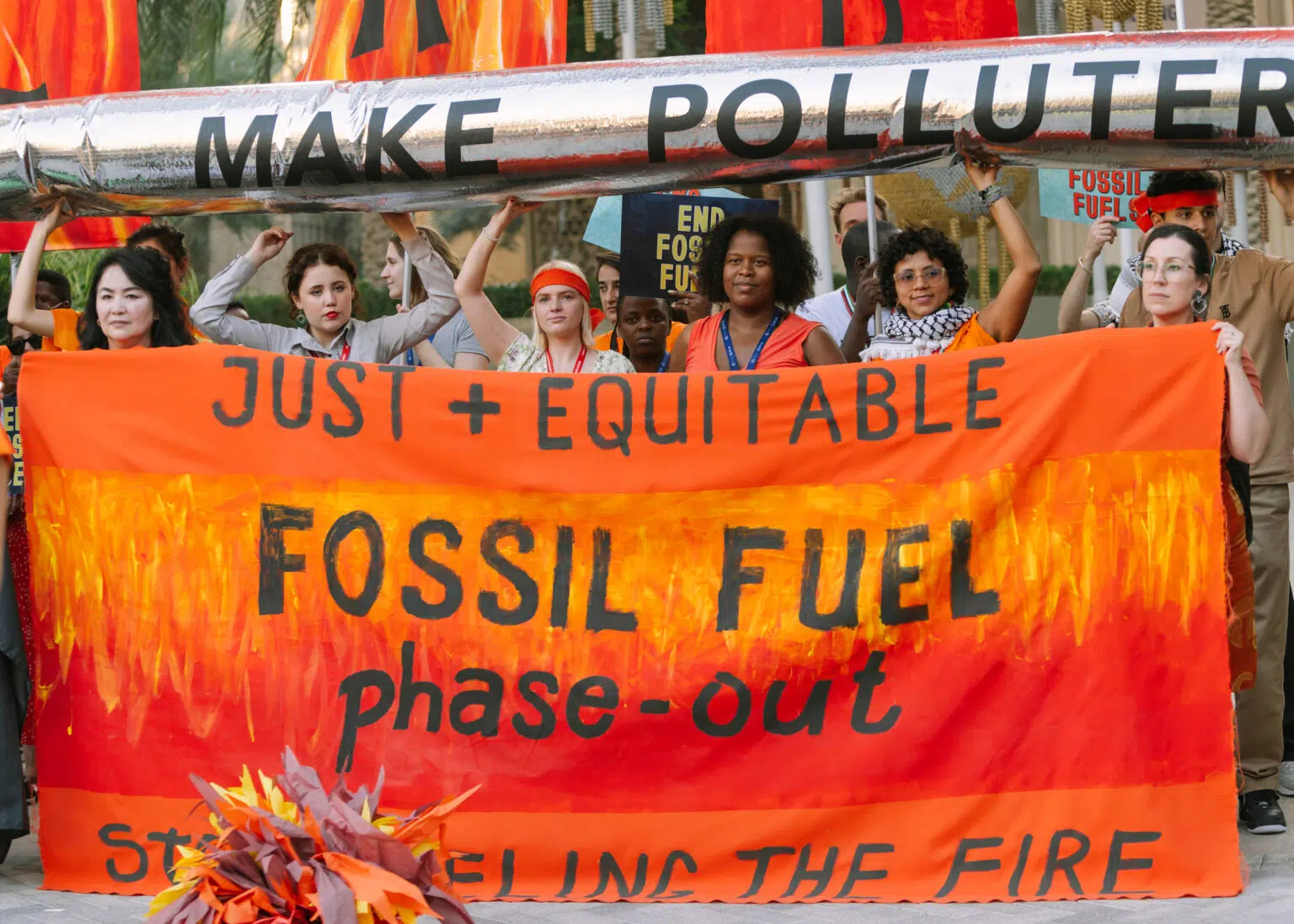
‘There’s Nothing Patriotic about Anti-Green Extremism’

Spread the love

https://bylinetimes.com/2023/08/17/theres-nothing-patriotic-about-anti-green-extremism/

[A}nti-net zero think tanks, such as the Global Warming Policy Foundation and Institute for Economic Affairs, both housed at the infamous 55 Tufton Street, are known to be highly influential in shaping government policy – yet their funding sources remain largely opaque.

Until last year that is, when an investigation by openDemocracy revealed the GWPF to have accepted money from US-based groups with interests in fossil fuels. As Bob Ward of the Grantham Institute told the Guardian following the revelations, “it is disturbing that the Global Warming Policy Foundation is acting as a channel through which American ideological groups are trying to interfere in British democracy”.

It is particularly disturbing when that influence leads to us being left behind in the transition to the post-fossil age.

As the world moves on to cheaper and better technologies, we must not allow fossil fuel-backed interests to dictate our energy and economic decisions – to do so would be to act like a newspaper board that decided not to invest in desktop computers because it was in thrall to the typewriter lobby.  

I haven’t even mentioned climate change, because I haven’t needed to. In a world of rapidly evolving technology, it makes sound economic sense to move beyond the fossil fuel era and onto better, cleaner ways of powering our activity. We must not listen to the anti-green extremists trying to hold us back.

https://bylinetimes.com/2023/08/17/theres-nothing-patriotic-about-anti-green-extremism/

Continue Reading‘There’s Nothing Patriotic about Anti-Green Extremism’

What is a heat dome? An atmospheric scientist explains the weather phenomenon baking Texas and forecast to expand

Spread the love
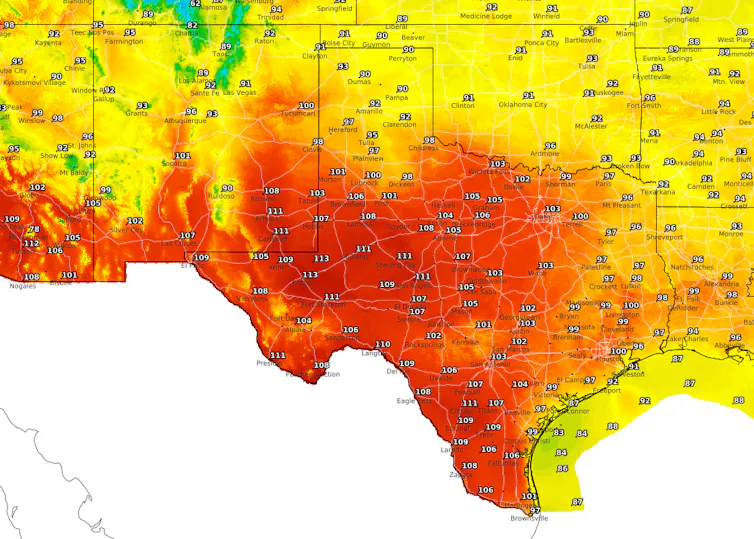
A heat dome began sizzling Texas and its neighbors in mid-June 2023, with warm nights providing little relief. National Weather Service

William Gallus, Iowa State University

A heat dome occurs when a persistent region of high pressure traps heat over an area. The heat dome can stretch over several states and linger for days to weeks, leaving the people, crops and animals below to suffer through stagnant, hot air that can feel like an oven.

Typically, heat domes are tied to the behavior of the jet stream, a band of fast winds high in the atmosphere that generally runs west to east.

Normally, the jet stream has a wavelike pattern, meandering north and then south and then north again. When these meanders in the jet stream become bigger, they move slower and can become stationary. That’s when heat domes can occur.

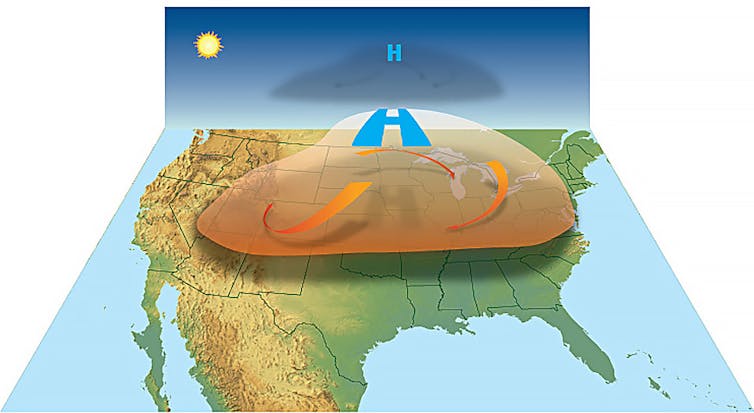
Map of U.S. with a bubble over the Midwest showing arrows moving, with the ridge air sinking
Heat domes involve high-pressure areas that trap and heat up the air below. NOAA

When the jet stream swings far to the north, air piles up and sinks. The air warms as it sinks, and the sinking air also keeps skies clear since it lowers humidity. That allows the sun to create hotter and hotter conditions near the ground.

If the air near the ground passes over mountains and descends, it can warm even more. This downslope warming played a large role in the extremely hot temperatures in the Pacific Northwest during a heat dome event in 2021, when Washington set a state record with 120 degrees Fahrenheit (49 Celsius), and temperatures reached 121 F in British Columbia in Canada, surpassing the previous Canadian record by 8 degrees F (4 C).

The human impact

Heat domes normally persist for several days in any one location, but they can last longer. They can also move, influencing neighboring areas over a week or two. The heat dome involved in the June 2023 heat wave in Texas and Mexico was forecast to expand deeper into the Southwest and South Central U.S.

On rare occasions, the heat dome can be more persistent. That happened in the southern Plains in 1980, when as many as 10,000 people died during weeks of high summer heat. It also happened over much of the United States during the Dust Bowl years of the 1930s.

A heat dome can have serious impacts on people, because the stagnant weather pattern that allows it to exist usually results in weak winds and an increase in humidity. Both factors make the heat feel worse – and become more dangerous – because the human body is not cooled as much by sweating.

The heat index, a combination of heat and humidity, is often used to convey this danger by indicating what the temperature will feel like to most people. The high humidity also reduces the amount of cooling at night. Warm nights can leave people without air conditioners unable to cool off, which increases the risk of heat illnesses and deaths. With global warming, temperatures are already higher, too.

One of the worst recent examples of the impacts from a heat dome with high temperatures and humidity in the U.S. occurred in the summer of 1995, when an estimated 739 people died in the Chicago area over five days.

This article was updated June 26, 2023, with the heat dome in Texas.

William Gallus, Professor of Atmospheric Science, Iowa State University

This article is republished from The Conversation under a Creative Commons license. Read the original article.

Continue ReadingWhat is a heat dome? An atmospheric scientist explains the weather phenomenon baking Texas and forecast to expand

‘Absolute Madness’: Record-Shattering Heat Dome Hits Europe

Spread the love

BRETT WILKINS Brett Wilkins is a staff writer for Common Dreams.

Original article republished from Common Dreams under Creative Commons (CC BY-NC-ND 3.0).

It’s “the most extreme event ever seen in European climatology,” said one climatologist. “Nothing stands close to this.”

As Europe closed the books on its warmest year ever recorded, an exceptionally potent winter heat dome descended on much of the continent over the holiday weekend, with thousands of daily and monthly high-temperature records shattered from Spain to Russia.

“The intensity and extent of warmth in Europe right now is hard to comprehend,” meteorologist Scott Duncan toldThe Times of London. “There are too many records to count. Literally thousands. Overnight minimum temperatures are like summer.”

The Times reported:

Bilbao in northern Spain reached 24.9°C, the hottest temperature recorded for the city in January and more akin to a summer’s day than the start of the year. Records were broken throughout Germany, including Dresden in the east where it was 13.5°C. Temperatures in Switzerland were at 20°C. The Czech Republic recorded a January national record of 19.6°C at the town of Javornik.

The Washington Postnoted that at least seven countries—Belarus, the Czech Republic, Denmark, Latvia, Lithuania, the Netherlands, and Poland—recorded their warmest January temperatures ever.

Poland’s Institute of Meteorology and Water Management (IMGW) said Sunday that “the average daily temperature for Słubice was 15.3°C for the last day, and 15°C in Warsaw and Wrocław.”

“This means that we have a one-day thermal summer in the middle of winter,” IMGW added. “The thermal anomaly is over 15°C. This is an unprecedented situation in our climate.”

Climatologist Maximiliano Herrera, who specializes in extreme weather, called the temperatures “totally insane” and “absolute madness.”

It’s “the most extreme event ever seen in European climatology,” Herrera told the Post. “Nothing stands close to this.”

As the Post noted:

This exceptional wintertime warmth comes on the heels of the warmest 2022 in many parts of Europe, including in the U.K., Germany, and Switzerland. Extreme heat visited Europe in waves throughout the year and was intensified by a historically severe summer drought. The combination helped push the United Kingdom to 104°F (40°C) for the first time on record in July.

Climatologists said that while weather conditions caused the heat dome currently over Europe, there is a proven link between the continued burning of fossil fuels and rising global temperatures.

“The record-breaking across Europe over the new year was made more likely to happen by human-caused climate change,” Imperial College of London climate scientist Friederike Otto told The Times, “just as climate change is now making every heatwave more likely and hotter.”

Original article republished from Common Dreams under Creative Commons (CC BY-NC-ND 3.0).

Continue Reading‘Absolute Madness’: Record-Shattering Heat Dome Hits Europe

Met Office: 2022 UK’s warmest year ever, 2023 to be hotter

Spread the love

2022 will be warmest year ever for UK, Met Office says

https://www.bbc.com/news/uk-64111625

The Met Office has said 2022 will be the warmest year on record for the UK.

According to provisional figures, every month was hotter than average, with the exception of December when the UK experienced a notable cold snap.

The year’s average temperature will likely beat the previous all-time high of 9.88C, set in 2014.

Dr Mark McCarthy, a senior climate scientist at the Met Office, said the provisional figures are in line with the “genuine impacts we expect as a result of human-induced climate change”.

“Although it doesn’t mean every year will be the warmest on record, climate change continues to increase the chances of increasingly warm years over the coming decades,” Dr McCarthy added.

Met Office forecasts 2023 will be hotter than 2022

https://www.bbc.com/news/science-environment-64032458

Next year will be warmer than this one, and one of the hottest on record, the UK Met Office is forecasting.

Predictions suggest it will be the 10th year in a row the global temperature is at least 1C above average.

The Met Office explained that a cooling effect known as La Niña will likely end after being in place for three years – part of a natural weather cycle.

It also noted the warming impact of human-induced climate change.

Scientific evidence shows that climate change is driving up the global temperature.

Continue ReadingMet Office: 2022 UK’s warmest year ever, 2023 to be hotter

Children born today will see literally thousands of animals disappear in their lifetime, as global food webs collapse

Spread the love

Frida Lannerstrom/Unsplash, CC BY

Corey J. A. Bradshaw, Flinders University and Giovanni Strona, University of Helsinki

Climate change is one of the main drivers of species loss globally. We know more plants and animals will die as heatwaves, bushfires, droughts and other natural disasters worsen.

But to date, science has vastly underestimated the true toll climate change and habitat destruction will have on biodiversity. That’s because it has largely neglected to consider the extent of “co-extinctions”: when species go extinct because other species on which they depend die out.

Our new research shows 10% of land animals could disappear from particular geographic areas by 2050, and almost 30% by 2100. This is more than double previous predictions. It means children born today who live to their 70s will witness literally thousands of animals disappear in their lifetime, from lizards and frogs to iconic mammals such as elephants and koalas.

But if we manage to dramatically reduce carbon emissions globally, we could save thousands of species from local extinction this century alone.

Ravages of drought will only worsen in coming decades.
CJA Bradshaw

An extinction crisis unfolding

Every species depends on others in some way. So when a species dies out, the repercussions can ripple through an ecosystem.

For example, consider what happens when a species goes extinct due to a disturbance such as habitat loss. This is known as a “primary” extinction. It can then mean a predator loses its prey, a parasite loses its host or a flowering plant loses its pollinators.

A real-life example of a co-extinction that could occur soon is the potential loss of the critically endangered mountain pygmy possum (Burramys parvus) in Australia. Drought, habitat loss, and other pressures have caused the rapid decline of its primary prey, the bogong moth (Agrotis infusa).

All species are connected in food webs. The spider shown here is an elongated St. Andrews cross spider Argiope protensa from Calperum Reserve, South Australia.
CJA Bradshaw

Research suggests co-extinction was a main driver of past extinctions, including the five previous mass extinction events going back many hundreds of millions of years.

But until now, scientists have not been able to interconnect species at a global scale to estimate how many co-extinctions will occur under projected climate and land-use change. Our research aimed to close that information gap.

The unprecedented bushfires of 2019/2020 on Kangaroo Island killed thousands of individuals in many different wildlife populations.
CJA Bradshaw

The fate of wildlife

Using one of Europe’s fastest supercomputers, we built a massive virtual Earth of interconnected food-web networks. We then applied scenarios of projected climate change and land-use degradation such as deforestation, to predict biodiversity loss across the planet.

Our virtual Earths included more than 15,000 food webs that we used to predict the interconnected fate of species to the end of the 21st Century.

Our models applied three scenarios of projected climate change based on future pathways of global carbon emissions. This includes the high-emissions, business-as-usual scenario that predicts a mean global temperature increase of 2.4℃ by 2050, and 4.4℃ by 2100.

If this scenario becomes reality, ecosystems on land worldwide will lose 10% of current animal diversity by 2050, on average. The figure rises to 27% by 2100.

Adding co-extinctions into the mix causes a 34% higher loss of biodiversity overall than just considering primary extinctions. This is why previous predictions have been too optimistic.

Worse still is the fate of the most vulnerable species in those networks. For species highest in food chains (omnivores and carnivores), the loss of biodiversity due to co-extinctions is a whopping 184% higher than that due to primary extinctions.

Without enough prey, predators like this African lion, will perish.
CJA Bradshaw

We also predict that the greatest relative biodiversity losses will occur in areas with the highest number of species already – a case of the rich losing their riches the fastest.

These are mainly in areas recognised as “biodiversity hotspots” — 36 highly threatened areas of the Earth containing the most unique species, such as Southwest Australia and South Africa’s Cape Floristic region. This is because the erosion of species-rich food webs makes biological communities more susceptible to future shocks.

Tropical forest is the main ecosystem found in many biodiversity hotspots worldwide.

We also detected that these networks of interacting species themselves will change. We used a measure of “connectance”, which refers to the density of network connections. Higher connectance generally means the species in a food web have more links to others, thereby making the entire network more resilient.

Connectance, we learnt, will decline between 18% and 34% by the end of this century in the worst-case climate scenario.

This reduction in connectance was also driven by the loss of some key species occupying the most important positions in their local networks. These could be top predators such as wolves or lions keeping plant eaters in check, or an abundant insect eaten by many different insectivores.

When such highly connected species go extinct, it makes the network even less resilient to disturbance, thereby driving even more loss of species than would otherwise have occurred under a natural ecological regime. This phenomenon illustrates the unprecedented challenges biodiversity faces today.

Adieu, koala?
CJA Bradshaw

Can we minimise the threat?

As the United Nations Biodiversity Conference winds up this week in Montreal, Canada, governments are trying to agree on a new set of global actions to halt and reverse nature loss.

It follows the recent COP27 climate change summit in Egypt, where the resulting agreement was inadequate to deal with the global climate crisis.

We hope our findings will, in future, help governments identify which policies will lead to fewer extinctions.

For example, if we manage to achieve a lower carbon-emissions pathway that limits global warming to less than 3℃ by the end of this century, we could limit biodiversity loss to “only” 13%. This would translate into saving thousands of species from disappearing.

Clearly, humanity has so far underestimated its true impacts on the diversity of life on Earth. Without major changes, we stand to lose much of what sustains our planet.The Conversation

Corey J. A. Bradshaw, Matthew Flinders Professor of Global Ecology and Models Theme Leader for the ARC Centre of Excellence for Australian Biodiversity and Heritage, Flinders University and Giovanni Strona, Doctoral program supervisor, University of Helsinki

This article is republished from The Conversation under a Creative Commons license. Read the original article.

Continue ReadingChildren born today will see literally thousands of animals disappear in their lifetime, as global food webs collapse