10 reasons why US president-elect Donald Trump can’t derail global climate action

Spread the love
Ahn Young-joon/AP

Wesley Morgan, UNSW Sydney and Ben Newell, UNSW Sydney

If you care about saving Earth from catastrophe, you might be feeling a little down about the re-election of Donald Trump as United States president. Undeniably, his return to the White House is a real setback for climate action.

Trump is a climate change denier who has promised to increase fossil fuel production and withdraw the US from the Paris climate deal, among other worrying pledges.

But beyond Trump and his circle, there remains deep concern about climate change, especially among younger people. Support for climate policy remains high in the US and around the world. And studies based on data from 60,000 people in more than 60 countries suggest individuals’ concern about climate change is widely underestimated.

So now is a good time to remember that efforts to tackle the climate crisis – both in Australia and globally – are much bigger than one man. Here are ten reasons to remain hopeful.

Beyond Trump and his circle, there remains deep concern about climate change around the world. HAYOUNG JEON/EPA

1. The global clean energy transition can’t be halted

The global shift to clean energy is accelerating, and Trump can’t stop it. Investment in clean energy has overtaken fossil fuels, and will be nearly double investment in coal, oil and gas in 2024. This is a historic mega-trend and will continue with or without American leadership.

2. Clean energy momentum is likely to continue in the US

Much of the Biden-era spending on clean energy industries went to Republican states and Congressional districts. New factories for batteries and electric vehicles will still go ahead under the Trump administration. After all, entrepreneur Elon Musk – who is expected to join the Trump administration – makes electric vehicles.

Some of Trump’s financial backers are receiving subsidies for clean energy manufacturing and 18 Republican Congress members have gone on record to oppose cuts to clean energy tax credits.

The clean energy shift will continue in the US. Piictured: a solar panel array floats on a water storage pond in New Jersey. Seth Wenig/AP

3. The US still wants to beat China

There is bipartisan concern in Washington about the US losing a technological edge to Beijing. China currently dominates global production of electric vehicles, batteries, wind turbines and solar panels. So internal pressure in the US to counter China’s manufacturing might will continue.

4. The federal government is not everything in the US

When Trump was last in power, he withdrew the US from some climate commitments, such as the Paris Agreement. But many state and local governments powered ahead with climate policy, and that will happen this time around, too. For example, California – the world’s fifth largest economy – plans to eliminate its greenhouse gas footprint by 2045. Even Texas, a Republican heartland, is leading a shift toward wind and solar power.

5. The US climate movement will be more energised than ever

During Trump’s first presidency, the US climate movement developed policy proposals for a “Green New Deal”. Many of these proposals were later implemented by the Biden administration. Initial reactions to Trump’s re-election suggest we can expect similar policy advocacy this time around.

Efforts to tackle the climate crisis are much bigger than one man in the White House. Kevin Wolf/AP

6. Global climate cooperation is bigger than Trump

If Trump makes good on his promise to leave the Paris Agreement (again), he will only be leaving the room where the world’s future is being shaped. The US has walked away from global climate agreements before – for example, refusing to join the Kyoto Protocol in 2001. But other nations rallied for global action, and will do so again.

7. The rules-based global order will remain

When a nation walks away from rules that have been agreed after decades of negotiation, responsible countries must work together to bolster global cooperation. This applies to trade and security – and climate is no different.

As our Foreign Minister Penny Wong recently explained, Australia, as a middle power on the world stage, wants:

a world where disputes are resolved by engagement, negotiation and by reference to rules [and] norms […] We don’t want a world in which disputes are resolved by power alone.

8. Australian diplomacy matters

Australia is seeking to co-host the United Nations climate talks with Pacific island countries in 2026, and is emerging as the favourite. Hosting the conference, known as COP31, would be a chance for Australia to help broker a new era of international climate action, even if the US opts out under Trump.

Hosting the talks would also help cement Australia’s place in the Pacific and assist our Pacific neighbours to deal with the climate threat.

Co-hosting COP31 would help assist our Pacific neighbours to deal with the climate threat. Mick Tsikas/AAP

9. Australia’s clean energy shift is accelerating

About 40% of Australia’s main national electricity grid is powered by renewables and this is set to rise to 80% by 2030. Some states are surging ahead – for example, South Australia is aiming for 100% renewables by 2027.

Australians love clean energy at home, too. One in three households have rooftop solar installed, making us a world-leader in the technology’s uptake. Trump’s occupation of the Oval Office cannot stop this momentum.

10. Trump cannot change the science of climate change

The science is clear – burning coal, oil and gas fuels climate change and increases the risk of disasters that are harming communities right now. In Australia, we need look no further than the Black Summer bushfires in 2019-20 and unprecedented Lismore floods in 2022.

And the damage is happening across the globe. In October, twin hurricanes in the US – made stronger by the warming ocean – left a damage bill of more than US$100 billion. And hundreds of people died when a year’s worth of rain fell in one day in Spain last month.

The devastating floods in Spain remind us that climate change has arrived. ANA ESCOBAR/EPA

On gloomy days – like, say, the election of a climate denier to the White House – it might feel humanity won’t rise to Earth’s biggest existential challenge. But there are many reasons for hope. The vast majority of us support policies to tackle climate change, and in many cases, the momentum is virtually unstoppable.

Wesley Morgan, Research Associate, Institute for Climate Risk and Response, UNSW Sydney and Ben Newell, Professor of Cognitive Psychology and Director of the UNSW Institute for Climate Risk and Response, UNSW Sydney

This article is republished from The Conversation under a Creative Commons license. Read the original article.

Continue Reading10 reasons why US president-elect Donald Trump can’t derail global climate action

Shadow Foreign Secretary Priti Patel Has Ties to Group Behind ‘Extreme’ Trump Agenda

Spread the love

Original article by Sam Bright and Adam Barnett republished from DeSmog.

Conservative MP Priti Patel speaking at the Heritage Foundation in 2021. Credit: GB News / Facebook

The Heritage Foundation’s Project 2025 blueprint proposes sweeping anti-climate policies.

New Shadow Foreign Secretary Priti Patel earlier this year welcomed into Parliament a radical U.S. organisation behind Donald Trump’s hard-right plan for a second term as president. 

As reported by DeSmog, Conservative MP Patel met with Kevin Roberts and Nile Gardiner of the Heritage Foundation in March, praising the pair on her Facebook page as “our friends across the pond” who stand for “Conservative values and beliefs at home and abroad”. 

Roberts is the president of the Heritage Foundation, while Gardiner is the director of its ‘Margaret Thatcher Center for Freedom’. 

The Heritage Foundation is an ultra-conservative group that authored the controversial Project 2025 blueprint for a second Donald Trump term, which proposes a range of radical anti-climate policies, including slashing restrictions on fossil fuel extraction, scrapping investment in renewable energy, and gutting the Environmental Protection Agency. 

Project 2025 has been accused of being “extreme” and “authoritarian” for setting out a plan to rapidly “reform” the U.S. government by shuttering bureaus and offices, overturning regulations, and replacing thousands of public sector employees with hand-picked political allies of Trump. The agenda also proposes radical tax cuts, and a crackdown on reproductive rights. 

On Wednesday (6 November), following Trump’s victory in the U.S. presidential election, Roberts sent an email on behalf of the foundation, saying that: “starting now, we will execute our plans to dismantle the administrative state.” 

At least 140 authors of Project 2025 worked for the last Trump administration, according to CNN, while several are expected to hold positions in the next Trump White House.

Patel also gave a speech about national security to the Heritage Foundation, hosted by Gardiner, in November 2021. Patel was at the time serving as home secretary, and her address was published on the UK government website. 

This news comes as the Conservative Party realigns itself after the election of new leader Kemi Badenoch, positioning itself as having better relations with the incoming Trump administration. 

In her first Prime Minister’s Questions (PMQs) this week, Badenoch called on Labour not to oppose a Trump address to Parliament, and asked whether Foreign Secretary David Lammy had apologised to the Republican for labelling him as a “neo-Nazi sympathising sociopath” in 2020.

Patel was appointed to Badenoch’s new shadow cabinet earlier this week, alongside Shadow Justice Secretary Robert Jenrick, who also has ties to the Heritage Foundation. 

In February, Jenrick – who came second in the recent Tory leadership election – gave a speech to the Heritage Foundation in Washington DC entitled, “Securing Sovereign Borders in an Age of Mass Migration”.

Project 2025 proposes new sweeping restrictions on immigration into the U.S., while setting the foundations for mass deportations – a key promise of Trump’s 2024 campaign. 

After being introduced by Roberts, Jenrick praised the foundation, and described meeting with and learning from Heritage while working as an intern for Condoleeza Rice, who served as secretary of state under Republican President George W. Bush. 

Jenrick also praised the event’s co-host Gardiner, whom Jenrick described as “the special relationship made flesh”. He said Gardiner, who writes a regular column for the Daily Telegraph, “creates links between conservatives here and in the UK”. 

As revealed by Democracy For Sale and Byline Times, Donald Trump and U.S. Republican campaigns received more than $45 million (£35 million) from donors who have funded the influential network of hard-wing Tufton Street think tanks in the UK. 

“That senior Conservatives would take time out to travel halfway around the world to give talks at a pro-Trump think tanks is very revealing,” said Peter Geoghegan, editor of Democracy For Sale. “We need to be aware that the dark money that fuelled the likes of the Heritage Foundation is washing up in Britain, where secretive Tufton Street think tanks refuse to declare their donors but take millions from pro-Trump U.S. conservatives.”

A Heritage Foundation spokesperson previously told DeSmog: “Project 2025 is a coalition of conservatives who wrote ‘Mandate for Leadership: The Conservative Promise’ which was published in April 2023, before any candidate declared a run for office. Project 2025 does not speak for any candidate or campaign.”

Project 2025 and Climate Denial

Project 2025 proposes replacing green investment with the further deregulation of the oil and gas industry. 

Speaking at an event co-hosted by the Heritage Foundation and the Hungarian Danube Institute in September, key Trump ally Robert Wilkie – who served as U.S. veterans’ affairs secretary from 2018 to 2021 – confirmed that his former boss would “kill” climate budgets. 

The Heritage Foundation received over £4.9 million between 1997 and 2017 from groups linked to the fossil fuel giant Koch Industries. The brothers behind the company, Charles and the late David Koch, have been the principal funders of climate denial groups in the U.S. since the 1980s. 

As revealed by DeSmog, advisory groups working on Project 2025 have received at least $9.6 million from Charles Koch since 2020, along with at least $21.5 million from the Sarah Scaife Foundation, which is funded by the Mellon oil and banking fortune.

The Heritage Foundation has disputed these figures, though has not offered its own calculations. A spokesperson previously told DeSmog: “Heritage research is independent and accurate, these numbers are not.”

At a 2022 Heritage Foundation event, Nile Gardiner said: “I do think the British government needs to rethink the whole green energy agenda. It’s not a conservative agenda, in fact it’s a socialist agenda”. He added: “I think net zero has become basically a form of religion, and anyone who questions the dogma on this immediately is accused of being a heretic.”

As DeSmog has reported, Kemi Badenoch has regularly criticised the UK’s green ambitions, describing herself as a “net zero sceptic” during her Conservative conference speech in October. 

During the leadership contest, Badenoch published a 40-page manifesto that cited the Committee to Unleash Prosperity, a U.S. group led by former advisors to Trump, which has likened climate science to believing the earth is flat. 

Jenrick has also attacked net zero policies and has advocated for increased fossil fuel extraction, including the development of new coal mines. 

Original article by Sam Bright and Adam Barnett republished from DeSmog.

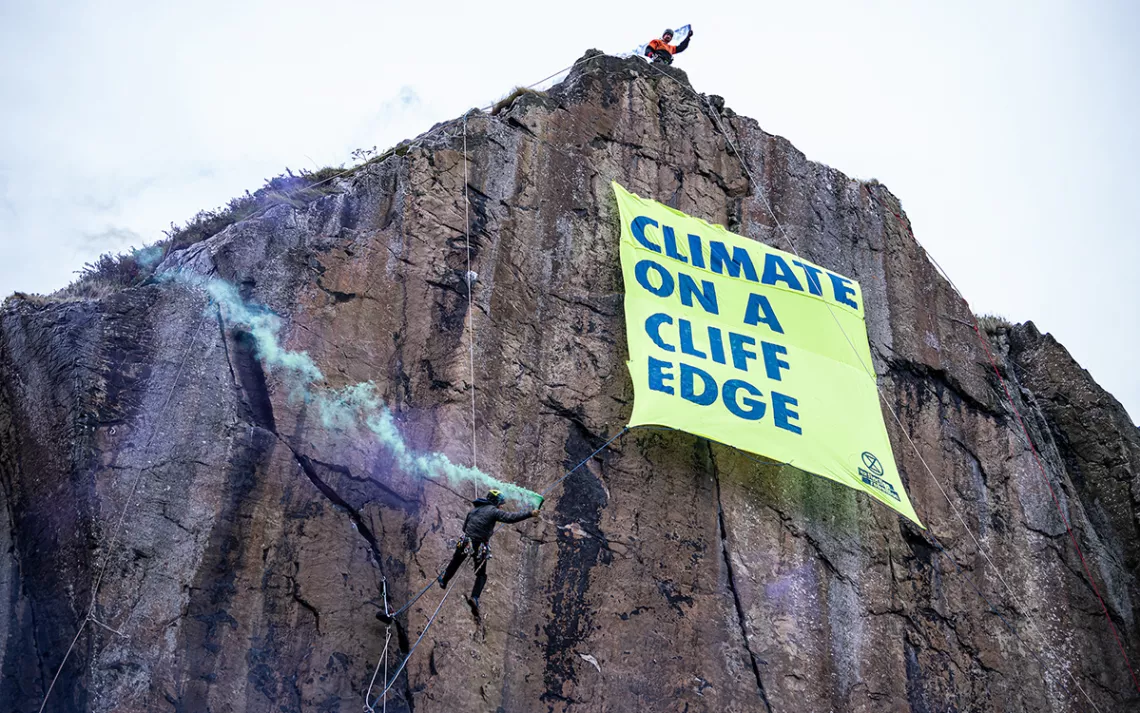
Experienced climbers scale a rock face near the historic Dumbarton castle in Glasgow, releasing a banner that reads “Climate on a Cliff Edge.” One activist, dressed as a globe, symbolically looms near the edge, while another plays the bagpipes on the shores below. | Photo courtesy of Extinction Rebellion and Mark Richards
Orcas comment on killer apes destroying the planet by continuing to burn fossil fuels. Second version, corrected text.
Continue ReadingShadow Foreign Secretary Priti Patel Has Ties to Group Behind ‘Extreme’ Trump Agenda

Water temperatures near UK last year were hottest on record, say scientists

Spread the love

https://www.theguardian.com/environment/article/2024/jul/25/water-temperatures-near-uk-last-year-were-hottest-on-record-say-scientists

Scientists compiling the annual State of the UK Climate report say they have have started to pay more attention to extremes. Photograph: Anadolu Agency/Getty Images

The water near the UK’s coasts was hotter in 2023 than scientists have ever before recorded, a report has found, with children today experiencing a hotter and wetter climate than that in which their parents and grandparents grew up.

The sea surface temperature near coasts was 0.9C hotter and winter rainfall across the country was 24% greater over the last decade than the average from 1961 to 1990, according to the State of the UK Climate 2023 report. It found the number of “hot” (28C) days has more than doubled over that period, and the number of “very hot” (30C) and “extremely hot” (32C) days has more than tripled.

Since the UK hit 40C heat for the first time in 2022 – “absolutely smashing records” – the scientists behind the annual report started to pay more attention to extremes, said Mike Kendon, a climate scientist at the Met Office who was the lead author of the report.

The scientists found the number of “very wet” days was 20% greater in the last decade than in the 1961-1990 period.

The mass burning of coal, oil and gas since the 1850s – together with the boom in livestock farming and heavy industry – has heated the planet by 1.3C and upended weather patterns that used to vary only naturally. The report found human activity had made the UK’s unusually high average temperature last year 150 times more likely.

Still, projections show that “2023 will be a fairly average year by the middle of the century and a fairly cool year by the end of the century,” said Kendon. “It’s a really dramatic indicator that our climate will be pushed out of the envelope of the historical range.”

The UK, which has pumped more planet-heating gas into the atmosphere than all but a handful of countries, according to an analysis from Carbon Brief – is already suffering from increasingly violent weather that scientists have traced back to the breakdown of a stable climate. An analysis in May found that a spell of “never-ending” rain in the UK and Ireland last autumn and winter was made 10 times more likely and 20% wetter by global heating.

https://www.theguardian.com/environment/article/2024/jul/25/water-temperatures-near-uk-last-year-were-hottest-on-record-say-scientists

Continue ReadingWater temperatures near UK last year were hottest on record, say scientists

Labour’s biggest corporate donor Ecotricity accused of ‘greenwashing’

Spread the love

Original article by Martin Williams republished from OpenDemocracy under a Creative Commons Attribution-NonCommercial 4.0 International licence.

Ecotricity’s founder, Dale Vince.  Bloomberg / Contributor

Exclusive: Energy firm making ‘misleading’ claims about ‘neutralising’ gas with carbon credits

The Labour Party’s biggest corporate donor has been accused of “greenwashing” after an investigation by openDemocracy.

Ecotricity Ltd, which has given almost £3.4m to Labour since Keir Starmer became leader in 2020, claims to be “Britain’s greenest energy supplier”.

Yet 99% of the gas it supplies comes from fossil fuels. The company claims this gas is “carbon-neutralised” because it invests in “carbon reduction programmes to cancel out the carbon burned”.

But openDemocracy has learned that Ecotricity has no active carbon credits – despite listing four environmental projects on its website that it says it supports.

When questioned about the company’s claims that “carbon emissions from our fossil fuel gas are offset by investing in carbon reduction schemes”, a spokesperson admitted that some of the schemes it previously supported had not done “as promised” – and said that information on its website would be “refreshed”.

But experts warned that even if the company held active carbon credits, its claims that these “neutralise” its fossil fuel gas would still be misleading.

“It is highly misleading for a company to claim that its product – or itself – is carbon- or climate-neutral,” said Lindsay Otis Nilles from Carbon Market Watch. “These false claims are based on heavily flawed scientific principles and lead to consumer confusion.”

The company has not broken any laws, but it will be illegal to claim that carbon offsets can “neutralise” fossil fuel products in the EU from 2026, as the bloc looks to crack down on greenwashing. An EU directive says these claims create a “false impression to consumers that the consumption of that product does not have an environmental impact”.

Analysis by openDemocracy shows that some of the carbon offset projects that Ecotricity previously pumped money into have been linked to environmental concerns and human rights abuses.

In some cases, records cast doubt on whether the company’s offsetting credits actually helped to reduce emissions at all – since the projects it invested in were already fully funded.

For example, two years ago, Ecotricity purchased credits in the Soubré hydropower plant, the largest hydroelectric dam in Ivory Coast, which was completed in 2017.

The project cost around £452m, 85% of which had already been secured by January 2017, with a loan from EXIM Bank of China. The remaining 15% was covered by the Ivory Coast government.

The Soubré powerplant previously came under fire in a 2019 report that accused it of having an “irresponsible” approach to monitoring its potential environmental impact.

The report, which was published by American environment and human rights organisation International Rivers, also included complaints by workers at the dam of instances of “discrimination and physical abuse” and “threats from the government” when they spoke out.

Meanwhile, the project’s main contractor, Chinese firm Sinohydro – which is responsible for its engineering, procurement and construction – has faced allegations of fraud elsewhere.

The company is currently excluded from projects financed by the European Investment Bank, following an investigation into “misconduct”. And in 2018, another investigation by the African Development Bank found that Sinohydro had “engaged in a fraudulent practice”.

Ecotricity has also held carbon credits in another hydroelectric power plant in Indonesia, called Asahan 1. Reports from as far back as 2012 say the company behind it, PT Bajradaya Sentranusa, had already secured funding from a bank “to take over the entire existing project loans for the construction” when Ecotricity bought the credits.

A spokesperson for Ecotricity said: “The information on the website about carbon reduction projects is being refreshed.”

They added: “We used carbon credits to entirely offset our gas supply for the financial year 2024 which is now closed and our offsetting programme for the financial year 2025 is currently under review which is why we do not currently hold any credits. Any suggestion that we do not or will not offset our gas in the future is false and misleading.”

“Offsetting is an annual accounting period practice and can take place at any point in that [financial year] – that is standard practice. Our offsetting programme for the financial year 2025 is currently under review. Any suggestion that we do not or will not offset our gas is wrong.”

The spokesperson added that Ecotricity is looking at “more direct carbon capture methods”, adding: “Carbon offsetting has been a bridge. We have always been clear about that.”

‘Greenwashing’

Ecotricity not only boasts about its own climate credentials, it also actively warns customers about “greenwashing” by rival energy suppliers.

“A number of energy companies claim green credentials for themselves or for some of their tariffs,” it says, “but are their claims genuine?”

But Ecotricity has itself now been accused of greenwashing. Responding to the company’s claims about carbon offsets, Nilles of Carbon Market Watch told openDemocracy: “It is a fallacy to think that purchasing carbon credits on the voluntary carbon market can magically ‘cancel out’ or ‘offset’ climate harm. Greenwashing practices like this must stop once and for all.”

Ecotricity’s founder, Dale Vince, recently joined Labour’s campaign in Bristol. His involvement in the constituency is controversial because it is seen as one of the few seats the Green Party has a genuine chance of winning in this week’s general election. But Vince tweeted: “Labour has a green manifesto and can make it happen.”

The self-styled “green industrialist” is the outright owner of Ecotricity’s parent company, Green Britain Group Limited. According to the latest accounts filed with Companies House, this firm made £38m profit in the year ending 30 April last year, after bringing in more than £550m turnover.

Responding to openDemocracy, Vince repeated the claim that carbon credits were used to achieve “net neutrality”.

He said: “Ecotricity bought carbon credits from the Asahan and Soubre schemes two years ago – we no longer do so. We’ve been reducing our carbon footprint annually for decades and only recently used carbon credits to achieve net neutrality, for our green gas while we built new gasmills.

“It’s important to reduce as far as possible before using credits, but that world is full of uncertainty, risk and projects that don’t do as promised, which these two schemes appear to be an example of. We welcome the EU move to clamp down on all forms of greenwashing.”

Vince accused openDemocracy of a “smear attack” with a “rather distorted presentation of facts”.

Prior to this response, openDemocracy had repeatedly asked Ecotricity to provide a complete and up-to-date list of its carbon credit portfolio, but it failed to do so.

Last week, Vince told the Financial Times that he was not seeking support for his own energy projects from Labour. “I don’t want support for my projects,” he said, “I’m not interested, life’s too short to be chasing money.”

The latest accounts filed by Green Britain Group Limited show it received £123m in “government grants” in the year ending April 2023. The financial support was designed to pay energy firms to cap prices for consumers.

The previous year, the company received a £9.4m Covid “business interruption” loan to support large companies in the pandemic.

However, Vince told openDemocracy: “Ecotricity hasn’t had any government subsidies.”

Original article by Martin Williams republished from OpenDemocracy under a Creative Commons Attribution-NonCommercial 4.0 International licence.

Continue ReadingLabour’s biggest corporate donor Ecotricity accused of ‘greenwashing’