Tag: climate

  • Nigel Farage’s Reform Party Has Accepted £2.3 Million from Fossil Fuel Interests, Climate Deniers, and Polluters Since 2019 Election

    Spread the love

    Original article by Adam Barnett and Sam Bright republished from DeSmog.

    Reform UK leader Nigel Farage, and deputy leader Richard Tice. Photo: Sipa US / Alamy

    The anti-net zero party has been bankrolled by oil and gas investors, aviation entrepreneurs, and those who reject climate science.

    Reform UK has received more than £2.3 million from oil and gas interests, highly polluting industries, and climate science deniers since December 2019, amounting to 92 percent of the party’s donations. 

    This week, Nigel Farage confirmed he would be returning as leader of Reform and standing in the general election, threatening to split the already fragile Conservative vote. His populist party, which campaigns to “scrap all of net zero”, claims to represent ordinary people against out of touch elites. 

    Yet Reform’s official register of donations reveals the party is bankrolled by rich businessmen who reject climate science or make money from polluting industries.

    In the past 12 months, Reform has received £200,000 from First Corporate Consultants. The firm is owned by Terence Mordaunt, a director and former chair of the Global Warming Policy Foundation (GWPF), the UK’s leading climate science denial group. 

    The GWPF has in the past expressed the view that carbon dioxide has been mis-characterised as pollution, when in fact it is a “benefit to the planet”. Mordaunt himself told openDemocracy in 2019 that “no one has proved yet that CO2 is the culprit” of climate change.

    The UN’s Intergovernmental Panel on Climate Change (IPCC), the world’s top climate science body, has stated that it is “unequivocal that human influence has warmed the atmosphere, ocean and land”. It has also stated that carbon dioxide “is responsible for most of global warming” since the late 19th century, which has increased the “severity and frequency of weather and climate extremes, like heat waves, heavy rains, and drought”.

    Reform has also received more than £500,000 since the last election from Jeremy Hosking, whose investment firm Hosking Partners had more than $134 million (around £108 million) invested in the energy sector at the close of 2021, two thirds of which was in the oil industry, along with millions in coal and gas. 

    Hosking previously told DeSmog: “I do not have millions in fossil fuels; it is the clients of Hosking Partners who are the beneficiaries of these investments.” 

    Since December 2019, Reform has also received £465,000 from Christopher Harborne, owner of AML Global, an aviation fuel supplier with a distribution network that includes “main and regional oil companies”, according to its website. Harborne is also the CEO of Sheriff Global Group, which trades in private jets. 

    Aviation emissions accounted for eight percent of the UK’s annual greenhouse gas emissions before the pandemic, according to the government’s Climate Change Committee. 

    In response to DeSmog’s request for comment, Harborne posted a lengthy statement on the AML Global website. He said: “I am not a climate science denier and … I do not seek to influence any government through donations or lobbying regarding their policies on climate change or in favour of corporate interests.”

    Harborne added that “there is overwhelming scientific evidence that human activity and in particular the use of hydrocarbons as an energy source is accelerating climate warming due to the greenhouse effect.”

    Reform has also received more than £1.1 million in donations from Richard Tice, a property millionaire and the party’s leader until this week. Tice has now become the party’s chairman. 

    In addition (and not included in the overall figures for this analysis), Reform has received more than 50 loans collectively worth around £1.4 million from a company called Tisun Investments, which is owned by Tice, since the start of 2020.

    Tice is one of the UK’s most prominent climate deniers, his presenting role on the right-wing broadcaster GB News to attack net zero policies and the science behind them. Tice has claimed that “there is no climate crisis” and expressed the view that “CO2 isn’t a poison. It’s plant food”.

    DeSmog has also revealed that the governing Conservative Party has received £8.4 million since December 2019 from oil and gas interests, highly polluting industries, and individuals who have expressed or supported climate science denial.

    “No political party should be taking any money from fossil fuel interests whatsoever,” Caroline Lucas, until recently the Green Party MP for Brighton Pavilion, told DeSmog. 

    Reform’s Climate Science Denial

    Reform’s platform on climate change conforms to the views and business interests of its major donors. 

    The party’s manifesto falsely claims that “scientists disagree as to how much” humans have had an impact on global warming. 

    A number of climate consensus studies conducted between 2004 and 2015 found that between 90 percent and 100 percent of experts agree that humans are responsible for climate change. A study published in 2021, which reviewed over 3,000 scientific papers, found that over 99 percent of climate science literature says that global warming is caused by human activity.

    Reform wants to develop new oil and gas fields in the North Sea, open onshore fracking sites across the country, end the windfall tax on oil and gas companies, and “restart opencast coal mines using the latest cleanest techniques”.

    The party has campaigned for a referendum on the UK’s 2050 net zero emissions target, and supports scrapping the policy entirely. 

    Farage himself also has a long history of opposing green reforms and criticising established climate science. 

    Speaking on GB News in August 2021, Farage said that he was “very much an environmentalist” and that he couldn’t “abide things like plastics in our seas, pollution in our rivers.” However, on the issue of climate change, he added: “What annoys me though, is this complete obsession with carbon dioxide almost to the exclusion of everything else, the alarmism that comes with it, based on dodgy predictions and science.”

    Reform’s only MP, Lee Anderson, who defected from the Conservative Party in March, has repeatedly attacked the government’s net zero policies, arguing in February 2024 that a net zero UK “wouldn’t make a blind bit of difference to the Earth’s atmosphere”.

    Anderson is also a vocal backer of new oil, gas, and coal extraction in the UK. In 2022 he supported the government’s decision to approve a new coal mine in Cumbria – the UK’s first new coal mine for 30 years.

    A Reform UK spokesman said: “Climate change is real, Reform UK believes we must adapt, rather than foolishly think you can stop it. We are proud to be the only party to understand that economic growth depends on cheap domestic energy and we are proud that we are the only party that are climate science realists, realising you can not stop the power of the sun, volcanoes or sea level oscillation.

    “The deniers are those who continually gaslight the public into thinking you can stop these powerful natural forces. We must use the energy under our feet, rather than send our money and jobs abroad.”

    Original article by Adam Barnett and Sam Bright republished from DeSmog.

    Nigel Farage urges you to ignore facts and reality and be a climate science denier like him. He says that Reform UK has received millions and millions from the fossil fuel industry to promote climate denial and destroy the planet.
    Nigel Farage urges you to ignore facts and reality and be a climate science denier like him. He says that Reform UK has received millions and millions from the fossil fuel industry to promote climate denial and destroy the planet.
    Donald Trump urges you to be a Climate Science denier like him. He says that he makes millions and millions for destroying the planet, Burn, Baby, Burn and Flood, Baby, Flood.
    Donald Trump urges you to be a Climate Science denier like him. He says that he makes millions and millions for destroying the planet, Burn, Baby, Burn and Flood, Baby, Flood.
    Nigel Farage explains the politics of Reform UK: Racism, Fake anti-establishmentism, Deregulation, Corporatism, Climate Change Denial, Mysogyny and Transphobia.
    Nigel Farage explains the politics of Reform UK: Racism, Fake anti-establishmentism, Deregulation, Corporatism, Climate Change Denial, Mysogyny and Transphobia.
  • Yorkshire enters drought after driest spring in 132 years

    Spread the love

    https://www.theguardian.com/environment/2025/jun/12/yorkshire-enters-drought-after-driest-spring-in-132-years

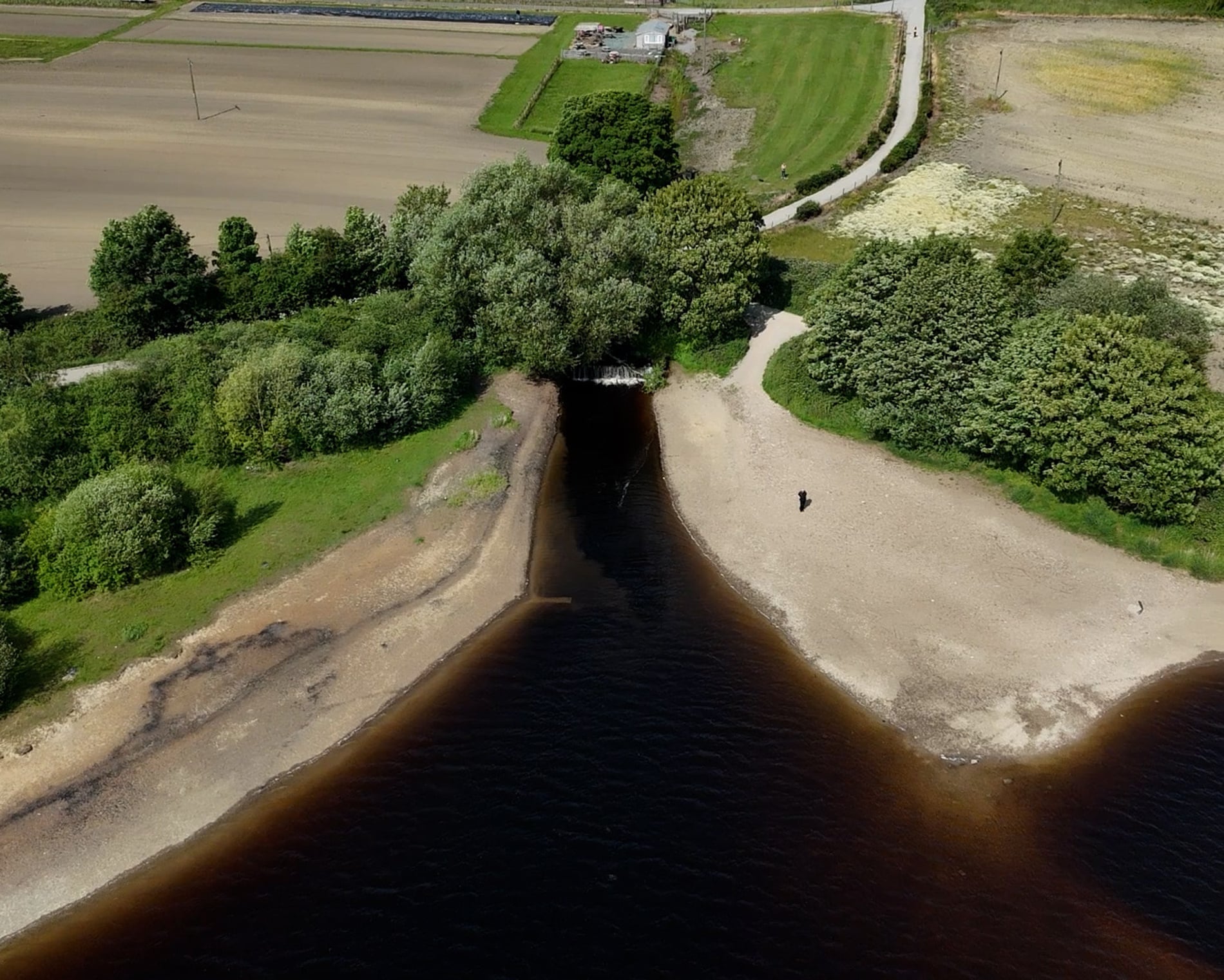
    Ardsley reservoir near Wakefield, West Yorkshire. This year was Yorkshire’s warmest spring for mean temperature since records began in 1884. Photograph: Richard McCarthy/PA

    Hosepipe bans possible as low reservoir levels make region second in England to enter drought status

    Yorkshire has become the second area of England to enter drought after the country recorded its driest spring in 132 years.

    Hosepipe bans could be possible if the region did not have significant rainfall in the coming weeks as, despite recent showers, reservoir stocks were continuing to dwindle. Yorkshire Water reservoir stocks dropped 0.51% over the last week to 62.3%, significantly below the average of 85.5% for this time of year.

    Last month, north-west England entered drought status as reservoir levels fell to half their capacity. Much of the rest of the country is in prolonged dry status, which is the step before drought.

    Warm and dry weather is forecast, and long-range forecasts suggest a greater-than-normal chance of a hot summer.

    Met Office data shows Yorkshire recorded its warmest spring for mean temperature this year since records began in 1884.

    …

    Claire Barrow, the Environment Agency’s planning manager for Yorkshire, said: “Our climate is changing, and we had 22 days of almost no recorded rainfall in May.

    “While we have had some rain at the start of June, it has not been enough to reverse the impacts of the prolonged dry weather.

    …

    https://www.theguardian.com/environment/2025/jun/12/yorkshire-enters-drought-after-driest-spring-in-132-years

  • 53% of Europe and Mediterranean Basin Impacted by Drought in Mid-May: Report

    Spread the love

    https://www.ecowatch.com/drought-europe-mediterranean-2025.html

    …

    From May 11 to 20, 42 percent of soils in Europe and the Mediterranean basin lacked moisture and were at a warning level, while five percent were at an alert level, indicating vegetation was not growing normally.

    Countries in northern, central and eastern Europe were at high alert levels.

    Roughly 19 percent of territory in Ukraine was on alert, with other countries in concerning circumstances, including nine percent of Hungary and Slovakia, 10 percent of Poland and 17 percent of lands in Belarus.

    The alert level for some territories and countries was as high as 20 percent, including the Palestinian territories, Cyprus and Syria.

    Several countries were experiencing drought conditions in mid-May without being at an alert level, including 98 percent of the United Kingdom. According to the UK’s Met Office, the country had its driest spring in over 50 years, as well as its warmest spring ever recorded.

    …

    Continues at https://www.ecowatch.com/drought-europe-mediterranean-2025.html

  • Children born in 2020 will face ‘unprecedented exposure’ to climate extremes

    Spread the love

    Original article republished from Carbon Brief under a CC license. 

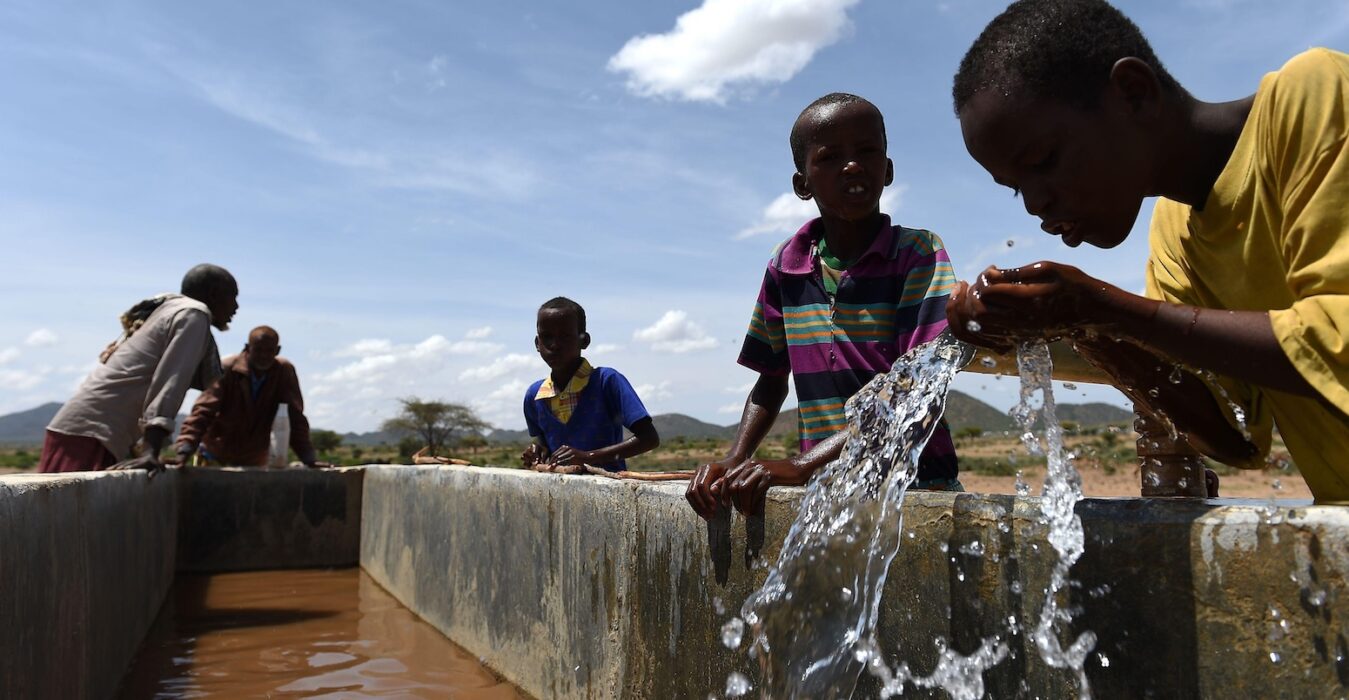
    Children drink water from a pipeline in the village of Afraaga, Somaliland. Credit: Joe Giddens / Alamy Stock Photo

    Children born in 2020 will face “unprecedented exposure” to extreme weather events, including heatwaves, droughts and wildfires, even if warming is limited to 1.5C above pre-industrial temperatures.

    That is according to a new study, published in Nature, which calculates the number of unprecedented extreme events that people born in different decades and countries might live through.

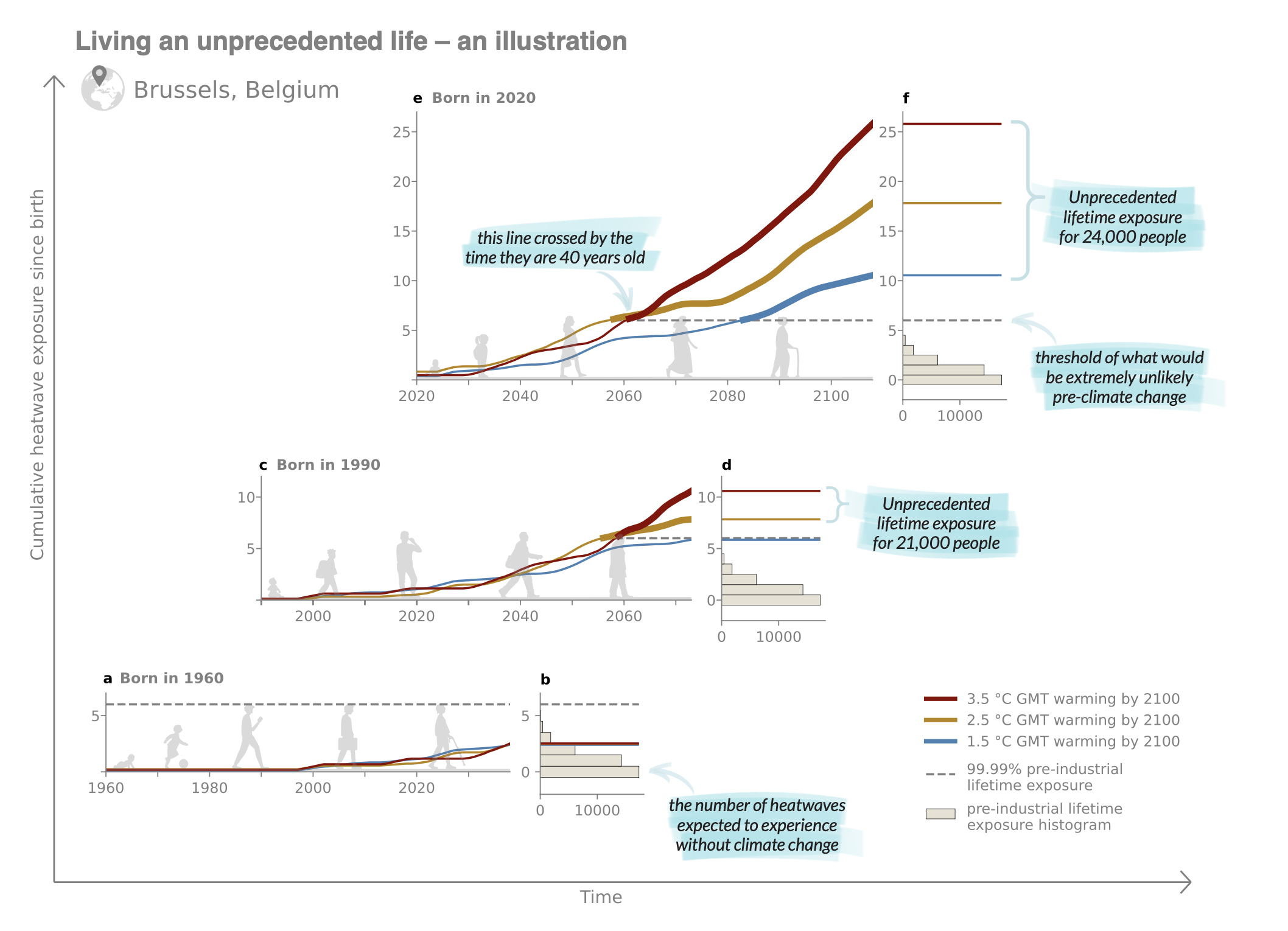
    Using a case study focused on Brussels, the researchers find that people born in 2020 will experience an “unprecedented” 11 heatwaves in their lifetime – even if global warming is limited to 1.5C by the end of the century.

    In contrast, in a pre-industrial climate, a person living in the Belgian capital would likely experience just three such heatwaves, according to the study.

    More than half of children born in 2020 – around 62 million people – will experience “unprecedented lifetime exposure” to heatwaves, even if warming is limited to 1.5C, the study finds. 

    However, this number nearly doubles to 111 million under a scenario where warming hits 3.5C.

    The study also analyses crop failures, river floods, tropical cyclones, wildfires and droughts. 

    The research “helps the climate community build new narratives that better clarify the impacts [of climate change] on younger generations and vulnerable populations”, one expert who was not involved in the study tells Carbon Brief.

    Intergenerational justice

    As the planet warms, extreme weather events such as heatwaves, floods and droughts are becoming more intense, more frequent and lasting longer.

    A popular 2021 study found that children born in the 21st century will be exposed to more extreme weather events in their lifetimes than their parents and grandparents.

    The paper found that in a scenario of 3C of warming above pre-industrial levels, a child who turns six in 2020 will experience twice as many wildfires and tropical cyclones, three times more river floods, four times more crop failures, five times more droughts and 36 times more heatwaves over their lifetime than a six-year-old living in a pre-industrial climate.

    The authors also found a “particularly strong increase” in children’s future exposure to extremes in the Middle East and North Africa.

    The lead author of the study – Prof Wim Thiery from Vrije Universiteit Brussel – told Carbon Brief at the time that today’s youth will live “an unprecedented life”, in which they will “face conditions which older generations have never experienced”.

    Four years later, Dr Luke Grant – a researcher in Thiery’s team – has led a new study building on the ideas of the 2021 paper.

    Grant tells Carbon Brief that rather than counting the number of extreme events that an individual might experience, his new study counts the number of people that reach an “unprecedented state” of exposure to extremes.

    Prof Kaveh Madani is the director of the UN University Institute for Water, Environment and Health and was not involved in the study. He tells Carbon Brief that the paper “helps the climate community build new narratives that better clarify the impacts [of climate change] on younger generations and vulnerable populations”.

    The authors define “exposure” as the number of extreme events that a person experiences in their lifetime, relative to the number they would have experienced in a pre-industrial climate.

    “Unprecedented lifetime exposure” is defined as exposure so high that it has only a one-in-10,000 chance of happening in a world without any greenhouse gas emissions.

    ‘Unprecedented lifetime exposure’

    The authors present a case study of extreme heat in Brussels, Belgium, to explain their method.

    They define a heatwave as a three-day extreme heat event, which reaches average temperatures that would be expected once per century in a pre-industrial climate.

    Using models from the Inter-Sectoral Impact Model Intercomparison Project (ISIMIP), the authors calculate heatwave frequency in a world without climate change. They also assess scenarios in which warming is limited to 1.5C, 2.5C and 3.5C by the end of the century.

    They combine this data with demographic information, including how many people are born in the country each year and their average life expectancy, using data from sources including the ISIMIP database and UN population estimates and projections.

    In a world without climate change, the study finds that a person born in 1960 in Brussels would have a one-in-10,000 chance of experiencing six of the pre-defined heatwaves in their lifetime. Any member of this “birth cohort” who experiences more than six heatwaves in their lifetime has therefore faced “unprecedented lifetime exposure” to extreme heat, according to the study.

    The authors find that a person born in Brussels in 1960 is likely to experience three heatwaves on average during their lives under all of the three future warming pathways– meaning that they are unlikely to face “unprecedented lifetime exposure” to heat.

    By contrast, the researchers find that many younger age cohorts will experience unprecedented heatwave exposure. For many younger age cohorts, lifetime exposure to heatwaves is greater for higher warming pathways. 

    For example, people born in Brussels in 2020 will experience 11 heatwaves in their lifetime if global warming is limited to 1.5C by the end of the century. If warming rises to 2.5C or 3.5C, they could experience 18 or 26 heatwaves, respectively. 

    The graphic below shows heat exposure since birth in Brussels for three “birth cohorts” of 1960 (bottom row), 1990 (middle row) and 2020 (top row). It presents three future scenarios, in which warming is limited to 1.5C (blue), 2.5C (yellow) and 3.5C (red) by 2100. The dotted line shows the threshold for an “unprecedented” lifetime exposure to extreme heat. 

    Lifetime exposure to unprecedented heat for people born in Brussels
    Lifetime exposure to unprecedented heat for people born in Brussels in 1960 (bottom row), 1990 (middle row) and 2020 (top row), under scenarios that limit warming to 1.5C (blue), 2.5C (yellow) and 3.5C (red) by the year 2100. The dotted line shows the threshold for an “unprecedented” lifetime exposure to extreme heat. Source: Grant et al (2025).

    Heat exposure

    The authors repeat their analysis across the Earth’s entire land surface, by dividing it into grid cells and using location-specific temperature and demographic data. 

    Of the 81 million people born in 1960, they find that 13 million are likely to face unprecedented exposure to heatwaves in their lifetimes. They add that for this age cohort, lifetime exposure to unprecedented extremes does not vary depending on the warming scenario.

    However, 21st century warming has a significant effect on exposure for younger generations. Under a 1.5C warming pathway, 52% of people born in 2020 will face unprecedented exposure to heatwaves. This rises to 92% under a 3.5C warming scenario.

    The study adds:

    “This implies that 111 million children born in 2020 will live an unprecedented life in terms of heatwave exposure in a world that warms to 3.5C versus 62 million in a 1.5C pathway.”

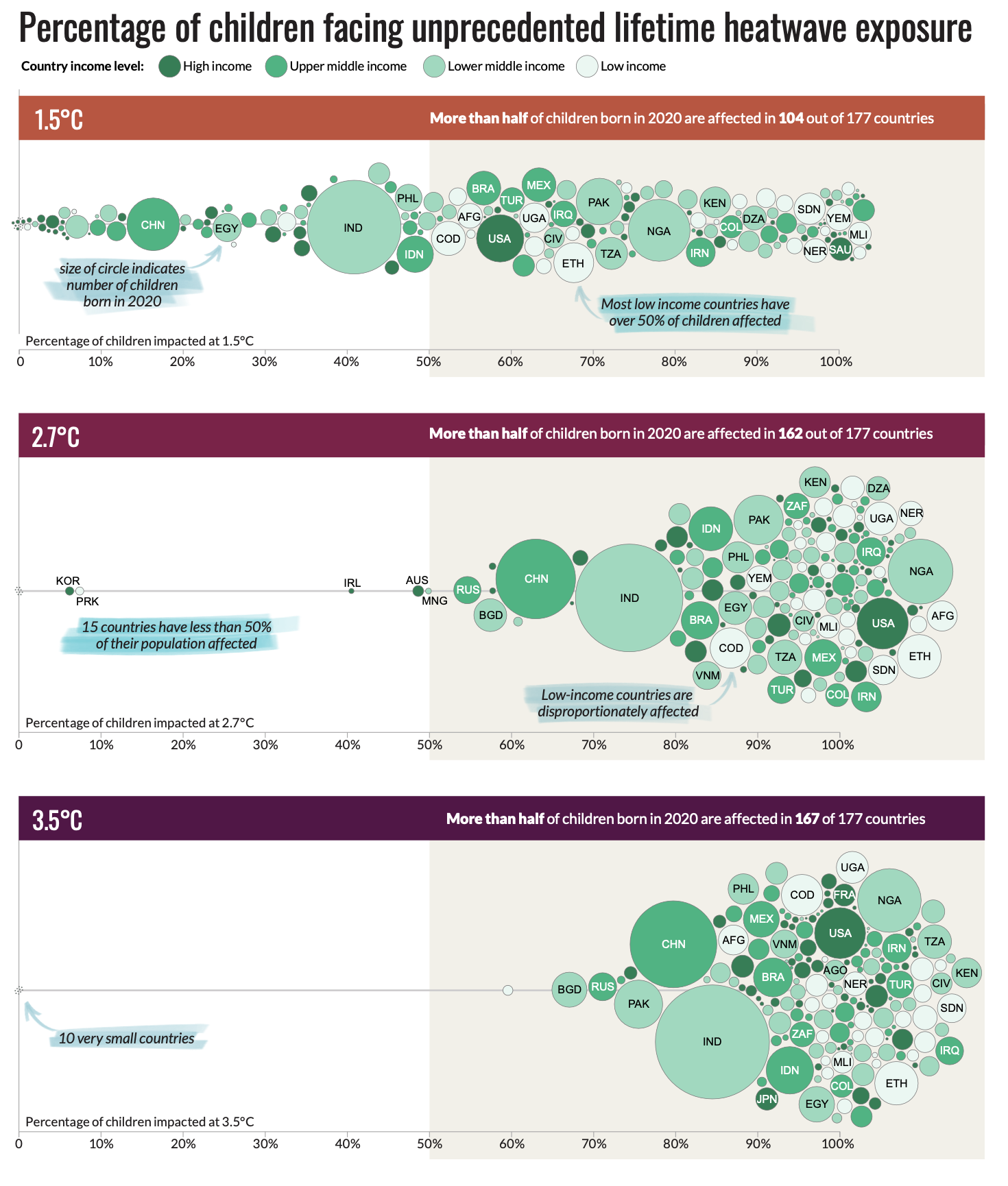
    The charity Save the Children has published a report which unpacks the findings of the study. The graphic below, from the report, shows the percentage of people from different countries born in 2020 who will face unprecedented lifetime exposure to heatwaves under the 1.5C (top), 2.5C (middle) and 3.5C (bottom) warming scenarios.

    Each circle shows a country, indicated by its three-letter countries code. The size of the circle indicates the number of people in the country. Darker circles indicate higher-income countries. 

    Circles on the right hand side of the graphic indicate that more than half of the country’s 2020 cohort will be exposed to unprecedented heatwaves in their lifetime. 

    The percentage of people born in 2020 who will face unprecedented lifetime exposure to heatwaves
    The percentage of people born in 2020 who will face unprecedented lifetime exposure to heatwaves under the 1.5C (top), 2.5C (middle) and 3.5C (bottom) warming scenarios. Each circle indicates a country, indicated by its three-letter countries code. The size of the circle indicates the number of people in the country. Darker circles indicate higher-income countries. Source: Save the Children

    “The evidence is now inescapable that heatwaves impact every community around the world,” Dr Luke Harrington, a senior lecturer in environmental science at the University of Waikato, who was not involved in the study, tells Carbon Brief. He adds: 

    “This paper offers the clearest view that climate change is verifiably unfair: those who have done the least to contribute to rising global temperatures will experience the most extreme impacts.”

    From floods to fires

    The authors apply the same method to five other climate extremes – crop failure, wildfires, droughts, floods and tropical cyclones.

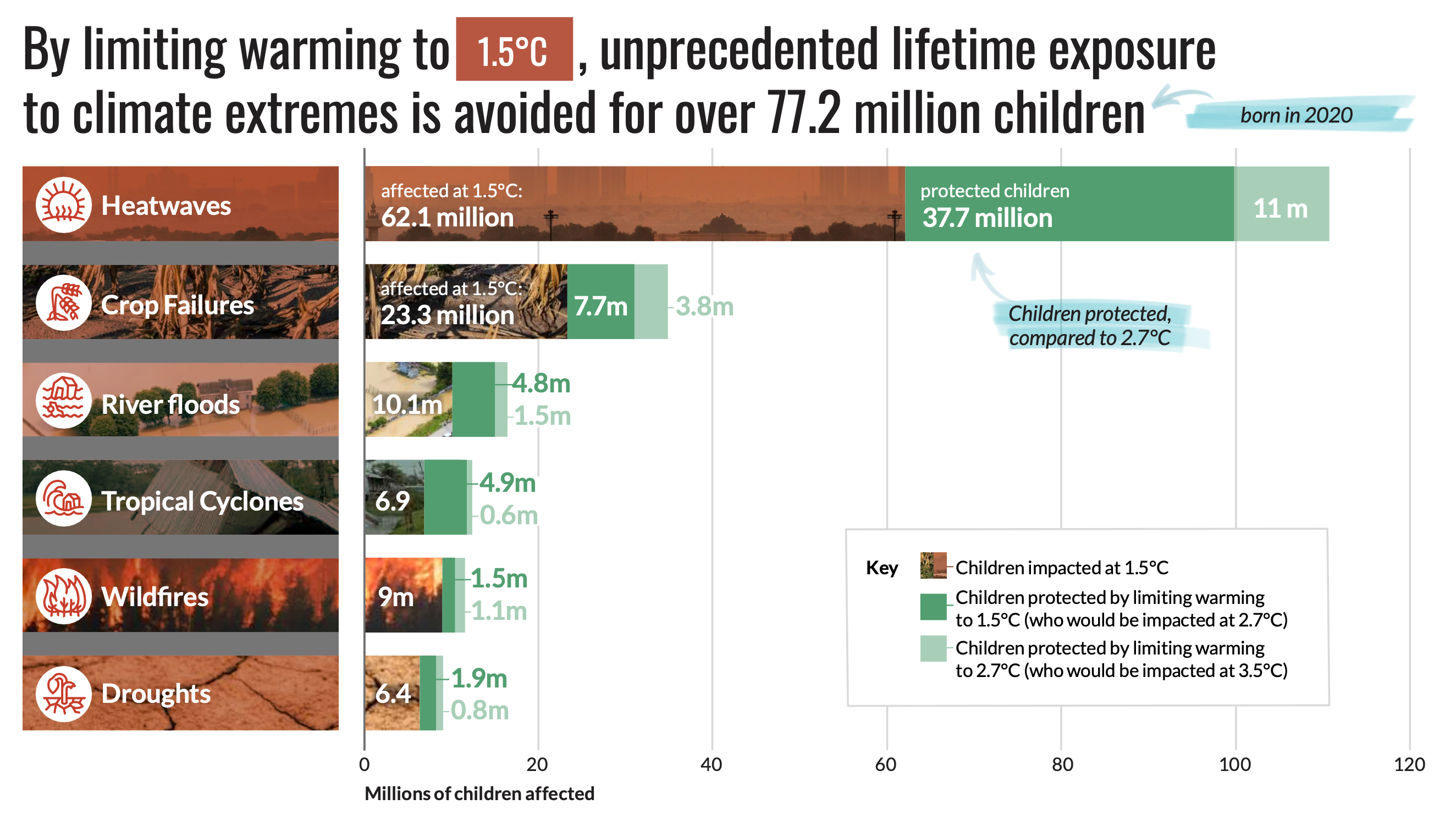
    The graphic below shows the key findings. The coloured portion of the bar shows the number of people born in 2020 who will face unprecedented exposure to each extreme under a 1.5C warming pathway. The dark green and light green bars show the additional exposure under 2.7C and 3.5C warming.

    Number of people born in 2020 who will face “unprecedented lifetime exposure” to heatwaves, crop failures, river floods, tropical cyclones, wildfires and droughts
    Number of people born in 2020 who will face “unprecedented lifetime exposure” to heatwaves, crop failures, river floods, tropical cyclones, wildfires and droughts under 1.5C 2.7C and 3.5C warming. Source: Save the Children

    The authors find that unprecedented lifetime exposure to heatwaves will affect the most people, with 62 million people born in 2020 likely to face unprecedented exposure to heat in their lifetimes if warming is limited to 1.5C.

    This is followed by crop failures and river floods, which will impact 23 million and 10 million people from the 2020 birth cohort under the 1.5C warming pathway, respectively.

    Lead author Grant tells Carbon Brief that he is “most confident” about his heatwave findings because temperature is a “basic” metric for climate models to “get right”.

    Meanwhile, extremes such as crop failure depend on a range of factors including soil moisture, land-atmosphere interactions and rainfall, which can make it harder for the models to accurately capture changes, Grant explains.

    Vulnerability

    The authors also assess how “socioeconomic vulnerability” affects their findings using a global deprivation index – a tool which measures the level of disadvantage and hardship experienced by individuals or communities in a particular geographic area.

    The authors use the index to identify the 20% most and least vulnerable people in each age cohort. They find that the most vulnerable groups are overwhelmingly from African countries.

    The authors also conclude that “socioeconomically vulnerable people have a consistently higher chance of facing unprecedented lifetime heatwave exposure compared to the least vulnerable members of their generation”.

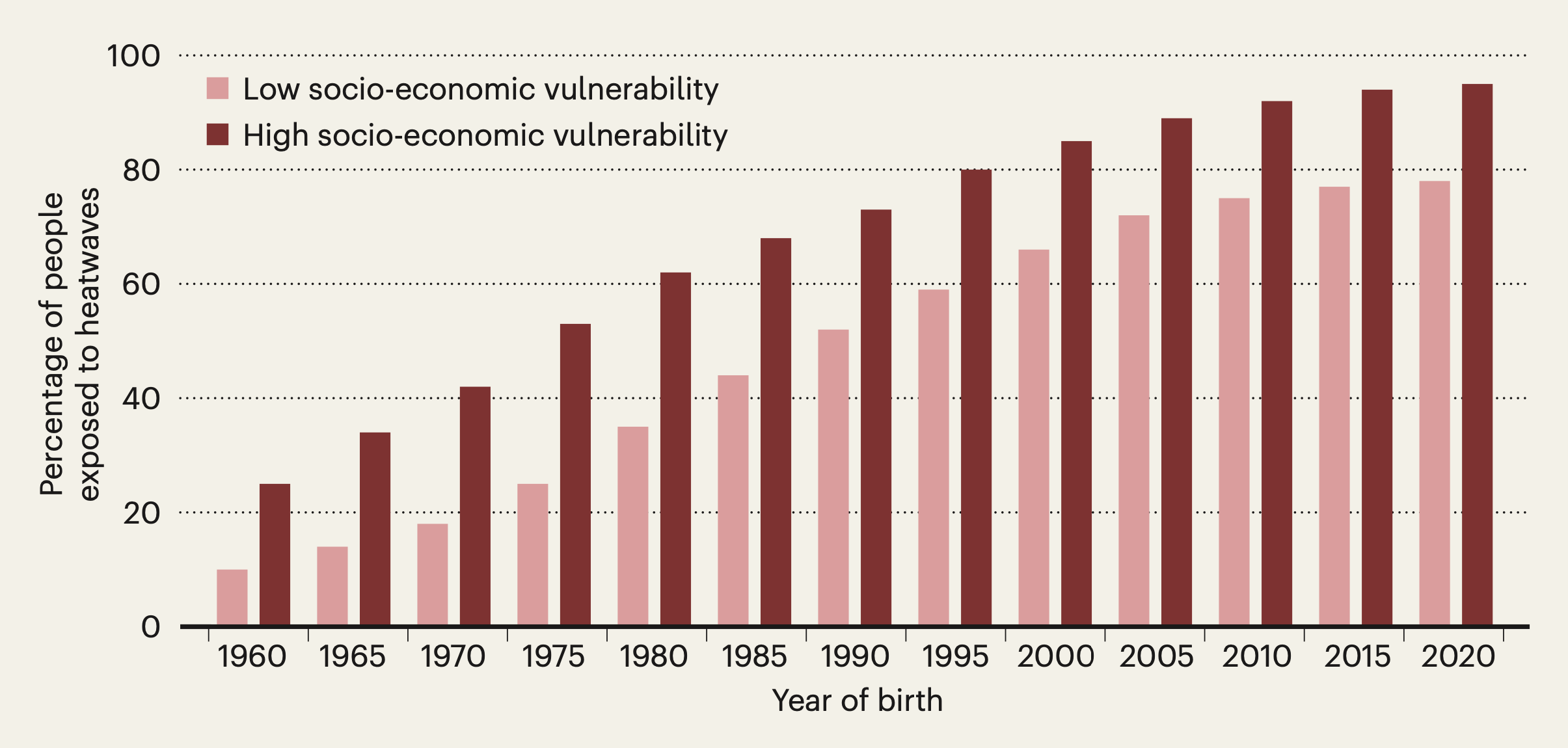
    The graph below, taken from a news and views article about the study, shows the percentage of high vulnerability (red) and low vulnerability (pink) people in each age cohort who would be exposed to unprecedented heat, under a 2.7C warming scenario. 

    The percentage of high vulnerability (red) and low vulnerability (pink) people in each age cohort who would be exposed to unprecedented heat,
    The percentage of high vulnerability (red) and low vulnerability (pink) people in each age cohort who would be exposed to unprecedented heat, under a 2.7C warming scenario. Source: Gualdi and Muttarak (2025).

    Dr Marina Romanello, a research fellow at the University College London and research director of the Lancet Countdown on Health and Climate Change who was not involved in the study, tells Carbon Brief that the paper “is an important addition to the scientific literature, showing how our delays in tackling climate change are putting the future of our children at risk”. 

    She adds:

    “The authors have used well-established models to project future health threats, framing them around what matters the most: the wellbeing, health and survival of present and future generations.”

    Grant, L. et al. (2025) Global emergence of unprecedented lifetime exposure to climate extremes, Nature, doi:10.1038/s41586-025-08907-1

    Original article republished from Carbon Brief under a CC license. 

  • ‘We Need Urgent Global Action’: Study Warns Humanity on Path to Trigger 16 Climate Tipping Points

    Spread the love

    Original article by Jessica Corbett republished from Common Dreams under Creative Commons (CC BY-NC-ND 3.0).

    A church spire of the submerged village of Graun protrudes from the nearly completely drained Reschensee Lake during construction work on May 23, 2024, near Resia, Italy. Climate change is thawing the permafrost that stabilizes alpine rocks, endangering numerous mountain passes across the European Alps. (Photo: Manuel Romano/NurPhoto via Getty Images)

    “It is clear that we are currently on a dangerous trajectory,” said one University of Exeter professor.

    Scientists on Wednesday released yet another study warning that humankind is at risk of triggering various climate “tipping points” absent urgent action to dramatically reduce planet-heating emissions from fossil fuels.

    The new peer-reviewed paper, published Wednesday in the journal Earth System Dynamics, comes from a trio of experts at the United Kingdom’s University of Exeter and the University of Hamburg in Germany.

    Climate scholars use the term “tipping point” to describe a critical threshold which, when crossed, “leads to significant and long-term changes of the system,” the paper notes. Debate over it “has intensified over the past two decades,” prompting several studies of specific risks.

    “Climate tipping points could have devastating consequences for humanity,” said co-author Tim Lenton in a statement. “It is clear that we are currently on a dangerous trajectory—with tipping points likely to be triggered unless we change course rapidly.”

    “We need urgent global action—including the triggering of ‘positive tipping points’ in our societies and economies—to reach a safe and sustainable future,” added the Exeter professor and Global Systems Institute director.

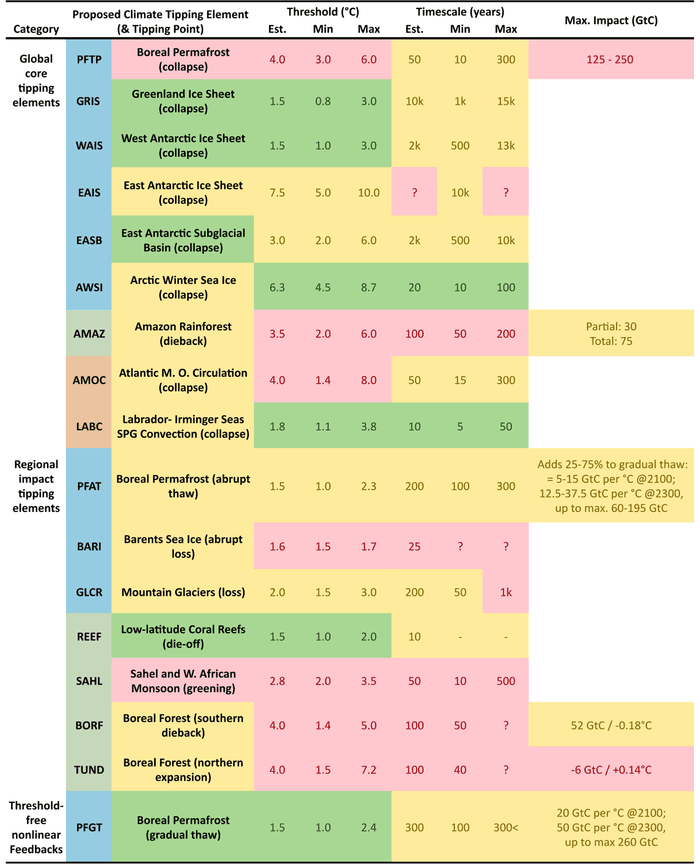
    Lenton’s team calculated the probabilities of triggering 16 tipping points. They looked at the risks of serious damage to key glaciers, ice sheets, sea ice, and permafrost; the dieback of forests such as the Amazon; the die-off of low-latitute coral reefs; and the collapse of the Atlantic Meridional Overturning Circulation (AMOC), which is part of a crucial “global conveyor belt” of ocean currents.

    To assess the risk of current policies triggering climate tipping points, the researchers focused on a scenario in which median warming of 2.8°C takes place by the end of the century.

    On that pathway, the study says, “our most conservative estimate of triggering probabilities averaged over all tipping points is 62%… and nine tipping points have a more than 50% probability of getting triggered.”

    Under scenarios with lower temperature rise, “the risk of triggering climate tipping points is reduced significantly,” the study continues. “However, it also remains less constrained since the behaviour of climate tipping points in the case of a temperature overshoot is still highly uncertain.”

    The paper concludes that “rapid action is needed to reduce greenhouse gas emissions, since climate tipping points are already close, and it will be decided within the coming decades if they will be crossed or not.”

    Lead author Jakob Deutloff shared that takeaway a bit more optimistically, saying that “the good news from our study is that the power to prevent climate tipping points is still in our hands.”

    “By moving towards a more sustainable future with lower emissions, the risk of triggering these tipping points is significantly reduced,” he added. “And it appears that breaching tipping points within the Amazon and the permafrost region should not necessarily trigger others.”

    ▶️New paper from Jakob Deutloff, Hermann Held and Tim Lenton highlights the need for action to prevent triggering climate tipping points. More on this at The Global Tipping Points conference @exeter.ac.uk Register now! global-tipping-points.org/conference-2…esd.copernicus.org/articles/16/…

    — Global Systems Institute (@gsiexeter.bsky.social) 2025-04-23T08:45:40.637Z

    The paper was published during Covering Climate Now’s joint week of media coverage drawing attention to the 89% of people worldwide who want their governments to do more to address the global crisis; ahead of a Global Systems Institute conference on tipping points this summer; and just over six months away from the next United Nations climate summit, COP30, in Brazil.

    While some governments are trying to prevent the worst-case scenario by taking action to cut emissions, U.S. President Donald Trump has made clear since returning to office in January that he aims to deliver on his pro-fossil fuel campaign pledge to “drill, baby, drill.”

    On the heels of the hottest year in human history, Trump is working to gut key agencies, ditched the Paris climate agreement, and has taken executive action to boost planet-wrecking coal, gas, and oil, including declaring a national energy emergency.

    Original article by Jessica Corbett republished from Common Dreams under Creative Commons (CC BY-NC-ND 3.0).

    Neo-Fascist Climate Science Denier Donald Trump says Burn, Baby, Burn.
    Neo-Fascist Climate Science Denier Donald Trump says Burn, Baby, Burn.
    Elon Musk urges you to be a Fascist like him, says that you can ignore facts and reality then.
    Elon Musk urges you to be a Fascist like him, says that you can ignore facts and reality then.