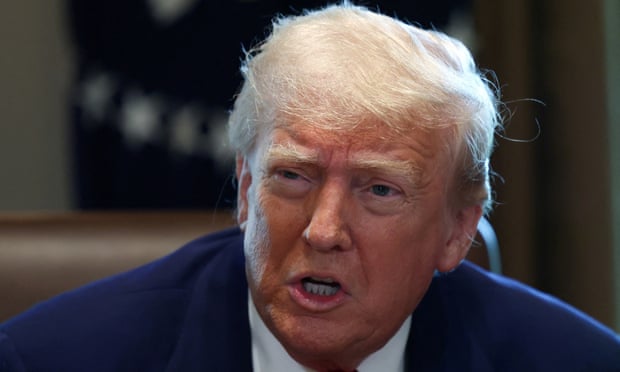
Donald Trump speaks during a cabinet meeting at the White House in Washington DC, on Wednesday. Photograph: Evelyn Hockstein/Reuters
President has repeatedly expressed idea of expansion into autonomous territory within fellow Nato member Denmark
Donald Trump would not rule out using military force to gain control of Greenland, the world’s largest island and an autonomous territory within Denmark, a fellow Nato member with the US.
Since taking office, the US president has repeatedly expressed the idea of US expansion into Greenland, triggering widespread condemnation and unease both on the island itself and in the global diplomatic community. Greenland is seen as strategically important both for defense and as a future source of mineral wealth.
In an interview on NBC’s Meet The Press on Sunday, Trump was asked whether he would rule out using force against the territory.
“I don’t rule it out. I don’t say I’m going to do it, but I don’t rule out anything. No, not there. We need Greenland very badly. Greenland is a very small amount of people, which we’ll take care of, and we’ll cherish them, and all of that. But we need that for international security,” Trump said.
Neo-Fascist Climate Science Denier Donald Trump says Burn, Baby, Burn.Elon Musk urges you to be a Fascist like him, says that you can ignore facts and reality then.
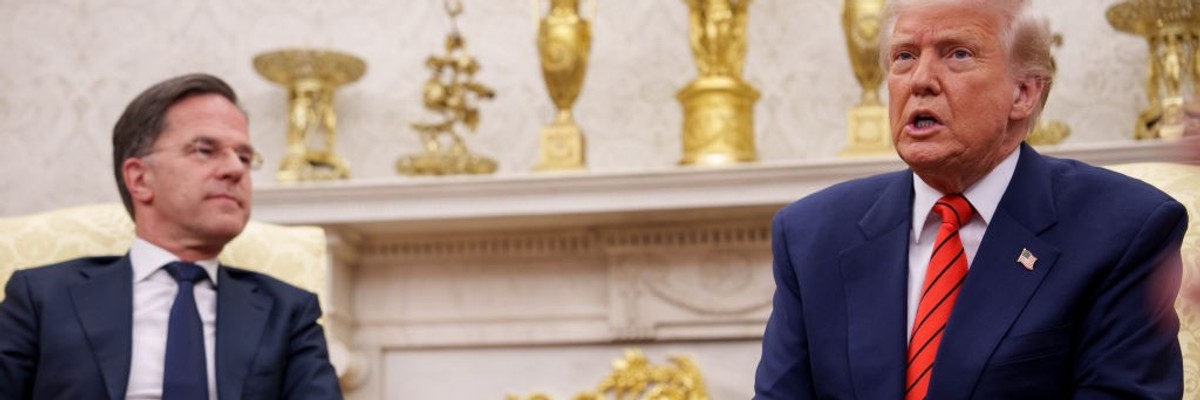
U.S. President Donald Trump speaks during a meeting with NATO Secretary General Mark Rutte in the Oval Office of the White House on March 13, 2025 in Washington, D.C. (Photo: Andrew Harnik/Getty Images)
“Trump is causing a completely unforced recession, the markets tanking, and your 401(k)s plummeting, and he’s focused on invading Greenland,” said one observer.
North Atlantic Treaty Organization Secretary General Mark Rutte met with President Donald Trump on Thursday at the White House in Washington, D.C., where he brushed off the Republican leader’s suggestion that the transatlantic alliance might get involved in his quixotic bid to annex the autonomous territory of another NATO member.
Revisiting his wish to somehow acquire Greenland from Denmark—an outcome opposed by Greenland, Denmark, and a majority of Americans—Trump told reporters during a joint press conference with Rutte and other NATO and U.S. officials including Vice President JD Vance and Defense Secretary Pete Hegseth that he’s bullish on the prospects of annexation.
“I think it’ll happen,” the president said. “And I’m just thinking, I didn’t give it much thought before, but I’m sitting with a man that could be very instrumental. You know, Mark, we need that for international security, not just security, international.”
At one point during the meeting, Trump turned to Hegseth and remarked, “You know, we have a couple of bases on Greenland already, and we have quite a few soldiers, and maybe you’ll see more and more soldiers go there, and I don’t know, what do you think about that, Pete?”
Maintaining the congenial vibe of the meeting, Rutte said with a laugh that “when it comes to Greenland yes or not joining the U.S., I would leave that outside, for me, this discussion, because I don’t want to drag NATO into that.”
The former longtime Dutch prime minister then said that Trump is “totally right” about countering Chinese and Russian regional influence, and that NATO cooperation on that matter is “very important.”
While many observers focused on Rutte’s diplomatic rejection of Trump’s desire to acquire Greenland, Rasmus Jarlov, a member of Denmark’s Parliament representing the Conservative People’s Party, said on social media that “we do not appreciate the secretary general of NATO joking with Trump about Greenland like this.”
“It would mean war between two NATO countries,” Jarlov warned. “Greenland has just voted against immediate independence from Denmark and does not want to be American, ever.”
The center-right Demokraatit Party pulled off a surprise victory Tuesday in Greenland’s parliamentary election, with Jens-Frederik Nielsen, the territory’s likely next prime minister, vehemently rejecting U.S. annexation.
“I hope it sends a clear message to [Trump] that we are not for sale,” he said of the election results in an interview with Sky News. “We don’t want to be Americans. No, we don’t want to be Danes. We want to be Greenlanders, and we want our own independence in the future. And we want to build our own country by ourselves.”
Trump’s comments came on the same day that NBC Newscited U.S. officials who said the president has ordered the Pentagon to prepare plans to “take back” the Panama Canal—including through the use of military force if deemed necessary.
Neo-Fascist Climate Science Denier Donald Trump says Burn, Baby, Burn.Elon Musk urges you to be a Fascist like him, says that you can ignore facts and reality then.
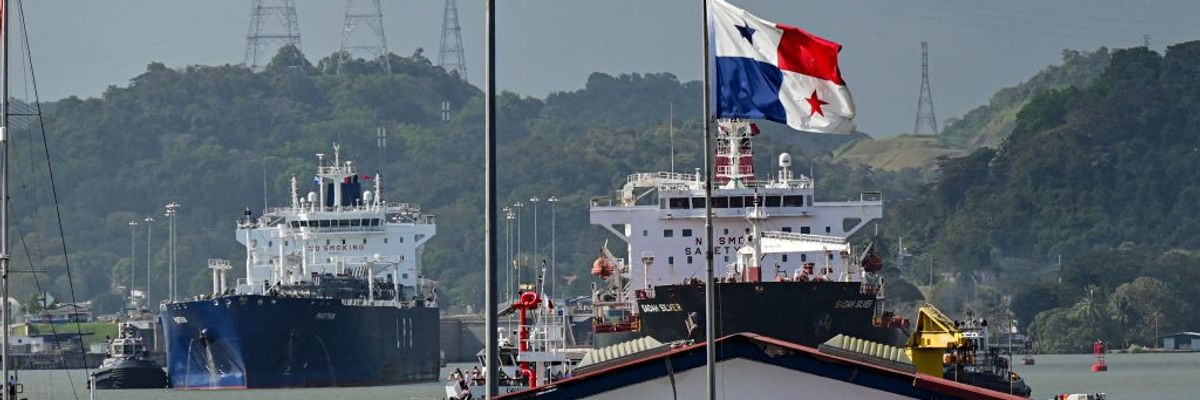
Two cargo ships enter the Miraflores Locks of the Panama Canal in Panama City on January 22, 2025. (Photo: Martin Bernetti/AFP via Getty Images)
U.S. officials familiar with the planning said options for “reclaiming” the vital waterway include close cooperation with Panama’s military and, absent that, possible war.
This is a breaking news story… Please check back for possible updates.
President Donald Trump has directed the Pentagon to prepare plans for carrying out his threat to “take back” the Panama Canal, including by military force if needed, two U.S. officials familiar with the situation told NBC News Thursday.
According to the outlet, the officials said that U.S. Southern Command (SOUTHCOM) is drawing up potential plans that run the gamut from working more closely with Panama’s military to a less likely scenario in which U.S. troops invade the country and take the canal by force. They also said that SOUTHCOM commander Adm. Alvin Holsey has presented draft strategies to be reviewed by U.S. Defense Secretary Pete Hegseth, who is scheduled to visit Panama next month.
The officials explained that the likelihood of a U.S invasion depended on the level of cooperation shown by the Panamanian military.
Trump has repeatedly refused to rule out use of military force to seize control of the vital U.S.-built waterway, as well as Greenland, an autonomous territory of NATO ally Denmark.
Last week during his joint address to Congress, Trump proclaimed that “to further enhance our national security, my administration will be reclaiming the Panama Canal,” but his administration has not clarified precisely what “reclaiming” entails.
The Republican president says the U.S. needs to retake control of the Panama Canal to enhance “economic security,” and has falsely claimed that the waterway is “operated by China.”
Earlier this month, the New York-based investment firm BlackRock led a group of investors in a $23 billion deal to purchase ports at both ends of the Panama Canal from a Hong Kong-based conglomerate, an agreement Trump dubiously seized upon as proof that “we’ve already started” reclaiming the conduit.
Panamanian President José Raúl Molina countered that “the Panama Canal is not in the process of being reclaimed… The canal is Panamanian and will continue to be Panamanian!”
The U.S. controlled what was formerly called the Panama Canal Zone from the time of the waterway’s construction in the early 20th century—largely done by Afro-Caribbean workers, thousands of whom died in what’s widely known as the world’s deadliest construction project—until then-President Jimmy Carter transferred sovereignty to Panama in the late 1970s. Under the Torrijos-Carter treaties, the U.S. reserves the right to use military force to defend the canal’s neutrality.
The United States has repeatedly used deadly military force in Panama over the decades, including during a 1964 student-led uprising against American control in which 22 Panamanians and four U.S. soldiers were killed, and in a full-scale invasion in 1989 ordered by then-President George H.W. Bush to capture erstwhile ally and CIA asset turned narcotrafficking dictator Manuel Noriega. The U.S. invaders killed hundreds of Panamanians, including many civilians.
Writing for Americas Quarterly this week, Panamanian jurist Alonso E. Illueca argued that Panama’s efforts to appease Trump aren’t working. These include the BlackRock deal and other moves like quitting China’s “Belt and Road” initiative, taking in third-country migrants deported by the U.S., backing a U.S. resolution on Ukraine at the United Nations Security Council, auditing the country’s ports, and revisiting a railway project originally developed by the Chinese government.
“Panama should abandon its accommodating policy towards the U.S., which can only lead to escalating demands to banish Chinese influence, to the detriment of Panama’s national sovereignty,” Illueca asserted.
“An alternative policy for Panama is to align with the rules based international order,” he continued. “This includes establishing synergies with like-minded states which have been also affected by U.S. actions such as Canada, Mexico, Greenland, and Denmark. The country should seek to transcend the U.S.-China binary and find alternatives for alliances, which should include partners like the European Union.”
“In short,” Illueca added, “the way forward for Panama lies in replacing strategic dissonance with strategic clarity.”
Neo-Fascist Climate Science Denier Donald Trump says Burn, Baby, Burn.Elon Musk urges you to be a Fascist like him, says that you can ignore facts and reality then.
People demonstrate against U.S. President-elect Donald Trump in Panama City, Panama on December 31, 2024, as the country marks the 25th anniversary of the United States’ handover of the Panama Canal. (Photo: Arnulfo Franco/AFP via Getty Images)
Trump claimed both the canal and the Danish territory are needed for U.S. “economic security.”
U.S. President-elect Donald Trump has been rebuked in recent days by the leaders of both Panama and Denmark for his insistence that the Panama Canal and Danish territory Greenland must be under American control, and his latest comments on Tuesday were expected to garner more anger—and eye-rolling—from abroad.
At a press conference at his Florida resort, Mar-a-Lago, the Republican leader refused to rule out using military force to take over the canal and Greenland.
“It might be that you’ll have to do something. The Panama Canal is vital to our country,” said Trump. “We need Greenland for national security purposes.”
He added that both the canal and Greenland, the world’s largest island and home to a U.S. military base, are needed for U.S. “economic security.”
Under President Jimmy Carter, who died late last month, the U.S. signed a treaty returning the Panama Canal Zone to Panama in 1979, and the waterway connecting the Atlantic and Pacific Oceans has been solely controlled by the Panamanian government since 1999.
Trump repeated a false claim that the canal is being “operated by China.”
Last month, after the president-elect demanded “that the Panama Canal be returned to the United States of America in full, quickly and without question,” Panamanian President José Raúl Mulino posted a video to social media in response.
“As president, I want to clearly state that every square meter of the Panama Canal and its adjoining zone is Panama’s and will remain so,” Mulino said. “The sovereignty and independence of our country is non-negotiable.”
Trump’s comments came as his son, Donald Trump Jr., joined right-wing activist Charlie Kirk and other Trump allies on a visit to Greenland.
The president-elect suggested in a social media post that the trip was made in an official capacity, writing: “The reception has been great. They, and the Free World, need safety, security, strength, and PEACE! This is a deal that must happen. MAGA. MAKE GREENLAND GREAT AGAIN!”
But Greenland officials clarified that Trump Jr. was visiting only as a “private individual” and said no representatives would be meeting with him.
Trump said at his press conference that “people really don’t even know if Denmark has any legal right to [Greenland], but if they do they should give it up because we need it for national security.”
Greenland is home to 60,000 people, and is self-ruling with its own legislature while its foreign and defense policy are controlled by Denmark. The Arctic island lies in a region where global powers are vying for military and economic control.
Trump also expressed a desire to purchase Greenland during his first term, a goal that was dismissed at the time as “absurd” by Danish Prime Minister Mette Frederiksen.
“Greenland belongs to the Greenlanders,” Frederiksen reiterated on Tuesday.
The Doctors Without Borders vessel Geo Barents intercepted two small boats full of migrants navigating toward Europe in the Central Mediterranean on March 16, 2024. (Photo by Simone Boccaccio/SOPA Images/LightRocket via Getty Images)
“As this legislative cycle starts, the E.U. can and must do better than abandon its commitment to the global refugee protection regime,” said an Amnesty campaigner.
Nearly 100 human rights organizations came together Tuesday to emphasize that members of the European Union “must guarantee the right to seek and enjoy asylum and uphold their commitments to the international refugee protection system.”
The joint statement from groups including Amnesty International, Human Rights Watch, and Oxfam came as members of the European Parliament prepare for the July 16 plenary sitting, the first meeting scheduled since the bloc’s June elections, which resulted in the far-right “Patriots for Europe” becoming the third-largest alliance in the legislative body.
The human rights coalition underscored obligations under Article 18 of the E.U. Charter of Fundamental Rights and expressed concern about “the recent and increasing attempts by the E.U. and its member states to evade their asylum responsibilities by outsourcing asylum processing and refugee protection risk undermining the international protection system.”
As the groups detailed:
Italy, for instance, is currently seeking to process asylum applications of certain groups of asylum-seekers outside of its territory, from detention in Albania—which risks leading to prolonged, automatic detention, a denial of access to fair asylum procedures with necessary procedural guarantees, and delayed disembarkation for people rescued or intercepted at sea. Others, such as Denmark and Germany, are assessing the feasibility of this type of arrangement. Fifteen E.U. member states and some political groups have endorsed similar shortsighted measures to shift asylum processing outside E.U. territory and encouraged the European Commission to explore ways to facilitate this through further legislative reform, including through a watered-down ‘safe third country’ concept.
These attempts must be seen in the context of parallel containment efforts that seek to stem departures and prevent the arrival of asylum-seekers to E.U. territory through partnership agreements with third countries, with little to no attention to the human rights records of those authorities.
The coalition stressed that “as the extensive track record of human rights violations in partner countries such as Libya demonstrates, the E.U. and Member States have no adequate tools and competencies to effectively monitor or enforce human rights standards outside of E.U. territory.”
A report published in November by Doctors Without Borders features stories of violence that migrants endured in nations including Libya and Tunisia while trying to get to the E.U. That publication also points out that 2023 was the deadliest year for migration in the Central Mediterranean since 2017, due in part to E.U. countries failing to assist those at risk of drowning.
On Friday, our aircrew witnessed 1 of 3 rescues by @soshumanity_de that day. While 111 people were evacuated to Lampedusa, the other ~180 survivors had to stay on board the Humanity 1, assigned the port of Bari, over 1100km & a 4-day crossing away—pure political harassment by 🇮🇹. pic.twitter.com/DXwVFzNq0X
— Sea-Watch International (@seawatch_intl) July 8, 2024
In addition to sounding the alarm about current E.U. policies and practices, the coalition on Tuesday cited examples including Australia’s offshore detention scheme, which “demonstrates how these models have created prolonged confinement and restricted freedom of movement, deeply harming both the mental and physical health of people seeking protection.”
The organizations also pointed to an asylum scheme attempted by the United Kingdom—which left the E.U. in 2020 following the 2016 Brexit vote—and Rwanda, which the statement notes “is not yet in effect following the U.K. Supreme Court declaring it unlawful and in any event is unlikely to be operationalized at any significant scale.”
The U.K.’s failed attempt to forcibly remove people to the African country was “projected to cost a staggering £1.8 million per asylum-seeker returned,” which is equal to €2.13 million or $2.3 million. The coalition called such schemes “not only an unjustifiable waste of public money, but also a lost opportunity to spend it in ways that would truly aid people seeking asylum by investing in fair and humane asylum systems and the communities that welcome them.”
Olivia Sundberg Diez, Amnesty’s E.U. advocate on migration and asylum, said in a statement Tuesday that “attempts by states to outsource their asylum responsibilities to other countries are not new—but have long been criticized, condemned, and rejected for good reason.”
“Just as the U.K.-Rwanda scheme is, rightly, collapsing, the E.U. and its member states should pay attention, stop making false promises, and wasting time and money on expensive, inhumane, and unworkable proposals,” she continued. “As this legislative cycle starts, the E.U. can and must do better than abandon its commitment to the global refugee protection regime.”
The EU and its member states have had some truly terrible policies toward asylum seekers in recent years.
The meeting scheduled for next week will follow the Pact on Migration and Asylum that the European Parliament passed in April and the Council of the E.U. adopted in May. The coalition highlighted that “civil society organizations have been clear about their serious concerns” regarding the reforms while also explaining that “the transfer of asylum-seekers outside of E.U. territory for asylum processing and refugee protection is not provided for in the pact, nor within current E.U. law.”
“After the E.U. and member states have spent close to a decade attempting to reform the E.U.’s asylum system, they should now focus on implementing it with a human rights-centered approach that prioritizes the right to asylum per E.U. law and fundamental principles of international refugee law to which they remain bound,” the coalition concluded. “They should not, mere weeks after the reform has passed, waste further time and resources on proposals that are incompatible with European and international law.”