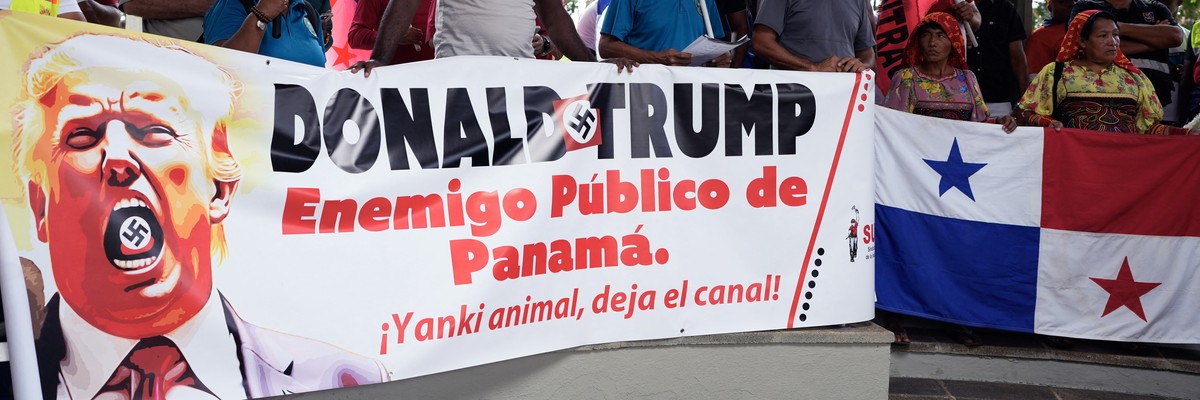
People demonstrate against U.S. President-elect Donald Trump in Panama City, Panama on December 31, 2024, as the country marks the 25th anniversary of the United States’ handover of the Panama Canal. (Photo: Arnulfo Franco/AFP via Getty Images)
Trump claimed both the canal and the Danish territory are needed for U.S. “economic security.”
U.S. President-elect Donald Trump has been rebuked in recent days by the leaders of both Panama and Denmark for his insistence that the Panama Canal and Danish territory Greenland must be under American control, and his latest comments on Tuesday were expected to garner more anger—and eye-rolling—from abroad.
At a press conference at his Florida resort, Mar-a-Lago, the Republican leader refused to rule out using military force to take over the canal and Greenland.
“It might be that you’ll have to do something. The Panama Canal is vital to our country,” said Trump. “We need Greenland for national security purposes.”
He added that both the canal and Greenland, the world’s largest island and home to a U.S. military base, are needed for U.S. “economic security.”
Under President Jimmy Carter, who died late last month, the U.S. signed a treaty returning the Panama Canal Zone to Panama in 1979, and the waterway connecting the Atlantic and Pacific Oceans has been solely controlled by the Panamanian government since 1999.
Trump repeated a false claim that the canal is being “operated by China.”
Last month, after the president-elect demanded “that the Panama Canal be returned to the United States of America in full, quickly and without question,” Panamanian President José Raúl Mulino posted a video to social media in response.
“As president, I want to clearly state that every square meter of the Panama Canal and its adjoining zone is Panama’s and will remain so,” Mulino said. “The sovereignty and independence of our country is non-negotiable.”
Trump’s comments came as his son, Donald Trump Jr., joined right-wing activist Charlie Kirk and other Trump allies on a visit to Greenland.
The president-elect suggested in a social media post that the trip was made in an official capacity, writing: “The reception has been great. They, and the Free World, need safety, security, strength, and PEACE! This is a deal that must happen. MAGA. MAKE GREENLAND GREAT AGAIN!”
But Greenland officials clarified that Trump Jr. was visiting only as a “private individual” and said no representatives would be meeting with him.
Trump said at his press conference that “people really don’t even know if Denmark has any legal right to [Greenland], but if they do they should give it up because we need it for national security.”
Greenland is home to 60,000 people, and is self-ruling with its own legislature while its foreign and defense policy are controlled by Denmark. The Arctic island lies in a region where global powers are vying for military and economic control.
Trump also expressed a desire to purchase Greenland during his first term, a goal that was dismissed at the time as “absurd” by Danish Prime Minister Mette Frederiksen.
“Greenland belongs to the Greenlanders,” Frederiksen reiterated on Tuesday.
The Doctors Without Borders vessel Geo Barents intercepted two small boats full of migrants navigating toward Europe in the Central Mediterranean on March 16, 2024. (Photo by Simone Boccaccio/SOPA Images/LightRocket via Getty Images)
“As this legislative cycle starts, the E.U. can and must do better than abandon its commitment to the global refugee protection regime,” said an Amnesty campaigner.
Nearly 100 human rights organizations came together Tuesday to emphasize that members of the European Union “must guarantee the right to seek and enjoy asylum and uphold their commitments to the international refugee protection system.”
The joint statement from groups including Amnesty International, Human Rights Watch, and Oxfam came as members of the European Parliament prepare for the July 16 plenary sitting, the first meeting scheduled since the bloc’s June elections, which resulted in the far-right “Patriots for Europe” becoming the third-largest alliance in the legislative body.
The human rights coalition underscored obligations under Article 18 of the E.U. Charter of Fundamental Rights and expressed concern about “the recent and increasing attempts by the E.U. and its member states to evade their asylum responsibilities by outsourcing asylum processing and refugee protection risk undermining the international protection system.”
As the groups detailed:
Italy, for instance, is currently seeking to process asylum applications of certain groups of asylum-seekers outside of its territory, from detention in Albania—which risks leading to prolonged, automatic detention, a denial of access to fair asylum procedures with necessary procedural guarantees, and delayed disembarkation for people rescued or intercepted at sea. Others, such as Denmark and Germany, are assessing the feasibility of this type of arrangement. Fifteen E.U. member states and some political groups have endorsed similar shortsighted measures to shift asylum processing outside E.U. territory and encouraged the European Commission to explore ways to facilitate this through further legislative reform, including through a watered-down ‘safe third country’ concept.
These attempts must be seen in the context of parallel containment efforts that seek to stem departures and prevent the arrival of asylum-seekers to E.U. territory through partnership agreements with third countries, with little to no attention to the human rights records of those authorities.
The coalition stressed that “as the extensive track record of human rights violations in partner countries such as Libya demonstrates, the E.U. and Member States have no adequate tools and competencies to effectively monitor or enforce human rights standards outside of E.U. territory.”
A report published in November by Doctors Without Borders features stories of violence that migrants endured in nations including Libya and Tunisia while trying to get to the E.U. That publication also points out that 2023 was the deadliest year for migration in the Central Mediterranean since 2017, due in part to E.U. countries failing to assist those at risk of drowning.
On Friday, our aircrew witnessed 1 of 3 rescues by @soshumanity_de that day. While 111 people were evacuated to Lampedusa, the other ~180 survivors had to stay on board the Humanity 1, assigned the port of Bari, over 1100km & a 4-day crossing away—pure political harassment by 🇮🇹. pic.twitter.com/DXwVFzNq0X
— Sea-Watch International (@seawatch_intl) July 8, 2024
In addition to sounding the alarm about current E.U. policies and practices, the coalition on Tuesday cited examples including Australia’s offshore detention scheme, which “demonstrates how these models have created prolonged confinement and restricted freedom of movement, deeply harming both the mental and physical health of people seeking protection.”
The organizations also pointed to an asylum scheme attempted by the United Kingdom—which left the E.U. in 2020 following the 2016 Brexit vote—and Rwanda, which the statement notes “is not yet in effect following the U.K. Supreme Court declaring it unlawful and in any event is unlikely to be operationalized at any significant scale.”
The U.K.’s failed attempt to forcibly remove people to the African country was “projected to cost a staggering £1.8 million per asylum-seeker returned,” which is equal to €2.13 million or $2.3 million. The coalition called such schemes “not only an unjustifiable waste of public money, but also a lost opportunity to spend it in ways that would truly aid people seeking asylum by investing in fair and humane asylum systems and the communities that welcome them.”
Olivia Sundberg Diez, Amnesty’s E.U. advocate on migration and asylum, said in a statement Tuesday that “attempts by states to outsource their asylum responsibilities to other countries are not new—but have long been criticized, condemned, and rejected for good reason.”
“Just as the U.K.-Rwanda scheme is, rightly, collapsing, the E.U. and its member states should pay attention, stop making false promises, and wasting time and money on expensive, inhumane, and unworkable proposals,” she continued. “As this legislative cycle starts, the E.U. can and must do better than abandon its commitment to the global refugee protection regime.”
The EU and its member states have had some truly terrible policies toward asylum seekers in recent years.
The meeting scheduled for next week will follow the Pact on Migration and Asylum that the European Parliament passed in April and the Council of the E.U. adopted in May. The coalition highlighted that “civil society organizations have been clear about their serious concerns” regarding the reforms while also explaining that “the transfer of asylum-seekers outside of E.U. territory for asylum processing and refugee protection is not provided for in the pact, nor within current E.U. law.”
“After the E.U. and member states have spent close to a decade attempting to reform the E.U.’s asylum system, they should now focus on implementing it with a human rights-centered approach that prioritizes the right to asylum per E.U. law and fundamental principles of international refugee law to which they remain bound,” the coalition concluded. “They should not, mere weeks after the reform has passed, waste further time and resources on proposals that are incompatible with European and international law.”
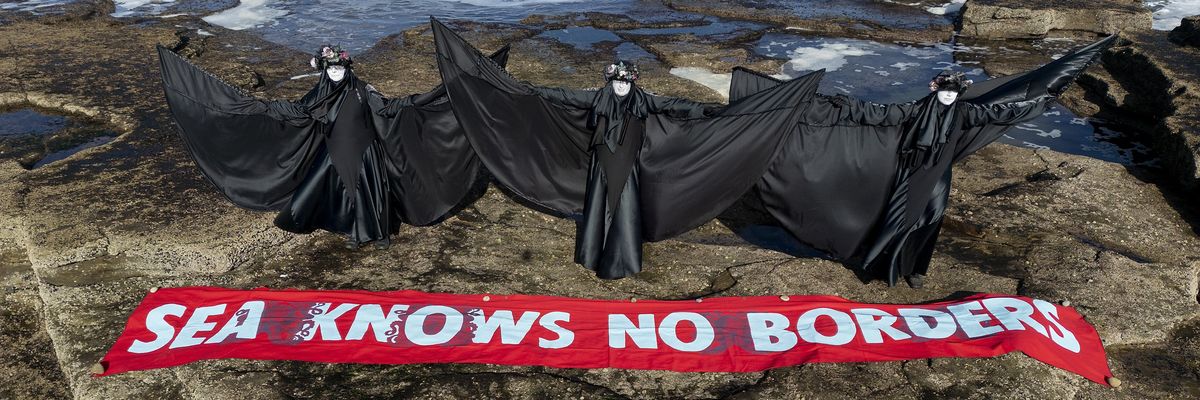
The “oil slicks” performance artist group demonstrates the impacts of a potential oil spill on Scotland’s Moray Firth as part of a North Sea-wide day of action on March 16, 2024. (Photo: XR Forres)
“Going full steam ahead with new North Sea oil and gas is a sure fire route to the worst climate scenarios,” one campaigner said.
Climate activists in six North Sea countries came together on Saturday to carry out acts of civil disobedience in protest of their governments’ continued fossil fuel development.
Demonstrators in the United Kingdom, Norway, Sweden, Denmark, Germany, and the Netherlands blockaded roads, ports, and refineries; dropped banners; and held solidarity concerts as part of the North Sea Fossil Free campaign to demand that their governments align their plans for the shared body of water with the Paris agreement goal of limiting global heating to 1.5°C above preindustrial levels.
“For too long, the U.K., Norway, and other North Sea countries have avoided scrutiny for their oil drilling plans as the emissions are not included in their national inventories,” a spokesperson for Extinction Rebellion U.K. told Common Dreams. “Going full steam ahead with new North Sea oil and gas is a sure fire route to the worst climate scenarios.”
“The only serious response we can make is for citizens to unite, but we need to see many many more people doing this work.”
The day of action, which was organized by Extinction Rebellion (XR), came days after a new report from Oil Change Internationalrevealed that none of five North Sea countries—Norway, the U.K., the Netherlands, Germany, and Denmark—have plans consistent either with limiting warming to 1.5°C or with the agreement to transition away from fossil fuels reached at last year’s United Nations COP28 climate conference. If the five countries were counted as one, they would be the seventh biggest producer of oil and gas in the world.
In particular, these governments continue to issue permits to explore for and develop oil and gas fields, despite the fact that the International Energy Agency has said that no new fossil fuel development is compatible with limiting global temperature rise to 1.5°C. In one high-profile example, the U.K. approved the undeveloped Rosebank oil field in September 2023. Taken together, these permits could lead to more than 10 billion metric tons of greenhouse gas emissions.
The worst offenders were Norway and the U.K., which could be among the top 20 developers of oil and gas fields through mid-century if they do not change course.
“The five major North Sea countries are at a crossroads: One path leads toward global leadership in climate action and green industries, where they take bold action to phase out oil and gas production that creates sustainable jobs and communities. The other path leads to catastrophic climate change, economic crisis, and the loss of status as climate leaders globally, as they cling to outdated practices while the world moves forward,” Silje Ask Lundberg, North Sea campaign manager at Oil Change International, said when the report was released.
Extinction Rebellion co-founder Clare Farrell said that the North Sea governments’ policies were a betrayal of their citizens and the world following the hottest year on record.
“Temperatures have tracked 1.5°C above average recently, almost 2°C,” Farrell said. “Our global commitments, such that they are, are being flushed away with no regard for what the public really want. Where’s the consent for that here in our democracies? No government has a mandate to do that. So people deserve to know that our governments are willfully destroying everything. The people of these North Sea nations have not consented to destroying civilization, but that’s what is going to happen. Their governments are unhinged and unchecked.”
Saturday’s protests, Farrell continued, were a way for the people in these countries to make their voices heard.
“The only serious response we can make is for citizens to unite, but we need to see many many more people doing this work,” Farrell said. “Direct action like this should shake us awake; our governments will destroy democracy and society if we let them continue, that’s the course we are on, and they are redoubling their efforts despite the facts and knowing how much suffering they are already causing all over the world as climate breaks down.”
The demands of Saturday’s protests were threefold: An end to new oil and gas infrastructure in the North Sea, for governments to tell the truth about the realities of the climate crisis, and for the countries to pursue a just transition to renewable energy. In addition, many activists made additional demands specific to their nations’ policies.
— Extinction Rebellion Nederland (@NLRebellion) March 16, 2024
In the Netherlands, activists with Extinction Rebellion and Scientist Rebellion blocked all roads and railways leading to the largest oil refinery in Europe: Shell’s Pernis refinery. They targeted Shell because the oil major has received new permits to drill in the Victory Gas Field and has also restarted its drilling in the Pierce Field. What’s more, the company has refused to clean up its aging equipment in the North Sea, leaving old pipelines and drilling platforms to rust and pollute the sea with mercury, polonium, and radioactive lead. While there are 75 aging Shell oil and gas platforms in the Dutch North Sea that should be removed by 2035, current efforts are not on track to meet this deadline.
“Like the rest of the fossil industry, Shell is only interested in profits and shareholder returns,” said Bram Kroezen of XR Netherlands, adding that Shell’s appeal of a landmark court ruling ordering it to reduce emissions showed that the company “completely lacks a moral compass.”
Germany
As part of today's concerted action #NorthSeaFossilFree, we shut down access inroads to water-bound LNG-infrastructure in #Brunsbüttel✊🏼
— Ende Gelände International #StopColonialViolence (@ende_gelande) March 16, 2024
Activists with Ende Gelände blocked off access to a floating liquefied natural gas (LNG) terminal in the port of Brunsbüttel, Germany, beginning at 9:00 am local time. The activists are calling for an end to LNG imports, as new science reveals the so-called “bridge” fuel may in fact be at least as damaging to the climate as coal due to previously unaccounted for methane leaks.
“LNG is a double climate killer,” Rita Tesch, spokesperson for Ende Gelände, said in a statement. “Because it consists of methane. Methane is even more harmful to the climate than carbon dioxide. It escapes into the atmosphere during transportation by LNG ships and at terminals such as here in Brunsbüttel, and heats it up rapidly. The carbon dioxide from burning it is on top of that. It’s clear: LNG imports are a climate crime!”
Norway
EXTINCTION REBELLION NORWAY BLOCKS RAFNES REFINERY Extinction Rebellion Norway (XR) is conducting a large-scale action aimed at Rafnes refinery in Bamble.XR-activists are now on their way into the security zone with a boat. Dozens of activists are blocking the main entrance on… pic.twitter.com/e2x9Vx1t6M
— Extinction Rebellion Norway (@XR_Norge) March 16, 2024
Activists with XR Norway targeted Rafnes Petroleum Refinery, with some blockading access on land while another group entered the security area by boat.
“I’m ashamed to be a Norwegian,” XR Norway spokesperson Jonas Kittelsen said in a statement. “Norway profits massively from aggressively expanding our oil and gas sector, causing mass suffering and death globally. My government portrays us as better than the rest of the world, which we are not.”
Denmark
Punkband Octopussy Riot is performing on top of a container next to the Total headquarter at Esbjerg Harbour in protest of new oil and gas extraction in the north sea. Becoming species and XR are part of an international action today all across The North Sea #NorthSeaFossilFreepic.twitter.com/wfheUpXVgd
— Extinction Rebellion Danmark (@ExtinctionRDK) March 16, 2024
Performance collective Becoming Species and Extinction Rebellion Denmark worked together to stage a creative protest targeting the oil company Total Energies, which is the leading oil and gas producer in the Danish North Sea and currently has plans to reopen “Tyra Feltet,” Denmark’s largest gas field. Four members of the band Octopussy Riot climbed a Total-owned container and staged a punk concert in Denmark’s Esbjerg Harbor.
“We octopuses have formed the band Octopussy Riot and have arrived here to play our song, a demand for you two-legs to stop oil and gas extraction,” performer Linh Le, said. “The sea is dying, our climate collapsing. We will not accept that the most rich and powerful destroy our home. We do not want to go extinct.”
Sweden
Kom till Göteborg nu på lördag 16:e mars och delta i denna kampanj mot ny fossil infrastruktur i Nordsjön: – Inga nya fossila investeringar i Nordsjön. – Fossilgas är inget alternativ. – Ta bort gamla oljeplattformar. – Sluta borra! pic.twitter.com/n3GzFhI05E
— Extinction Rebellion Sverige (@ExtinctionR_SV) March 14, 2024
Members of XR Sweden blocked the road to Gothenburg’s Oil Harbor, where the group has been protesting since May of 2022. The activists called on Sweden to stop investing in the harbor and on city officials to develop a plan to dismantle the harbor and refineries.
“Twenty-two million tons of oil enter Gothenburg’s port every year, which is owned by the city,” one activist said. “There is no plan for decommissioning. This does not go together with the climate goals.”
Scotland
XR Scotland Oil Slicks and Scottish groups in Forres, Shetland, Aberdeen and Dundee are supporting amazing #NorthSeaFossilFree blockades of fossil fuel infrastructure in 5 countries.
— Extinction Rebellion Scotland (@ScotlandXr) March 16, 2024
Finally, protesters across Scotland stood in solidarity with the other actions with performances and banner drops. In Aberdeen, activists unfurled banners outside the offices of Equinor, which owns 80% of Rosebank, and Ithaca, which owns the remaining 20%. The banners read, “North Sea Fossil Free,” “Stop Rosebank,” and “Sea knows no borders.” In Dundee, protesters targeted the Valaris 123 oil platform off the coast with banners. Shetland Stop Rosebank also brought signs to Lerwick Harbor, from where the first stage of Rosebank’s development is launching. XR Forres organized a performance of the group the “oil slicks” along the Moray Firth, to demonstrate what an oil spill would do to its unique coastal landscape.
“All countries should align their drilling plans with the Paris agreement now,” the XR U.K. spokesperson said. “We thank everyone who has taken action today in defense of a livable planet.”
New survey results from 40 countries shows that climate change matters to most people. In the vast majority of countries, fewer than 3% said climate change was not serious at all.
We carried out this research as part of the University of Oxford’s Reuters Institute annual Digital News Reports. More than 80,000 people were surveyed online in January and February of this year.
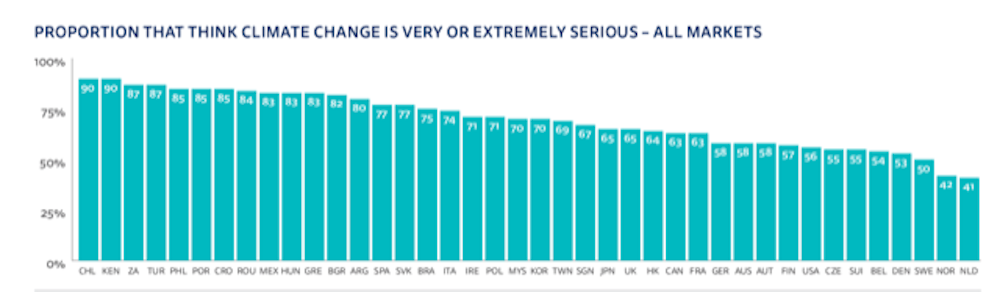
Almost seven in ten think climate change is “a very, or extremely serious, problem”, but the results show notable country differences. Lack of concern is far higher in the US (12%) as well as in Sweden (9%), Greta Thunberg’s home country. Despite disastrous bush fires at the time of our fieldwork, 8% of respondents in Australia report that climate change is not serious at all. These groups with low levels of concern tend to be right wing and older.
Four of the five countries showing the highest levels of concern (85-90%) were from the global south, namely Chile, Kenya, South Africa and the Philippines. However, in countries with lower levels of internet penetration, our online survey samples over-represent people who are more affluent and educated.
Almost everyone in Chile and Kenya thinks climate change is serious. But that’s not the case in Scandinavia and the Low Countries. Reuters Institute Digital News Report, Author provided
Perhaps surprisingly, the five countries with the lowest levels of concern are all in Western Europe. In Belgium, Denmark, Sweden, Norway and the Netherlands, only around half (or less) think that climate change is a serious problem.
It is the first time that results from survey questions on climate change have been included in the Reuters Institute’s reports, so it is difficult to draw out historical trends. However, results in 2015 from the Pew Center based on surveys in 40 countries (with different questions and countries to those in our survey) found that 54% of those surveyed thought that climate change was “a very serious” problem.
In the UK, data from the CAST centre at Cardiff University showed that in 2019 levels of “worry” about climate change were at their highest recorded point. Extreme weather events, media reporting and wider publicity were mentioned by respondents as reasons for their increase in concern.
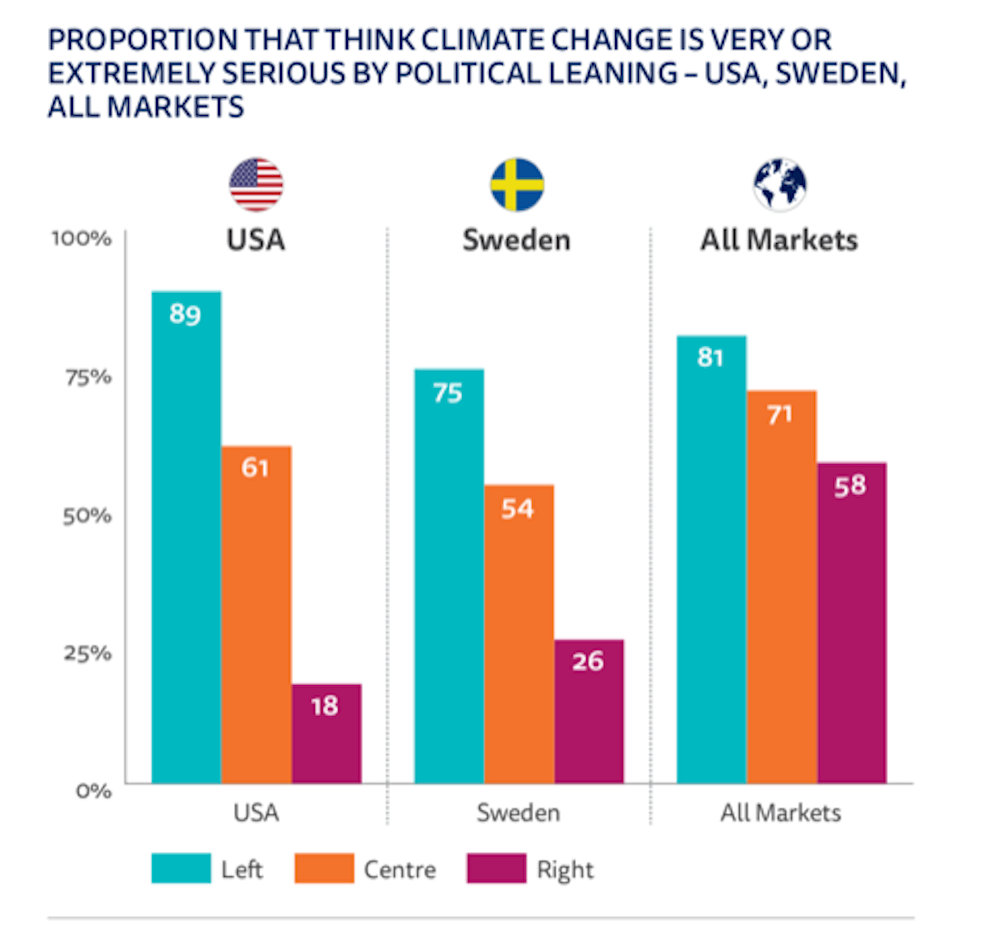
In our survey, across countries and markets, individuals who identify as left-wing tend to report higher levels of concern. This finding is even more visible in more polarised societies such as the US where 89% of those who self-identify on the left note that climate change is serious, compared to only 18% of those who self-identify on the right.
Right-wingers tend to take climate change less seriously – especially in the US and Sweden. Reuters Institute Digital News Report, Author provided
We also find a similar divide in Sweden. As Sweden is widely considered one of the world’s most progressive nations, these results surprised us and we asked Martin Hultman, a researcher in climate denialism at Chalmers University in Gothenburg, what to make of them.
“These figures do not surprise me”, he told us in an email. “Since 2010, the leadership of the far-right political party Sweden Democrats has been against all types of policies to tackle climate change, including the Paris Agreement.”
“And we know that the spread of climate change denial ideas and rhetoric is widespread in Sweden – not least when digitally-born far-right media sites spread conspiracy theories about Greta Thunberg.”
TV news still dominates
Across all countries, people say they pay most attention to climate news on television (35%). Online news sites of major news organisations are the second most popular news source (15%), followed by specialised outlets covering climate issues (13%), then alternative sources such as social media and blogs (9%).
Figures from the UK, US and Australia are broadly in line with these preferences. Printed newspapers and radio are way down, with only around 5% saying each was the source they paid most attention to. In Chile, where the concern is high, specialised outlets covering climate issues (24%) as well as alternative sources such as social media (17%) are nearly as popular as television (26%).
The differences in climate news consumption are also visible among different age groups. Younger generations, more specifically the so-called Generation Z (aged 18-24), are more likely to report paying attention to alternative sources on climate change (17%) as well as TV (23%) and online news sites from major news organisations (16%). Older people, however, rely more heavily on TV (42%) and use less of the online news sites (12%) or alternative sources such as social media (5%).
Respondents from both sides of the political spectrum criticise the media for either being too doom-laden, or not bold enough, in their coverage of climate change. That said, our survey shows that almost half of our respondents (47%) think that news media generally do a good job of informing them about climate change, and 19% think that they do a bad job.
However, those who have low levels of concern are much more inclined to say that the news media are doing a bad job (46%). This might indicate a lack of trust in climate change coverage or a more general loss of confidence in the news media.