This work by Middle East Monitor is licensed under a Creative Commons Attribution-NonCommercial-ShareAlike 4.0 International License.
Israeli far-right Finance Minister Bezalel Smotrich displays a map of an area near the settlement of Maale Adumim, a land corridor known as E1, outside Jerusalem in the occupied West Bank, on August 14, 2025. [Photo by MENAHEM KAHANA/AFP via Getty Images]
Far-right Israeli Finance Minister Bezalel Smotrich on Wednesday announced plans for 1,000 new settlement housing units in the northern occupied West Bank, a day after 12 Western countries said they intended to impose trade restrictions on goods from illegal Israeli settlements, Anadolu reports.
Smotrich said on US social media company X that 1,665 dunams (411.5 acres) had been added to the Kida and Havat settlements, allowing for the construction of 1,000 new housing units.
The leader of the Religious Zionism party described the move as “another historic step in the settlement revolution.”
Israel has occupied the West Bank, including East Jerusalem, since 1967. The international community considers Israeli settlements built on occupied Palestinian territory illegal under international law, a position rejected by Tel Aviv.
“After more than 25 years, the Kida and Havat settlements have finally reached the moment when the government is advancing procedures to legalize their status,” Smotrich said.
Kida and Havat were established in 2003 and 2001, respectively. The Israeli government decided to convert them into recognized settlements in December and March, respectively.
The government of Prime Minister Benjamin Netanyahu has touted that since taking office in late 2022, it has approved the establishment of 104 new settlements and established 160 agricultural settlement outposts in the occupied West Bank.
Around 750,000 Israeli occupiers live in 156 settlements and 360 outposts across the occupied West Bank, including occupied East Jerusalem, according to Palestinian figures.
On Tuesday, the UK, Canada, Denmark, Finland, France, Iceland, Ireland, Norway, Poland, Portugal, Spain and Sweden announced plans to impose trade restrictions on goods originating from the Israeli settlements.
This work by Middle East Monitor is licensed under a Creative Commons Attribution-NonCommercial-ShareAlike 4.0 International License.
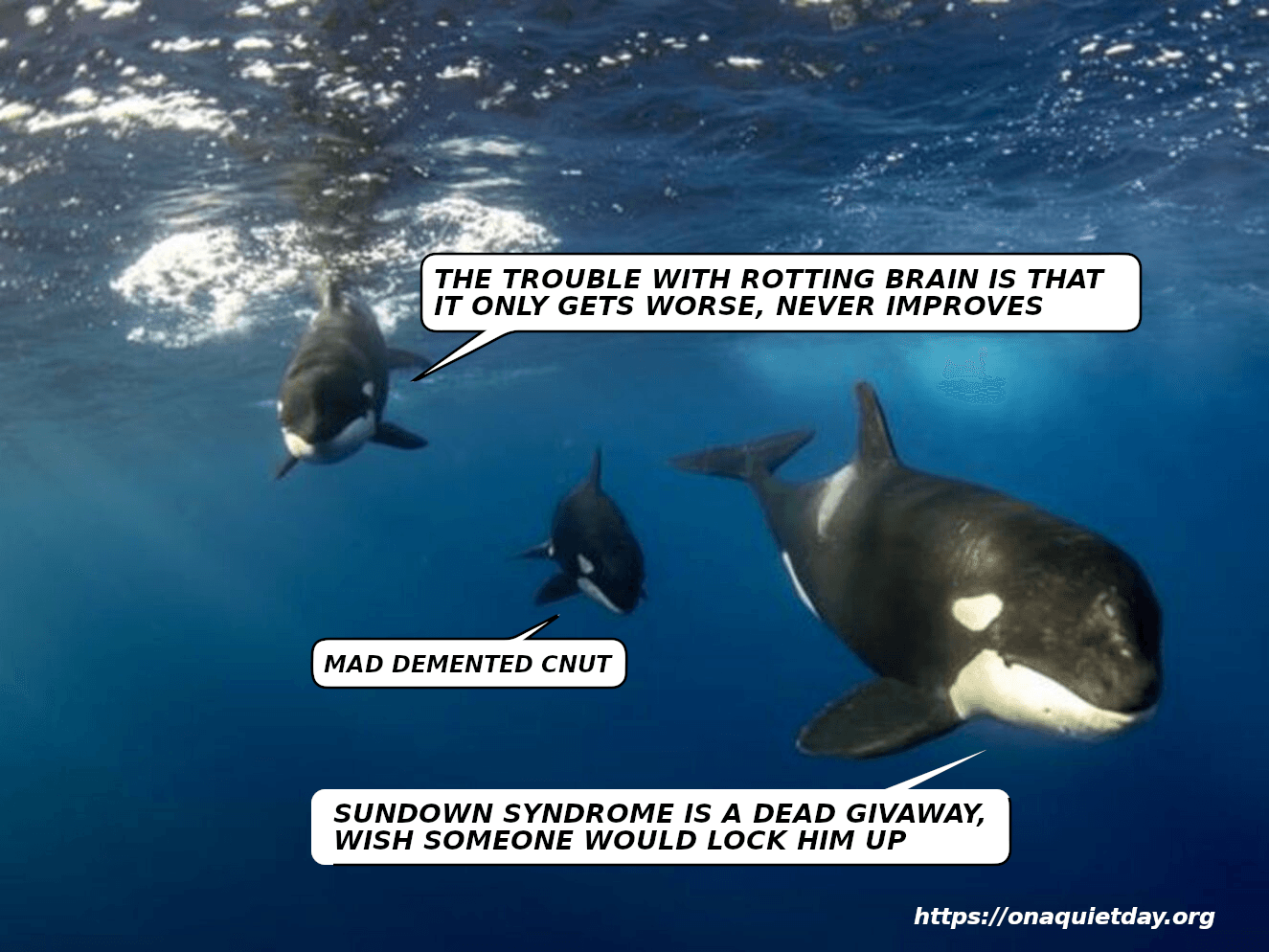
Orcas discuss rotting brain, front Orca says Sundown Syndrome is a dead givaway and he wishes someone would Lock Him Up
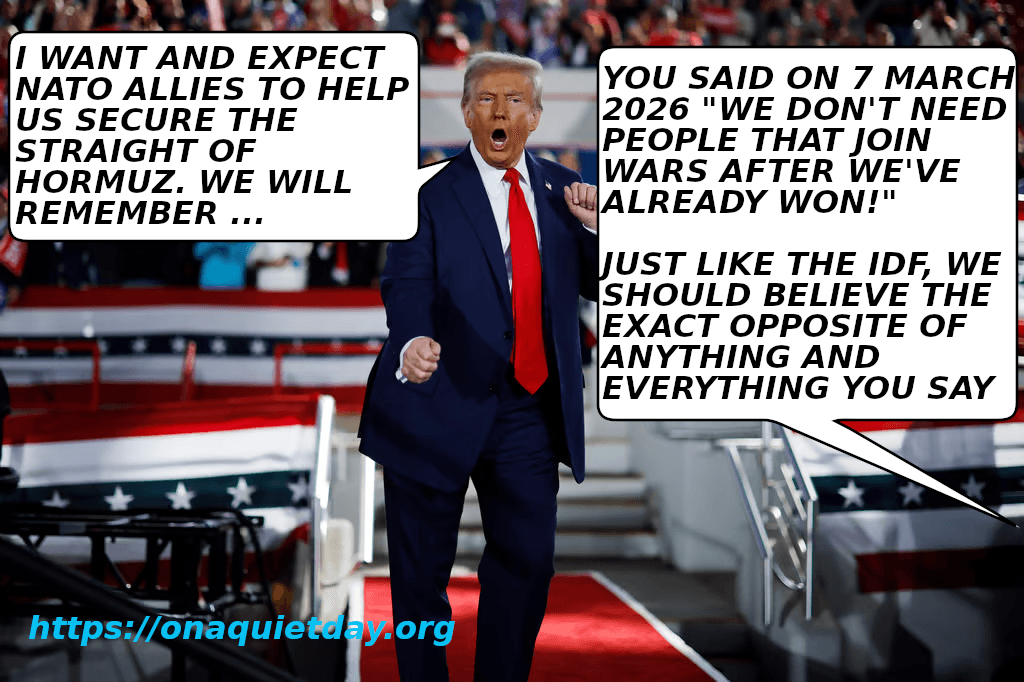
Donald Trump calls for help from NATO allies in securing the Strait of Hormuz despite saying on 7 March 2026 that they don’t need people to join wars after they’ve already won. He’s challenged with the claim that he lies as much as the IDF.Climate science denier Donald Trump confirms that he knows nothing about democracy and that more liquid gold is being secured according to his policy of policy of global privateering.
This work by Middle East Monitor is licensed under a Creative Commons Attribution-NonCommercial-ShareAlike 4.0 International License.
Israeli authorities continue construction activities for settlement projects in the Maale Arugot area, expanding the broader land policy agenda across the territory following recent administrative decisions in West Bank on September 3, 2026. [Wisam Hashlamoun – Anadolu Agency]
Eleven European countries plus Canada announced plans on Tuesday to introduce national restrictions on trade in goods with Israeli settlements that are illegal under international law, French Foreign Minister Jean-Noel Barrot announced, Anadolu reports.
“Today, France, the United Kingdom, Canada, Denmark, Spain, Finland, Ireland, Iceland, Norway, Poland, Portugal and Sweden confirm their intention to impose national restrictions on trade in goods with settlements that are illegal under international law and/or to support European restrictions to this effect,” said a joint declaration issued by Barrot.
The statement reaffirmed that the 12 countries are “seriously considering” adopting such restrictions or other measures in accordance with their national procedures.
“In this regard, France, the United Kingdom and Canada welcome the significant measures already taken by Ireland, Spain, the Netherlands, Norway and Belgium, and will propose national measures to prohibit trade in goods originating from settlements,” it added.
The declaration decried actions taken by the Israeli government in the West Bank that undermine the possibility of a two-state solution.
“The situation is rapidly deteriorating as settler violence and settlement expansion have reached unprecedented levels, including the unacceptable decision to issue tenders for the E1 settlement project,” it underscored.
They also stressed the need for protecting the possibility of a two-state solution and vowed their determination to work for a just and lasting peace.
“We firmly oppose any action resulting in the annexation of Palestinian land and the forced displacement of Palestinian populations,” the declaration said.
It further urged Israel to immediately halt the expansion of illegal settlements and civilian administrative powers while ensuring that settlers responsible for violence are held accountable for their actions and investigating allegations involving Israeli forces.
Donald Trump calls for help from NATO allies in securing the Strait of Hormuz despite saying on 7 March 2026 that they don’t need people to join wars after they’ve already won. He’s challenged with the claim that he lies as much as the IDF.Climate science denier Donald Trump confirms that he knows nothing about democracy and that more liquid gold is being secured according to his policy of policy of global privateering.
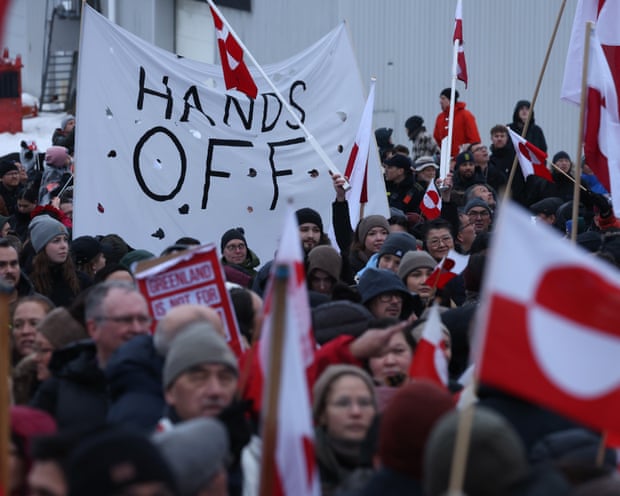
In Nuuk, Greenlanders protested against Trump’s threats to annexe the island | Alessandro Rampazzo/AFP via Getty Images
“If the United States takes over and annexes Greenland, what legal rights will they have to try to stop Putin in Ukraine?”
That was the question posed by Jens B. Frederiksen, Greenland’s former deputy prime minister, when we met over coffee in central Copenhagen last week. “Which legal rights will they have to try to defend Taiwan, if China wants Taiwan?” he continued. “Trump [is] just the same person as Putin. Trump wants to own Greenland. He wants to make the US bigger.”
Three weeks before our conversation, Frederiksen had addressed 30,000 Danes and Greenlanders as they gathered in the Danish capital to oppose Donald Trump’s threat to invade Greenland some 3,550 kilometres away. The strategically important island, two-thirds of which lies within the Arctic Circle, has been a semi-autonomous part of the Kingdom of Denmark for more than 70 years, and a Danish colony for 140 years before that.
One crucial dividing line in Greenlandic politics is independence. When the country was fully integrated into the Danish state in 1953, it established its own Parliament, constitution and introduced a host of electoral reforms. But in recent years, polls suggest around two-thirds of Greenlanders want to break away from Denmark, not least due to long-running issues such as pay inequality and the legacy of colonialism. For now, though, the threat from the US has prompted a renewed sense of unity with Denmark and Europe, with a poll from last month finding only 6% of Greenland’s adult population wants to join the US.
“I would say that everybody has been agreeing that Greenland will be independent at some point, and the disagreements were on when,” said Camilla Siezing of Kalaallit Peqatigiiffiisa Kattuffiat Inuit, an organisation that represents Greenlanders living in Denmark. “But this situation has moved back a lot of things in this regard, because I think Greenland realised how fragile we are. A lot of the discussion for independence has been on the economic and social parts. But now we also have to think about the international security issue.”
The US has had extensive access to and a military presence in Greenland since 1951, when it signed the US-Denmark Defence Agreement as the Cold War intensified. The treaty granted it operational rights on the island, including over construction, logistics, military activity and mining. Earlier this year, the concession of Greenland’s Tanbreez mining project was sold to New York-based Critical Metals Corp.
For Trump, though, the agreement is no longer enough. He began signalling his expansionist aims towards Greenland in his first presidency, initially arguing that the White House should be able to buy the island from Denmark. Earlier this year, he upped the ante, claiming US annexation of the island is necessary to secure his “golden dome” defence system, in which the Pentagon would use Greenland to launch its air defences against a hypothetical missile attack from Russia.
Similarly, as the Arctic becomes a high-pressure region in terms of security and resources, the US president says he is also concerned by China’s expansionist aims. With Greenland, he says, he could better defend his country against any eastern aggression.
Defence experts say Trump’s logic is flawed. “The US falsely claimed that there has been an increase in Russian and Chinese presence in and around Greenland,” wrote Rachel Ellehus of the Royal United Services Institute, a UK defence and security think tank, last month. “Actually, there has been little to no Chinese and Russian military activity around Greenland over the last decade.” This was echoed days later by Spenser A Warren, the Stanton nuclear security postdoctoral fellow at Harvard’s Belfer Center, who branded Trump’s national security claims “grossly overblown” in the War on the Rocks blog.
There is a more extractive motivation behind the US’s interest in the Arctic. Greenland is rich in mineral wealth, including much-coveted rare earth minerals essential for technologies such as phones and the growing AI industry. Seizing Greenland would give the US access to the minerals and mining territories desired by its government and its billionaire class.
“To some of Trump’s supporters, some of the tech billionaires, Greenland has become a new territory from where the US can expand and enlarge,” said Cecilie Felicia Stokholm Banke, a senior researcher at the Danish Institute for International Studies, when we met in her book-lined office in Copenhagen.
Greenland is not an empty island, existing only to provide minerals and military bases – despite how some members of the US right have sought to portray it in recent months. It’s home to 70,000 people, and has a diaspora of around 18,000 in Denmark.
Its population includes an Indigenous community with a close relationship with nature and the land, who “live in ways that are not only organised around capitalist markets and profits”, said Danish trade unionist, writer, campaigner and Red-Green Alliance member Bjarke Friborg. “Many people still hunt and fish, share food within families and communities, and plan their time around seasons, weather and ice conditions. When you depend directly on nature like that, it shapes how you think about work, time and what really matters.”
While Friborg is clear that the “Indigenous people have been subject to colonisation and domination from Denmark,” he warned against “how the US has treated its native populations. Greenlanders know this, too, and they are not encouraged.” Greenland’s Inuit people, he added, fear what a US annexation would mean for their wellbeing and safety.
Former deputy PM Frederiksen is a member of Greenland’s historically unionist Democrats Party, which has in recent years shifted its stance to support independence in the long term, as part of a gradual process that starts with increased self-determination. He pointed out that Greenlanders, like residents in Denmark, are entitled to free healthcare, receive payments to support their education, and a generous welfare system – which he fears could all be lost under US control.
“Look at Alaska, look at Puerto Rico,” he said, adding: “Our people are incredibly anxious. We are anxious about our country, our families, our own lives. We are anxious about all the connections we have. And it’s all just because a bully wants our country for his own ‘psychological welfare.’”
These anxieties have also led politicians on the island to put aside their differences, said Frederiksen. “Greenland’s political parties, at this time, realised they have to stand up together. You couldn’t imagine that three, four months before that they should work together. And I was so proud, because I think it was a very, very strong signal to send to all the world that we don’t want to be a part of the United States.”
The signal was particularly loud and clear when 30,000 people marched in Copenhagen. Anders Franssen, one of the co-founders of the Hands Off Greenland campaign group, told openDemocracy he knew he had to do something after Trump’s vice president, J D Vance, visited Greenland in March last year.
“We all know what that visit meant,” Franssen told openDemocracy. “It meant they were going to try to convert the Greenlandic people to look more positively on Trump and the Trump administration. “I called up the police, and I said, I’m going [to organise] a demonstration. He said, ‘How many people are gonna show?’ I said, it’s going to be me, then two cops, it’ll be three of us. We ended up being 3,500.”
A child watches the Hands off Greenland protest | Provided by Jens B Frederiksen
Since then, the Hands Off Greenland protests have grown in size and number, with several large marches held in Danish cities and Greenland’s capital, Nuuk.
Like their cause, the protests transcend traditional politics, said Siezing, whose organisation is non-political but joined one of the many demonstrations that took place across Denmark. “It was really emotional because it was so peaceful, and everybody just got together. There were a lot of Danish people there, and they just supported the demonstrations. Greenland has been shown a lot of support.”
“I think the demonstration showed that we are all together,” said Franssen.
Frederiksen agreed. “I really feel like it was we were united,” he said. “I’m the first person who had a speech in Greenlandic at that place in the middle of Copenhagen. At one point, I shouted to the crowd, ‘Greenland is not for sale,’ and thousands of people shouted it back. It was really powerful, a really amazing feeling.”
European security
Earlier this year, Denmark’s European allies sent troops to Greenland in response to Trumpian aggression – a display of solidarity with the embattled country. The move did not come without cost. In response, Trump tried to escalate his trade war against the region, though he later reversed a threat to increase tariffs on the UK and the EU.
This increased military presence has created, said Friborg, a “new and dynamic situation” that is forcing the Danish and Greenlandic left to ask new questions about its approach to independence, military force, NATO and international security.
“Our traditional policy in the Red-Green Alliance is that the Arctic should be a low-tension area and preferably demilitarised,” said Friborg. “But for the time being, this is just wishful thinking. When faced with classical imperialist and open imperialist behavior like we see from Trump, then the military presence is a way of supporting the people of Greenland. You could say it is also a way of keeping Danish unity, but in a situation where Greenland actually has increasing autonomy and positive attention.”
It’s a question of Western solidarity, too. What happens in Greenland does not stay in Greenland. Trump’s actions, said Fribog, who is also the Red-Green Alliance project manager for Ukraine, “is an encouragement to other imperialists such as Russia and China, saying it is okay to annex other countries, it is okay to try to dominate other countries, whatever the wishes of the local population.”
Russia’s pro-government media praised Trump’s ambitions for Greenland, with the Rossiyskaya Gazeta writing: “If Trump annexes Greenland by July 4 2026, when America celebrates the 250th anniversary of the Declaration of Independence, he will go down in history as a figure who asserted the greatness of the United States.”
In Beijing, the reaction has been more circumspect, with Guo Jiakun, a spokesperson of the Chinese foreign ministry, telling a regular news briefing, “We have no intention of competing for influence with any country, nor would we ever do so.”
Annexing Greenland also risks European security and the future of NATO. The defence organisation’s Article 5 states that if one member state is attacked, others will come to its aid – a protocol invoked only once, when European soldiers, including from Denmark, joined the US in its invasion and occupation of Afghanistan in 2001. In January, as Trump escalated his demands against Denmark, it seemed possible that its second invocation would lead to the end of the alliance, as it’s hard to imagine it surviving a scenario in which one NATO member attacked another.
For this reason, insisted Frederiksen, “this is not only for Greenland. It’s not only for Denmark. It’s not only for the kingdom. This is about the world order. It’s about the international laws we have. It’s about NATO. ”
The impact on European security has served, said Banke, who leads the foreign policy and diplomacy research unit at the Danish Institute for International Studies, as a “wake-up call to Europeans” who are having to confront the reality that the region can no longer rely on the US as an ally.
“Now it’s time that we as Europeans take care of our own security,” she told openDemocracy. While she believes that Europe “cannot be completely independent of the Americans”, Trump’s threats combined with a combative US national security strategy must prompt “Europe to be much stronger in security and defence. We have to see European countries developing their own and stronger defence, and we have to see this moving as fast as possible.”
The US president’s meeting with NATO’s secretary general Mark Rutte in Switzerland last month pointed towards a framework that recognises both US and European priorities in the island – details of which have not yet been confirmed. But, said Camilla Siezing, “I am not calm yet.” She, and others, recognise that Trump can renew his threats at any time.
“There’s a dialogue and diplomacy is working,” said Banke. “But one issue of the Trump administration is its unpredictability. You cannot be sure of what you’re dealing with, and that’s a big change from the very tight transatlantic relationship we have had.”
Trump’s administration, Banke said, “doesn’t respect that Greenland is part of the kingdom. They don’t respect people’s rights, and national sovereignties. These are all very fundamental principles for Europe and are fundamental in the multilateral framework developed after the Second World War.”
For now, Trump has withdrawn his threats. Some of the European troops that headed north have gone home. But the future is still uncertain, with Greenlanders still hoping for peace and a more self-determined future. “I think the only thing that we hope for is just to have some peace and quiet, leave us alone and just let us be,” said Siezing.
Orcas discuss Donald Trump and the killer apes’ concept of democracy. Front Orca warns that Trump is crashing his country’s economy and that everything he does he does for the fantastically wealthy.Donald Fuhrump says that Amerikkka doesn’t bother with crimes or charges anymore, not being 100% Amerikkkan and opposing his real estate intentions is enough.Elon Musk urges you to be a Fascist like him, says that you can ignore facts and reality then.
Protesters on City Square gather during a protest in support of Greenland on January 17, 2026 in Copenhagen, Denmark. (Photo by Martin Sylvest Andersen/Getty Images)
“Trump has no legal authority to tariff American allies to bully them into backing his brainless attempt to seize Greenland,” one US lawmaker said.
President Donald Trump on Saturday announced new tariffs on eight European countries that oppose his plan to annex Greenland hours after thousands of people gathered in Denmark and Greenland to declare, “Greenland is not for sale.”
In a post on Truth Social, Trump announced that imports from Denmark, Norway, Sweden, France, Germany, the United Kingdom, the Netherlands, and Finland would face a 10% tariff beginning February 1, which would jump to a 25% tariff on June 1.
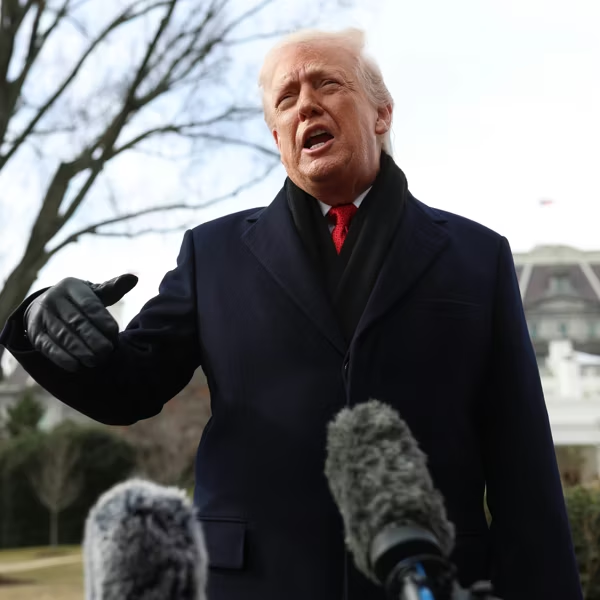
“This Tariff will be due and payable until such a time as a Deal is reached for the Complete and Total purchase of Greenland,” Trump wrote from his West Palm Beach, Florida gulf course.
The announcement seemed to deliver on a threat the president made Friday to impose tariffs on countries “if they don’t go along with” his designs on Greenland. It also ignored the sentiment of the thousands of people who marched in Denmark and Greenland’s capitals wearing red hats with the slogan, “Make America Go Away.”
“You cannot buy Greenland, you cannot buy a people. It is so wrong, disrespectful to think that you can purchase a country and a people.”
“We are demonstrating against American statements and ambitions to annex Greenland,” Camilla Siezing, chairwoman of the Inuit Association, said in a statement. “We demand respect for the Danish Realm and for Greenland’s right to self-determination.”
Julie Rademacher, chair of Uagut—an association of Greenlanders who live in Denmark that helped organize the demonstrations—said at the Copenhagen protest, as Deutsche Welle reported: “We are also sending a message to the world that you all must wake up… Greenland and the Greenlanders have involuntarily become the front in the fight for democracy and human rights.”
One Greenlander who attended the Copenhagen protest was Naja Mathilde Rosing.
“America has a sense of feeling they can steal land from the Native Americans, steal land from the Indigenous Hawaiian people, steal land from the Indigenous Inuit from Alaska,” she toldNPR. “You cannot buy Greenland, you cannot buy a people. It is so wrong, disrespectful to think that you can purchase a country and a people.”
Protests were also held in the Danish cities of Aarhus, Aalborg and Odense.
Greenland is a semiautonomous territory of Denmark with a population of nearly 57,000, 85% of whom do not want to join the United States.
Greenland’s Prime Minister prime minister Jens-Frederik Nielsen joined a crowd of 5,000 in the island’s capital city of Nuuk, where people carried signs reading, “Greenland is already great,” and “Yankee, go home,” according toCNN.
“We have seen what (Trump) does in Venezuela and Iran,” one protester, named Patricia, told CNN. “He doesn’t respect anything. He just takes what he thinks is his… He misuses his power.”
Yet Trump did not acknowledge the feelings of Greenlanders in his post on Saturday. Instead, he was focused on the actions of eight European countries that have sent small numbers of troops to the island, accusing them of “playing this very dangerous game.”
The leaders of the eight countries and the European Union pushed back against Trump’s threats.
French President Emmanuel Macron likened Trump’s designs on Greenland to Russian President Vladimir Putin’s invasion of Ukraine.
“No intimidation or threat will influence us—neither in Ukraine, nor in Greenland, nor anywhere else in the world when we are confronted with such situations,” he wrote on social media. “Tariff threats are unacceptable and have no place in this context. Europeans will respond in a united and coordinated manner should they be confirmed. We will ensure that European sovereignty is upheld. It is in this spirit that I will engage with our European partners.”
Swedish Prime Minister Ulf Kristersson posted: “We will not let ourselves be blackmailed. Only Denmark and Greenland decide on issues concerning Denmark and Greenland.”
European Commission President Ursula von der Leyen wrote: “Tariffs would undermine transatlantic relations and risk a dangerous downward spiral. Europe will remain united, coordinated, and committed to upholding its sovereignty.”
Denmark’s Foreign Minister Lars Løkke Rasmussen, meanwhile, said Trump’s tariff announcement came “as a surprise,” noting that it followed a meeting with Vice President JD Vance and Secretary of State Marco Rubio earlier in the week, which he described as “constructive.”
Trump’s latest tariff threat also drew criticism from US lawmakers.
“To threaten Denmark—and now six other NATO allies—in a crusade to take Greenland threatens to blow up the NATO alliance that has kept Americans safe and destroy our standing in the world as a trustworthy ally,” wrote Sen. Chris Coons (D-Del.), who led a bipartisan congressional delegation to Denmark that coincided with Saturday’s protests.
Rep. Don Beyer (D-Va.) said: “Trump has no legal authority to tariff American allies to bully them into backing his brainless attempt to seize Greenland. This is against the law, it’s a total disaster for America, and Republicans in Congress and the Supreme Court need to find their spines and stop it.”
“ Donald Trump wants to be Tariff King, but he’s nothing more than a tax troll with no legal authority to levy these tariffs, no support from the American people, and no support from his allies.”
Sens. Bernie Sanders (I-Vt.) and Patty Murray (D-Wash.) also called on Congress to act.
“Trump is raising tariffs on eight NATO allies because they rightly support Denmark’s sovereignty in Greenland. Destroying our closest alliances to take Greenland—which Denmark lets us use freely already—is insane. Congress must say NO,” Sanders wrote on social media.
Murray posted: “To my Republican colleagues: ENOUGH. It’s time for the Senate to vote to block these tariffs and to block the use of military force against Greenland. Trump is tearing apart our alliances in real time and the economic and diplomatic consequences will be catastrophic.”
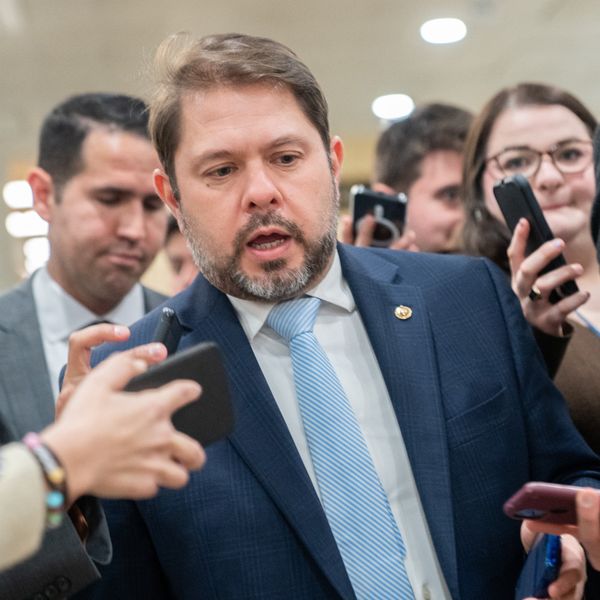
Sen. Mark Kelly (D-Ariz.) also appealed to Republican colleagues, and pointed out that it would ultimately be Americans who would pay higher prices as a result of the tariffs.
“Troops from European countries are arriving in Greenland to defend the territory from us,” he wrote on social media. “Let that sink in. And now Trump is setting tariffs on our allies, making you pay more to try to get territory we don’t need. The damage this President is doing to our reputation and our relationships is growing, making us less safe. If something doesn’t change we will be on our own with adversaries and enemies in every direction. Republicans in Congress need to stand up to Trump.”
Sen. Ed Markey (D-Mass.) posted a video from the streets of Boston, evoking the spirit of the American Revolution.
“Donald Trump wants to be Tariff King, but he’s nothing more than a tax troll with no legal authority to levy these tariffs, no support from the American people, and no support from his allies. Enough is enough,” he said.
Trump wants to be the Tariff King but he’s nothing more than a tax troll. Imposing tariffs on our allies if they don’t hand over Greenland? Enough is enough. pic.twitter.com/77Hxq59vx7
Ultimately, Trump’s ability to play “tariff king” will be determined by the Supreme Court, which could rule as soon as next week on the legality of many of his tariffs.
Elon Musk urges you to be a Fascist like him, says that you can ignore facts and reality then.Donald Fuhrump says that Amerikkka doesn’t bother with crimes or charges anymore, not being 100% Amerikkkan and opposing his real estate intentions is enough.Orcas discuss how Trump was re-elected and him being an obviously insane, xenophobic Fascist.
People march to protest against Donald Trump and his announced intent to acquire Greenland, on 17 January 2026 in Nuuk, Greenland. Photograph: Sean Gallup/Getty Images
Heads of state across Europe respond in solidarity with Denmark and Greenland, and boycott of World Cup suggested
Donald Trump threatened a 25% tariff on a slew of European countries including Denmark, Germany, France and the UK – until the US is allowed to purchase Greenland, in an extraordinary escalation of the president’s bid to claim the autonomous Danish territory.
In a lengthy post on Saturday on Truth Social, Trump said he would impose a 10% tariff on Denmark, Norway, Sweden, France, Germany, the United Kingdom, the Netherlands and Finland beginning 1 February, “on any and all goods sent to the United States of America”.
He said the tariff will increase to 25% on 1 June.
“This Tariff will be due and payable until such time as a Deal is reached for the Complete and Total purchase of Greenland,” Trump said.
The president’s longstanding interest in acquiring Greenland “one way or the other” has become a fixation since the US raid that captured Venezuelan president Nicolás Maduro earlier in January. While he has claimed the Arctic territory’s current status poses a national security threat to the US, this has been disputed by US allies, including Denmark.
Elon Musk urges you to be a Fascist like him, says that you can ignore facts and reality then.Donald Fuhrump says that Amerikkka doesn’t bother with crimes or charges anymore, not being 100% Amerikkkan and opposing his real estate intentions is enough.Orcas discuss how Trump was re-elected and him being an obviously insane, xenophobic Fascist.