Shrivelled sunflowers near the village of Kovilj, Serbia. Photograph: Andrej Isaković/AFP/Getty Image.
Slovakia reaches new high of 42C as authorities in Poland forced to shut down Kozienice and Połaniec power plants
Temperature records have been broken in several countries across central and eastern Europe as the extreme weather that has caused wildfires and droughts across the continent continues.
Countries including Slovakia, Austria and Hungary registered record temperatures. On Thursday, the Slovakian hydrometeorological agency said a new high of 42C (108F) had been reached in Dolné Plachtince.
Authorities in Poland were forced to shut down the Kozienice and Połaniec coal-fired power plants after critically low water levels in the Vistula River limited cooling water supplies. The disruption removed about 1.3GW of capacity from Poland’s power system.
In Germany, climate activists demanding an end to the use of fossil fuels demonstrated outside the chancellery against the lack of government action to keep people safe from extreme heat. An estimated 11,900 people across the country have died from heat this summer, according to new estimates from the Robert Koch Institute.
Nigel Farage urges you to ignore facts and reality and be a climate science denier like him and his Deputy Richard Tice. He says that Reform UK has received £Millions and £Millions from the fossil fuel industry to promote climate denial and destroy the planet.Donald Trump urges you to be a Climate Science denier like him. He says that he makes millions and millions for destroying the planet, Burn, Baby, Burn and Flood, Baby, Flood.Power-mad orange gasbag Donald Trump says Burn, Baby, Burn.
‘Across much of the UK, combines have been rolling earlier than usual this year.’ Photograph: Gareth Fuller/PA
Farmers battle to salvage what they can of their crops as heatwave set to continue
Britain could face shortages of certain foods after punishing drought in parts of England, the National Farmers’ Union (NFU) has warned as a heatwave was forecast to continue into next week.
The UK’s Health Security Agency (UKHSA) has issued heat health alerts for eight regions of England, with temperatures set to rise above 30C in parts of the country. UKHSA said rising temperatures may increase health risks, particularly for vulnerable groups.
Farms across the country were affected by floods over the winter, making planting extremely difficult, and now in many areas they do not have access to water as irrigation is being restricted due to drought.
It is the third drought in five years and farming groups say this is the new normal for agriculture in Britain. Wheat farmers say their crop is half its normal height, and England is seeing its earliest ever harvest as farmers battle to salvage what they can of their produce.
In some areas it has not rained for over a month, while multiple record-breaking heatwaves have hit the country since early summer, drying out the soil.
Nigel Farage urges you to ignore facts and reality and be a climate science denier like him and his Deputy Richard Tice. He says that Reform UK has received £Millions and £Millions from the fossil fuel industry to promote climate denial and destroy the planet.Donald Trump urges you to be a Climate Science denier like him. He says that he makes millions and millions for destroying the planet, Burn, Baby, Burn and Flood, Baby, Flood.Orcas comment on killer apes destroying the planet by continuing to burn fossil fuels.
Reform is also giving a platform to a number of groups belonging to the Tufton Street network – an alliance of anti-government campaign outfits that lobby for more fossil fuel extraction and keep their donors a secret.
For the second year in a row, DeSmog has been banned from attending the event, which will be held in Birmingham.
The conference will also feature Together, a prominent anti-vaccine conspiracy theory group that has launched a campaign against the UK’s 2050 net zero emissions target.
“By giving a platform to climate deniers like Net Zero Watch and the Heartland Institute, Reform is showing open contempt for the British public already living with the realities of climate breakdown,” said Tessa Khan, executive director of the research and campaign group Uplift.
“Homes are being flooded again and again, farmers are losing billions to drought, and Scotland’s firefighters are battling wildfires. This is not theory – it’s people’s lives and livelihoods at stake,” Khan said.
“Reform’s deluded energy policy wilfully ignores the fact that the UK has already burnt most of its gas. Official projections show, even with new drilling, the UK will be 94 percent reliant on expensive, dirty imports by 2050. All this while Reform seeks to block the UK from profiting from some of the world’s best resources for offshore wind.
“Our dangerous dependence on fossil fuels is exactly why energy bills are so high and why millions of families across the UK have been driven into fuel poverty. Reform knows this. And it simply does not care.”
Most senior Reform politicians, including Farage, deny basic climate science. At the Alliance for Responsible Citizenship conference in February, the Reform leader said it was “absolutely nuts” for CO2 to be considered a pollutant. In the same month, Farage’s deputy Richard Ticetold Sky News: “There’s no evidence that man-made CO2 is going to change the climate. Given that it’s gone on for millions of years, it will go on for millions of years.”
Last month, Reform’s Great Lincolnshire Mayor Andrea Jenkynssaid in an interview with Times Radio: “Do I believe that climate change exists? No.”
They have expressed these views despite representing areas exposed to the worst effects of extreme heat.
Reform received 92 percent of its donations between the 2019 and 2024 UK elections from polluting sources and climate science deniers, while its treasurer Nick Candy has claimed the party is actively raising money from oil executives.
In Farage’s constituency of Clacton, 68 percent of the public is worried about rising temperatures, according to a YouGov poll published last August – slightly above the national average of 66 percent.
A recent report by the New Economics Foundation found that Reform’s climate policies would cost more than 60,000 jobs and wipe £92 billion off the UK economy. The science of climate change is also unequivocal: scientists at the UN’s Intergovernmental Panel on Climate Change (IPCC) have stressed that “it is a statement of fact, we cannot be any more certain; it is unequivocal and indisputable that humans are warming the planet”.
DeSmog previously revealed that Reform is offering access to Farage during the conference in exchange for hefty donations. A sum of £250,000 buys 10 seats at a champagne breakfast with the Reform leader during the two-day event, as well as “chauffeur-driven travel”, a personal assistant, and the sponsor’s logo on the main conference stage and battle bus.
Reform didn’t respond to DeSmog’s request for comment.
Below is a summary of the key anti-climate groups to be given a platform at Reform’s conference.
Heartland Institute
The Heartland Institute is a U.S. climate science denial group with close ties to the Trump administration.
It has denied that humans are driving climate change, which it has called a “delusion”. The group claims it is “the world’s most prominent think tank supporting scepticism about man-made climate change”.
Heartland received at least $676,000 between 1998 and 2007 from U.S. oil giant ExxonMobil, and has received donations from foundations linked to the owners of Koch Industries – a fossil fuel giant and a leading sponsor of climate science denial.
The Heartland Institute previously told DeSmog that it ”stands resolute in its mission to advance sound science, economic prosperity, and individual liberty”. It added that “our support comes from a diverse array of individuals and organisations who share our vision for a freer, more prosperous world.”
Heartland was one of the groups involved in drafting Project 2025, the radical blueprint for Trump’s second term, which proposed reversing climate policies, slashing restrictions on fossil fuel extraction, scrapping state investment in renewable energy, and gutting the Environmental Protection Agency (EPA).
Earlier this month, President Trump hired Roy Spencer, a policy advisor at the Heartland Institute and a former fellow at the Heritage Foundation – the key group behind Project 2025 – as an advisor to the Department of Energy.
Heartland’s UK-EU director Lois Perry has claimed that the institute boasts “very strong affiliations” with “certain big individuals” in Trump’s team.
Nigel Farage attended a fundraising dinner for the institute in September 2024 during which he called for more fossil fuel extraction and the victory of Trump in November’s presidential election, saying: “Let’s get Trump back; let’s drill baby drill”.
He also advocated what he called “a bit of reverse colonialism”.
“Maybe it’s time that Heartland came and set up in Britain and Europe and brought some of the wisdom that you’ve brought to the American debate,” he said – adding: “I’d love to see Heartland on the other side of the pond.”
Farage soon got his wish. In December, Heartland announced it was setting up a UK-EU branch. The Reform leader was the “special guest of honour” at the group’s launch event in London, which also featured disgraced former Conservative prime minister Liz Truss.
Cementing his Heartland links, Farage headlined an invite-only event in June this year entitled “Net Zero: The New Brexit?” held at 55 Tufton Street.
As revealed by DeSmog, Heartland has been working closely with far-right politicians in Europe to undermine the bloc’s green reforms.
Perry, who is speaking at Reform’s conference, has previously said she does not believe climate change is caused by humans. She has said it’s her “personal belief” that climate change “is happening” but “is not man made”.
Like Farage, Perry is a former leader of the UK Independence Party (UKIP). She used to run the anti-net zero pressure group CAR26, which has claimed that carbon dioxide is “essential to all life” and that its “welcome growth has greened our planet saving countless human and other lives”.
She recently claimed on a Heartland Institute podcast that she “knows for a fact” Farage credits Heartland with helping to shape Reform’s climate policies.
Heartland Institute president James Taylor told DeSmog: “Climate realism and energy realism are gaining traction throughout the world. The Heartland Institute appreciates that the Reform Party is on board and recognises Heartland as the global leader courageously providing truthful information on these topics. We also appreciate the encouragement and support provided by many policymakers among the UK Conservative Party. A rising tide lifts all boats and we are excited to be prominently leading the charge in the UK and throughout Europe.”
Institute of Economic Affairs
The Institute of Economic Affairs (IEA) is a radical anti-government campaign group that is part of the Tufton Street network.
The IEA, which has close ties to Liz Truss, advocates for increased fossil fuel production and against state-led climate action.
The IEA is a prominent supporter of the continued and extended use of fossil fuels. The group has advocated for the ban to be lifted on fracking for shale gas, calling it the “moral and economic choice”. The IEA has also said that the ban on new North Sea oil and gas licences is “madness”, has criticised the windfall tax imposed by the UK on fossil fuel firms, and said that the previous government’s commitment to “max out” the UK’s oil and gas reserves was a “welcome step”.
In 2018, Greenpeace’s investigative journalism unit Unearthed revealed that the IEA had received funding from oil major BP every year since 1967. In response to the story, an IEA spokeswoman said: “It is surely uncontroversial that the IEA’s principles coincide with the interests of our donors.”
The IEA also received a £21,000 grant from U.S. oil major ExxonMobil in 2005. The IEA is a member of Atlas Network, a Washington-based umbrella organisation that suppors over 450 “free market” groups around the world. Both the IEA and Atlas were founded by Antony Fisher. Fisher’s daughter, Linda Whetstone, was chair of the Atlas Network as well as a director of the IEA until her death in December 2021.
The IEA does not publicly declare its donors, and it’s not known if the pressure group has received funding from BP or ExxonMobil in more recent years.
The group is currently under investigation by the Charity Commission. The IEA was approached for comment.
TaxPayers’ Alliance
The TaxPayers’ Alliance (TPA), based in 55 Tufton Street, also campaigns in favour of fossil fuel extraction and against climate policies.
The group, which claims to be a grassroots movement while being supported by anonymous private donors, has supported ending the windfall tax on oil companies, scrapping the UK’s 2050 net zero target, and restarting fracking.
The TPA was approached for comment.
Net Zero Watch
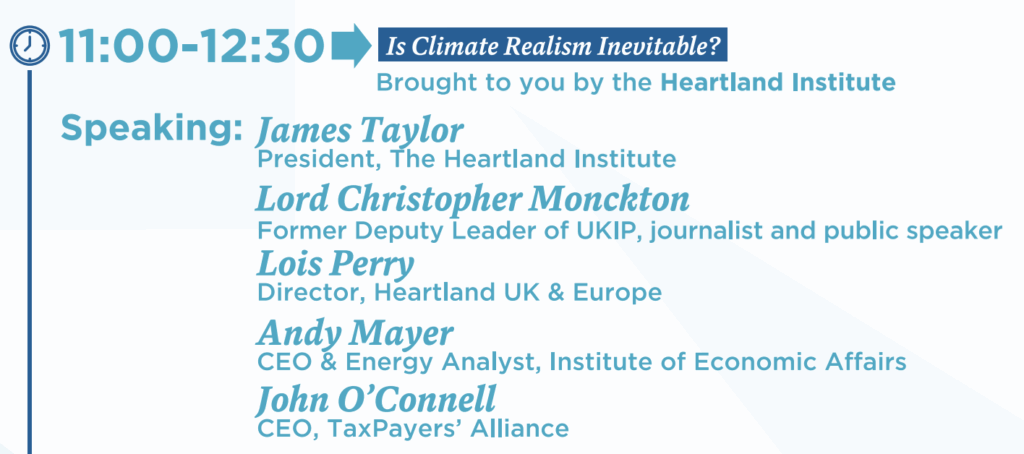
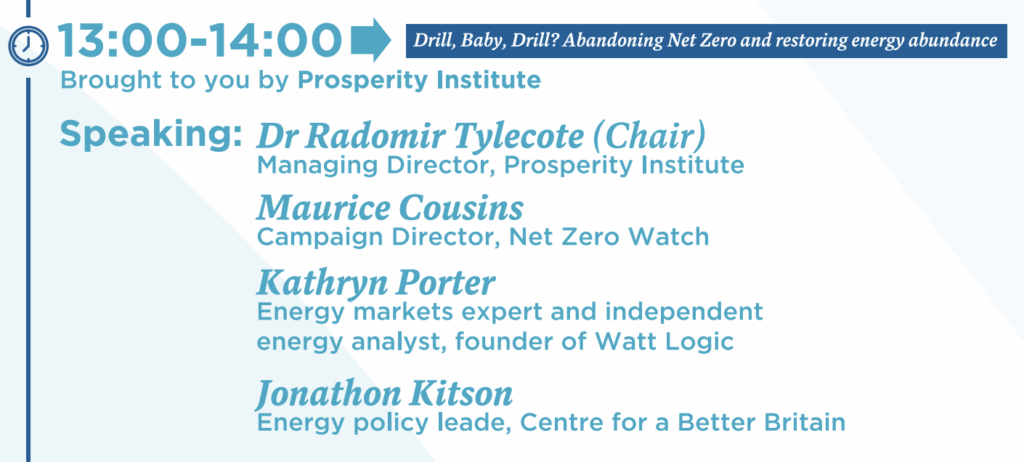
Reform’s conference will also feature Net Zero Watch – one of the UK’s most notorious anti-climate campaign groups – on a panel entitled “Drill baby drill: abandoning net zero and restoring energy abundance”.
Net Zero Watch has urged the government to “recommit to fossil fuels”, including “a new fleet of coal fired power stations”, and has called for renewable energy from wind and solar to be “wound down completely”. From May 2023 to 2025, Reform’s Andrea Jenkyns sat on the Net Zero Watch board.
In a report published last March, the GWPF claimed it was “naive and entirely unrealistic” to believe that CO2 is causing climate change, that record global temperatures are “normal”, and that “there is no observational evidence for any global climate crisis”.
The group has previously expressed the view that carbon dioxide has been “mercilessly demonised”, when in fact it is a “benefit to the planet” and should be “two or three times” higher than its current level.
Net Zero Watch campaign director will be speaking alongside Kathryn Porter, a fossil fuel industry consultant who has written several reports for the GWPF and Net Zero Watch.
Net Zero Watch and the GWPF were approached for comment.
Prosperity Institute
The Prosperity Institute – formerly known as the Legatum Institute – is hosting several events at Reform conference.
A pro-Brexit think tank, the Prosperity Institute is run by the Dubai-based investment firm Legatum Group, which co-owns the anti-climate broadcaster GB News alongside hedge fund mogul Paul Marshall. GB News employs Farage to the tune of more than £300,000 a year.
In May, after Reform’s local election gains, Prosperity published an article entitled “Farage has the power to defund Net Zero” which claimed that “energy bills have skyrocketed, industries have fled and living standards have fallen” due to the UK’s climate policies.
According to the Spectator Australia, at a Prosperity Institute event in July, Farage said he would need the think tank to bring “fresh young talent into current affairs” and provide “policy solutions we can give to the electorate next time round”.
He said “the great revolution that took place from 1979” – a reference to the election of Margaret Thatcher – was based on the “hard work and good thinking” of neo-liberal economists like Keith Joseph and Milton Friedman.
“That in many ways is your role today”, he told the Prosperity Institute audience – urging the group to produce “the ammunition” to “those of us on the front lines”.
As revealed by DeSmog, the Prosperity Institute previously donated £50,000 to the New Conservatives – a faction of the Conservative Party.
Centre for a Better Britain
The conference will also feature the Centre for a Better Britain – a new Reform-aligned think tank set to launch this month.
The group is funded by Mark Thompson, an investor with interests in metals, fossil fuels, and renewable energy, and his business associate David Lilley, a senior metals trader and former Conservative donor who has given over £270,000 to Reform.
The Centre for a Better Britain, which is attempting to raise £25 million – including from Trump donors – intends to “support Reform with policy development, briefing and rebuttal,” according to plans seen by the Financial Times.
The think tank is chaired by James Orr, a Cambridge academic who has been described as the “philosopher king” of U.S. Vice President JD Vance.
Orr has expressed radical anti-climate positions, claiming in an interview with the European Conservative last month that the UK’s energy policies are “crazy” and that the pursuit of net zero is “fiscal suicide”.
At an event in Hungary last month hosted by the oil-funded think tank Mathias Corvinus Collegium (MCC), Orr also accused the UK of adopting a “naive and dangerous” approach to Russia’s invasion of Ukraine and instead praised Hungary’s approach, which has seen the country systematically block and delay EU military aid packages, and sanctions on Russian oligarchs.
In the European Conservative interview, Orr suggested the war was a “regional Slavic conflict”.
“It is a conflict happening in the world that I don’t care very much about,” he added.
Farage, who used to appear regularly on state broadcaster Russia Today, has previously said that Putin is the world leader that he most admires, though he has also called him a “bad man”.
Together and Farmers to Action
Established in 2021 to oppose mandatory Covid-19 protection measures, such as lockdowns and vaccines, Together has since launched a “no to net zero” campaign that calls for the UK to scrap climate policies.
In January last year, the group said it was “incredible” that the then prime minister Rishi Sunak should “mindlessly assert ‘Covid vaccines are safe’” in a post on X. It has also backed a report which called for the government to pause its vaccination programme over a number of widely debunked conspiracy theories about its safety, including that the vaccine alters human DNA.
Together has recently partnered with Farmers To Action – a protest group also set to feature at Reform’s conference. The group has used recent anti-inheritance tax campaigns to spread anti-climate views.
The leader of Farmers to Action, Justin Rogers, has claimed that “climate change is one of the biggest scams that has ever been told”, propagated by “our governments and their puppet masters.” He has also claimed that oil and gas are renewable, and that carbon dioxide cannot be dangerous because it “feeds plants”.
At an event co-hosted by Together and Farmers to Action in February, Farage endorsed a conspiracy theory popular among the far-right.
Speaking in front of around 50 tractors at Belmont Farm in North London, Farage insinuated that the Labour government had a “sinister agenda” to acquire “lots of land because they’re planning for another five million people to come into the country”.
This claim is borne from the “Great Replacement” conspiracy theory, which holds that progressive immigration policies are a mechanism to replace white people in the West, and has been cited by Donald Trump in recent months.
Farmers to Action and Together were approached for comment.
Nigel Farage urges you to ignore facts and reality and be a climate science denier like him. He says that Reform UK has received millions and millions from the fossil fuel industry to promote climate denial and destroy the planet.Nigel Farage explains the politics of Reform UK: Racism, Fake anti-establishmentism, Deregulation, Corporatism, Climate Change Denial, Mysogyny and Transphobia.Nigel Farage reminds you that he’s the man that brought you Brexit and asks what could possibly go wrong.
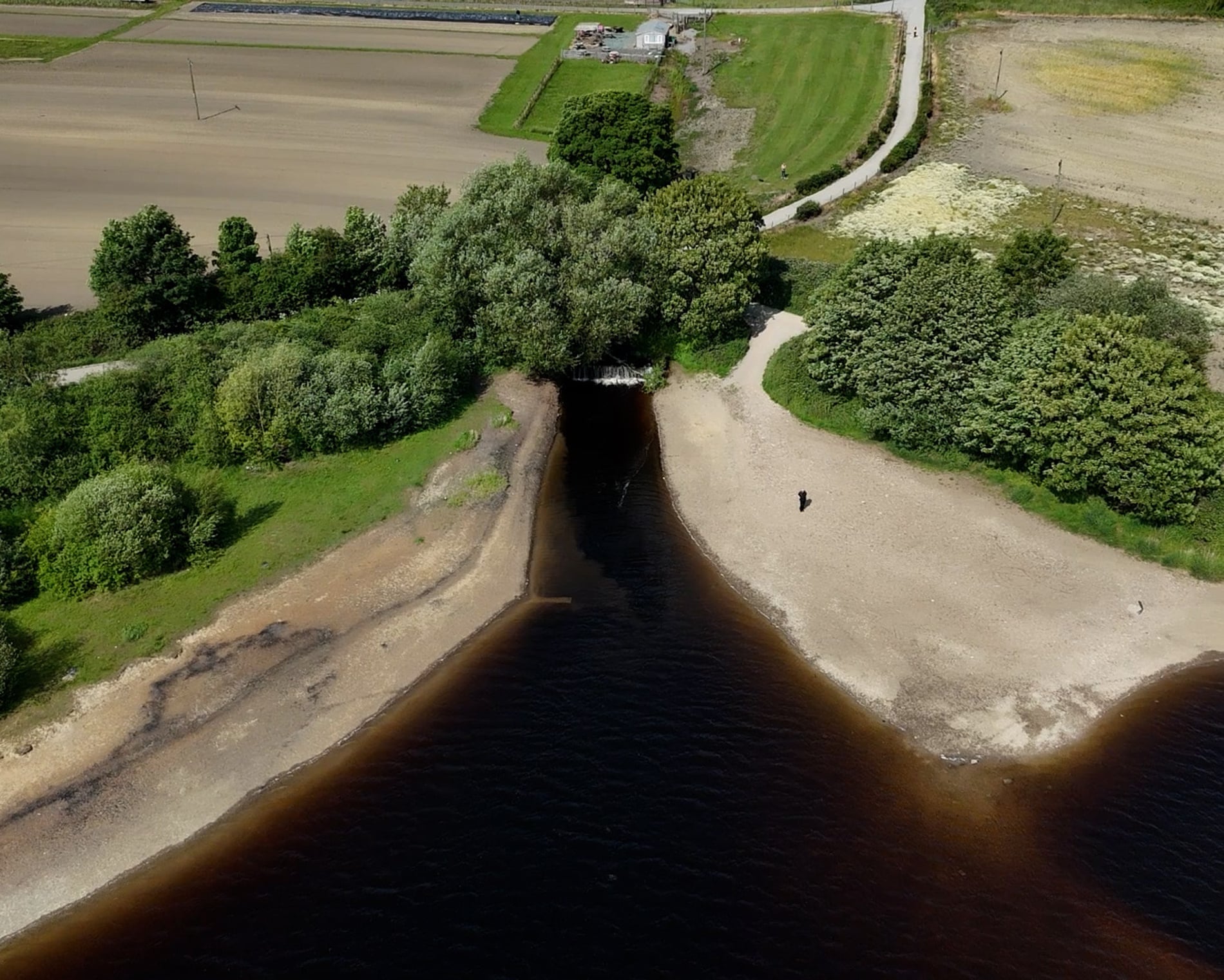
Ardsley reservoir near Wakefield, West Yorkshire. This year was Yorkshire’s warmest spring for mean temperature since records began in 1884. Photograph: Richard McCarthy/PA
Hosepipe bans possible as low reservoir levels make region second in England to enter drought status
Yorkshire has become the second area of England to enter drought after the country recorded its driest spring in 132 years.
Hosepipe bans could be possible if the region did not have significant rainfall in the coming weeks as, despite recent showers, reservoir stocks were continuing to dwindle. Yorkshire Water reservoir stocks dropped 0.51% over the last week to 62.3%, significantly below the average of 85.5% for this time of year.
Last month, north-west England entered drought status as reservoir levels fell to half their capacity. Much of the rest of the country is in prolonged dry status, which is the step before drought.
Warm and dry weather is forecast, and long-range forecasts suggest a greater-than-normal chance of a hot summer.
Met Office data shows Yorkshire recorded its warmest spring for mean temperature this year since records began in 1884.
…
Claire Barrow, the Environment Agency’s planning manager for Yorkshire, said: “Our climate is changing, and we had 22 days of almost no recorded rainfall in May.
“While we have had some rain at the start of June, it has not been enough to reverse the impacts of the prolonged dry weather.
From May 11 to 20, 42 percent of soils in Europe and the Mediterranean basin lacked moisture and were at a warning level, while five percent were at an alert level, indicating vegetation was not growing normally.
Countries in northern, central and eastern Europe were at high alert levels.
Roughly 19 percent of territory in Ukraine was on alert, with other countries in concerning circumstances, including nine percent of Hungary and Slovakia, 10 percent of Poland and 17 percent of lands in Belarus.
The alert level for some territories and countries was as high as 20 percent, including the Palestinian territories, Cyprus and Syria.
Several countries were experiencing drought conditions in mid-May without being at an alert level, including 98 percent of the United Kingdom. According to the UK’s Met Office, the country had its driest spring in over 50 years, as well as its warmest spring ever recorded.