Tag: drought

  • How the weather got ‘stuck’ over the UK – and produced an unusually dry and warm spring

    Spread the love
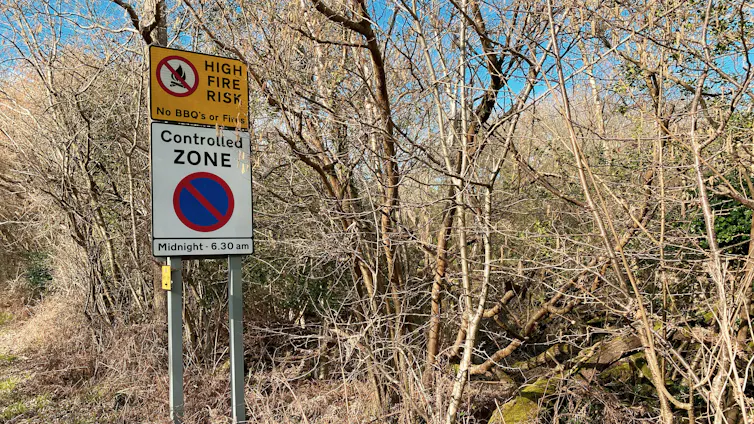
    Wildfires have ignited in forests and on moorland across the UK in recent months. LSP EM/Shutterstock

    Simon H. Lee, University of St Andrews and Matthew Patterson, University of St Andrews

    A “blocking” weather system lingering high above the UK has produced one of the driest, warmest and brightest starts to spring on record.

    April 2025 was the sunniest since records began in 1910. This followed the third-sunniest March, and both months saw temperatures well above average nationwide. On May 1, the temperature reached 29.3°C in Kew Gardens in London – a new record for the date.

    Meteorologists are warning of the potential for a summer drought, as the UK has seen roughly half its usual amount of rainfall for March and April. While farmers fret about this year’s harvest, some water companies are urging customers to help reservoir levels recover by limiting water use.

    Meanwhile, wildfires have engulfed forest and moorland in areas of Scotland, Wales and England.
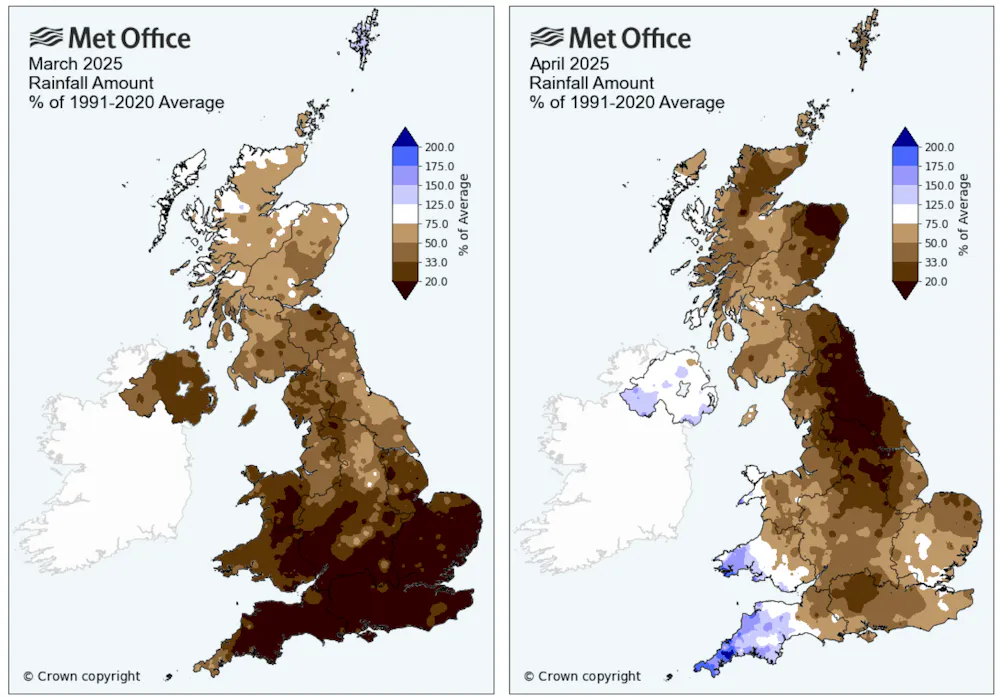
    Two maps of the UK, showing mostly dark brown colours which indicate rainfall below 50% of normal.
    Most of the UK has experienced a record-dry spring so far. Met Office

    For several weeks, a stubborn area of high pressure over the UK has diverted the usual flow of mild, moist air from the North Atlantic like a boulder in a river. This is known as a blocking weather system.

    Within it, air descends, warms and dries, which is why this weather pattern tends to be linked to heatwaves and drought. Blocking is usually persistent, making it seem like the weather is stuck.

    Here’s how climate change may have played a role in setting up this unusual spring.


    Get your news from actual experts, straight to your inbox. Sign up to our daily newsletter to receive all The Conversation UK’s latest coverage of news and research, from politics and business to the arts and sciences. Join The Conversation for free today.


    The human fingerprint

    The warming climate means that unusually warm weather is occurring more often and becoming more intense. At the same time, we can expect more periods of both severe drought and extreme rainfall. Sudden changes from drought to deluge, termed “weather whiplash”, are due to the intensification of the water cycle in a warmer atmosphere that can hold more water vapour.

    However, certain weather patterns are necessary to produce extreme weather. More blocking events in future could increase the chance of heatwaves or drought. But are blocking weather patterns becoming more common?

    It’s difficult to determine how weather patterns will change as a result of the rising concentration of greenhouse gases in the atmosphere, which is predominantly caused by the burning of fossil fuels.

    Part of the difficulty arises from the fact that weather patterns vary year to year. Several years in a row with more blocking events than usual could make it seem like blocking is increasing due to climate change, but it could simply be down to chance.

    As a result, it is difficult to detect the fingerprint of human activity from weather observations alone. For example, blocking weather patterns over Greenland during summer have happened more often in recent decades, which can enhance the melting of the ice sheet. But it isn’t clear that this trend is the result of human-induced climate change.

    Climate models do suggest future changes in the occurrence of blocking, however. These computer simulations, consisting of equations that describe the fundamental physics of the atmosphere, are the main tool scientists use to perform experiments that parse how the climate will behave in future.
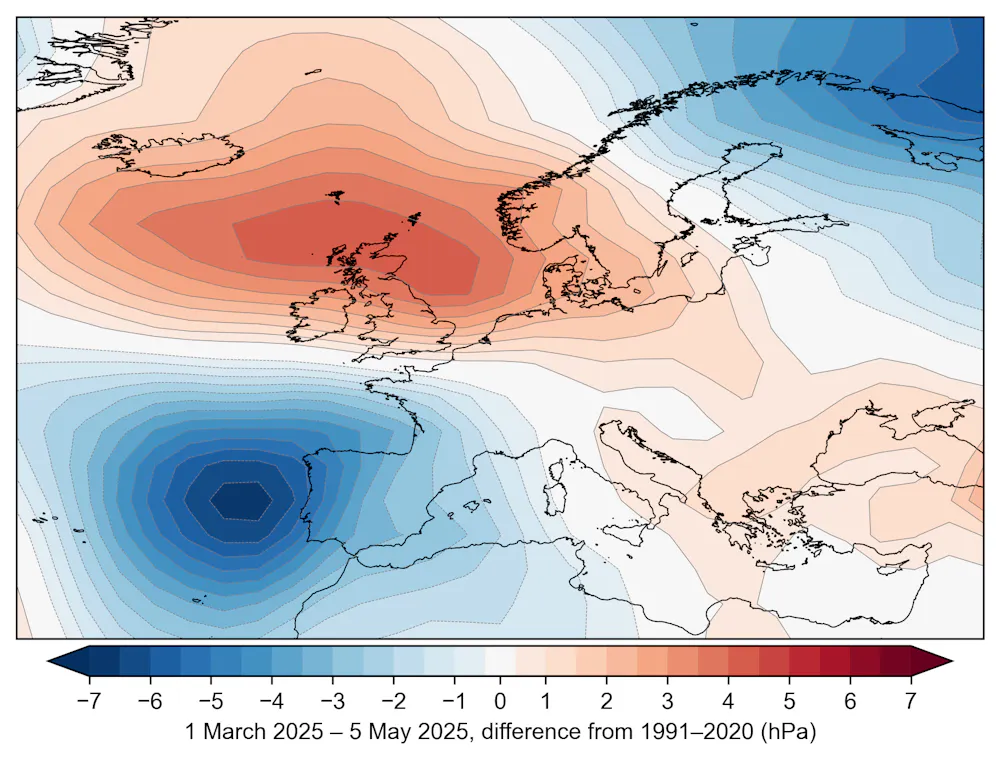
    A map of pressure anomalies over Europe.
    The blocking system is visible in the area of high pressure over Britain and Ireland. National Centers for Environmental Prediction/National Center for Atmospheric Research/NOAA Physical Sciences Laboratory, CC BY

    When scientists run climate model simulations with increased greenhouse gas concentrations the results consistently show a decrease in blocking events. But blocking generally happens more often in real life than model simulations, which reduces the confidence scientists have in future projections.

    Keeping track of the jet stream

    The movement of weather systems in Earth’s mid-latitudes – including over the UK – is linked to the jet stream, which is a fast-flowing river of air driven by the contrast in temperature between the poles and mid-latitudes.

    Some researchers have suggested that, because the Arctic is warming faster than the tropics, the jet stream may weaken and become more “wavy”, increasing the occurrence of blocking events, contrary to what most climate models show.

    Outside of the scientific community, this idea has become popular. However, the hypothesis remains controversial among scientists, and observational evidence has weakened in recent years.

    In fact, around ten kilometres above the Earth’s surface, near commercial aircraft cruising altitudes, the opposite trends are occurring: the temperature difference between the Arctic and mid-latitudes is increasing, acting to increase the strength of the jet stream.

    There are considerable challenges with understanding how climate change is affecting the large-scale atmospheric patterns which drive the weather we experience. These include large natural variability and imperfect climate models. Models mostly suggest a decline in blocking events with climate change, though this remains relatively uncertain compared with other aspects of the science.

    Overall, we can be confident that climate change is bringing warmer conditions in all seasons. Scientists also have strong evidence to suggest that drought conditions will become more common. These changes are already affecting food production, energy generation and water availability and these impacts will continue to worsen with climate change.


    Don’t have time to read about climate change as much as you’d like?
    Get a weekly roundup in your inbox instead. Every Wednesday, The Conversation’s environment editor writes Imagine, a short email that goes a little deeper into just one climate issue. Join the 45,000+ readers who’ve subscribed so far.


    Simon H. Lee, Lecturer in Atmospheric Science, University of St Andrews and Matthew Patterson, Research Fellow in climate and machine learning, University of St Andrews

    This article is republished from The Conversation under a Creative Commons license. Read the original article.
  • ‘This Is Unprecedented’: Several Horrific Wildfires Ravage Los Angeles

    Spread the love

    Original article by Jake Johnson republished from Common Dreams under Creative Commons (CC BY-NC-ND 3.0).

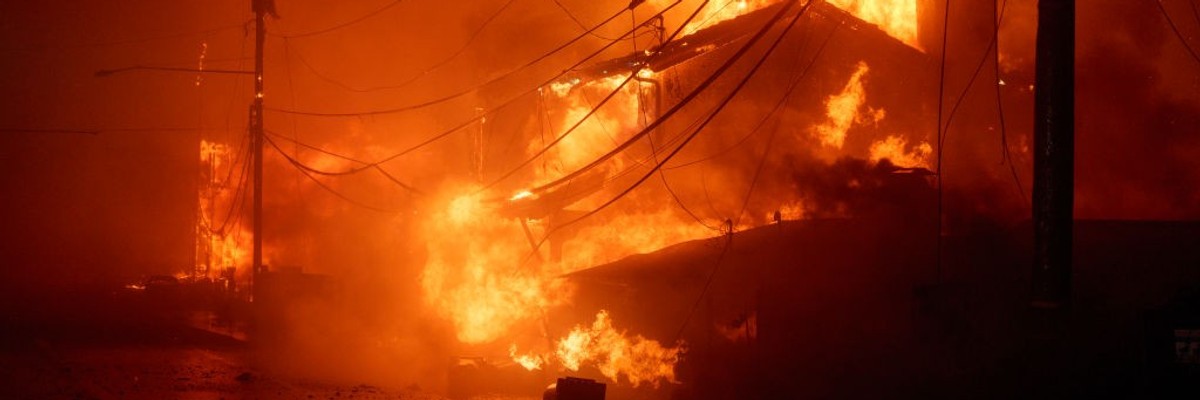
    Flames from the Palisades fire burn homes on January 7, 2025 in the Pacific Palisades neighborhood of Los Angeles, California. (Photo: Eric Thayer/Getty Images)

    “There is no ‘firefighting’ in these kinds of conditions,” said one meteorologist. “There is only saving as many lives as possible and getting the heck out of the fire’s way.”

    Several major wildfires burned out of control in California’s Los Angeles County on Wednesday as roaring winds fueled the rapid spread of the blazes, forcing tens of thousands to evacuate as state, local, and federal officials mobilized resources to confront the emergency.

    Los Angeles Mayor Karen Bass wrote on social media late Tuesday that the city is “working aggressively” to stem the wildfires, which scientists and government officials characterized as uniquely devastating.

    “Emergency officials, firefighters, and first responders are all hands on deck through the night to do everything possible to protect lives,” California Gov. Gavin Newsom said early Wednesday. The governor noted that more than 1,400 firefighting personnel have been deployed to “combat these unprecedented fires.”

    The Palisades, Eaton, and Hurst fires broke out on Tuesday. It quickly exploded amid what the National Weather Service described as “extremely critical fire weather,” with wind gusts up to 99 mph propelling the devastating blazes. The extreme winds forced emergency crews to ground aircraft that were working to contain the fires.

    “For some context, fire crews are up against near hurricane-force winds occurring mid-winter in rugged terrain during a drought at night,” wrote meteorologist Eric Holthaus. “There is no ‘firefighting’ in these kinds of conditions. There is only saving as many lives as possible and getting the heck out of the fire’s way.”

    “The emergence of extreme wintertime wildfires in California presents one of those classic ‘this is climate change’ moments.”

    The Eaton fire, which broke out Tuesday evening in the Pasadena area, “spread so rapidly that staff at a senior living center had to push dozens of residents in wheelchairs and hospital beds down the street to a parking lot,” The Los Angeles Times reported.

    “The residents waited there in their bedclothes as embers fell around them until ambulances, buses, and even construction vans arrived to take them to safety,” the newspaper added.

    The three fires have together burned thousands of acres so far and destroyed or endangered tens of thousands of homes and buildings, according to Newsom’s office. So far, at least 19 school districts have announced complete or partial closures due to the fires.

    Video footage posted to social media showed residents watching in horror as flames surrounded their homes:

    https://twitter.com/i/status/1876845562328146405

    Sorry, this content could not be embedded.
    X

    Another video shows residents attempting to salvage as many belongings as possible before fleeing:

    https://twitter.com/i/status/1876845004745748780

    Sorry, this content could not be embedded.
    X

    “There has been a recent massive increase in wildfires in California but really, a fire this big in January? This is unprecedented,” scientist Hayley Fowler wrote on social media. “One of many extreme events fueled by the climate crisis.”

    Holthaus wrote Tuesday that Southern California is “facing a rare and dangerous juxtaposition of extreme winds and midwinter drought,” the meteorologist described as “a worrying example of the state’s expanding wildfire threat as climate change worsens.”

    “The National Weather Service defines ‘extremely critical’ fire weather as sustained winds over 30 mph and relative humidity of less than 10% in drought conditions and temperatures warmer than 70 degrees,” Holthaus observed. “This is the first time in history these criteria have been met anywhere in the United States during January.”

    “The emergence of extreme wintertime wildfires in California,” he added, “presents one of those classic ‘this is climate change’ moments: A specific set of weather conditions are now occurring in such a way to produce the potential for rare disasters to become much more common.”

    Original article by Jake Johnson republished from Common Dreams under Creative Commons (CC BY-NC-ND 3.0).

  • Humanity’s Chance to Reverse Amazon’s Slide Toward Tipping Point Is ‘Shrinking’

    Spread the love

    Original article by Eloise Goldsmith republished from Common Dreams under Creative Commons (CC BY-NC-ND 3.0).

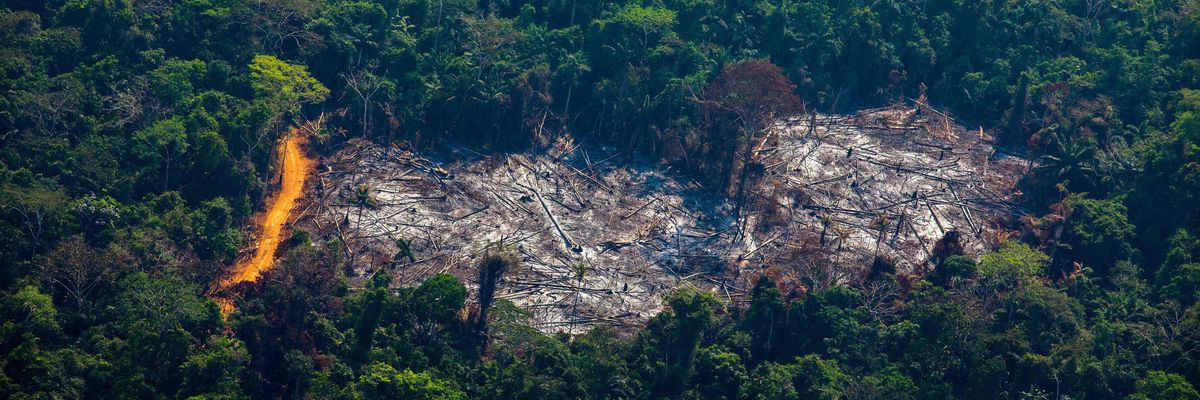
    This aerial view shows Amazon forest degradation in the Menkragnoti Indigenous Territory in Altamira, Pará state, Brazil, on August 28, 2019. (Photo: Joao Laet/AFP/Getty Images)

    The world’s largest rainforest showed “ominous indicators,” including wildfires and extreme drought, in 2024.

    The Amazon, sometimes called the “lungs of the planet,” this year showed signs of further inching toward a much-feared tipping point, threatening the very existence of the world’s largest rainforest.

    Rampant wildfires and extreme drought ravaged large parts of the Amazon in 2024. The fires and dry conditions were fueled by deforestation and the El Niño weather pattern, and also made worse by climate change, according to the World Economic Forum. “The number of fires reached its highest level in 14 years this September,” the group reported in October.

    Drought has also impacted the Amazon River, causing one of the river’s main tributaries to drop to its lowest level ever recorded, according to October reporting from The Associated Press. The drop in the river has negatively impacted local economies and food supplies.

    Andrew Miller, advocacy director at Amazon Watch, told the AP last week that the fires and droughts experienced across the Amazon in 2024 “could be ominous indicators that we are reaching the long-feared ecological tipping point.”

    “Humanity’s window of opportunity to reverse this trend is shrinking, but still open,” he said.

    The Amazon plays a vital role in keeping the planet healthy. 150-200 billion tons of carbon are stored in the Amazon, and it also carries 20% of the earth’s fresh water to sea.

    According to the World Economic Forum, if the Amazon tipping point is reached, “it will release billions of tonnes of CO2 into the atmosphere through fires and plants dying off. This would further exacerbate climate change and make the 1.5°C goal impossible to achieve. It would also alter weather patterns, which would impact agricultural productivity and global food supplies.”

    A paper published in the journal Nature in February indicates that up to half of the rainforest could hit a tipping point by the middle of the century. “We estimate that by 2050, 10% to 47% of Amazonian forests will be exposed to compounding disturbances that may trigger unexpected ecosystem transitions and potentially exacerbate regional climate change,” explained the researchers behind the paper.

    However, it wasn’t all bad news out of the Amazon in 2024. According to the AP, the amount of deforestation in Brazil and Colombia declined in this year. In Brazil, which houses the largest chunk of the Amazon, forest loss dropped 30.6% compared to the year prior, bringing it to the lowest level of destruction in nearly a decade.

    The improvement is an about-face from a couple of years ago, when the country registered 15-year high of deforestation during the leadership of former far-right President Jair Bolsonaro. Brazil is now led by the left-wing President Luiz Inácio Lula da Silva, who—despite presiding over this drop in deforestation—has also come under scrutiny, as AP noted, by environmentalist for backing projects that they argue could harm the environment.

    Original article by Eloise Goldsmith republished from Common Dreams under Creative Commons (CC BY-NC-ND 3.0).

  • COP29 puts world on course for more extreme weather – and more deaths

    Spread the love

    Original article by Paul Rogers republished from Open Democracy under a Creative Commons Attribution-NonCommercial 4.0 International licence.

    After a disappointing COP29, we should prepare for more extreme weather events like the floods that hit Valencia last month
     | David Ramos/Getty Images

    Summit proves change won’t come until floods and wildfires are killing tens of thousands in rich Global North cities

    While COP29 in Baku narrowly avoided collapsing, its results were bitterly disappointing for delegations from across the Global South, who ended up with barely a quarter of the annual $1.3trn of support they were seeking by 2035 to respond to climate breakdown.

    Quite apart from other factors, more than 1,500 pro-carbon lobbyists worked hard to limit progress and ensure that burning oil, gas and coal at profit continues for as long as possible whatever the global consequences. After all, the world’s fossil fuel industries rake in around a trillion dollars in profits a year.

    Meanwhile, more and more examples are emerging of accelerating climate breakdown. The flooding in Valencia is just one, but scarcely noticed in Europe is the thoroughly weird weather being experienced in the eastern United States.

    This autumn there have been over five hundred wildfires in New Jersey alone, a 5,000-acre fire has been burning for a week on the New York-New Jersey border prompting a voluntary evacuation, and New York City’s Fire Department was called out to deal with 271 brush fires in the first two weeks of November alone.

    As if timed for that and certainly released with COP29 in mind, Carbon Brief, a website covering the latest developments in climate science, climate policy and energy policy, has mapped every published study on ‘impossible’ weather events – record heatwaves or storms that would not have happened without the overall global climate changes.

    The first such study came in 2004, the year after weeks of extreme heat hit Europe and killed 70,000 people across the continent over several months. That early example of an ‘impossible’ weather event kick-started a new field of research known as ‘extreme event attribution’, which looks at how climate change has influenced extreme weather.

    There are now 600 studies of 750 such extreme events spanning the past 20 years – a tiny fraction of the total number of these kinds of events. Of these 750, Carbon Brief found that scientists and researchers had concluded that 74% were made more likely or more severe because of climate change.

    This has added to the growing sense of urgency right across the climate science community coupled with a highly critical view of the whole COP process. Even before the dismaying summit in the Azerbaijani capital, both last year’s COP in Abu Dhabi and the year before in Egypt were notable for their lack of progress even as the urgency of preventing climate breakdown was becoming more and more obvious.

    There are other risks to global security including nuclear weapons, pandemics, cyber warfare, AI misuse and the progressive destruction of biodiversity, but climate breakdown is different from all of these. It is not a future risk, it is a current happening, it is accelerating, and we now have very few years left to get on top of it. If we don’t then a worldwide catastrophe with many hundreds of millions dying and societal collapse will become increasingly likely.

    Does it have to be like that?

    As things stand, in terms of changing attitudes, developments in renewables, resistance of the fossil carbon industries and, of course, Donald Trump’s looming presidency in the US, a reasonable prognosis for the next decade has three elements.

    First, the use of renewable energy resources does continue to increase but not at anything like the rate required, so net carbon emissions will continue to rise, not fall, for most of the next ten years. Second, resistance to decarbonisation will continue from many quarters, no doubt now including the White House. Finally, severe weather events will become both more common and more destructive.

    Eventually, and it might take more than a decade, the disasters will be so great, including sudden weather events in rich cities in the Global North killing many tens of thousands of people, that public pressure across the world will force governments to respond. There will be no alternative to engage in truly transformative change.

    But what that means is that the task ahead by then will be hugely greater than if the transformation starts much sooner, so timescales become crucial, especially what can speed up the process.

    There is, though, one thing to remember at a time of widespread pessimism. If nations had got their act together 25 years ago after the Kyoto Protocols, were signed we would be in a far more favourable position worldwide than we are now. We are acting more than two decades late.

    But climate breakdown is not happening as a slow, steady process of change, creeping up almost unawares. If that had been the case then with all the reasons not to act, especially the global fossil carbon lobby, we would have been in an even worse position now. Instead, it is happening at variable rates in two respects, some parts of the world – such as the polar regions – are warming up much faster than others and extreme weather events are happening much more often.

    We are therefore getting a foretaste of what will affect everyone a few years before it does, and this gives us just a little more time to act. It means that the next ten years, and perhaps even the five years to 2030, will be the key time for us to come to terms with the transformation in society that is essential for global well-being. That is possible, just.

    Original article by Paul Rogers republished from Open Democracy under a Creative Commons Attribution-NonCommercial 4.0 International licence.

  • Record Amazon Basin Drought Impacts 420,000 Children: UNICEF

    Spread the love

    https://www.ecowatch.com/amazon-basin-drought-impacts-children-unicef.html

    In Brazil’s Amazon region, more than 1,700 schools and 760 health centers have been shuttered or become inaccessible due to drought. A scene from Tabatinga, Amazonan State, Brazil in October 2024. UNICEF / UNI671256 / Diogenes

    A drought in much of South America impacts more than 420,000 children living in the Amazon basin, according to new estimates from UNICEF.

    The record-breaking drought — ongoing since last year — has left rivers in the region at an all-time low, a press release from UNICEF said.

    The lack of rain has affected river transportation and water supplies for Indigenous children and their communities in Colombia, Brazil and Peru. Families use the rivers to access and transport water, food, fuel and medical supplies. The children also use them to travel to school.

    “For centuries the Amazon has been home to precious natural resources. We are witnessing the devastation of an essential ecosystem that families rely on, leaving many children without access to adequate food, water, health care and schools,” said Executive Director of UNICEF Catherine Russell in the press release.

    Food insecurity caused by the drought has increased malnutrition risk in the region’s children, while restricted access to drinking water could lead to an increase in infectious diseases, UNICEF said, as AFP reported.

    “Food insecurity caused by drought increases the risk of malnutrition, stunting and wasting, and death in children,” the press release said. “Research has also found that pregnant women who experience droughts are likely to have children with lower birth weights.”

    In the Brazilian Amazon, more than 760 medical clinics and over 1,700 schools have become inaccessible or were forced to close due to low river levels.

    …

    Article continues at https://www.ecowatch.com/amazon-basin-drought-impacts-children-unicef.html