As Planet Burns, Shell Reports $5 Billion in Profits and Plans to Ramp Up Fossil Fuels

Spread the love

Original article by JAKE JOHNSON republished from Common Dreams under Creative Commons (CC BY-NC-ND 3.0).
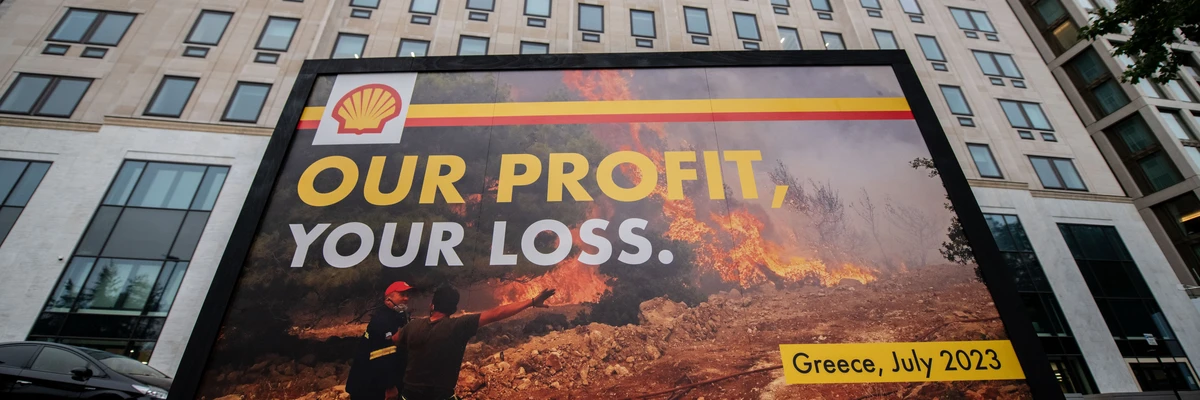
Greenpeace activists display a billboard during a protest outside Shell headquarters on July 27, 2023 in London.
Greenpeace activists display a billboard during a protest outside Shell headquarters on July 27, 2023 in London. (Photo: Handout/Chris J. Ratcliffe for Greenpeace via Getty Images)

“Every house burnt to the ground, every town forced to evacuate, every ecosystem lost to a wildfire is a necessary consequence of a business model like Shell’s.”

With much of the world reeling from record-shattering heat and devastating wildfires, the London-based oil giant Shell is poised to ramp up its investments in planet-warming fossil fuels after ditching its plan to cut oil production.

An analysis released Thursday by the rights group Global Witness estimates that Shell’s investments in oil and gas projects are set to surge to around $14.5 billion this year, a 10% increase over 2022. The company is expected to spend far less on what it defines as “renewables and energy solutions.”

“Fossil fuels are the number one cause of climate breakdown, which is stoking extreme heatwaves, forest fires, and drought,” said Jonathan Noronha-Gant, a senior campaigner at Global Witness. “Every house burnt to the ground, every town forced to evacuate, every ecosystem lost to a wildfire is a necessary consequence of a business model like Shell’s, which prioritizes short-term cash grabs over the safety and survivability of our societies.”

The new analysis came as Shell reported $5.1 billion in second-quarter profits, a major decline compared to the company’s record-setting $11.5 billion in profits during the same period last year. Despite the profit dip, which Shell blamed on falling oil and gas prices, the company announced a 15% quarterly dividend increase and $3 billion in stock buybacks.

“CEO Wael Sawan’s fossil fuel direction continues to be solely aimed at profit for shareholders,” Nine de Pater, a campaigner with Friends of the Earth Netherlands, said in a statement. “This is immoral and completely irresponsible. We are seeing the impact of the climate crisis around the world this summer: the wildfires in Greece and heat records in southern Europe, Algeria, and India, among others, and the floods in Italy and Afghanistan.”

“Shell’s profits clearly show that the company chooses profits over human lives,” she added.

Shell, which has known about the climate impacts of burning fossil fuels since the 1970s, announced last month that it intends to boost gas production in the coming years while abandoning its plan to reduce oil production by up to 2% per year.

In an interview weeks after the announcement, Sawan claimed it would be “dangerous and irresponsible” to curb oil and gas production even as scientists say that’s exactly what’s needed to avert catastrophic warming.

Global Witness recently estimated that Shell’s reversal on oil production could generate an average of “29 million tonnes of extra carbon per year, almost as much as Denmark emits annually.”

“By 2030,” the group added, “Shell’s extra estimated emissions would be as much as Spain—one of Europe’s largest polluters—produces in one year.”

Original article by JAKE JOHNSON republished from Common Dreams under Creative Commons (CC BY-NC-ND 3.0).
Continue ReadingAs Planet Burns, Shell Reports $5 Billion in Profits and Plans to Ramp Up Fossil Fuels

What is a flash drought? An earth scientist explains

Spread the love
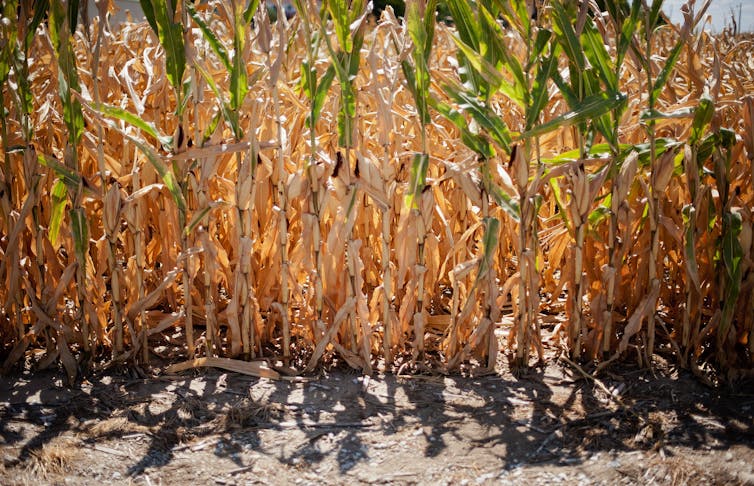
As of June 20, 2023, 64% of the U.S. corn crop faced moderate or more intense drought. Jim Watson/AFP/GettyImages

Antonia Hadjimichael, Penn State

Many people are familiar with flash floods – torrents that develop quickly after heavy rainfall. But there’s also such a thing as a flash drought, and these sudden, extreme dry spells are becoming a big concern for farmers and water utilities.

Flash droughts start and intensify quickly, over periods of weeks to months, compared to years or decades for conventional droughts. Still, they can cause substantial economic damage, since communities have less time to prepare for the impacts of a rapidly evolving drought. In 2017, a flash drought in Montana and the Dakotas damaged crops and grasses that served as forage for cattle, causing US$2.6 billion in agricultural losses.

Flash droughts also can increase wildfire risks, cause public water supply shortages and reduce stream flow, which harms fish and other aquatic life.

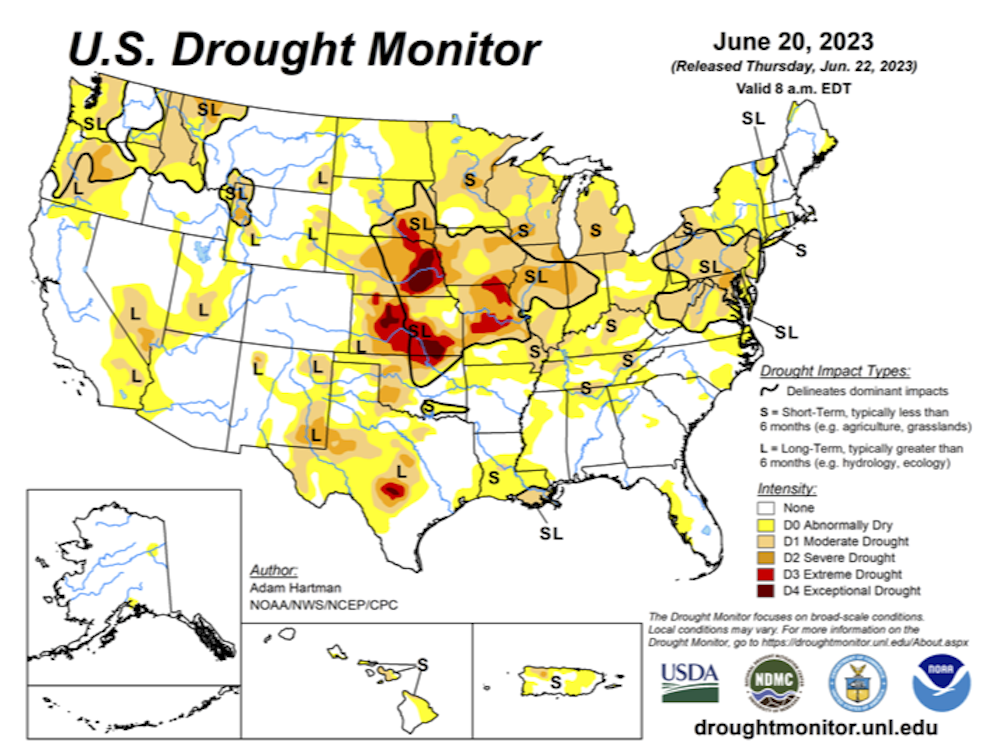
Map of drought regions in U.S. with central Plains highlighted.
A developing flash drought in the central U.S. covered 64% of corn territory and 57% of soybean territory in late June 2023. Areas marked S are under short-term drought. U.S. Drought Monitor via USDA

Less rain, warmer air

Flash droughts typically result from a combination of lower-then-normal precipitation and higher temperatures. Together, these factors reduce overall land surface moisture.

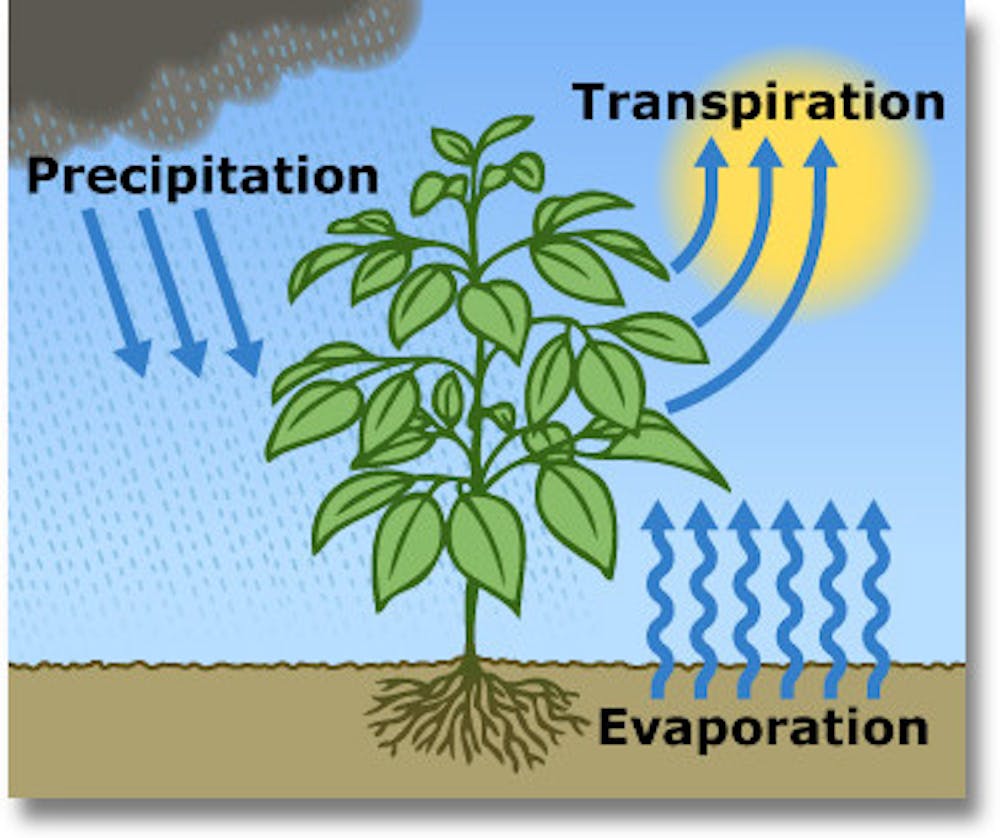
Water constantly cycles between land and the atmosphere. Under normal conditions, moisture from rainfall or snowfall accumulates in the soil during wet seasons. Plants draw water up through their roots and release water vapor into the air through their leaves, a process called transpiration. Some moisture also evaporates directly from the soil into the air.

Graphic showing precipitation, evaporation and transpiration between soil and the atmosphere
Water constantly circulates between soil and the atmosphere – sometimes directly, sometimes via plants. USGS

Scientists refer to the amount of water that could be transferred from the land to the atmosphere as evaporative demand – a measure of how “thirsty” the atmosphere is. Higher temperatures increase evaporative demand, which makes water evaporate faster. When soil contains enough moisture, it can meet this demand.

But if soil moisture is depleted – for example, if precipitation drops below normal levels for months – then evaporation from the land surface can’t provide all the moisture that a thirsty atmosphere demands. Reduced moisture at the surface increases surface air temperatures, drying out the soil further. These processes amplify each other, making the area increasingly hot and dry.

Moist regions can have flash droughts

Flash droughts started receiving more attention in the U.S. after notable events in 2012, 2016 and 2017 that reduced crop yields and increased wildfire risks. In 2012, areas in the Midwest that had had near-normal precipitation conditions through May fell into severe drought conditions in June and July, causing more than $30 billion in damages.

New England, typically one of the wetter U.S. regions, experienced a flash drought in the summer of 2022, with areas including Boston and Rhode Island receiving only a fraction of their normal rainfall. Across Massachusetts, critically low water levels forced towns to issue mandatory water restrictions for residents.

Planning for flash droughts in a changing climate

Conventional droughts, like the Dust Bowl of the 1930s or the current 22-year drought across the southwestern U.S., develop over periods of years. Scientists rely on monitoring and prediction tools, such as measurements of temperature and rainfall, as well as models, to forecast their evolution.

Predicting flash drought events that occur on monthly to weekly time scales is much harder with current data and tools, largely due to the chaotic nature of weather and limitations in weather models. That’s why weather forecasters don’t typically make projections beyond 10 days – there is a lot of variation in what can happen over longer time spans.

And climate patterns can shift from year to year, adding to the challenge. For example, Boston had a very wet summer in 2021 before its very dry summer in 2022.

Scientists expect climate change to make precipitation even more variable, especially in wetter regions like the U.S. Northeast. This will make it more difficult to forecast and prepare for flash droughts well in advance.

But new monitoring tools that measure evaporative demand can provide early warnings for regions experiencing abnormal conditions. Information from these systems can give farmers and utilities sufficient lead time to adjust their operations and minimize their risks.

Antonia Hadjimichael, Assistant Professor of Geosciences, Penn State

This article is republished from The Conversation under a Creative Commons license. Read the original article.

Continue ReadingWhat is a flash drought? An earth scientist explains

Climate activists fill golf course holes with cement in France

Spread the love

https://www.independent.co.uk/climate-change/news/climate-activist-france-water-ban-b2144729.html

French climate activists have filled golf course holes with cement in protest against a water ban exemption on greens across the country during a severe drought.

The group, part of the Extinction Rebellion organisation, targeted courses near the city of Toulouse, calling golf the “leisure of the most privileged.”

In a petition, the local activists said the exemption showed that “economic madness takes precedence over ecological reason”.

“At a time when the greatest drought ever observed in France since the beginning of meteorological readings is raging, while the drying up of rivers is accelerating in our regions, at a time when 93 departments out of 96 are placed under water use restrictions, resulting in total bans on irrigation for certain market gardeners and for agriculture; a sector concerning a tiny fraction of the population seems to enjoy a privilege worthy of another world in these times of crisis; golf,” the group said in its online petition.

Continue ReadingClimate activists fill golf course holes with cement in France