Tag: drought

  • The climate is changing so fast that we haven’t seen how bad extreme weather could get

    Spread the love
    Andreas Thaller/Alamy Stock Photo

    Simon H. Lee, University of St Andrews; Hayley J. Fowler, Newcastle University, and Paul Davies, Newcastle University

    Extreme weather is by definition rare on our planet. Ferocious storms, searing heatwaves and biting cold snaps illustrate what the climate is capable of at its worst. However, since Earth’s climate is rapidly warming, predominantly due to fossil fuel burning, the range of possible weather conditions, including extremes, is changing.

    Scientists define “climate” as the distribution of possible weather events observed over a length of time, such as the range of temperatures, rainfall totals or hours of sunshine. From this they construct statistical measures, such as the average (or normal) temperature. Weather varies on several timescales – from seconds to decades – so the longer the period over which the climate is analysed, the more accurately these analyses capture the infinite range of possible configurations of the atmosphere.

    Typically, meteorologists and climate scientists use a 30-year period to represent the climate, which is updated every ten years. The most recent climate period is 1991-2020. The difference between each successive 30-year climate period serves as a very literal record of climate change.

    This way of thinking about the climate falls short when the climate itself is rapidly changing. Global average temperatures have increased at around 0.2°C per decade over the past 30 years, meaning that the global climate of 1991 was around 0.6°C cooler than that in 2020 (when accounting for other year-to-year fluctuations), and even more so than the present day.

    A moving target for climate modellers

    If the climate is a range of possible weather events, then this rapid change has two implications. First, it means that part of the distribution of weather events comprising a 30-year climate period occurred in a very different background global climate: for example, northerly winds in the 1990s were much colder than those in the 2020s in north-west Europe, thanks to the Arctic warming nearly four times faster than the global average. Statistics from three decades ago no longer represent what is possible in the present day.

    Second, the rapidly changing climate means we have not necessarily experienced the extremes that modern-day atmospheric and oceanic warmth can produce. In a stable climate, scientists would have multiple decades for the atmosphere to get into its various configurations and drive extreme events, such as heatwaves, floods or droughts. We could then use these observations to build up an understanding of what the climate is capable of. But in our rapidly changing climate, we effectively have only a few years – not enough to experience everything the climate has to offer.
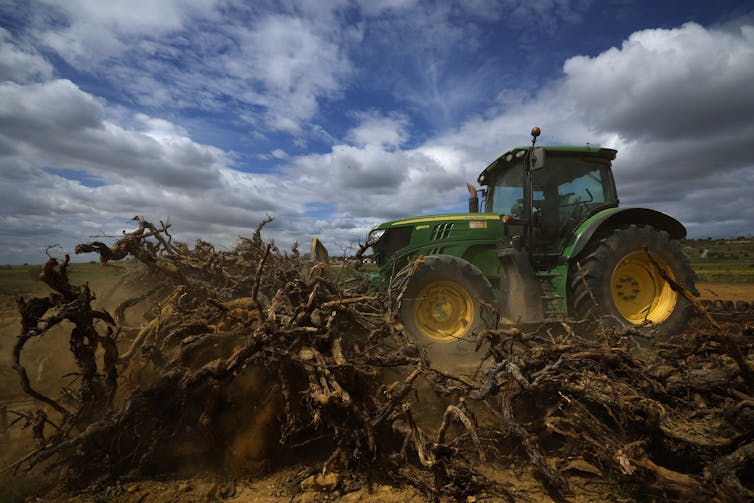
    Extreme weather, such as drought, is a particular problem for farmers. EPA-EFE/Guillaume Horcajuelo

    Extreme weather events require what meteorologists might call a “perfect storm”. For example, extreme heat in the UK typically requires the northward movement of an air mass from Africa combined with clear skies, dry soils and a stable atmosphere to prevent thunderstorms forming which tend to dissipate heat.

    Such “perfect” conditions are intrinsically unlikely, and many years can pass without them occurring – all while the climate continues to change in the background. Based on an understanding of observations alone, this can leave us woefully underprepared for what the climate can now do, should the right weather conditions all come together at once.

    Startling recent examples include the extreme heatwave in the Pacific north-west of North America in 2021, in which temperatures exceeded the previous Canadian record maximum by 4.6°C. Another is the occurrence of 40°C in the UK in summer 2022, which exceeded the previous UK record maximum set only three years earlier by 1.6°C. This is part of the reason why the true impact of a fixed amount of global warming is only evident after several decades, but of course – since the climate is changing rapidly – we cannot use this method anymore.

    Playing with fire

    To better understand these extremes, scientists can use ensembles: many runs of the same weather or climate model that each slightly differ to show a range of plausible outcomes. Ensembles are routinely used in weather prediction, but can also be used to assess extreme events which could happen even if they do not actually happen at the time.

    When 40°C first appeared in ensemble forecasts for the UK before the July 2022 heatwave, it revealed the kind of extreme weather that is possible in the current climate. Even if it had not come to fruition, its mere appearance in the models showed that the previously unthinkable was now possible. In the event, several naturally occurring atmospheric factors combined with background climate warming to generate the record-shattering heat on July 19 that year.

    The highest observed temperature each year in the UK, from 1900 to 2023
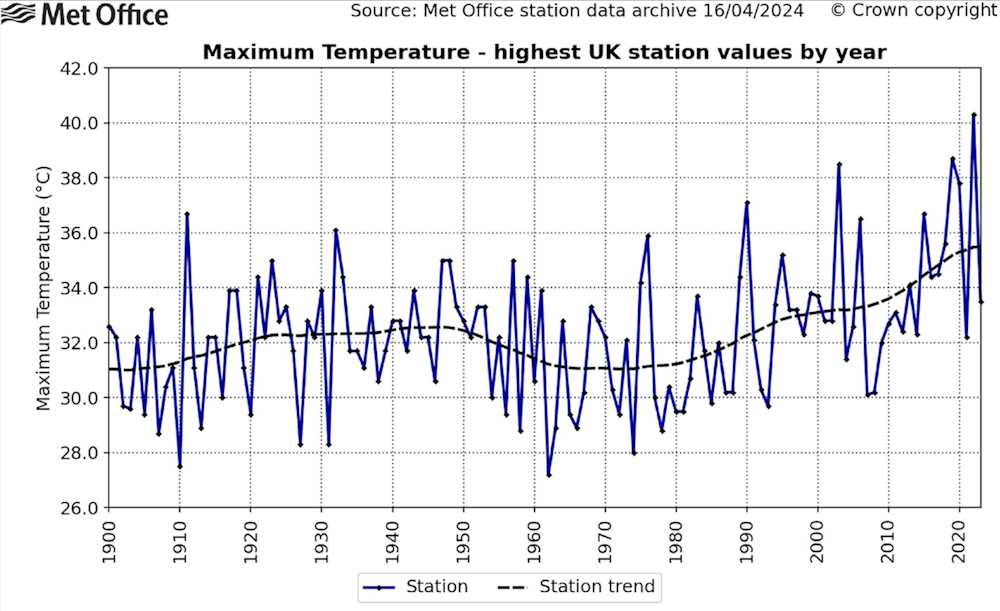
    A graph showing the highest observed temperature in the UK between 1900 and 2023.
    The hottest days are getting hotter in the UK. Met Office/Kendon et al. 2024

    Later in summer 2022, after the first occurrence of 40°C, some ensemble weather forecasts for the UK showed a situation in which 40°C could be reached on multiple consecutive days. This would have posed an unprecedented threat to public health and infrastructure in the UK. Unlike the previous month, this event did not come to pass, and was quickly forgotten – but it shouldn’t have been.

    It is not certain whether these model simulations correctly represent the processes involved in producing extreme heat. Even so, we must heed the warning signs.

    Despite a record-warm planet, summer 2024 in the UK has been relatively cool so far. The past two years have seen global temperatures far above anything previously observed, and so potential extremes have probably shifted even further from what we have so far experienced.

    Just as was the case in August 2022, we’ve got away with it for now – but we might not be so lucky next time.


    Imagine weekly climate newsletter

    Don’t have time to read about climate change as much as you’d like?
    Get our award-winning weekly roundup in your inbox instead. Every Wednesday, The Conversation’s environment editor writes Imagine, a short email that goes a little deeper into just one climate issue. Join the 35,000+ readers who’ve subscribed so far.


    Simon H. Lee, Lecturer in Atmospheric Science, University of St Andrews; Hayley J. Fowler, Professor of Climate Change Impacts, Newcastle University, and Paul Davies, Chief Meteorologist, Met Office and Visiting Professor, Newcastle University

    This article is republished from The Conversation under a Creative Commons license. Read the original article.

  • US oil company ran 1977 article predicting climate crisis could cause starvation

    Spread the love

    https://www.theguardian.com/us-news/article/2024/jul/18/us-oil-marathon-petroleum-climate-change

    A Guardian collage of images from industry 1970s industry periodical Marathon World published by a corporate predecessor of Marathon Petroleum Composite: The Guardian/Getty Images/Marathon Oil Company

    Marathon Petroleum predecessor warned of potential for ‘social and economic calamities’ in decades-old publication

    The corporate predecessor to America’s largest refiner of oil, Marathon Petroleum, explained in a company periodical nearly 50 years ago that global temperature rise potentially linked to “industrial expansion” could one day cause “widespread starvation and other social and economic calamities”.

    This decades-old description of climate breakdown is from a 1977 issue of the magazine Marathon World and is attributed in the article by an unnamed author to several experts including a scientist working for a top US agency.

    “Although climatologists disagree on the underlying reasons, many see a future climate of greater variability, bringing with it areas of extreme drought,” said the magazine, previously published by Marathon Oil Company, which later split into Marathon Petroleum as well as the exploration and production company Marathon Oil.

    Marathon Petroleum is among several oil and gas companies – including Exxon, Shell and BP – currently being sued by the city of Honolulu for allegedly engaging in a coordinated communications effort “to conceal and deny their own knowledge” of catastrophic climate impacts caused by burning their products.

    That lawsuit alleges that Marathon knew of the dangers of global temperature rise long before the general public due to its membership in the American Petroleum Institute, which began studying the link between fossil fuels and global heating decades ago.

    This newly surfaced article shows the company was undertaking efforts on its own to stay up to date on the latest climate science and the threats a more volatile climate could pose to humankind.

    …

    The current Honolulu lawsuit alleges that Marathon contributed to climate obstruction by belonging to industry associations that spent decades trying to convince the public that science linking coal, oil and gas to climate change was shaky and unreliable.

    “Pestilence, starvation, drought. To know one’s product may bring that about, and bury the evidence, is unspeakable,” Timmons Roberts, a professor of environment and sociology at Brown University, who’s an expert in climate disinformation, wrote in an email to the Guardian after viewing the 1977 article.

    Marathon and other companies named in the litigation are currently petitioning the US supreme court to throw out the case.

    https://www.theguardian.com/us-news/article/2024/jul/18/us-oil-marathon-petroleum-climate-change

  • Rate of Global Warming Reaches All-Time High, Report Shows

    Spread the love

    Original article by EDWARD CARVER republished from Common Dreams under Creative Commons (CC BY-NC-ND 3.0).

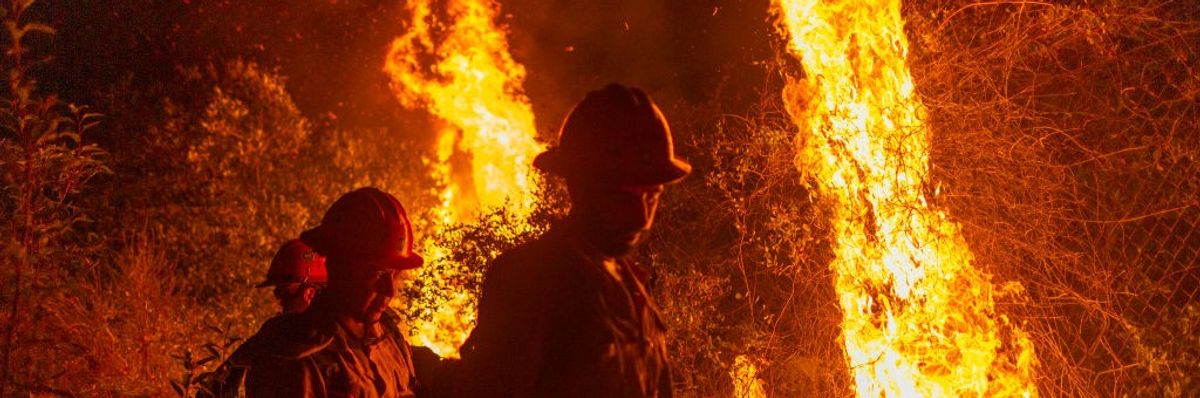
    Firefighters set a backfire to protect homes during a wildfire in California in September 2020.  (Photo: David McNew/Getty Images)

    “The devastation wrought by wildfires, drought, flooding, and heatwaves the world saw in 2023 must not become the new normal,” the report’s author said.

    Climate scientists published a report Wednesday showing that the rate of global warming reached an all-time high in the 10 years up to and including 2023 and that the record-breaking heat of last year was primarily due to that human-caused heating rather than other factors such as El Niño.

    The scientists found that from 2014 to 2023, the Earth warmed 0.26°C—higher than any previous 10-year period. The report, published in Earth System Science Data, was completed by 57 scientists who used the methods of the United Nations Intergovernmental Panel on Climate Change (IPCC), which produces major reports only every five to 10 years, with the next one expected in 2027. The report authors sought to fill the gap and, at least in one case, to galvanize climate action.

    “Rapidly reducing emissions of greenhouse gases towards net zero will limit the level of global warming we ultimately experience. At the same time, we need to build more resilient societies,” lead author Piers Forster, a climate physicist at the University of Leeds in the U.K. and an IPCC author, said in a statement. “The devastation wrought by wildfires, drought, flooding, and heatwaves the world saw in 2023 must not become the new normal.”

    Over the course of 2023, temperatures were on average 1.43°C above preindustrial levels, Forster and co-authors found, with an estimated 1.31°C of that due to human-caused global warming, and the relatively small remainder due to variability from events such as El Niño and La Niña.

    The report also shows that the Earth’s remaining “carbon budget”—how much can be emitted before reaching 1.5°C of warming, the Paris agreement target—is now roughly 200 gigatonnes, which will take only five years or so for the global population to use. This is down from the 500 gigatonnes that the IPCC estimated remained in the budget as of 2020.

    Adam Vaughan, environment editor at The Times, a U.K. newspaper, drew attention to the short time period in which humanity has to act, writing on social media that the 1.5°C target could be “blown” if emissions didn’t go down.

    In a guest post in Carbon Brief, Forster and another co-author explained that their report was “nothing short of alarming, yet it does contain some encouraging news.”

    “Greenhouse gas emissions have not yet risen beyond pre-pandemic levels and there is evidence that the rate of increase in CO2 emissions over the past decade has slowed compared to the 2000s,” they said.

    Forster, who also led the annual report in its first iteration last year, spoke to reporters in such a way as to avoid doomsday rhetoric.

    “If you look at this world accelerating or going through a big tipping point, things aren’t doing that,” he told TheAssociated Press. “Things are increasing in temperature and getting worse in sort of exactly the way we predicted.”

    However, the climate news remains dire: Researchers working with even more up-to-date data—through May—have found that the average temperature increase above preindustrial levels is now 1.6°C, and each of the last 12 months has been the hottest on record for that month. Those findings are from data released by the European Union’s Copernicus Climate Change Service and reported by The Washington Post.

    Original article by EDWARD CARVER republished from Common Dreams under Creative Commons (CC BY-NC-ND 3.0).

  • China cancels line of credit, pulling the plug on Argentina’s ‘anarcho-capitalist’ president

    Spread the love

    Original article by JAMES MEADWAY republished from People’s World under http://creativecommons.org/licenses/by-nc-nd/3.0/us/.

    Dollarization: Javier Milei holds up a giant cardboard sign depicting a U.S. $100 banknote emblazoned with an image of his face during a rally in La Plata, Sept. 12, 2023. Milei wants to replace the peso with the U.S. dollar as Argentina’s currency and says that the country’s Central Bank should be abolished. He’s got a new financial challenge, though: China just cut his line of credit. | Natacha Pisarenko / AP

    The Chinese government may have pulled the plug on far-right “anarcho-capitalist” President of Argentina Javier Milei, just weeks after his shock election win.

    In a spectacular demonstration of how the lines of geopolitical power are shifting, the People’s Bank of China has withdrawn its “swapline” to the Argentinian central bank, depriving it of a vital source of cheap funding.

    This leaves debt-ridden Argentina without ready access to funding to meet its promises to pay creditors. These international creditors include the IMF, to whom Argentina owes a world-record $43 billion. China provided the Argentinian government with funds for its $2.7 billion IMF repayment over the summer, lending it ultra-cheap foreign currency through its swapline arrangement.

    Milei, a fanatical free marketeer, was elected with 55% of the vote in November from a population desperate for a break with the failed political Establishment. Developing his public profile through TV appearances and his 1.4 million followers on TikTok, Milei was able to present his program of ferocious spending cuts and the abolition of the Argentinian currency, the peso, as the bitter medicine the country needed to end its economic crisis. Younger voters, in particular, flocked to him in droves.

    This was a product of desperation. Two-fifths of Argentinians live below the poverty line, and close to 60% of children. Inflation was over 140% when the election campaign ended, meaning prices doubling roughly every six months.

    Since the government defaulted—halted payments—on its debts at the end of 2001, the two decades since have seen governments both pro and anti-neoliberal attempts to negotiate agreements with Argentina’s creditors and break the cycle of crises.

    The latest round of these was a colossal 2018 loan from the IMF, attached to conditions on cutting government spending over the following three years.

    But what tipped the country over the edge into its latest round of crisis has been the catastrophic drought that began in 2019. This ongoing drought is the worst for over 60 years, hammering farmers and severely cutting harvests—soybean production fell to its lowest level for a century.

    For a country dependent on agricultural exports for foreign exchange earnings, it has been a disaster. Its trade deficit ballooned, taxes fell and government spending mushroomed. Government borrowing swelled and the Argentina central bank resorted to issuing more money to cover spending costs. Climate change almost certainly worsened the drought.

    Milei’s program offered nothing on this—he is a climate change denier, claiming that those who “blame the human race” for climate change are “fake…only looking to raise funds for socialist bums who write for fourth-rate newspapers.”

    The colorful language is very much part of his appeal, along with waving a chainsaw at his public appearances, to symbolize what he planned for government spending, and smashing a piñata of the central bank on live TV.

    But cartoonish posing shouldn’t kid us: Milei’s program is neoliberalism on steroids. He campaigned on a promise to cut government spending by 15% of Argentina’s GDP.

    His plan to abolish the peso and “dollarize” the economy was arguably even more radical, claiming this would prevent Argentinian bureaucrats and politicians from printing money. Although two other Latin American countries, Ecuador and Panama, use the dollar as their official currency, neither is the size of Argentina, the continent’s second-largest economy.

    And while many Argentinians already use the dollar, with $246 billion in dollar savings, the government has no dollars to hand, and would have to either buy them to replace pesos, or perhaps seize them from those mostly middle-class savings.

    The plan is a non-starter. Confronted with the economic realities, Milei has rapidly defaulted to conservative type, appointing a former president of the central bank, Luis Caputo, as his economy minister, and appointing a close associate of Caputo as the new central bank head. So much for “burning it down.”

    The ferocious spending cuts are still planned, along with a 54% devaluation of the peso as part of a program approved by the IMF.

    Far from a radical break, Milei is a stooge for the maintenance of Argentina’s failed elite—including even the rehabilitation of the dictatorship, with his running mate for Vice President, Victoria Villaruel, claiming the figure of 30,000 “disappearances” under the regime is a “myth.”

    This is a familiar pattern. Across the world, supposed populists from the radical right have taken power, often with the promise of taking on corrupt local elites. They don’t follow through.

    Italy’s radical right government, for example, in August threatened a windfall tax on banks that were profiteering from interest rate rises. But they rapidly backed down after howls of protests from the banks themselves.

    Milei has almost certainly bitten off more than he can chew. Expecting protests, harsh new guidelines for police and military, including the criminalization of the parents of younger protests have been rushed through—“prison or bullet,” as one pro-government MP described them. Inflation has accelerated, to 3,678% a year, which the government are now using to justify their “shock therapy.”

    However, it is anti-China posturing that could prove his undoing. China is Argentina’s second-biggest market for exports, and loans from China make up over 42 per cent of Argentina’s foreign exchange reserves.

    Yet Milei called China an “assassin” during his election campaign, promising to sever ties and instead reorienting Argentina towards full-throated support for Israel and the U.S. Argentina’s foreign minister has confirmed that the country would not be joining the China-led BRICS coalition, as pledged by the last government.

    This was treated as a “slap in the face” by China: Cutting loan support to Argentina is the inevitable response. As Milei himself might put it: Fuck around and find out.

    Morning Star

    Original article by JAMES MEADWAY republished from People’s World under http://creativecommons.org/licenses/by-nc-nd/3.0/us/.

  • Drought in the Amazon: Understanding the causes and the need for an immediate action plan to save the biome

    Spread the love

    Lucas Ferrante, Universidade Federal do Amazonas (UFAM)

    The drought plaguing the Amazon is a worrying portrait of the climate challenges facing the world. The combination of the El Niño phenomenon and anthropogenic climate change has played a significant role in accentuating this extreme weather event. The Amazon region, known for its lush rainforest and flowing rivers, is facing a critical situation due to a lack of rainfall and rising temperatures.

    This phenomenon, never recorded at this intensity, has affected biodiversity and human life in eight Amazonian states. The drought has already killed more than 140 dolphins, including pink dolphins and tucuxis, also known as grey dolphins. The mortality of fish and other aquatic animals is also high. The low volume of the rivers affects the human supply, causing a lack of drinking water and food in all the small villages, even those located on the banks of the big rivers. Of the 62 municipalities in the state of Amazonas, 42 are in a state of emergency, 18 are in a state of alert and only two are in a normal situation.

    The El Niño phenomenon has a direct influence on the Amazon drought. It manifests itself in the abnormal warming of the surface waters of the Pacific Ocean, affecting the rainfall regime in various parts of the world. In the case of the Amazon region, the drought is exacerbated by a decrease in humidity and a lack of rainfall, damaging the vegetation, fauna and local communities that depend on natural resources.

    However, anthropogenic climate change is making the situation even worse. Rampant deforestation, driven by agricultural expansion and logging activity, reduces the Amazon rainforest’s ability to regulate the climate and retain moisture. In addition, the destruction of vast areas of vegetation contributes to rising temperatures, creating a cycle of even more accentuated droughts.

    Deforestation and mining, major factors

    Deforestation has been particularly devastating in the region of Highway BR-319, in the south of Amazonas state, driven by land grabbing which has provided cheap land to cattle ranchers from other states. In turn, this deforestation has increased the number of fires that feed back into the climate crisis. When they occur near riverbanks, deforestation also intensifies the phenomenon known as fallen land, which has drastically affected the draught of rivers and is already significantly jeopardising navigation and logistics, mainly affecting villages in the interior of the Amazon, which are already suffering from shortages.

    Another factor that has played a significant role in affecting navigation is mining activity. Disorganised mineral extraction has created banks of land that are harmful to navigation and which, in the critical scenario of drought, have caused many vessels to run aground.

    The impact of hydroelectric dams

    Hydroelectric dams also play a role in contributing to the drought scenario, especially on the Madeira River. This is mainly due to the decomposition of organic matter in reservoirs created by dams, which releases methane, a potent greenhouse gas, into the atmosphere. In addition, deforestation associated with the construction of dams, as well as soil degradation and erosion resulting from the alteration of aquatic and terrestrial ecosystems, can increase emissions of carbon dioxide (CO2) and other pollutants, contributing to the impact of hydroelectric dams on climate change.

    The Madeira River, now at its lowest level in almost 60 years, has been drastically affected and transformed by the Jirau and Santo Antônio hydroelectric dams. This was due to the drastic alteration of the river’s natural flow caused by the damming of water for power generation. When water is dammed, a reservoir is formed that retains part of the water that would normally flow along the river. This diversion of the flow directly affects the region’s aquatic and terrestrial ecosystems, since the basin’s hydrological cycle is interrupted. The reduction in the volume of water in the Madeira River, for example, can lead to prolonged periods of drought, affecting not only aquatic fauna and riparian habitats, but also local communities that depend on the river for their livelihoods.

    In addition, the construction and operation of hydroelectric dams in the Amazon often involves the clearing of significant areas of forest for the construction of dams and associated infrastructure. Deforestation contributes to a reduction in evapotranspiration, which is a crucial process for water balance in the region. With fewer trees to release water into the atmosphere, the Amazon becomes more susceptible to drought. The combination of these factors results in a significant impact on the region, making hydroelectric dams one of the causes of drought in the Amazon, particularly on the Madeira River, with worrying environmental and social consequences.

    What can still be done

    In order to combat the extreme drought in the Amazon and its devastating effects, it is essential to adopt strict measures to curb deforestation and illegal mining in the region, and for the federal government to review major undertakings such as hydroelectric dams and roads, such as the BR-319 motorway.

    Many politicians have argued that the road, if paved, could reduce the state’s isolation, especially during droughts. However, this is a fallacious argument, because connecting the most isolated municipalities would require hundreds of kilometres of side roads, which would further increase deforestation and aggravate the climate crisis.

    In addition, the BR-319 motorway has become a spearhead that cuts through one of the most conserved blocks of forest, linking the central Amazon, which is still preserved, to the “arc of Amazonian deforestation”, a region that concentrates most of the climate anomalies in the entire biome.

    Ecosystem on the edge

    In a recent study published in the renowned journal Conservation Biology, it was shown that deforestation in the Amazon is already impacting ecosystem services that are essential for Brazil, such as the Amazon’s flying rivers. This scientific data shows that we are already at the threshold of deforestation and environmental degradation tolerated by the Amazon, and more forceful action needs to be taken now.

    Part of this responsibility lies now in the hands of President Lula, in reviewing major developments in the Amazon, such as hydroelectric dams and highways like the BR-319. In addition, it is essential to institute a zero deforestation policy that should begin this year, and not in 2030, when it will be too late. Furthermore, it is crucial that the international community and local governments work together to reduce greenhouse gas emissions and tackle climate change effectively. Only with coordinated and decisive action will we be able to mitigate the impacts of drought in the Amazon and protect this unique ecosystem that plays a vital role in regulating the global climate.The Conversation

    Lucas Ferrante, Pesquisador Vinculado ao Programa de Pós-graduação em Zoologia, Universidade Federal do Amazonas (UFAM)

    This article is republished from The Conversation under a Creative Commons license. Read the original article.