At Least 20 Children Among 93 Killed in Horrific Israeli Massacre in Northern Gaza

Spread the love

Original article by Jake Johnson republished from Common Dreams under Creative Commons (CC BY-NC-ND 3.0). 
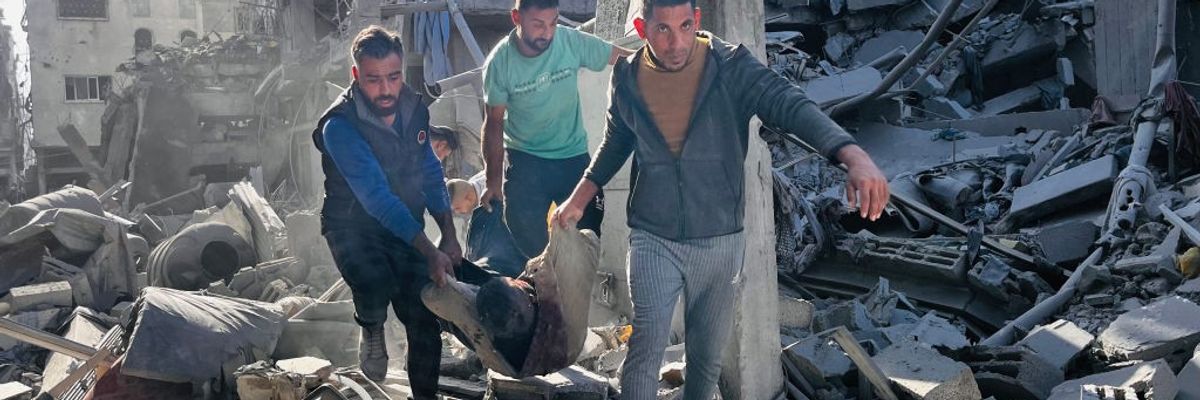
People remove a body from the rubble of a building hit by an Israeli strike in Beit Lahiya, Gaza on October 29, 2024.
 (Photo: AFP via Getty Images)

“Put simply, those children who have survived so far are running out of time,” said one aid group. “We are pleading with the international community to urgently intervene.”

Israeli forces on Tuesday bombed a crowded residential building in the northern Gaza town of Beit Lahiya, killing around 93 people—including at least 20 children—in the latest atrocity in a region that has been under heavy military siege for weeks.

Eyewitnesses described an appalling scene at the building decimated by the Israeli strike. One person who was helping to remove victims from the rubble told Reuters that there were “body parts hanging on the walls.” Another eyewitness said that “most of the victims are women and children.”

The Israeli strike on the residential building—which was reportedly sheltering roughly 200 displaced people—also wounded dozens, but hospitals in the region are overwhelmed and barely functional after relentless Israeli raids and attacks, leaving them unable to handle an influx of bombing victims.

Dr. Hussam Abu Safia, the director of nearby Kamal Adwan Hospital, told Al Jazeera that “more than 150 dead and wounded had arrived after the attack.”

“However, he warned that many of those injured may die because of a lack of resources,” the outlet reported. “Israeli forces detained dozens of medical staff at the hospital last week, leaving only three doctors.”

https://twitter.com/i/status/1851243781451895240

Israel’s attack in Beit Lahiya was one of a number of massacres committed in recent days in northern Gaza, where an estimated 100,000 Palestinians are trapped with virtually no access to food, medicine, and other essentials.

“There is nothing. You are talking about tens of days that they are not receiving any supplies,” said Mahmoud Alsaqqa, Oxfam’s food security and livelihood lead in Gaza. Alsaqqa said people are “starving to death” in northern Gaza as Israel impedes humanitarian aid shipments and moves to ban the United Nations’ Palestinian refugee agency.

Dylan Williams, vice president for government affairs at the Center for International Policy, noted Tuesday that “in the last day, Israel passed bills that would block most aid delivery in Gaza and the West Bank and bombed a building sheltering displaced civilians, reportedly killing mostly women and children.”

“Yet [U.S. President Joe] Biden keeps arming Israel counter to U.S. and international law,” Williams wrote on social media.

“Every possible step must be taken to secure a definitive cease-fire and to ensure adherence to international law.”

Internet blackouts in the region, meanwhile, have made it difficult for aid workers and reporters to relay news of northern Gaza’s dire conditions to the world.

“Communication between hospitals, health workers, and aid agencies is becoming sporadic, and ground fighting has made travel increasingly dangerous, making it hard to coordinate care and treatment and accurately collect casualty data,” The Guardian reported Tuesday. “The civil defense service suspended activities last Wednesday after crews were attacked by Israeli forces and tank shelling destroyed their last fire engine.”

Last week, Save the Children decried deadly Israeli attacks on 13 residential buildings in the Jabalia refugee camp and warned that “the threat of attacks and lack of fuel and supplies have left rescue services unable to operate” in the northern part of the Palestinian enclave.

“Attacks by Israeli forces across the Gaza Strip have killed scores of people, including many children and an 11-month-old baby,” said Jeremy Stoner, Save the Children’s regional director. “The attacks have targeted a school-turned-shelter in NuseiratKamal Adwan Hospital, and residential homes in Khan Younis—the very places where children are supposed to be safest, protected under international law.”

“Put simply, those children who have survived so far are running out of time. We are pleading with the international community to urgently intervene,” Stoner added. “Every possible step must be taken to secure a definitive cease-fire and to ensure adherence to international law. Governments must stop fueling the conflict with a supply of weapons and ammunition.”

Médecins Sans Frontières (MSF) staffer Hasan Suboh was among those killed in the wave of Israeli attacks on residential homes in northern Gaza last week, the humanitarian group said in a statement Monday.

“Hasan’s tattered MSF vest, which he wore all the time, was found under the rubble,” the group said. “This vest symbolizes Hasan’s commitment to helping people in distress, but more globally it also symbolizes healthcare and humanitarian assistance.”

“To see it destroyed,” MSF added, “is representative of how in this war, Israel, the U.S. government, and the rest of Israel’s allies have disregarded the protection of healthcare workers, and ripped the rules of war to shreds. The claim that humanitarian workers are protected, that civilian lives are protected, has once again been exposed as a lie for all the world to see.”

Original article by Jake Johnson republished from Common Dreams under Creative Commons (CC BY-NC-ND 3.0). 

Current UK Prime Minister Keir Starmer is quoted that he supports Zionism without qualification. He also confirms that his active support and that of UK's air force has been essential in Israel's mass-murdering genocide. Includes URLs https://www.declassifieduk.org/keir-starmers-100-spy-flights-over-gaza-in-support-of-israel/ and https://youtu.be/O74hZCKKdpA
Current UK Prime Minister Keir Starmer is quoted that he supports Zionism without qualification. He also confirms that his active support and that of UK’s air force has been essential in Israel’s mass-murdering genocide. Includes URLs https://www.declassifieduk.org/keir-starmers-100-spy-flights-over-gaza-in-support-of-israel/ and https://youtu.be/O74hZCKKdpA
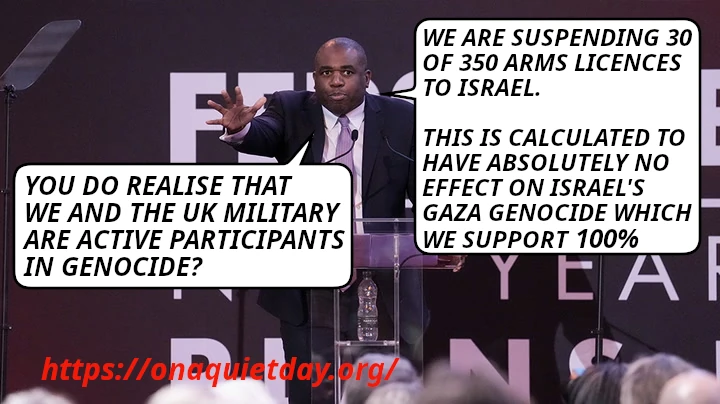
UK Foreign Secretary David Lammy says that UK is suspeding 30 of 350 arms licences to Israel. He also confirms the UK government's support for Israel's Gaza genocide and the UK government and military's active participation in genocide.
UK Foreign Secretary David Lammy says that UK is suspeding 30 of 350 arms licences to Israel. He also confirms the UK government’s support for Israel’s Gaza genocide and the UK government and military’s active participation in genocide.
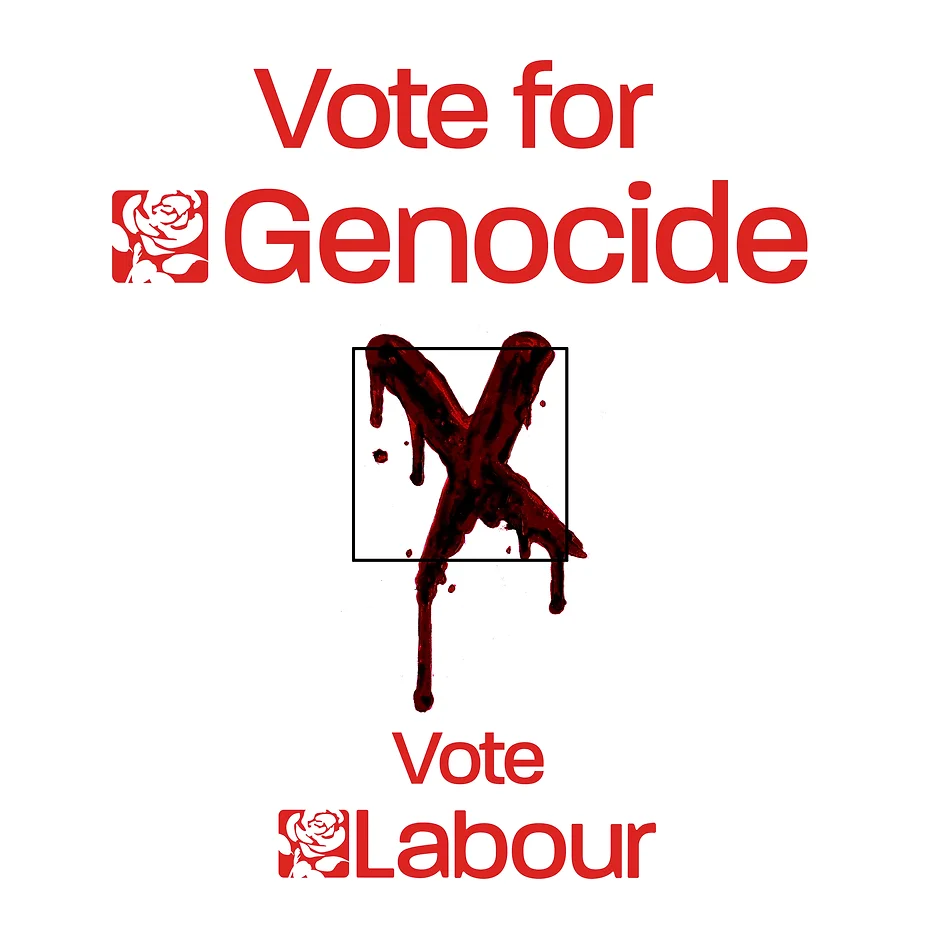
Vote For Genocide Vote Labour.
Continue ReadingAt Least 20 Children Among 93 Killed in Horrific Israeli Massacre in Northern Gaza

‘Grotesque’: Israeli Knesset Bans UN Agency in Charge of Humanitarian Aid in Gaza

Spread the love

Original article by Jessica Corbett republished from Common Dreams under Creative Commons (CC BY-NC-ND 3.0). 

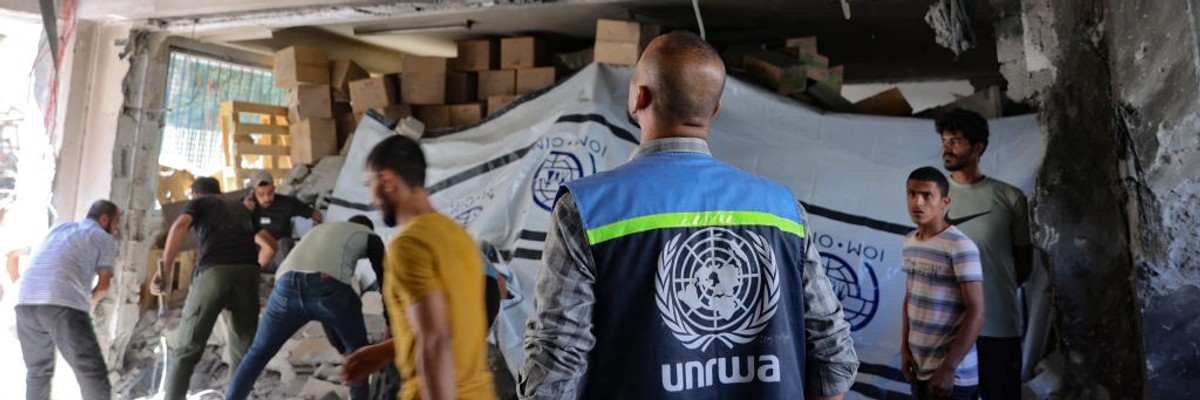
A worker with the United Nations Relief and Works Agency for Palestine Refugees in the Near East and displaced Palestinians check the damage inside a U.N. school-turned-shelter near Gaza City after a reported Israeli strike on October 19, 2024. (Photo: Omar al-Qattaa/AFP via Getty Images)

“This legislation not only contravenes the basic principles of human rights that led to the U.N. General Assembly’s founding of UNRWA, but also violates a range of Israel’s international legal obligations.”

Over a year into Israel’s obliteration of the Gaza Strip, Israeli lawmakers faced sharp criticism on Monday after voting for a pair of bills targeting the United Nations agency responsible for humanitarian aid in the illegally occupied Palestinian territories.

The first bill, which says that the United Nations Relief and Works Agency for Palestine Refugees in the Near East (UNRWA) “will not operate any missions, won’t provide any service, and won’t hold any activity—directly or indirectly—in the sovereign territory of the state of Israel,” passed the Israeli parliament 92-10.

The second legislative proposal—under which the Israeli agency that handles humanitarian issues, the Coordinator of Government Activities in the Territories (COGAT), will have to cut off contact with UNRWA—passed the 120-member Knesset 87-9. Critics called the votes “grotesque” and “outrageous.”

The Israel-based organization Adalah said in a statement that “despite widespread international pressure and condemnation, the Knesset has nearly unanimously passed two bills aimed at dismantling UNRWA, all while Israel continues its genocidal assault on Gaza and intensifies violence across the West Bank, including East Jerusalem.”

“This legislation threatens a vital lifeline for over 2.5 million Palestinian refugees throughout the occupied Palestinian territory,” the group warned. “It represents a deliberate attempt to fundamentally undermine UNRWA and its essential mission of supporting the relief, education, and human development of Palestinian refugees. Specifically, the laws aim to strip Palestinians—who were forcibly displaced from their homes during the 1948 Nakba and the 1967 war—of their status as refugees and their right of return.”

The United Nations General Assembly created UNRWA in 1949, in the wake of the Nakba, or “catastrophe,” when more than 750,000 Palestinians fled or were forced from their homeland to establish the modern state of Israel—whose officials have claimed without providing evidence that a dozen of the agency’s 13,000 staffers in Gaza were involved with the Hamas-led October 7, 2023 attack on Israel.

“This legislation not only contravenes the basic principles of human rights that led to the U.N. General Assembly’s founding of UNRWA, but also violates a range of Israel’s international legal obligations, including those under the Genocide Convention and the Rome Statute of the International Criminal Court,” said Adalah. “The international community must hold Israel accountable.”

Although Israel faces a South Africa-led genocide case at the International Court of Justice over its war on Hamas-controlled Gaza—which has killed at least 43,020 people and injured another 101,110 since last October—governments around the world have not acted to stop the bloodshed. The U.S. Congress and President Joe Biden’s administration have even provided Israel with billions of dollars in military aid and blocked cease-fire resolutions at the United Nations.

Earlier this month, the Biden administration finally threatened to cut off weapons if the Israeli government does not take “urgent and sustained actions” to improve humanitarian conditions in Gaza within 30 days. U.S. Secretary of State Antony Blinken and Secretary of Defense Lloyd Austin’s letter specifically raised concerns about the legislation that passed the Knesset Monday.

Asked about the Israeli bills on Monday, Matthew Miller, a U.S. State Department spokesperson frequently slammed for his statements about Israel, pointed to the secretaries’ criticism of the legislation in the recent letter and acknowledged that UNRWA serves the West Bank and plays “an irreplaceable role” in Gaza, where Palestinians are starving to death.

Sally Abi Khalil, Oxfam’s regional director in the Middle East and North Africa, said Monday that “Israel has bombed Palestinians to death, maimed them, starved them, and is now ridding them of their biggest lifeline of aid. Piece by piece, Israel is systemically dismantling Gaza as a land that is autonomous and liveable for Palestinians.”

“Its banning of UNRWA today is condemnable and another step in this crime,” she argued. “The decision will further undermine the ability of the international community to provide sufficient humanitarian aid and to save lives in any safe, independent, and impartial way. UNRWA was not only the biggest and most established agency that has been delivering aid and sustenance to the people of Gaza for years, it was also a thread that connected them in some hope of solidarity and security to the United Nations.”

“We are in no doubt that Israel and its allies are fully aware of the terrible consequences that this decision will have on Palestinians living in Gaza, many of whom are already starving,” she added. “We join others in warning again that this will result in more death, more suffering, and more forced displacement of people from their besieged homeland. It is impossible not to believe that this is their aim.”

Leading up to the votes, human rights advocates have been sounding the alarm. On Saturday, over 50 groups including Oxfam, Human Rights Watch, and ActionAid released a joint statement demanding action and warning that “dismantling UNRWA would be catastrophic for Palestinians especially in Gaza and the West Bank as they are deprived of essentials such as food, water, medical aid, education, and protection. It will also have catastrophic consequences for millions of Palestinian refugees in Lebanon, Jordan, and Syria, where essential humanitarian aid is crucial for both the refugees and the host communities.”


Philippe Lazzarini, the UNRWA commissioner-general, delivered a similar warning on social media Monday, declaring that the Knesset action not only “is unprecedented and sets a dangerous precedent” but “it opposes the U.N. Charter and violates the state of Israel’s obligations under international law.”

“This is the latest in the ongoing campaign to discredit UNRWA and delegitimize its role towards providing human-development assistance and services to Palestine Refugees,” he continued. “These bills will only deepen the suffering of Palestinians, especially in Gaza where people have been going through more than a year of sheer hell.”

“It ⁠will deprive over 650,000 girls and boys there from education, putting at risk an entire generation of children,” Lazzarini added. “These bills increase the suffering of the Palestinians and are nothing less than collective punishment.”

Original article by Jessica Corbett republished from Common Dreams under Creative Commons (CC BY-NC-ND 3.0). 

Continue Reading‘Grotesque’: Israeli Knesset Bans UN Agency in Charge of Humanitarian Aid in Gaza
Britain not reviewing Israel’s conduct in Lebanon for arms export decisions

Spread the love

https://www.middleeasteye.net/news/uk-government-admits-it-not-reviewing-israeli-conduct-lebanon-arms-exports

Protesters in London calling for a permanent ceasefire and for the UK government to stop arming Israel are met by counter-protesters holding Israeli flags, 13 April 2024 (Reuters)

The UK government says there is “no legal requirement” to assess Israel’s compliance with international humanitarian law in its military conduct in Lebanon as part of its decision-making on licensing UK arms exports to Israel.

Middle East minister Hamish Falconer said on Monday that the suspension of 30 arms export licences to Israel last month means there are “no existing UK arms licences to Israel for use in Lebanon” apart from UK-made F-35 fighter jet components.

“So there is no legal requirement to assess [international humanitarian law] compliance,” Falconer said in response to a written question from Labour MP Abtisam Mohamed.

Arms control experts and human rights advocates were surprised by the admission which several said appeared to show that the government had decided to forgo international law.

“Under its legal obligations, the UK government cannot refuse to do IHL assessments for any of its arms export licences,” Martin Butcher, policy adviser on arms and conflict for Oxfam told Middle East Eye. 

https://www.middleeasteye.net/news/uk-government-admits-it-not-reviewing-israeli-conduct-lebanon-arms-exports

UK Foreign Secretary David Lammy says that UK is suspeding 30 of 350 arms licences to Israel. He also confirms the UK government's support for Israel's Gaza genocide.
UK Foreign Secretary David Lammy says that UK is suspeding 30 of 350 arms licences to Israel. He also confirms the UK government’s support for Israel’s Gaza genocide.
Vote For Genocide Vote Labour.
Continue ReadingBritain not reviewing Israel’s conduct in Lebanon for arms export decisions

‘An Extremely Dark Place in History’: UN Panel Says Israel Violated Child Rights Treaty

Spread the love

Original article by Jessica Corbett republished from Common Dreams under Creative Commons (CC BY-NC-ND 3.0). 

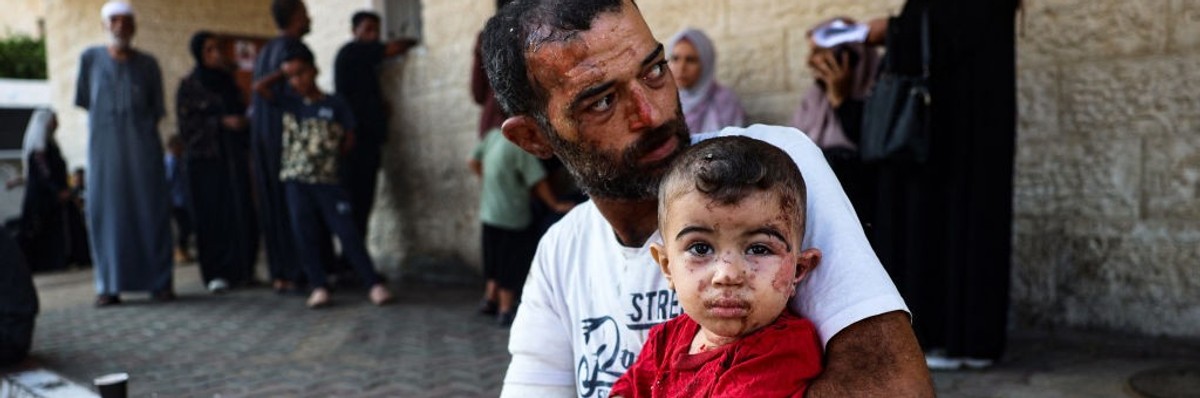
Palestinian Ahmad Yunis and his three-year-old son, Sami, who were both injured in an Israeli bombing in the Bureij refugee camp, sit outside the Al-Aqsa Martyrs Hospital in Deir al-Balah in the central Gaza Strip on September 8, 2024. (Photo: Eyad Baba/AFP via Getty Images)

“I don’t think we have seen before, a violation that is so massive, as we are seeing in Gaza now,” said one committee leader.

A United Nations committee on Thursday called out Israel for “serious violations” of the Convention on the Rights of the Child in the occupied Palestinian territories, particularly with its nearly yearlong assault on the Gaza Strip.

“The outrageous death of children is almost historically unique. This is an extremely dark place in history,” said Bragi Guðbrandsson, vice chair of the U.N. Child Rights Committee, which also released its findings on five other parties to the global treaty—Argentina, Armenia, Bahrain, Mexico, and Turkmenistan.

Since the Hamas-led October 7 attack on Israel, Israeli forces have killed at least 41,272 Palestinians in Gaza and injured another 95,551, according to local officials. Many more remain missing and are believed to be dead and buried in the rubble of bombed civilian infrastructure. The vast majority of the enclave’s 2.3 million residents have been displaced, often numerous times.

Earlier this week, the Gaza Health Ministry publicly identified 34,344 Palestinians who have been killed in the Hamas-governed enclave as of August 31. The document spans 649 pages, the first 14 of which are filled with the names of babies. In total, there are 11,355 children.

The U.N. report states that “the committee is gravely concerned about… the outrageously high number of children in Gaza who continue to be killed, maimed, injured, missing, displaced, orphaned, and subjected to famine, malnutrition, and disease, as well as the multiple displacements of the Gazan population, as a result of the state party’s indiscriminate and disproportionate attacks on Gaza using explosive weapons with wide-area effects in densely populated areas and its denial of humanitarian access, with at least 1 million children displaced, 21,000 children reported missing, 20,000 children who have lost one or both parents, 17,000 children unaccompanied or separated from their families in Gaza, dozens of child deaths due to malnutrition, and 3,500 children at risk of death due to malnutrition and lack of food.”

The panel also expressed alarm over “attacks on and destruction of hospitals, schools, residential buildings, refugee camps, and essential infrastructure, including power facilities and water tanks, by the armed forces, restricting access to health services, education, and housing for the nearly 1 million children living in Gaza.”

Guðbrandsson said that “I don’t think we can identify any measure that was taken to save children’s lives in this military operation in Gaza.”

“I don’t think we have seen before, a violation that is so massive, as we are seeing in Gaza now,” he noted. “These are extremely grave violations that we do not often see.”

As Reuters reported:

Israel, which ratified the treaty in 1991, accused the committee of having a “politically-driven agenda,” in a statement sent by its diplomatic mission in Geneva.

It sent a large delegation to a series of U.N. hearings in Geneva in early September where they argued that the treaty did not apply in Gaza or the West Bank and said that it was committed to respecting international humanitarian law.

It says its military campaign in Gaza is aimed at eliminating the Palestinian enclave’s Hamas rulers and that it does not target civilians but that the militants hide among them, which Hamas denies.

Anne Skelton, chair of the U.N. committee, pushed back against Israel’s position on Thursday, telling journalists, “They were not, in our view, facing up to the reality that 17,000 children are dead and that there have been repeated attacks on schools and hospitals.”

The report also addresses Israel’s claims, saying that “the committee deeply regrets the state party’s repeated denial of its legal obligations under the convention in the occupied Palestinian territory (OPT) based on its position that the convention ‘does not apply… to areas beyond a state’s national territory’ and ‘was not designed to apply in situations of armed conflict,’ and that international humanitarian law is the relevant and specific applicable body of law in the Gaza Strip and the West Bank.”

“The committee also regrets the limited information it received on the situation of children living in the OPT due to such a position,” the 22-page “concluding observations” document continued. “The committee is of the view that the state party’s denial of the application of the convention cannot be used to justify its grave and persistent violations of international human rights and humanitarian law.”

The panel cited the International Court of Justice advisory opinion from July that found “international human rights instruments are applicable.” The ICJ—which has taken up a genocide case against Israel—also said at the time that the decadeslong Israeli occupation of Gaza and the West Bank, including East Jerusalem, is illegal and must end “as rapidly as possible.”

The new report says that the Child Rights Committee, “aligning its position with the position of the ICJ, reiterates that the convention applies to all children at all times and is directly applicable in all territories over which the state party exercises effective control, and reminds the state party of its legal obligations both under the convention and international humanitarian law concerning children in the OPT.”

Skelton also argued that “the only real way to serve children’s rights in this situation is a cease-fire.”

However, Israel has shown no signs of ending its assault on the Palestinian enclave—in fact, fears of a wider regional conflict are heightened this week due to bombings of pagers, walkie-talkies, and other devices across Lebanon, attacks supposedly targeting Hezbollah members that Israeli and U.S. officials attributed to Israel’s military and intelligence operatives.

The Child Rights Committee’s report follows U.N. Secretary-General António Guterres adding Israel to the so-called “List of Shame” of nations that kill and wound children during armed conflicts, a June decision that outraged Israeli officials but was praised by human rights advocates as long overdue.

Original article by Jessica Corbett republished from Common Dreams under Creative Commons (CC BY-NC-ND 3.0). 

Continue Reading‘An Extremely Dark Place in History’: UN Panel Says Israel Violated Child Rights Treaty

Pager and walkie-talkie attacks on Hezbollah look like war crimes – international legal expert

Spread the love
EPA-EFE/Wael Hamzeh

Giacomo Biggio, University of Bristol

Tensions in the Middle East have reached a new high after thousands of pagers and radios used by members of Hezbollah exploded across various cities in Lebanon and Syria over September 17 and 18. The attacks – which have widely been attributed to Israel, which has not commented – have resulted in at least 30 people killed and more than 3,000 wounded.

Many analysts and politicians are now speculating that the conflict between Israel and Hezbollah, which has been simmering during the 11-month conflict in Gaza, will spiral into open warfare.

Far from taking place in a legal vacuum, the attacks are governed by international humanitarian law (IHL). This is the international legal regime that regulates the conduct of hostilities in situations of armed conflict.

Since the Hamas attacks on October 7 provoked Israel’s ferocious response in Gaza, Israel and Hezbollah have been involved in a series of cross-border hostilities. These qualify as what is called a “non-international armed conflict”, to which IHL applies. This includes the rules set out in, among other instruments, the Geneva conventions.

In pursuing the objective of protecting civilians in wartime, the Geneva conventions rely on the fundamental principles of “distinction” and “proportionality”.

What international law says

The principle of distinction essentially requires belligerents to distinguish at all times between the civilian population and combatants.

Combatants are lawful targets and can be attacked at all times. But intentionally attacking civilians is prohibited and constitutes a war crime under the Rome statute of the International Criminal Court. To this end, military commanders are under an obligation to do everything feasible to verify that the target of an attack is not a civilian.

Even assuming that only Hezbollah members were using the radios and pagers at the moment of the attacks, that does not mean that they shall be presumed to be combatants (and, therefore, lawful targets). Under IHL, a combatant is a “member of the armed forces of a party to the conflict”. This comprises “all organized forces, groups and units which are under a command responsible to that party for the conduct of its subordinates”.

By contrast, whoever is not a member of the armed forces of a party to the conflict is a civilian and subject to the protection of IHL.

There is no doubt that members of the military wings of Hezbollah are “members of the armed forces”, so they qualify as combatants. But those members of Hezbollah’s political wing who are not combatants should be considered as civilians and accordingly, are protected from attack.

Civilians may lose protection from attack for such time as they take a direct part in hostilities. This includes conduct like the intentional killing of civilians and carrying out acts which adversely affect the military capacity of a party to an armed conflict – for example, the planning of attacks against Israel.

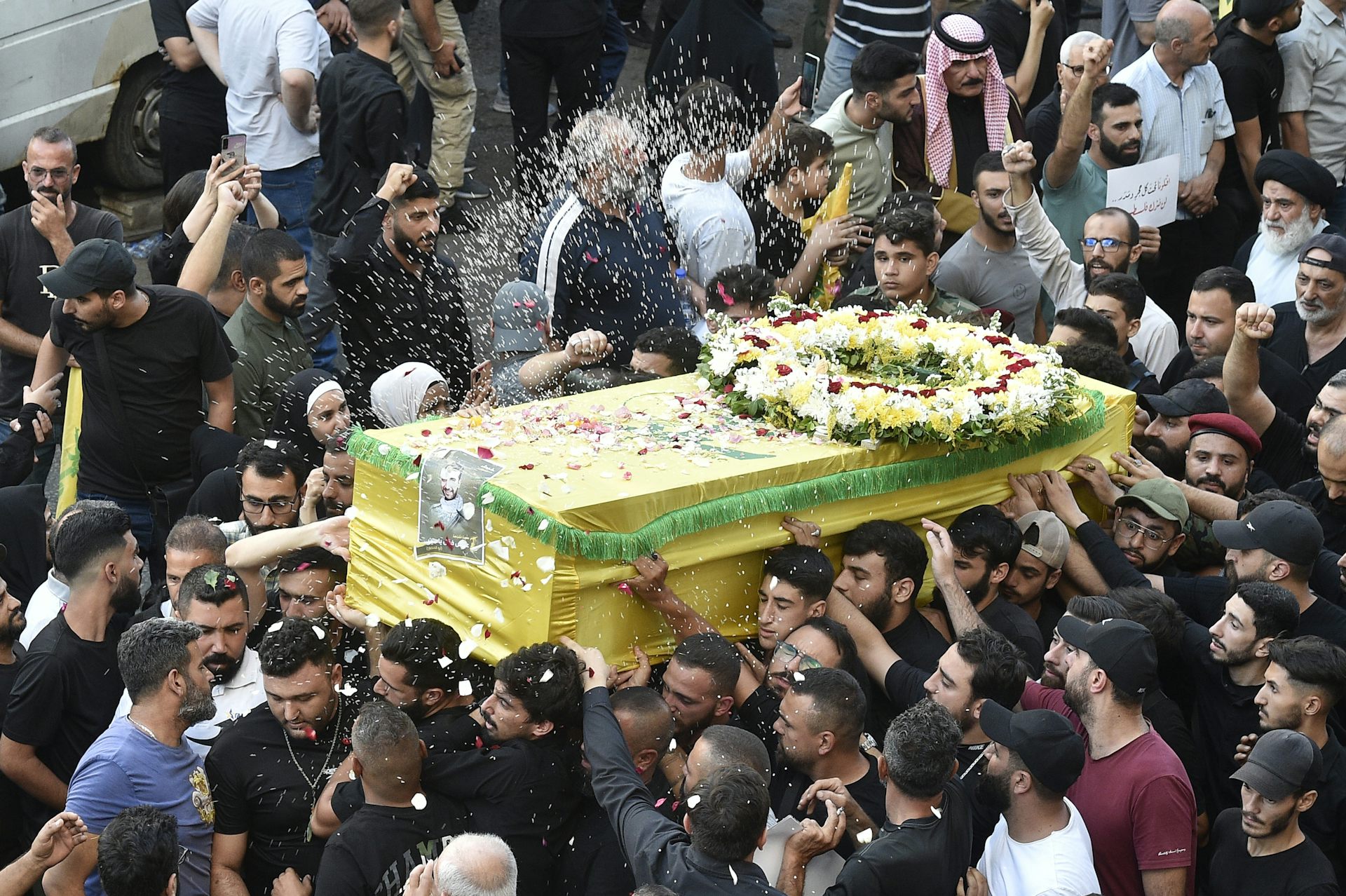
The pagers were detonated at 3:30, on September 17 in hundreds of locations in Beirut and other Lebanese cities. Abaca Press / Alamy Stock Photo

What about the attacks against members of Hezbollah’s military wing?

In this case, complying with the principle of distinction does not suffice, since the attack must also respect the principle of proportionality. This requires that the expected “collateral damage” (that is, the incidental killing or wounding of civilians) should not be excessive to the “concreted and direct military advantage” anticipated from the attacks.

Launching an attack with the knowledge that it would cause excessive collateral damage also constitutes a war crime.

Collateral damage

In this case, the attacks killed several civilians. These included the nine-year-old daughter of a Hezbollah member, an 11-year-old boy and at least two health workers. Moreover, the attacks injured thousands more, including Iran’s ambassador to Lebanon.

Although we do not know how many of those killed or injured were civilians, it seems logical that the level of collateral damage to be expected from the attacks would be substantial. After all, the pagers and radios were remotely detonated at the same time, exploding in crowded places such as markets and funerals. In these situations, the likelihood of killing and wounding civilians is extremely high.

These elements suggest that the expected incidental damage is excessive to the military advantage anticipated from the pager attacks – which, at the time of writing, remains unclear.

But it’s important to note that what amounts to “excessive” incidental damage is subject to disagreement. On the one hand there are those who, like the International Committee of the Red Cross, believe that extensive incidental damage is always excessive. Others – including the Israeli government – consider that even extensive incidental damage is allowed if the attack results in a high amount of military advantage.

In my opinion, Israel’s interpretation should be rejected. It turns IHL’s aims of protecting the civilian population on its head and allows for unrestricted warfare.

My conclusion, based on the available information, appears to be that the pager and walkie-talkie attacks purportedly carried out by Israel against Hezbollah members appear to violate the principles of distinction and proportionality. In other words, they could well amount to war crimes.

Giacomo Biggio, Lecturer in Law, University of Bristol Law School, University of Bristol

This article is republished from The Conversation under a Creative Commons license. Read the original article.

Continue ReadingPager and walkie-talkie attacks on Hezbollah look like war crimes – international legal expert