Protesters in London calling for a permanent ceasefire and for the UK government to stop arming Israel are met by counter-protesters holding Israeli flags, 13 April 2024 (Reuters)
The UK government says there is “no legal requirement” to assess Israel’s compliance with international humanitarian law in its military conduct in Lebanon as part of its decision-making on licensing UK arms exports to Israel.
Middle East minister Hamish Falconer said on Monday that the suspension of 30 arms export licences to Israel last month means there are “no existing UK arms licences to Israel for use in Lebanon” apart from UK-made F-35 fighter jet components.
“So there is no legal requirement to assess [international humanitarian law] compliance,” Falconer said in response to a written question from Labour MP Abtisam Mohamed.
Arms control experts and human rights advocates were surprised by the admission which several said appeared to show that the government had decided to forgo international law.
“Under its legal obligations, the UK government cannot refuse to do IHL assessments for any of its arms export licences,” Martin Butcher, policy adviser on arms and conflict for Oxfam told Middle East Eye.
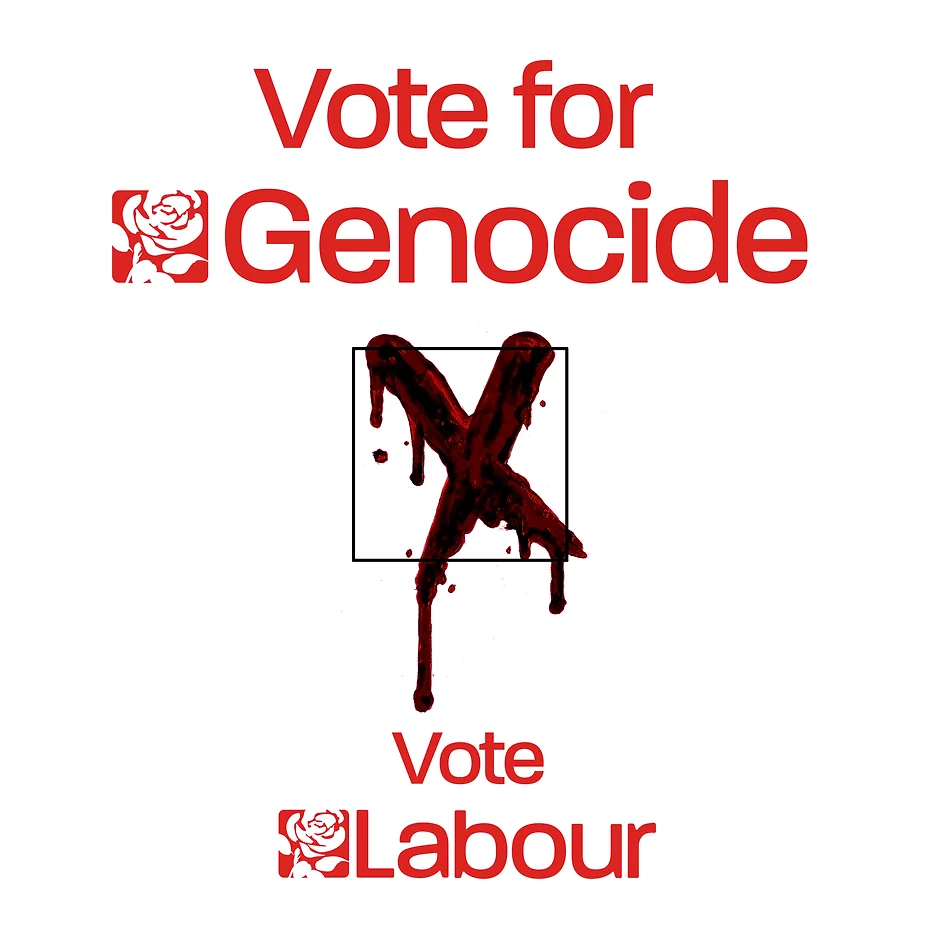
UK Foreign Secretary David Lammy says that UK is suspeding 30 of 350 arms licences to Israel. He also confirms the UK government’s support for Israel’s Gaza genocide.Vote For Genocide Vote Labour.
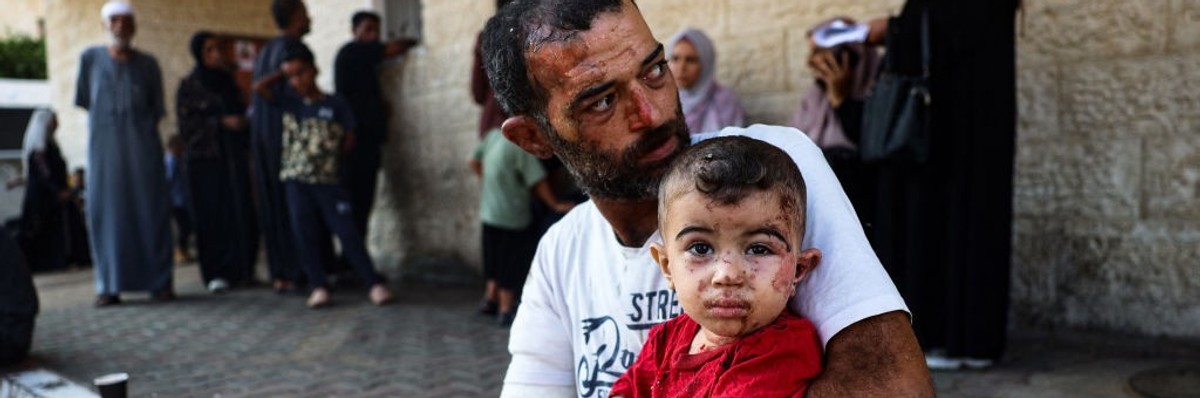
Palestinian Ahmad Yunis and his three-year-old son, Sami, who were both injured in an Israeli bombing in the Bureij refugee camp, sit outside the Al-Aqsa Martyrs Hospital in Deir al-Balah in the central Gaza Strip on September 8, 2024. (Photo: Eyad Baba/AFP via Getty Images)
“I don’t think we have seen before, a violation that is so massive, as we are seeing in Gaza now,” said one committee leader.
A United Nations committee on Thursday called out Israel for “serious violations” of the Convention on the Rights of the Child in the occupied Palestinian territories, particularly with its nearly yearlong assault on the Gaza Strip.
“The outrageous death of children is almost historically unique. This is an extremely dark place in history,” said Bragi Guðbrandsson, vice chair of the U.N. Child Rights Committee, which also released its findings on five other parties to the global treaty—Argentina, Armenia, Bahrain, Mexico, and Turkmenistan.
Since the Hamas-led October 7 attack on Israel, Israeli forces have killed at least 41,272 Palestinians in Gaza and injured another 95,551, according to local officials. Many more remain missing and are believed to be dead and buried in the rubble of bombed civilian infrastructure. The vast majority of the enclave’s 2.3 million residents have been displaced, often numerous times.
Earlier this week, the Gaza Health Ministry publicly identified 34,344 Palestinians who have been killed in the Hamas-governed enclave as of August 31. The document spans 649 pages, the first 14 of which are filled with the names of babies. In total, there are 11,355 children.
The U.N. report states that “the committee is gravely concerned about… the outrageously high number of children in Gaza who continue to be killed, maimed, injured, missing, displaced, orphaned, and subjected to famine, malnutrition, and disease, as well as the multiple displacements of the Gazan population, as a result of the state party’s indiscriminate and disproportionate attacks on Gaza using explosive weapons with wide-area effects in densely populated areas and its denial of humanitarian access, with at least 1 million children displaced, 21,000 children reported missing, 20,000 children who have lost one or both parents, 17,000 children unaccompanied or separated from their families in Gaza, dozens of child deaths due to malnutrition, and 3,500 children at risk of death due to malnutrition and lack of food.”
The panel also expressed alarm over “attacks on and destruction of hospitals, schools, residential buildings, refugee camps, and essential infrastructure, including power facilities and water tanks, by the armed forces, restricting access to health services, education, and housing for the nearly 1 million children living in Gaza.”
Guðbrandsson said that “I don’t think we can identify any measure that was taken to save children’s lives in this military operation in Gaza.”
“I don’t think we have seen before, a violation that is so massive, as we are seeing in Gaza now,” he noted. “These are extremely grave violations that we do not often see.”
Israel, which ratified the treaty in 1991, accused the committee of having a “politically-driven agenda,” in a statement sent by its diplomatic mission in Geneva.
It sent a large delegation to a series of U.N. hearings in Geneva in early September where they argued that the treaty did not apply in Gaza or the West Bank and said that it was committed to respecting international humanitarian law.
It says its military campaign in Gaza is aimed at eliminating the Palestinian enclave’s Hamas rulers and that it does not target civilians but that the militants hide among them, which Hamas denies.
Anne Skelton, chair of the U.N. committee, pushed back against Israel’s position on Thursday, telling journalists, “They were not, in our view, facing up to the reality that 17,000 children are dead and that there have been repeated attacks on schools and hospitals.”
The report also addresses Israel’s claims, saying that “the committee deeply regrets the state party’s repeated denial of its legal obligations under the convention in the occupied Palestinian territory (OPT) based on its position that the convention ‘does not apply… to areas beyond a state’s national territory’ and ‘was not designed to apply in situations of armed conflict,’ and that international humanitarian law is the relevant and specific applicable body of law in the Gaza Strip and the West Bank.”
“The committee also regrets the limited information it received on the situation of children living in the OPT due to such a position,” the 22-page “concluding observations” document continued. “The committee is of the view that the state party’s denial of the application of the convention cannot be used to justify its grave and persistent violations of international human rights and humanitarian law.”
The panel cited the International Court of Justice advisory opinion from July that found “international human rights instruments are applicable.” The ICJ—which has taken up a genocide case against Israel—also said at the time that the decadeslong Israeli occupation of Gaza and the West Bank, including East Jerusalem, is illegal and must end “as rapidly as possible.”
The new report says that the Child Rights Committee, “aligning its position with the position of the ICJ, reiterates that the convention applies to all children at all times and is directly applicable in all territories over which the state party exercises effective control, and reminds the state party of its legal obligations both under the convention and international humanitarian law concerning children in the OPT.”
Skelton also argued that “the only real way to serve children’s rights in this situation is a cease-fire.”
However, Israel has shown no signs of ending its assault on the Palestinian enclave—in fact, fears of a wider regional conflict are heightened this week due to bombings of pagers, walkie-talkies, and other devices across Lebanon, attacks supposedly targeting Hezbollah members that Israeli and U.S. officials attributed to Israel’s military and intelligence operatives.
The Child Rights Committee’s report follows U.N. Secretary-General António Guterres adding Israel to the so-called “List of Shame” of nations that kill and wound children during armed conflicts, a June decision that outraged Israeli officials but was praised by human rights advocates as long overdue.
Tensions in the Middle East have reached a new high after thousands of pagers and radios used by members of Hezbollah exploded across various cities in Lebanon and Syria over September 17 and 18. The attacks – which have widely been attributed to Israel, which has not commented – have resulted in at least 30 people killed and more than 3,000 wounded.
Many analysts and politicians are now speculating that the conflict between Israel and Hezbollah, which has been simmering during the 11-month conflict in Gaza, will spiral into open warfare.
Far from taking place in a legal vacuum, the attacks are governed by international humanitarian law (IHL). This is the international legal regime that regulates the conduct of hostilities in situations of armed conflict.
Since the Hamas attacks on October 7 provoked Israel’s ferocious response in Gaza, Israel and Hezbollah have been involved in a series of cross-border hostilities. These qualify as what is called a “non-international armed conflict”, to which IHL applies. This includes the rules set out in, among other instruments, the Geneva conventions.
In pursuing the objective of protecting civilians in wartime, the Geneva conventions rely on the fundamental principles of “distinction” and “proportionality”.
What international law says
The principle of distinction essentially requires belligerents to distinguish at all times between the civilian population and combatants.
Combatants are lawful targets and can be attacked at all times. But intentionally attacking civilians is prohibited and constitutes a war crime under the Rome statute of the International Criminal Court. To this end, military commanders are under an obligation to do everything feasible to verify that the target of an attack is not a civilian.
Even assuming that only Hezbollah members were using the radios and pagers at the moment of the attacks, that does not mean that they shall be presumed to be combatants (and, therefore, lawful targets). Under IHL, a combatant is a “member of the armed forces of a party to the conflict”. This comprises “all organized forces, groups and units which are under a command responsible to that party for the conduct of its subordinates”.
By contrast, whoever is not a member of the armed forces of a party to the conflict is a civilian and subject to the protection of IHL.
There is no doubt that members of the military wings of Hezbollah are “members of the armed forces”, so they qualify as combatants. But those members of Hezbollah’s political wing who are not combatants should be considered as civilians and accordingly, are protected from attack.
Civilians may lose protection from attack for such time as they take a direct part in hostilities. This includes conduct like the intentional killing of civilians and carrying out acts which adversely affect the military capacity of a party to an armed conflict – for example, the planning of attacks against Israel.
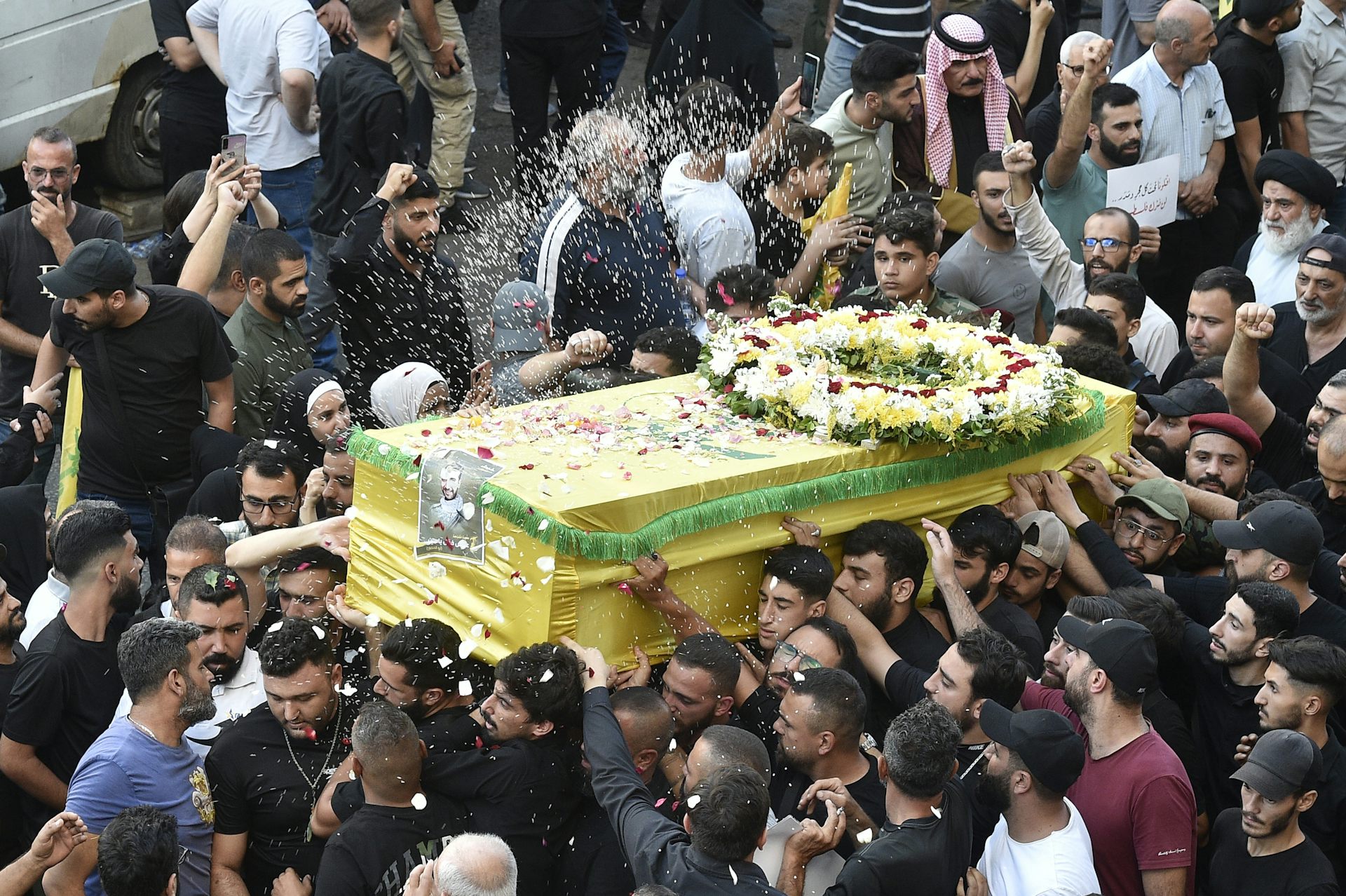
The pagers were detonated at 3:30, on September 17 in hundreds of locations in Beirut and other Lebanese cities. Abaca Press / Alamy Stock Photo
What about the attacks against members of Hezbollah’s military wing?
In this case, complying with the principle of distinction does not suffice, since the attack must also respect the principle of proportionality. This requires that the expected “collateral damage” (that is, the incidental killing or wounding of civilians) should not be excessive to the “concreted and direct military advantage” anticipated from the attacks.
Launching an attack with the knowledge that it would cause excessive collateral damage also constitutes a war crime.
Collateral damage
In this case, the attacks killed several civilians. These included the nine-year-old daughter of a Hezbollah member, an 11-year-old boy and at least two health workers. Moreover, the attacks injured thousands more, including Iran’s ambassador to Lebanon.
Although we do not know how many of those killed or injured were civilians, it seems logical that the level of collateral damage to be expected from the attacks would be substantial. After all, the pagers and radios were remotely detonated at the same time, exploding in crowded places such as markets and funerals. In these situations, the likelihood of killing and wounding civilians is extremely high.
These elements suggest that the expected incidental damage is excessive to the military advantage anticipated from the pager attacks – which, at the time of writing, remains unclear.
But it’s important to note that what amounts to “excessive” incidental damage is subject to disagreement. On the one hand there are those who, like the International Committee of the Red Cross, believe that extensive incidental damage is always excessive. Others – including the Israeli government – consider that even extensive incidental damage is allowed if the attack results in a high amount of military advantage.
In my opinion, Israel’s interpretation should be rejected. It turns IHL’s aims of protecting the civilian population on its head and allows for unrestricted warfare.
My conclusion, based on the available information, appears to be that the pager and walkie-talkie attacks purportedly carried out by Israel against Hezbollah members appear to violate the principles of distinction and proportionality. In other words, they could well amount to war crimes.
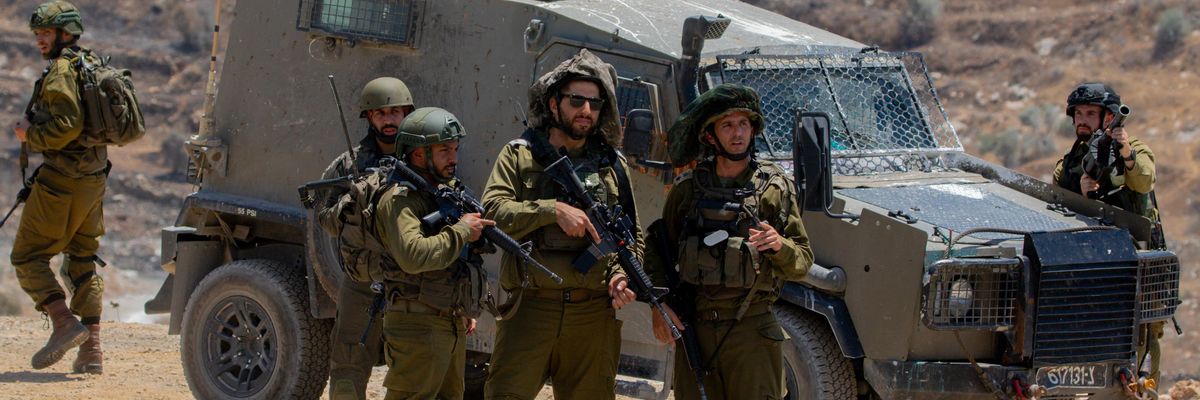
Israeli soldiers and armored vehicles are pictured in the West Bank town of Beita on July 12, 2024. (Photo: Wahaj Bano Moufleh/Middle East Images/AFP via Getty Images)
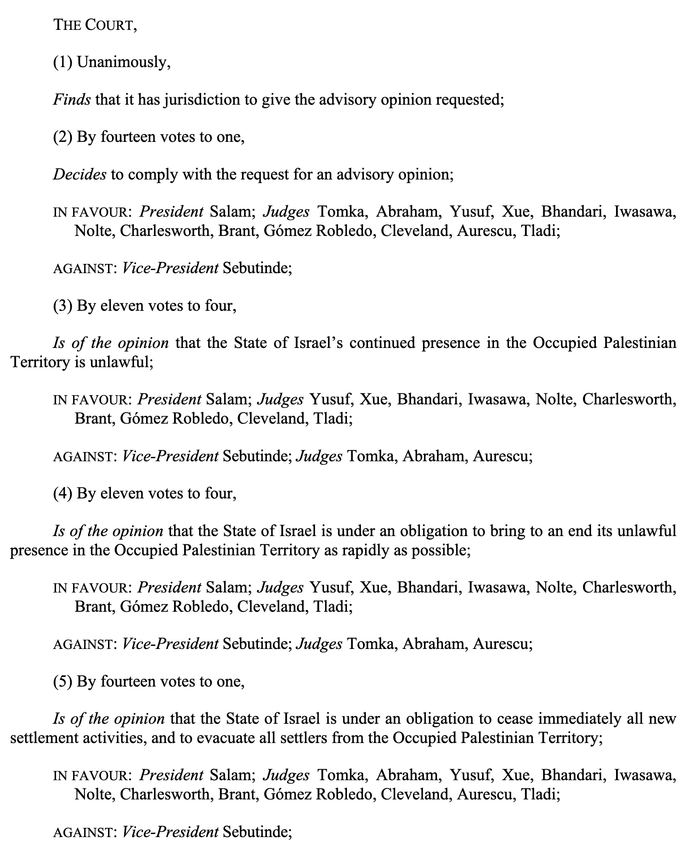
The United Nations’ highest court issued an advisory opinion arguing that Israel’s large-scale expansion of settlements amounts to annexation, a crime under international law.
The International Court of Justice said Friday that Israel’s decadeslong occupation of Gaza and the West Bank, including East Jerusalem, is unlawful and must end “as rapidly as possible.”
The court’s nonbinding advisory opinion was read aloud by ICJ President Nawaf Salam, a Lebanese judge and academic. Salam said the court determined based on “extensive evidence” that Israel is guilty of confiscating “large areas” of Palestinian land for use by Israeli settlers, exploiting natural resources, and undermining the local population’s right to self-determination under international law.
The court pointed to “Israel’s systematic failure to prevent or punish” settler violence and “demolition of Palestinian property” in the West Bank as part of its case that the Israeli government’s actions in the occupied territories are indicative of an attempt to permanently annex land and forcibly transfer Palestinians from their homes.
“Israel is not entitled to sovereignty in any part of the occupied Palestinian territory on account of its occupation, nor can security concerns override the prohibition on acquisition of territory by force,” said Salam.
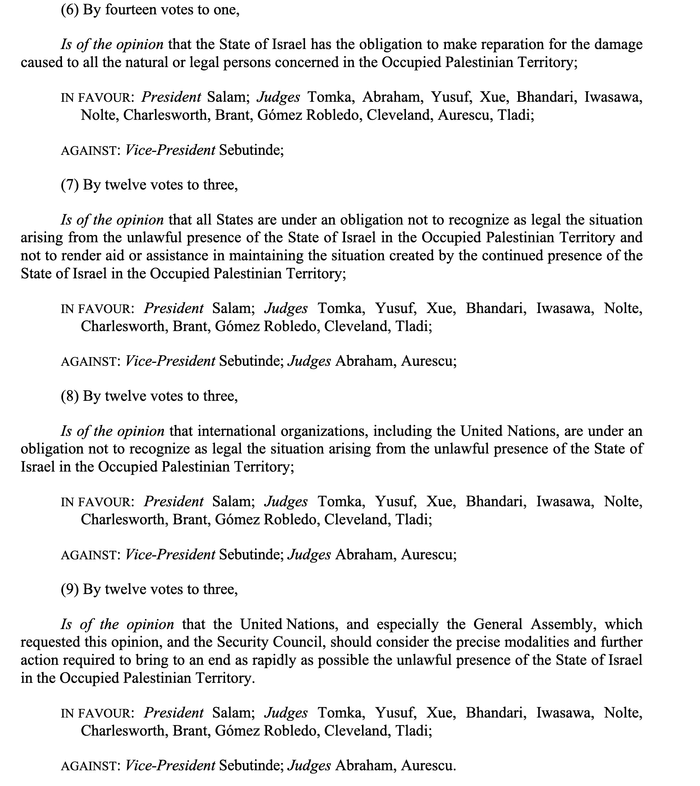
The ICJ vote against Israel’s occupation was 11-4. The court also voted to call on Israel to evacuate all settlers from the West Bank.
In a 12-3 vote, the ICJ said that all nations “are under an obligation not to recognize as legal the situation arising from the unlawful presence of the state of Israel in the occupied Palestinian territory and not to render aid or assistance in maintaining the situation created by the continued presence of the state of Israel in the occupied Palestinian territory.”
The United States was among the countries that warned the ICJ against advising that Israel must swiftly end its occupation.
The ICJ handed down its opinion as the court is also considering a genocide case brought against Israel over its ongoing assault on the Gaza Strip—a devastating war that the court did not weigh as part of its new advisory opinion.
Trita Parsi, executive vice president of the Quincy Institute for Responsible Statecraft, applauded the ICJ’s call for the dismantling of Israeli settlements and reparations for Palestinians harmed by Israel’s occupation.
“The ICJ ruling in essence confirmed what the majority of people (except the West) already knew and have recognized: that Israel’s occupation is illegal, that it is still occupying Gaza, it is annexing the West Bank, and Israel is an apartheid state,” Parsi wrote on social media. “If there is any respect for international law, Western media must now include this in all its Israel coverage. Most don’t even describe settlements as illegal!”
Nancy Okail, president and CEO of the Center for International Policy, said in a statement that “while the ICJ’s action is nonbinding, countries that seek to uphold international law should respect the court’s determination and take all appropriate steps to counter the injustices of the occupation and bring it to a peaceful end.”
“At a minimum, countries should not engage in actions which help to perpetuate the occupation and its discriminatory, annexationist goals,” said Okail. “In particular, the United States must end the unconditional supply of arms that Israel uses in connection with the dispossession and settlement of Palestinian land and other violations of Palestinian rights.”
dizzy: It’s difficult to argue that they are not Fascists when they commit the very crimes created immediately after WWII to address Fascism, to ensure “never again” and quote Fascist Adolf Hitler. It’s difficult to see that supporting countries are not aiding and abetting and complicit in genocide and war crimes when such blatant calls for such crimes are and have been made.
Israeli far-right Zehout (identity) political party chairman Moshe Feiglin gives a joint press statement with Prime Minister and Likud Chairman Benjamin Netanyahu (unseen) in Ramat Gan, near the Israeli coastal city of Tel Aviv on August 29, 2019. (Photo: Jack Guez/AFP via Getty Images)
“In what kind of society can one openly advocate policies modeled on Hitler’s conduct? In a society that feels complete impunity due to America’s protection,” one foreign policy expert said.
Former Israeli Knesset member Moshe Feiglin quoted Adolf Hitler as he called for Israel to resettle the Gaza Strip and create a “Hebrew Gaza.”
Feiglin, who quit Prime Minister Benjamin Netanyahu’s Likud Party to found the right-wing Zehut Party and plans to challenge Likud in Israel’s next elections, made the comments during a panel discussion on Israel’s Channel 12 that was shared on social media on Sunday, as Middle East Eye reported.
“We are not guests in our country, this is our country, all of it…” Feiglin said, adding, “As Hitler said, ‘I cannot live if one Jew is left.’ We can’t live here if one ‘Islamo-Nazi’ remains in Gaza.”
On @N12News Israel's most watched news show, former Likud MP Moshe Feiglin invokes ***Hitler*** to justify Gaza resettlement:
"As Hitler said, 'I cannot live if one Jew is left,' we can't live here if one 'Islamo-nazi' remains in Gaza."
Feiglin’s remarks earned widespread condemnation on social media.
“In what kind of society can one openly advocate policies modeled on Hitler’s conduct?” asked Trita Parsi, the executive vice president of the Quincy Institute for Responsible Statecraft. “In a society that feels complete impunity due to America’s protection.”
Former Greek Finance Minister and leader of the pan-European leftist political party DiEM25 Yanis Varoufakiswrote that “the evidence of genocidal intentions is mounting” and asked, “When will the ICC [International Criminal Court] act?”
Israel has killed at least 37,337 people and injured 85,299 in its war on Gaza since October 7, when Hamas carried out a lethal attack against southern Israel, killing around 1,100 people and taking more than 240 hostage. Prior to the attack, Israel had maintained a 16-year blockade of the narrow enclave.
South Africa brought a case before the International Court of Justice accusing Israel of genocide in Gaza, citing the vast destruction of its bombing campaign as well as statements made by high-level Israeli politicians, including Netanyahu, that portray all Gazans as complicit in the October 7 attacks. Several human rights experts and scholars have also concluded that Israel is committing genocide.
This is not the first time that Feiglin, who served in the Knesset from 2013 to 2015, has called for the expulsion of Palestinians from Gaza.
“We need a different prime minister who is willing to stick his neck out to win. Zehut will provide, whenever elections happen, such a candidate,” he told supporters in January, according to Middle East Eye. “For us, the war in Gaza is not merely a defensive war. It’s a war of liberation, the liberation of the land from its occupiers.”
In an October 2023 interview with Al Jazeera, he also advocated for the “complete destruction of Gaza, before invading it… Destruction like Dresden and Hiroshima, without a nuclear weapon.”
Zehut’s 2019 platform included the cancellation of the Oslo Accords with the Palestinians, according to Haaretz.
“Don’t talk to me about international law, because there is not such a thing. You know, the minute you use the word ‘Palestinian,’ you stop saying the truth. Because there is no Palestinian nation, and they know it,” Feiglin said that same year.
Other currently governing Israeli politicians have also called for the expulsion of Palestinians from Gaza.
Israeli National Security Minister Itamar Ben-Gvir said in January that the Israeli government should “encourage the migration” of Palestinians out of Gaza.
Later the same month, Ben-Gvir and Finance Minister Bezalel Smotrich attended a right-wing conference calling for the “resettlement” of Gaza.