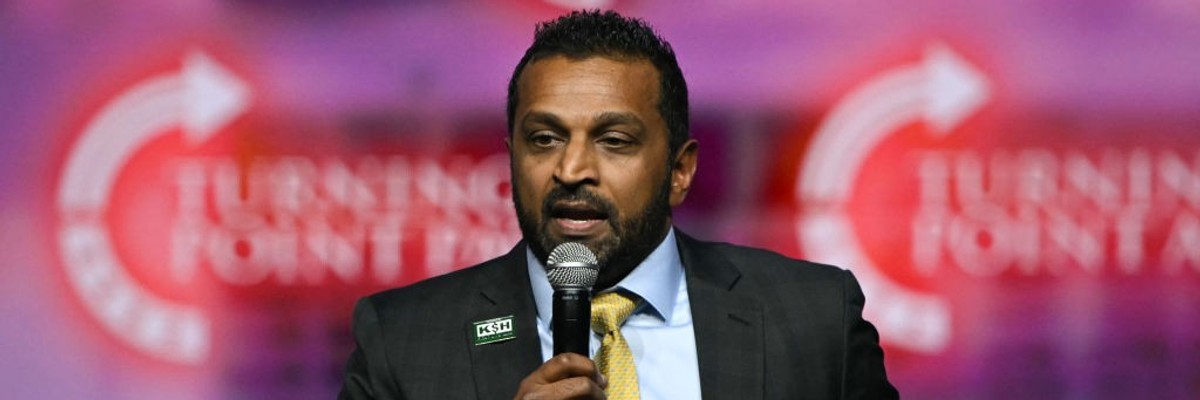
Former Chief of Staff to the United States Secretary of Defense Kash Patel speaks during a Turning Point Action ‘United for Change’ campaign rally for former US President and Republican presidential candidate Donald Trump in Las Vegas, Nevada, on October 24, 2024. (Photo by PATRICK T. FALLON/AFP via Getty Images) Photo by Patrick T. Fallon / AFP
Kash’s nomination to lead the FBI, said one watchdog, “represents the cronyism that is coming to define the second Trump administration. Loyalty to President-elect Trump is what matters above all else.”
Watchdog critics are sounding the alarm over president-elect Donald Trump’s choice of Kashyap “Kash” Patel to be the next director of the FBI, calling the MAGA ultra-loyalist—who even former Republican colleagues describe as “dangerous” and unqualified—to be running the nation’s top law enforcement agency.
Patel, who served in the previous Trump administration as chief of staff in the Department of Defense and a counterterrorism adviser on the National Security Council, was characterized by the Associated Press earlier this year as “trusted aide and swaggering campaign surrogate who mythologizes the former president while promoting conspiracy theories and his own brand.”
Journalist Medhi Hasan, co-founder of Zeteo, said that while previously working for MSNBC he had done a deep-dive on Patel, during which he discovered just what “a deeply strange and alarming and sycophantic figure” Trump’s pick is.
“Yes, we’re going to come after people in the media.” —Kash Patel, 2023
As the New York Timesreports, Patel founded a nonprofit that provides legal assistance to individuals prosecuted for involvement in the January 6, 2021 insurrection and also runs a merchandise business which sells flashy pro-MAGA gear under the “K$H” label.
Patel, the Times notes, “sells pro-Trump T-shirts and other items as well as a series of his children’s books that pay homage to ‘King Donald.’ Mr. Patel also collected hundreds of thousands of dollars in consulting fees from the 2024 Trump campaign and from Friends of Matt Gaetz, the campaign committee for the former House Republican from Florida, who withdrew from consideration as Mr. Trump’s attorney general after criticism over allegations of sex trafficking and drug use.”
According to the watchdog group Accountable.US, Patel is just the latest unqualified choice by a president-elect will to put “political loyalty above national security.” As the group noted in a statement:
While Patel joined the previous Trump administration in its last year and quickly rose through the ranks thanks to his hard-nosed style and fawning devotion to Donald Trump, other Trump officials reportedly regarded Patel as “dangerous” including General Mark Milley who feared he would break the law for Trump, and former Trump Attorney General Bill Barr who said “Over my dead body” when Trump entertained naming Patel deputy director of the FBI. Recently, Patel has threatened to prosecute journalists and political opponents of Trump. Patel has also reportedly spread baseless Qanon conspiracy theories and “earned hundreds of thousands of dollars a year from his own business dealings with Trump-related entities.”
Last year, during an appearance on Steve Bannon’s War Room podcast, Patel vowed that Trump’s enemies would be targeted if the former president returned to power. “We will go out and find the conspirators not just in government, but in the media,” Patel said at the time.
“Yes, we’re going to come after people in the media,” Patel explained to Bannon, talking about journalists and others who he claimed “help Joe Biden rig elections.”
Tony Carrk, Accountable’s executive director, warned Kash’s nomination to lead the FBI “represents the cronyism that is coming to define the second Trump administration. Loyalty to President-elect Trump is what matters above all else.”
“Even former Trump officials have questioned Patel’s qualifications and ability to adhere to the rule of law after he has threatened to prosecute journalists and Trump’s political opponents,” Carrk added. “Patel’s financial entanglements with the president-elect also present potential conflicts of interest. He has turned his gushing idolization of Trump into a money-making opportunity, enriching himself by promoting the Trump brand alongside his own. It says it all about Donald Trump’s priorities to once again reward a devout political crony even if it means America’s national security interests come a distant second.”
“Even in an administration full of loyalists, Patel was exceptional in his devotion.”
Writing Saturday in The Atlantic, staff writer Elaina Plott Calabro described Kash as “exactly the kind of person who would serve in a second Trump administration,” based on his personality as much as his record.
Why was he seen as “dangerous,” even among Trump administration insiders at the time?
“It wasn’t a question of ideology,” according to Calabro. “He wasn’t a zealot like Stephen Miller, trying to make the bureaucracy yield to his agenda. Rather, Patel appeared singularly focused on pleasing Trump. Even in an administration full of loyalists, Patel was exceptional in his devotion.”
As Israel’s October 1 invasion of Lebanon unfolds, the media’s complicity in shaping public perception raises urgent questions, particularly when viewed through the lens of a controversial 1984 conference where influential advertising and media figures gathered to refine Israel’s narrative strategies. This conference laid the groundwork for a sophisticated propaganda campaign—Hasbara—that sought to sanitize Israel’s actions and cast its military operations in a favorable light. Today, as Western journalists whitewash, distort, and conceal [Israel’s ?] the realities of Israel’s deadly campaign of violence, the enduring legacy of this meeting becomes alarmingly clear, revealing how narratives crafted decades ago continue to shape the coverage of a conflict that claims countless lives.
In the first week of October, Israeli forces fired 355 bullets at a car containing a five-year-old, then shot at rescue workers who rushed to save her life. A horrific crime – yet, per many Western media headlines, she was simply a “girl killed in Gaza.” The circumstances and perpetrators of her death, if mentioned at all, were invariably buried at the bottom of reports, well hidden from the 80% of the news-consuming public who only read headlines, not accompanying articles.
By contrast, on October 15, Sky News was very keen that its viewers know the names and faces of four “teenage” IDF soldiers “killed” in a “Hezbollah drone attack,” humanizing and infantilizing individuals who, by mere token of their service in Israel’s military, are by definition, guilty of genocide. In passing, the same report briskly noted: “‘23 die’ in Gaza school strike.” Their identities, ages, and photos, let alone clarity on who or what murdered them, weren’t provided.
Moreover, the inverted commas incongruously hovering around the number of Palestinians killed subtly undermined that claim’s credibility while reducing the child victims to an afterthought compared to the considerably more important quartet of deceased IDF genocidaires. MintPress News senior staff writer Alan MacLeod put it succinctly when he Tweeted, “In years to come, students in university departments around the world will be studying the propaganda embedded in this headline. It’s truly incredible how much propaganda has been packed into 16 words.”
The mainstream media’s systematic use of distancing and evasive language, omission and other duplicitous chicanery to downplay or outright justify Israel’s murder of innocent civilians while simultaneously dehumanizing their victims and delegitimizing Palestinian resistance against brutal, illegal IDF occupation is as unconscionable as it is well-documented. Amazingly though, ‘twasn’t ever thus. Once upon a time, mainstream news networks exposed Israel’s war crimes without qualification, and anchors and pundits openly condemned these actions on live TV to audiences of millions.
The story of how Western media was transformed into Israel’s doting, servile propaganda appendage is not only a fascinating and sordid hidden chronicle. It is a deeply educational lesson in how imperial power can easily subordinate supposed arbiters of truth to its will. Comprehending how we got to this point equips us with the tools to assess, identify, and deconstruct lies large and small – and effectively challenge and counter not only Israel’s falsehoods but the entire settler colonial endeavor.
‘NEIGHBORHOOD BULLY’
On June 6, 1982, Israel invaded Lebanon. The effort was ostensibly intended to drive Palestinian Liberation Organization freedom fighters away from their positions on Israel’s northern border. But, as the IDF savagely pushed ever-deeper into the country, including Beirut, it became clear that ethnic cleansing, massacres, and land theft were – as in Palestine – the true goal. Throughout the Lebanese capital, news crews from major networks and reporters from the West’s biggest newspapers were waiting.
Israel’s rapacious bloodlust and casual contempt for Arab lives had hitherto been, by and large, successfully concealed from the outside world. Suddenly, though, scenes of deliberate IDF airstrikes on residential housing blocks, Tel Aviv’s trigger-happy soldiers running amok in Beirut’s streets, and hospitals overflowing with civilians suffering from grave injuries, including chemical burns due to Israel’s use of phosphorus shells, were broadcast the world over, to nigh-universal outcry. As veteran NBC news anchor John Chancellor contemporarily explained to Western viewers:
What in the world is going on? Israel’s security problem, on its border, is 50 miles to the south. What’s an Israeli army doing here in Beirut? The answer is we are now dealing with an imperial Israel, which is solving its problems in someone else’s country, world opinion be damned.”
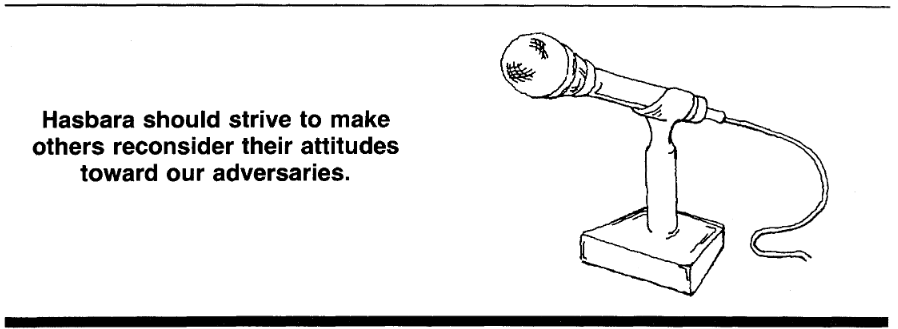
From: “Hasbara: Israel’s Public Image: Problems and Remedies”
Global shock and repulsion at Israel’s conduct would only ratchet during the IDF’s resultant illegal military occupation of swaths of Lebanon. In September 1982, an Israel-backed armed Christian militia, Phalange, entered Sabra, a Beirut neighborhood home to many Palestinians displaced by the 1948 Nakba. Over a two-day span, they slaughtered up to 3,500 people while mutilating and raping countless others. Again, unfortunately for Tel Aviv, mainstream journalists were on hand to document these heinous crimes first-hand.
To say the least, Israel had an international PR disaster of historic proportions on its blood-soaked hands. The risk that further exposure of its genocidal nature might decisively and permanently shift global opinion in favor of the Palestinians and the Arab world more generally was significant. The attack on Lebanon had already spurred Western news outlets to critically reassess other illegal annexations and occupations in which Israel was and remains engaged. As ABC News reporter Richard Threlkeld commented at the time:
Israel was always that gallant little underdog democracy fighting for survival against all the odds. Now, the Israelis have annexed East Jerusalem and the Golan Heights, settled down more or less permanently on the West Bank, and occupied close to half of Lebanon. In the interests of self-defense, that gallant little underdog, Israel, has suddenly started behaving like the neighborhood bully.”
So it was that in the summer of 1984, the American Jewish Congress – a major Zionist lobby organization – convened a conference in Jerusalem, Israel’s Public Image: Problems and Remedies. It was chaired by U.S. advertising supremo Carl Spielgovel, who a decade earlier provided pro bono advice to the Israeli government on strategies for publicly communicating why Tel Aviv refused to adhere to the terms of the Henry Kissinger-brokered 1973 Sinai Accords. Spielgovel later recalled:
It occurred to me then that the Israelis were doing a good job at training their military people, and they were doing a relatively good job at training their diplomatic corps. But they weren’t spending any time training information officers, people who could present Israel’s case to embassies and TV anchormen around the world. Over the years, I made this a personal cause celebre.”
The 1984 Jerusalem conference offered Spielgovel and a welter of Western advertising and public relations executives, media specialists, editors, journalists, and leaders of major Zionist advocacy groups an opportunity to achieve that malign objective. Together, they hammered out a dedicated strategy for ensuring the “crisis” caused by news reporting on the invasion of Lebanon two years earlier would never be repeated. Their antidote? Ceaseless, methodical, and wide-ranging “Hasbara” – Hebrew for propaganda – for “changing people’s minds [and] making them think differently.”
‘BIG SCOOP’
The AJC subsequently published records of the conference. They offer extraordinarily candid insight into how multiple Hasbara strategies, which have been in perpetual operation ever since were birthed. For example, basic propaganda messages were agreed upon. This included messages that are echoed by Israel’s supporters to this day, emphasizing Israel’s regional importance to the U.S. and Europe, Western cultural and political values, geographic vulnerability, and supposed striving for peace in the face of implacable Palestinian belligerence and intransigence.
As Judith Elizur, an expert in “communications” from Tel Aviv’s Hebrew University, explained:
Because the ‘power dimension’ of Israel’s image is so problematic, it seems to me that Hasbara must concentrate on reinforcing other aspects of Israel that have a positive appeal – medicine, agriculture, science, archaeology…We have been too preoccupied with extinguishing political brush fires. We need to devote more of our resources to long-range image-making. We must recreate a multi-dimensional image of Israel which will assure us the basic support we require in times of crisis.”
There was extensive discussion of how to present “unpalatable policies” to Western populations, and counter the perception of Israel as “Goliath steamrolling” across West Asia, against adversaries “outgunned, outclassed and outmanned” with “no capacity to resist.” The necessity of training the Jewish diaspora in countering criticism of Israel was considered paramount.
AJC’s president lamented that “many American Jews” had condemned the invasion of Lebanon and “did us a terrible disservice.” Any such future “disagreement” would make it “very difficult for us to conduct Hasbara effectively.”
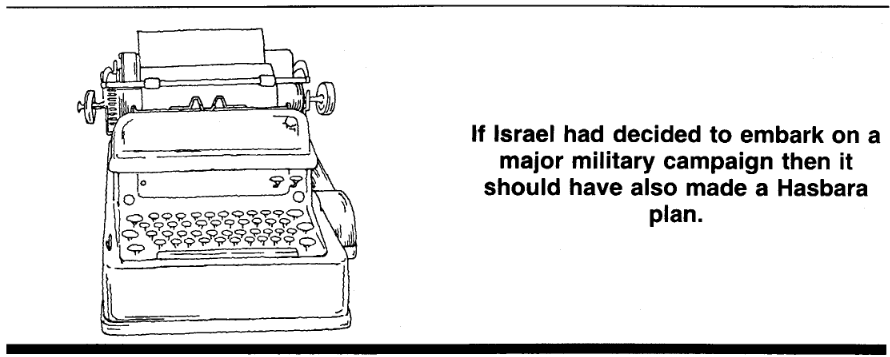
From: “Hasbara: Israel’s Public Image: Problems and Remedies”
Joseph Block, Pepsi’s former vice president of public relations, stressed the need for a dedicated, 24/7 Israel press operation “equipped to offer foreign journalists an occasional exclusive or scoop” and engage in other media outreach to balance critical coverage and get reporters and newsrooms ‘on side.’ Block lamented that had Israeli officials not “briefed NBC and other networks appropriately” and given them “a big scoop” during Lebanon’s invasion, “a different story would have reached America’s 90 million TV households”:
News doesn’t just jump into a camera. It’s directed. It’s managed. It’s made accessible. Public relations is a process that makes news available in a particular form. In the US, PR is as important as accounting, the law and the military…As a corporate spokesman for two of America’s top 50 corporations, I wish I had a shekel for every time I said, ‘no comment’ to a reporter. I was always careful, however, not to antagonize or intimidate the reporter. I knew I had to live with him or her.”
Yoram Ettinger, media analysis chief at the Israel Information Center, concurred, declaring that media framing on Israel’s actions needed to be determined in advance. “Actions” such as “blowing up houses,” which were “difficult to explain,” could be preemptively justified or at least relativized by placing them “in context” while “[drawing] analogies that others will understand.” This would “help others to interpret their meaning,” per Tel Aviv’s perspectives.
The Conference hoped such efforts would mean “our American friends will be able to take a more activist posture as amplifiers of our policy” and assist them in “tucking away the house problems in a back room.” It was also suggested that on an individual and organizational level, Zionist activists serve as a rapid reaction force, deluging news outlets with complaints en masse should their coverage of Israel be at all critical. One attendee boasted of their personal success in this regard:
One day CBS News Radio reported that an American soldier had been hurt by stepping on an Israeli cluster bomb at the Beirut airport. I called CBS to point out that no one had established the bomb was an Israeli one. One hour later CBS reported that an American soldier had stepped on a bomb; this time the report omitted any reference to Israel.”
‘FREQUENT VIOLATIONS’
Another significant recommendation came from Carl Spielgovel: creating a “training program” to bring carefully selected Israeli information specialists into U.S. advertising, PR agencies, and major news outlets. The initiative aimed to equip them with industry insights, ensure Hasbara efforts were maximized, and establish close relationships between Israeli officials and the organizations to which they were assigned.
These “specialists” would operate under the guidance of a U.S.-Israeli council described as “wise persons who can project different scenarios and how to cope with them” on complex issues like “annexation and Jerusalem.” Spielgovel was careful to clarify that he was “not suggesting that we make policy” but rather that “we should make the best minds available to help elucidate the consequences of certain policies.” The goal, he suggested, was to reinforce to the American public that Tel Aviv remains Washington’s “staunch political and military ally.”
Spielgovel further proposed that future AJC conferences should incorporate input from “young people” and people of color to better promote Tel Aviv’s image among diverse “constituencies.” He argued that “Hasbara needs to implant in the consciousness of the world the day-to-day existence” of Israeli citizens, requiring a steady stream of “stories in the arts, business, and cooking sections of U.S. newspapers.” Since then, a dedicated Hasbara program aimed at cultivating skilled Zionist advocates in the U.S. has operated continuously.
Buoyed by its success, the operation soon expanded to include school and university students worldwide, training them to act as vigorous advocates for Israel in classrooms and on campuses. Graduates of these Israeli-funded programs frequently enter influential fields, including journalism, where they continue to promote Hasbara narratives and defend Israel’s actions. The impact on Western media coverage of Palestine has been profound.
To a significant degree, the portrayal of Tel Aviv as “the gallant little underdog democracy fighting for survival against all the odds” has been firmly reestablished. Despite the ongoing crisis in Gaza, mainstream outlets seldom provide context for Palestinian resistance to Israel’s policies of annexation, occupation, and military actions. Coverage nearly always frames Israel’s actions as “self-defense” against “terrorist” threats, with Western journalists keenly aware of potential repercussions for diverging from this narrative.
From: “Hasbara: Israel’s Public Image: Problems and Remedies”
The rapid reaction force proposed at the 1984 AJC conference remains highly active. An extensive network of Hasbara-trained individuals and Israel lobby organizations is always on standby, ready to pressure and intimidate news outlets if coverage diverges from favorable framing or casts Israel in a critical light. As a senior BBC producer once confided to veteran media critic Greg Philo:
We wait in fear for the telephone call from the Israelis. The only issue we face then is how high up it’s come from them. Has it come from a monitoring group? Has it come from the Israeli embassy? And how high has it gone up our organization? Has it reached the editor or director general? I have had journalists on the phone to me before a major news report, asking which words can I use – ‘is it alright I say this’?”
An October exposé by Al Jazeera, citing testimony from BBC and CNN whistleblowers, detailed “pro-Israel bias in coverage, systematic double standards, and frequent violations of journalistic principles” at both networks. According to insiders, much of this was driven by concerns over how Israeli officials might perceive and react to certain coverage. Independent activists and journalists, however, are not bound by such institutional pressures—and since October 7, 2023, they have mounted a formidable challenge to Hasbara narratives.
Were it not for the persistent investigations by outlets like MintPress News, The Grayzone, and Electronic Intifada, unfounded allegations promoted by Israel since the outset of the Gaza conflict—such as claims of Hamas committing mass rape or beheading infants—might never have been thoroughly debunked and might still shape the “context” for Israel’s actions against Palestinians. Meanwhile, countless concerned citizens have actively challenged Western narratives on the conflict in real-time across social media, a groundswell of critique that may be fueling pushback within some mainstream newsrooms.
It is a poetic irony that the same information warfare techniques once honed under Hasbara are now being directed at Israel and its defenders. For decades, these methods allowed Israel to proceed with its gradual displacement of the Palestinian people, often with tacit approval from Western audiences. But those times seem to be fading. Today, critics and former targets of Israeli policy are effectively using these strategies, wielding what they see as their most potent tools—truth and justice.
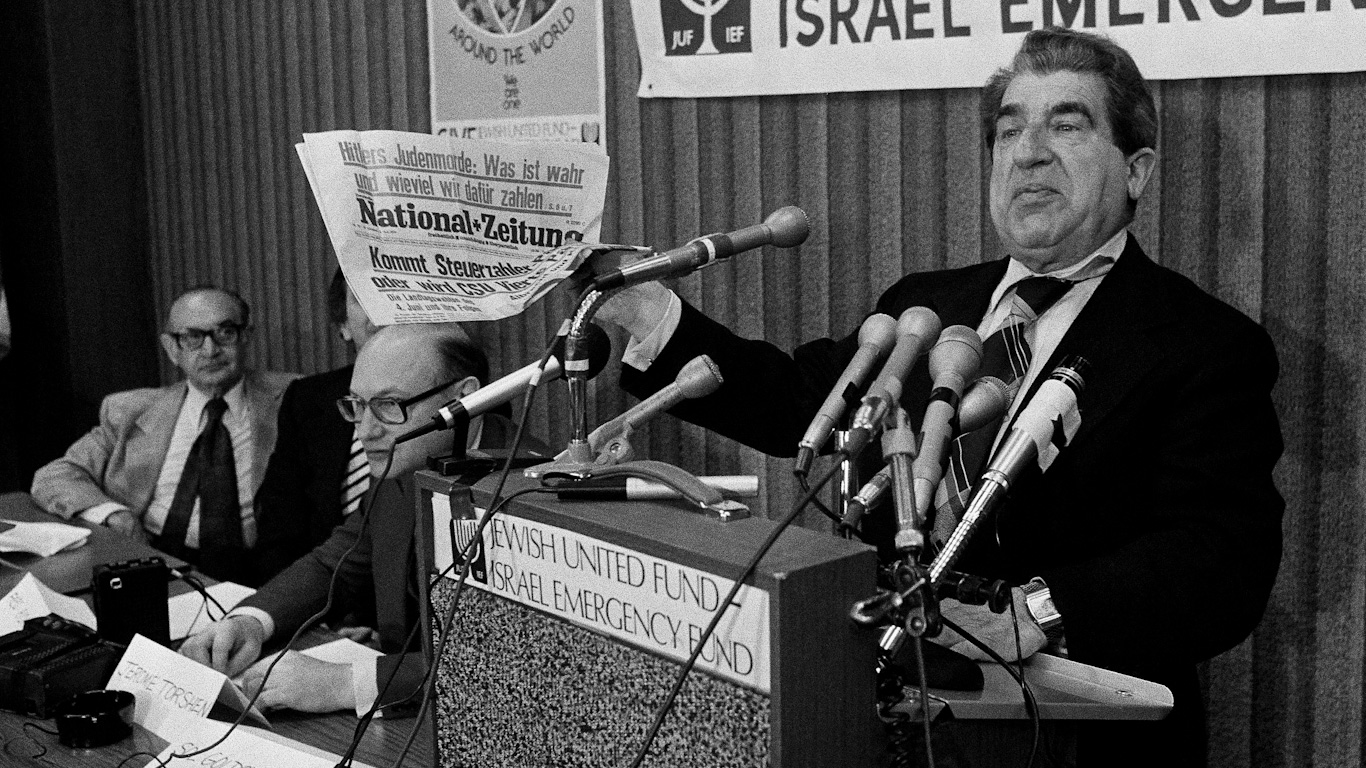
Feature image | Sol Goldstein, spokesman for a group of Jewish organizations, holds up a German language newspaper with headlines questioning the validity of the Holocaust, at a news conference in Chicago, June 14, 1978. Photo | AP
Kit Klarenberg is an investigative journalist and MintPress News contributor exploring the role of intelligence services in shaping politics and perceptions. His work has previously appeared in The Cradle, Declassified UK, and Grayzone. Follow him on Twitter @KitKlarenberg.
The views expressed in this article are the author’s own and do not necessarily reflect MintPress News editorial policy.
Mainline media are being fundamentally dishonest in presenting the killing of Chris Kaba. There is a concerted attempt to further excuse armed police from killing people, that is what it’s about. For example, a hard traffic stop is presented as a traffic stop. A hard traffic stop is an intentional crash to sandwich a car between 2 others front and back. If I was subjected to a hard stop, I would then expect to be killed by armed men (police or army) and it’s certainly not unreasonable or unexpected to try to escape.
Deputy Labour Party Leader Angela Rayner calls for police to kill and harass innocent people.
You already don’t need to be armed to be killed by armed police in UK. It helps no end if you’re black but I’ve know people to be killed because of their names. I don’t regard myself as black but can get a very deep tan. My father was once told to “Get back to where you came from” to which he replied “What, Ely?”. Ely is an area of Cardiff.
It’s not that difficult to ram hard into the back of the car in front – it happens many times every day.
Journalist Hassan Hamad holds a photo of Ismael al-Ghoul and Rami al-Rifi, Palestinian reporters also killed by Israel in Gaza. (Photo: Maha Hussaini/X)
“Western journalists and editors should hang their heads in shame for their outrageous silence in the face of these crimes,” said one professor.
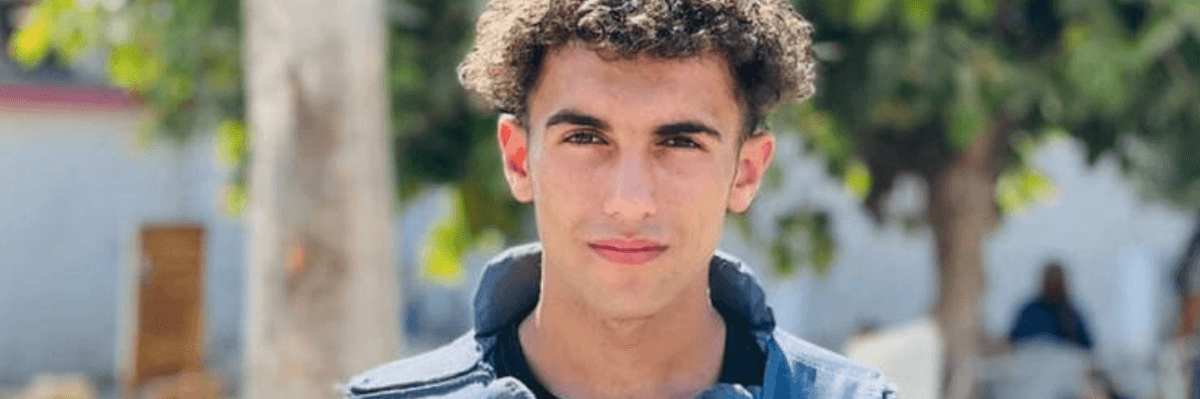
Journalists around the world expressed outrage Monday over the Israeli military’s killing of a teenage Palestinian reporter who continued showing the world the destruction of Gaza despite threats to his life—and at the Western media’s silence on the story.
Hassan Hamad, 19, whose work appeared on Al Jazeera and other outlets, was killed Sunday in an Israeli drone strike on his home in the Jabaliya refugee camp in northern Gaza, The Palestine Chronicle reported. The bombing followed multiple text messages warning Hamad to stop recording images of Israel’s assault on Gaza, which has killed or injured nearly 150,000 Palestinians and for which the close U.S. ally is on trial for genocide at the International Court of Justice.
Palestinian journalist Maha Hussaini posted a photo of one threatening WhatsApp message sent to Hamad. It read, “Listen, if you continue spreading lies about Israel, we’ll come for you next and turn your family into… This is your last warning.”
Hussaini said that Hamad also received “several calls from an Israeli officer ordering him to stop filming in Gaza.”
“He didn’t comply,” she wrote. “He was killed today.”
Hassan Hamad was a 19-year-old Palestinian journalist who tried to document one of the worst crimes of our age in impossible circumstances.
The Israeli state threatened to murder him unless he fell silent.
A colleague of Hamad’s wrote on the slain journalist’s X account:
With great sadness and pain, I mourn the journalist Hassan Hamad… Hamad, the journalist who is not yet 20 years old, resisted for a whole year in his own special way. He resisted when he was away from his family so that they would not be targeted. He resisted when he was suffering to find an internet signal and would sit for an hour or two on the roof of the house to send videos that reach you in seconds. Yesterday, since 10:00, he was moving between the bombed areas and returning to search for an internet signal, then returning to cover the places of the remains, suffering from an injury he sustained in his leg. Nevertheless, he completed filming. At 6:00 am, he called me to send me the last video. After a call that did not exceed a few seconds, he was saying, “Hey, hey, it’s done,” and he hung up. This is a feeling that no human being can bear. Hassan also resisted the occupation and left a mark and left a message that we will complete after him.
Journalists and others posted graphic video footage of pieces of Hamad’s remains being collected and placed in a shoebox.
“I will never forget the silence of the media industry about this,” Al Jazeera executive producer Laila Al-Arian wrote in a social media post containing the video.
I just saw my friend and colleague Hassan Hamad an hour ago Israeli occupation forces have just killed him, and what remains of his body is in pieces in a plastic bag. Why do I have to see my friends in plastic bags? Why is this world so cruel to us?
Thomson Reuters Foundation deputy editor-in-chief Barry Malone responded to Hassan’s killing by asking, “If you’re a journalist and you’re not speaking out in solidarity… why?”
Anthropology professor Jason Hickel said that “we can never unsee the images of journalist Hassan Hamad’s remains, after he was assassinated by Israeli forces.”
“Western journalists and editors should hang their heads in shame for their outrageous silence in the face of these crimes,” he added.
🚨Breaking: Israeli army have killed journalist Hassan Hamad @Hassan_hamad77 by bombing his family’s home in northern #Gaza.
Not long before, he had shared a video from inside his home, capturing the brutal airstrikes surrounding him. pic.twitter.com/XXwMu4lZoF
The New York-based Committee to Protect Journalists says that “at least 128 journalists and media workers, all but five of them Palestinian, have been killed—more journalists than have died in the course of any year since CPJ began documenting journalist killings in 1992.”
“All of the killings, except two Israeli journalists killed in the October 7, 2023 attack by Hamas on Israel, were carried out by Israeli forces,” the group added. “CPJ has found that at least five journalists were specifically targeted by Israel for their work.”
Gaza’s Government Media Office (GMO) said Sunday that 175 media workers have been killed in the embattled enclave over the past year.
The press freedom group Reporters Without Borders (RSF) has filed multiple complaints at the International Criminal Court—whose chief prosecutor is seeking arrest warrants for Israeli Prime Minister Benjamin Netanyahu, Defense Minister Yoav Gallant, and Hamas leaders—alleging “war crimes against journalists in Gaza.”
#Gaza: 🔴 Hassan Hamad, one of the last journalists still reporting from the northern enclave, was killed yesterday, in a targeted Israeli strike, according to RSF’s information, as he was about to send footage from home after a report. Impunity must end.https://t.co/SaiE2HgQJ8pic.twitter.com/9x0CTtNAXI