Tag: media

  • UK Labour MP Says Right-Wing Politicians, Media Fueled Xenophobic Mob Attacks

    Spread the love

    Original article by JULIA CONLEY republished from Common Dreams under Creative Commons (CC BY-NC-ND 3.0). Ed Balls was previously a Labour Party MP.
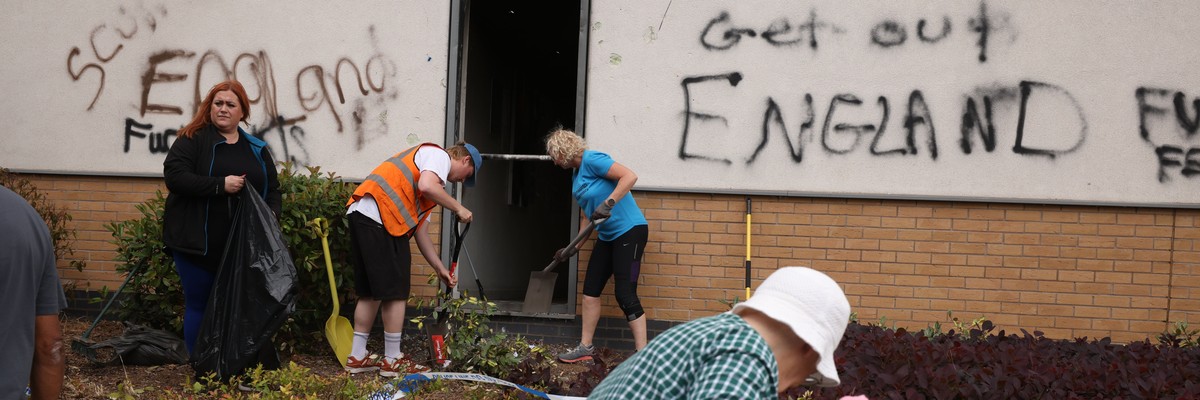
    People clean up debris outside a Holiday Inn Express whose walls bear graffiti reading “Get Out England” and a racial epithet on August 5, 2024 in Tamworth, England.

    “There are politicians and there are journalists who have played an active role in fanning the flames of hate and division, and we are seeing that play out,” said Zarah Sultana.

    As British Prime Minister Keir Starmer covened an emergency security meeting on Monday to respond to violent attacks on immigrant and Muslim communities that have spread across the United Kingdom in recent days, progressive MP Zarah Sultana said the crisis—fueled by rampant disinformation and xenophobia—must serve as a reckoning for politicians and journalists who have “fanned the flames” of hatred for years.

    Sultana, who represents Coventry South in the House of Commons, appeared on ITV’s “Good Morning Britain” to discuss the violent riots that have taken place in at least a dozen cities across the U.K. in recent days, mostly in England, with far-right protesters attacking mosques, libraries, and a hotel housing asylum-seekers.

    The attacks have been in response to disinformation that has pinned the blame for a deadly stabbing attack on a children’s dance class in Southport, England last week on undocumented immigrants. The suspect was born and raised in the U.K., according to police.

    “Rather than saying, this is the result of political decisions made by consecutive governments, people have blamed and scapegoated minorities.”

    Sultana said that the violent attacks in cities including Blackpool, Leeds, and Manchester “shouldn’t be a surprise,” considering the years the British government—led for 14 years by the Conservative Party until the Labour Party won last month’s elections—has spent pushing anti-immigration policies and demonizing asylum-seekers, with the help of national news outlets.

    “There is decades of work by the right-wing press and by politicians who have fanned the flames of this hate,” said Sultana in a panel discussion that also included journalists from The Daily Mail. “When we look at the role that media outlets like GB News has played, that The Daily Mail has played… There are politicians and there are journalists who have played an active role in fanning the flames of hate and division, and we are seeing that play out.”

    Andrew Pierce of The Daily Mail took issue with Sultana’s remarks, demanding that she provide examples of anti-Muslim news stories in the paper.

    The lawmaker did so after the broadcast, posting an image of 16 front pages from the outlet, including ones that asked “how many more” migrants the U.K. can take, referred to asylum-seekers as “illegals,” and claimed that migrants are taking the majority of jobs in the U.K. and sparking a “housing crisis.”

    Sultana added that former Home Secretary Suella Braverman referred to refugees arriving in the U.K. as an “invasion” and far-right Reform UK leader Nigel Farage said in May that British Muslims do not share “British values.”

    “So when we look at the complicity,” said Sultana, “there’s a lot of mirrors that people have to be looking into.”

    Sultana also implored politicians and the British media to explicitly refer to the riots over the weekend as Islamophobic, noting that Prime Minister Keir Starmer and others have denounced the attacks as racist but have not clearly expressed solidarity with the Muslim communities that have been targeted.

    “Naming it as Islamophobia is really important because that allows us to shape our response,” said Sultana. “If we’re not identifying what is happening, the language that is being used and what this is about, we’re not going to be able to address this fundamentally.”

    “Why is there such controversy around calling it Islamophobia?” asked Sultana after “Good Morning Britain” host Ed Balls dismissed her concerns, displaying what the lawmaker called “sneering contempt.”

    The interview took place a week after three children were killed and 10 were injured in a knife attack in Southport. The 17-year-old suspect, Axel Rudakubana, was born and raised in Britain, according to authorities, who took the unusual step of making his identity public to counter disinformation that quickly spread online and fueled riots that first began in Southport the day after the crime.

    The first riot included anti-Muslim and anti-immigrant demonstrators throwing bricks at a mosque in the town, setting cars on fire, and damaging a convenience store.

    The authorities’ decision to disclose the suspect’s identity did not stop the violence from escalating over the weekend, with rioters setting a library on fire in Liverpool, burning books, and attempting to block firefighters from putting out the flames on Saturday.

    In Rotherham, an anti-immigration mob broke into a hotel housing asylum-seekers and attempted to set the building on fire while blocking exits.

    Nearly 150 people were arrested for taking part in the attacks, and Starmer warned Sunday that “those who have participated in this violence will face the full force of the law.”

    “This is not protest. It is organized, violent thuggery,” said Starmer.

    BJ Harrington, the National Police Chiefs’ Council lead for public order, said in a statement Sunday that “disinformation is a huge driver of this appalling violence and we know a lot of those attending these so-called protests are doing so in direct response to what they’ve read online.”

    “Often posts are being shared and amplified by high profile accounts. We’re working hard to counteract this,” added Harrington. “They won’t win.”

    While calling on the government and media to directly confront the Islamophobia that has been fomented in the U.K. in recent decades, Sultana said the new Labour government should also correct the austerity policies that have caused unrest and scapegoating of immigrants and Muslim communities.

    “The economic system which has allowed inequality to exacerbate in this country, has brought down living standards,” said Sultana. “Our communities have faced the brunt of Tory austerity, and what has happened on the right-wing side of politics, in the media and in politics, is that migrants, Muslims, and trans people have been blamed for people not being able to access council housing, not being able to get [National Health Service] appointments, not being able to find school places for their kids. Rather than saying, this is the result of political decisions made by consecutive governments, people have blamed and scapegoated minorities.”

    Original article by JULIA CONLEY republished from Common Dreams under Creative Commons (CC BY-NC-ND 3.0). Ed Balls was previously a Labour Party MP.

  • Mainstream media scales up attacks against Maduro ahead of Sunday’s elections

    Spread the love

    Original article republished from peoples dispatch under a Creative Commons Attribution-ShareAlike 4.0 (CC BY-SA) license.

    Closing campaign rally of Nicolás Maduro in Caracas. Photo: Zoe Alexandra

    Numerous international media outlets have stepped up attacks against Nicolás Maduro in a seemingly scripted manner with key messages that they seek to establish as the truth

    On Sunday, the people of Venezuela will head to the polls to elect their next president. The 21 million eligible voters in Venezuela have the opportunity to pick between 10 candidates from a broad range of political parties and currents. The two projected front runners however, are from completely opposite ends of the spectrum: incumbent President Nicolás Maduro and candidate for the right-wing Unitary Democratic Platform, Edmundo González.

    As election day comes closer, and international mainstream media pays more attention to what is happening in the Caribbean country, several dominant patterns have emerged in the discourse and messages of these outlets.

    First of all, several media outlets have carried profiles of the leading candidates, and presented a very stark dichotomy. Maduro is authoritarian, González is democratic. Maduro is oppressive, González is free. In these profiles, when talking about Maduro, they will talk about the alleged amount of money and properties that he owns, but when profiling González, no such questions are asked.

    When speaking of González, another type of framing is used, namely, that of the chosen one who was able to bring about the unity of an opposition that has historically had enormous difficulties in reaching minimum agreements. In this way, they want to present a worn out, questioned and “possibly” corrupt candidate (Maduro), while on the other hand, they want to show a peaceful, conciliatory, and ethically pristine candidate (Gónzález). This framing also erases the other eight opposition candidates who are running in these elections who also represent important political sectors. This has a very clear political intention, although not explicitly stated.

    It goes without saying that there is almost no mention of the ferocious hybrid war which Venezuela has been subjected to for the last decade and how the Maduro government has endured coup attempts, assassination attempts, a near complete blockade on the country’s economy and oil production, and attempted invasions by paramilitary groups. In this situation of an almost constant political and economic siege, Maduro and his party United Socialist Party of Venezuela (PSUV) have not only been able to initiate remarkable economic recovery, but also have forged unity amongst the diverse political progressive tendencies which are under the broad umbrella of Chavismo. During the last several months, the socialist candidate has traveled to dozens of cities and towns across the country to meet with the people, listen to them, and hear their demands of the government and the Bolivarian process. These multitudinous rallies and meetings have received almost no media attention.

    Another type of premise that hegemonic media outlets have tried to establish is that of an almost certain electoral fraud if the candidate of the PSUV wins. At the same time they state that if the opposition wins, Maduro will not recognize the results (even though the government has repeatedly publicly stated that it will respect the results, whatever they may be).

    That is to say, the media perspective acquires the structure of an informal fallacy called “false dilemma”, in which, according to the hegemonic narrative, either the opposition wins and Maduro ignores the results, or Maduro wins but only through electoral fraud.

    For almost a month, these media outlets have also sought to express that the so-called opinion polls (carried out by corporate, right-wing pollsters) give such a wide advantage to González that Maduro will be unable to subtract such difference, implicitly stating that, for almost a month, the election has already been decided. This fatalism also relies on the false premise that election results are absolute and defined several weeks before voting day – completely undermining the people’s will and sovereignty to decide their future.

    Furthermore, it is intentionally not said that other polls have put Maduro ahead in terms of voting intentions, thus reinforcing their message that either González wins overwhelmingly or that Maduro carries out electoral fraud. Hence, it is justified, in a somewhat bizarre way, when far-right opposition leaders like María Corina Machado that are backing the candidacy of González, say that the only result they will accept is the victory of their candidate. These figures continue to denounce that Chavismo would only accept a victory of its own. Ironically, only the PSUV has affirmed that it would accept the result, whatever it may be.

    This type of Manichean media attitude provokes an evident polarization and increases the tension in a country that already suffered right-wing political violence and tensions after electoral processes.

    With all eyes on Venezuela this Sunday, these predetermined media narratives are important to identify and debunk. It will not be the mainstream media outlets like the New York Times, CNN, InfoBae, Voz de América and others that will determine Venezuela’s future, it will be the Venezuelan people.


    Original article republished from peoples dispatch under a Creative Commons Attribution-ShareAlike 4.0 (CC BY-SA) license.

  • Jeremy Corbyn publishes his manifesto

    Spread the love
    Image of Jeremy Corbyn MP, former leader of the Labour Party
    Jeremy Corbyn MP, former leader of the Labour Party

    Former leader of the Labour Party Socialist Jeremy Corbyn publishes his manifesto as independent candidate for Islington North.

    https://www.votecorbyn.com/manifesto

    This manifesto is our manifesto – it belongs to every single person who has written to me over the last 41 years, met me at a community event or simply stopped me in the street. Meeting people, talking to people and working together to bring about a fairer society – that is what being an MP is all about.

    The issues facing people in Islington are part of a much wider set of crises. There are more people living in desperate poverty than I have ever known. More rough sleepers struggling to survive. More refugees fleeing the horrors of war and climate catastrophe. We will not solve these crises unless we build a new kind of politics. Our people-powered campaign will demand a redistribution of wealth, ownership and power. For rent controls. For an end to the two-child benefits cap. For a Green New Deal. For safe routes for asylum seekers. For a fully funded, fully public NHS.

    This future is no pipedream – our community is proof that a kinder world is possible. I visit community centres which are welcoming, creative places, where people can meet each other, learn, eat together, receive support when they need it, and give it when they are able to. I meet carers doing all they can to support relatives or friends, often in the most difficult circumstances. I meet members of mutual aid groups who are building a new economy, one act of solidarity at a time. If we applied these basic principles across the board, we would create a society that cares for each other and cares for all.

    When I vote in Parliament, I do not vote alone. I vote with my community – and this campaign is bringing together people of all ages, faiths and backgrounds in pursuit of a better world. We are offering people something very precious: hope.

    Join us at www.votecorbyn.com to prove that when we come together to fight for a better society for everyone, we can win.

    CONTENTS


    ACTION ON THE COST OF LIVING

    End the energy and water rip-off
    Fair pay for Islington workers
    Abolish the two-child benefit cap
    Universal basic income
    Wealth tax


    HOUSING IS A HUMAN RIGHT
    Security for renters
    Build social housing
    Housing insulation
    Leasehold reform
    Cladding justice


    DEFEND OUR NHS
    End privatisation
    Support our doctors and nurses
    Mental health
    A National Care Service
    Reproductive health


    A GREENER ISLINGTON
    A Green New Deal
    Protect our parks
    Save our buses
    Walking and cycling
    Animal welfare


    EDUCATION FOR ALL
    Save our schools
    Education is not a commodity
    Lifelong learning
    Update our curriculum


    A SAFER ISLINGTON
    A public health approach
    Tackling hate crime and extremism
    A fairer criminal justice system


    HUMAN RIGHTS ARE UNIVERSAL
    Peace
    Reparations
    Refugees are welcome here
    Migrant justice


    OUR DEMOCRACY
    The right to protest
    The right to strike
    Decentralisation
    Local public ownership
    Media and sport

    Click here to download the manifesto

  • Media Scorn Gaza Protesters for Recognizing Corporate Reporters Aren’t Their Friends

    Spread the love

    Original article by ARI PAUL republished from FAIR under a Creative Commons licence.

    An emerging complaint the corporate media have against the nationwide—and now international—peace encampments is that many student protesters won’t speak to them. The problem, pundits and reporters say, is that these encampments have designated media spokespeople, and other protesters often keep their mouths shut to the press.

    Peggy Noonan (Wall Street Journal5/2/24), based, apparently, on talking to no protesters, concluded that “they weren’t a compassionate group. They weren’t for anything, they were against something: the Israeli state, which they’d like to see disappear, and those who support it.”

    Conservative pundit Peggy Noonan (Wall Street Journal5/2/24) said of her trip to the Columbia University encampment:

    I was at Columbia hours before the police came in and liberated Hamilton Hall from its occupiers. Unlike protesters of the past, who were usually eager to share with others what they thought and why, these demonstrators would generally not speak or make eye contact with members of the press, or, as they say, “corporate media.”

    I was on a bench taking notes as a group of young women, all in sunglasses, masks and kaffiyehs, walked by. “Friends, please come say hello and tell me what you think,” I called. They marched past, not making eye contact, save one, a beautiful girl of about 20. “I’m not trained,” she said. Which is what they’re instructed to say to corporate-media representatives who will twist your words. “I’m barely trained, you’re safe,” I called, and she laughed and half-halted. But her friends gave her a look and she conformed.

    Peter Baker (Twitter5/4/24), the chief White House correspondent for the New York Times, supportively amplified the former Ronald Reagan speechwriter’s claim, saying the protests are “not about actually explaining your cause or trying to engage journalists who are there to listen.”

    A reporter for KTLA (4/29/24) complained that his news team was not granted access to the encampment at UCLA, and Fox News (4/30/24) had a similar complaint about the New York University protest:

    Fox News Digital was told that the outlet was not allowed inside, and only student press could access the gated lawn. A local ABC team and several independent reporters were also denied. However, Fox News Digital witnessed a documentary crew and a reporter from Al Jazeera reporting inside the area.

    One has to wonder: What could make activists suspect that the network that produced “Anti-Israel Agitators: Signs of ‘Foreign Assistance’ Emerge in Columbia, NYU Unrest” (4/26/24), “Pressure Builds for Colleges to Close or Shut Down Anti-Israel Encampments Amid Death Threats Toward Jews” (4/26/24) and “Ivy League Anti-Israel Agitators’ Protests Spiral Into ‘Actual Terror Organization,’ Professor Warns” (4/21/24) wouldn’t give them a fair shake?

    Organized structure

    New York Times news report (5/2/24) ties protests to the US’s official enemies, despite “little evidence—at least so far—that the countries have provided material or organizational support to the protests.”

    What is clear is that the student protesters across the country have organized a structure where many participants who are approached by media defer to appointed media liaisons (Daily Bruin4/27/24KSBW5/3/24Daily Freeman5/4/24WCOS5/4/24).

    For Baker and Noonan, this is evidence that the protests are at best not serious, and at worst not democratic. Indeed, corporate media, at every turn, have attempted to sully calls to halt a genocide as some kind of perverted anti-democratic extremism (Atlantic4/22/24New York Times4/23/245/2/24Washington Post5/6/245/6/24Free Press5/6/24).

    But why would such a communications structure even be considered unusual? Most organizations that corporate journalists cover have dedicated spokespeople to handle media inquiries, while others stay silent. Noonan’s experience is no different than how many street reporters interact with the cops; ask a cop for a comment and you’ll get sent over to the public information officer. You’ll rarely if ever see a news story that complains or even notes that a government or corporate employee directed a reporter to talk to the press office.

    It’s true that in the worlds of business and bureaucracy, restrictions on employee speech can hamper investigative reporting  (FAIR.org2/23/24). But the media discipline at these encampments seems more like a way to keep the message clear. Vox-pop free-for-alls at these encampments could make it harder for news consumers to figure out what the protests are about; the demands and the aims of the movement might be muddled if every participant sounded off into the nearest reporter’s microphone.

    With the current media strategy, Baker and Noonan really don’t have to wonder what the messages are: The encampments want their campuses to divest from Israel, and now students are protesting their administrations and the police violence against free speech and assembly. They are not entitled to the time of every individual protester.

    It’s also all too easy for corporate reporters or right-wing commentators to find one loose cannon at a protest who can be prompted to go off-message during an interview, giving media outlets the ability to paint protesters generally as unhinged and ignorant. The fact that the Gaza encampment protesters have such a structure in place is a sign of political maturity, because they have found a way to keep the message simple and unified.

    “The college kids are showing a precocious message discipline to reporters hostile to the substance of their protest,” Chase Madar, a New York University adjunct instructor, told FAIR.

    Insinuating illiberalism

    Baker and Noonan don’t express alarm that student reporters covering the protests have been subjected to extreme violence by the police (CNN5/2/245/2/24), a very real form of state censorship. Nevertheless, Noonan and Baker insinuate that an aversion to speak to the corporate press signifies the movement’s illiberalism.

    Perhaps establishment media are a little bitter that student reporters at places like Columbia University’s WKCR are doing a better job of covering the unrest than some salaried professionals in the media class (AP5/3/24Washington Post5/4/24Axios5/4/24).

    If anything, what Baker and Noonan are lamenting is that the discipline of the students is making it harder for corporate media to misrepresent, ridicule and embarrass students who are protesting the US-backed genocide of Palestinians in Gaza. They’re telling on themselves.

    Featured image: Fox News depiction (4/30/24) of the Columbia University encampment it complained it had been shut out of.

    Original article by ARI PAUL republished from FAIR under a Creative Commons licence.