How Europe’s Climate and Sustainability Rules Were Shredded While Citizens Remained in the Dark

Spread the love

Original article by Hugh Wheelan and Raj Thamotheram republished from DeSmog

(Credit: Mahen Rin/Unsplash)

Policymakers, civil society, investors, business, and the media all must answer key questions fast — before the regulatory rollback turns into a rout.

The European Union’s package of major corporate environment and sustainability laws was years in the making — and has just been quietly gutted.

A debate that reshaped corporate Europe unfolded almost entirely within Brussels policy circles. Millions of Europeans who believe climate action should be prioritised and favour greater corporate accountability never realized the regulations were under threat

This should prompt serious reflection among those of us who believe that the climate and human rights focus of the regulations was deadly serious, but that support among politicians was not.

The so-called “Omnibus” rollback — a regulatory rationalisation ascribed to competitiveness concerns amid pressure from the United States – has exempted 90 percent of Europe’s companies from climate reporting. In parallel, supply chain reporting has been seriously watered down and postponed until the end of the decade.

The overturned rules included mandatory reporting by most EU companies of their impact on climate change, and how environmental dangers could affect their business. They also forced companies selling products on the continent to report on child and forced labour issues, as well as potentially dangerous working conditions in their international supply chains.

In today’s economy, corporate lobbyists seize moments of regulatory weakness to ram home anti-growth or relative competitiveness arguments that instantly gather financial and political support.

Indeed, the printer ink had barely dried on the official publication of the EU Omnibus — finalised this month — before companies started attacking the EU’s 20-year-old Emissions Trading System (ETS) carbon pricing regime on similar international competition grounds.

If we don’t quickly digest the lessons of the Omnibus debacle, sterner tests will come as populists challenge for power across the bloc. 

Why Was the Rollback Invisible?

Why was the European public largely unaware of such a huge regulatory rollback?

The reason is that it took place in a legacy media vacuum. No major polling organisation measured citizen awareness. The BBC, The Guardian, Le Monde, and Der Spiegel barely — if at all — covered the vote. 

Further, how can we support and defend policies when we hide them behind letter jumbles like CSRD, SFDR, CSDDD — acronyms that mean nothing to the public? (The Corporate Sustainability Reporting Directive, Sustainability Finance Disclosure Regulation, and Corporate Sustainability Due Diligence Directive, respectively.)

Fluency in Brussels acronyms becomes a political liability when success requires public mobilisation. 

Campaigns succeed with vivid phrases that citizens quickly understand. Surveys consistently show that large numbers of Europeans support corporate accountability when it’s described in plain language. Germany’s “Supply Chain Law” campaign gathered over 200,000 supporters by using a clear, native-language label.

No comparable EU-wide branding effort for the sustainable finance regulations emerged. Defenders of the EU sustainability rules never attempted an equivalent translation.

By contrast, industry lobbyists framed their arguments with accessible language such as “simplification” and “cutting red tape,” while pushing the convenient elements of the Draghi report on EU competitiveness.  Advocates countered with “transposition deadlines,” “ESRS requirements,” and “regulatory coherence.” The contrast was decisive.

Post-defeat reflection on this communications failure has been nearly non-existent.

Green Groups: Bureaucratised and Compromised? 

Typically, the rallying call to voters on environmental and rights regulations comes from non-governmental organisations (NGOs). In the case of the EU climate and sustainability Omnibus, more than 360 NGOs and other civil society organisations signed a coalition statement against the “disastrous” and “dangerous” deregulation.

Over the decades, many European climate and human rights groups have evolved into Brussels-based policy shops that are staffed by lawyers and technical experts fluent in EU procedure, but which seem to be relatively poorly equipped for mass public and political campaigning.

Their efforts produced no mass protests, no breakthrough petitions, and no broad public mobilisation. 

Some NGO funding structures appear to reinforce this limitation. Major foundations often restrict grants against “political or partisan activities,” while EU funding frameworks have introduced reputational-risk benchmarks that discourage confrontational advocacy. Funders also often seek short-term results to long-term problems that require deep, structural change, not “hope-for-the-best” strategy thinking. 

A coalition spanning 27 countries that relies on consensus decision-making could not move quickly. The NGOs deployed the only tools their structures supported: letters, technical briefings, and procedural complaints. The limitation was not a strategic choice; it was institutional. 

Big-spending corporate lobbyists, meanwhile, began organising months before public announcements on the Omnibus were made. In addition, the accelerated legislative timeline of the Omnibus compressed the opposition response time from multiple years to less than one, leaving opponents flat-footed. 

ExxonMobil alone is reported to have had more than 25 meetings with the European Commission to lobby against the CSDDD, and allegedly threatened to withhold $20bn in renewables spending in Europe if it was not rolled back.

We hear there have been reflections by major NGOs on what went wrong. To stop mistakes from recurring, the publication of these learnings is essential.

Why Doesn’t Capital Defend Itself?

Institutional investors representing €6.6 trillion in assets had strong financial incentives to oppose the Omnibus. Their risk analysis was clear: Stranding of major fossil-fuel assets would likely accelerate without transition planning; weakened disclosure rules would leave investors short of necessary climate information; regulatory uncertainty would stall long-term investment; and Europe would forfeit advantages in green technology. 

Citizens’ pensions and long-term savings could face potential portfolio-wide losses if systemic climate risks go unmanaged. 

Investors wrote detailed letters explaining these dangers. 

Then they watched the regulations collapse. 

They did not mobilize beneficiaries, fund public campaigns, or coordinate with the 362 NGOs in the field. The UN-backed Principles for Responsible Investment, the huge investor environment, sustainability and governance (ESG) coalition, could only muster a hundred or so of its 5,000-plus investors to sign a letter warning against a serious unravelling of the regulations. Many of the heavyweight investors in its ranks weren’t there.

The failure reveals a deeper structural problem: Even when capital’s interests align with regulation, financial institutions often lack the political capacity and institutional mechanisms to defend those interests against coordinated opposition.

Why Didn’t Progressive Business and Labour Fight?

Allies with different tools and constituencies struggled to convert shared positions into effective action.

Eighty-eight companies — including Unilever, Mars, Nestlé, Ferrero, DP World, and Primark — signed letters opposing the rollback and acknowledged that customers demanded consistent sustainability standards.

Why didn’t they also launch consumer campaigns, threaten relocation, withdraw from trade associations backing deregulation, or apply coordinated market pressure?

Competitive dynamics discouraged unilateral action by business, and company executives feared appearing overtly political during an ESG backlash. Meanwhile, trade associations often lobbied in the opposite direction.

Trades unions showed similar restraint. Despite representing tens of millions of workers, major confederations limited their involvement largely to signing coalition letters.

Unions excel at domestic workplace negotiations but often struggle with international supply chain issues and EU-level regulatory processes. When industry framed the debate as “regulation kills jobs,” unions faced an apparent dilemma between global labour protections and local employment security. 

Did the Regulation Work?

Businesses and investors respond to clear regulatory signals. They rarely get out ahead of politics or the market without a strong policy or pricing foundation to lean on.

One of the overarching responses we’ve heard from business and finance professionals to the Omnibus policy rollback is that the EU regulatory approach in its Action Plan on green and sustainable finance suffered from a “first principles” problem, skewing heavily towards bureaucratic solutions for policy or incentives problems. 

Many told us, for example, that the EU was not prepared to put the budget stimulus alongside hard regulations to seize the future green technology opportunity. Instead, they opted for a lower cost, weaker, reporting-led investment approach (more data encourages more finance) where actual green output (business R&D, investment flows) may be slow or unclear.

This risks creating a sort of Potemkin Village of climate and sustainability progress, because reporting and compliance solutions cannot replace market drivers such as incentives, infrastructure, or price signals.  

Some of these issues are being addressed, but they have been long in the amendment, despite concerns being raised.

To work, reporting frameworks require a clear, gradual shift in rules or pricing that can surmount competition barriers by underpinning market shifts.

Without it, data collection and research are costly and lack an underlying economic “materiality” (policy push, pricing, time-horizon). They quickly become a comparative drag.

The addition of important but complicated regulations, like supply chain reporting, then gets scapegoated as a further cost to EU companies in globally competitive markets. Bureaucratic overreach is easily lobbied against on competitiveness grounds. Policy row-back then becomes itself highly disruptive, creating a cycle of negativity.

Rationalising data points for corporate reporting and focusing, for example, on the biggest corporate CO2 emitters, as the Omnibus proposes, are not in themselves problematic reforms.  

But it is vital to ensure that policy is smart, joined-up, backed by developments in the real economy, competitive, and road-tested for outcome. 

This will be key to embedding regulations that align with the capital spending decisions that companies are already taking (according to EU data) as a result of the EU’s green taxonomy for sustainable activities.

How Should We Understand the Authoritarian-Fossil Fuel Alliance? 

The Omnibus was not a result of routine corporate lobbying. It reflected a broader geopolitical alignment.

Corporate actors, political movements, and transnational advocacy networks converged around shared economic and ideological interests. Months before public announcement, extensive lobbying campaigns began, leveraging substantial financial resources to coordinate messaging across institutions.

This alignment shifted the terrain from a conventional policy dispute to a power asymmetry.

Civil society coalitions and institutional investors faced opponents with larger budgets and stronger political backing. Investor inaction and NGO limitations become more understandable in this context: The imbalance was structural, not incidental.

We need to reflect deeply on this and what it means for EU sustainability regulations. 

Europe’s Own Leverage: What Can Still Work?

The Omnibus outcome is not final. The EU rules can be improved and made to work with the right public and business support, political will, and technical know-how.

Member states can move ahead independently, setting stronger national standards like Germany’s Supply Chain Law, which companies must meet to access their markets. The EU can lean in to sustainability initiatives via issues of global security, energy transition, and justice.

The economic momentum favours transition: Renewable energy capacity continues to expand and market trends are rewarding low-carbon shifts.

Practical paths forward include coordinated member-state regulation, economic-sovereignty instruments tied to market access, judicial challenges, cross-sector coalitions among cities and businesses, and clearer public narratives that link sustainability to competitiveness and security.

Europe’s regulatory influence remains significant when it acts decisively. Large markets can still set de facto global standards. But to get there we need to start answering these hard questions.

Original article by Hugh Wheelan and Raj Thamotheram republished from DeSmog

Donald Trump urges you to be a Climate Science denier like him. He says that he makes millions and millions for destroying the planet, Burn, Baby, Burn and Flood, Baby, Flood.
Nigel Farage urges you to ignore facts and reality and be a climate science denier like him and his Deputy Richard Tice. He says that Reform UK has received £Millions and £Millions from the fossil fuel industry to promote climate denial and destroy the planet.
Elon Musk urges you to be a Fascist like him, says that you can ignore facts and reality then.
Continue ReadingHow Europe’s Climate and Sustainability Rules Were Shredded While Citizens Remained in the Dark

Media Faces Reckoning After Helping Trump Downplay Project 2025 on Campaign Trail

Spread the love

Original article by Stephen Prager republished from Common Dreams under Creative Commons (CC BY-NC-ND 3.0). 

The Democratic National Committee sponsors a billboard about then-Republican candidate Donald Trump and Project 2025 at 12th & Vine Streets on September 9, 2024, in Philadelphia, Pennsylvania. (Photo by Lisa Lake/Getty Images for the Democratic National Committee)

“A Trump denial is not a fact,” said one media critic.

As President Donald Trump openly embraces Project 2025, mainstream media outlets are facing criticism for their role in helping him downplay his ties to the wildly unpopular far-right governing playbook in the lead-up to his reelection last year.

After she became the Democratic nominee in July, former Vice President Kamala Harris made the Heritage Foundation’s over 900-page manifesto for “the next conservative president” central to her case against Trump during the 2024 election, often referring to it as “Trump’s Project 2025.”

She and other Democrats warned that if he retook power, he would swiftly enact many of its most extreme and unpopular proposals and dramatically expand executive power while doing it.

Among those proposals were steep cuts to social safety net programs like Medicaid and the Supplemental Nutrition Assistance Program (SNAP), the “mass deportations” of millions of immigrants, the elimination of the Department of Education, new restrictions on abortions, the gutting of climate protections, and the replacement of career civil servants with political appointees, among many others.

Democrats amplified the plan’s danger at the Democratic National Convention and in campaign ads, and Trump began to distance himself from the platform. Despite the fact that as many as 140 people who’d worked in his first administration—including Paul Dans, Heritage’s director of Project 2025—had a hand in its creation, Trump said: “I know nothing about Project 2025. I have no idea who is behind it.”

This was demonstrably untrue, even at the time. Media Matters for America dug up a clip from as far back as May 2023 of Dans stating that “President Trump’s very bought in with this,” speaking of the program.

Project 2025 was almost inconceivably unpopular. An NBC News poll from September 2024 showed that while 57% of registered voters viewed the plan negatively, just 4% viewed it positively.

But in the critical months leading up to the election, many media outlets took Trump’s denial at face value, publishing fact checks and other commentary that painted Democrats’ warnings about his connection to the plan as alarmist or misleading.

Responding to a social media post in July stating that “Trump has made his authoritarian intentions quite clear with his Project 2025 plan,” a fact check by USA Today rated the statement “false,” because, as the headline said, “Project 2025 is an effort by the Heritage Foundation, not Donald Trump.”

In September, after Harris confronted Trump about Project 2025 at the first and only debate between the two, the paper published another fact-check with the headline: “Harris repeats claim that Project 2025 is Trump’s plan. That’s still not right.”

In response to Harris’ claim during the debate that Project 2025 was “a detailed and dangerous plan… that the former president intends on implementing if he were elected,” Washington Post fact-checker Glenn Kessler, whose coverage received a fair bit of criticism during the 2024 cycle, reported in bold text that “Project 2025 is not an official campaign document.”

CNN fact check of the Harris campaign’s social media in September remarked that one account “frequently invokes Project 2025,” before caveating that “Project 2025 is not Trump’s initiative, and he has said he disagrees with some of its proposals.”

In an October interview on CBS‘s“Face the Nation,”anchor Norah O’Donnell, Harris attempted to warn about Project 2025, before O’Donnell responded: “You know that Donald Trump has disavowed Project 2025. He says that is not his campaign plan.”

After nine months back in power, the website Project 2025 Tracker estimates that Trump has already implemented approximately 48% of the objectives outlined in the policy document.

In addition to his key campaign promises many of his second administration’s policies are highly specific to Project 2025, such as his pledge to abolish the Federal Emergency Management Agency (FEMA), his efforts to privatize the National Weather Service (NWS), his reconfiguration of Title X funding to promote pregnancy, and his elimination of the Office for Civil Rights and Civil Liberties.

Trump is no longer hiding his connection to Project 2025, having brought in many of its hiring picks and authors to staff his administration almost immediately after his victory last November.

This week, he began to boast about it openly. As his Office of Management and Budget (OMB) director, Russ Vought, one of Project 2025’s architects, began using the current government shutdown to unilaterally cut off funding to infrastructure projects in blue states and cities, Trump lauded him as “he of PROJECT 2025 Fame.”

“This was always the plan,” Harris responded on social media.

While many commentators expressed outrage that Trump blatantly lied about his connections to Project 2025, others dredged up old clips of newspapers and anchors taking him at his word.

“All those 2024 media fact checks that said, ‘Donald Trump and the Trump campaign deny any connection to Project 2025’ look pretty ridiculous right now,” said MeidasTouch editor-in-chief Ron Filipkowski. “A Trump denial is not a fact. You just used his lies to ‘debunk’ a reality that was obvious to anyone paying attention.”

Mehdi Hasan, the founder of the independent media company Zeteohighlighted the CBS interview, saying Trump’s embrace of Project 2025 was “embarrassing not just for Norah O’Donnell but a whole host of leading American anchors and reporters who echoed Trump’s false denials.”

“Nothing showed the difference between mainstream and independent media better than the response to Trump’s obvious lie about not knowing anything about Project 2025,” said David Pepper, author of the book Saving Democracy: A User’s Manual. “Most mainstream media started fact-checking those who claimed a connection to be somehow false. Others ‘both sides’ed’ it. Far more in independent media called it out as a whopping lie.”

Original article by Stephen Prager republished from Common Dreams under Creative Commons (CC BY-NC-ND 3.0). 

Elon Musk urges you to be a Fascist like him, says that you can ignore facts and reality then.
Donald Fuhrump says that Amerikkka doesn't bother with crimes or charges anymore, not being 100% Amerikkkan and opposing his real estate intentions is enough.
Donald Fuhrump says that Amerikkka doesn’t bother with crimes or charges anymore, not being 100% Amerikkkan and opposing his real estate intentions is enough.
Orcas discuss how Trump was re-elected and him being an obviously insane, xenophobic Fascist.

Continue ReadingMedia Faces Reckoning After Helping Trump Downplay Project 2025 on Campaign Trail

Media Largely Ignored Gaza Famine When There Was Time to Avert Mass Starvation

Spread the love

Original article by Julie Hollar republished from FAIR under a Creative Commons Attribution-NonCommercial-NoDerivs 3.0 Unported License.

Media Largely Ignored Gaza Famine When There Was Time to Avert Mass Starvation

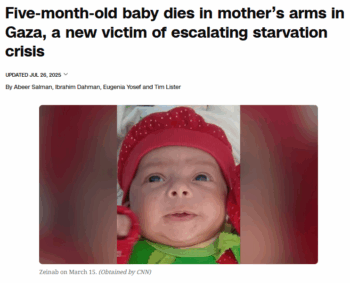
CNN: Five-month-old baby dies in mother’s arms in Gaza, a new victim of escalating starvation crisis

Even as media report more regularly on starvation in Gaza, coverage still tends to obscure responsibility—as with this CNN headline (7/26/25) blaming the baby’s death on the “starvation crisis” rather than on the US-backed Israeli government.

The headlines are increasingly dire.

  • “Child Dies of Malnutrition as Starvation in Gaza Grows” (CNN7/21/25)
  • “More Than 100 Aid Groups Warn of Starvation in Gaza as Israeli Strikes Kill 29, Officials Say” (AP7/23/25)
  • “No Formula, No Food: Mothers and Babies Starve Together in Gaza” (NBC7/25/25)
  • “Five-Month-Old Baby Dies in Mother’s Arms in Gaza, a New Victim of Escalating Starvation Crisis” (CNN7/26/25)
  • “Gaza’s Children Are Looking Through Trash to Avoid Starving” (New York7/28/25)

This media coverage is urgent and necessary—and criminally late.

Devastatingly late to care

Wall Street Journal: Aid Delivered Into Gaza

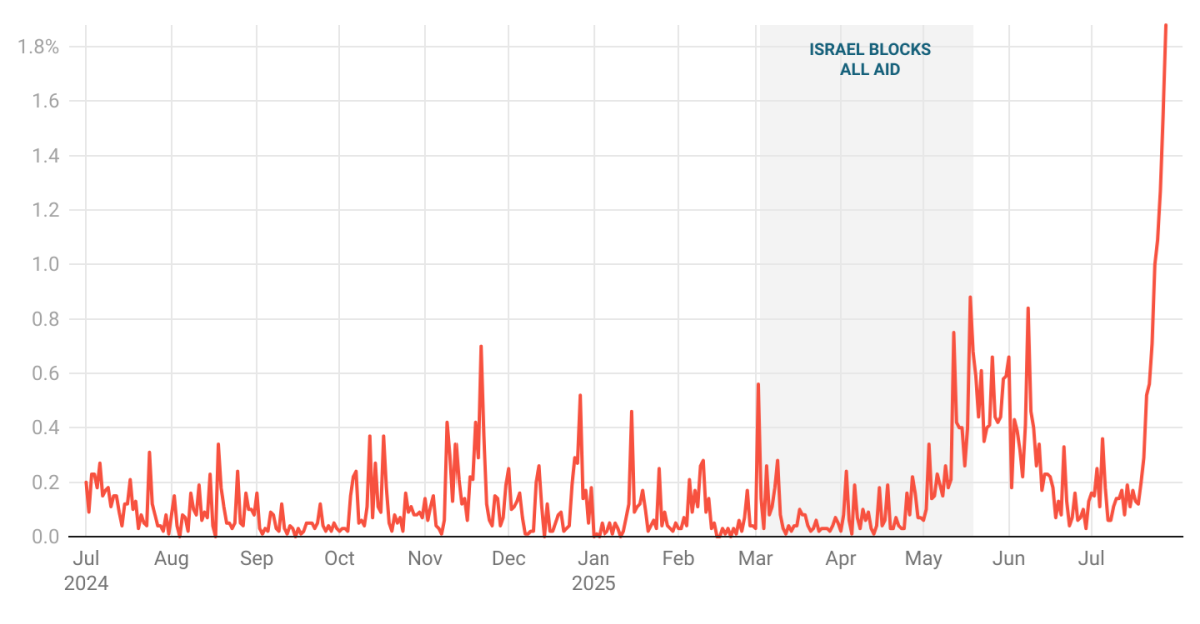
An informative Wall Street Journal chart (7/27/25) shows the complete cutoff of food into Gaza at the beginning of 2025—a genocidal policy decision by Israel that was not accompanied by increased coverage in US media of famine in the Strip.

Since the October 7 attacks, Israel has severely restricted humanitarian aid to the Gaza Strip, using starvation of civilians as a tool of war, a war crime for which Israeli Prime Minister Benjamin Netanyahu and Foreign Minister Yoav Gallant have been charged by the International Criminal Court. Gallant proclaimed a “complete siege” of Gaza on October 9, 2023: “There will be no electricity, no food, no fuel, everything is closed.”

Aid groups warned of famine conditions in parts of Gaza as early as December 2023. By April 2024, USAID administrator Samantha Power (CNN4/11/24) found it “likely that parts of Gaza, and particularly northern Gaza, are already experiencing famine.”

modest increase in food aid was allowed into the Strip during a ceasefire in early 2025. But on March 2, 2025, Netanyahu announced a complete blockade on the occupied territory. Israeli National Security Minister Itamar Ben-Gvir declared that there was “no reason for a gram of food or aid to enter Gaza.”

After more than two months of a total blockade, Israel on May 19 began allowing in a trickle of aid through US/Israeli “Gaza Humanitarian Foundation” (GHF) centers (FAIR.org6/6/25)—while targeting with snipers those who came for it—but it is not anywhere near enough, and the population in Gaza is now on the brink of mass death, experts warn. According to UNICEF (7/27/25):

The entire population of over 2 million people in Gaza is severely food insecure. One out of every three people has not eaten for days, and 80% of all reported deaths by starvation are children.

According to the Gaza Health Ministry, at least 147 Gazans have died from malnutrition since the start of Israel’s post–October 7 assault. Most have been in the past few weeks.

Mainstream politicians are finally starting to speak out—even Donald Trump has acknowledged “real starvation” in Gaza—but as critical observers have pointed out, it is devastatingly late to begin to profess concern. Jack Mirkinson’s Discourse Blog (7/28/25) quoted Refugees International president Jeremy Konyndyk:

I fear that starvation in Gaza has now passed the tipping point and we are going to see mass-scale starvation mortality…. Once a famine gathers momentum, the effort required to contain it increases exponentially. It would now take an overwhelmingly large aid operation to reverse the coming wave of mortality, and it would take months.

And there are long-term, permanent health consequences to famine, even when lives are saved (NPR7/29/25). Mirkinson lambasted leaders like Cory Booker and Hillary Clinton for failing to speak up before now: “It is too late for them to wash the blood from their hands.”

Barely newsworthy

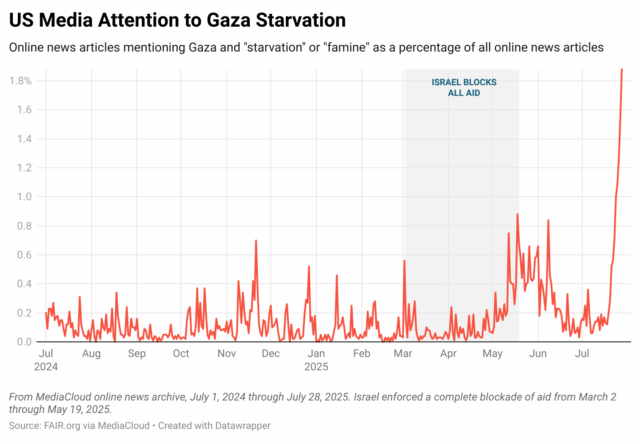
US Media Attention to Gaza Starvation

Major US media, likewise, bear a share of responsibility for the hunger-related deaths in Gaza. The conditions of famine have been out in the open for well over a year, and yet it was considered barely newsworthy in US news media.

A MediaCloud search of online US news reports mentioning “Gaza” and either “famine” or “starvation” shows that since Netanyahu’s March 2 announcement of a total blockade—which could only mean rapidly increasing famine conditions—there was a brief blip of media attention, and then even less news coverage than usual for the rest of March and April. Media attention rose modestly in May, at a time when the world body that classifies famines announced in May that one in five people in Gaza were “likely to face starvation between May 11 and September 30″—in other words, that flooding Gaza with aid was of the highest urgency.

But as aid continued to be held up, and Gazans were shot by Israeli snipers when attempting to retrieve the little offered them, that coverage eventually dwindled, until the current spike that began on July 21.

FAIR (e.g., 3/22/244/25/255/16/255/16/25) has repeatedly criticized US media for  coverage that largely absolves Israel of responsibility for its policy of forced starvation—what Human Rights Watch (5/15/25) called “a tool of extermination”—implemented with the backing of the US government.

The current headlines reveal that the coverage still largely diverts attention from Israeli (let alone US) responsibility, but it’s a positive development that major US news media are beginning to devote serious coverage to the issue. Imagine how different this all could have looked had they given it the attention it has warranted, and the accountability it has demanded, when alarms were first raised.

Original article by Julie Hollar republished from FAIR under a Creative Commons Attribution-NonCommercial-NoDerivs 3.0 Unported License.

Continue ReadingMedia Largely Ignored Gaza Famine When There Was Time to Avert Mass Starvation

Reporters Without Borders Sounds Alarm Over Trump Effort to ‘Bring the Press Into Line’

Spread the love

Original article by Brett Wilkins republished from Common Dreams under Creative Commons (CC BY-NC-ND 3.0).

U.S. President Donald Trump takes a question from a reporter at the White House in Washington, D.C. on April 29, 2025.  (Photo: Andrew Harnik/Getty Images)

RSF says Trump’s moves “have jeopardized the country’s news outlets and indicate that he intends to follow through on his threats, setting up a potential crisis for American journalism.”

Press freedom in the United States has fallen to its lowest level since Reporters Without Borders began publishing its annual ranking more than 20 years ago, with President Donald Trump’s return to power “greatly exacerbating the situation,” RSF said Friday.

The U.S. fell from 55th to 57th place on RSF’s World Press Freedom Index, marking the second straight year that the situation in the country which lists freedom of the press first in its Bill of Rights has been classified as “problematic.” The report comes ahead of World Press Freedom Day on May 3.

The U.S. has been trending downward on RSF’s index since 2013, when it ranked 32nd in global press freedom. A decade later, it had fallen to 45th place before plunging to 55th place last year amid Trump’s attacks on the media.

“Trump was elected to a second term after a campaign in which he denigrated the press on a daily basis and made explicit threats to weaponize the federal government against the media,” the report states.

Press freedom in the United States has hit a record low, according to the latest World Press Freedom Index published annually by Reporters Without Borders.

Axios (@axios.com) 2025-05-02T04:03:47.520Z

“His early moves in his second mandate to politicize the Federal Communications Commission (FCC), ban The Associated Press from the White House, or dismantle the U.S. Agency for Global Media, for example, have jeopardized the country’s news outlets and indicate that he intends to follow through on his threats, setting up a potential crisis for American journalism,” the publication continues, accusing Trump of using “false economic pretexts” to “bring the press into line.”

“The First Amendment to the U.S. Constitution provides broad protections for the press. However, no meaningful press freedom legislation has been passed at the national level in recent years despite the country’s consistent slide on the Press Freedom Index,” the report notes. “The PRESS Act, a federal shield law, failed to pass for a second successive time in 2024. More than a dozen states and communities have proposed or enacted laws to limit journalists’ access to public spaces, including barring them from legislative meetings and preventing them from recording the police.”

RSF continued:

Economic constraints have a considerable impact on journalists. Roughly one-third of the American newspapers operating in 2005 have now shuttered. While some public media outlets, and radio stations in particular, have been able to offset this decline thanks to online subscription models, others have found ways to sustain growth through individual donations. Massive waves of layoffs swept the U.S. media throughout 2023 and 2024 and have continued into 2025, affecting both local newsrooms and major legacy outlets. Many parts of the country are now considered news deserts, with the disappearance of local news outlets reaching crisis levels. Since 2022, more than 8,000 journalists have been laid off in the U.S.

Furthermore, “more Americans have no trust in the media than trust it a fair amount. Online harassment, particularly towards women and minorities, is also a serious issue for journalists and can impact their quality of life and safety.”

“Politicians’ open disdain for the media has trickled down to the public,” RSF added. “Journalists reporting on the ground can face harassment, intimidation, and assault while working. When covering demonstrations, journalists are sometimes attacked and physically assaulted by protestors or wrongfully arrested by police. According to the U.S. Press Freedom Tracker, there were 49 journalist arrests in 2024 compared to only 15 in 2023. The last journalist to be killed in the course of his work was Dylan Lyons in February of 2023.”

RSF paints a grim picture for journalism around the world.

“The conditions for practicing journalism are bad in half of the world’s countries,” as “less than 1% of the world’s population lives in a country where press freedom is fully guaranteed,” the report states.

Noting that economic self-sufficiency is critical to a free press, RSF editorial director Anne Bocandé said in a statement that “guaranteeing freedom, independence,s and plurality in today’s media landscape requires stable and transparent financial conditions.”

“Without economic independence, there can be no free press,” Bocandé continued. “When news media are financially strained, they are drawn into a race to attract audiences at the expense of quality reporting, and can fall prey to the oligarchs and public authorities who seek to exploit them. When journalists are impoverished, they no longer have the means to resist the enemies of the press—those who champion disinformation and propaganda.”

“The media economy must urgently be restored to a state that is conducive to journalism and ensures the production of reliable information, which is inherently costly,” she added. “Solutions exist and must be deployed on a large scale. The media’s financial independence is a necessary condition for ensuring free, trustworthy information that serves the public interest.”

RSF’s new rankings come days after U.S. Attorney General Pam Bondi ended a Biden administration policy that strictly limited the Justice Department’s authority to seize journalists’ records and compel them to testify in leak investigations.

On Wednesday, the Committee to Protect Journalists (CPJ) published a report on Trump’s first 100 days in office, which the group said were “marked by a flurry of executive actions that have created a chilling effect and have the potential to curtail media freedoms.”

"It is disturbing that, on the eve of #WorldPressFreedomDay, the Trump administration has dealt major blows to journalists and the public they serve." — Katherine Jacobsen, CPJ's U.S., Canada, and Caribbean program coordinator

Committee to Protect Journalists (@pressfreedom.bsky.social) 2025-05-02T16:09:12.602Z

“From denying access to upending respect for the independence of a free press to vilifying news organizations to threatening reprisals, this administration has begun to exert its power to punish or reward based on coverage,” CPJ said. “Whether in the states or on the streets, this behavior is setting a new standard for how the public can treat journalists.”

“The uncertainty and fear resulting from these actions have caused requests for safety advice to increase as journalists and newsrooms aim to prepare for what might be next,” the group added. “These moves represent a notable escalation from the first Trump administration, which also pursued banning and deriding elements of the press. After nearly a decade of repeating insults and falsehoods, and filing lawsuits, Trump has normalized disdain for media to an alarming degree.”

Original article by Brett Wilkins republished from Common Dreams under Creative Commons (CC BY-NC-ND 3.0).

Orcas discuss how Trump was re-elected and him being an insane, xenophobic Fascist.
Climate Science Denier Donald Trump says Burn, Baby, Burn.
Elon Musk urges you to be a Fascist like him, says that you can ignore facts and reality then.

From Your Site Articles

Continue ReadingReporters Without Borders Sounds Alarm Over Trump Effort to ‘Bring the Press Into Line’

As Israel Openly Declares Starvation as a Weapon, Media Still Hesitate to Blame It for Famine

Spread the love

Original article by Belén Fernández republished from FAIR under a Creative Commons Attribution-NonCommercial-NoDerivs 3.0 Unported License.

Israeli National Security Minister Itamar Ben-Gvir tweeted that Republican officials at Mar-a-Lago “expressed support for my very clear position on how to act in Gaza and that the food and aid depots should be bombed in order to create military and political pressure to bring our hostages home safely.”

Israeli Prime Minister Benjamin Netanyahu announced on March 2 that “Israel has decided to stop letting goods and supplies into Gaza,” where the ongoing Israeli genocide, with the loyal backing of the United States, has officially killed more than 51,000 Palestinians since October 2023. The announcement regarding the total halt of humanitarian aid amounted to yet another explicit declaration of the starvation policy that Israel is pursuing in the Gaza Strip, a territory that—thanks in large part to 17 consecutive years of Israeli blockade—has long been largely dependent on such aid for survival.

Of course, this was not the first time that senior Israeli officials had advertised their reliance on the war crime of forced starvation in the current genocidal assault on Gaza. On October 9, 2023, two days after the most recent launch of hostilities, then–Defense Minister Yoav Gallant ordered a “complete siege” of the Gaza Strip: “There will be no electricity, no food, no fuel, everything is closed.” Two days after that, Foreign Minister Israel Katz boasted of cutting off “water, electricity and fuel” to the territory.

And just this month, Israeli National Security Minister Itamar Ben-Gvir proclaimed that there was “no reason for a gram of food or aid to enter Gaza.” Following an April 22 dinner held in his honor in Florida at US President Donald Trump’s Mar-a-Lago resort, Ben-Gvir reported that US Republicans had

expressed support for my very clear position on how to act in Gaza and that the food and aid depots should be bombed in order to create military and political pressure to bring our hostages home safely.

Never mind that the hostages would have been brought home safely as scheduled had Israel chosen to comply with the terms of the ceasefire agreement with Hamas that was implemented in January, rather than definitively annihilating the agreement on March 18. It is no doubt illustrative of Israel’s modus operandi that the March 2 decision to block the entry of all food and other items necessary for human existence took place in the middle of an ostensible ceasefire.

‘Starved, bombed, strangled’

A year ago, USAID administrator Samantha Power (CNN4/11/24) said it was “likely that parts of Gaza, and particularly northern Gaza, are already experiencing famine.” 

While Ben-Gvir’s most recent comments have thus far eluded commentary in the US corporate media, the roundabout media approach to the whole starvation theme has been illuminating in its own right. It has not, obviously, been possible to avoid reporting on the subject altogether, as the United Nations and other organizations have pretty much been warning from the get-go of Israel’s actions causing widespread famine in Gaza.

In December 2023, for example, just two months after the onset of Israel’s blood-drenched campaign, the Integrated Food Security Phase Classification initiative, or IPC scale, determined that “over 90% of the population in the Gaza Strip (about 2.08 million people) was estimated to face high levels of acute food insecurity, classified in IPC Phase 3 or above (Crisis or worse).” The assessment went on: “Among these, over 40% of the population (939,000 people) were in Emergency (IPC Phase 4) and over 15% (378,000 people) were in Catastrophe (IPC Phase 5).”

A full year ago, in April 2024, even Samantha Power—then the administrator of the US Agency for International Development—conceded that it was “credible” that famine was already well underway in parts of the Gaza Strip. And the UN Office for the Coordination of Humanitarian Affairs now warns that Gaza is “likely facing the worst humanitarian crisis in the 18 months since the escalation of hostilities in October 2023”—its population being “starved, bombed, strangled” and subjected to “deprivation by design.”

Disappearance of agency

Typically, even when outlets report sympathetically on hunger in Gaza, they fail to state clearly that it is the deliberate result of Israeli policy, as in this New York Times headline (6/25/24).

None of these details have escaped the pages and websites of corporate media outlets, although the media’s frequent reliance on ambiguous wordiness tends to distract readers from what is actually going on—and who is responsible for it. Take, for instance,  the New York Times headline “Gaza Famine Warning Spurs Calls to Remove Restrictions on Food Shipments” (6/25/24), or the CBS video “Hunger Spreads Virtually Everywhere in Gaza Amid Israel/Hamas War” (12/5/24). Even news outlets that intermittently undertake to spotlight the human plight of, inter alia, individual parents in Gaza losing their children to starvation remain susceptible to long-winded efforts to disperse blame. (As of April of last year, Save the Children confirmed that 27 children in northern Gaza had already died of starvation and disease.)

In an era in which news consumption often consists of skimming headlines, the phrasing of article titles is of utmost import. And yet many headlines manage to entirely excise the role of Israel in Gaza’s “hunger crisis”—as in CNN’s report (2/24): “‘We Are Dying Slowly:’ Palestinians Are Eating Grass and Drinking Polluted Water as Famine Looms Across Gaza.” Or take the Reuters headline (3/24/24): “Gaza’s Catastrophic Food Shortage Means Mass Death Is Imminent, Monitor Says.” Or this one from ABC News (11/15/24): “Famine ‘Occurring or Imminent’ in Parts of Northern Gaza, Experts Warn UN Security Council.”

It’s not that these headlines are devoid of sympathy for Palestinian suffering. The issue, rather, is the dilution—and even disappearance—of agency, such that the “catastrophic food shortage” is rendered as transpiring in a sort of vacuum and thereby letting the criminals perpetrating it off the hook. Imagine if a Hamas rocket from Gaza killed an infant in Israel and the media reported the event as follows: “Israeli Baby Perishes as Rocket Completes Airborne Trajectory.”

‘No shortage of aid’

NBC‘s headline (4/17/24) gives Israel’s denial of a problem equal weight with aid workers’ description of Gazans’ desperate situation.

Then there is the matter of the media’s incurable habit of ceding Israeli officials a platform to spout demonstrable lies, as in the April 17 NBC News headline “Aid Groups Describe Dire Conditions in Gaza as Israel Says There Is No Shortage of Aid.” The fact that Israel is permitted to make such claims is particularly perplexing, given Israeli officials’ own announcements that no aid whatsoever may enter the territory, while the “dire conditions” are made abundantly clear in the text of the article itself: “The Global Nutrition Cluster, a coalition of humanitarian groups, has warned that in March alone, 3,696 children were newly admitted for care for acute malnutrition” in Gaza.

Among numerous other damning statistics conveyed in the dispatch, we learn that all Gaza bakeries supported by the UN World Food Programme closed down on March 31, “after wheat flour ran out.” Meanwhile, the WFP calculated that Israel’s closure of border crossings into Gaza caused prices of basic goods “to soar between 150% and 700% compared with prewar levels, and by 29% to as much as 1,400% above prices during the ceasefire.”

Against such a backdrop, it’s fairly ludicrous to allow Israeli officials to “maintain there is ‘no shortage’ of aid in Gaza and accuse Hamas of withholding supplies.” If the press provides Israel with space to spout whatever nonsense it wants—reality be damned—where is the line ultimately drawn? If Israel decides Hamas is using wheat flour to build rockets, will that also be reported with a straight face?

Lest anyone think that thwarting the entry of food into the Gaza Strip is a new thing, recall that Israel’s blockade of Gaza long predated the present war—although the details of said blockade are generally glossed over in the media in favor of the myth that Israel unilaterally “withdrew” from the territory in 2005. In 2010, the BBC (6/21/10) listed some basic foodstuffs—pardon, potential “dual-use items”—that Israel had at different times in recent history blocked from entering Gaza, including pasta, coffee, tea, nuts and chocolate. In 2006, just a year after the so-called “withdrawal,” Israeli government adviser Dov Weissglas outlined the logic behind Israel’s restriction of food imports into Gaza: “The idea is to put the Palestinians on a diet, but not to make them die of hunger.”

Fast forward almost two decades, and it’s safe to say that the “idea” has evolved; this is a genocide, after all—even if the corporate media refuse to say the word—and starvation is part and parcel of that. But on account of Israel’s extra-special relationship with the United States, US media have institutionalized the practice of beating around the bush when it comes to documenting Israeli crimes. This is how we end up with the aforementioned long-winded headlines instead of, say, the far more straightforward “Israel is starving Gaza,” a Google search of which terms produces not a single corporate media dispatch, but does lead to a January 2024 report by that very name, courtesy of none other than the Israeli human rights organization B’Tselem.

‘Starving as negotiation tactic’

Megan Stack (New York Times3/13/25): “Lately it feels as if the human beings in Gaza are increasingly lost from our understanding.”

That said, there have been a few surprises. The New York Times (3/13/25), for example, took a short break from its longstanding tradition of unabashed apologetics for Israeli atrocities in allowing the following sentence to appear in a March opinion article by Megan Stack: “Israeli officials are essentially starving Gaza as a negotiation tactic.” In the very least, this was a vast improvement, in terms of syntactic clarity and assignation of blame, over previous descriptions of Israeli behavior immortalized on the pages of the US newspaper of record—like that time the Israeli military slaughtered four kids playing by the sea in Gaza, and the Times editors (7/16/14) went with the headline “Boys Drawn to Gaza Beach, and Into Center of Mideast Strife.”

In the end, Israel’s starvation of the Gaza Strip is multifaceted. It’s not just about physically blocking the entry of food into the besieged enclave. It’s also about Israel’s near-total decimation of Gaza’s healthcare system: the bombardment of hospitals, the targeting of ambulances, the massacres of medical personnel (FAIR.org4/11/25). It’s about Israeli military attacks on humanitarian aid convoys and workers, including the April 2024 massacre of seven international employees of the food organization World Central Kitchen.

It’s about Israel razing agricultural areas, wiping out food production, devastating the fishing industry and depleting livestock. It’s about Israel bombing water infrastructure in Gaza. And it’s about Israeli troops slaughtering at least 112 desperate Palestinians queuing for flour on February 29, 2024 (FAIR.org3/22/24)—which was at least a quicker way of killing starving people than waiting for them to starve.

In his 2017 London Review of Books essay (6/15/17) on the use of famine as a weapon of war, Alex de Waal referenced the “physical debilitation of groups as a technique of genocide,” noting that “forced starvation was one of the instruments of the Holocaust.” It’s worth reflecting on the essay’s opening paragraph:

In its primary use, the verb “to starve” is transitive: It’s something people do to one another, like torture or murder. Mass starvation as a consequence of the weather has very nearly disappeared: Today’s famines are all caused by political decisions, yet journalists still use the phrase “man-made famine” as if such events were unusual.

As for the current case of the Gaza Strip, US establishment journalists appear to be doing their best to avoid the transitive nature of the verb in question—or any subject-verb-object construction that might too overtly expose Israeli savagery. And by treating famine in Gaza as a subject unto itself, rather than a “technique of genocide,” to borrow de Waal’s words, the media assist in obscuring the bigger picture about this very man-made famine—which is that Israel is not just starving Gaza. Israel is exterminating Gaza.

FAIR’s work is sustained by our generous contributors, who allow us to remain independent. Donate today to be a part of this important mission.

Original article by Belén Fernández republished from FAIR under a Creative Commons Attribution-NonCommercial-NoDerivs 3.0 Unported License.

Vote For Genocide Vote Labour.
Experiencing issues with this image not appearing. I suspect because it's so critical of Zionist Keir Starmer's support of and complicity in Israel's genocides.
Genocide denier and Current UK Prime Minister Keir Starmer is quoted that he supports Zionism without qualification. He also confirms that UK air force support has been essential in Israel’s mass-murdering genocide. Includes URLs https://www.declassifieduk.org/keir-starmers-100-spy-flights-over-gaza-in-support-of-israel/ and https://youtu.be/O74hZCKKdpA
UK Foreign Minister David Lammy confirms that UK government and military are active participants in Israel’s genocides and that the F-35 parts that they suspended from supplying to Israel are instead simply diverted via the United States. He says see https://youtu.be/QILgUHrdWRE
Continue ReadingAs Israel Openly Declares Starvation as a Weapon, Media Still Hesitate to Blame It for Famine