Tag: net zero

  • Fossil CO₂ emissions hit record high yet again in 2023

    Spread the love

    Pep Canadell, CSIRO; Corinne Le Quéré, University of East Anglia; Glen Peters, Center for International Climate and Environment Research – Oslo; Judith Hauck, Universität Bremen; Julia Pongratz, Ludwig Maximilian University of Munich; Philippe Ciais, Commissariat à l’énergie atomique et aux énergies alternatives (CEA); Pierre Friedlingstein, University of Exeter; Robbie Andrew, Center for International Climate and Environment Research – Oslo, and Rob Jackson, Stanford University

    Global emissions of fossil carbon dioxide (CO₂), in yet another year of growth, will increase by 1.1% in 2023. These emissions will hit a record 36.8 billion tonnes. That’s the finding of the Global Carbon Project’s 18th annual report card on the state of the global carbon budget, which we released today.

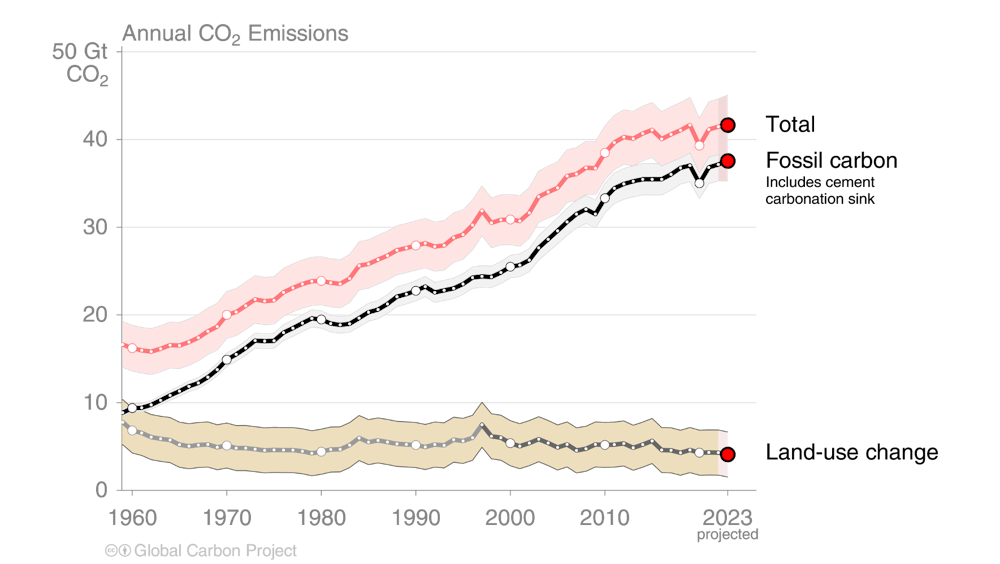
    Fossil CO₂ includes emissions from the combustion and use of fossil fuels (coal, oil and gas) and cement production. Adding CO₂ emissions and removals from land-use change, such as deforestation and reforestation, human activities are projected to emit 40.9 billion tonnes of CO₂ in 2023.

    The world’s vegetation and oceans continue to remove about half of all CO₂ emissions. The rest builds up in the atmosphere and is causing increasing warming of the planet.

    At current emission levels, the remaining carbon budget for a one-in-two chance to limit warming to 1.5°C will likely be exceeded in seven years, and in 15 years for 1.7°C. The need to cut emissions has never been so urgent.

    Emissions from every fossil source are up

    Fossil CO₂ emissions now account for about 90% of all CO₂ emissions from human activities. Emissions from every single fossil source increased this year compared to 2022:

    • coal (41% of global CO₂ emissions) up 1.1%
    • oil (32%) up 1.5%
    • natural gas (21%) up 0.5%
    • cement (4%) up 0.8%.
    Line graph showing emissions from fossil fuels, land-use changes and total emissions from 1960 to 2023
    All fossil fuel sources are driving the increase in total CO₂ emissions.
    Global Carbon Budget 2023/Global Carbon Project, CC BY

    Although global emissions have increased, the picture for individual countries is more diverse. There are some signs of progress towards decarbonisation.

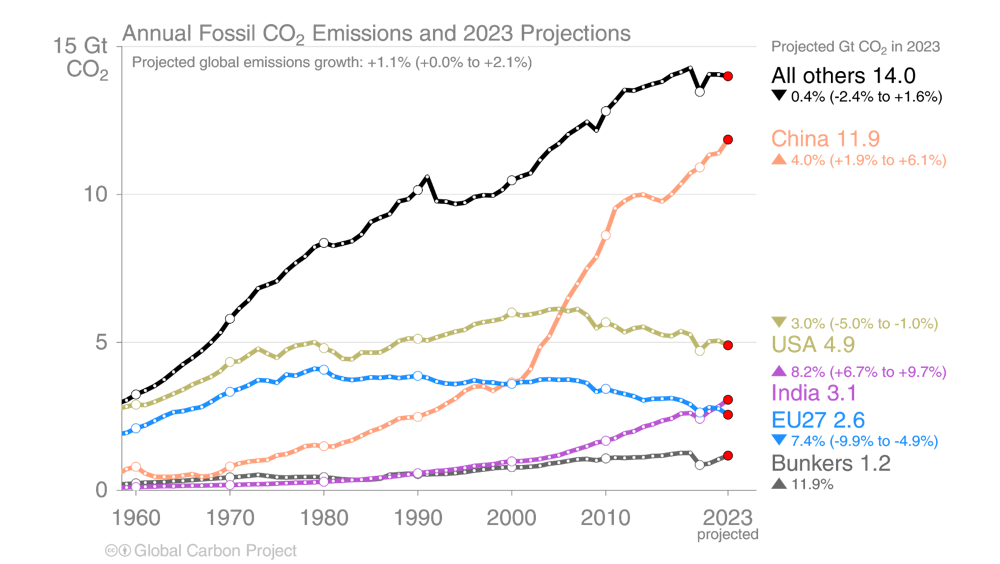
    China’s emissions (31% of the global total) increased by 4% with growth in all fossil fuel sources. The highest relative growth was from oil emissions. This was in part due to the transport sector’s recovery after COVID-19 pandemic shutdowns.

    The United States’ emissions (14% of global) are down by 3%. The rapid retirement of coal-fired power plants drove most of this decline. US coal emissions are the lowest since 1903.

    India’s emissions (8% of global) increased by 8.2%. Emissions for all fossil fuels grew by 5% or more, with coal the highest at 9.5%. India is now the world’s third-largest fossil CO₂ emitter.

    European Union emissions (7% of global) are down by 7.4%. This decline was due to both high renewable energy penetration and the impacts on energy supply of the war in Ukraine.

    During the decade of 2013-2022, 26 countries had declining fossil CO₂ emission trends while their economies continued to grow. The list includes Brazil, France, Germany, Italy, Japan, Portugal, Romania, South African, United Kingdom and USA.

    Emissions by individual countries from 1960 to 2023
    Individual country performances vary widely, but there are some signs of progress towards decarbonisation.
    Global Carbon Budget 2023/Global Carbon Project, CC BY

    Total CO₂ emissions are near a peak

    While fossil CO₂ emissions continue to increase, net emissions from land-use change, such as deforestation (CO₂ source), minus CO₂ removals, such as reforestation (CO₂ sink), appear to be falling. However, estimates of emissions from land-use change are highly uncertain and less accurate overall than for fossil fuel emissions.

    Our preliminary estimate shows net emissions from land-use change were 4.1 billion tonnes of CO₂ in 2023. These emissions follow a small but relatively uncertain decline over the past two decades.

    The declining trend was due to decreasing deforestation and a small increase in reforestation. The highest emitters are Brazil, Indonesia and the Democratic Republic of the Congo. These three countries contribute 55% of net global CO₂ emissions from land-use change.

    When we combine all CO₂ emissions from human activities (fossil and land use), we find very little trend in total emissions over the past decade. If confirmed, this would imply global CO₂ emissions from human activities are not growing further but remain at very high record levels.

    Stable CO₂ emissions, at about 41 billion tonnes per year, will lead to continuing rapid CO₂ accumulation in the atmosphere and climate warming. To stabilise the climate, CO₂ emissions from human activities must reach net zero. This means any residual CO₂ emissions must be balanced by an equivalent CO₂ removal.

    Nature’s a big help, with a little human help

    Terrestrial vegetation and ocean absorb about half of all CO₂ emissions. This fraction has remained remarkably stable for six decades.

    Besides the natural CO₂ sinks, humans are also removing CO₂ from the atmosphere through deliberate activities. We estimate permanent reforestation and afforestation over the past decade have removed about 1.9 billion tonnes of CO₂ per year.

    This is equivalent to 5% of fossil fuel emissions per year.

    Other non-vegetation strategies are in their infancy. They removed 0.01 million tonnes of CO₂.

    Machines (direct air carbon capture and storage) pulled 0.007 million tonnes of CO₂ out of the atmosphere. Enhanced weathering projects, which accelerate natural weathering processes to increase the CO₂ uptake by spreading certain minerals, accounted for the other 0.004 million tonnes. This is more than a million times smaller than current fossil fuel emissions.

    The remaining carbon budget

    From January 2024, the remaining carbon budget for a one-in-two chance to limit global warming to 1.5°C has been reduced to 275 billion tonnes of CO₂. This budget will used up in seven years at 2023 emission levels.

    The carbon budget for limiting warming to 1.7°C has been reduced to 625 billion tonnes of CO₂, with 15 years left at current emissions. The budget for staying below 2°C is 1,150 billion tonnes of CO₂ – 28 years at current emissions.

    Reaching net zero by 2050 requires total anthropogenic CO₂ emissions to decrease on average by 1.5 billion tonnes of CO₂ per year. That’s comparable to the fall in 2020 emissions resulting from COVID-19 measures (-2.0 billion tonnes of CO₂).

    Without additional negative emissions (CO₂ removal), a straight decreasing line of CO₂ emissions from today to 2050 (when many countries aspire to achieve net zero CO₂ or the more ambitious net zero for all greenhouse gases) would lead to a global mean surface temperature of 1.7°C, breaching the 1.5°C limit.

    Renewable energy production is at a record high and growing fast. To limit climate change fossil and land-use change, CO₂ emissions must be cut much more quickly and ultimately reach net zero.The Conversation

    Pep Canadell, Chief Research Scientist, CSIRO Environment; Executive Director, Global Carbon Project, CSIRO; Corinne Le Quéré, Royal Society Research Professor of Climate Change Science, University of East Anglia; Glen Peters, Senior Researcher, Center for International Climate and Environment Research – Oslo; Judith Hauck, Helmholtz Young Investigator group leader and deputy head, Marine Biogeosciences section a Alfred Wegener Institute, Universität Bremen; Julia Pongratz, Professor of Physical Geography and Land Use Systems, Department of Geography, Ludwig Maximilian University of Munich; Philippe Ciais, Directeur de recherche au Laboratoire des science du climat et de l’environnement, Institut Pierre-Simon Laplace, Commissariat à l’énergie atomique et aux énergies alternatives (CEA); Pierre Friedlingstein, Chair, Mathematical Modelling of Climate, University of Exeter; Robbie Andrew, Senior Researcher, Center for International Climate and Environment Research – Oslo, and Rob Jackson, Professor, Department of Earth System Science, and Chair of the Global Carbon Project, Stanford University

    This article is republished from The Conversation under a Creative Commons license. Read the original article.

  • UK likely to miss Paris climate targets by wide margin, analysis shows

    Spread the love

    https://www.theguardian.com/environment/2023/dec/05/uk-miss-paris-climate-targets-emissions

    Exclusive: Under current policies, Britain could fall short of internationally agreed goal of 68% cut in emissions by 2030

    The UK government is likely to miss its targets under the Paris climate agreement by a wide margin, analysis shows, dealing a devastating blow to Britain’s standing on the international stage.

    Under current policies, the UK’s greenhouse gas emissions are likely to be 59% lower in 2030 than they were in 1990 – but the country’s internationally agreed target is for a 68% reduction by the end of this decade. The gap is likely to leave Britain in breach of these commitments.

    The 2030 emissions goal was agreed at Cop26, the UN climate summit hosted by the UK in Glasgow in 2021, and has been reaffirmed at Cop28, taking place in Dubai this week.

    Failure to meet the UK’s commitments would hinder international efforts to limit global temperature rises to 1.5C (2.7F) above pre-industrial levels.

    The estimate comes from analysis of publicly available and government data carried out by Friends of the Earth. It found that current policies would achieve just over half the emissions cuts needed by 2030.

    The gap had grown significantly under Rishi Sunak’s leadership, Friends of the Earth found.

    https://www.theguardian.com/environment/2023/dec/05/uk-miss-paris-climate-targets-emissions

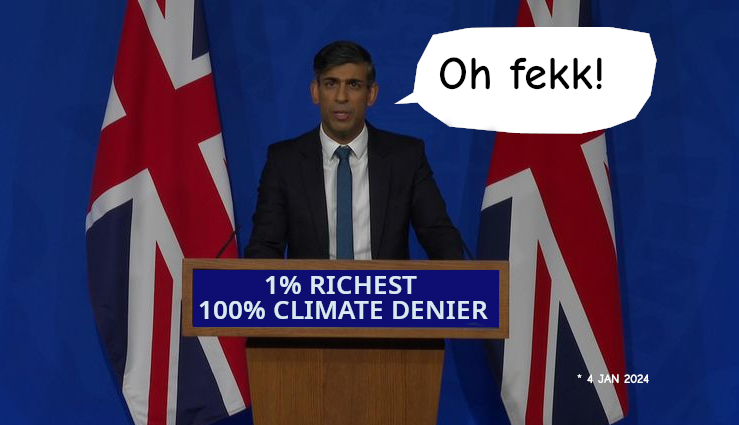
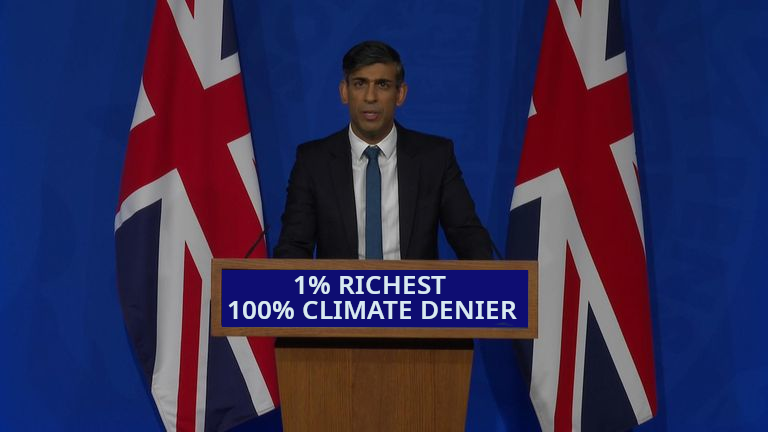
    Image of UK Prime Minister Rishi Sunak reads 1% RICHEST 100% CLIMATE DENIER
    Image of UK Prime Minister Rishi Sunak reads 1% RICHEST 100% CLIMATE DENIER
  • Activists drench Sainsbury’s in red paint over supermarket profiteering

    Spread the love

    https://www.morningstaronline.co.uk/article/b/this-is-rigged-launch-offensive-against-supermarket-profiteering

    Members of This Is Rigged covered the Sainsbury’s branch in Glasgow’s Buchanan Street with red paint Photo: This is Rigged / Twitter

    CLIMATE and social justice activists in Scotland have highlighted their opposition to food poverty by staging a series of stunts.

    Members of This Is Rigged covered the Sainsbury’s branch in Glasgow’s Buchanan Street with red paint today as they demanded an end to “profiteering” by supermarkets.

    The day before, the group entered Edinburgh Castle and smashed the glass case housing the Stone of Destiny, which had recently been returned to Scotland following the coronation of Charles Windsor.

    Near the end of a year of high-profile interventions pressing for decisive action on climate change and a fair net-zero transition for workers, the group’s latest stunts are focused on the cost-of-greed crisis, which they argue is indivisible from the climate crisis.

    The group warned that it would escalate actions in support of its demands that the Scottish government provide “food hubs” in every community and that supermarkets reverse their 24 per cent increase in baby food prices over the last two years.

    https://www.morningstaronline.co.uk/article/b/this-is-rigged-launch-offensive-against-supermarket-profiteering

  • Fossil Fuel Firms ‘Building Bridge to Climate Chaos’

    Spread the love
    North Sea oil rigs in Cromarty Firth, Scotland. Credit: joiseyshowaa (CC BY-SA 2.0)
    North Sea oil rigs in Cromarty Firth, Scotland. Credit: joiseyshowaa (CC BY-SA 2.0)

    Original article by JAKE JOHNSON republished from Common Dreams under Creative Commons (CC BY-NC-ND 3.0).

    An updated database shows that more than 1,000 oil and gas companies around the world are planning to expand their planet-wrecking infrastructure.

    More than a thousand fossil fuel companies around the world are currently planning to build new liquefied natural gas terminals, pipelines, or gas-fired power plants even as scientists warn that fossil fuel expansion is incompatible with efforts to prevent catastrophic warming.

    That’s according to an updated database released Wednesday by Urgewald and dozens of partner groups. Described as the most comprehensive public database on the fossil fuel industry, the Global Oil & Gas Exit List (GOGEL) covers 1,623 companies that are operating in the upstream, midstream, or gas-fired power sector and collectively account for 95% of global oil and gas production.

    More than a thousand fossil fuel companies around the world are currently planning to build new liquefied natural gas terminals, pipelines, or gas-fired power plants even as scientists warn that fossil fuel expansion is incompatible with efforts to prevent catastrophic warming.

    That’s according to an updated database released Wednesday by Urgewald and dozens of partner groups. Described as the most comprehensive public database on the fossil fuel industry, the Global Oil & Gas Exit List (GOGEL) covers 1,623 companies that are operating in the upstream, midstream, or gas-fired power sector and collectively account for 95% of global oil and gas production.

    According to the 2023 GOGEL, 96% of the 700 upstream oil and gas companies in the database are exploring or actively developing new oil and gas fields, projects that Urgewald said “severely jeopardize efforts to limit global temperature increase to 1.5 °C.”

    Nearly 540 companies in the database are collectively planning to produce 230 billion barrels of oil equivalent (bboe) over the short term, the database shows.

    “The seven companies with the largest short-term expansion plans are Saudi Aramco (16.8 bboe), QatarEnergy (16.5 bboe), Gazprom (10.7 bboe), Petrobras (9.6 bboe), ADNOC (9.0 bboe), TotalEnergies (8.0 bboe) and ExxonMobil (7.9 bboe),” Urgewald noted. “These seven companies are responsible for one-third of global short-term oil and gas expansion.”

    The database also shows that fossil fuel companies are planning to expand global LNG capacity by 162%, a significant threat to critical climate targets. A United Nations-backed report published last week warned that fossil fuel expansion plans are “throwing humanity’s future into question.”

    Urgewald pointed specifically to the LNG boom in the U.S., which the group said is “cementing its position as the world’s largest export hub for LNG” with 21 new export facilities planned along the Gulf Coast. Those facilities account for more than 40% of worldwide LNG expansion documented in the GOGEL database.

    “Most of the fossil gas that will be exported from these terminals stems from the Permian Basin, the heart of the U.S. fracking industry,” Urgewald observed.

    The updated database shows that nearly 80 companies—including Exxon, Chevron, and BP—are currently operating in the Permian Basin, located in the U.S. Southwest.

    Climate campaigners and experts have also sounded alarm over Calcasieu Pass 2 (CP2), a planned $10 billion LNG export hub that would ship up to 24 million tons of gas annually once it is completed.

    “The fossil fuel industry wants to pave undeveloped wetlands all along the coast with LNG facilities like NextDecade Corporation’s Rio Grande LNG Terminal, Rebekah Hinojosa, a member of the South Texas Environmental Justice Network said Wednesday. “Besides their environmental implications, these plans violate Indigenous sacred lands, and people working in fishing, shrimping, and eco-tourism risk losing their jobs. Our communities refuse to be sacrificed for the fracking industry’s dirty gas exports.”

    Original article by JAKE JOHNSON republished from Common Dreams under Creative Commons (CC BY-NC-ND 3.0).

  • UK Conservatives heading to elections with a growing green policy gap

    Spread the love
    UK Prime Minister Rishi Sunak denies climate change.
    UK Prime Minister Rishi Sunak denies climate change.

    https://www.energymonitor.ai/policy/net-zero-policy/weekly-data-uk-conservatives-heading-to-elections-with-a-growing-green-policy-gap/

    There is now a 21% share of required emissions cuts in the UK’s 2028–32 carbon budget that is not covered by policy.

    Green Alliance’s Net Zero Policy Tracker analyses the gap between confirmed policy and what would be required for net zero by 2050, according to the UK’s five-yearly carbon budgets. 

    At the start of 2023, there was a 13% share of required emissions cuts in the 2028–32 carbon budget that was not covered by policy. Following the government’s so-called Energy Security Day in March – which saw 2,800 pages of new energy and climate policy – the share of emissions cuts not covered by policy grew to 15%

    Since Sunak’s latest speech in March, the gap has grown to 21%: a near-doubling of the gap that existed at the start of the year. 

    “The Prime Minister delayed vital policies that would have lowered energy bills, increased UK energy security, and played a critical role in creating a green and growing economy,” said Chris Venables, Green Alliance’s deputy director of politics and partnerships, in a statement following Sunak’s speech. “This represents a deeply alarming pivot that has undermined business confidence, and put at serious risk the hard-won, cross-party and evidence-based approach we have had to actually reaching our legally binding net-zero targets.”

    https://www.energymonitor.ai/policy/net-zero-policy/weekly-data-uk-conservatives-heading-to-elections-with-a-growing-green-policy-gap/