The Paris Agreement 2015 is the latest international treaty on climate change.
Quoted from wikipedia
...
The Paris Agreement's long-term temperature goal is to keep the rise in mean global temperature to well below 2 °C (3.6 °F) above pre-industrial levels, and preferably limit the increase to 1.5 °C (2.7 °F), recognizing that this would substantially reduce the effects of climate change. Emissions should be reduced as soon as possible and reach net-zero by the middle of the 21st century.[3] To stay below 1.5 °C of global warming, emissions need to be cut by roughly 50% by 2030. This is an aggregate of each country's nationally determined contributions.
...
According to the 2020 United Nations Environment Programme (UNEP), with the current climate commitments of the Paris Agreement, global mean temperatures will likely rise by more than 3 °C by the end of the 21st century.
...
Countries determine themselves what contributions they should make to achieve the aims of the treaty. As such, these plans are called nationally determined contributions (NDCs).
...
In 2021, a study using a probabilistic model concluded that the rates of emissions reductions would have to increase by 80% beyond NDCs to likely meet the 2 °C upper target of the Paris Agreement, that the probabilities of major emitters meeting their NDCs without such an increase is very low. It estimated that with current trends the probability of staying below 2 °C of warming is 5% – and 26% if NDCs were met and continued post-2030 by all signatories.
...
The message from the above quotations is
1. The Paris Agreement is an attempt to limit climate change effects by keeping global mean (average) temperatures below 1.5C or 2C.
2. We are likely looking at global temperature rises between 2C and over 3C by the end of the century.
We are currently at 1.1 or 1.2C global mean temperature above pre-industrial levels. There are extreme climate events now never mind at 1.5, 2 or over 3C.
2022 saw record-breaking heat in UK while there were heatwaves and vast wildfires in North America, record-breaking temperatures and huge wildfires across France and Western Europe, huge drought followed by severe flooding in Pakistan, repeated flooding in Eastern Australia and currently East Africa is suffering the worst drought in decades.
We are in a climate crisis at 1.2C. The crisis is now.
The main cause of global warming is the use of fossil fuels. The best response to the climate crisis is to stop the use of fossil fuels as much as we possibly can and to transition to renewable sources of energy instead. This would also involve a programme of insulation to reduce the use of fossil fuels.
Politicians worldwide are neglecting to address the climate crisis in any meaningful way. The protest group Just Stop Oil is calling for no new development of fossil fuels. Grant Shapps, UK's Secretary of State for Business, Energy and Industrial Strategy is so totally out of touch that he's not even familiar with Just Stop Oil's objectives:“I’ve no issue with people arguing for lower levels of petrol, gas or whatever other thing they want to campaign for usage, that is fine, that is one thing. But don’t go disrupting other people’s lives - it’s unacceptable, it’s illegal!”, the Business Secretary said.
Young people particularly should get active opposing climate destruction because it's fekking their futures and otherwise they're just going to keep on getting totally disregarded, shat on. Extreme weather events at 1.2C are so serious, 3C may well lead to extinction and next to nothing is being done to prevent it.
Some links - try searching for your own e.g. extreme weather events 2022
https://en.wikipedia.org/wiki/Paris_Agreement
Met Office: Unprecedented extreme heatwave (UK), July 2022Analysis: Africa’s unreported extreme weather in 2022 and climate changeOver 20,000 died in western Europe’s summer heatwaves, figures show
16/12/22 Climate Reality Check 2021
Geneva, 13 September 2022 (WMO) – Climate science is clear: we are heading in the wrong direction, according to a new multi-agency report coordinated by the World Meteorological Organization (WMO), which highlights the huge gap between aspirations and reality. Without much more ambitious action, the physical and socioeconomic impacts of climate change will be increasingly devastating, it warns.
The report, United in Science, shows that greenhouse gas concentrations continue to rise to record highs. Fossil fuel emission rates are now above pre-pandemic levels after a temporary drop due to lockdowns. The ambition of emissions reduction pledges for 2030 needs to be seven times higher to be in line with the 1.5 °C goal of the Paris Agreement
The past seven years were the warmest on record. There is a 48% chance that, during at least one year in the next 5 years, the annual mean temperature will temporarily be 1.5°C higher than 1850-1900 average. As global warming increases, “tipping points” in the climate system can not be ruled out.
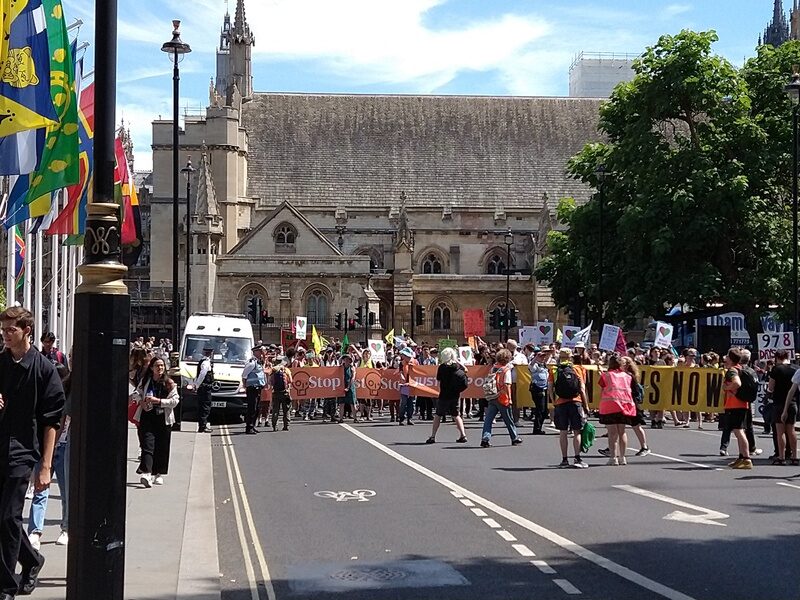
JSO, FPA, PJP protest London 23 July 2022. My pic, free to use.
I’ve not long got back from the Just Stop Oil, Fuel Poverty Action, Peace and Justice Project protest in London.
Coming soon a rethink by me of how to campaign effectively. Our planet is burning and it’s clear that the Paris Agreement goals were seriously wrong. The World’s climate is fekked now never mind 1.5C rise and there is no action from governments other than accelerating the destruction of out beautiful World. Please feel free to contribute and comment once it’s published.
ed: Forgot to say that I argued with Piers Corbyn while I was there.
Scientists attending Cop26 have sent a clear warning to policymakers: get a move on, because every moment of delay, every extra fraction of a degree of global heating will have dire consequences.
That message has been reinforced at Glasgow with reports, forums and discussions, but those involved in channelling the science to the world’s leaders are frustrated that words are still not being matched by actions.
Peter Stott, a climate scientist at the Met Office’s Hadley Centre who has been attending Cops since 1998, said he was marginally more optimistic than he had been before the Glasgow summit. “I have mixed emotions. I feel relieved that things have started to move, but I am concerned about the speed,” he said. “The scientific message we have talked about for 25 years is being acted on. That is a vindication. We might be starting to turn the corner. But I feel a strong sense of anxiety I haven’t felt before. I want to see the policymakers get a move on. In the next two years we have got to cut emissions rapidly.”
Countries are currently expected to return with better pledges in 2025, but many are now demanding the deadline should be brought forward. This is seen as the most closely fought area of disagreement as the UK hosts struggle to broker a deal.
“If that [five years] is the first time that countries are called to increase their ambitions, honestly that’s going to be too late,” said Figueres, founding partner of the Global Optimism thinktank.
A COP26 declaration to cut aviation emissions is “full of scams”, environmental campaigners have warned.
The International Aviation Climate Ambition Coalition agreed to support measures to reduce the sector’s carbon emissions.
These included promoting the development of low-carbon aircraft, sustainable aviation fuels and carbon offsetting. It was signed by 20 countries including the UK, the US, France and Spain.
But Greenpeace is calling on European leaders not to support it, and urged them to ban short-haul flights and “massively invest” in rail instead.
CREATING universal and comprehensive public transport is the only way to effectively cut carbon emissions from travel at home and abroad, unions and campaigners have said during Cop26.
Campaigners and politicians condemned the lack of consideration of rail, bus, ferry and cycle transport during proceedings at the summit today, where the focus was put on cars and planes instead.
Officials and delegates at the gathering in Glasgow made a number of announcements on transport, including on zero-emissions vehicles, so-called green shipping corridors, and on decarbonising air travel.
Tory Transport Secretary Grant Shapps said that travel, including aviation, should be “guilt-free.” He also said that the government did not see flying as “the ultimate evil,” after officials, including Prime Minister Boris Johnson, were condemned for using planes for short journeys during Cop26.
A home burns as flames from the Dixie Fire tear through the Indian Falls neighborhood of unincorporated Plumas County, California on July 24, 2021. (Photo: Josh Edelson/AFP via Getty Images)
The United Nations warned Friday that the planet is barreling toward 2.7°C of warming by the end of the century, a nightmare scenario that can be averted only if policymakers take immediate and sweeping action to slash greenhouse gas emissions.
Even if the 191 parties to the Paris climate accord meet their current commitments, global greenhouse gas emissions will still rise 16% by 2030 compared to 2010 levels, according to a new report published by the U.N. Framework Convention on Climate Change (UNFCCC).
“Failure to meet this goal will be measured in the massive loss of lives and livelihoods.”
The goal of the 2015 Paris agreement is to limit global warming to below 2°C—and preferably to 1.5°C—above pre-industrial levels. An analysis released earlier this week found that the climate targets and actions of just one country—The Gambia—are in line with the critical 1.5° goal.
“This is what betrayal looks like,” Swedish climate activist Greta Thunberg tweeted in response to the latest U.N. findings. “Whatever our so-called ‘leaders’ are doing, they are doing it wrong.”
Patricia Espinosa, executive secretary of U.N. Climate Change,
said in a statement that the international community must “peak emissions as soon as possible before 2030 and support developing countries in building up climate resilience.”
“The 16% increase is a huge cause of concern,” said Espinosa. “It is in sharp contrast with the calls by science for rapid, sustained, and large-scale emission reductions to prevent the most severe climate consequences and suffering, especially of the most vulnerable, throughout the world.”
The U.N. analysis came as U.S. President Joe Biden met with world leaders and announced that the United States is partnering with the European Union in an effort to cut methane emissions—a powerful driver of global warming—by nearly 30% by the end of the decade.
In its landmark report last month, the Intergovernmental Panel on Climate Change (IPCC) emphasized that a “strong, rapid, and sustained” reduction in methane emissions is necessary to prevent the worst of the planetary crisis.
The IPCC also estimated that keeping global warming to 1.5°C above pre-industrial levels would require a 45% reduction in carbon dioxide emissions by 2030—a mark that the international community is currently on track to miss badly, according to the new U.N. report.
António Guterres, the secretary-general of the U.N., said in a statement Friday that 2.7°C of planetary heating would be “catastrophic” and that world leaders are “rapidly running out of time” to act.
“This is breaking the promise made six years ago to pursue the 1.5°C goal of the Paris agreement,” said Guterres. “Failure to meet this goal will be measured in the massive loss of lives and livelihoods.”
Our work [Common Dreams] is licensed under Creative Commons (CC BY-NC-ND 3.0). Feel free to republish and share widely.