Former Labour leader Jeremy Corbyn, MP John McDonnell (front, fourth from left) and Khalid Abdalla (front row third from right) join people taking part in a national march for Palestine on Whitehall in central London, January 20, 2025
PEACE campaigners vowed to “break the climate of fear” fed by intensified police repression in a weekend rally to defend protest rights.
Hundreds gathered in Bethnal Green’s Atrium to discuss the Metropolitan Police’s mass detentions of marchers, including the violent arrest of chief steward Chris Nineham, at a Palestine solidarity demonstration on January 18, and the subsequent decision to charge Mr Nineham, Palestine Solidarity Campaign (PSC) director Ben Jamal and others with public order offences.
Mr Jamal said the policing that day was “an escalation of repression by the state against our movement.
“Very clearly in my view, the police sought to provoke scenes of disorder on the streets. They began arresting people very early for the crime of standing in the wrong bit of Whitehall at the wrong moment. They brought empty coaches to transport to police stations those they intended to arrest… despite the fact that every single one of our protests has been peaceful and has had a low rate of arrest.”
The PSC leader said police intended to create “a scene of chaos and disorder that would create the political climate to enable [Home Secretary] Yvette Cooper to go into Parliament and announce she was banning all future marches.
“They did not succeed… [because] this is a peaceful and disciplined movement.”
The Metropolitan Police deny having tried to provoke disorder and referred the Morning Star to a previous statement accusing marchers of “a deliberate effort, involving organisers of the demonstration,” to breach the conditions they had imposed on the march, which included blocking a protest outside the BBC.
Chris Nineham – deputy leader of the Stop the War Coalition and Chief Steward for many of London’s demonstrations against the Israel Hamas War and the British government’s involvement (source) – was arrested for some reason at the Gaza protest in London yesterday. There’s also a video of him getting arrested.
This video is from 2 months ago. Among other things, he says
The police and the establishment in this country … are conducting a campaign of vilification and repression against the movement … it’s really a campaign against freedom of speech in general in this country and certainly on the issue of Palestine.
…
We should take no lectures from the Metropolitan Police or any other police force about hate crime and about intimidation …
FORMER Labour leader Jeremy Corbyn has hit out at the Met Police over its handling of a Palestine rally in London on Saturday.
More than 70 demonstrators were arrested on suspicion of breaching protest conditions after reportedly breaking through a police line as they marched from a rally in Whitehall.
Police clash with protesters at the rally (Image: Jeff Moore/PA Wire)
…
Corbyn, who sits as an independent MP, responded to a post from the Met Police on Twitter/X which said: “The group that forced its way through the police line is now held at the north west corner of Trafalgar Square.
“Anyone in that group should now disperse and leave the area. Anyone remaining in breach of the conditions, or inciting further breaches, will be arrested.”
In his response, the former Labour leader said: “This is not an accurate description of events at all.
“I was part of a delegation of speakers, who wished to peacefully carry and lay flowers in memory of the children in Gaza who had been killed.
“This was facilitated by the police. We did not force our way through. When we reached Trafalgar Square, we informed police that we would go no. further, lay down flowers and disperse.”
…
This is not an accurate description of events at all.
I was part of a delegation of speakers, who wished to peacefully carry and lay flowers in memory of children in Gaza who had been killed.
This was facilitated by the police. We did not force our way through.
The Crown Prosecution Service (CPS) has dropped all charges against 34 Greenpeace activists who blockaded Unilever’s London headquarters last September. The decision was made just days before the start of what would have been the largest ‘locking on’ trials ever seen in the UK.
Eight protesters had been facing charges of Aggravated Trespass and a further 26 protesters were charged with the new offence of ‘locking-on’ introduced in the Public Order Act 2023. The letter from the CPS said the charges were dropped because “there is not enough evidence to provide a realistic prospect of conviction”. The first trials were due to begin on 15 January at City of London Magistrates’ Court.
The charges related to 5 September 2024 when Greenpeace activists blockaded the entrances to Unilever House in protest at the firm’s ongoing failure to tackle plastic pollution. Climbers scaled the building and attached a huge artwork to the outside wall. Activists also blocked the entrances to the building, locking themselves onto large models of the company’s flagship Dove products and a ‘Dead Dove’ parody of the company logo.
Will McCallum, Co-Executive Director of Greenpeace UK said: “This is a bolt of good news in an otherwise bleak landscape for protest rights. Our activists were facing a combined total of up to 15 years in prison for standing up to one of the world’s largest plastic polluters. The invented crime of ‘locking-on’ is just one new tool in a well-stocked legal arsenal that is being used to stifle dissent and send peaceful protesters to jail. Previous governments brought in these laws and powers, but the responsibility lies with Keir Starmer to end their chilling effect on democracy and repeal them.”
The crime of ‘locking-on’ was one of a number of offences and powers created by recent Conservative governments to crack down on peaceful protest. It has resulted in hundreds of protesters being arrested, often for as little as walking down a street. Last year saw five climate activists sentenced to a total of 21 years in prison for taking part in a Zoom call to discuss a planned protest.
Greenpeace’s protest was part of an ongoing campaign against Unilever after the corporate giant announced a major rollback of plastic reduction targets last year. A Greenpeace International report showed that it was the largest corporate seller of single-use plastic sachets, selling the equivalent of 1,700 a second.
Daniel Jones, interim head of Greenpeace’s plastics campaign, said: “This is an important milestone in our campaign against Dove’s toxic brand of beauty. We reluctantly staged our protest last September after months of failed talks with Unilever and multiple attempts to raise our concerns in other ways. Since then, Unilever has come back to the table and has begun playing a more constructive role in negotiations for a Global Plastics Treaty. We won’t stop until the company commits to reducing plastic production – particularly of its super-polluting plastic sachets.”
‘Locking-on’ involves protesters attaching themselves to another person, building or object to make it harder for police to remove them. It has long been used as a tactic by protesters, including by the Suffragettes. The Public Order Act 2023 contained the new offences of locking-on and being ‘equipped for locking on’.
Climate and environmental protest is being criminalised and repressed around the world. The criminalisation of such protest has received a lot of attention in certain countries, including the UK and Australia. But there have not been any attempts to capture the global trend – until now.
We recently published a report, with three University of Bristol colleagues, which shows this repression is indeed a global trend – and that it is becoming more difficult around the world to stand up for climate justice.
This criminalisation and repression spans the global north and south, and includes more and less democratic countries. It does, however, take different forms.
Our report distinguishes between climate and environmental protest. The latter are campaigns against specific environmentally destructive projects – most commonly oil and gas extraction and pipelines, deforestation, dam building and mining. They take place all around the world.
Climate protests are aimed at mitigating climate change by decreasing carbon emissions, and tend to make bigger policy or political demands (“cut global emissions now” rather than “don’t build this power plant”). They often take place in urban areas and are more common in the global north.
The intensifying criminalisation and repression is taking four main forms.
1. Anti-protest laws are introduced
Anti-protest laws may give the police more powers to stop protest, introduce new criminal offences, increase sentence lengths for existing offences, or give policy impunity when harming protesters. In the 14 countries we looked at, we found 22 such pieces of legislation introduced since 2019.
2. Protest is criminalised through prosecution and courts
This can mean using laws against climate and environmental activists that were designed to be used against terrorism or organised crime. In Germany, members of Letzte Generation (Last Generation), a direct action group in the mould of Just Stop Oil, were charged in May 2024 with “forming a criminal organisation”. This section of the law is typically used against mafia organisations and had never been applied to a non-violent group.
Criminalising protest can also mean lowering the threshold for prosecution, preventing climate activists from mentioning climate change in court, and changing other court processes to make guilty verdicts more likely. Another example is injunctions that can be taken out by corporations against activists who protest against them.
3. Harsher policing
This stretches from stopping and searching to surveillance, arrests, violence, infiltration and threatening activists. The policing of activists is carried out not just by state actors like police and armed forces, but also private actors including private security, organised crime and corporations.
In Germany, regional police have been accused of collaborating with an energy giant (and its private fire brigade) to evict coal mine protesters, while private security was used extensively in policing anti-mining activists in Peru.
4. Killings and disappearances
Lastly, in the most extreme cases, environmental activists are murdered. This is an extension of the trend for harsher policing, as it typically follows threats by the same range of actors. We used data from the NGO Global Witness to show this is increasingly common in countries including Brazil, Philippines, Peru and India. In Brazil, most murders are carried out by organised crime groups while in Peru, it is the police force.
Protests are increasing
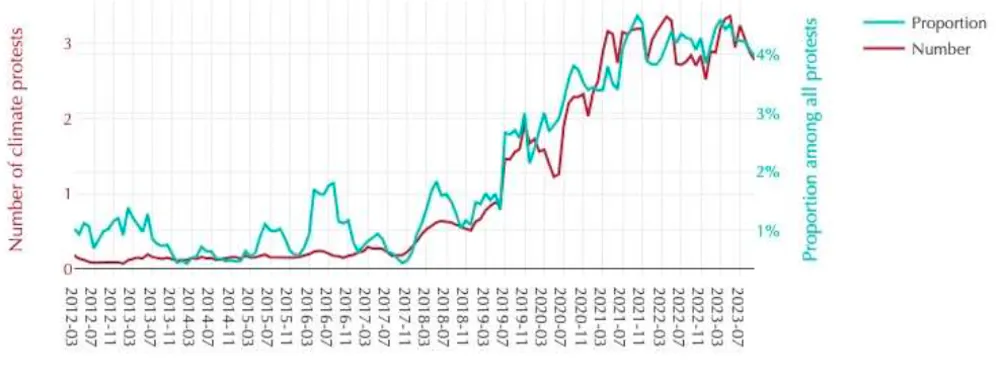
To look more closely at the global picture of climate and environmental protest – and the repression of it – we used the Armed Conflicts Location Event database. This showed us that climate protests increased dramatically in 2018-2019 and have not declined since. They make up on average about 4% of all protest in the 81 countries that had more than 1,000 protests recorded in the 2012-2023 period:
Climate protests increased sharply in the late 2010s in the 14 countries studied. (Data is smoothed over five months; number of protests is per country per month.) Berglund et al; Data: ACLED, CC BY-SA
This second graph shows that environmental protest has increased more gradually:
Environmental protests in the same 14 countries. Data: ACLED, CC BY-SA
We used this data to see what kind of repression activists face. By looking for keywords in the reporting of protest events, we found that on average 3% of climate and environmental protests face police violence, and 6.3% involve arrests. But behind these averages are large differences in the nature of protest and its policing.
A combination of the presence of protest groups like Extinction Rebellion, who often actively seek arrests, and police forces that are more likely to make arrests, mean countries such as Australia and the UK have very high levels of arrest. Some 20% of Australian climate and environmental protests involve arrests, against 17% in the UK – with the highest in the world being Canada on 27%.
Meanwhile, police violence is high in countries such as Peru (6.5%) and Uganda (4.4%). France stands out as a European country with relatively high levels of police violence (3.2%) and low levels of arrests (also 3.2%).
In summary, while criminalisation and repression does not look the same across the world, there are remarkable similarities. It is increasing in a lot of countries, it involves both state and corporate actors, and it takes many forms.
This repression is taking place in a context where states are not taking adequate action on climate change. By criminalising activists, states depoliticise them. This conceals the fact these activists are ultimately right about the state of the climate and environment – and the lack of positive government action in these areas.