The Crown Prosecution Service (CPS) has dropped all charges against 34 Greenpeace activists who blockaded Unilever’s London headquarters last September. The decision was made just days before the start of what would have been the largest ‘locking on’ trials ever seen in the UK.
Eight protesters had been facing charges of Aggravated Trespass and a further 26 protesters were charged with the new offence of ‘locking-on’ introduced in the Public Order Act 2023. The letter from the CPS said the charges were dropped because “there is not enough evidence to provide a realistic prospect of conviction”. The first trials were due to begin on 15 January at City of London Magistrates’ Court.
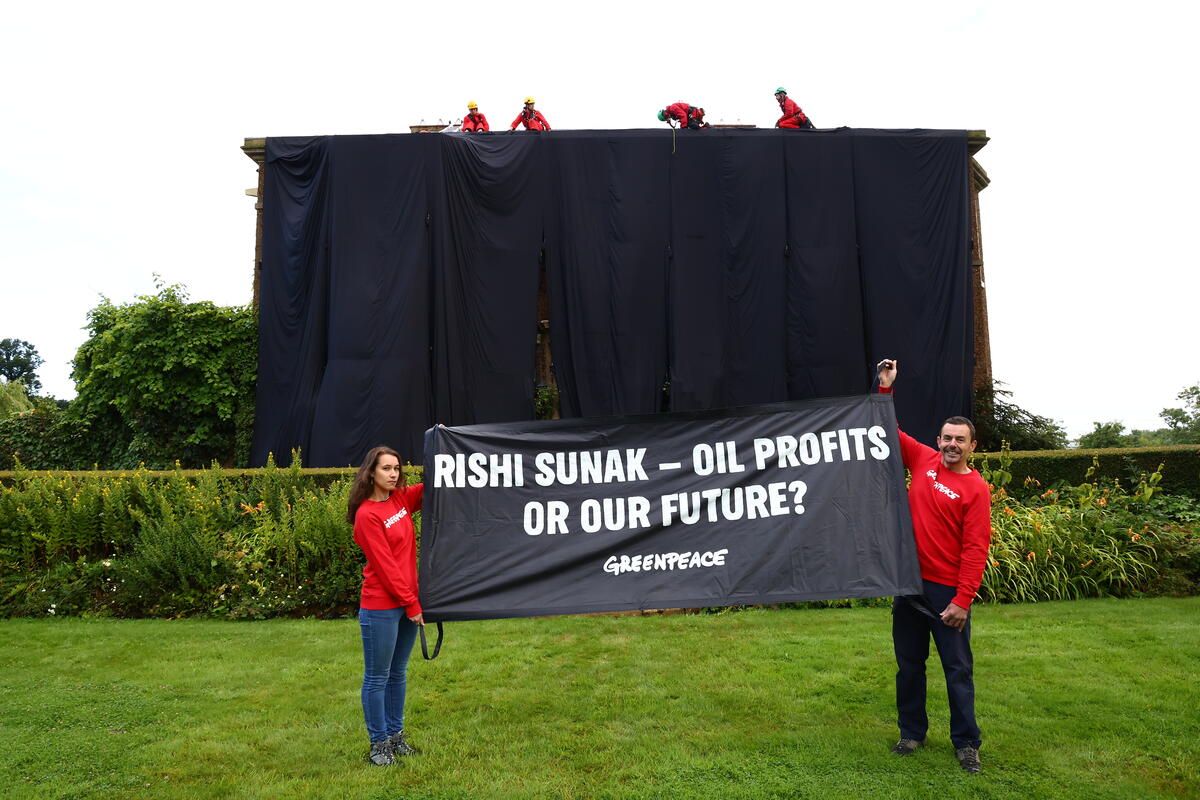
The charges related to 5 September 2024 when Greenpeace activists blockaded the entrances to Unilever House in protest at the firm’s ongoing failure to tackle plastic pollution. Climbers scaled the building and attached a huge artwork to the outside wall. Activists also blocked the entrances to the building, locking themselves onto large models of the company’s flagship Dove products and a ‘Dead Dove’ parody of the company logo.
Will McCallum, Co-Executive Director of Greenpeace UK said: “This is a bolt of good news in an otherwise bleak landscape for protest rights. Our activists were facing a combined total of up to 15 years in prison for standing up to one of the world’s largest plastic polluters. The invented crime of ‘locking-on’ is just one new tool in a well-stocked legal arsenal that is being used to stifle dissent and send peaceful protesters to jail. Previous governments brought in these laws and powers, but the responsibility lies with Keir Starmer to end their chilling effect on democracy and repeal them.”
The crime of ‘locking-on’ was one of a number of offences and powers created by recent Conservative governments to crack down on peaceful protest. It has resulted in hundreds of protesters being arrested, often for as little as walking down a street. Last year saw five climate activists sentenced to a total of 21 years in prison for taking part in a Zoom call to discuss a planned protest.
Greenpeace’s protest was part of an ongoing campaign against Unilever after the corporate giant announced a major rollback of plastic reduction targets last year. A Greenpeace International report showed that it was the largest corporate seller of single-use plastic sachets, selling the equivalent of 1,700 a second.
Daniel Jones, interim head of Greenpeace’s plastics campaign, said: “This is an important milestone in our campaign against Dove’s toxic brand of beauty. We reluctantly staged our protest last September after months of failed talks with Unilever and multiple attempts to raise our concerns in other ways. Since then, Unilever has come back to the table and has begun playing a more constructive role in negotiations for a Global Plastics Treaty. We won’t stop until the company commits to reducing plastic production – particularly of its super-polluting plastic sachets.”
‘Locking-on’ involves protesters attaching themselves to another person, building or object to make it harder for police to remove them. It has long been used as a tactic by protesters, including by the Suffragettes. The Public Order Act 2023 contained the new offences of locking-on and being ‘equipped for locking on’.
Climate and environmental protest is being criminalised and repressed around the world. The criminalisation of such protest has received a lot of attention in certain countries, including the UK and Australia. But there have not been any attempts to capture the global trend – until now.
We recently published a report, with three University of Bristol colleagues, which shows this repression is indeed a global trend – and that it is becoming more difficult around the world to stand up for climate justice.
This criminalisation and repression spans the global north and south, and includes more and less democratic countries. It does, however, take different forms.
Our report distinguishes between climate and environmental protest. The latter are campaigns against specific environmentally destructive projects – most commonly oil and gas extraction and pipelines, deforestation, dam building and mining. They take place all around the world.
Climate protests are aimed at mitigating climate change by decreasing carbon emissions, and tend to make bigger policy or political demands (“cut global emissions now” rather than “don’t build this power plant”). They often take place in urban areas and are more common in the global north.
The intensifying criminalisation and repression is taking four main forms.
1. Anti-protest laws are introduced
Anti-protest laws may give the police more powers to stop protest, introduce new criminal offences, increase sentence lengths for existing offences, or give policy impunity when harming protesters. In the 14 countries we looked at, we found 22 such pieces of legislation introduced since 2019.
2. Protest is criminalised through prosecution and courts
This can mean using laws against climate and environmental activists that were designed to be used against terrorism or organised crime. In Germany, members of Letzte Generation (Last Generation), a direct action group in the mould of Just Stop Oil, were charged in May 2024 with “forming a criminal organisation”. This section of the law is typically used against mafia organisations and had never been applied to a non-violent group.
Criminalising protest can also mean lowering the threshold for prosecution, preventing climate activists from mentioning climate change in court, and changing other court processes to make guilty verdicts more likely. Another example is injunctions that can be taken out by corporations against activists who protest against them.
3. Harsher policing
This stretches from stopping and searching to surveillance, arrests, violence, infiltration and threatening activists. The policing of activists is carried out not just by state actors like police and armed forces, but also private actors including private security, organised crime and corporations.
In Germany, regional police have been accused of collaborating with an energy giant (and its private fire brigade) to evict coal mine protesters, while private security was used extensively in policing anti-mining activists in Peru.
4. Killings and disappearances
Lastly, in the most extreme cases, environmental activists are murdered. This is an extension of the trend for harsher policing, as it typically follows threats by the same range of actors. We used data from the NGO Global Witness to show this is increasingly common in countries including Brazil, Philippines, Peru and India. In Brazil, most murders are carried out by organised crime groups while in Peru, it is the police force.
Protests are increasing
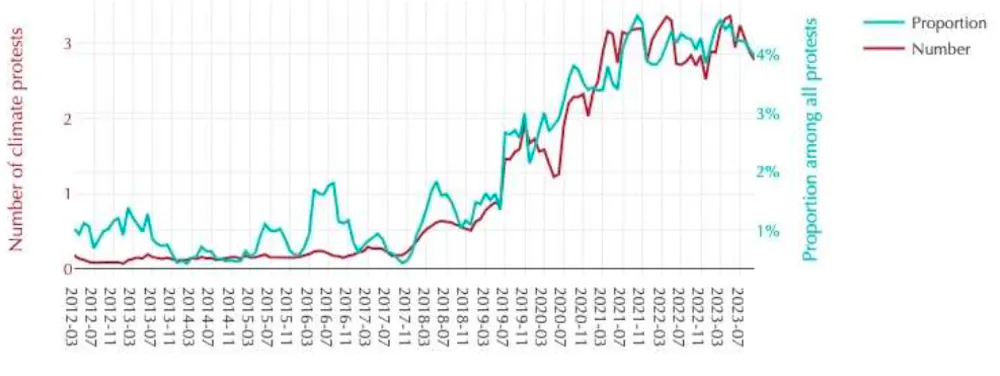
To look more closely at the global picture of climate and environmental protest – and the repression of it – we used the Armed Conflicts Location Event database. This showed us that climate protests increased dramatically in 2018-2019 and have not declined since. They make up on average about 4% of all protest in the 81 countries that had more than 1,000 protests recorded in the 2012-2023 period:
Climate protests increased sharply in the late 2010s in the 14 countries studied. (Data is smoothed over five months; number of protests is per country per month.) Berglund et al; Data: ACLED, CC BY-SA
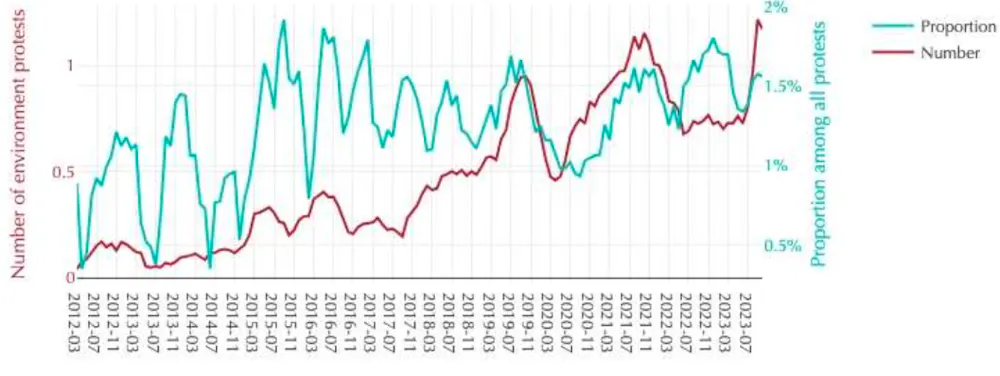
This second graph shows that environmental protest has increased more gradually:
Environmental protests in the same 14 countries. Data: ACLED, CC BY-SA
We used this data to see what kind of repression activists face. By looking for keywords in the reporting of protest events, we found that on average 3% of climate and environmental protests face police violence, and 6.3% involve arrests. But behind these averages are large differences in the nature of protest and its policing.
A combination of the presence of protest groups like Extinction Rebellion, who often actively seek arrests, and police forces that are more likely to make arrests, mean countries such as Australia and the UK have very high levels of arrest. Some 20% of Australian climate and environmental protests involve arrests, against 17% in the UK – with the highest in the world being Canada on 27%.
Meanwhile, police violence is high in countries such as Peru (6.5%) and Uganda (4.4%). France stands out as a European country with relatively high levels of police violence (3.2%) and low levels of arrests (also 3.2%).
In summary, while criminalisation and repression does not look the same across the world, there are remarkable similarities. It is increasing in a lot of countries, it involves both state and corporate actors, and it takes many forms.
This repression is taking place in a context where states are not taking adequate action on climate change. By criminalising activists, states depoliticise them. This conceals the fact these activists are ultimately right about the state of the climate and environment – and the lack of positive government action in these areas.
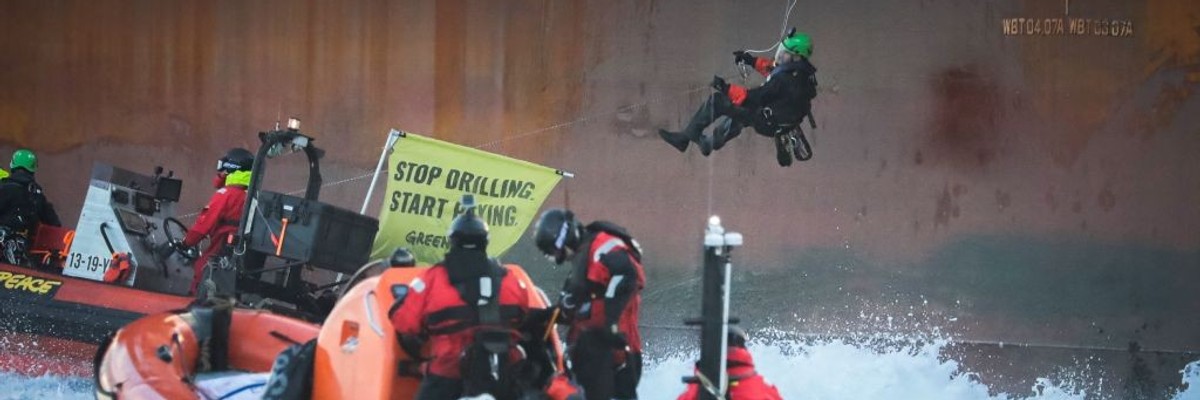
Greenpeace activists board a Shell platform headed toward the North Sea on February 6, 2023. (Photo: Lou Benoist/AFP via Getty Images)
“Shell thought suing us for millions over a peaceful protest would intimidate us, but this case became a PR millstone tied around its neck,” said the co-executive director of Greenpeace U.K.
The United Kingdom-based oil giant Shell agreed Tuesday to settle a major lawsuit the company brought against Greenpeace after activists from the group boarded and occupied a company oil platform last year to protest fossil fuel expansion.
Greenpeace said in a statement that as part of the settlement, it agreed to donate £300,000—roughly $382,000—to the Royal National Lifeboat Institution, a charity that helps save lives at sea, but will pay nothing to Shell and accept no liability. The donation represents a fraction of the over $11 million in damages and legal costs defendants faced, the group said.
The Greenpeace defendants have also “agreed to avoid protesting for a period at four Shell sites in the northern North Sea.”
“Shell thought suing us for millions over a peaceful protest would intimidate us, but this case became a PR millstone tied around its neck,” said Areeba Hamid, co-executive director of Greenpeace U.K. “The public backlash against its bullying tactics made it back down and settle out of court.”
“This settlement shows that people power works. Thousands of ordinary people across the country backed our fight against Shell and their support means we stay independent and can keep holding Big Oil to account,” Hamid added. “This legal battle might be over, but Big Oil’s dirty tricks aren’t going away. With Greenpeace facing further legal battles around the world, we won’t stop campaigning until the fossil fuel industry stops drilling and starts paying for the damage it is causing to people and planet.”
“These aggressive legal tactics, the huge sums of money, and attempts to block the right to protest pose a massive threat.”
Shell brought the case, which Greenpeace characterized as a “textbook” strategic lawsuit against public participation (SLAPP), in February 2023 and sought $1 million in damages from activists who boarded a Shell-contracted ship carrying equipment to drill for oil in the North Sea.
“When the protest ended, the only damage Shell could find was a padlock which, they alleged, our activists broke. That’s it,” Greenpeace U.K. said Tuesday. “Yet they came after us with a million-dollar lawsuit, which they justified for their spending on safety.”
The group, which warned that the case had dire implications for the right to protest, credited a “sustained, year-long campaign against the suit” for forcing the oil behemoth to back down. The campaign, according to Greenpeace, “turned the legal move into a PR embarrassment for Shell.”
“The case was dubbed the ‘Cousin Greg’ lawsuit by Forbes after a scene in the Emmy-awarded drama Succession, in which the hapless character threatens to sue Greenpeace to universal dismay,” the environmental group noted Tuesday.
Greenpeace is currently facing several other SLAPP suits, including one brought by Energy Transfer, majority-owner of the Dakota Access pipeline. The group said Tuesday that the Energy Transfer suit “threatens the very existence of Greenpeace in the U.S.”
“These aggressive legal tactics, the huge sums of money, and attempts to block the right to protest pose a massive threat. It could stop Greenpeace being able to make a real difference on the things that matter most,” the organization said Tuesday. “It’s part of a growing trend by powerful corporations and governments to crush peaceful protest—using draconian laws or intimidation lawsuits like this.”
“It seeks to silence the people most impacted by the climate crisis. This threatens the global fight for climate justice,” the group added. “We won’t give up. This is Shell versus all of us.”
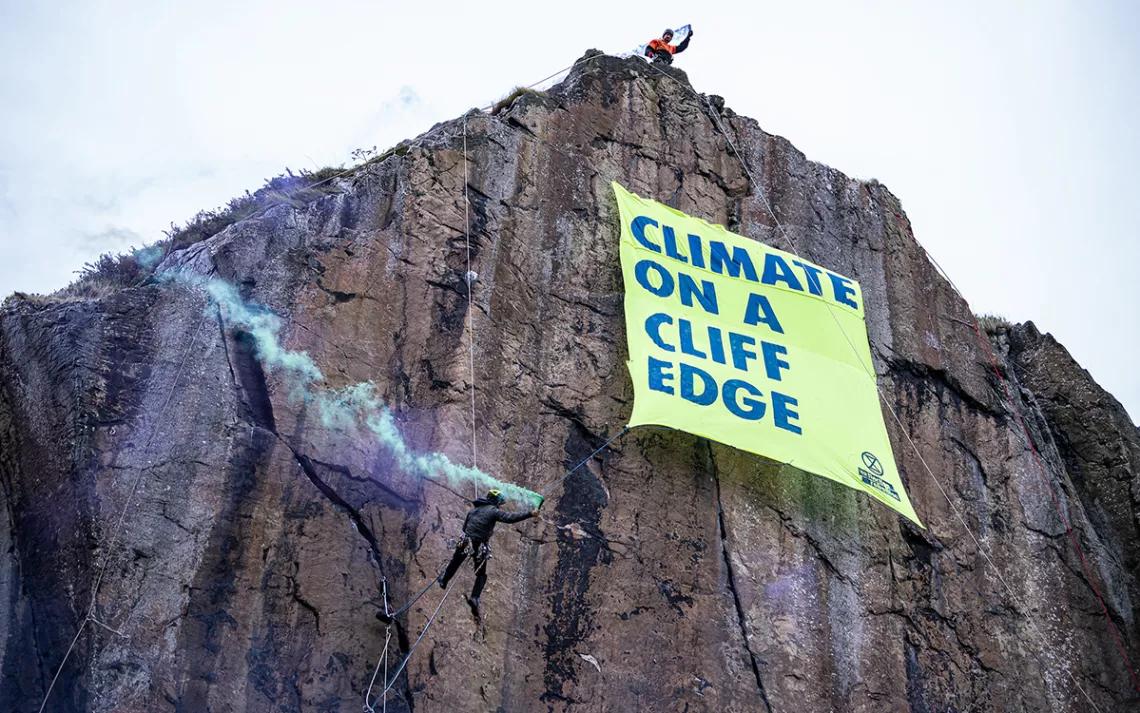
Experienced climbers scale a rock face near the historic Dumbarton castle in Glasgow, releasing a banner that reads “Climate on a Cliff Edge.” One activist, dressed as a globe, symbolically looms near the edge, while another plays the bagpipes on the shores below. | Photo courtesy of Extinction Rebellion and Mark Richards
The Whole Truth Five (from left to right) Lucia Whittaker De Abreu, Cressida Gethin, Louise Lancaster, Daniel Shaw and Roger HallamPhoto: Just Stop Oil
SIXTEEN non-violent Just Stop Oil protesters handed draconian sentences since July have been granted an extraordinary mass hearing before the Court of Appeal next year, it was announced on Saturday.
The hearing on January 29 and 30 at the Royal Courts of Justice in London will examine four separate cases involving activists from the group. Key points of contention will include whether conscientious motivation should be considered a mitigating factor.
The outcome is anticipated to be a defining moment for protest rights in Britain.
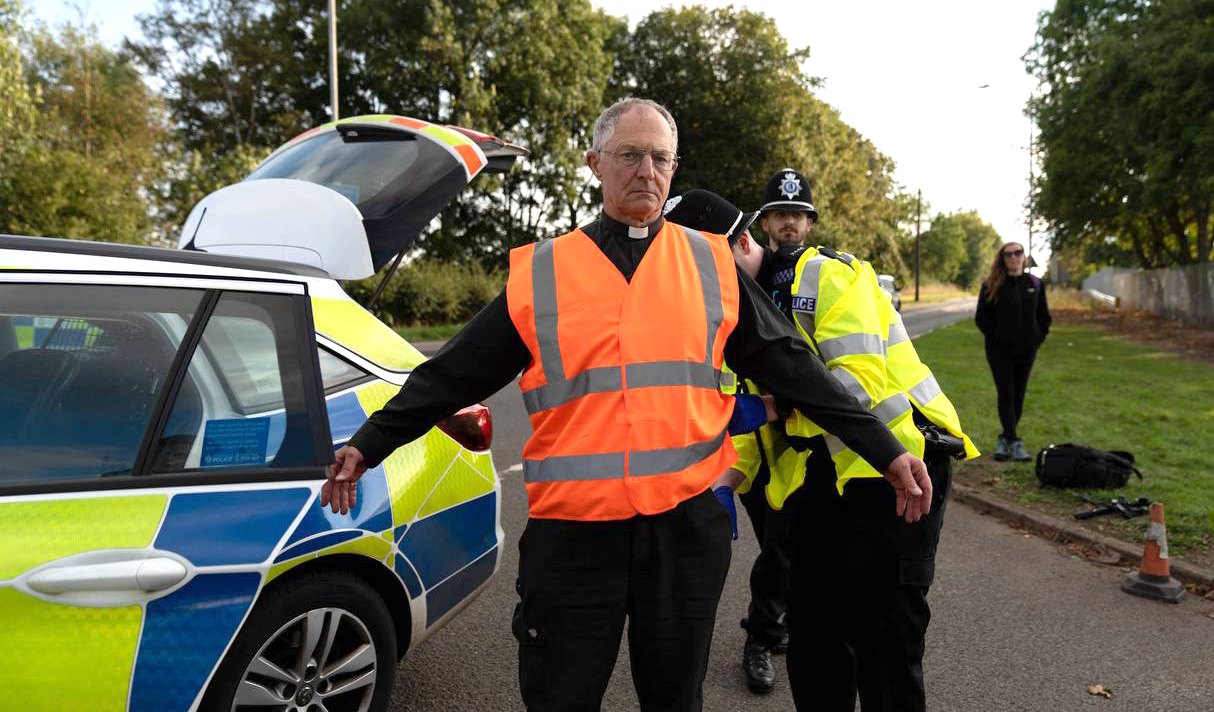
The 16 include the “Whole Truth Five,” who organised a protest on the M25 calling for a halt to new oil and gas licences. Roger Hallam, Cressida Gethin, Louise Lancaster, Daniel Shaw, and Lucia Whittaker De Abreu received a combined total of 21 years for their action.
At the time, UN special rapporteur Michel Forst said the verdict marked a dark day for “anyone concerned with the exercise of their fundamental freedoms” in Britain.
…
Spokesman for the Free Political Prisoners campaign Lex Korte said: “A subset of judges have responded all too eagerly to the call from the disgraced Lord Walney, the arms and oil industry lobbyist, to jail peaceful climate campaigners for longer than if they’d committed serious crimes of sexual violence.
European movements call for an end to the US-imposed blockade on Cuba, condemning disinformation campaigns that hinder the progress of the socialist project on the Caribbean island
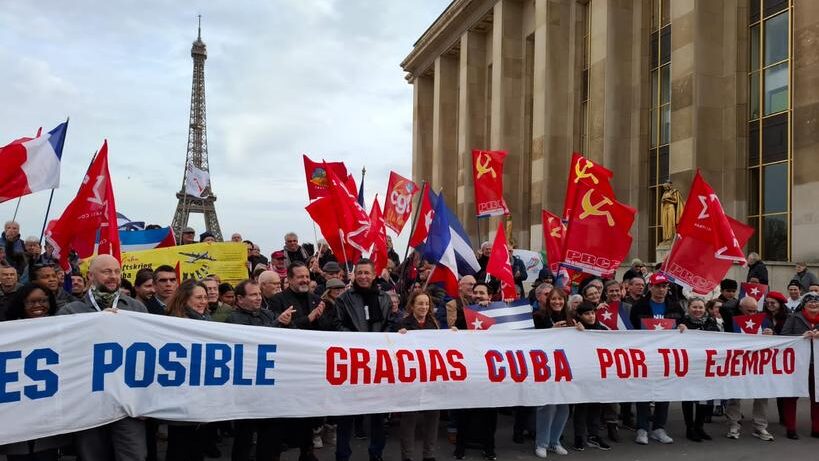
As Cuba continues to face the challenges of a US-imposed blockade and widespread disinformation campaigns, over 300 representatives of social movements, trade unions, and political organizations gathered in Paris during the weekend of November 22-24 for the 19th European Continental Meeting of Solidarity with Cuba. The delegates focused on strengthening ties between the Caribbean island and European countries, addressing the economic consequences of the blockade and everyday realities of life under these pressures.
The meeting produced a declaration outlining guidelines for European networks to counter mainstream defamation of Cuba, such as a campaign to end the country’s classification as a state sponsor of terrorism. In direct contrast to the stance of European leaders who align with the US-imposed blockade, participants expressed “unconditional support for the Cuban Revolution and its right to build the socialist project chosen by the majority of the people,” the Cuban Institute of Friendship with Peoples (Instituto Cubano de Amistad con los Pueblos, ICAP) reported in a statement.
According to Rodrigo Suñe from the International Peoples’ Assembly, the declaration “reaffirms unconditional support for Cuba’s right to continue building its path to socialism in a sovereign manner.” This, Suñe explains, will be achieved by “gradually and collectively” strengthening political solidarity with Cuba’s struggle against attacks led by successive US administrations.
Among these attacks, Suñe highlights the US-imposed blockade, designed to strangle the Cuban economy, and a “permanent media war” aimed at spreading manipulation and misinformation. He emphasizes that those in solidarity with Cuba must actively denounce and counter these campaigns. To achieve this it is essential to raise awareness and exchange information about the everyday realities of life in Cuba under the blockade. Reflecting this priority, part of the meeting focused on analyzing the blockade’s impact on Cuba’s economy, trade, and financial systems.
“We left the meeting with a mission to strengthen material solidarity by financing and implementing new cooperation projects, as well as promoting and organizing campaigns to send priority donations,” says Suñe. “To achieve this, it will be crucial to involve young people and expand their participation in building solidarity.”
On the final day of the conference, participants staged a protest in central Paris, reaffirming their call for solidarity with Cuba and urging European countries to radically change their approach. Currently, European Union member states continue to follow US policy on Cuba, a stance that, according to ICAP, does not reflect the interest – or the will – of the peoples of Europe. As part of the meeting’s conclusions, an appeal was launched for the EU to break away from US interference and remove the obstacles hampering its relations with Cuba, Rodrigo Suñe told Peoples Dispatch.
This work is particularly important given the escalating crises at a global level. “We are facing a very complex situation, with the deepening of the capitalist crisis, wars, and the rise of the far-right and its neofascist ideals. This is why we need to improve the quality of our articulation of internationalist solidarity,” explains Suñe.
The commitment to strengthening solidarity between Europe and Cuba will remain a key focus for ICAP and other organizations as they prepare for the next meeting, scheduled to take place in Turkey in 2026. Leading up to that event, Suñe says, the movements involved will focus on building a unified strategy to strengthen both political and material solidarity with Cuba, addressing the challenges discussed during their meeting in Paris.