Tag: protest

  • ‘People Power Works’: Shell Backs Down in Anti-Protest Lawsuit Against Greenpeace

    Spread the love

    Original article by Jake Johnson republished from Common Dreams under Creative Commons (CC BY-NC-ND 3.0). 
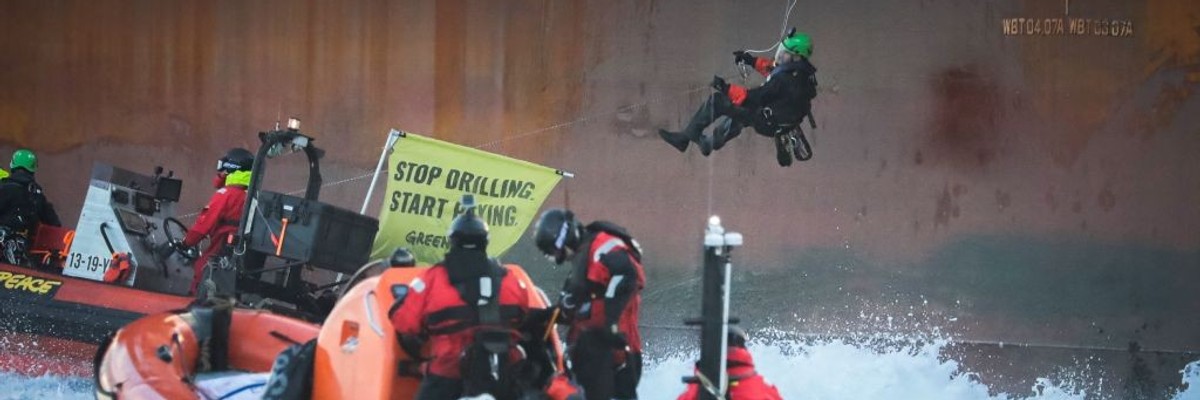
    Greenpeace activists board a Shell platform headed toward the North Sea on February 6, 2023.  (Photo: Lou Benoist/AFP via Getty Images)

    “Shell thought suing us for millions over a peaceful protest would intimidate us, but this case became a PR millstone tied around its neck,” said the co-executive director of Greenpeace U.K.

    The United Kingdom-based oil giant Shell agreed Tuesday to settle a major lawsuit the company brought against Greenpeace after activists from the group boarded and occupied a company oil platform last year to protest fossil fuel expansion.

    Greenpeace said in a statement that as part of the settlement, it agreed to donate £300,000—roughly $382,000—to the Royal National Lifeboat Institution, a charity that helps save lives at sea, but will pay nothing to Shell and accept no liability. The donation represents a fraction of the over $11 million in damages and legal costs defendants faced, the group said.

    The Greenpeace defendants have also “agreed to avoid protesting for a period at four Shell sites in the northern North Sea.”

    “Shell thought suing us for millions over a peaceful protest would intimidate us, but this case became a PR millstone tied around its neck,” said Areeba Hamid, co-executive director of Greenpeace U.K. “The public backlash against its bullying tactics made it back down and settle out of court.”

    “This settlement shows that people power works. Thousands of ordinary people across the country backed our fight against Shell and their support means we stay independent and can keep holding Big Oil to account,” Hamid added. “This legal battle might be over, but Big Oil’s dirty tricks aren’t going away. With Greenpeace facing further legal battles around the world, we won’t stop campaigning until the fossil fuel industry stops drilling and starts paying for the damage it is causing to people and planet.”

    “These aggressive legal tactics, the huge sums of money, and attempts to block the right to protest pose a massive threat.”

    Shell brought the case, which Greenpeace characterized as a “textbook” strategic lawsuit against public participation (SLAPP), in February 2023 and sought $1 million in damages from activists who boarded a Shell-contracted ship carrying equipment to drill for oil in the North Sea.

    “When the protest ended, the only damage Shell could find was a padlock which, they alleged, our activists broke. That’s it,” Greenpeace U.K. said Tuesday. “Yet they came after us with a million-dollar lawsuit, which they justified for their spending on safety.”

    The group, which warned that the case had dire implications for the right to protest, credited a “sustained, year-long campaign against the suit” for forcing the oil behemoth to back down. The campaign, according to Greenpeace, “turned the legal move into a PR embarrassment for Shell.”

    “The case was dubbed the ‘Cousin Greg’ lawsuit by Forbes after a scene in the Emmy-awarded drama Succession, in which the hapless character threatens to sue Greenpeace to universal dismay,” the environmental group noted Tuesday.

    Greenpeace is currently facing several other SLAPP suits, including one brought by Energy Transfer, majority-owner of the Dakota Access pipeline. The group said Tuesday that the Energy Transfer suit “threatens the very existence of Greenpeace in the U.S.”

    “These aggressive legal tactics, the huge sums of money, and attempts to block the right to protest pose a massive threat. It could stop Greenpeace being able to make a real difference on the things that matter most,” the organization said Tuesday. “It’s part of a growing trend by powerful corporations and governments to crush peaceful protest—using draconian laws or intimidation lawsuits like this.”

    “It seeks to silence the people most impacted by the climate crisis. This threatens the global fight for climate justice,” the group added. “We won’t give up. This is Shell versus all of us.”

    Original article by Jake Johnson republished from Common Dreams under Creative Commons (CC BY-NC-ND 3.0). 
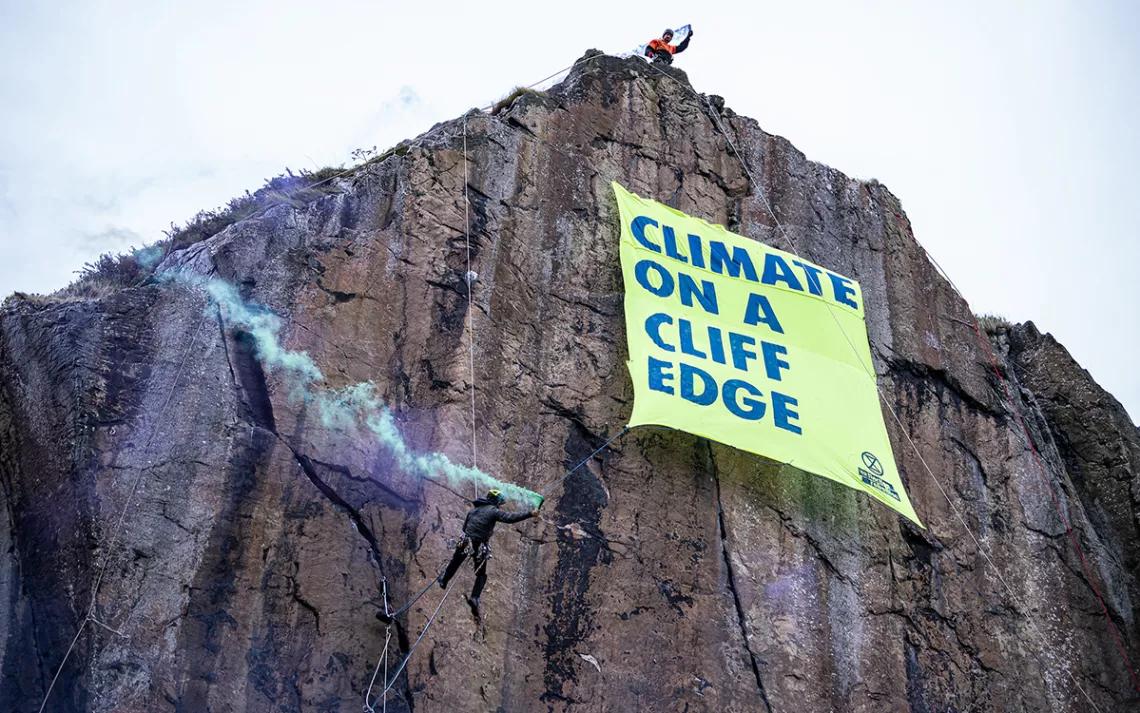
    Experienced climbers scale a rock face near the historic Dumbarton castle in Glasgow, releasing a banner that reads “Climate on a Cliff Edge.” One activist, dressed as a globe, symbolically looms near the edge, while another plays the bagpipes on the shores below. | Photo courtesy of Extinction Rebellion and Mark Richards
    Experienced climbers scale a rock face near the historic Dumbarton castle in Glasgow, releasing a banner that reads “Climate on a Cliff Edge.” One activist, dressed as a globe, symbolically looms near the edge, while another plays the bagpipes on the shores below. | Photo courtesy of Extinction Rebellion and Mark Richards
  • Climate activists serving combined 41 years of jail time granted mass appeal hearing

    Spread the love

    https://morningstaronline.co.uk/article/climate-activists-serving-combined-41-years-jail-time-granted-mass-appeal-hearing Many articles from the Morning Star today

    The Whole Truth Five (from left to right) Lucia Whittaker De Abreu, Cressida Gethin, Louise Lancaster, Daniel Shaw and Roger Hallam Photo: Just Stop Oil

    SIXTEEN non-violent Just Stop Oil protesters handed draconian sentences since July have been granted an extraordinary mass hearing before the Court of Appeal next year, it was announced on Saturday.

    The hearing on January 29 and 30 at the Royal Courts of Justice in London will examine four separate cases involving activists from the group. Key points of contention will include whether conscientious motivation should be considered a mitigating factor.

    The outcome is anticipated to be a defining moment for protest rights in Britain.

    The 16 include the “Whole Truth Five,” who organised a protest on the M25 calling for a halt to new oil and gas licences. Roger Hallam, Cressida Gethin, Louise Lancaster, Daniel Shaw, and Lucia Whittaker De Abreu received a combined total of 21 years for their action.

    At the time, UN special rapporteur Michel Forst said the verdict marked a dark day for “anyone concerned with the exercise of their fundamental freedoms” in Britain.

    …

    Spokesman for the Free Political Prisoners campaign Lex Korte said: “A subset of judges have responded all too eagerly to the call from the disgraced Lord Walney, the arms and oil industry lobbyist, to jail peaceful climate campaigners for longer than if they’d committed serious crimes of sexual violence.

    …

    https://morningstaronline.co.uk/article/climate-activists-serving-combined-41-years-jail-time-granted-mass-appeal-hearing Many articles from the Morning Star today

  • European movements demand an end to US blockade on Cuba

    Spread the love

    Original article by Ana Vračar republished from peoples dispatch under a Creative Commons Attribution-ShareAlike 4.0 (CC BY-SA) license.

    Source: ICAP/X

    European movements call for an end to the US-imposed blockade on Cuba, condemning disinformation campaigns that hinder the progress of the socialist project on the Caribbean island

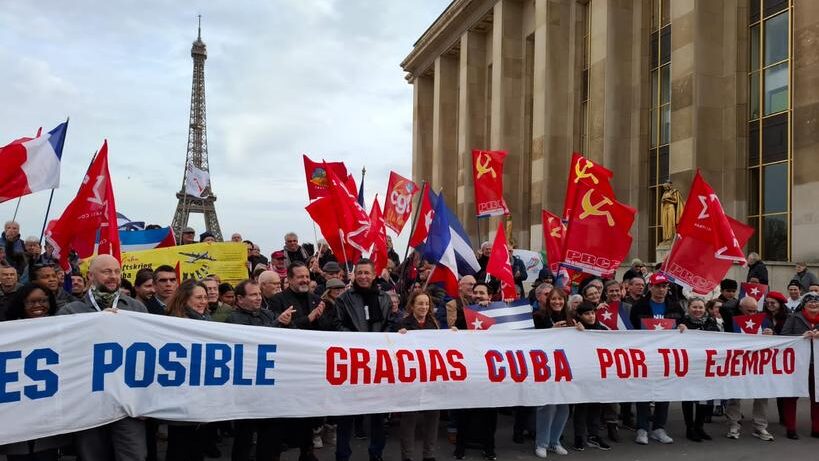
    As Cuba continues to face the challenges of a US-imposed blockade and widespread disinformation campaigns, over 300 representatives of social movements, trade unions, and political organizations gathered in Paris during the weekend of November 22-24 for the 19th European Continental Meeting of Solidarity with Cuba. The delegates focused on strengthening ties between the Caribbean island and European countries, addressing the economic consequences of the blockade and everyday realities of life under these pressures.

    The meeting produced a declaration outlining guidelines for European networks to counter mainstream defamation of Cuba, such as a campaign to end the country’s classification as a state sponsor of terrorism. In direct contrast to the stance of European leaders who align with the US-imposed blockade, participants expressed “unconditional support for the Cuban Revolution and its right to build the socialist project chosen by the majority of the people,” the Cuban Institute of Friendship with Peoples (Instituto Cubano de Amistad con los Pueblos, ICAP) reported in a statement.

    Read more: Fidel: building and defending the Cuban Revolution

    According to Rodrigo Suñe from the International Peoples’ Assembly, the declaration “reaffirms unconditional support for Cuba’s right to continue building its path to socialism in a sovereign manner.” This, Suñe explains, will be achieved by “gradually and collectively” strengthening political solidarity with Cuba’s struggle against attacks led by successive US administrations.

    Among these attacks, Suñe highlights the US-imposed blockade, designed to strangle the Cuban economy, and a “permanent media war” aimed at spreading manipulation and misinformation. He emphasizes that those in solidarity with Cuba must actively denounce and counter these campaigns. To achieve this it is essential to raise awareness and exchange information about the everyday realities of life in Cuba under the blockade. Reflecting this priority, part of the meeting focused on analyzing the blockade’s impact on Cuba’s economy, trade, and financial systems.

    “We left the meeting with a mission to strengthen material solidarity by financing and implementing new cooperation projects, as well as promoting and organizing campaigns to send priority donations,” says Suñe. “To achieve this, it will be crucial to involve young people and expand their participation in building solidarity.”

    Read more: Cuba, in the dark but not defeated

    On the final day of the conference, participants staged a protest in central Paris, reaffirming their call for solidarity with Cuba and urging European countries to radically change their approach. Currently, European Union member states continue to follow US policy on Cuba, a stance that, according to ICAP, does not reflect the interest – or the will – of the peoples of Europe. As part of the meeting’s conclusions, an appeal was launched for the EU to break away from US interference and remove the obstacles hampering its relations with Cuba, Rodrigo Suñe told Peoples Dispatch.

    This work is particularly important given the escalating crises at a global level. “We are facing a very complex situation, with the deepening of the capitalist crisis, wars, and the rise of the far-right and its neofascist ideals. This is why we need to improve the quality of our articulation of internationalist solidarity,” explains Suñe.

    The commitment to strengthening solidarity between Europe and Cuba will remain a key focus for ICAP and other organizations as they prepare for the next meeting, scheduled to take place in Turkey in 2026. Leading up to that event, Suñe says, the movements involved will focus on building a unified strategy to strengthen both political and material solidarity with Cuba, addressing the challenges discussed during their meeting in Paris.

    Original article by Ana Vračar republished from peoples dispatch under a Creative Commons Attribution-ShareAlike 4.0 (CC BY-SA) license.

  • General strike brings Greece to a standstill

    Spread the love

    NB This article a week old

    Original article by Ana Vračar republished from peoples dispatch under a Creative Commons Attribution-ShareAlike 4.0 (CC BY-SA) license.

    Source: PAME Greece

    Thousands of people across Greece joined a general strike and mass protests, demanding action against high living expenses, restrictions on union organizing, and excessive military spending

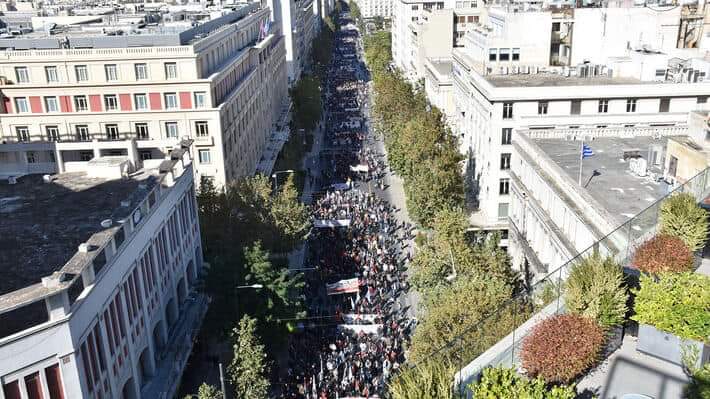
    Greece was brought to a halt on Wednesday, November 20, as a 24-hour general strike brought workers from across sectors—including education, logistics, construction, public transportation, and health—to the streets of dozens of cities. The mass mobilization, which began early in the morning, followed a media strike on Tuesday that included both public and private outlets.

    The striking workers demanded the repeal of anti-worker laws, including measures that extended working hours, and called for wage restoration. Over the past decade, successive governments, most recently led by Prime Minister Kyriakos Mitsotakis, have implemented austerity policies under pressure from the European Union and international financial institutions. These policies have led to drastic income reductions, with wages remaining about 14% lower than in 2011, according to trade unions.

    Read more: Workers in Greece mobilize against austerity, announce general strike in November

    Protesters warned that current conditions mean they cannot lead dignified lives. With a minimum wage of approximately 900 euros, they face housing and food costs comparable to those in European countries with higher income. While the government has boasted about recent improvements in unemployment rates, unions highlighted that these figures mask the economy’s heavy reliance on tourism and fail to account for poor working conditions.

    Greek unions emphasized that anti-worker legislation has persisted for over a decade, including wage cuts and freezes, extended working hours, and severe restrictions on collective bargaining. These policies have left only a small fraction of workers benefiting from collective agreements. “At the same time, they are further commodifying the functioning of critical sectors such as health, education, energy, water, transport, social security, infrastructure and civil protection services for natural disasters,” stated the All Workers Militant Front (PAME) ahead of the strike. In response, unions demanded guarantees of universal, public, and free education and healthcare, alongside accessible housing solutions.

    The push to privatize and commodify basic rights highlights how successive administrations have prioritized fiscal targets over people’s interests. This has led to a situation where financial organizations commend Greece’s economic recovery, while the working class continues to face systemic denial of basic rights. On top of that, Greece has allocated millions of euros to military spending through NATO—a decision that has become a significant point of contention for trade unions.

    “We do not accept our basic and daily needs to be sacrificed to give billions to NATO armaments, for missiles, frigates, war planes,” PAME stated. Hundreds of thousands of euros have been allocated for the frigate in the Red Sea—”money that is equivalent to the annual budget of a hospital”—the workers’ organization concluded.

    Read more: Athens dockworkers block ammunition shipment bound for Israel

    Marches on November 20 highlighted international solidarity as opposed to war and militarization. Palestinian flags were prominently displayed at the rallies, reflecting the longstanding support of Greek workers for the people of Gaza and other occupied territories. Trade unions called for an immediate end to the Israeli genocide against Palestinian and Lebanese people. This message resonated with the general strike’s motto: “Out of the war slaughterhouses; fund wages, health, and education instead.”

    “The large participation in the strike and rallies demonstrates the workers’ strong opposition to the government’s anti-people policies and its alignment with business interests,” PAME stated on the day of the strike. The organization reaffirmed its commitment to continue with the mobilizations, aiming to pressure the government to shift its priorities toward addressing workers’ rights and peace.

    Original article by Ana Vračar republished from peoples dispatch under a Creative Commons Attribution-ShareAlike 4.0 (CC BY-SA) license.

  • Thousands of PTI supporters reach Islamabad demanding Imran Khan’s immediate release

    Spread the love

    Original article republished from peoples dispatch under a Creative Commons Attribution-ShareAlike 4.0 (CC BY-SA) license.

    Thousands of supporters of former Prime Minister Imran Khan marched to Islamabad over the past few days facing heavy repression from security forces

    Thousands of members and supporters of Tehreek-e-insaf (PTI) reached Pakistan’s capital, Islamabad, on Tuesday, November 26, facing heavy repression by security forces including tear gas and live fire. Reportedly four people have been killed. Protesters are demanding the release of their leader, former Prime Minister Imran Khan and have also called for the restoration of the party’s allegedly stolen mandate in this year’s national elections.

    PTI and Khan supporters started marching to Islamabad from all corners of the country on Sunday, aiming to reach D-Chowk near the country’s Parliament. However, security forces have attempted to prevent the movement by erecting barricades, including shipping containers, on roads linking the capital with other regions, along with other coercive measures.

    Protesters traveling in trucks, buses, cars or on foot from various provinces, including Khyber Pakhtunkhwa (KP), where the PTI is in power, were reportedly attacked by the security forces using batons and tear gas. Additionally, a large number of people have been arrested after the Islamabad High Court (IHC) declared the protest illegal last week.

    The actions of the security forces delayed the gathering in Islamabad on Sunday, forcing the PTI to announce that it might take a couple more days for all its supporters to assemble at the designated place in Islamabad. PTI announced that it will not abandon the protest until all objectives are achieved.

    The march is organized in response to Khan’s “final call” for protest issued earlier this month. Khan urged all his supporters and party leaders to mobilize and march in solidarity until they achieve the release of all political prisoners, the reversal of 26th constitutional amendment, the restoration of democracy and of the constitution, and the return of “the stolen mandate,” referring to allegedly rigged general elections held in February this year.

    The 26th amendment, passed in October, gave more power to the parliament over the judiciary, despite objections raised by PTI and several other parties. PTI claims that the amendment was introduced specifically to prevent Khan’s early release from jail.

    Interior Minister Mohsin Naqvi announced that the government would prevent protesters from entering the capital at any cost. The government also accused PTI of working against the interest of the nation. Naqvi admitted that mobile internet services had been suspended in some parts of the country to manage the situation.

    The government also filed cases against Imran Khan, his wife Bushra Bibi, former president Arif Alvi, and several other PTI leaders under Pakistan’s anti-terrorism laws, the Express Tribune reported.

    The protests may further erode the legitimacy of the government 

    Ammar Ali Jan, head of the Haqooq-e-Khalq Party (HKP), told Peoples Dispatch that the coalition government of Pakistan Muslim League (Nawaz) and Peoples Party of Pakistan (PPP), led by Prime Minister Shahbaz Sharif, is already facing a serious crisis of legitimacy due to the questionable way in which it came to power during the general elections with the backing of the “establishment”, i.e. the military. The ruling coalition is now on the defensive as PTI’s frequent calls for popular protests further deepen the crisis of legitimacy.

    Khan, who has been held in Pakistan’s Adiala Jail since his arrest in August last year on various charges, remains very popular. Despite allegations of manipulation, attempts to disqualify the party, and Khan’s imprisonment, PTI won the largest number of seats in the parliament.

    While the former Prime Minister has been convicted on several charges, many of those convictions have been reversed by higher courts, and in some, he has been granted bail. Last week, the IHC granted him bail in one of the most high-profile cases, related to Toshakhana or the illegal sale of state gifts.

    However, the Pakistan’s government has refused to release him, claiming that several cases are still pending. Khan and his supporters assert that all cases filed against him since his ousting from power in July 2022 are politically motivated and stem from his criticism of the military’s role in politics.

    Ammar Ali Jaan warns that if the current siege of the capital is prolonged or if any bloodshed occurs, the regime’s “crisis of legitimacy” will intensify further, potentially numbering the days in power for the current government.

    Original article republished from peoples dispatch under a Creative Commons Attribution-ShareAlike 4.0 (CC BY-SA) license.