

Original article by Jessica Corbett republished from Common Dreams under Creative Commons (CC BY-NC-ND 3.0).
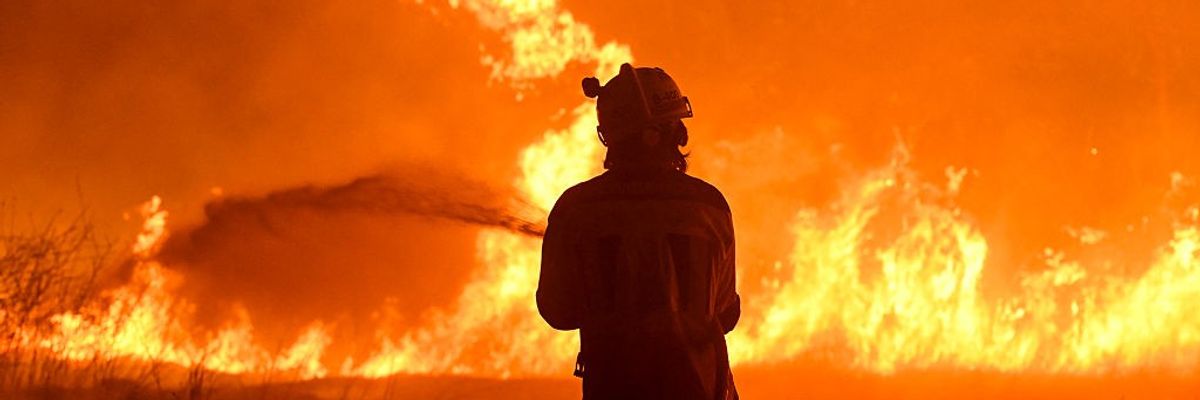
With firefighters in southern Europe battling blazes that have killed people in multiple countries and forced thousands to evacuate, Spain’s environment minister on Wednesday called the wildfires a “clear warning” of the climate emergency driven by the fossil fuel industry.
While authorities have cited a variety of causes for current fires across the continent, from arson to “careless farming practices, improperly maintained power cables, and summer lightning storms,” scientists have long stressed that wildfires are getting worse as humanity heats the planet with fossil fuels.
The Spanish minister, Sara Aagesen, told the radio network Cadena SER that “the fires are one of the parts of the impact of that climate change, which is why we have to do all we can when it comes to prevention.”
“Our country is especially vulnerable to climate change. We have resources now but, given that the scientific evidence and the general expectation point to it having an ever greater impact, we need to work to reinforce and professionalize those resources,” Aagesen added in remarks translated by The Guardian.
The Spanish meteorological agency, AEMET, said on social media Wednesday that “the danger of wildfires continues at very high or extreme levels in most of Spain, despite the likelihood of showers in many areas,” and urged residents to “take extreme precautions!”
The heatwave impacting Spain “peaked on Tuesday with temperatures as high as 45°C (113°F),” according to Reuters. AEMET warned that “starting Thursday, the heat will intensify again,” and is likely to continue through Monday.
The heatwave is also a sign of climate change, Akshay Deoras, a research scientist in the Meteorology Department at the U.K.’s University of Reading, told Agence France-Presse this week.
“Thanks to climate change, we now live in a significantly warmer world,” Deoras said, adding that “many still underestimate the danger.”
There have been at least two fire-related deaths in Spain this week: a man working at a horse stable on the outskirts of the Spanish capital Madrid, and a 35-year-old volunteer firefighter trying to make firebreaks near the town of Nogarejas, in the Castile and León region.
Acknowledging the firefighter’s death on social media Tuesday, Spanish Prime Minister Pedro Sánchez sent his “deepest condolences to their family, friends, and colleagues,” and wished “much strength and a speedy recovery to the people injured in that same fire.”
According to The New York Times, deaths tied to the fires were also reported in Turkey, Montenegro, and Albania. Additionally, The Guardian noted, “a 4-year-old boy who was found unconscious in his family’s car in Sardinia died in Rome on Monday after suffering irreversible brain damage caused by heatstroke.”
There are also fires in Greece, France, and Portugal, where the mayor of Vila Real, Alexandre Favaios, declared that “we are being cooked alive, this cannot continue.”
Reuters on Wednesday highlighted Greenpeace estimates that investing €1 billion, or $1.17 billion, annually in forest management could save 9.9 million hectares or 24.5 million acres—an area bigger than Portugal—and tens of billions of euros spent on firefighting and restoration work.
The European fires are raging roughly three months out from the next United Nations Climate Change Conference, or COP30, which is scheduled to begin on November 10 in Belém, Brazil.
Original article by Jessica Corbett republished from Common Dreams under Creative Commons (CC BY-NC-ND 3.0).


This work by Middle East Monitor is licensed under a Creative Commons Attribution-NonCommercial-ShareAlike 4.0 International License.

Spain’s foreign minister said Monday that his country and the European Union will “never recognize” any unilateral annexation of the Gaza Strip or the West Bank, condemning Israel’s military escalation in the territory, Anadolu reports.
“I spoke out immediately, I firmly condemned it: neither we nor the European Union will ever recognize it,” Jose Manuel Albares told Spanish broadcaster RTVE. “We will never recognize this illegal unilateral annexation of Gaza or the West Bank, where illegal settlements are advancing.”
Albares stressed that what the Middle East needs right now is the security of the Palestinian people, and the security of the people of Israel.
“This escalation in Israel’s military occupation of Gaza will only bring more death, more suffering, further impede the release of the hostages, and destabilize the Middle East,” he warned.
He urged for “a permanent ceasefire, an end to this blockade that Israel is imposing on Gaza, this induced famine, a massive influx of humanitarian aid, the immediate release of all the hostages, and a definitive peace, which is the same as establishing a two-state solution.”
Israel is already facing mounting condemnation for its genocidal war on Gaza, where it has killed more than 61,000 Palestinians since October 2023. The military campaign has devastated the enclave and led to deaths by starvation.
READ: Israel to call up 430,000 reservists for planned Gaza occupation
Original article by Orla Dwyer, Ho Woo Nam and Tom Prater republished from Carbon Brief under a CC license.

Wildfires have scorched more than 40,000 hectares of land so far this year across the UK – an area more than twice the size of the Scottish city of Glasgow.
This is already a record amount of land burned in a single year, far exceeding the previous high, Global Wildfire Information System (GWIS) data shows.
It is also almost four times the average area burned in wildfires by this stage of the year over 2012-24 – and 50% higher than the previous record amount burned by this time in 2019.
The burned area overtook the previous annual record in April, BBC News reported at the time, and has continued to soar in the months since.
The chart below shows that UK wildfires in 2025 so far have already burned by far the largest area of land over any calendar year since GWIS records began in 2012. The previous record year was 2019, followed by 2022, while 2024 saw the lowest area size burned.
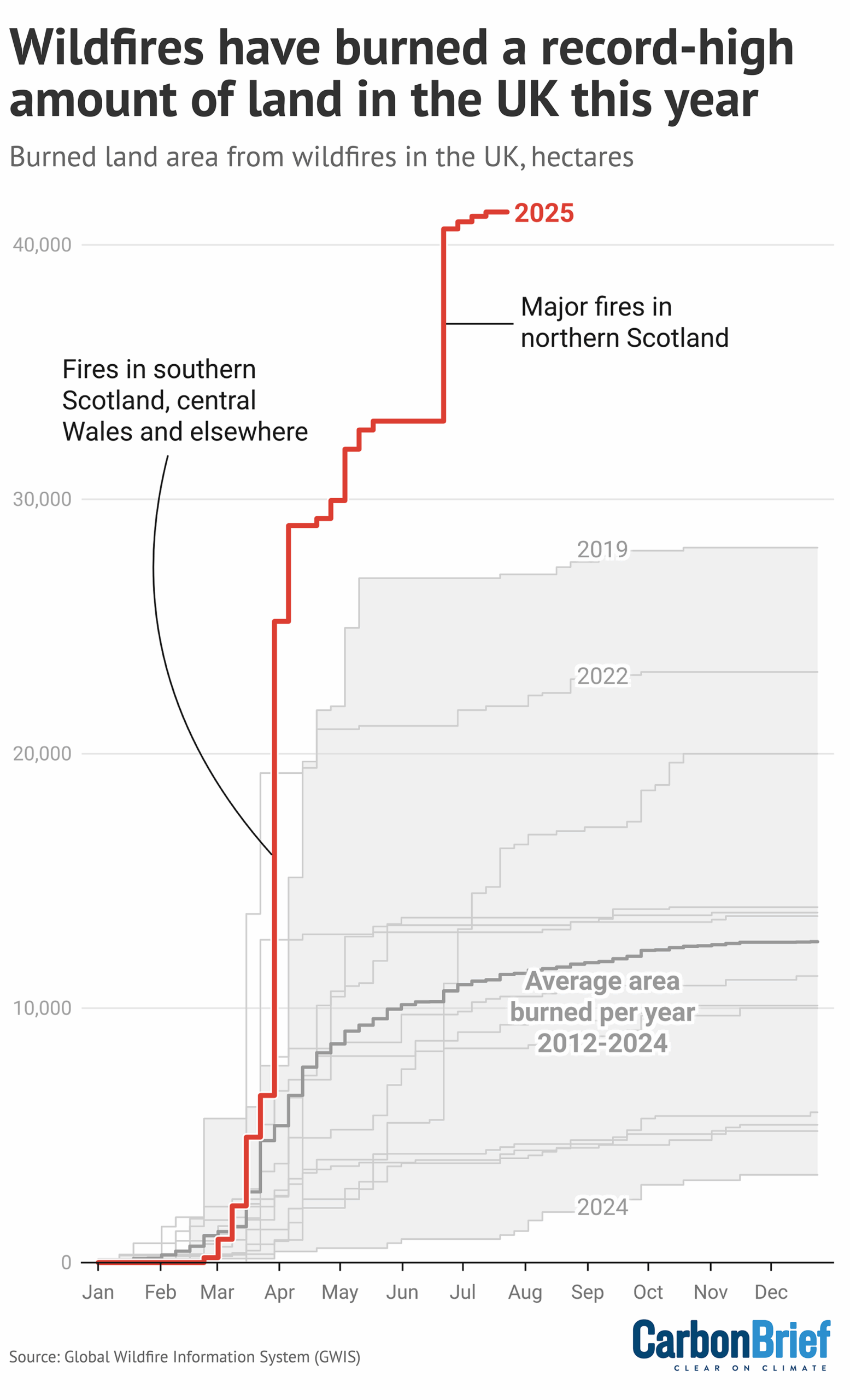
Annual land area burned by wildfires across the UK from 2012 to 2025 (red), alongside the average area burned each year over 2012-24. Source: Global Wildfire Information System.
Climate change can increase the risk and impact of wildfires. Warmer temperatures and drought can leave land parched and dry out vegetation, which helps fires spread more rapidly. Climate change is making these types of extreme conditions more likely to occur, as well as more severe.
Fire services in England and Wales responded to 564 wildfires from January to June 2025 – an increase from 69 fires in the same period last year, the National Fire Chiefs Council (NFCC) said in a statement in June.
Most wildfires in the UK are caused by human activity, whether accidental or deliberate, according to the NFCC. Some common ignition sources are disposable barbecues, lit cigarettes and campfires.
Jessica Richter, a research analyst at Global Forest Watch, says that, while fires are also a key part of some ecosystems, climate change is the “major driver behind the increasing fire activity around the globe”. She tells Carbon Brief:
“As we see more fires, we’re going to see more carbon being emitted and that’s just going to be, for lack of a better phrasing, adding fuel to the fire.”
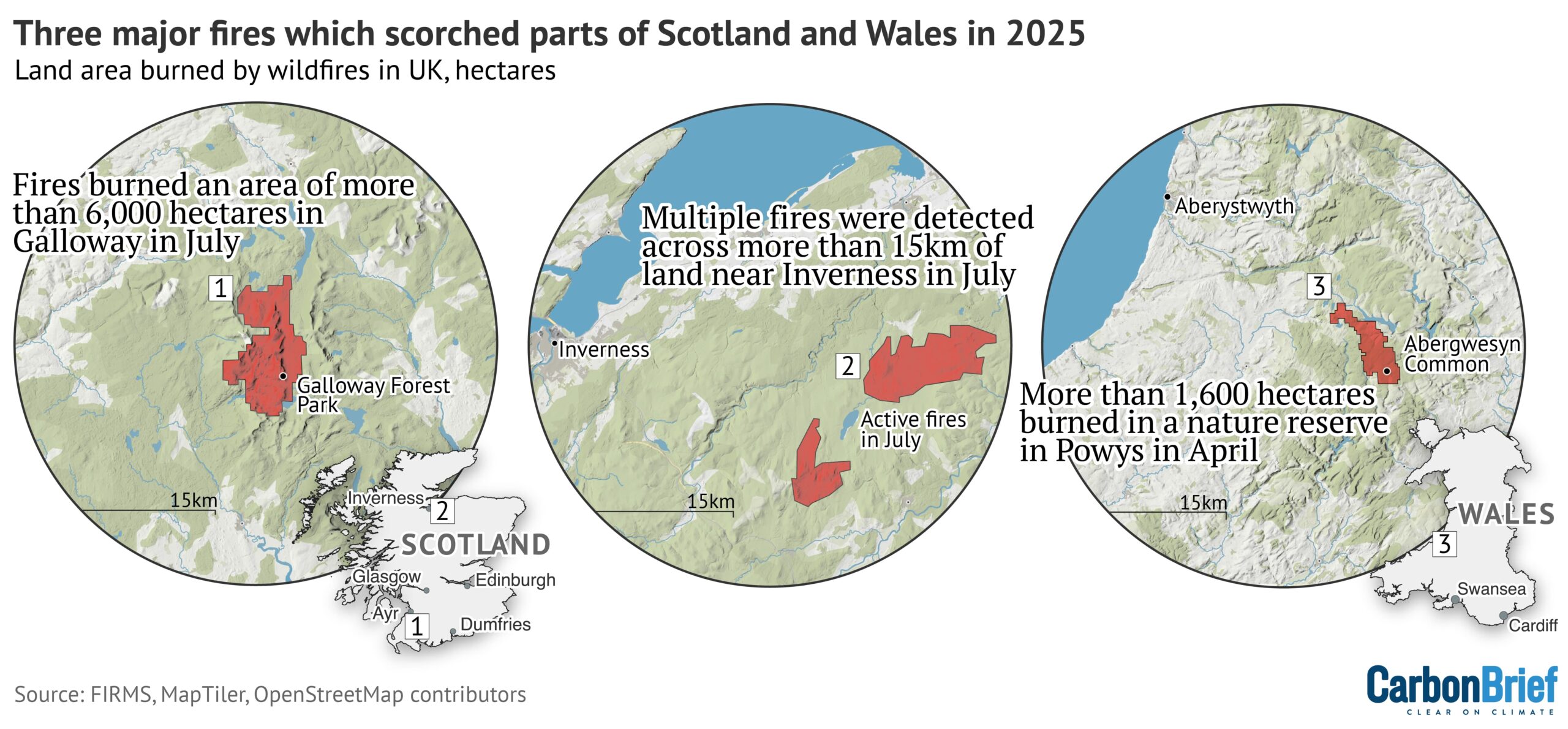
Examples of 2025 wildfires around Galloway (1) and Inverness (2) in Scotland, and a wildfire in Powys (3) in Wales. Source: FIRMS, MapTiler, OpenStreetMap contributors.
The UK has also recorded its highest-ever wildfire emissions this year, according to Copernicus, which was “primarily driven” by major wildfires in Scotland from late June to early July.
These were the largest wildfires ever recorded in the country, reported the Scotsman. They “ravaged” land in Moray and the Highlands in the north of the country, the newspaper added.
Scotland experienced an extreme wildfire in Galloway Forest Park in April, which was “so intense it could be seen from space”, the Financial Times said.
Elsewhere, in April, the Belfast News Letter reported that firefighters tackled almost 150 fires on the Mourne Mountains in Northern Ireland.
More recently, BBC News reported that firefighters in Dorset, England received “non-stop” wildfire calls in the first weekend of August, with one blaze “engulf[ing] an area the size of 30 football pitches”.
Wildfires have also caused devastation across many parts of Europe in recent weeks – including Albania, Cyprus, France, Greece, Spain and Turkey – as well as in the US and Canada.
Words by Orla Dwyer. Analysis by Ho Woo Nam. Charts by Tom Prater.
Original article by Orla Dwyer, Ho Woo Nam and Tom Prater republished from Carbon Brief under a CC license.
Media reaction: The 2025 Texas floods and the role of climate change Extreme weather 10.07.25
Children born in 2020 will face ‘unprecedented exposure’ to climate extremes Attribution 07.05.25
Two-thirds of global warming since 1990 caused by world’s ‘wealthiest 10%’ Attribution 07.05.25
Global soil moisture in ‘permanent’ decline due to climate change Drought 27.03.25

Original article by Pablo Meriguet republished from peoples dispatch under a Creative Commons Attribution-ShareAlike 4.0 (CC BY-SA) license.
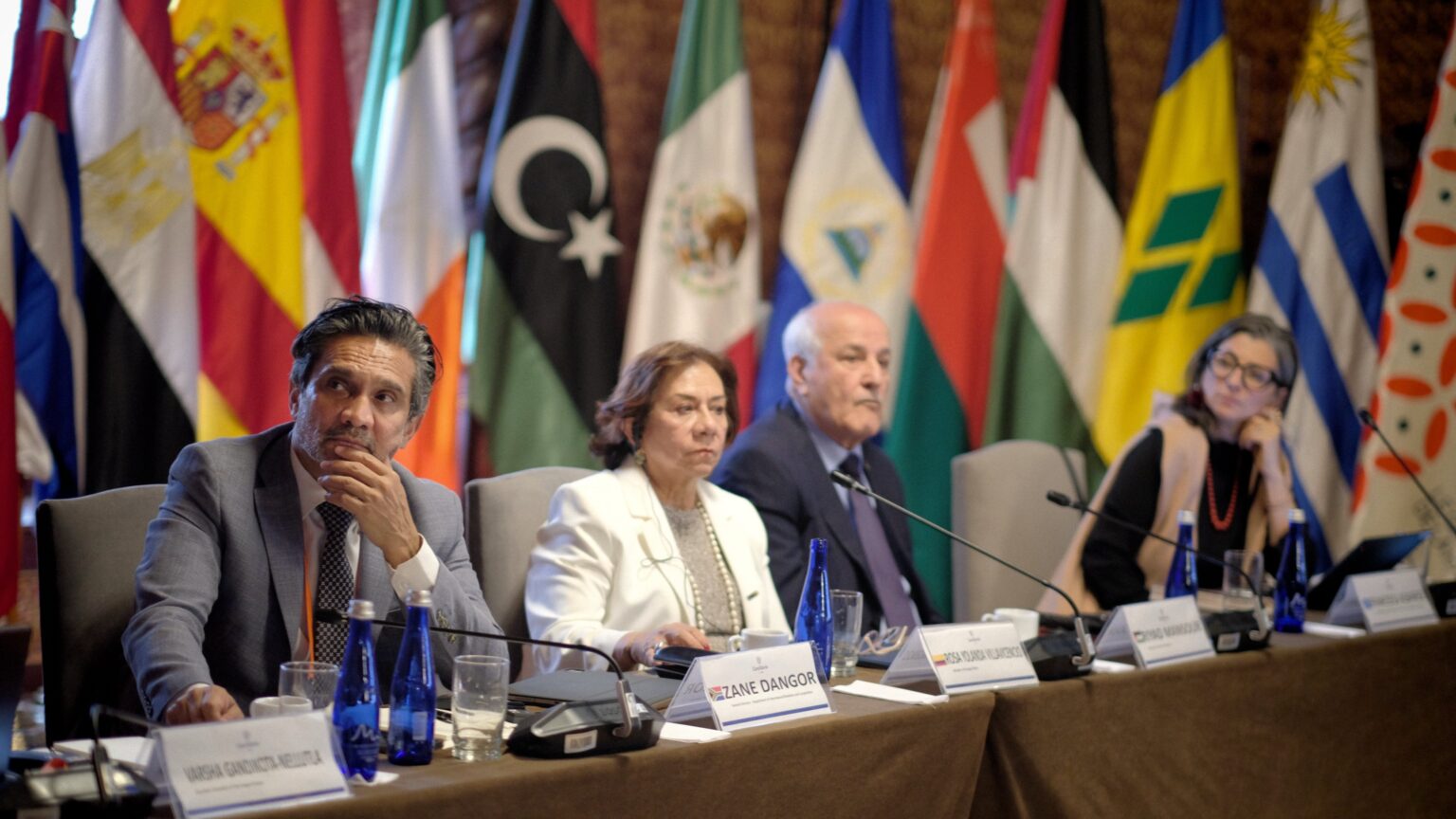
Countries of the Global South have expressed their solidarity with the Palestinian people at the Emergency Ministerial Conference on Palestine organized by The Hague Group, which took place on July 15 and 16 in Bogotá, Colombia. The multilateral meeting was attended by representatives from Algeria, Bangladesh, Botswana, Brazil, Chile, China, Djibouti, Egypt, Slovenia, Spain, Honduras, Indonesia, Iraq, Ireland, Lebanon, Libya, Malaysia, Mexico, Namibia, Nicaragua, Norway, Oman, Pakistan, Palestine, Qatar, Saint Vincent and the Grenadines, South Africa, Turkey, Uruguay, and Venezuela.
Regarding the meeting, Colombia’s deputy secretary of state, Mauricio Jaramillo, said: “This conference is being convened by the Hague Group, but it is not an exclusive meeting of this group. Given the urgency of what is happening in the occupied territories, especially in Gaza, where today, for example, we have passed the threshold of 58,000 fatalities, we must commit ourselves to action.”
The conference, which was organized by the governments of Colombia and South Africa and attended by 30 countries, agreed that: “The era of impunity must end – and that international law must be enforced without fear or favor through immediate domestic policies and legislation – along with a unified call for an immediate ceasefire.”
According to an official press release, the meeting laid out several measures to stop the genocide in Gaza:
Although 30 countries attended the meeting, only 12 countries committed to immediately complying with the agreements outlined in the final declaration: Bolivia, Cuba, Colombia, Indonesia, Iraq, Libya, Malaysia, Namibia, Nicaragua, Oman, Saint Vincent and the Grenadines, and South Africa. The others expected to join them by September 20, 2025 – the date of the 80th UN General Assembly. The group will also be consulting various other states on an ongoing basis for participation in the measures against Israel.
Colombia’s President Gustavo Petro stated: “We came to Bogotá to make history — and we did … Together, we have begun the work of ending the era of impunity. These measures show that we will no longer allow international law to be treated as optional, or Palestinian life as disposable.”
“What we have achieved here is a collective affirmation that no state is above the law … The Hague Group was born to advance international law in an era of impunity. The measures adopted in Bogotá show that we are serious — and that coordinated state action is possible,” said South African Secretary of State Ronald Lamola.
The final agreement is historic as it is the first multilateral agreement that seeks to influence the Israeli government’s actions in its offensive against Gaza. In this sense, it is the first time that several countries have challenged the apparent immunity of the Israeli state in its actions in Gaza, which could have unpredictable diplomatic repercussions. It could also become the starting point for other countries to demand an end to the violence in Palestine jointly.
Original article by Pablo Meriguet republished from peoples dispatch under a Creative Commons Attribution-ShareAlike 4.0 (CC BY-SA) license.