This work by Middle East Monitor is licensed under a Creative Commons Attribution-NonCommercial-ShareAlike 4.0 International License.
Spain says will ‘never recognize’ unilateral annexation of Gaza, West Bank
Spanish Foreign Minister Jose Manuel Albares attends the meeting of EU Foreign Ministers at the EU Council headquarter in Brussels, Belgium on 19 February, 2024 [Dursun Aydemir/Anadolu Agency]
Spain’s foreign minister said Monday that his country and the European Union will “never recognize” any unilateral annexation of the Gaza Strip or the West Bank, condemning Israel’s military escalation in the territory, Anadolu reports.
“I spoke out immediately, I firmly condemned it: neither we nor the European Union will ever recognize it,” Jose Manuel Albares told Spanish broadcaster RTVE. “We will never recognize this illegal unilateral annexation of Gaza or the West Bank, where illegal settlements are advancing.”
Albares stressed that what the Middle East needs right now is the security of the Palestinian people, and the security of the people of Israel.
“This escalation in Israel’s military occupation of Gaza will only bring more death, more suffering, further impede the release of the hostages, and destabilize the Middle East,” he warned.
He urged for “a permanent ceasefire, an end to this blockade that Israel is imposing on Gaza, this induced famine, a massive influx of humanitarian aid, the immediate release of all the hostages, and a definitive peace, which is the same as establishing a two-state solution.”
Israel is already facing mounting condemnation for its genocidal war on Gaza, where it has killed more than 61,000 Palestinians since October 2023. The military campaign has devastated the enclave and led to deaths by starvation.
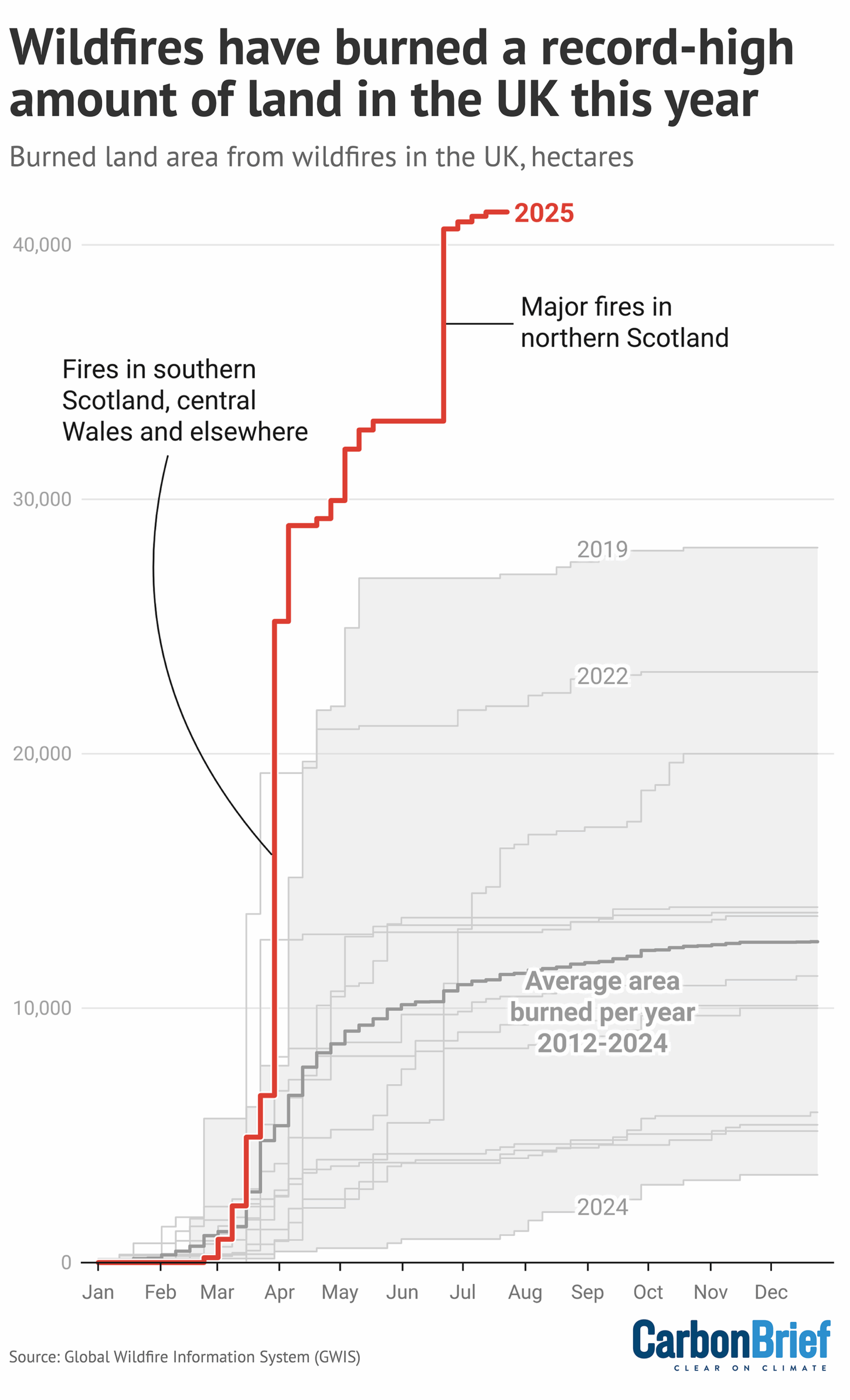
Wildfires have scorched more than 40,000 hectares of land so far this year across the UK – an area more than twice the size of the Scottish city of Glasgow.
This is already a record amount of land burned in a single year, far exceeding the previous high, Global Wildfire Information System (GWIS) data shows.
It is also almost four times the average area burned in wildfires by this stage of the year over 2012-24 – and 50% higher than the previous record amount burned by this time in 2019.
The burned area overtook the previous annual record in April, BBC News reported at the time, and has continued to soar in the months since.
Major wildfires
The chart below shows that UK wildfires in 2025 so far have already burned by far the largest area of land over any calendar year since GWIS records began in 2012. The previous record year was 2019, followed by 2022, while 2024 saw the lowest area size burned.
Annual land area burned by wildfires across the UK from 2012 to 2025 (red), alongside the average area burned each year over 2012-24. Source: Global Wildfire Information System.
Climate change can increase the risk and impact of wildfires. Warmer temperatures and drought can leave land parched and dry out vegetation, which helps fires spread more rapidly. Climate change is making these types of extreme conditions more likely to occur, as well as more severe.
Fire services in England and Wales responded to 564 wildfires from January to June 2025 – an increase from 69 fires in the same period last year, the National Fire Chiefs Council (NFCC) said in a statement in June.
Most wildfires in the UK are caused by human activity, whether accidental or deliberate, according to the NFCC. Some common ignition sources are disposable barbecues, lit cigarettes and campfires.
Jessica Richter, a research analyst at Global Forest Watch, says that, while fires are also a key part of some ecosystems, climate change is the “major driver behind the increasing fire activity around the globe”. She tells Carbon Brief:
“As we see more fires, we’re going to see more carbon being emitted and that’s just going to be, for lack of a better phrasing, adding fuel to the fire.”
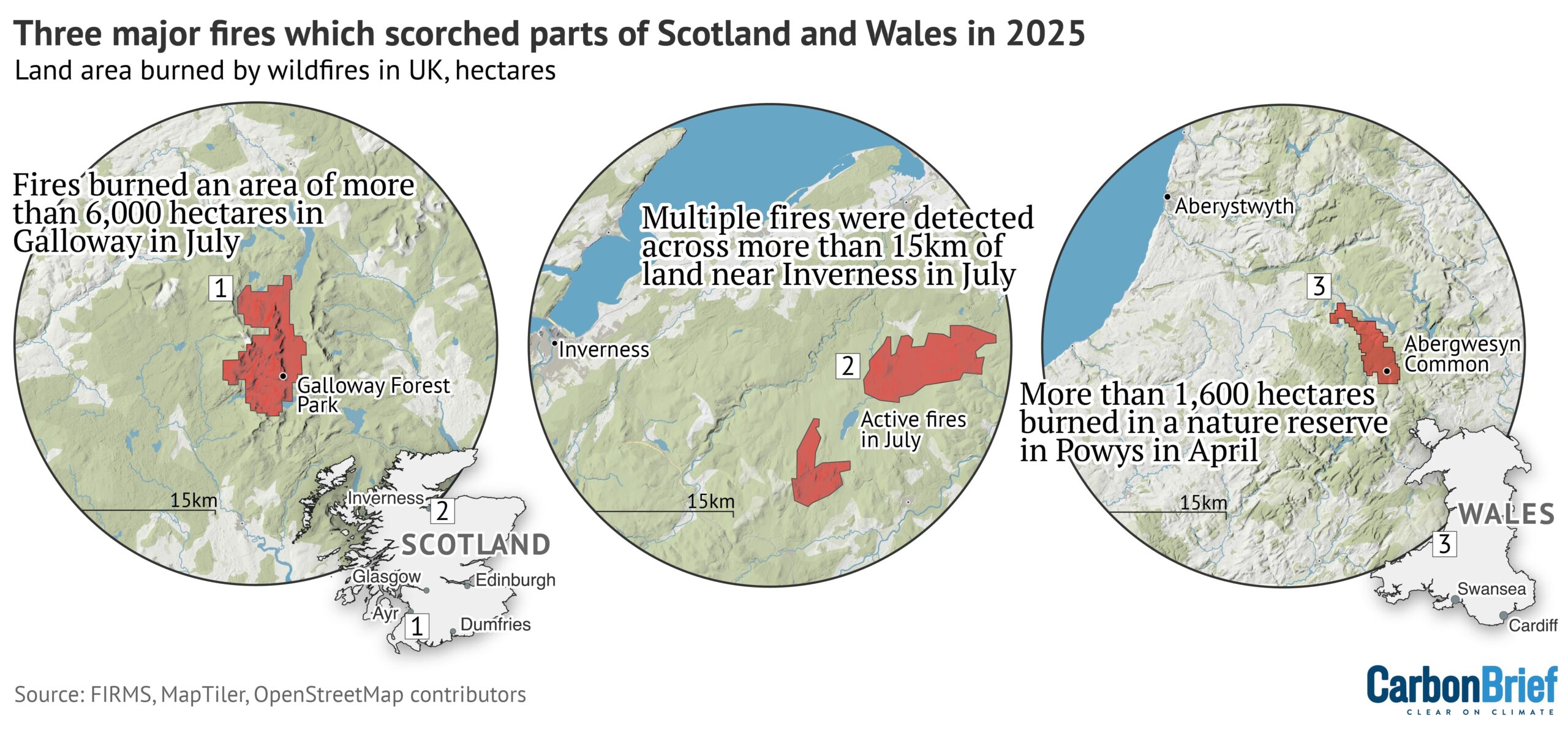
Examples of 2025 wildfires around Galloway (1) and Inverness (2) in Scotland, and a wildfire in Powys (3) in Wales. Source: FIRMS, MapTiler, OpenStreetMap contributors.
The UK has also recorded its highest-ever wildfire emissions this year, according to Copernicus, which was “primarily driven” by major wildfires in Scotland from late June to early July.
These were the largest wildfires ever recorded in the country, reported the Scotsman. They “ravaged” land in Moray and the Highlands in the north of the country, the newspaper added.
Scotland experienced an extreme wildfire in Galloway Forest Park in April, which was “so intense it could be seen from space”, the Financial Times said.
Elsewhere, in April, the Belfast News Letter reported that firefighters tackled almost 150 fires on the Mourne Mountains in Northern Ireland.
More recently, BBC News reported that firefighters in Dorset, England received “non-stop” wildfire calls in the first weekend of August, with one blaze “engulf[ing] an area the size of 30 football pitches”.
Wildfires have also caused devastation across many parts of Europe in recent weeks – including Albania, Cyprus, France, Greece, Spain and Turkey – as well as in the US and Canada.
Words by Orla Dwyer. Analysis by Ho Woo Nam. Charts by Tom Prater.
Nigel Farage urges you to ignore facts and reality and be a climate science denier like him. He says that Reform UK has received millions and millions from the fossil fuel industry to promote climate denial and destroy the planet.Donald Trump urges you to be a Climate Science denier like him. He says that he makes millions and millions for destroying the planet, Burn, Baby, Burn and Flood, Baby, Flood.
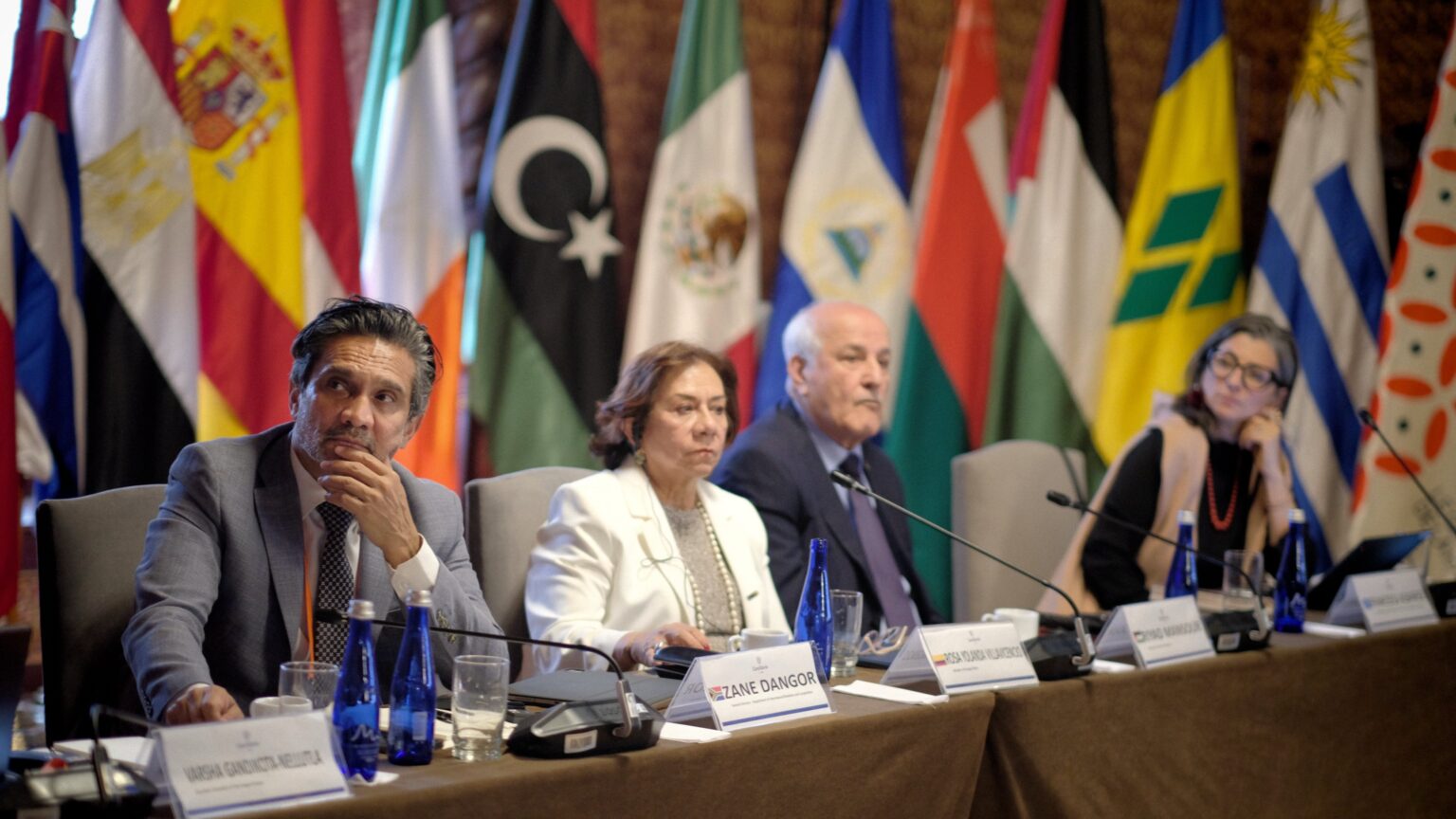
Hague Group Summit in Bogotá, Colombia. Photo: Abby Martin
In the final document, the signatory countries commit, among other things, to cease arms trade with Israel, review public contracts with that country, and seek accountability for war crimes.
Countries of the Global South have expressed their solidarity with the Palestinian people at the Emergency Ministerial Conference on Palestine organized by The Hague Group, which took place on July 15 and 16 in Bogotá, Colombia. The multilateral meeting was attended by representatives from Algeria, Bangladesh, Botswana, Brazil, Chile, China, Djibouti, Egypt, Slovenia, Spain, Honduras, Indonesia, Iraq, Ireland, Lebanon, Libya, Malaysia, Mexico, Namibia, Nicaragua, Norway, Oman, Pakistan, Palestine, Qatar, Saint Vincent and the Grenadines, South Africa, Turkey, Uruguay, and Venezuela.
Regarding the meeting, Colombia’s deputy secretary of state, Mauricio Jaramillo, said: “This conference is being convened by the Hague Group, but it is not an exclusive meeting of this group. Given the urgency of what is happening in the occupied territories, especially in Gaza, where today, for example, we have passed the threshold of 58,000 fatalities, we must commit ourselves to action.”
The conference, which was organized by the governments of Colombia and South Africa and attended by 30 countries, agreed that: “The era of impunity must end – and that international law must be enforced without fear or favor through immediate domestic policies and legislation – along with a unified call for an immediate ceasefire.”
The agreements
According to an official press release, the meeting laid out several measures to stop the genocide in Gaza:
Prevent the provision or transfer of arms, munitions, military fuel, related military equipment, and dual-use items to Israel.
Prevent the transit, docking, and servicing of vessels at any port … in all cases where there is a clear risk of the vessel being used to carry arms, munitions, military fuel, related military equipment, and dual-use items to Israel.
Prevent the carriage of arms, munitions, military fuel, related military equipment, and dual-use items to Israel on vessels bearing our flag … and ensure full accountability, including de-flagging, for non-compliance with this prohibition.
Commence an urgent review of all public contracts to prevent public institutions and funds from supporting Israel’s illegal occupation of the Palestinian Territory and entrenching its unlawful presence.
Comply with obligations to ensure accountability for the most serious crimes under international law, through robust, impartial, and independent investigations and prosecutions at national or international levels, to ensure justice for all victims and the prevention of future crimes.
Support universal jurisdiction mandates, as and where applicable in national legal frameworks and judiciaries, to ensure justice for victims of international crimes committed in the Occupied Palestinian Territory.
Although 30 countries attended the meeting, only 12 countries committed to immediately complying with the agreements outlined in the final declaration: Bolivia, Cuba, Colombia, Indonesia, Iraq, Libya, Malaysia, Namibia, Nicaragua, Oman, Saint Vincent and the Grenadines, and South Africa. The others expected to join them by September 20, 2025 – the date of the 80th UN General Assembly. The group will also be consulting various other states on an ongoing basis for participation in the measures against Israel.
Colombia’s President Gustavo Petro stated: “We came to Bogotá to make history — and we did … Together, we have begun the work of ending the era of impunity. These measures show that we will no longer allow international law to be treated as optional, or Palestinian life as disposable.”
“What we have achieved here is a collective affirmation that no state is above the law … The Hague Group was born to advance international law in an era of impunity. The measures adopted in Bogotá show that we are serious — and that coordinated state action is possible,” said South African Secretary of State Ronald Lamola.
The final agreement is historic as it is the first multilateral agreement that seeks to influence the Israeli government’s actions in its offensive against Gaza. In this sense, it is the first time that several countries have challenged the apparent immunity of the Israeli state in its actions in Gaza, which could have unpredictable diplomatic repercussions. It could also become the starting point for other countries to demand an end to the violence in Palestine jointly.
This work by Middle East Monitor is licensed under a Creative Commons Attribution-NonCommercial-ShareAlike 4.0 International License.
France’s President Emmanuel Macron delivers a speech in front of humanitarian aid destined to Gaza, at the Egyptian Red Crescent warehouse in Egypt’s northeastern city of Arish in the north of the Sinai peninsula, about 55 kilometres west of the border with the Gaza Strip, on 8 April 2025. [LUDOVIC MARIN/POOL/AFP via Getty Images]
Plans by the UK and France to recognise a Palestinian state at an upcoming international peace conference in New York this month have been shelved, marking yet another U-turn just weeks after both governments signalled support for Palestinian self-determination in response to Israel’s genocide in Gaza and ongoing ethnic cleansing in the occupied West Bank.
The three-day conference, scheduled between 17-20 June and co-sponsored by France and Saudi Arabia, was initially framed as a diplomatic breakthrough that could see major Western powers recognise Palestinian statehood as a matter of principle. However, diplomats have now confirmed to the Guardian that the event will instead focus on vague “steps towards recognition.”
The reversal comes despite recent pledges by both London and Paris to re-evaluate their approach in light of Israel’s devastating military campaign in Gaza, which has killed over 55,000 Palestinians, most of them women and children, and the aggressive settlement expansion in the illegally occupied West Bank. Israeli officials have recently approved 22 new settlements, in what Defence Minister Yoav Gallant described as “a strategic move that prevents the establishment of a Palestinian state.”
French President Emmanuel Macron had previously declared Palestinian statehood a “moral duty and political requirement,” but according to officials who briefed Israeli counterparts this week, recognition will no longer be announced at the conference. Instead, it is being repositioned as a distant outcome contingent on a series of conditions, including a permanent ceasefire in Gaza, the release of Israeli captives, and the restructuring of the Palestinian Authority to exclude Hamas.
The UK government, which has faced increasing pressure from MPs to take stronger measures against Israel, has taken a similar position.
According to the Guardian, British and French officials now view recognition not as a moral position or legal obligation, but as a reward contingent on the compliance of Palestinians with a framework shaped largely by Israel’s priorities. The Israeli public, however, has largely abandoned the idea of a two-state solution. According to figures cited by the Guardian, just 20 per cent of Israelis support the creation of a Palestinian state, while a staggering 56 per cent of Jewish Israelis back the “transfer” of Palestinian citizens of Israel to other countries, an explicit endorsement of ethnic cleansing.
Meanwhile, public support for Palestinian statehood continues to grow across Europe. Ireland, Spain and Norway formally recognised Palestine last year, and several Conservative MPs in Britain, including former Attorney General Sir Jeremy Wright, have broken ranks to endorse recognition.
Saudi Arabia, the conference’s co-host, has repeatedly accused Israel of committing genocide in Gaza, and there appears little prospect of Riyadh normalising relations with Tel Aviv. Analysts note that France’s vision of mutual recognition, Western states recognising Palestine in exchange for Arab normalisation with Israel, is rapidly collapsing in the face of Israeli escalation and public outrage across the Arab world.
Palestinians and their supporters are likely to view this latest shift as yet another instance of Western duplicity, offering rhetorical support while continuing to shield Israel from accountability. The Elders, a group of former global statesmen, urged Macron in an open letter to treat recognition as a “transformative step toward peace,” and not to view the self-determination of Palestinians as a chip to be negotiated with Israel.
This work by Middle East Monitor is licensed under a Creative Commons Attribution-NonCommercial-ShareAlike 4.0 International License.
Spanish Foreign Minister Jose Manuel Albares speaks to press ahead of the international meeting to discuss ending the war between Israel and Hamas, and advancing toward a two-state solution, in Madrid, Spain on May 25, 2025. [Şenhan Bolelli – Anadolu Agency]
Spain’s foreign minister insisted Sunday that the two-state solution is the only alternative to conflict between Israel and Palestine and is pushing for concrete measures to advance it at an international meeting in Madrid, Anadolu reports.
“What’s the alternative? Kill all the Palestinians? Send them, I don’t know where—to the moon?” Jose Manuel Albares said in a speech ahead of the meeting.
Madrid is hosting a group of 20 countries—foreign representatives from European nations, Muslim countries, and Brazil—as well as international organizations to discuss ending the war, Israel’s siege on Gaza, and advancing toward a two-state solution.
“Gaza is an open wound for humanity… There are no words to describe what is happening in Gaza—but just because there are no words doesn’t mean we will remain silent,” said Albares.
The number of countries in the so-called Madrid Plus Group has doubled, said Albares, with countries like Germany, Italy, France, and Portugal, which did not attend the first meeting, showing up on Sunday.
“There’s a lot of diplomatic muscle here today,” said Albares. “We are different governments coming together, but we all believe in the same principles and are not resigned to accepting violence as the natural way for Israelis and Palestinians to relate.”
He said that “time is running out” for a two-state solution, but the Madrid meeting aims to clarify “concrete steps” to turn the situation around for the sake of both Palestinians and Israelis.
Albares said Spain will push for measures to end the war, including suspending the EU-Israel trade agreement, an EU-wide arms embargo on Israel, sanctioning more individuals linked to the conflict, and “making the two-state solution impossible.”
Spain will propose that the upcoming UN meeting on June 16 be used as a “great movement for the recognition of a Palestinian state,” he added.
“Then, around a year later, we can hold another international meeting with Palestine as a full state with complete rights within the UN,” he said.
This work by Middle East Monitor is licensed under a Creative Commons Attribution-NonCommercial-ShareAlike 4.0 International License.
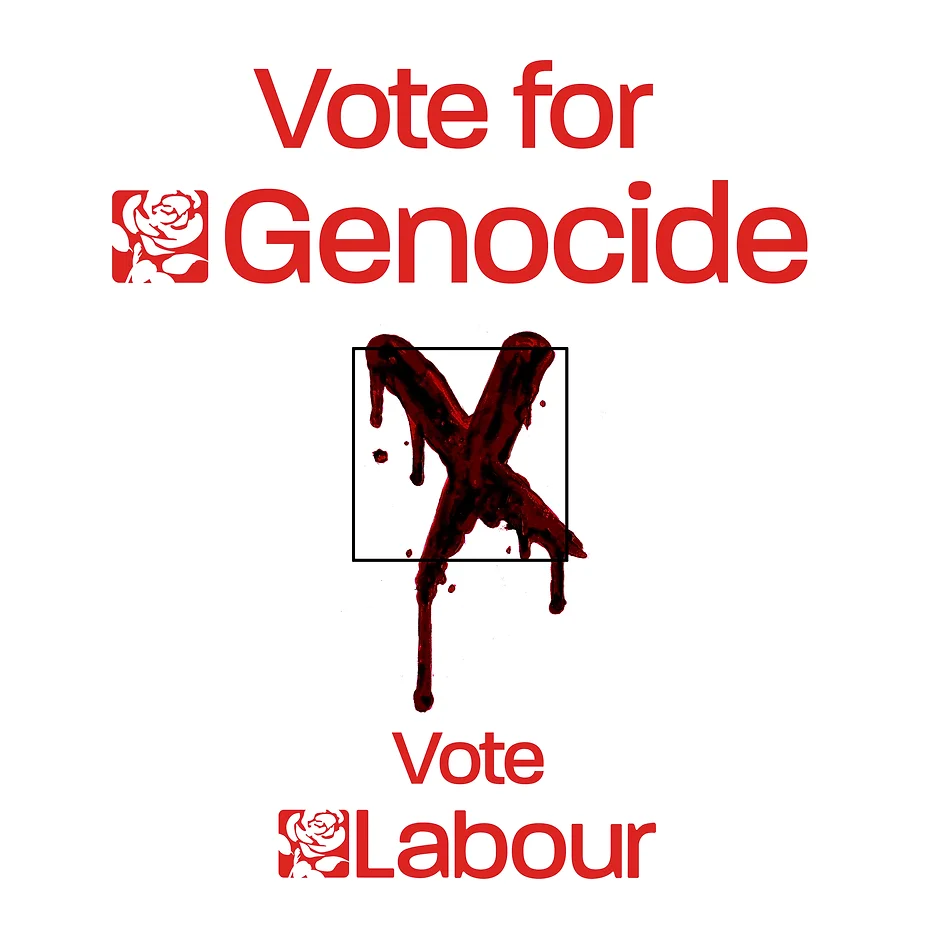
UK Labour Party government ministers Keir Starmer, Angela Rayner and Rachel Reeves explain that they are partners complicit in Israel’s Gaza genocide. The UK has provided Israel with arms, military and air force support. They explain that they don’t do gas chambers but do do forced marches, starvation, destroy hospitals, mass-murders of journalists and healthcare workers.Vote For Genocide Vote Labour.UK Foreign Minister David Lammy confirms that UK government and military are active participants in Israel’s genocides and that the F-35 parts that they suspended from supplying to Israel are instead simply diverted via the United States. He says see https://youtu.be/QILgUHrdWRE
![Spanish Foreign Minister Jose Manuel Albares attends the meeting of EU Foreign Ministers at the EU Council headquarter in Brussels, Belgium on 19 February, 2024 [Dursun Aydemir/Anadolu Agency]](https://i0.wp.com/www.middleeastmonitor.com/wp-content/uploads/2024/02/AA-20240219-33749880-33749846-EU_FOREIGN_MINISTERS_MEETING-scaled-e1708426205524.jpg?fit=920%2C613&ssl=1)