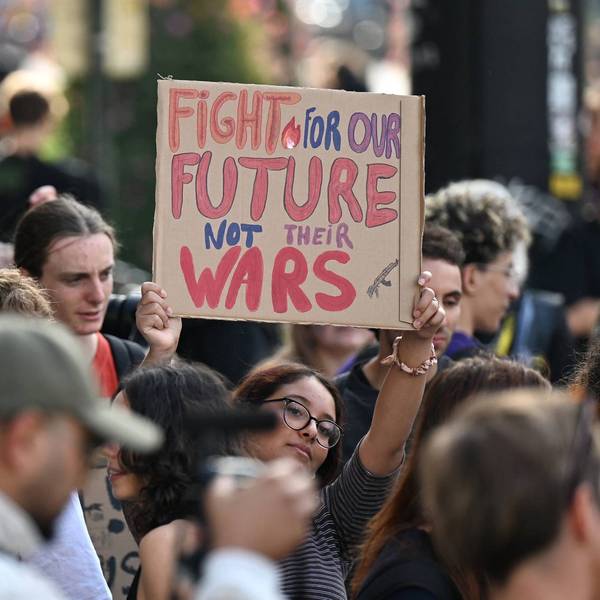
Tens of thousands joined strike rallies on Wednesday, November 25. Source: PAME/Flickr
Tens of thousands of workers took to the streets across Greece in a general strike, protesting further austerity measures and military expenditure.
A nationwide general strike in Greece drew tens of thousands onto the streets of approximately 80 towns and cities on Wednesday, November 25. Workers from both the public and private sectors protested against further austerity and war spending.
“We refuse to pay with our lives and incomes for involvement in war and the profits of business groups,” the All-Workers Militant Front (PAME) stated when announcing the strike.
The strike call had already been launched during the dockworkers’ international day of action against the militarization of ports at the end of October. It is expected to ripple outward in the coming weeks, including during a new national mobilization on December 15.
“Today’s strike shows that the policy that is crushing our lives, that brings yet another budget of profits and war, has an adversary: the organized labor movement, the collective action of workers, of struggling farmers, of the self-employed and of the youth,” PAME wrote.
The union emphasized broad participation across sectors, from construction to public transport and administration. “Through persistent organizing in the workplaces, in the face of employer intimidation, blackmail and threats, the hundreds of strike decisions taken ‘from below,’ many by unions that have taken such a decision for the first time, show that ‘the new’ and hopeful in our lives will be born out of exactly this kind of action, multiplying the sites of struggle and demand.”
Workers across sectors participated in the November 25 strike. Source: PAME/Flickr
The strike in Greece comes as unions across Europe continue taking action against cuts to social security made in the name of militarization. Over the past weeks, mass demonstrations and industrial actions have taken place in Italy, Spain, France, and Belgium, all demanding more investment in social protection and labor rights.
“In Greece, as in Italy, inadequate wages, the rising cost of living, job insecurity and deteriorating working conditions are affecting millions of people, whilst enormous resources are being channelled into rearmament and military spending,” the Italian grassroots union Unione Sindacale di Base (USB) wrote in a statement of solidarity with PAME.
“War is not a prospect for the future of the people,” echoed the Trade Union Association of Bohemia, Moravia, Silesia from the Czech Republic. “It is death, destruction, poverty, and new opportunities for profit for the arms industry, while the working class always pays the price.”
Orcas discuss Donald Trump and the killer apes’ concept of democracy. Front Orca warns that Trump is crashing his country’s economy and that everything he does he does for the fantastically wealthy.Orcas discuss Genocide-supporting and complicit Zionists. Donald Trump, Keith Starmer, David Lammy, Rachel Reeves, Angela Rayner and Wes Streeting are acknowledged as evil genocide-complicit and supporting cnuts.
Reporting for Double Down News, journalist and musician Lowkey examines the international legal battle surrounding American philanthropist and human rights advocate Fergie Chambers, who was granted conditional bail by Spain’s National Court in Madrid following U.S. extradition proceedings and an urgent asylum application.
Drawing on public court records and international legal commentary, Lowkey reviews:
Chambers’ humanitarian relief funding and philanthropic initiatives
Constitutional and First Amendment legal arguments surrounding a 2023 demonstration in New Hampshire
Evidentiary and translation discrepancies acknowledged by U.S. officials, alongside property-transfer breaches under the 1970 U.S.–Spain Extradition Treaty
Warnings from the UN Special Rapporteur on Human Rights Defenders ahead of a final ruling by Prime Minister Pedro Sánchez’s government
People around the world have contended with unprecedented weather events and their fatal effects caused by the climate catastrophe
After the world’s hottest summer since records began in 1850, the death toll from extreme weather in 2026 is already in the high tens of thousands. That is a conservative estimate and is certain to rise much higher.
As Cop31 continues [now ended] and scientists warn that climate breakdown may be accelerating, the Guardian looks back at a year of droughts, fires and floods as a reminder that, unless the world takes urgent action to cut emissions, this disastrous year will be one of the best of the rest of our lives.
…
July Joint-hottest July on record
Europe hit by wildfires and severe drought – video
Fires choke Canada and Europe
Almost 1,000 wildfires sweep across Canada, charring 3m hectares (7.4m acres) and sending a haze of smoke as far as New York. On 15 July Toronto registers the world’s worst air quality as a result of the haze. Smoke kills 4,000 people in Canada each year, almost four times as many as at the start of the century. Meanwhile, in Europe, prolonged droughts create tinderbox conditions for wildfires in Greece, Portugal, Italy, Norway, Germany, Spain and France. They burn 686,000 hectares in Europe, twice the average of the past 20 years.
Extreme weather disrupts US 250th birthday festivities and theWorldCup
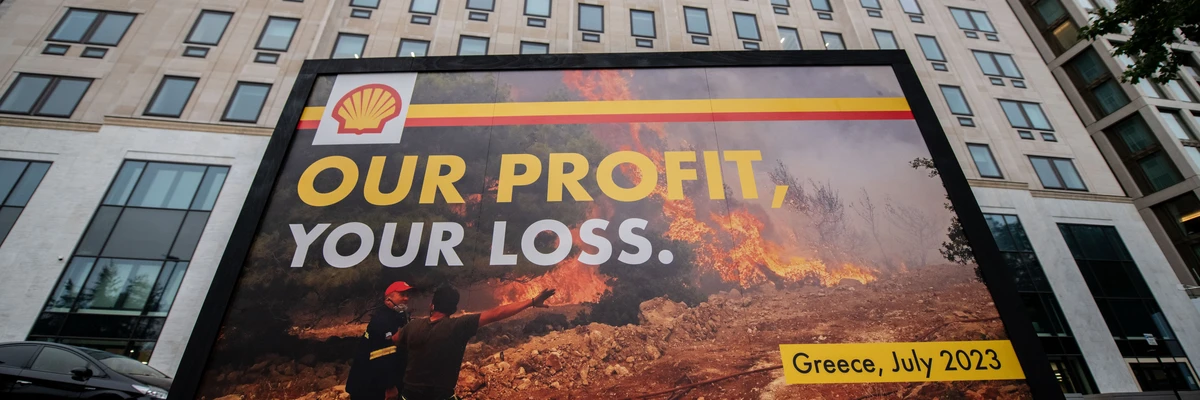
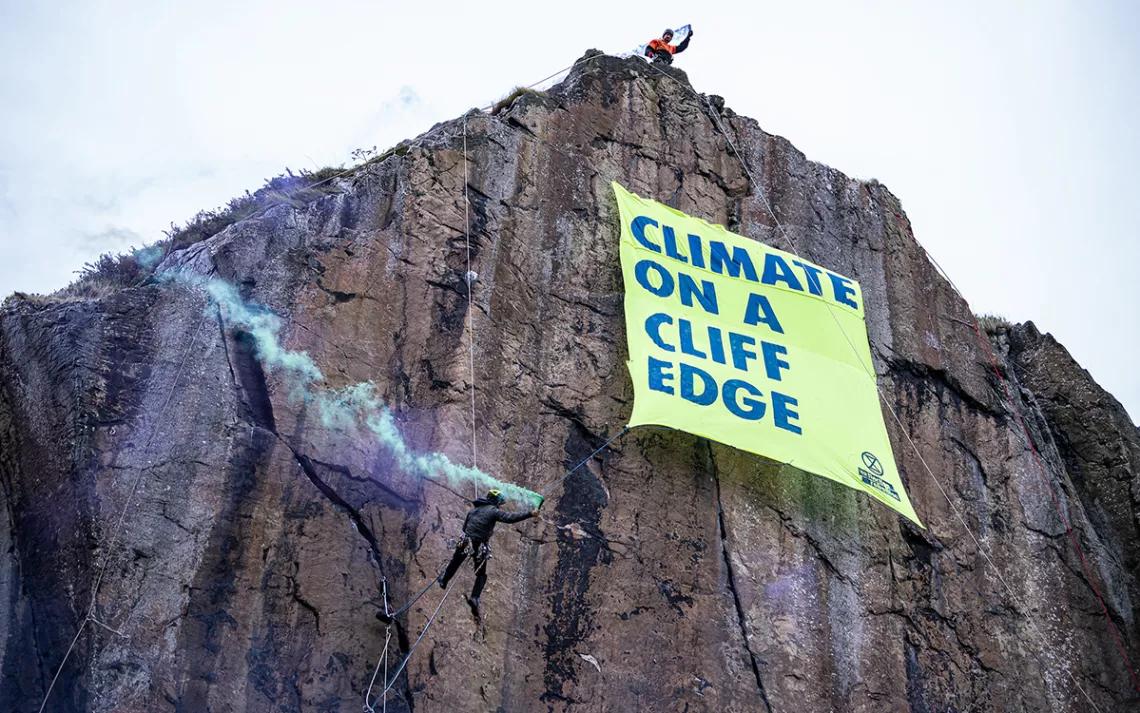
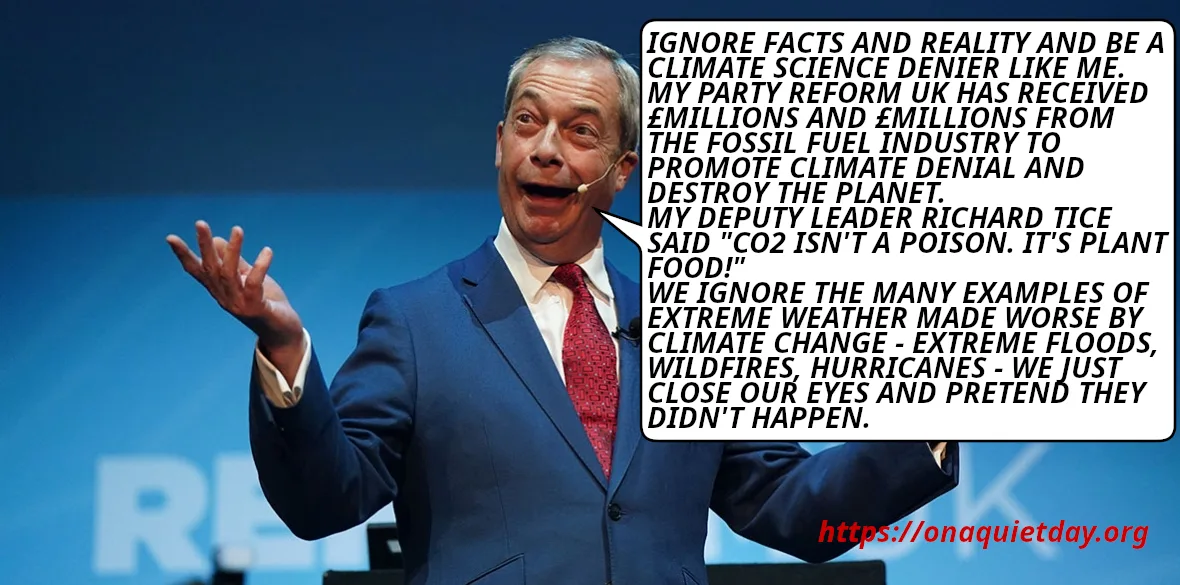
Greenpeace activists display a billboard during a protest outside Shell headquarters on July 27, 2023 in London. (Photo: Handout/Chris J. Ratcliffe for Greenpeace via Getty Images)Experienced climbers scale a rock face near the historic Dumbarton castle in Glasgow, releasing a banner that reads “Climate on a Cliff Edge.” One activist, dressed as a globe, symbolically looms near the edge, while another plays the bagpipes on the shores below. | Photo courtesy of Extinction Rebellion and Mark RichardsNigel Farage urges you to ignore facts and reality and be a climate science denier like him and his Deputy Richard Tice. He says that Reform UK has received £Millions and £Millions from the fossil fuel industry to promote climate denial and destroy the planet.
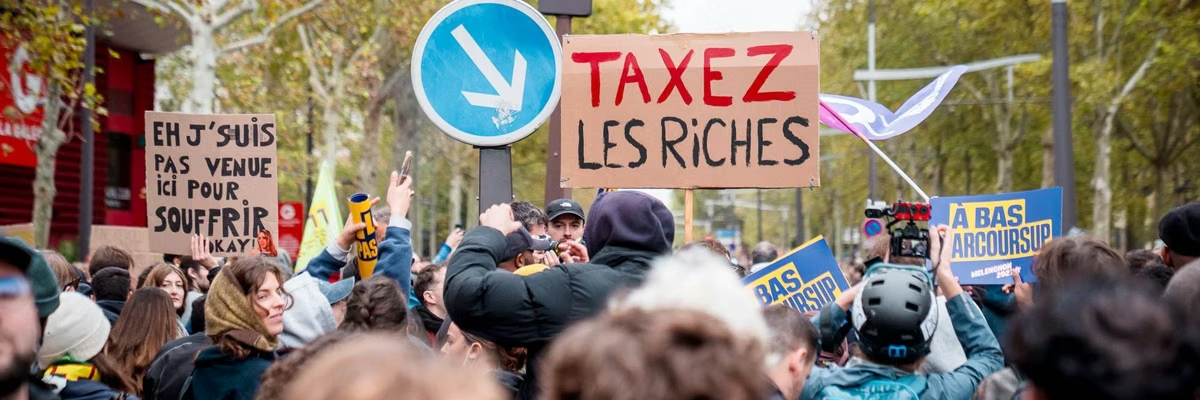
People march in Paris for education reform and against inequality on October 24, 2026. (Photo by Jean-Luc Mélenchon /X)
“Looking at countries like the United States, we don’t want to end up like them, where part of the population has everything and the others have nothing,” one French protester said.
Hundreds of thousands of people took to the streets across Europe on Saturday as anger continues to build over the rising cost of living and deteriorating social services.
While demonstrators emphasized different demands in different countries, the protest wave reflects a sense that the status quo has ceased to work for ordinary people, especially the young.
“I see so many more similarities than differences,” Alice de Brito, the vice president of French student union UNEF, told CNN of the protests. “We are all talking about the need for investments in education, in the universities, in youth in general. But we are also talking about the cost of living, about housing.”
France
Across France, between 410,000 and 800,000 people turned out in the continuation of protests that erupted in September when students began to mobilize against underfunding, teacher shortages, and other poor conditions in their schools. Adult workers have joined with the students, criticizing widespread inequality and the rising cost of living, leading to mass demonstrations on October 17 and again a week later.
“Looking at countries like the United States, we don’t want to end up like them, where part of the population has everything and the others have nothing,” Paris protester Louis Ledoux–Xatard told The Associated Press.
“Too many billionaires; we are preparing the revolution,” one group of protesters chanted, according to Al Jazeera.
There were 289 protests in France, including in Marseilles, Nantes, Nice, Lyon, Bordeaux, and Orleans. Interior Minister Laurent Nunez said that almost 1,000 people were arrested, though the number was expected to grow. Two people sustained significant injuries.
“Behind every police officer, a compliant camera.”
The protest in Paris had originally been scheduled to run through the center of the city, but authorities relocated it to outskirts and banned marches organized by groups other than unions.
“It won’t stop the movement. It won’t stop students from demanding better conditions in schools,” nurse Soumaya Abed told AP of the changes.
Jean-Luc Mélenchon, who leads the left-wing France Unbowed party, criticized the government of President Emmanuel Macron for changing the route, but also praised the marchers for carrying on.
“Total victory for the social movement,” Mélenchon wrote on social media. “The march gathered at the new authorized point and is now flowing calmly over more than four kilometers. The provocations for disorder by the Paris police prefect and [French Prime Minister Sébastien] Lecornu are a total failure. For the authorities, it is time to give in, or soon they will have only the exit door left.”
Victoire totale du mouvement social. La marche s'est rassemblée au nouveau point autorisé et déferle dans le calme sur plus de quatre kilomètres. Les provocations aux désordres du préfet de police et de Lecornu sont un échec total. Pour les autorités, il est temps de céder, sinon… pic.twitter.com/S3d6k2DWf3
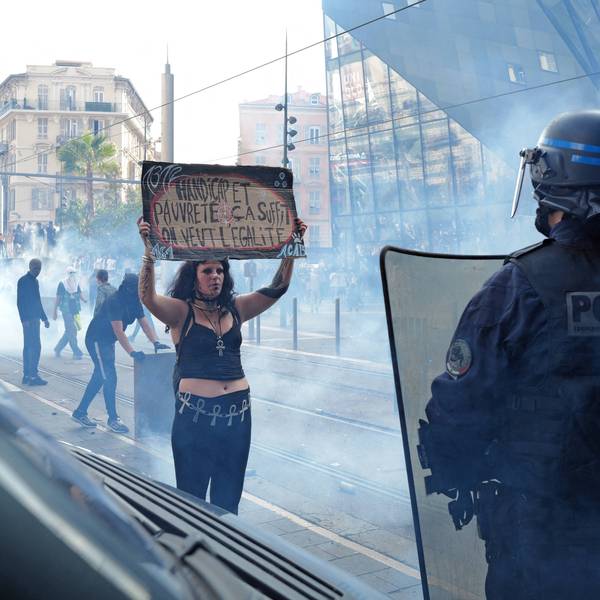
Media reported that the Parisian demonstration was largely peaceful until the end, when police released tear gas and fired water cannons and some black-clad protesters threw projectiles.
Reporters with Agence France-Presse said they saw:
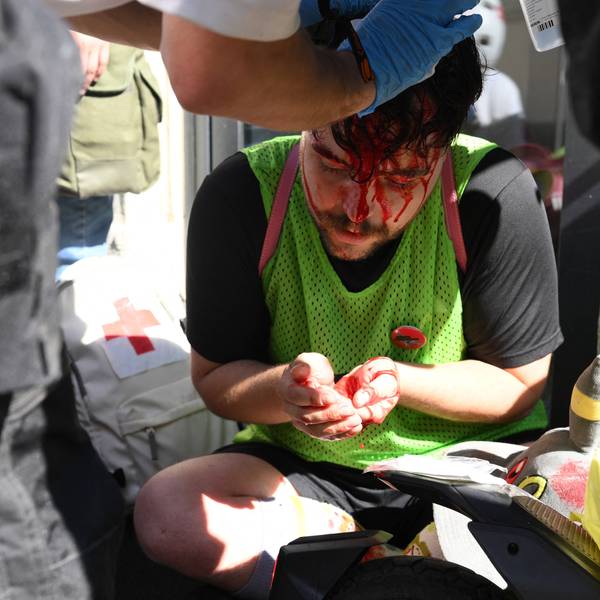
police charge several times and vigorously use tear gas and batons against some, mostly young, protesters. “The police started moving towards everyone, telling them to get down and back off. They were just taking people down, you know, beating protesters,” one demonstrator bleeding from a baton blow to his face, who gave his first name as David, told AFP.
Other witnesses also described a repressive police response to The Guardian:
Mike, a 23-year-old student who also declined to give his surname, said: “Look around, they’re just teenagers. Is it normal for teenagers to be teargassed and beaten with batons?”
For Jessica, a 24-year-old student, said: “I just don’t understand why there’s so much violence. I feel like our right to protest is being trampled on.”
Mélenchon lambasted the police and the media for working together to discredit the movement.
“In Paris, to ruin the day and unwind, the so-called forces of law and order gas and fire into the crowd at the back of the procession, all in a bid to get footage for the domestic news channels that spent the whole week airing the images that spurred the Trappes killer,” he wrote on social media, referring to a racially motivated shooting west of Paris on Friday that killed one and wounded five.
In a second post, he added: “It continues with the policing of minds through the televisions of power. Tonight, staging of the « tails of the procession » to spew hatred against the popular movement. Without a single image of the masses in peaceful action. Behind every police officer, a compliant camera.”
He encouraged readers to “turn off the televisions! Form your own opinion without a guardian. Journey through social networks. Stay free to think for yourselves.”
Belgium
In neighboring Belgium, hundreds of people marched in Brussels in a continuation of demonstrations for improvements in the education system.
“We are here for young people’s future, for better work,” rally speaker Celia Ponce told the crowd, as The Brussels Times reported.
She also accused governments of wanting to “destroy public services.”
Protesters build barricades with bikes and scooters in Brussels, Belgium.
Police used tear gas to disperse some protesters and, in an incident reported by Reuters, kicked and hit one demonstrator after they fell during a chase.
Spain
Approximately 25,000 people marched in Madrid to support Spain’s pension system and demand that it keep pace with inflation and that a gender gap be eliminated, according to Al Jazeera.
“How beautiful Madrid is when it defends its rights,” Emilio Delgado, deputy spokesperson for left party Mas Madrid, wrote on social media. “We propose that no pension should be below the minimum wage. A lifetime of work deserves a dignified retirement.”
The protests come a month ahead of Spain’s general election, in which current Prime Minister Pedro Sanchez’s Spanish Socialist Workers’ Party will face off against the right-wing Popular Party. Popular Party leader Alberto Nunez Feijoo has promised to adjust pensions according to inflation if his party wins, but demonstrators are still concerned about what a right-wing victory would mean for the pension system.
People marched in Lisbon, continuing a movement that began October 10 in the city of Porto calling on the government to address the country’s housing crisis, according to The Resident.
Palco dos protestos promovidos pelo movimento Acampada de Lisboa, o Rossio voltou a acolher "um mar de gente" que reivindica soluções do Governo para a atual crise da habitação.
“We have no home, so we set up tents!” read the slogan of the March, organized by the Acampada de Lisboa movement.
The protesters also opposed new policies from Prime Minister Luis Montenegro that would weaken a limit on annual rent increases and make it easier to evict people who are unable to make rent payments, according to AP.
Italy
Thousands of people joined demonstrations across Italy to protest the affordability crisis as well as the right-wing government of Prime Minister Giorgia Meloni. Protests were called for eight cities including Milan, Turin, and Rome, with 10,000 attending the Milan demonstration alone.
“We are here because of the rising prices and because I believe that our government has no respect for its citizens,” a 17-year-old student participant, who did not give a name, told Al Jazeera. “There are four people in my family. My mother works in a factory, but my father is about to lose his job. It’s hard to make ends meet on just one salary.”
Thousands of protesters took to the streets across Italy to demonstrate against Giorgia Meloni’s right-wing government and the rising cost of living, as hundreds of soldiers were deployed to Milan as protests continue.
The Italian protests were a continuation of demonstrations that have taken place throughout October. There were fewer clashes between police and demonstrators on Saturday compared with earlier marches, though some protesters tried to enter the Colosseum before being pushed back.
Albania
In Albania, outrage over plans by US President Donald Trump’s son-in-law Jared Kushner to build a luxury resort near a protected wildlife area—which is widely seen as an example of government corruption—has dovetailed with demands by students for less corruption in the education system specifically as well as lower tuition fees and more funding.
A demonstration in the capital of Tirana on Saturday marked the 12th day of anti-government protests this month following a summer of mobilizations against the luxury hotel.
Some protesters lit fires and threw projectiles, while police used tear gas, rubber bullets, and water cannons.
Protesters in Albania have fought running battles with police, on a 12th day of anti-government protests.
Police in the capital, Tirana, used water cannon, tear gas and rubber bullets after Prime Minister Edi Rama warned he would take strong action to quell unrest. pic.twitter.com/6oZMYPU7Ei
Students gather at the Gare Centrale in Brussels, Belgium on October 7, 2026, to protest against education reforms and budget cuts. (Photo by Lilli Förter/picture alliance via Getty Images)
Protests across Europe have focused on education cuts, while a Gen Z-led movement has spearheaded demonstrations over voting rights in India.
“We are going to sweep away the old world,” said the deputy of the French National Assembly on Thursday, highlighting a rapidly growing global protest movement, largely led by students and young people, against austerity measures.
Clémence Guetté, a member of the left-wing French party La France Insoumise, or France Unbowed, added that “the youth wants to change everything,” posting on social media a video of a massive demonstration in Paris—just one of several cities across France where students have led more than 250,000 people in protests demanding education funding and decrying cuts in the proposed 2027 national budget.
But Guetté noted that while France’s growing protests—and the violent response of the police—have captured international attention, with thousands of people demanding the resignation of President Emmanuel Macron in Place de la Bastille, Paris on Thursday, the movement against austerity and corrupt governance has spread across Europe and is also gaining traction across Latin America and South Asia.
Les jeunesses du monde entier se lèvent.
En France, en Espagne, au Brésil, en Allemagne, au Chili : partout, les peuples demandent à être respectés et écoutés.
“The youth of the world are rising up,” said Guetté.
The protests against education cuts, dilapidated school buildings, and crowded classrooms in France began in mid-September in lower-income Parisian suburbs before spreading nationwide.
As they have shown no sign of slowing down, thousands of miles away in India, the Generation Z-led Cockroach Janta Party (CJP)—so named because the chief justice of the Supreme Court derided unemployed young people as “cockroaches” this year—has spearheaded calls for the resignation of the country’s top Election Commission official.
The Election Commission has been accused of an illegal purge of voters over its “special intensive revision” of voter rolls, which has included removing more than 130 million names.
The CJP initially took to the streets over the summer to demand the resignation of the Indian education minister, due to leaks of the country’s medical school entrance exam, which had delayed university admissions for millions of students and forced them to retake the intense exams. CJP organizers said the scandal has led to the suicides of more than 20 students.
Those protests were ultimately successful in forcing Education Minister Dharmendra Pradhan out of office.
Thousands of supporters joined a demonstration in Bengaluru on Thursday as the CJP condemned the detention on Wednesday of politician Rahul Gandhi, a leader of the opposition against Prime Minister Narendra Modi, as well as other protesters.
Leaders of the mass protest movement on Thursday rejected allegations that the protests, which have also been met with violence from police, are “destabilizing the country.”
“When you declare living people as dead [on voter rolls] for your political gains, that is destabilizing the country,” said one organizer.
When you declare living people as “Dead” for your political gains, that is destabilising the country. pic.twitter.com/FZTPkKgBJk
— Cockroach Janta Party – CJP (@Cockroachisback) October 8, 2026
As Common Dreams reported Wednesday, Spain residents have also been inspired in recent days to take to the streets by the tens of thousands following the eviction of María del Carmen Abascal Martín, an 87-year-old woman who died this week before she was able to return home, as the demonstrations over housing justice were underway.
After Maricarmen’s eviction on September 23, the Spanish Socialist Workers’ Party, led by Prime Minister Pedro Sánchez, announced new rental regulations and protections for vulnerable tenants, but lawmakers rejected the package. Sánchez responded by dissolving the legislature and calling for snap elections in November.
Meanwhile, tens of thousands of people have marched in Madrid, Valencia, and other cities to demand a general strike and affordable housing across Spain, where the average rent has doubled over the last 10 years.
More than 1,000 people have set up encampments at Puerta del Sol in Madrid and Plaza Catalunya in Barcelona, saying they will not leave until the government takes concrete steps to protect tenants.
🇪🇸 Maricarmen Abascal, the 87-year-old woman whose eviction sparked housing protests in #Spain, has died, Madrid's tenants' union said on Wednesday.
Abascal became a symbol of Spain's housing market on September 23 when she was evicted from her life-long Madrid home on a… pic.twitter.com/jfYIPn4vDK
In Chile, student unionsled protests last week against proposed education cuts in the country’s 2027 budget, put forward by conservative President Jose Antonio Kast. Chilean national police blocked people from marching through Santiago last Thursday toward La Moneda presidential palace, with officers firing water cannons and tear gas at the crowd.
According to the undersecretary of the interior, at least 17 people were arrested, and Kast condemned the protests.
One commentator on the social media platform X called on the public to connect “the dots on these Gen Z protests.”
Across the globe, they said, “young people can’t get hired. Can’t afford rent. Can’t afford a house. Can’t see a future.”
“The streets are the only place left,” they added. “This is going global.”
Another recent entry into the international protest movement came last week in Belgium, where students in Liège were reportedly directly inspired by the France protests to speak out against rising education costs and overcrowding in schools.
The city’s main train station was temporarily closed on Thursday and traffic was disrupted, and more than 100 protesters were arrested.
“We support each other because we’re facing pretty much the same issues,” Alfred, a 19-year-old student, told Reuters of the connection between the Belgian and French unrest.
Students in Italy, Ireland, and Germany have also called for protests over soaring university costs and government disinvestment in education, particularly as worldwide energy costs have gone up due to the US-Israeli war on Iran.
In Rome and Turin, high school students began occupying their schools on Monday under the slogan, “Let’s do as in France.”