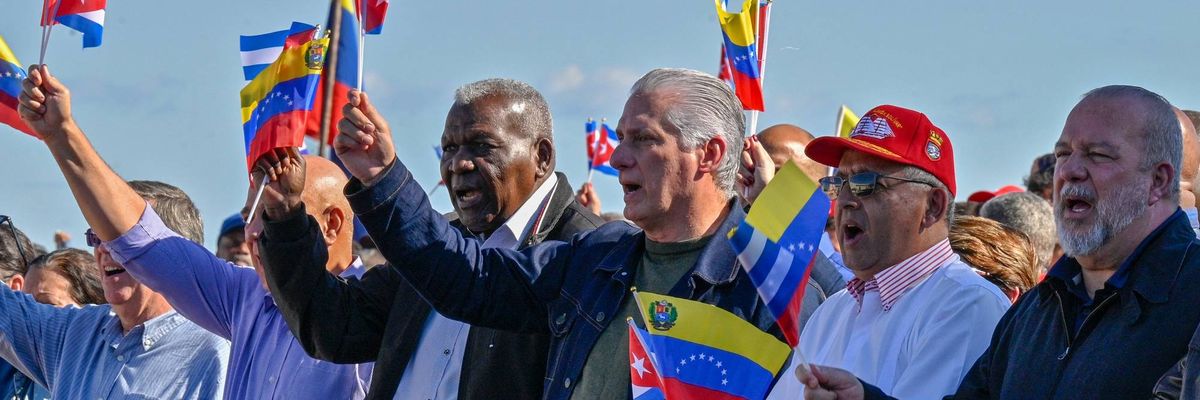
Cuban President Miguel Diaz-Canel waves a Venezuelan national flag in Havana on January 3, 2026. (Photo by Adalberto Roque/AFP via Getty Images)
“The ‘Trump corollary’ to the Monroe Doctrine—applied in recent hours with violent force over the skies of Caracas—is the single greatest threat to peace and prosperity that the Americas confront today,” said Progressive International.
US President Donald Trump and top administration officials, including Secretary of State Marco Rubio, characterized Saturday’s assault on Venezuela and abduction of the country’s president as a warning shot in the direction of Cuba, Mexico, Colombia, and other Latin American nations.
During a Saturday press conference, Trump openly invoked the Monroe Doctrine—an assertion of US dominance of the Western Hemisphere—and said his campaign of aggression against Venezuela represented the “Donroe Doctrine” in action.
In his unwieldy remarks, Trump called out Colombian President Gustavo Petro by name, accusing him without evidence of “making cocaine and sending it to the United States.”
“So he does have to watch his ass,” the US president said of Petro, who condemned the Trump administration’s Saturday attack on Venezuela as “aggression against the sovereignty of Venezuela and Latin America.”
Petro responded defiantly to the possibility of the US targeting him, writing on social media that he is “not worried at all.”
In a Fox News appearance earlier Saturday, Trump also took aim at the United States’ southern neighbor, declaring ominously that “something’s going to have to be done with Mexico,” which also denounced the attack on Venezuela and abduction of President Nicolás Maduro.
“She is very frightened of the cartels,” Trump said of Mexican President Claudia Sheinbaum. “So we have to do something.”
“This armed attack on Venezuela is not an isolated event. It is the next step in the United States’ campaign of regime change that stretches from Caracas to Havana.”
Rubio, for his part, focused on Cuba—a country whose government he has long sought to topple.
“If I lived in Havana and I was in the government, I’d be concerned, at least a little bit,” Rubio, who was born in Miami to Cuban immigrant parents, said during Saturday’s press conference.
“It is the next step in the United States’ campaign of regime change that stretches from Caracas to Havana—and an attack on the very principle of sovereign equality and the prospects for the Zone of Peace once established by the Community of Latin American and Caribbean States,” the coalition said in a statement. “This renewed declaration of impunity from Washington is a threat to all nations around the world.”
“Trump has clearly articulated the imperial logic of this intervention—to seize control over Venezuela’s natural resources and reassert US domination over the hemisphere,” said Progressive International. “The ‘Trump corollary’ to the Monroe Doctrine—applied in recent hours with violent force over the skies of Caracas—is the single greatest threat to peace and prosperity that the Americas confront today.”
Orcas discuss how Trump was re-elected and him being an obviously insane, xenophobic Fascist.Donald Fuhrump says that Amerikkka doesn’t bother with crimes or charges anymore, not being 100% Amerikkkan and opposing his real estate intentions is enough.
A civilian runs from the sound of explosions in Caracas overnight
THE United States bombed Venezuela overnight, with explosions rocking the capital Caracas and targets in the states of Miranda, Aragua and La Guaira.
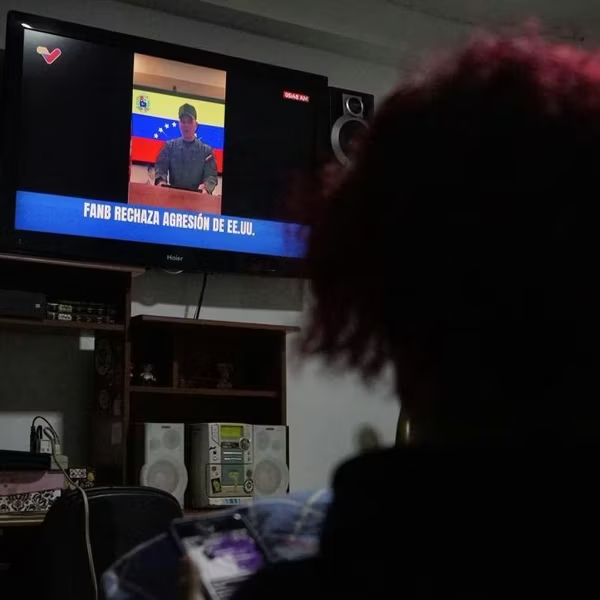
The Venezuelan government ordered “all national defence plans to be implemented” and called for the people of the country to mobilise to fend off a “colonial war” aiming at regime change, in co-ordination with the “fascist oligarchy” that has always sought to reverse the Bolivarian revolution. Given the explicit threats of an attack from the US in recent months, Venezuela has distributed arms to popular militias around the country.
The Pentagon and White House have been tight-lipped about the attacks, with the main confirmation simply a Federal Aviation Authority warning to commercial aircraft to steer clear of the Latin American country because of “military activity.” Reports aired by some US broadcasters that US President Donald Trump has ordered a land invasion have not been confirmed.
“The whole ground shook… this is horrible,” Carmen Hidalgo, a 21-year-old office worker, her voice trembling, told the Associated Press. She was walking briskly with two relatives, returning from a birthday party. “We felt like the air was hitting us.”
Mr Trump has built up a huge armada off Venezuela’s coast and carried out a lethal campaign of bombings against boats in the Caribbean, accusing them without evidence of smuggling drugs. Officially the US accuses the government of President Nicolas Maduro of being involved in drug-smuggling too, but in online rants the US leader has revealed his real aim is to restore US corporate control of the country’s oil reserves, the largest proven reserves on Earth. The US boarded and stole two oil tankers carrying Venezuelan crude last month.
A recent National Security Strategy published by the White House called on the United States to reassert the Monroe Doctrine — which calls for US dominance in the western hemisphere and the exclusion of all “non-hemispheric” powers from it.
“The Bolivarian government calls upon all social and political forces of the country to activate mobilisation plans and to repudiate this imperialist attack,” the Venezuelan government said in a statement.
There are reports in the last few minutes that Trump has announced on his truth social that President Maduro and his wife have been captured and removed from Venezuela.
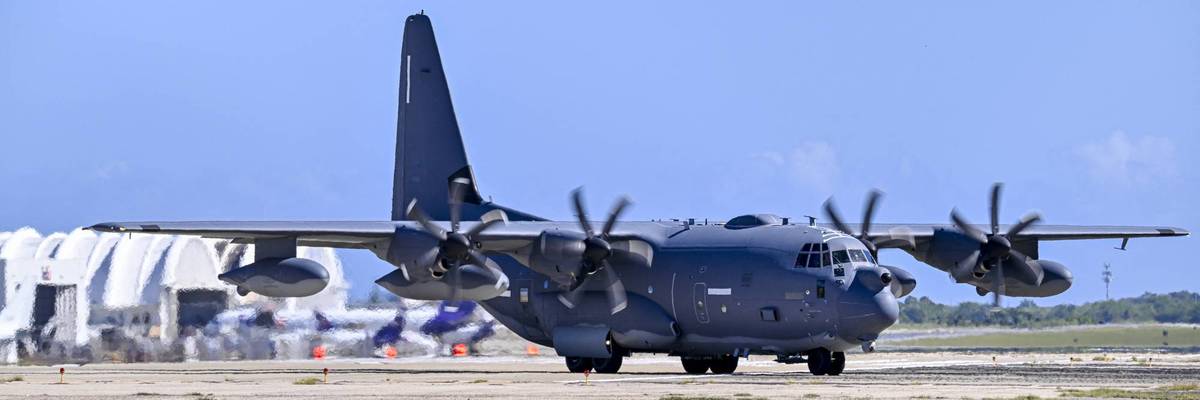
A US Air Force C-130 Hercules taxis at Rafael Hernandez Airport in Aguadilla, Puerto Rico, on December 18, 2025. US President Donald Trump’s administration is conducting a military campaign in the Caribbean and eastern Pacific, deploying naval and air forces for what it calls an anti-drugs offensive. (Photo by Miguel J. Rodriguez Carrillo / AFP via Getty Images)
Administration officials have yet to provide any details about the supposed strike, which would mark a massive escalation in the president’s lawless military campaign.
President Donald Trump claimed during a recent discussion about his high-seas boat bombing blitz that US forces took out “a big facility” as part of the Venezuela-centered campaign—but no one seems to know what he’s talking about.
Trump said Friday during an apparently impromptu phone call to billionaire supporter John Catsimatidis—who owns and hosts programming on WABC radio in New York—that South American narcotraffickers “have a big plant or a big facility where the ships come from,” and that “two nights ago, we knocked that out.”
On Monday, Trump was asked during a meeting with fugitive Israeli Prime Minister Benjamin Netanyahu to clarify Friday’s claim.
“There was a major explosion in the dock area where they load the boats up with drugs,” the president said, “so we hit all the boats and now we hit the area. It’s the implementation area. That’s where they implement, and that is no longer around.”
Neither Trump nor anyone in his administration offered any evidence to support the claim. There have also been no public statements from any Venezuelan government official regarding any US attack.
Q: Can you say any more about the explosion in Venezuela that you mentioned in a radio interview. Did the military do that?
TRUMP: Well, it doesn't matter. But there was a major explosion in the dock area where they load the boats up with drugs. We hit the area. pic.twitter.com/hvZa7fKxbq
Trump did say during a Christmas Eve call to troops taking part in escalating hostilities against Venezuela—whose socialist leader, President Nicolás Maduro, has long been in Trump’s regime-change crosshairs—that, after more than two dozen boat strikes, “now we’re going after the land.”
Threats by Trump to bomb targets inside Venezuela—or even invade the oil-rich South American nation in order to oust Maduro—are nothing new. The president has deployed an armada of warships and thousands of US troops to the region and has also authorized covert Central Intelligence Agency action against Maduro. Earlier this month, Trump vowed that the US would attack Venezuela “on land,” and “very soon, too.”
However, Trump’s remarks on Friday left observers scratching their heads and scouring news reports in a fruitless effort to make sense of the president’s claim.
One US official interviewed by the Intercept on condition of anonymity said the US targeted a “facility”—but declined to disclose its location, or whether it was attacked by US forces.
“That announcement was misleading,” the official said of Trump’s claim last week.
There is some speculation that a Christmas Eve explosion and fire at a warehouse on the grounds of a Primazol chemical plant in Zulia state may have been caused by a US strike. However, the site—which reportedly makes products including chicken feed—is not located directly on any coast, and Primazol issued a statement “categorically” rejecting claims that the facility was bombed.
Either Trump is lying about 'striking' a factory inside Venezuela, or his people dropped a missile on Christmas Eve on a private industrial food/chemical & raw materials factory (Primazol) unrelated to the Venezuelan government or drug trafficking. They make chicken feed. https://t.co/i6FZCWkvwUpic.twitter.com/uV5nCAlfhw
If Trump did order any bombing of targets in Venezuela, it would be a major escalation and clear act of war by a man who, while billing himself as “the most anti-war president in history,” has now, with last week’s attack on Nigeria, bombed more countries than any president in history.
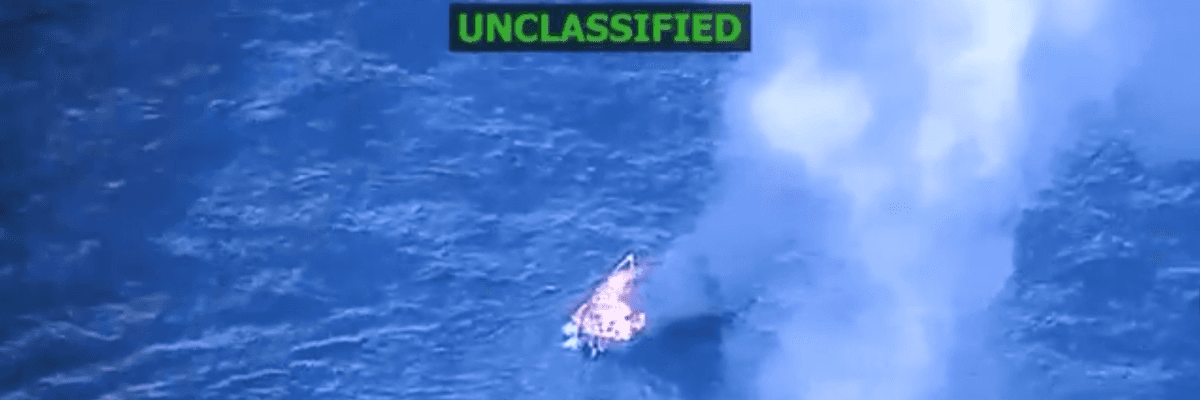
This photo shows the aftermath of a US military strike on a boat allegedly carrying drugs in the Caribbean Sea on October 3, 2025. (Photo: screenshot/Donald Trump/Truth Social)
At least 107 people have been killed in US bombings of boats that the Trump administration claims—without evidence—were involved in narco-trafficking in the Caribbean Sea and Pacific Ocean.
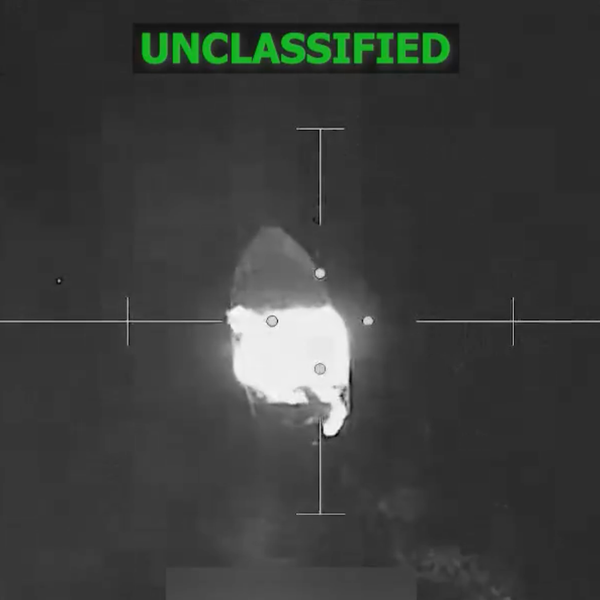
The US military said Monday that two alleged drug smugglers were killed in the bombing of another boat in the eastern Pacific Ocean, but—as has been the case throughout 30 such strikes—offered no verifiable evidence to support its claim.
US Southern Command (SOUTHCOM) said on X that, on orders from Defense Secretary Pete Hegseth, “Joint Task Force Southern Spear conducted a lethal kinetic strike on a vessel operated by Designated Terrorist Organizations in international waters.”
“Intelligence confirmed the vessel was transiting along known narco-trafficking routes in the eastern Pacific and was engaged in narco-trafficking operations,” SOUTHCOM added. “Two male narco-terrorists were killed. No US military forces were harmed.”
According to the Trump administration’s figures, at least 107 people have been killed in 30 boat strikes since early September. The administration has tried to justify the strikes to Congress by claiming that the US is in an “armed conflict” with drug cartels, while legal scholars and Democratic US lawmakers counter that the bombings are likely war crimes.
On Dec. 29, at the direction of @SecWar Pete Hegseth, Joint Task Force Southern Spear conducted a lethal kinetic strike on a vessel operated by Designated Terrorist Organizations in international waters. Intelligence confirmed the vessel was transiting along known… pic.twitter.com/69ywxXk30N
War powers resolutions aimed at reining in President Donald Trump’s ability to extrajudicially execute alleged drug traffickers in or near Venezuela failed to pass the Senate in October and the House earlier this month.
Monday’s strike came amid Trump’s escalating aggression against Venezuela, including the deployment of warships and thousands of US troops to the region, authorization of covert CIA operations targeting the country’s socialist government, and threats to launch ground attacks.
Trump claimed Monday without providing evidence that US forces destroyed a “big facility” in an unspecified country where narco-traffickers’ “ships come from.”
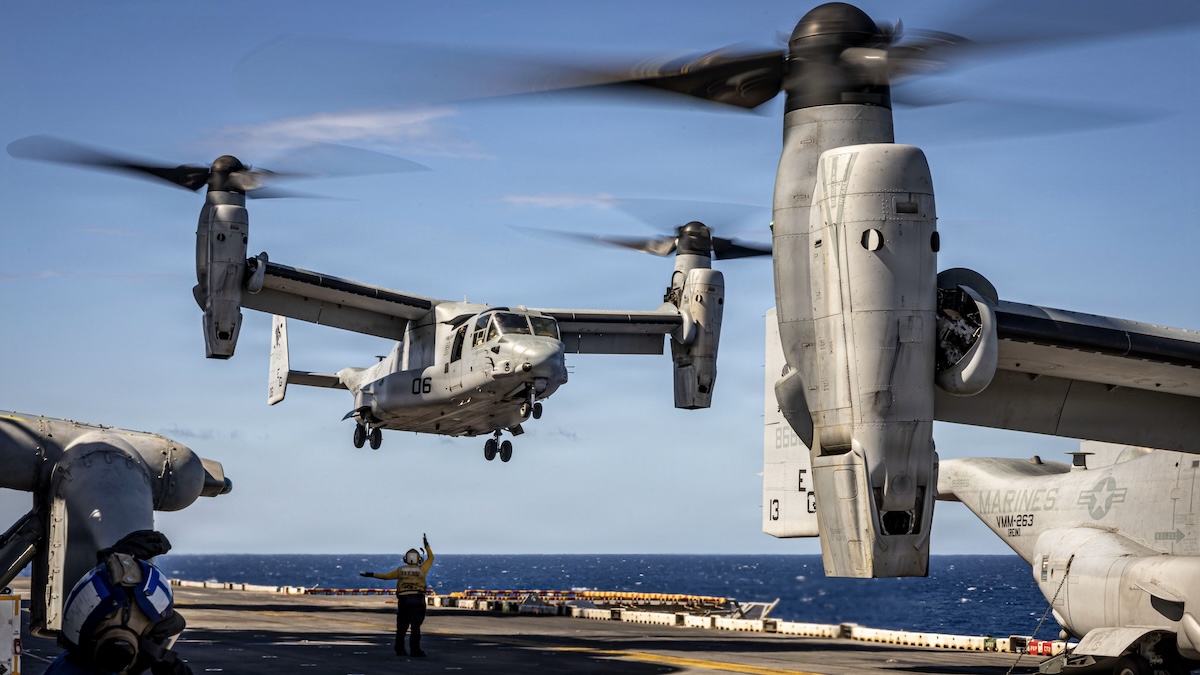
Marines aircraft on the USS Iwo Jima deployed to Caribbean Sea as part of SOUTHCOM’s Operation Southern Spear. Photo: US Marines / X
Tensions continue to rise in the Caribbean. The United States continues to confiscate and pursue Venezuelan oil tankers, while Caracas denounces what it considers an “act of international piracy” at the UN.
US hostilities continue in the Caribbean. The US Coast Guard has gone after its third “prey” in international waters. According to information from US authorities, the ship “Bella 1” was headed to Venezuela to pick up oil when US forces attempted to apprehend it. “Bella 1” continued sailing, which led to a maritime chase, according to Kristi Noem, US Secretary of Homeland Security.
“The US Coast Guard is actively pursuing a sanctioned vessel from the dark fleet that is part of Venezuela’s illegal sanctions evasion … It is sailing under a false flag and under a court order for seizure,” said an anonymous official who spoke to CNN.
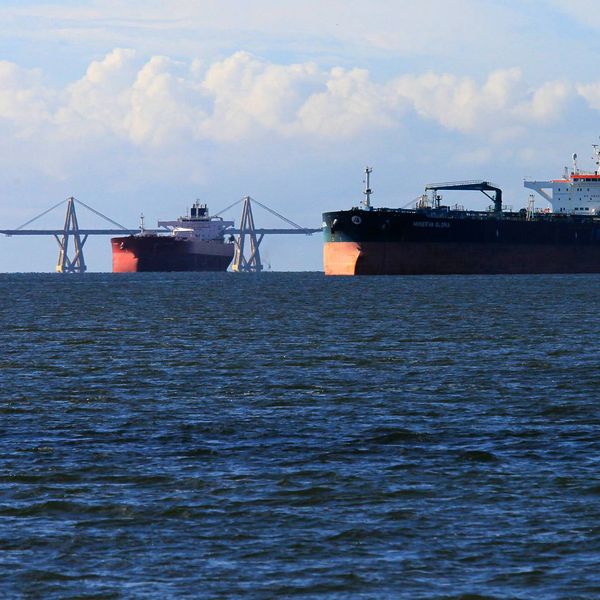
Washington confirmed on December 20 that it had intercepted and forcibly confiscated a second oil tanker off the coast of Venezuela, called “Centuries”, something that the Chavista government has now repeatedly denounced as an act of “international piracy”.
Although White House spokeswoman Anna Kelly said “Centuries” was a sanctioned vessel, it does not appear on the list of vessels unilaterally sanctioned by Washington, leading several analysts to fear that it is no longer just the 30 sanctioned vessels that are being targeted, but all Venezuelan ships, which will be seized by force if the opportunity arises.
Caracas’ diplomatic and legal rejection
For her part, Venezuelan Vice President Delcy Rodríguez stated: “Venezuela rejects the theft and hijacking of a new private vessel carrying Venezuelan oil … [We will take] all appropriate actions, including reporting this to the United Nations Security Council, other multilateral organizations, and the governments of the world.”
Furthermore, it is important to note that the Venezuelan National Assembly has proposed a law that seeks to fine and imprison for up to 20 years anyone who promotes, solicits, supports, finances, or participates in acts of piracy, blockades, and other similar acts against national institutions.
Pursuing and capturing Venezuelan ships: the new mission of the US Coast Guard
Following the seizure of the first Venezuelan oil tanker, “Skipper”, US forces are continuing their plan to economically strangle Venezuela by seizing more Venezuelan oil in the Caribbean Sea.
In recent days, Trump said, “we will keep” the oil seized from the first ship on December 10. A few hours later, through his social network, Truth Social, Trump went further and claimed that Venezuelan oil was “ours”, that is, the United States’.
According to Trump, the nationalization of Venezuelan oil in the 1970s was “theft”.
These statements led Venezuelan authorities to confirm suspicions that the main reason for taking action against Venezuela has more to do with economic issues than national security or the fight against drug trafficking.
Washington has claimed that the Chavista government is part of a criminal structure called the Cartel of the Suns. However, Caracas flatly denies the accusations and affirms that the flimsy accusation is a media ploy to justify a military invasion that would change the government to one in favor of the US; essentially, a US-puppet president. Following this, foreign companies would take over the Caribbean country’s natural resources, as has been promised by far-right opposition leader María Corina Machado. Venezuela has the largest oil reserves in the world.
The beginning of a new blockade in the Caribbean
For more than 60 years, the United States has maintained an economic and commercial blockade on Cuba. This has caused enormous difficulties for the socialist country to maintain and develop its economy. Despite this, Cuba, to the surprise of humanity, has managed to circumvent the blockade and resist attempts to boycott the revolutionary process on the island.
The United States hopes that this strategy will have a different effect in Venezuela. Under the constant threat of a military invasion, which would cause the deaths of hundreds or thousands of people, Washington is betting on blocking Venezuelan tankers to destroy an economy that is deeply dependent on oil.
Last week, Trump ordered a “blockade” of sanctioned oil tankers entering and leaving Venezuela for allegedly trading with groups that pose a threat to US security. About 30 of the 80 Venezuelan ships that transport oil have been sanctioned by the United States, which significantly reduces the Venezuelan economy’s room for maneuver, without ruling out future sanctions or a total blockade.
The Venezuelan government has denounced the confiscation of Venezuelan oil tankers to the highest international bodies. Before the UN Security Council, which met in emergency session on December 23, Samuel Moncada, Venezuela’s representative, said that the United States wants to impose a colonial system on his country. “[These operations are] the greatest extortion known in our history, a gigantic crime of aggression unfolding outside of any national parameters, legal logic, or historical precedent.” Moncada emphasized, “It’s not drugs, it’s not security, it’s not freedom; it is oil, it’s the mines, it’s the land.”
For his part, Washington representative Mike Waltz justified the actions as part of the fight against drug trafficking, which is why his country considers the matter to be a “non-international armed conflict”. “The United States will apply maximum sanctions to deprive Maduro of the resources he uses to finance the Cartel of the Suns, designated as a terrorist organization by the United States,” Waltz said.
Both Russia and China have publicly questioned Washington’s actions, considering them “dangerous”. Russian Ambassador Vasily Nebenzya stated: “The actions committed by the United States violate all fundamental norms of international law.” Sun Lei, China’s representative, said that his country “opposes all acts of unilateralism and intimidation and supports all countries in defending their sovereignty and national dignity … Venezuela has the right to independently develop mutually beneficial cooperation with other countries.”
Iranian President Masoud Pezeshkian added his voice to these denunciations. According to Telesur: “Iranian President Masoud Pezeshkian sent his support in a phone call to Venezuelan President Nicolás Maduro in response to the new threats and aggressions by the United States against the Venezuelan people and the Caribbean. Masoud said he hopes to consolidate cooperation ties with Venezuela by 2026.”


 A civilian runs from the sound of explosions in Caracas overnight