Tag: Venezuela

  • US Troops Near Venezuela Reportedly Denied Holiday Leave as Fears Grow of Unpopular and Lengthy Trump War

    Spread the love

    Original article by Stephen Prager republished from Common Dreams under Creative Commons (CC BY-NC-ND 3.0). 
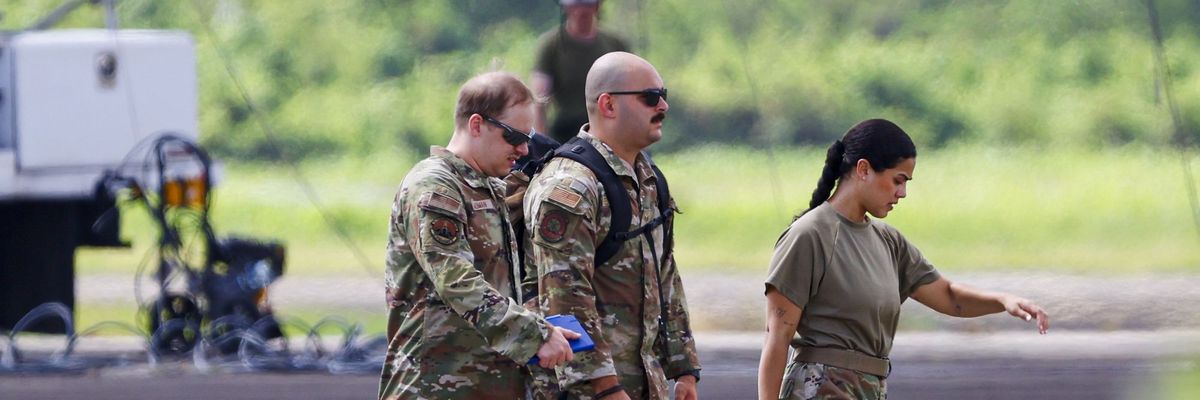
    US Air Force personnel patrol the area surrounding José Aponte de la Torre Airport, the former Roosevelt Roads Naval Station, September 11, 2025, in Ceiba, Puerto Rico. (Photo by Miguel J. Rodríguez Carrillo/Getty Images)

    Meanwhile, newly released documents suggest the administration is gearing up to have troops in the region until the end of Trump’s term.

    Following reports that the Trump administration is eyeing a “deadly new phase” of military actions against Venezuela, including land strikes, a new report suggests that the US troops stationed near the South American nation are being denied holiday leave in anticipation of immediate action.

    On Monday, NewsNation White House Correspondent Kellie Meyer reported via social media that the United States Southern Command (SOUTHCOM) is “restricting/limiting leave over the Thanksgiving and Christmas holidays in preparation for possible land strikes in the next 10 days to two weeks.”

    SOUTHCOM has denied the claim, with a spokesperson saying: “Our service members and civilian employees are always afforded the opportunity to take leave throughout the year, and that includes holiday periods.”

    As of yet, reports only suggest that the US may be planning imminent airstrikes against Venezuela. But as documents reported Tuesday by The Intercept revealed, the US is planning to maintain “a massive military presence in the Caribbean almost to the end of President Donald Trump’s term in office—suggesting the recent influx of American troops to the region won’t end anytime soon.”

    According to the report: “One spreadsheet outlining supplies for ‘Puerto Rico Troops’ notes tens of thousands of pounds of baked goods are scheduled for delivery from November 15 of this year to November 11, 2028. Foodstuff set to feed the troops include individually wrapped honey buns, vanilla cupcakes, sweet rolls, hamburger rolls, and flour tortillas.” The food is slated to be delivered to every branch of the military, including the Coast Guard, Army, Navy, Air Force, and Marine Corps.

    “The procurement’s length of time and the level of effort seemed to point to these operations continuing at the current level for several years,” said Mark Cancian, an analyst with the Center for Strategic and International Studies. “That’s significant because it means that the Navy will maintain a large presence in the Caribbean that is far larger than what it has been in recent years. It further implies that the Navy will be involved in these counter-drug operations.”

    The Pentagon currently has more than 15,000 troops stationed in the region, the most since 1989, when the US launched a land invasion of Panama to topple the drug-running dictator Manuel Noriega, whom it had previously supported.

    The reports came shortly after the US State Department designated the so-called “Cartel de los Soles,” which the US accuses Venezuelan President Nicolás Maduro of leading, as a “terrorist organization.” This is despite the fact that it is not actually an organized cartel at all, but a media shorthand developed to refer to the alleged connections that high-level Venezuelan officials have to the drug trade.

    “It is not a group,” Adam Isaacson, director for defense oversight at the Washington Office on Latin America organization, told the Associated Press Tuesday. “It’s not like a group that people would ever identify themselves as members. They don’t have regular meetings. They don’t have a hierarchy.”

    Colombian journalist Juan Esteban Silva explains that the terrorist designation, despite its factual flimsiness, “gives the US authority to conduct covert operations, bring terrorism and drug charges, issue international arrest warrants, freeze assets, and block transactions. It also enables extraterritorial prosecution, travel restrictions, broader law enforcement and military cooperation, and asset seizures.”

    Maduro’s government called the designation an “infamous, vile lie to justify an illegitimate and illegal intervention against Venezuela under the classic US format of regime change.”

    It comes after Reuters reported Sunday that “covert operations” in Venezuela “would likely be the first part of the new action against Maduro” and that the US was “prepared to use every element of American power” to achieve its goals in the region.

    While stopping drug trafficking was the initial justification for the administration’s push for regime change, White House messaging has shifted in recent days, with officials telling Fox News that it “goes beyond the Maduro regime” and is also about “getting Russia, China, and Iran out of the Western hemisphere.”

    On Monday, US Rep. María Salazar (R-Fla.) gave a more candid explanation for the potentially imminent military action and the need for regime change on Fox Business.

    Maduro, she said, “is understanding that we’re about to go in.” She went on: “Venezuela, for the American oil companies, will be a field day, because it will be more than a trillion dollars in economic activity. American companies can go in and fix all the oil rigs and everything that has to do with the Venezuelan petroleum companies.”

    Prior to returning to office, Trump said at a rally in 2023 that he regretted not invading Venezuela during his first term: “We would have taken [Venezuela] over; we would have gotten to all that oil; it would have been right next door.”

    Though the White House appears increasingly committed to military action against Venezuela, it is overwhelmingly unpopular among Americans.

    A CBS News/YouGov survey published on Sunday found that 70% of Americans—including 91% of Democrats and 42% of Republicans—are against the “US taking military action in Venezuela,” and a majority don’t believe a direct attack on Venezuela would even achieve the Trump administration’s stated goal of reducing the flow of drugs to the United States.

    The same poll found that just 13% of Americans consider Venezuela to be a “major threat” to “US security,” while 48% consider it a “minor threat,” and 39% consider it to be “not a threat.”

    Alfons López Tena, a former member of the Catalan parliament and an analyst on public and international affairs, expressed shock at the Trump administration’s brazenness despite the total lack of public consent for war.

    “The US doesn’t feel at all like a country marching into war, 70% oppose military action in Venezuela,” he said. “The government’s cursory explanations show they are so heedless of public opinion that they don’t even feel the need to mount a proper propaganda campaign.”

    Nathan J. Robinson, the editor-in-chief ofthe left-wing magazine Current Affairs, meanwhile, said he’s not surprised.

    “It’s no mystery to a leftist when the US government’s foreign policy is out of step with popular opinion,” he said, “because we understand foreign policy is shaped by narrow elite interests.”

    Original article by Stephen Prager republished from Common Dreams under Creative Commons (CC BY-NC-ND 3.0). 

    Donald Fuhrump says that Amerikkka doesn't bother with crimes or charges anymore, not being 100% Amerikkkan and opposing his real estate intentions is enough.
    Donald Fuhrump says that Amerikkka doesn’t bother with crimes or charges anymore, not being 100% Amerikkkan and opposing his real estate intentions is enough.
    Orcas discuss how Trump was re-elected and him being an obviously insane, xenophobic Fascist.
    Orcas discuss how Trump was re-elected and him being an obviously insane, xenophobic Fascist.
    Orcas discuss Donald Trump and the killer apes' concept of democracy. Front Orca warns that Trump is crashing his country's economy and that everything he does he does for the fantastically wealthy.
    Orcas discuss Donald Trump and the killer apes’ concept of democracy. Front Orca warns that Trump is crashing his country’s economy and that everything he does he does for the fantastically wealthy.
  • 70% of US Public Opposes Military Attack on Venezuela as Trump Eyes ‘Deadly New Phase’

    Spread the love

    Original article by Jake Johnson republished from Common Dreams under Creative Commons (CC BY-NC-ND 3.0). 

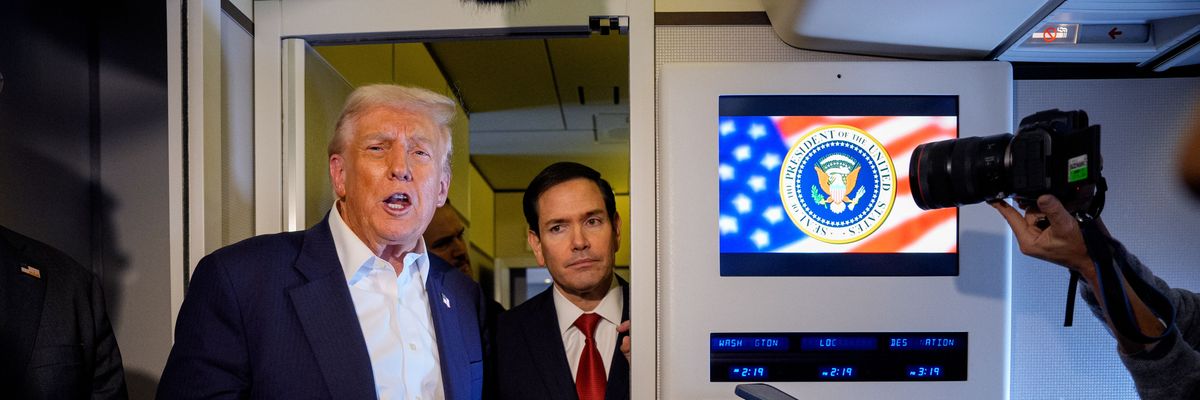
    US President Donald Trump, accompanied by Secretary of State Marco Rubio, speaks to members of the media aboard Air Force One on October 27, 2025. Photo: Andrew Harnik/Getty Images)

    “It should come as no surprise by now that the president who campaigned on keeping the US out of wars and then promptly bombed Iran has now found another conflict in which to embroil the country.”

    New survey results show that Americans strongly oppose US military action against Venezuela as the Trump administration privately weighs options for land strikes against the South American country—as well as possible covert action targeting the government of President Nicolás Maduro.

    The CBS News/YouGov survey, published on Sunday, found that 70% of Americans—including 91% of Democrats and 42% of Republicans—are against the “US taking military action in Venezuela,” and a majority don’t believe a direct attack on Venezuela would even achieve the Trump administration’s stated goal of reducing the flow of drugs to the United States.

    The poll also found that a slim majority, 53%, support “using military force to attack boats suspected of bringing drugs into” the US, even as human rights groups and United Nations experts say such attacks—which have killed more than 80 people since early September—are grave violations of US and international law.

    The survey data came amid reports that the Trump administration is set to launch “a potentially deadly new phase” of its campaign against Maduro’s government, which has responded to the US president’s threats and military buildup in the Caribbean with a large mobilization of troops and weaponry.

    Citing two unnamed US officials, Reuters reported on Sunday that “covert operations would likely be the first part of the new action against Maduro.” The outlet quoted one anonymous official as saying Trump is “prepared to use every element of American power” to achieve his stated goals in the region.

    On Monday, as the New York Times reported, the chairman of the US Joint Chiefs of Staff is set to visit “Puerto Rico and one of the several Navy warships dispatched to the Caribbean Sea to combat drug trafficking as the Trump administration weighs the possibility of a broader military campaign against Venezuela.”

    Gen. Dan Caine, the top US military officer, has “been a major architect of what the Pentagon calls Operation Southern Spear, the largest buildup of American naval forces in the Caribbean since the Cuban Missile Crisis and the blockade of Cuba in 1962,” the Times added.

    Also on Monday, the Trump administration formally designated Maduro and top officials in his government members of a foreign terrorist organization, a move that the White House believes expands US military options in Venezuela.

    While polling data has consistently shown that the US public opposes military intervention in Venezuela by significant margins, Republicans in Congress have thus far blocked action to prevent the Trump administration from attacking the country and bombing vessels in international waters without lawmakers’ approval.

    Al Jazeera columnist Belén Fernández wrote Sunday that “it should come as no surprise by now that the president who campaigned on keeping the US out of wars and then promptly bombed Iran has now found another conflict in which to embroil the country.”

    “And as is par for the course in US imperial belligerence, the rationale for aggression against Venezuela doesn’t hold water,” Fernández added. “For example, the Trump administration has strived to pin the blame for the fentanyl crisis in the US on Maduro. But there’s a slight problem—which is that Venezuela doesn’t even produce the synthetic opioid in question.”

    Late last week, a group of House Democrats led by Seth Moulton of Massachusetts announced a new legislative effort aimed at preventing the Trump administration from attacking Venezuela without congressional authorization.

    The bill, titled the No Unauthorized Force in Venezuela Act, would bar the White House from spending federal funds on military action against Venezuela absent specific congressional approval.

    “We owe our service members clarity, legality, and leadership—not threats, not chaos, and not another unnecessary conflict,” said Moulton. “This legislation draws the line the president refuses to draw. It protects our troops, reasserts Congress’ constitutional role, and ensures we do not sleepwalk into another ill-advised war.”

    Original article by Jake Johnson republished from Common Dreams under Creative Commons (CC BY-NC-ND 3.0). 

    Donald Fuhrump says that Amerikkka doesn't bother with crimes or charges anymore, not being 100% Amerikkkan and opposing his real estate intentions is enough.
    Donald Fuhrump says that Amerikkka doesn’t bother with crimes or charges anymore, not being 100% Amerikkkan and opposing his real estate intentions is enough.
    Orcas discuss how Trump was re-elected and him being an obviously insane, xenophobic Fascist.
    Orcas discuss how Trump was re-elected and him being an obviously insane, xenophobic Fascist.
  • European left urges solidarity with Venezuela amid growing US aggression

    Spread the love

    Original article by Ana Vračar republished from peoples dispatch under a Creative Commons Attribution-ShareAlike 4.0 (CC BY-SA) license.

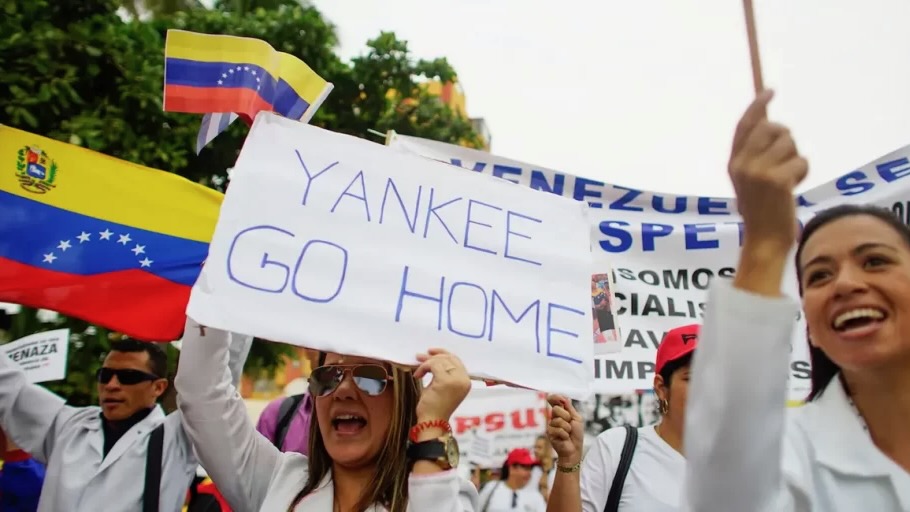
    Protest against US and UK sanctions on Venezuela. Photo: Venezuela Solidarity Campaign

    Left parties and organizations across Europe are calling for respect for Venezuela’s sovereignty and action against escalating US aggression in the Caribbean.

    European leaders continue to subordinate themselves to the Trump administration, including on the United States’ escalating military threats against Venezuela. Shortly before this month’s CELAC–EU summit in Colombia, several high-ranking figures, including European Commission President Ursula von der Leyen, German Chancellor Friedrich Merz, and French President Emmanuel Macron, suddenly announced they would not attend the meeting. Their move has widely been understood as an attempt to avoid displeasing US President Donald Trump at a moment of mounting US aggression in Latin America.

    Read more: A brief overview of US military interventions in the Americas

    In contrast, left parties in the region warn against this approach. Instead of supporting US militarism, they insist, Europe should uphold international law, respect the sovereignty of Latin American states, and push for diplomacy over war.

    “We are witnessing an unprecedented military escalation in 20 years, a multifaceted aggression that threatens not only Venezuela, but any project of sovereignty and social justice in Latin America,” the Workers’ Party of Belgium (PTB-PVDA) wrote in response to the situation. Italy’s Potere al Popolo echoed this concern, noting that US interests in Latin America have remained unchanged for decades. “On the one hand, it’s about securing access to the immense oil, water, and raw materials reserves, but also to the food production capacities of the Latin American continent (an economic and trade war),” the party wrote. “On the other hand, they want to stifle the efforts of progressive and socialist governments (an ideology war).”

    For left organizations from Greece to Britain, there is little doubt that the current US threats against Venezuela amount to a push for regime change. Most see this as yet another step that could trap Latin America and the rest of the world into an even deeper cycle of violence. Despite such concerns, most European governments have not shown any sign of questioning US plans or proposing alternatives. Just the opposite: in addition to skipping multilateral discussions with Latin American counterparts, some have even chosen to reduce diplomatic representation in the region.

    Belgium recently announced it would close several diplomatic missions, including those in Havana and Rio de Janeiro. The PTB-PVDA warned against this decision, emphasizing that it is both dangerous and short-sighted. “This is a very bad idea,” said party General Secretary Peter Mertens. “At a time when international law and international relations are already under heavy pressure, and US President Donald Trump is announcing new military aggressions in the Caribbean region, we need more diplomacy.”

    Read more: US deploys aircraft carrier and threatens invasion of Venezuela

    Peace networks and organizations are similarly calling for a change of approach. Belgian associations Vrede and Intal appealed to parliamentary bodies to take action in light of recent US announcements regarding the launch of its new military initiative, Operation Southern Spear. “Venezuela is risking being plunged into chaos similar to the most devastating conflicts of recent decades, and a prolonged instability could arise across the region,” the groups wrote.

    They also warned that Belgium has legal and political obligations to uphold international law and therefore support peaceful solutions. Similar calls have appeared in Britain, where several MPs and peace networks have criticized Prime Minister Keir Starmer for failing to oppose the US militarization drive. “There are deep fears that US military intervention in Venezuela would be the first step in a wider military escalation by Trump in Latin America,” their appeal warns. “The US has a long history of interference in the continent, where so-called ‘regime change’ has caused widespread suffering and lasting harm.”

    The Venezuela Solidarity Campaign in Britain also urged action, saying: “The task now is to maximize support for solidarity with Venezuela on the basis of respect for Venezuela’s sovereignty, a recall of the US fleet, and end to US military aggression in Latin America and the Caribbean.”

    Read more: From Palestine to Venezuela: The US is behind the door

    Those calling for solidarity with Venezuela are well aware that their initiatives stand in stark contrast to the interests of powerful actors poised to benefit from the escalation. “War is beneficial for some, not least those who are well aware that Venezuela sits on the world’s largest oil reserves,” Jeremy Corbyn noted for the Stop the War Coalition.

    Despite anticipating a response from conservative and right-wing forces, left parties and progressive networks insist that now is the time to intensify solidarity. “Trump is responding to the crisis of US hegemony with greater militarization of the world. Europe – including Giorgia Meloni’s government – is following suit by increasing military spending and attacking the rights of the working class,” Potere al Popolo stated. “Today, more than ever, we have a duty to stop this expanding war economy, as the dockworkers demonstrated with their recent general strikes and as millions around the world showed by marching for peace.”

    Original article by Ana Vračar republished from peoples dispatch under a Creative Commons Attribution-ShareAlike 4.0 (CC BY-SA) license.

    Orcas discuss how Trump was re-elected and him being an obviously insane, xenophobic Fascist.
    Orcas discuss how Trump was re-elected and him being an obviously insane, xenophobic Fascist.
  • Between invasion and diplomacy: Trump’s options with Venezuela

    Spread the love

    Original article by Pablo Meriguet republished from peoples dispatch under a Creative Commons Attribution-ShareAlike 4.0 (CC BY-SA) license.

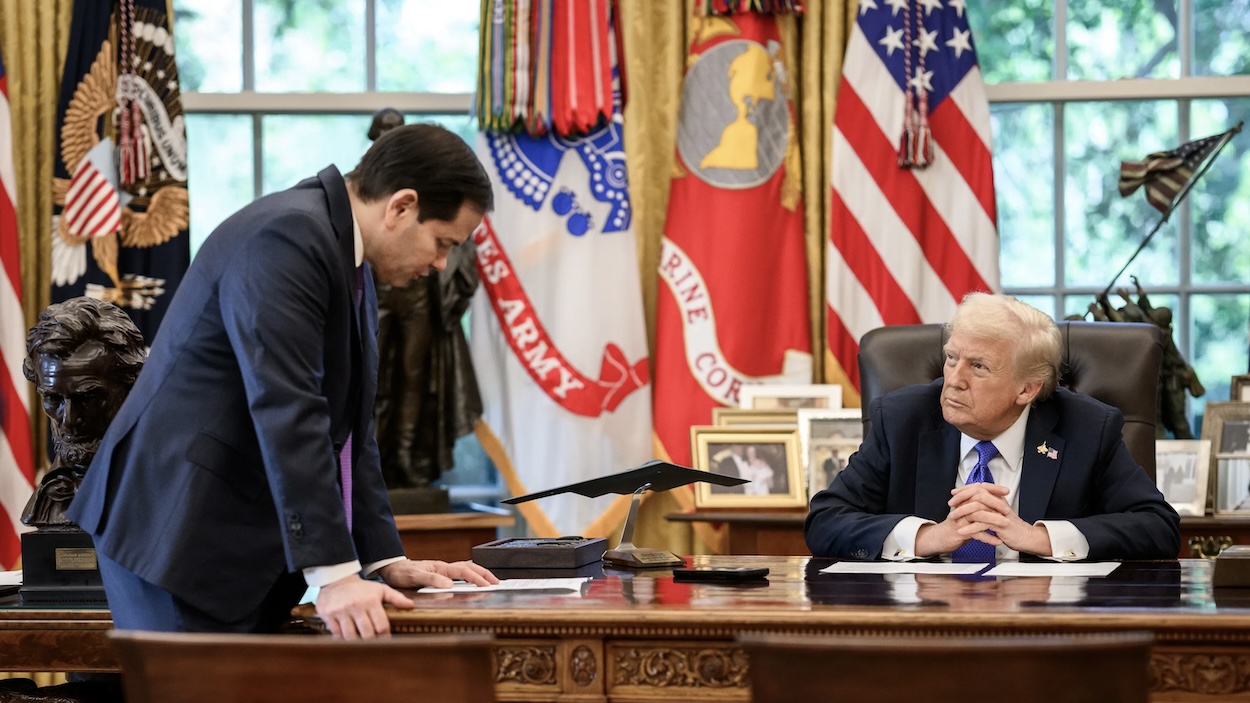
    US President Donald Trump and US Secretary of State Marco Rubio in the Oval Office. Photo: The White House

    While Trump increases military pressure in the Caribbean Sea, he hasn’t ruled out the possibility of resuming talks with Caracas. Meanwhile, Maduro supports the diplomatic route and rejects the possibility of war

    At a press conference on November 17, US President Donald Trump stated that he does not rule out using his armed forces in Venezuela. This military buildup has involved the Pentagon deploying thousands of soldiers to the Caribbean Sea and to countries collaborating with Washington in the so-called Southern Spear military operation. Most recently, the USS Gerald R. Ford, the largest aircraft carrier in the United States, arrived in the Caribbean to, according to the Pentagon, “combat transnational threats”.

    The Trump administration claims that a large amount of the drugs entering the United States comes from Venezuela, whose government is allegedly part of a criminal structure called the “Cartel of the Suns”.

    Caracas has flatly denied these accusations and claimed that they are part of a justification to overthrow the Venezuelan government (which controls the world’s largest oil reserves) and thus force a change of direction in the country that is aligned with Washington’s economic and geopolitical interests.

    Washington insists on its accusations

    On November 16, the US State Department announced that it will designate the Cartel of the Suns (Cartel de los Soles) a foreign terrorist organization. Defense Secretary Marco Rubio stated: “The Cartel of the Suns, along with other designated foreign terrorist organizations, including the Aragua Train and the Sinaloa Cartel, are responsible for terrorist violence throughout the hemisphere, as well as drug trafficking to the United States and Europe.”

    According to US authorities, this designation gives the US military carte blanche to attack the assets and infrastructure of what they consider to be part of the Cartel de los Soles, despite the fact that a large number of international law experts argue that this is not sufficient to legally justify an attack outside its borders.

    Despite these warnings, the Trump administration has already launched attacks on small boats in the Caribbean Sea that, according to Washington, were carrying drugs to the United States, although no reliable evidence has yet been presented to prove this. Dozens of deaths have been reported so far.

    Read More: From Palestine to Venezuela: The US is behind the door

    The big question arising from the recent military and administrative maneuvers by the United States is whether Washington will dare to attack Venezuelan territory on the grounds that it is an attack to destroy a terrorist organization. For the moment, Trump has moved forward with these measures, although he has been cautious in stating that the attack will take place.

    Trump says he will speak with Maduro soon

    While the Trump administration increases pressure on Venezuela, even authorizing covert actions in the Caribbean country according to the New York Times, it also claims that there may be an open channel of communication with Caracas.

    This was seemingly confirmed at the November 17 press conference, when, in response to questions from reporters about possible communication with Maduro, Trump said, “At some point, I will talk to him.”

    Maduro’s response

    In response to these statements, the Venezuelan president reacted by saying that the conversation should take place: “Only through diplomacy can differences be resolved … Anyone who wants to talk to Venezuela will talk face to face, but the Venezuelan people cannot be allowed to be massacred.”

    Maduro warned that one of the consequences of a possible military invasion of Venezuela would be the loss of legitimacy of the Trump administration: “A war against Venezuela would be the political end of his leadership and his name. [Some people are trying to push Trump to] make the most serious mistake of his entire life.” He also said that public opinion in the United States is increasingly rejecting a possible military intervention in South America.

    For now, Washington wants to maintain all options available when negotiating with Maduro’s government, whether through military or diplomatic means. Thus, Trump is deploying his military and intelligence assets in South America while keeping the lines of communication open with Maduro. For its part, the Venezuelan government is betting on diplomacy while preparing for a possible military invasion that would seek to end more than 25 years of Chavista rule, although such an operation could have unforeseen effects in the region, even for Washington.

    Original article by Pablo Meriguet republished from peoples dispatch under a Creative Commons Attribution-ShareAlike 4.0 (CC BY-SA) license.

    Donald Fuhrump says that Amerikkka doesn't bother with crimes or charges anymore, not being 100% Amerikkkan and opposing his real estate intentions is enough.
    Donald Fuhrump says that Amerikkka doesn’t bother with crimes or charges anymore, not being 100% Amerikkkan and opposing his real estate intentions is enough.
    Orcas discuss how Trump was re-elected and him being an obviously insane, xenophobic Fascist.
    Orcas discuss how Trump was re-elected and him being an obviously insane, xenophobic Fascist.

  • As Trump Issues New Threats to Mexico and Colombia, Democrats Push to End Unauthorized Aggression

    Spread the love

    Original article by Stephen Prager republished from Common Dreams under Creative Commons (CC BY-NC-ND 3.0). 

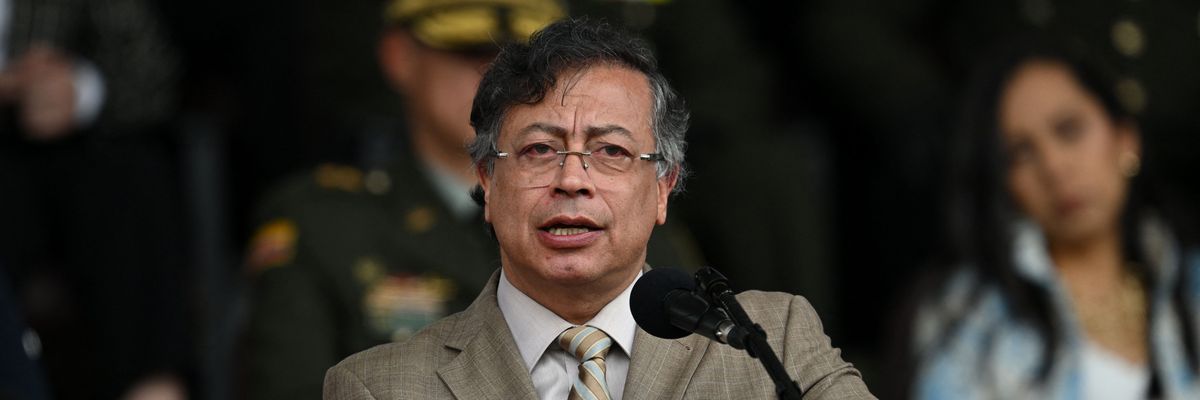
    Colombia’s President Gustavo Petro delivers a speech during the commemoration of the 134th anniversary of the National Police and the promotion of officers at the General Santander Police Academy in Bogotá on November 13, 2025. (Photo by Raul Arboleda/AFP via Getty Images)

    Rep. Gregory Meeks, who introduced a war powers resolution, said Trump’s actions combine the “worst excesses of the war on drugs and the war on terror.”

    As Democrats in the US House of Representatives introduced their latest measure to stop President Donald Trump from continuing his attacks against alleged drug cartels without approval from Congress, the president said he wouldn’t “rule out” deploying US ground troops in Venezuela—and warned he could escalate attacks across Latin America, with possible strikes in Mexico and Colombia as well.

    Shortly after the Department of Defense, called the Department of War by the Trump administration, announced its 21st illegal airstrike on what they’ve claimed, without evidence, to be “narco-terrorist” vessels mostly in the Caribbean—attacks that have killed at least 83 people—Trump told reporters in the Oval Office on Monday that he may soon begin similar operations against drug cartels in mainland Mexico.

    “Would I launch strikes in Mexico to stop drugs? It’s OK with me. I’ve been speaking to Mexico. They know how I stand,” he said. “We’re losing hundreds of thousands of people to drugs. So now we’ve stopped the waterways, but we know every route.”

    Earlier this month, following reports from US officials that the Trump administration had started “detailed planning” to send US troops to Mexico, the nation’s president, Claudia Sheinbaum, retorted that “it’s not going to happen.”

    In his comments Monday, Trump threatened to carry out strikes in Colombia as well, saying: “Colombia has cocaine factories where they make cocaine. Would I knock out those factories? I would be proud to do it personally.”

    Colombian President Gustavo Petro has been one of Latin America’s fiercest critics of Trump’s extrajudicial boat bombings, last week referring to the US president as a “barbarian.” Trump, meanwhile, has baselessly accused Petro of being “an illegal drug leader,” slapping him and his family with sanctions and cutting off aid to the country.

    In response to Trump’s threats on Monday, Petro touted the number of cocaine factories that have been “destroyed” under his tenure. According to figures from the Colombian Ministry of Defense, around 18,000 of them have been taken out of commission since Petro took office in 2022, a 21% increase from Colombia’s previous president.

    Immediately after Trump issued his threat against Colombia, he backpedaled, saying: “I didn’t say I’m doing it, I would be proud to do it.”

    However, reporting from Drop Site News earlier this month has suggested that Sen. Lindsey Graham (R-SC) “was briefed by Secretary of War Pete Hegseth on the new list of hard targets inside Venezuela, Colombia, and Mexico in early October, and lobbied fellow senators on expanding the war to include drug-related sites in Colombia.”

    The senator had alluded to the plans on CBS News’ “Face the Nation,” saying: “We’re not gonna sit on the sidelines and watch boats full of drugs come into our country. We’re gonna blow them up and kill the people who want to poison America. And we’re now gonna expand our operations, I think, to the land. So please be clear about what I’m saying today. President Donald Trump sees Venezuela and Colombia as direct threats to our country, because they house narco-terrorist organizations.”

    On Tuesday, a group of Democrats in the US House of Representatives introduced another measure that would stop Trump from continuing his attacks against alleged drug cartel members without approval from Congress.

    The measure would require the removal of “United States Armed Forces from hostilities with any presidentially designated terrorist organization in the Western Hemisphere,” unless Congress authorizes the use of military force or issues a declaration of war. Previous measures to stall Trump’s extrajudicial attacks have been narrowly stymied, despite receiving some support from the Republican majority.

    “There is no evidence that the people being killed are an imminent threat to the United States of America,” said Rep. Gregory Meeks (NY), the top Democrat on the House Foreign Affairs Committee, who introduced the resolution.

    Meeks added that Trump’s campaign of assassinations in Latin America combines “the worst excesses of the war on drugs and the war on terror.”

    Trump’s threats of military action come after Hegseth announced what he called “Operation Southern Spear” last week, which he said would be aimed at “remov[ing] narco-terrorists from our hemisphere.” In a description that evoked the 19th-century Monroe Doctrine, Hegseth wrote on social media that “the Western Hemisphere is America’s neighborhood—and we will protect it.”

    In the Oval Office, Trump declared, without evidence, that with each strike his administration carries out against Venezuelan boats, “we save 25,000 American lives,” which experts say is obviously false since Venezuela plays a very minor role in global drug trafficking.

    Several international legal experts have said Trump’s strikes constitute a war crime. Earlier this month, Oona A. Hathaway, a professor of international law at Yale Law School, said that members of the Trump administration “know what they are doing is wrong.”

    “If they do it, they are violating international law and domestic law,” Hathaway said. “Dropping bombs on people when you do not know who they are is a breach of law.”

    The Trump administration has argued that its actions are consistent with Article 51 of the UN’s founding charter, which requires the UN Security Council to be informed immediately of actions taken in self-defense against an armed attack.

    The administration has not provided evidence that its attacks constitute a necessary form of self-defense. But last month, a panel of independent UN experts said that “even if such allegations were substantiated, the use of lethal force in international waters without proper legal basis violates the international law of the sea and amounts to extrajudicial executions.”

    Original article by Stephen Prager republished from Common Dreams under Creative Commons (CC BY-NC-ND 3.0). 

    Donald Fuhrump says that Amerikkka doesn't bother with crimes or charges anymore, not being 100% Amerikkkan and opposing his real estate intentions is enough.
    Donald Fuhrump says that Amerikkka doesn’t bother with crimes or charges anymore, not being 100% Amerikkkan and opposing his real estate intentions is enough.