Prime Minister Rishi Sunak is being condemned for his ‘barefaced lie’ after claiming, incorrectly, that the government had met its pledge to clear the backlog of so-called legacy asylum claims.
The prime minister posted on X (formerly Twitter) that the Home Office had dealt with 112,000 “legacy cases” – relating to claims made before June 2022 – by the end of last year.
However, thousands of asylum cases are still awaiting a final decision, with Downing Street forced to admit that 4,500 “complex cases” remain outstanding. That means that the government has not cleared the “legacy” backlog of pre-June 2022 asylum claims.
Furthermore, the Home Office has revealed that there are more than 98,000 asylum applications still awaiting a decision, largely consisting of claims made since June 2022. 17,000 claims have also been withdrawn by the Home Office, with Yvette Cooper saying that the government has ‘no idea where those people are’.
To add to the humiliation for the PM, his post on X was community noted with the message “the backlog has not been cleared” and a link to a BBC report confirming the target has not been met.
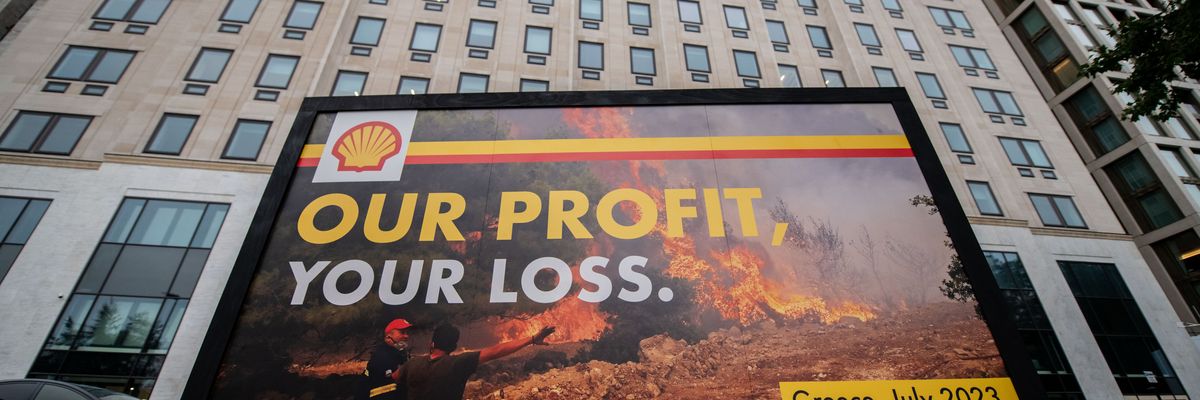
Greenpeace activists display a billboard during a protest outside Shell headquarters on July 27, 2023 in London. (Photo: Handout/Chris J. Ratcliffe for Greenpeace via Getty Images)
“The global energy crisis has been a giant cash grab for fossil fuel firms,” said one campaigner. “And instead of investing their record profits in clean energy, these companies are doubling down on oil, gas, and shareholder payouts.”
The year 2023 was marked by weather events that made it increasingly clear that the Earth has entered what United Nations Secretary General António Guterres called the “era of global boiling,” with wildfires and prolonged heatwaves impacting millions of people and scientists confirming their suffering was the direct result of fossil fuel extraction and planetary heating.
But for the world’s five largest oil giants, the year marked record profits and the approval of several major new fossil fuel projects, allowing the companies to lavish their shareholders with payouts that are expected to exceed $100 billion—signaling that executives have little anxiety that demand for their products will fall, said one economist.
The companies—BP, Shell, Chevron,ExxonMobil, and TotalEnergies—spent $104 billion on shareholder payouts in 2022, and are expected to reward investors with even more in buybacks and dividends for 2023, The Guardian reported.
Shell announced plans in November to pay investors at least $23 billion—more than six times the amount it planned to spend on renewable energy projects—while BP promised shareholders a 10% raise in dividends and Chevron could exceed the $75 billion stock buyback it announced early last year.
Alice Harrison, a campaigner for Global Witness, noted that fossil fuel shareholders will be enjoying their paydays as households across Europe struggle with fuel poverty and the world faces the rising threat of climate disasters brought on by the industry.
“The global energy crisis has been a giant cash grab for fossil fuel firms,” Harrison told The Guardian. “And instead of investing their record profits in clean energy, these companies are doubling down on oil, gas, and shareholder payouts. Yet again millions of families won’t be able to afford to heat their homes this winter, and countries around the world will continue to suffer the extreme weather events of climate collapse. This is the fossil fuel economy, and it’s rigged in favor of the rich.”
It’s a happy new year for oil company shareholders enjoying massive dividends. The 5 largest majors are distributing over $100 billion. Not so happy a new year for British energy consumers who are subject to a new round of price increases, plunging more households into poverty. https://t.co/g3i4Zdoxo7
In 2023 campaigners intensified their demands for accountability from the oil, gas, and coal industries, and as of last month had successfully pressured more than 1,600 universities, pension funds, and other institutions to divest from fossil fuels. In the U.S., provisions in the Inflation Reduction Act, which has been touted as the “largest investment in climate and energy in American history,” went into effect.
But Dieter Helm, a professor of economic policy at the University of Oxford, The Guardian that if the industry were truly fearful of policymakers phasing out fossil fuel extraction and expediting a transition to renewable sources, they would be spending far less on new projects and shareholder payouts.
“For this to be the case you would have to believe that the energy transition is happening, and that demand for fossil fuels is going to fall,” Helm told The Guardian.
In 2023, U.S. President Joe Biden infuriated climate campaigners by approving the Willow oil drilling project in Alaska, which could lead to roughly 280 million metric tons of heat-trapping carbon dioxide emissions. His administration also included in a debt limit deal language that would expedite the approval of the Mountain Valley Pipeline, which could emit the equivalent of more than 89 million metric tons of carbon dioxide, while the U.K. government greenlit a massive oil drilling field in the North Sea and French company TotalEnergies continued to construct the 900-mile-long East African Crude Oil Pipeline, which would transport up to 230,000 barrels of crude oil per day.
“These companies are investing a huge amount in new projects, and they’re handing out bigger dividends because they are confident that they’re going to make big returns,” Helm said. “And when we look at the state of our current climate progress, who’s to say they’re wrong?”
Climate campaigner Vanessa Nakate pointed out that the shareholder paydays are expected following a deal on a loss and damage fund at the 28th annual United Nations Climate Change Conference, aimed at helping developing countries to fight the climate emergency. That fund was hailed as “historic” and included a commitment of $700 million from wealthy countries—a sum that is expected to be dwarfed by fossil fuel investors’ profits.
“They have picked people’s pockets, fueled inflation and pollution, and deepened poverty,” U.K. House of Lords member and Tax Justice Network co-founder Prem Sikka said of the oil giants. “Governments do nothing to end their monopolistic control. Need to break-up this cartel.”
As we welcome in the new year, we must raise our collective voices for sustainability, peace and justice more urgently than ever, says JEREMY CORBYN MP
…
There has to be an alternative which refuses to accept Tory tax policies that favour the better-off. An alternative that ends the scandal of the two-child benefit policy. An alternative that builds council housing. An alternative that takes energy, water, rail and mail into democratic public ownership.
An alternative that challenges the dehumanisation of human beings seeking asylum. The rhetoric against the so-called “boat people” is appalling, racist and fuels the most dangerous forces in our society. Their heart-rending tales should shame anybody who seeks to outsource their responsibilities to fellow human beings trying to survive.
There are more refugees than ever in this world, more desperate people who want to survive, and more people who want to live and contribute to our collective good. It requires political leadership and vision to stand up and say: refugees are human beings, and we need an immigration system that treats everybody with dignity, care and respect.
Refugees are victims of environmental disaster. They are victims of persecution. They are victims of war. We know this because we can see it live on our TV screens.
Over 20,000 people have already been killed by the Israeli assault on Gaza, in response to the 1,200 killed on October 7 by Hamas. Meanwhile, there has been a horrifying increase in settler violence on the West Bank, as the Israeli Defence Force supports a system of oppression and apartheid.
Only an immediate ceasefire can bring about a halt to the killings. That should be the first step to an international demand for the end to the occupation, and justice for the Palestinian refugees in camps in Jordan, Syria and Lebanon.
BRITAIN’S threats to bomb the Yemeni Houthi movement for attacking Israeli-linked ships in the Red Sea “pose a serious threat to world peace” and is “completely irresponsible,” anti-war campaigners warned today.
Defence Secretary Grant Shapps said that the government would not hesitate to take “direct action” on the Iranian-backed forces after the US military said four boats from Houthi-controlled areas in Yemen fired at the Maersk Hangzhou and got within metres of the vessel.
Britain and the US were reportedly preparing a joint statement to issue a final warning to the Houthis.
Stop The War Coalition’s Lindsey German said that the action would be “another potential escalation” in the Middle East, warning that it is “the last thing we need.”
She told the Star: “We have got Israel bombing Gaza on a daily basis with terrible consequences and so far the war hasn’t spread further than Palestine, but the truth is the Israelis are threatening to launch attacks on Hezbollah in Lebanon.
…
“People might wonder what British and US ships are doing in the Middle East and they have to realise they are contributing to a very dangerous situation which may lead to a regional war.”