Protests were a preview of planned marches in the city ahead of United Nations’ climate ambition summit on 20 September
Progressive lawmakers and climate activists rallied at the Capitol on Thursday to demand an end to fossil fuel usage, previewing a planned march in New York on Sunday ahead of the United Nations’ climate ambition summit on 20 September.
“Clearly, saving the planet is the most important issue facing humanity,” the Democratic senator Jeff Merkley of Oregon, said. “But here’s the ugly and brutal truth: right now, humanity is failing. The planet is crying out for help.”
The rally was one of more than 650 global climate actions taking place this week in countries including Bolivia, Pakistan, Ethiopia and Austria.
In New York, dozens of activists protested outside of the headquarters for asset manager BlackRock and Citibank on Wednesday and Thursday respectively, to call attention to both firms’ investments in fossil fuels.
The mobilizations are set to culminate with the March to End Fossil Fuels in New York City on Sunday, 17 September, which has been endorsed by 400 scientists and 500 organizations, including the NAACP, the Sierra Club and the Sunrise Movement. Organizers have predicted the event, which aims to convene tens of thousands of activists from across the country and around the world, will be the largest climate march in the US in five years.
…
Climate activists kick off rallies against fossil fuel in week of action in New York
California Joins States Suing Big Oil for Its Role in the Climate Crisis
Original article by Dana Drugmand republished from DeSmog.
Lawsuit filed against five oil and gas majors and API demands they pay for their decades of deception.

The California State Superior Court in San Francisco. Credit: Cocoablini (CC BY-SA 4.0), via Wikimedia Commons The state of California has jumped into the ring in the fight to hold some of the world’s biggest fossil fuel producers accountable for their role in driving the worsening climate crisis. On Friday, California Attorney General Rob Bonta filed a lawsuit against five oil and gas majors including ExxonMobil, Chevron, BP, Shell, and ConocoPhillips as well as their chief lobby group the American Petroleum Institute. The lawsuit alleges these entities deliberately deceived the public about the dangers of fossil fuels and their impact on the climate system, and effectively engineered a delayed societal response to addressing the climate problem.
California’s filing adds to a growing wave of climate lawsuits brought by cities, counties and states across the country against Exxon and its industry peers. A handful of the state’s coastal communities led the way in this wave of litigation by filing some of the first cases against fossil fuel companies in 2017 and 2018. Now more than three dozen states and municipalities are taking corporate climate polluters to court.
California has become the eighth state to file a climate liability lawsuit, joining Rhode Island, Massachusetts, Connecticut, Vermont, Delaware, Minnesota, and New Jersey. Given its sheer size, California’s move to take legal action adds significant weight to this mounting roster of states.

“California’s decision to take Big Oil companies to court is a watershed moment in the rapidly expanding legal fight to hold major polluters accountable for decades of climate lies,” Richard Wiles, president of the Center for Climate Integrity, a group advocating for holding climate polluters accountable, said in a statement.
According to the complaint, filed in Superior Court for the County of San Francisco, the defendants “have misled consumers and the public about climate change for decades,” mounting a disinformation campaign to discredit the emerging scientific consensus dating back to at least the 1970s. The alleged deception continues to this day through misleading advertising that greenwashes the companies’ image by portraying them as climate-friendly, the complaint contends.
Misleading advertising is among the charges the lawsuit brings, along with misleading environmental marketing; unlawful, unfair, or fraudulent business practices; products liability; pollution and destruction of natural resources; and public nuisance. California is seeking monetary damages.
Noting that just this year the state has suffered from multiple climate-related disasters such as extreme flooding and drought, severe wildfires, and a record-hot summer, the complaint argues that California taxpayers should not have to bear all the costs of dealing with these escalating climate impacts. Instead, “the companies that have polluted our air, choked our skies with smoke, wreaked havoc on our water cycle, and contaminated our lands must be made to mitigate the harms they have brought upon the State,” the complaint states, adding it “seeks to hold those companies accountable for the lies they have told and the damage they have caused.”
Original article by Dana Drugmand republished from DeSmog.
Climate change is set to make our holidays look very different – here’s how
Nick Davies, Glasgow Caledonian University
Holidays are making a comeback after several years of disruption caused by the COVID pandemic. Nearly 4 billion passengers boarded international flights in 2022, up from fewer than 2 billion in 2020. Recent research suggests that people are likely to continue travelling more in 2023 and beyond.
But this resurgence in travel is concerning. The tourism sector alone is responsible for an estimated 8%–10% of global greenhouse gas emissions. And conditions at traditional holiday destinations in high summer are becoming increasingly unpleasant if not downright hazardous.
During the past year, numerous climate records have been broken as heatwaves and wildfires ravaged large parts of Europe, Asia and North America. In July, both Sardinia and Sicily experienced temperatures in excess of 46°C, nearly breaking European records.
Most of what we do while on holiday, particularly on holidays abroad, releases greenhouse gases into the atmosphere and ultimately has an impact on the climate. But the way most of us get there – by flying – is potentially most damaging. UK data suggests that a single passenger on a short-haul flight, for instance, is responsible for releasing the equivalent of approximately 154g of CO₂ for every kilometre travelled.
As the effects of climate change become increasingly severe, there’s genuine concern that traditional destinations will become too hot in summer to remain appealing to visitors. This raises the question: how will tourism adapt?
Changing destinations
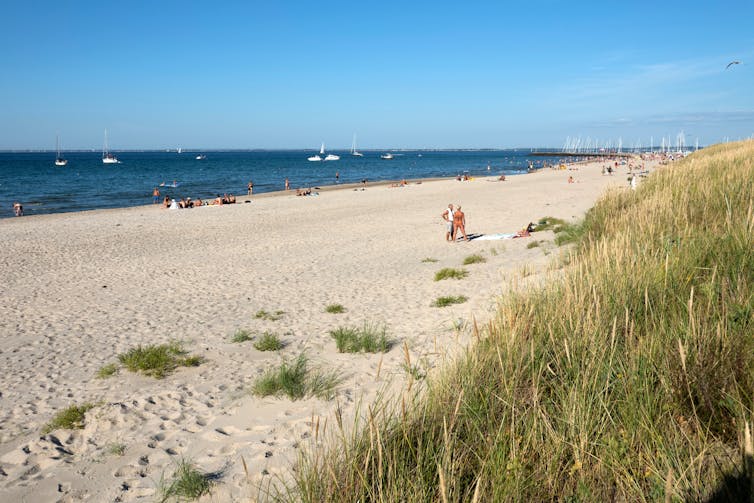
Researchers have been trying to predict the future of tourism for quite some time. One idea is that tourism will undergo a “poleward shift” as global warming causes temperatures to rise not only in traditionally hot regions, but also in locations further to the north and south.
A modelling study from 2007 predicted that, by 2050, hotter weather would make popular tourist hotspots like the Mediterranean less appealing in the summer. At the same time, northern destinations such as Scandinavia and the UK would experience longer holiday seasons.
Destinations like Hornbæk strand in Denmark may become more popular in the future.
Jo Jones/ShutterstockApproximately half of global tourism is concentrated in coastal areas. So another concern is the potential loss of beaches due to rising sea levels. In the Caribbean, an estimated 29% of resort properties would be partially or fully inundated by one metre of sea-level rise – though many of these resorts would have lost a significant amount of their beach area before this.
Some other beach destinations are potentially even more vulnerable. Sardinia was hit by disruptive storms in 2022. Research suggests that the beaches there may struggle to accommodate tourists in the near future due to a greater risk of flooding and storms.
The impact of climate change on tourism will extend beyond just coastal areas. Many popular city break destinations, including Porto in Portugal, are expecting to endure more severe heat. Tourism in mountainous areas will be affected, too, as accelerated snow melt leads to shorter ski seasons.
The practicalities of tourism shifting
Changing conditions will affect where humans can safely travel to. But travel patterns take time to evolve. In the meantime, established destinations will need to change to withstand challenges such as extreme heat, rising sea levels and other climatic conditions.
Existing tourist destinations in areas of the world that are vulnerable to the effects of climate change, such as the Nile Delta in Egypt, are already considering ways to adapt. These include building seawalls and natural dunes to protect tourist areas from coastal flooding. Changing construction materials and reconfiguring urban spaces to improve ventilation have also been proposed as ways to reduce reliance on expensive and energy-intensive air-conditioning.
New destinations that begin to emerge in more temperate regions will require substantial infrastructure development to support the influx of visitors. This includes transport systems, accommodation, dining options and attractions. The process of establishing tourist destinations typically takes time and requires careful thought.
Barcelona, for example, has experienced a rapid surge in tourism demand since the 1992 Olympics. This has resulted in a tenfold increase in visitors over the past three decades.
Such rapid tourism development can put a strain on local people and the environment. Although Barcelona already had a transport system and some infrastructure to accommodate visitors, the rapid growth in tourism has led to strong opposition from local residents.
Tourists have caused a nuisance in Barcelona.
Volodymyr Dvornyk/ShutterstockWhat will happen next year?
The current thinking among tourism academics is that those responsible for managing tourist destinations should work towards reducing carbon emissions by focusing on the domestic market.
But, as recent summers have shown, international tourism does not look set to slow down yet. Even amid crises such as the fires burning through Rhodes in summer 2023, tourists continued to arrive.
Rather than choose different destinations, the most likely scenario – at least in the short-term – is that tourists themselves will adapt to the effects of climate change. During Europe’s summer 2023 heatwave, there were reports that people were staying in their hotel rooms in the hottest part of the day and taking sightseeing trips in the evening.
Nevertheless, there are some signs that travellers may be starting to worry about more extreme weather conditions and adapt their travel plans accordingly. A survey conducted in May 2023 showed that 69% of Europeans planned to travel between June and November – a fall of 4% compared to 2022.
The heatwave of summer 2023 might mean that tourists start looking for cooler destinations as early as the coming year.
The evolving landscape of global tourism in the face of climate change is complex. What is clear, though, is that if Europe continues to experience extreme weather conditions like the summer of 2023, many people will think twice about booking their place in the sun.

Nick Davies, Lecturer and Programme Leader, BA International Tourism and Events Management, Glasgow Caledonian University
This article is republished from The Conversation under a Creative Commons license. Read the original article.
Climate protests everywhere yesterday and today
Greta Thunberg was arrested in Sweden on Friday after allegedly disobeying police orders during a climate protest. Quintin Bignell reports on what happened and the plans for this week.



- 7 July
- 7/7
- Adrian Ramsay
- AI Artificial Intelligence
- Airstrip One
- Alba Party
- Amazon
- Amber Rudd plc
- Andrew Feinstein
- Andrew Lansley
- Andy Burnham
- Angela Rayner
- anti-austerity
- austerity
- Austerity 2
- be afraid
- be afraid of terrrists
- bees
- benefits
- Benjamin Netanyahu
- Blackstone
- Blair government following 9/11 script
- Boris 'Rice pudding' Johnson
- Boris Johnson
- BP
- Brexit
- Buller
- Carla Denyer
- Caroline Lucas
- CCS carbon capture and storage
- Chevron
- Climate Crisis
- Climate Emergency
- Climate Science Denial
- Communist Party
- conservatives
- COP26
- COP27
- COP28
- COP29
- COP30
- COP31
- COP31
- Coronavirus
- Cost of Living crisis
- Count Binface
- Covid-19
- Craig Murray
- crap pretend Labour
- David Cameron
- David Lammy
- David Miliband
- deregulaton
- Diane Abbott
- Donald Trump
- Dubya Bush
- dust explosions
- Eat shit
- economy
- Ed Balls
- Ed Davey
- Ed Miliband
- Edward Snowden
- Ellie Chowns
- Elon Musk
- Emily Thornberry
- Enough is Enough
- environment
- Equinor
- Extinction Rebellion
- ExxonMobil
- fake manufactured terrorism
- fake news
- Fascism
- FFF
- fossil fuel subsidies
- Freedom of Information
- GCHQ
- General Election
- genocide
- George Galloway
- George Osborne
- Gordon Brown
- Grant Shapps
- Green Party
- Greenpeace
- Greta Thunberg
- Hannah Spencer
- Hinkley Point C
- HP£
- HP3
- HS2
- human rights violations
- Hydrogen-Pyroxide
- I think that I got the point that it was a premature announcement by BBC before it actually happened – they were following a script
- Ian Blair
- IDS Iain Duncan Smith
- Independent Alliance
- Insulate Britain
- IPCC
- Iran
- Iraq wars
- Israel
- it was done for me
- it's a myth
- Jack Straw
- James Cleverly
- JD Vance
- Jean Charles de Menezes
- Jeffrey Epstein
- Jeremy Corbyn
- Jeremy Hunt
- Joe Biden
- John Healey
- John McDonnell
- John Reid
- John Swinney
- Julian Assange
- Just Stop Oil
- Kamala Harris
- Keir Starmer
- Kemi Badenoch
- Ken Livingstone
- King Charles III
- Kwasi Kwarteng
- Labour Party
- Lebanon
- Led by Donkeys
- Leon Brittan
- Liam Fox
- Lib Dems
- Liz Kendall
- Liz Truss
- lobbying non-register
- lobbying secrecy and anti-democracy bill
- Margaret Thatcher
- Microsoft
- money laundering
- Monster Raving Loony Party
- nationalise
- neo-con
- Neo-liberalism
- new authoritarianism
- NHS
- Nick Clegg
- Nicola Sturgeon
- Nigel Farage
- nuclear
- nuclear filth
- nuclear waste
- OpenAI
- paedo
- Palantir
- Palestine
- Pete Hegseth
- Peter Mandelson
- Plaid Cymru
- plutocracy
- political bigotry and intolerance
- politics
- premature collapsation
- previous blog
- Priti Patel
- private medicine
- privatise
- Project 2025
- Rachel Reeves
- racism
- Real Estate
- Reform 2025 Ltd (Reform UK)
- renewable energy
- Richard Branson
- ridiculously irresponsible attitude to nuclear waste
- RIPA
- Rishi 'Richy' Sunak
- Rishi Sunak
- Roger Hallam
- Rosebank
- Royal Mail
- Rupert Murdoch
- Sadiq Khan
- Saudi Armaco
- Scottish Greens
- Scottish National Party (SNP)
- Sellafield
- serious joking
- Shabana Mahmood
- Shell
- Siân Berry
- Sinn Fein
- Slinky … bike
- Socialism
- Socialist
- Sue-Ellen Suella Braverman
- Super-injunction
- swears,
- tax evasion
- tax exemption
- terrorism bullshit
- Thatcher's paedos
- the filthy rich
- The Plot Against the NHS
- the resistence
- Theresa May
- they made it up
- thinks
- this is Islamaphobia
- Thoughts of the Day
- to make me a terrorist
- Tony Blair
- Total
- trade unionism
- Trump
- UK Coronavirus
- UK history
- Ukraine War
- Uncategorized
- universal credit
- unofficial narrative
- US Coronavirus
- USUK
- Venezuela
- Vince Cable
- virgin
- Vladimir Putin
- war crime
- war on science
- war on terrorism
- war on terrorism bullshit
- we are protecting you from evil terrrists (honest). We're not evilly manipulating your fears
- Wes Streeting
- what a load of crap
- working-class history
- Your Party
- Youth Demand
- Yvette Cooper
- Zack Polanski
- Zarah Sultana
- Zionism