I need to do an article or a series of articles – particularly but not only addressed at young people – on why it’s so important to protest climate now.
From 11am on Monday November 21st, Extinction Rebellion and other aligned groups took nonviolent action at thirteen sites across central London, targeting the offices of companies and organisations which have links to the fossil fuel industry. The groups sent a universal message that it’s time to ‘cut the ties’ with fossil fuels.
Actions took place at BP, Hill+Knowlton Strategies, BAE Systems, Church House, Ineos, Eversheds Sutherland, Schlumberger, the International Maritime Organisation, the Institute of Economic Affairs, JP Morgan, Arch Insurance, the Ontario Teachers Pension Plan and the Department for Business, Energy and Industrial Strategy.
The actions follow the conclusion of COP27 in Egypt, which was widely criticised for the heavy presence of representatives of oil and gas companies. Hill+Knowlton Strategies, one of the companies targeted today, has worked for fossil fuel companies ExxonMobil, Shell, Chevron and Saudi Aramco and recently managed communications for Egypt’s presidency of the UN climate conference at Sharm El Sheikh.
Extinction Rebellion spokesperson, Sarah Hart, said:“Behind incomprehensible government decisions to double down on fossil fuel development, sign off new oil exploration licenses and allow the big energy companies to rake in record profits, lies a network of companies and organisations that are profiting from this destructive path.
“While the rest of us worry about the cost of turning the heating on our government is prioritising the profits of the very companies that are jeopardising our climate and environment. But everyday people are way ahead of politicians. They want to be able to heat their homes and they want a future for their children.
“So today, Extinction Rebellion are sending the message that it’s time to cut the ties with fossil fuels or lose the social license to operate in the UK.”
DETAILS OF THE ACTIONS:
XR Cymru at Hill+Knowlton Strategies offices, Clerkenwell Green XR Cymru splattered fake oil over the offices of public relations consultancy Hill+Knowlton Strategies. Hill+Knowlton has worked for fossil fuel companies ExxonMobil, Shell, Chevron and Saudi Aramco and recently managed communications for Egypt’s presidency of the UN climate conference at Sharm El Sheikh.
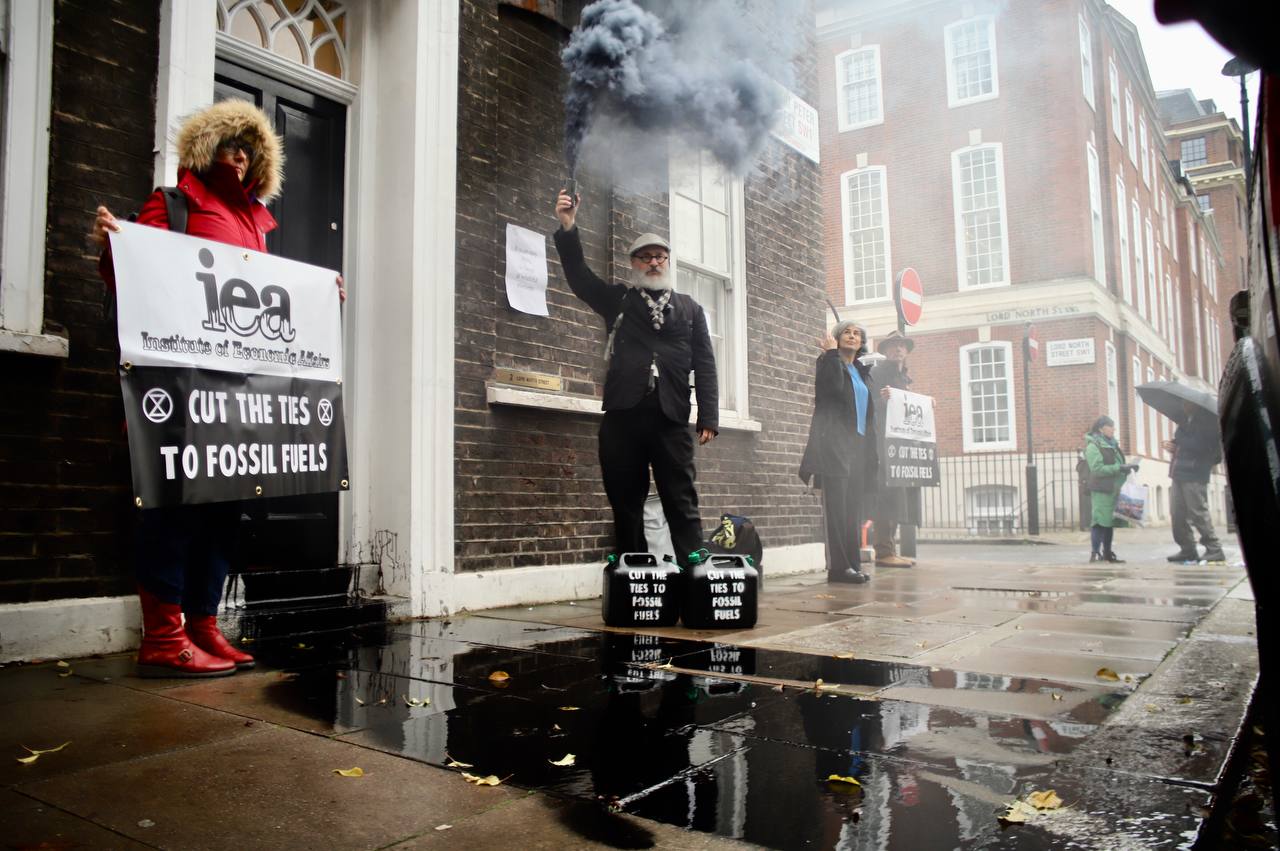
IEA Writers Rebel. Photo: Extinction Rebellion.
Writers Rebel at the Institute of Economic Affairs, Lord North Street Writers Rebel poured fake oil on the front steps of free market think tank the Institute of Economic Affairs. The institute, located just meters from the Houses of Parliament, has received money from fossil fuel companies, regularly publishes materials questioning the consensus on climate science and has huge influence on politicians.
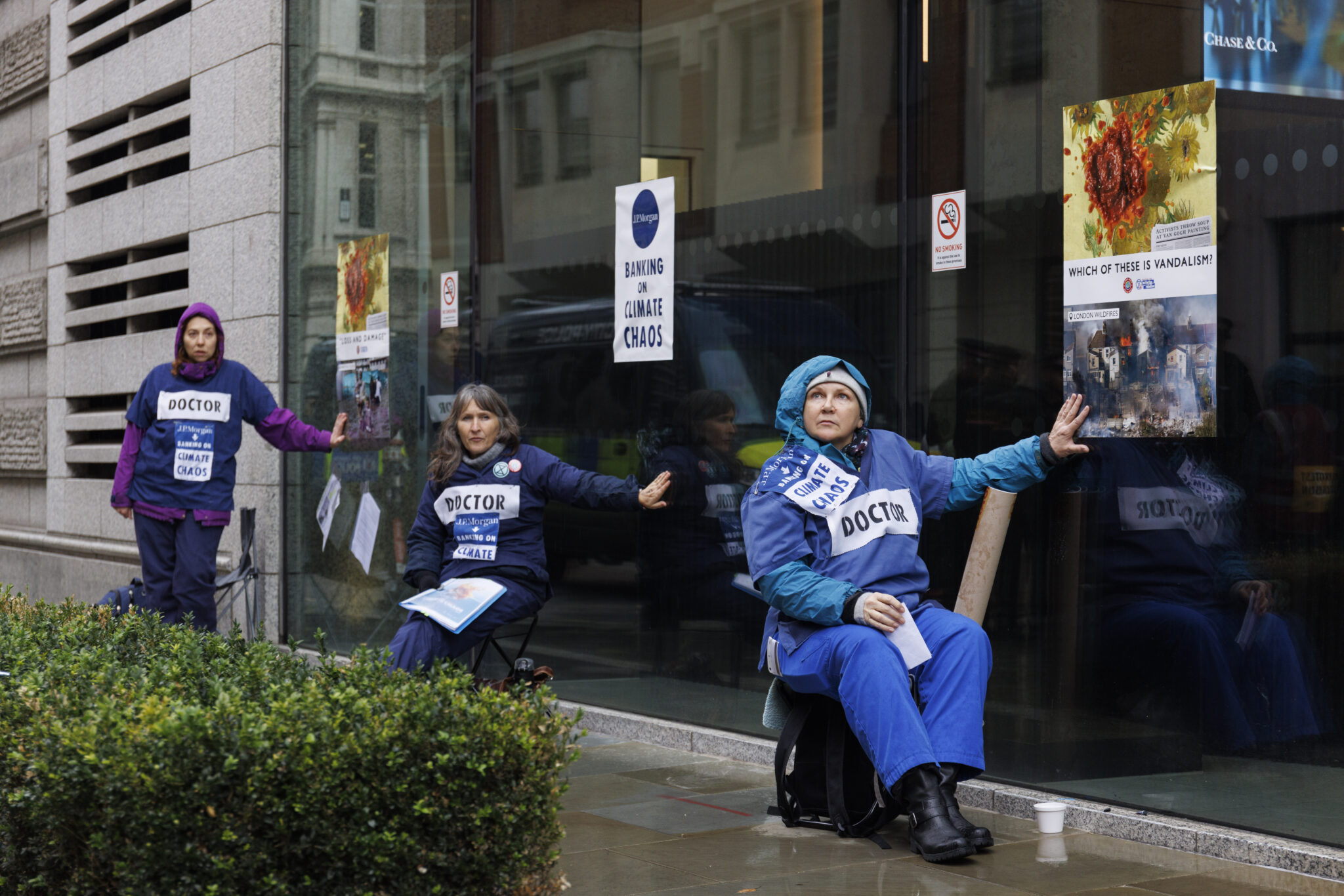
21st Nov 2022. J P Morgan offices, 60 Victoria Embankment, London, UK. Three Doctors for XR arrested after pasting posters and gluing themselves to the outside windows.Photo: Extinction Rebellion.
Doctors for XR at JP Morgan, Victoria Embankment Doctors for XR glued themselves to the windows at the London HQ of JP Morgan and pasted images to the front facade of the building depicting scenes of climate breakdown both here in the UK and overseas. JP Morgan are the world’s biggest fossil fuel financiers.
Christian Climate Action at BAE Systems offices, Carlton Gardens Christian Climate Action left handprints of fake blood and oil on the offices of Britain’s leading arms manufacturer BAE Systems. BAE Systems supply weaponry to conflicts which increase the vulnerability of people living on the front lines of climate change. The arms giant also provides military and technical support to Saudia Arabia, enabling the regime’s oil production.
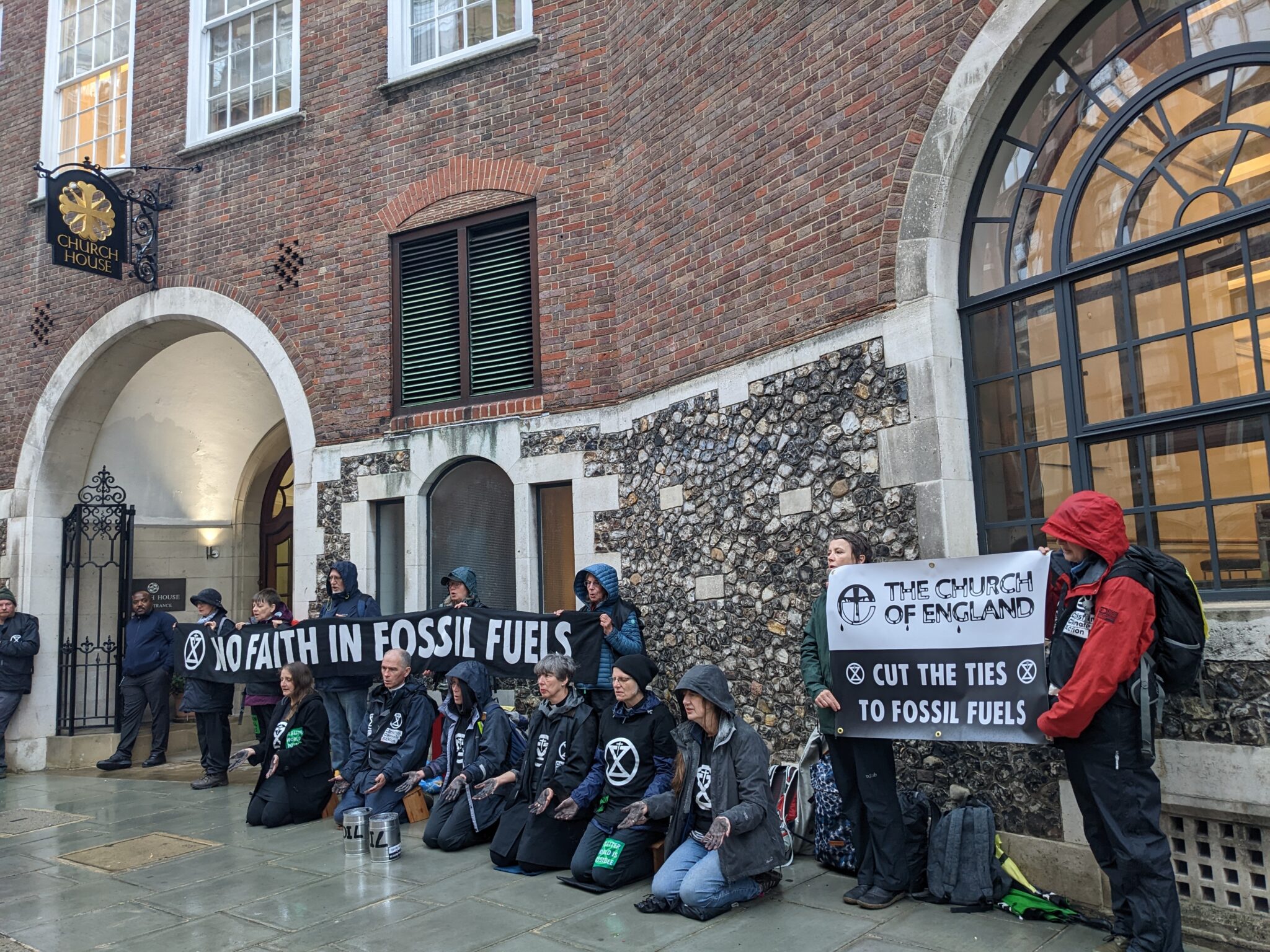
Christian Climate Action. Photo: Extinction Rebellion Holly
Christian Climate Action at Church House, Great Smith Street Christian Climate Action also took action outside Church House in Westminster to highlight the Church of England’s failing strategy to stay invested in fossil fuels and influence the industry as shareholders.
A spokesperson for Christian Climate Action, said: “The Church should be showing moral leadership in rejecting profiting from investments in companies that continue to fuel climate suffering.”
Plastics Rebellion at Ineos offices, Hans Crescent Plastics Rebellion sprayed fake oil outside the offices of Ineos, one of the world’s largest petrochemical producers and a significant player in the oil and gas market. Many of the plastics produced in the UK start their life at the INEOS Grangemouth refinery.
HS2 Rebellion at Eversheds Sutherland, Wood Street HS2 Rebellion sprayed the offices of multinational law firm Eversheds Sutherland with fake oil. As solicitors for HS2 and Esso, Eversheds Sutherland have been forerunners in criminalising nonviolent environmental protest through the use of injunctions.
XR East of England and XR Youth at Schlumberger offices in London, Buckingham Gate XR East of England and XR Youth poured fake oil over a globe at the offices of the world’s largest oilfields services provider Schlumberger to expose their complicity in ecocide. As the world’s largest oilfield services provider, Schlumberger enable fossil fuel extraction, operating in 120 countries around the world, with over 36,000 patents dedicated to extracting every last drop of oil and gas from the ground.
Ocean Rebellion at the International Maritime Organisation, Albert Embankment Ocean Rebellion held protests outside the offices of the International Maritime Organisation where performances illustrated the UN shipping body’s refusal to regulate shipping emissions. A heavy plume of smog filled the air and an oil slick appeared on the ground with dead birds caught in it.
Money Rebellion at Arch Insurance, Great Tower Street Money Rebellion poured fake oil at the offices of Arch Insurance. Arch Insurance are understood to be in negotiations with fossil fuel giant Total regarding the insurance of the East Africa Crude Oil Pipeline (EACOP), a project that will jeopardise important ecosystems, fuel climate change and pose significant risks to millions of people. Money Rebellion is there to say ‘Arch must rule out EACOP’.
Sky Rebellion at Ontario Teacher’s Pension Plan, Portman Square Sky Rebellion poured fake oil in front of the London offices of Ontario Teacher’s Pension Plan. The Canadian based pension fund invests in infrastructure projects including the controversial expansion of Bristol Airport which it owns.
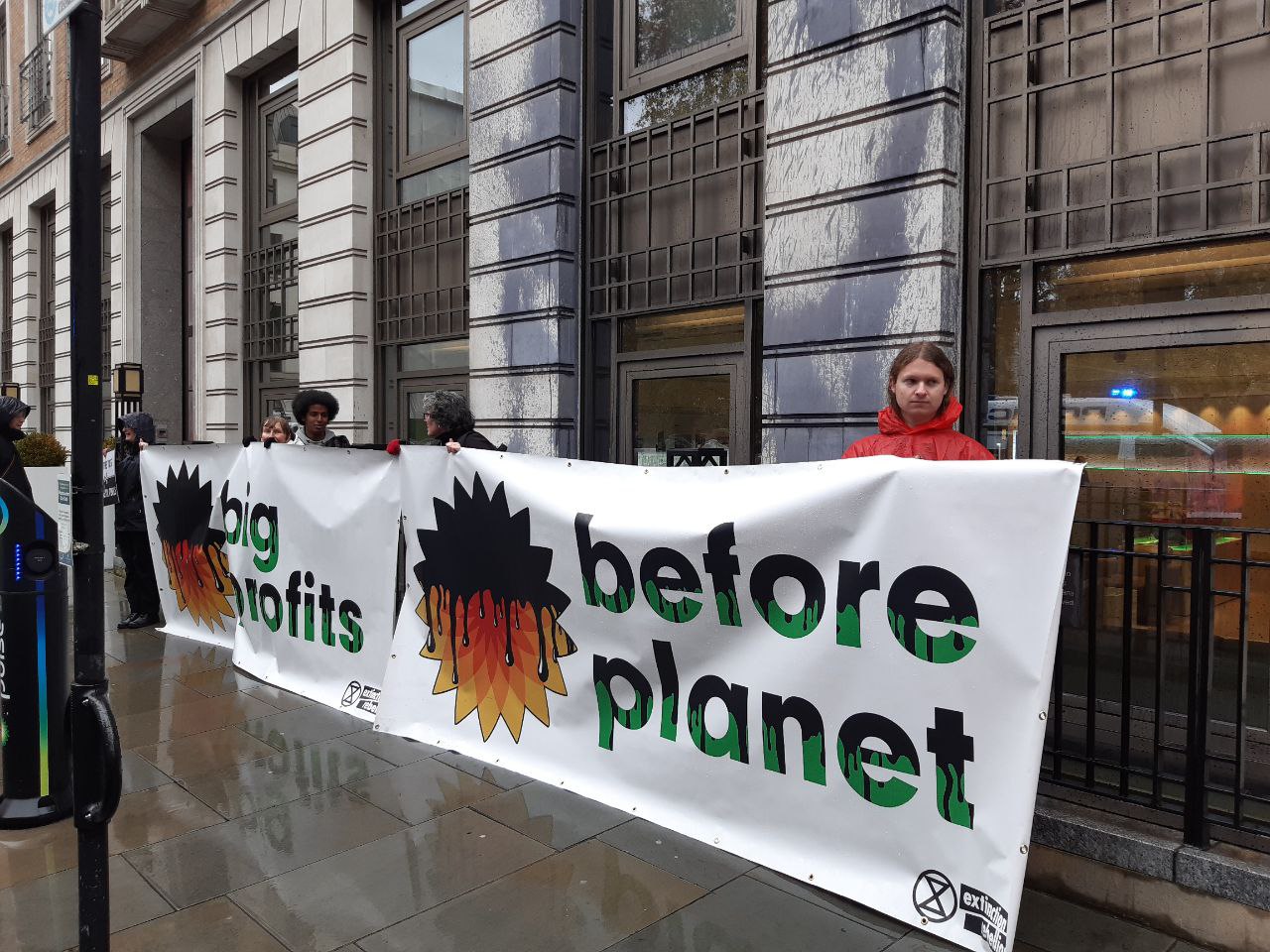
XR South East at BP. Photo: Extinction Rebellion
XR South East at BP HQ, St James’ Square XR South East used fire extinguishers to spray fake on oil BP headquarters in central London.
A spokesperson for XR South East, said: “The addiction to fossil fuels must end. The huge fossil fuel corporations like BP and those who aid and abet them KNOW what we face. BP hides the dirty secrets that lie behind its latest big profit of £7,100,000,000. Enough is enough. Today we are exposing the ties between the collaborators and we will piece together the web of lies with our actions.”
XR South West at the Department for Business, Energy and Industrial Strategy, Victoria Street XR South West sprayed fake oil on the Department for Business, Energy and Industrial Strategy to protest against its plans to issue more than 100 new licences for exploration and extraction of oil and gas in the North Sea – meaning renewed and accelerating extraction way beyond 2030 and way beyond the UK’s Paris Agreement commitments.
XR Rhythms (marching between the locations listed above) In June, London endorsed the Fossil Fuel Non-Proliferation Treaty, so XR Rhythms is marching through London to highlight the web of fossil fuel enablers still working in our city. We want to drum out fossil fuel investments and celebrate the future transition to a more sustainable economy!
The Extinction Rebellion Group offered food for thought at this year’s The Superyacht Forum event after turning up on the final day to protest against the existence of the industry. The group arrived at roughly 9:30am on Wednesday morning with a megaphone and banners to peacefully protest against the complicit behaviour of stakeholders in yachting – they also made it clear they would not be using superglue or tins of tomato soup. We invited the group on stage to speak candidly to the nucleus of the industry about their reasoning and motivations.
Republished from Common Dreams under Creative Commons (CC BY-NC-ND 3.0). Feel free to republish and share widely.
“If all fossil fuels are not rapidly phased out, no amount of money will be able to cover the cost of the resulting loss and damage,” said one climate justice advocate.
Despite mountains of iron-clad evidence that extracting and burning more coal, oil, and gas will exacerbate deadly planetary heating, negotiators at the United Nations COP27 climate conference failed yet again to directly confront the fossil fuel industry whose insatiable quest for profits is putting the future of humanity in jeopardy.
“More fossil fuels equals more loss and damage.”
“In a critical year, this COP made no progress towards the just and equitable phase-out of fossil fuels needed to avoid the worst impacts of climate change,” Oil Change International executive director Elizabeth Bast said Sunday in a statement. “Despite important progress on the establishment of a loss and damage fund, the final outcome reiterated unambitious language on fossil fuels that will lead to catastrophic consequences.”
In what climate justice advocates called a major breakthrough, the United States on Saturday dropped its opposition to the establishment of a loss and damage fund that aims to compensate low-income nations for the devastating effects of global warming. Through no fault of their own, the world’s poorest people are most vulnerable to the deadly impacts of increasingly frequent and intense extreme weather caused primarily by wealthy polluters. A committee of 24 countries has one year to hammer out details, including which governments will contribute to the fund and which will benefit from it.
However, “COP27’s key steps toward a loss and damage fund are deeply marred by the lack of progress on fossil fuels,” said Collin Rees, U.S. campaign manager for Oil Change International. “Despite unprecedented discussion of equitably phasing out oil, gas, and coal, the end result was yet another COP without formal recognition that Big Oil is driving the climate crisis and harming communities.”
In 30 years of UN climate negotiations, eliminating the primary cause of global heating – fossil fuels – has never been mentioned in the decisions, not even in the COP27 in 2022.
“The failure of leaders at COP27 to commit to an unqualified phase-out of oil, gas, and coal not only pushes 1.5ºC further out of reach, it also undermines progress on loss and damage,” Nikki Reisch, director of climate and energy at the Center for International Environmental Law, wrote on social media. “The plain truth is that more fossil fuels equals more loss and damage. Remedy requires cessation of the harm.”
“In settling for a copy-paste of the Glasgow Pact’s incomplete and loophole-ridden language on a ‘phasedown of unabated coal power’ and ‘phase-out of inefficient fossil fuel subsidies,’” Reisch continued, “governments at COP27 took a giant step backward.”
This critical assessment was shared by many observers.
“If all fossil fuels are not rapidly phased out, no amount of money will be able to cover the cost of the resulting loss and damage,” said Yeb Saño, executive director of Greenpeace Southeast Asia. “When your bathtub is overflowing you turn off the taps, you don’t wait awhile and then go out and buy a bigger mop.”
Republished from Common Dreams under Creative Commons (CC BY-NC-ND 3.0). Feel free to republish and share widely.
A new fund for #LossAndDamage at #COP27 is a major step forward. But governments have again failed to commit to phase out the three primary causes of #LossAndDamage: coal, oil and gas. This is why we need a #fossiltreaty, to secure a rapid global just transition from fossil fuels
Ahead of the COP27 summit, the U.N. found that Earth is on currently track to be up to 2.9°C hotter than the preindustrial average by century’s end. Existing emissions reductions targets and policies are so weak, the body warned, that there is “no credible path to 1.5°C in place,” and only “urgent system-wide transformation” can prevent the world from crossing dangerous tipping points that will lead to the most cataclysmic outcomes.
Temperature rise of roughly 1.2°C to date has already unleashed chaos around the world, including calamitous flooding in Nigeria and Pakistan, along with several other disasters in various places this year.
Despite the worsening nature of the fossil fuel-driven climate emergency, hundreds of corporations are planning to expand dirty energy production in the coming years, including several proposed drilling projects and pipelines in Africa. To make matters worse, delegates at COP27—where more than 630 fossil fuel industry representatives made their presence felt—refused to endorse a complete phase-out of coal, oil, and gas.
“We are at risk of a major surge of new oil and gas production.”
“I don’t in any way want to diss the great success by poorer nations in achieving a loss and damage agreement,” environmental journalist George Monbiot tweeted Sunday, though he predicted that “rich nations will break their promises to pay,” as they have when it comes to providing $100 billion each year to fund climate action in the Global South. “There was no progress on stopping climate breakdown. COP27 is another terrible failure.”
“Whenever an agreement is reached at one of these meetings, people celebrate, largely with relief at having got to the end,” Monbiot added. “It’s only afterwards that we begin to ask, ‘What exactly has been achieved?’ If it’s is anything other than decisive action, the answer is not much.”
David Tong, global industry campaign manager at Oil Change International, said that “some people turned up to negotiate for their futures, but oil and gas lobbyists turned up to negotiate for their wallets.”
“The reality is that the only way to safely limit warming to 1.5ºC is to equitably phase out oil, gas, and coal,” said Tong. “Instead, we are at risk of a major surge of new oil and gas production.”
Tong noted that “new fields and shale wells approved from 2022-2025 could result in 70 gigatonnes of additional climate pollution—and every single tonne of that would take us further beyond 1.5ºC because burning just the oil and gas in already existing fields would exhaust our carbon budget for a 50% chance at 1.5ºC.”
“Although this COP failed to call for an equitable phase-out of oil, gas, and coal,” Tong continued, “momentum is growing. A remarkable group of countries across numerous negotiating blocs spoke up together, urging the phase-out of fossil fuels.”
At #COP27 80+ countries supported a call to phase out ALL fossil fuels.
These governments must back up this stance with action.
How?
❌ Commit to no new coal, oil or gas
✍️ Join Vanuatu and Tuvalu in developing a Fossil Fuel Non-Proliferation Treaty. https://t.co/d2Ak0ZHTah
Notwithstanding the anti-extraction struggles being waged by communities and climate justice campaigners the world over, Seve Paeniu, minister of finance for the Pacific island nation of Tuvalu, denounced his fellow policymakers for omitting language that explicitly demands a fossil fuel phase-out. Tuvalu called for a Fossil Fuel Non-Proliferation Treaty at COP27, becoming the second country to do so, after Vanuatu at the U.N. General Assembly in September.
“We have finally responded to the call of hundreds of millions of people across the world to help them address loss and damage. So this is a defining COP in that respect,” said Paeniu. “However, it is regrettable that we haven’t achieved an equal success in our attempt to achieve the 1.5ºC target. It is regrettable that we haven’t got strong language included in the cover decision before us on phasing out fossil fuel.”
“It is regrettable that we haven’t got text on peaking emissions before 2025,” Paeniu continued. “It is regrettable that we haven’t managed to get stronger mention of methane reduction.”
"We haven't responded sufficiently…it has made Sharm El Sheikh a missed opportunity for a truly successful #COP27."
“In Glasgow, we saw a phase-down of coal,” Zeina Khalil Hajj, head of global campaigning and organizing at 350.org, said in a statement. “At COP27 in Sharm El-Sheikh, we needed to see an equitable and just phase-out of all fossil fuels.”
“A text that does not stop fossil fuel expansion, that does not provide progress from the already weak Glasgow Pact makes a mockery of the millions of people living with the impacts of climate change,” Hajj continued. “The agreement on loss and damage is a major breakthrough, but without action to phase out the expansion of the fossil fuels that will cause further loss and damage, COP27 has failed to make the progress needed. And we are building a fund for our own destruction.”
“Most importantly, COP27 has showcased the growing power of the climate justice movement,” said Bast. “Throughout these two weeks, civil society voices have demanded a phase-out of fossil fuels and called for rich countries to pay up for climate debt.”
“Every day, we are seeing the power of communities resisting harmful oil, gas, and coal projects,” she added. “We are seeing massive growth in the breadth and depth of the movement. With this people power, we will force an equitable end to fossil fuels and a just transition to clean energy.”
Republished from Common Dreams under Creative Commons (CC BY-NC-ND 3.0). Feel free to republish and share widely.