European governments have rushed to build fossil gas infrastructure since Russia invaded Ukraine. Photograph: Annegret Hilse/Reuters
Just 2% of continent’s gas capacity has planned retirement date despite pledges to decarbonise, study shows
Europe’s “tone-deaf” expansion of fossil gas is accelerating climate breakdown and increasing reliance on hostile regimes, campaigners have warned.
Just four of Europe’s gas-fired power plants have a retirement plan and new projects will increase the continent’s gas generation capacity by 27%, according to analysis from the campaign group Beyond Fossil Fuels.
It argues that the dash for gas contradicts the International Energy Agency’s recommendation that rich countries decarbonise their electricity grids in the next 10 years to stop the planet from heating 1.5C.
Governments must send a clear message to the gas industry that its days are numbered, said Alexandru Mustață, a campaigner at Beyond Fossil Fuels. “This undermines our security, exposes us to volatile power prices and toxic emissions, and heightens the risk of stranded assets.”
A wounded person receives treatment at a local hospital in the southern Gaza Strip city of Rafah on March 24, 2024. (Photo: Khaled Omar/Xinhua via Getty Images
U.N. member states must “use their influence” to push Israel to halt its bombardment of Gaza and blocking of humanitarian aid, said the group’s secretary general.
“The time to act to prevent genocide is now,” Amnesty International’s secretary general said Tuesday, a day after the United Nations Human Rights Council released a draft report detailing how the panel found that there are “reasonable grounds to believe” that Israel is already committing genocidal violence in Gaza.
Amnesty’s Agnes Callamard called the 25-page report a “crucial body of work that must serve as a vital call to action to states,” many of which have called for a cease-fire in Gaza for several months.
After the U.N. report found that “the overwhelming nature and scale of Israel’s assault on Gaza… reveal an intent to physically destroy Palestinians as a group,” Callamard said “states must now focus their efforts on making these calls a reality.”
“Third states must apply political pressure on the warring parties to implement the U.N. Security Council resolution adopted yesterday demanding an immediate cease-fire, use their influence to insist that Israel abides by the resolution, including by stopping the shelling and lifting restrictions on humanitarian aid,” said Callamard. “They must impose a comprehensive arms embargo against all parties to the conflict. They must also pressure Hamas and other armed groups to free all civilian hostages.”
“The time to act to prevent genocide is now": #UN Special Rapporteur report on #Gaza provides crucial evidence that must spur international action. Read more below: https://t.co/z8r6FSi7Wl
The U.N. report was released the same day that the U.N Security Council adopted a resolution demanding an immediate, temporary cease-fire for the remainder of the month of Ramadan—the first cease-fire resolution to pass at the council following three that failed due to the U.S. vetoing the measures.
The U.S., which gives Israel $3.8 billion in annual military aid and has continued to provide support throughout the bombardment, abstained from voting on Monday’s resolution and infuriated human rights experts by baselessly claiming the vote was “nonbinding.”
It was irresponsible on the part of the US Ambassador to suggest that a resolution meant to save lives and address massive devastation and suffering can be disregarded. Just plain irresponsible. https://t.co/9VZIGfpJ88
The U.N. report, titled Anatomy of a Genocide, detailed actions Israel has taken since beginning its bombardment of Gaza in October that could violate Article II of the Genocide Convention, including killing members of the group, causing serious bodily or mental harm to members of the group, deliberately inflicting conditions of life calculated to bring about its physical destruction, and imposing measures intended to prevent births.
Along with killing at least 32,414 Palestinians in Gaza—73% of whom have been women and children, and the remaining 27% were not proven to have been Hamas members—Israel has also imposed mass starvation on the population, killing “10 children daily,” according to the report. Israel has detained thousands of Palestinian men and boys in undisclosed locations; injured 70,000 people; forced medical personnel to perform “hazardous health procedures, such as amputations without anesthetics, including on children”; and “destroyed or severely damaged most life-sustaining infrastructure.”
Callamard noted on Tuesday that the report came two months after the International Court of Justice (ICJ) announced an interim ruling that Israel is “plausibly” committing a genocide in Gaza and ordered the country to take action to prevent genocidal violence by its forces.
“In that time, the situation in Gaza has grown exponentially worse, with thousands more Palestinians killed and Israel continuing to refuse to comply with the ICJ ruling to ensure provision of sufficient humanitarian aid to Palestinians as human-made famine edges closer each day and more people starve to death,” said Callamard.
The secretary general echoed a call in the report, which was compiled by Francesca Albanese, special rapporteur on human rights in the occupied Palestinian territories, for the full funding of the U.N. Relief and Works Agency for Palestine Refugees in the Near East (UNRWA).
Israel said Sunday it will no longer permit UNRWA aid trucks to deliver humanitarian relief in northern Gaza, where one-third of children under age 2 are now suffering from acute malnutrition. The U.S. officially suspended UNRWA funding through March 2025 on Monday after President Joe Biden signed a new spending package into law.
The U.S. led several countries in cutting funding to the agency in January after Israel claimed 12 of UNRWA’s 13,000 employees in Gaza had been involved in the Hamas-led attack on southern Israel in October. Countries including Finland, Canada, and Australia have since reinstated funding.
Callamard also called on all states, particularly powerful Western countries that are allied with Israel, including the U.S., to support international authorities as they try to hold Israeli officials to account for the mass killing and starving of civilians in Gaza. Israel has refused to allow U.N. experts and other independent human rights monitors access to Gaza.
“Helping to prevent genocide also means supporting accountability efforts including the ongoing investigation by the Office of the Prosecutor of the International Criminal Court and exercising universal jurisdiction to bring those suspected of crimes under international law to justice,” said Callamard.
The secretary general noted that momentum has grown in recent days around international calls for a cease-fire, but said a desperately needed halt in fighting requires a concerted push by influential states to become a reality.
“An enduring cease-fire,” said Callamard, “remains the best way to enforce the ICJ’s provisional measures to prevent genocide and further crimes and civilian suffering.”
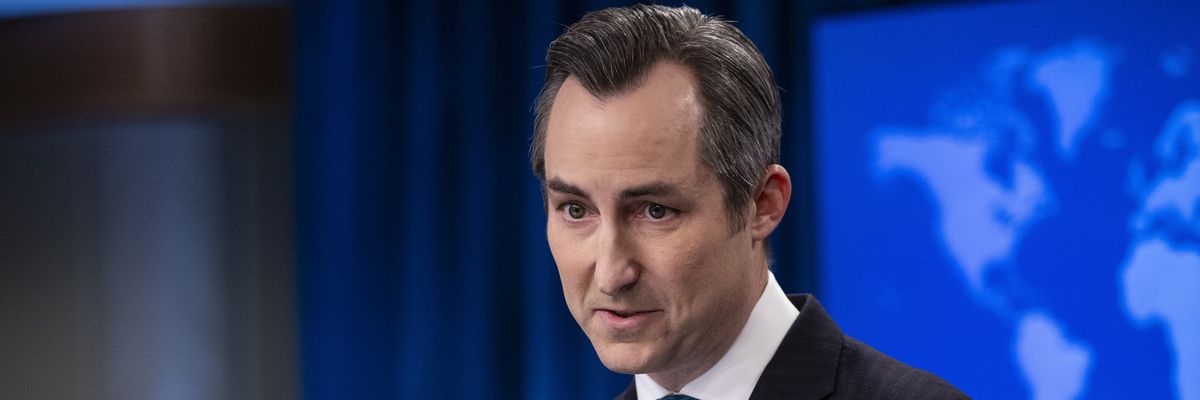
U.S. State Department spokesperson Matthew Miller speaks to reporters during a press briefing on March 25, 2024. (Photo: Mostafa Bassim/Anadolu via Getty Images)
One expert accused the U.S. of working to “undermine and sabotage the U.N. Security Council, the ‘rules-based order,’ and international law.”
Biden administration officials attempted Monday to downplay the significance of a newly passed United Nations Security Council resolution, drawing ire from human rights advocates who said the U.S. is undercutting international law and stonewalling attempts to bring Israel’s devastating military assault on Gaza to an end.
The resolution “demands an immediate cease-fire for the month of Ramadan respected by all parties, leading to a lasting sustainable cease-fire.” The U.S., which previously vetoed several cease-fire resolutions, opted to abstain on Monday, allowing the measure to pass.
Shortly after the resolution’s approval, several administration officials—including State Department spokesman Matthew Miller, White House National Security Council spokesman John Kirby, and U.S. Ambassador to the U.N. Linda Thomas-Greenfield—falsely characterized the measure as “nonbinding.”
“It’s a nonbinding resolution,” Kirby told reporters. “So, there’s no impact at all on Israel and Israel’s ability to continue to go after Hamas.”
Watch Matt Lee ask StateSpox about the passing of the UN ceasefire resolution. Basically the US position is it makes no difference and Miller calls 🇷🇺/🇨🇳 veto cynical.
Lee: Do you expect Israel is going to announce a ceasefire?
Josh Ruebner, an adjunct lecturer at Georgetown University and former policy director of the U.S. Campaign for Palestinian Rights, wrote in response that “there is no such thing as a ‘nonbinding’ Security Council resolution.”
“Israel’s failure to abide by this resolution must open the door to the immediate imposition of Chapter VII sanctions,” Ruebner wrote.
Beatrice Fihn, the director of Lex International and former executive director of the International Campaign to Abolish Nuclear Weapons, condemned what she called the Biden administration’s “appalling behavior” in the wake of the resolution’s passage. Fihn said the administration’s downplaying of the resolution shows how the U.S. works to “openly undermine and sabotage the U.N. Security Council, the ‘rules-based order,’ and international law.”
In a Monday op-ed for Common Dreams, Phyllis Bennis, a senior fellow at the Institute for Policy Studies, warned that administration officials’ claim that the resolution was “nonbinding” should be seen as “setting the stage for the U.S. government to violate the U.N. Charter by refusing to be bound by the resolution’s terms.”
While all U.N. Security Council resolutions are legally binding, they’re difficult to enforce and regularly ignored by the Israeli government, which responded with outrage to the latest resolution and canceled an Israeli delegation’s planned visit to the U.S.
Israel Katz, Israel’s foreign minister, wrote on social media Monday that “Israel will not cease fire.”
The resolution passed amid growing global alarm over the humanitarian crisis that Israel has inflicted on the Gaza Strip, where most of the population of around 2.2 million is displaced and at increasingly dire risk of starvation.
Amnesty International secretary-general Agnes Callamard said Monday that it was “just plain irresponsible” of U.S. officials to “suggest that a resolution meant to save lives and address massive devastation and suffering can be disregarded.”
In addition to demanding an immediate cease-fire, the Security Council resolution calls for the unconditional release of all remaining hostages and “emphasizes the urgent need to expand the flow of humanitarian assistance.”
Farhan Haq, deputy spokesman for the U.N. secretary-general, stressed during a briefing Monday that “all the resolutions of the Security Council are international law.”
“They are as binding as international laws,” Haq said.
Children in Rafah, Gaza gather to receive food distributed by aid organizations on March 15, 2024. (Photo: Jehad Alshrafi/Anadolu via Getty Images
“The State Department’s position makes a mockery of U.S. law and assurances provided to Congress,” said Sen. Bernie Sanders.
Sen. Bernie Sanders on Monday said the U.S. State Department’s determination that Israel is not violating international law with its assault on the Gaza Strip is “absurd on its face,” pointing to the mass death, destruction, and starvation that Israeli forces have inflicted on the territory’s population over the past six months.
“Thirty-two thousand Palestinians in Gaza have been killed and almost 75,000 injured, two-thirds of whom are women and children,” Sanders (I-Vt.) said in a statement. “Some 60% of the housing units have been damaged or destroyed, and almost all medical facilities have been made inoperable. Today, hundreds of thousands of Palestinian children are facing starvation because [Israeli Prime Minister Benjamin] Netanyahu won’t let in sufficient humanitarian aid, while thousands of trucks are waiting to get into Gaza.”
“The State Department’s position,” said Sanders, “makes a mockery of U.S. law and assurances provided to Congress.”
The senator’s statement came after State Department spokesperson Matthew Miller told reporters during a press briefing earlier Monday that the Biden administration has not found Israel “to be in violation of international humanitarian law, either when it comes to the conduct of the war or when it comes to the provision of humanitarian assistance.”
Miller was responding to a question about assurances the administration has received from the Israeli government that its use of American weaponry has complied with international law and that it has permitted U.S. humanitarian aid to enter Gaza, where the entire population is facing acute hunger.
Under a new Biden administration policy known as NSM-20, recipients of American military aid are required to provide the U.S. government with “credible and reliable” written assurances that they are using such assistance “in a manner consistent with all applicable international and domestic law and policy.”
Late last week, a group of U.S. senators—including Sanders—warned the Biden administration that deeming Israeli assurances credible would “be inconsistent with the letter and spirit of NSM-20” and “establish an unacceptable precedent” for the application of the policy “in other situations around the world.”
“Until Biden is ready to impose real policy consequences on Netanyahu’s government, the famine will continue.”
It is a violation of U.S. law to continue sending military assistance to a country that is obstructing the delivery of American humanitarian aid. Last month, far-right Israeli Finance Minister Bezalel Smotrich blocked a U.S.-funded flour shipment from entering the Gaza Strip, and Israeli forces have repeatedly fired on convoys attempting to deliver aid to desperate Gazans.
But the Biden administration has refused to even apply concrete restrictions on American military aid. Over the weekend, U.S. President Joe Biden signed into law a measure that approves $3.8 billion in unconditional military assistance for the Israeli government and imposes a one-year ban on funding for the primary humanitarian aid organization in Gaza.
Jeremy Konyndyk, the president of Refugees International and a former USAID official, said Monday that Israel’s assurances to the U.S. are “not remotely credible” and argued the Biden administration is undermining efforts to combat the worsening humanitarian crisis in Gaza by accepting the Israeli government’s claims.
The U.S., he said, is “talking a big game about fighting the famine that its bombs and diplomatic cover have helped create.” Resorting to “gimmicky” efforts such as airdrops and temporary ports while a U.S. ally obstructs humanitarian aid “is not how you fight a famine,” Konyndyk argued.
“Fundamentally Biden must choose: between continuing to enable Netanyahu, or ending the famine. There’s no way to split the difference,” said Konyndyk. “Until Biden is ready to impose real policy consequences on Netanyahu’s government, the famine will continue.”
CounterSpin interview with Evlondo Cooper on climate coverage
Janine Jackson interviewed Media Matters’ Evlondo Cooper about climate coverage for the March 22, 2024, episode of CounterSpin. This is a lightly edited transcript.
Janine Jackson: Climate disruption is, of course, one of the most disastrous phenomena of today’s life, affecting every corner of the globe. It’s also one of the most addressable. We know what causes it, we know what meaningful intervention would entail. So it’s a human-made tragedy unfolding in real time before our eyes.
To understate wildly, we need to be talking about it, learning about it, hearing about it urgently, which is why the results of our next guest’s research are so alarming. I’ll just spoil it: Broadcast news coverage of the climate crisis is going down.
Evlondo Cooper is a senior writer with the Climate and Energy Program at Media Matters for America. He joins us now by phone from Washington state. Welcome to CounterSpin, Evlondo Cooper.
Evlondo Cooper: Thank you for having me. I’m excited about our conversation today.
JJ: We’re talking about the latest of Media Matters’ annual studies of climate crisis coverage. First of all, just tell us briefly what media you are looking at in these studies.
EC: So we’re looking at corporate broadcast network coverage. That’s ABC, CBS and NBC. And for the Sunday morning shows, we also include Fox Broadcasting—Fox News Sunday.
JJ: All right. And then, for context, this decline in coverage that you found in the most recent study, that’s down from very little to even less.
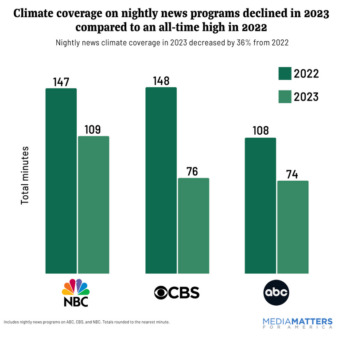
EC: Yeah, so a little context: 2021 and 2022 were both record years for climate coverage, and that coverage was a little bit more than 1%. This year, we saw a 25% decrease from 2022, which brought coverage to a little bit less than 1%. We want to encourage more coverage, but even in the years where they were doing phenomenal, it was only about 1% of total coverage. And so this retrenchment by approximately 25% in 2023 is not a welcome sign, especially in a year where we saw record catastrophic extreme weather events, and scientists are predicting that 2024 might be even worse than ’23.
JJ: Let’s break out some of the things that you found. We’re talking about such small numbers—when you say 1%, that’s 1% of all of the broadcast coverage; of their stories, 1% were devoted to the climate crisis. But we’ve seen, there’s little things within it. For example, we are hearing more from actual climate scientists?
EC: That was a very encouraging sign, where this year we saw 41 climate scientists appeared, which was 10% of the featured guests in 2023, and that’s up from 4% in 2022. So in terms of quality of coverage, I think we’re seeing improvements. We’re seeing a lot of the work being done by dedicated climate correspondents, and meteorologists who are including climate coverage as part of their weather reports and their own correspondents’ segments, a bigger part of their reporting.
So there are some encouraging signs. I think what concerns us is that these improvements, while important and necessary and appreciated, are not keeping up with the escalating scale of climate change.
JJ: It’s just not appropriate to the seriousness of the topic. And then another thing is, you could say the dominance of white men in the conversation, which I know is another finding, that’s just kind of par for the elite media course; when folks are talked to, they are overwhelmingly white men. But it might bear some relation to what you’re seeing as an underrepresentation of climate-impacted populations, looking at folks at the sharp end of climate disruption. That’s something you also consider.
EC: Yeah, we look at coverage of, broadly, climate justice. I think a lot of people believe it’s representation for representation’s sake, but I think when people most impacted by climate change—and we’re talking about communities of color, we’re talking about low-income communities, we’re talking about low-wealth rural communities—when these folks are left out of the conversation, you’re missing important context about how climate change is impacting them, in many cases, first and worse. And you’re missing important context about the solutions that these communities are trying to employ to deal with it. And I think you’re missing an opportunity to humanize and broaden support for climate solutions at the public policy level.
So these aren’t communities where these random acts of God are occurring; these are policy decisions, or indecisions, that have created an environment where these communities are being most harmed, but least talked about, and they’re receiving the least redress to their challenges. And so those voices are necessary to tell those stories to a broad audience on the corporate broadcast networks.
Another finding that I thought was very interesting was that extreme weather seemed to be the biggest driver of climate coverage, and that, to me, suggests that the way corporate broadcast media are coming at climate disruption is reactive: “Look at what happened.”
EC: Totally.
JJ: And even when they say, “Look at what’s happening,” and you know what, folks pretty much agree that this is due to climate disruption, these houses sliding into the river, it’s still not saying, “While you look at this disaster, know that this is preventable, and here is who is keeping us from acting on it and why.”
EC: Yeah, that is so insightful, because that’s a core critique of even the best coverage we see, that there is no accountability for the fossil fuel industry and other industries that are driving the crisis. And then there’s no real—solutions are mentioned in about 20% of climate segments this year. But the solutions are siloed, like there are solution “segments.”
But to your point, when we’re talking about extreme weather, when you have the most eyeballs hearing about climate change, to me, it would be very impactful to connect what’s happening in that moment—these wildfires, these droughts, these heat waves, these hurricanes and storms and flooding—to connect that to a key driver, fossil fuel industry, and talk about some potential solutions to mitigate these impacts while people are actually paying the most attention.
JJ: And then take it to your next story about Congress, or your next story about funding, and connect those dots.
EC: Exactly. I mean, climate is too often siloed. So you could see a really great segment, for instance, on the Willow Project, at the top of the hour—and this is on cable, but the example remains—and then later in the hour, you saw a story about an extreme weather event. But those things aren’t connected, they’re siloed.
And so a key to improving coverage in an immediate way would be to understand that the climate crisis is the background for a range of issues, socioeconomic, political. Begin incorporating climate coverage in a much broader swath of stories that, whether you know it or not, indirectly or directly, are being impacted by global warming.
JJ: It’s almost as though corporate media have decided that another horrible disaster due to climate change, while it’s a story, it’s basically now like a dog-bites-man story. And if they aren’t going to explore these other angles, well, then there really isn’t anything to report until the next drought or the next mudslide. And that’s just a world away from what appropriate, fearless, future-believing journalism would be doing right now.
Evlondo Cooper: “It doesn’t have to be about just showing the destruction and carnage. There are ways that you can empower people to take action.”
EC: It’s out of step, right? Pull up the poll showing bipartisan support for government climate action, because, whether people know it or not, as far as the science, —and there’s some deniers out there, but anecdotally, people know something is happening, something is changing in their lives. We’re seeing record-breaking things that no one’s ever experienced, and they want the government to do something about it.
And so it’s important to cover extreme weather and to cover these catastrophes. And I know there’s a range of thought out there that says if you’re just focusing on devastating impacts, it could dampen public action. But to me, to your point, report on it and connect it to solutions, empower people to call their congressperson, their representative, their senator, to vote in ways that have local impacts to deal with the local climate impacts.
It doesn’t have to be about just showing the destruction and carnage. There are ways that you can empower people to take action in their own lives, and to galvanize public support.
And the public wants it. The public is asking for this. So I think just being responsive to what these polls are showing would be a way to immediately improve the way that they cover climate change right now.
JJ: All right, then. We’ve been speaking with Evlondo Cooper of Media Matters for America. You can find this work and much else at MediaMatters.org. Evlondo Cooper, thank you so much for joining us this week on CounterSpin.