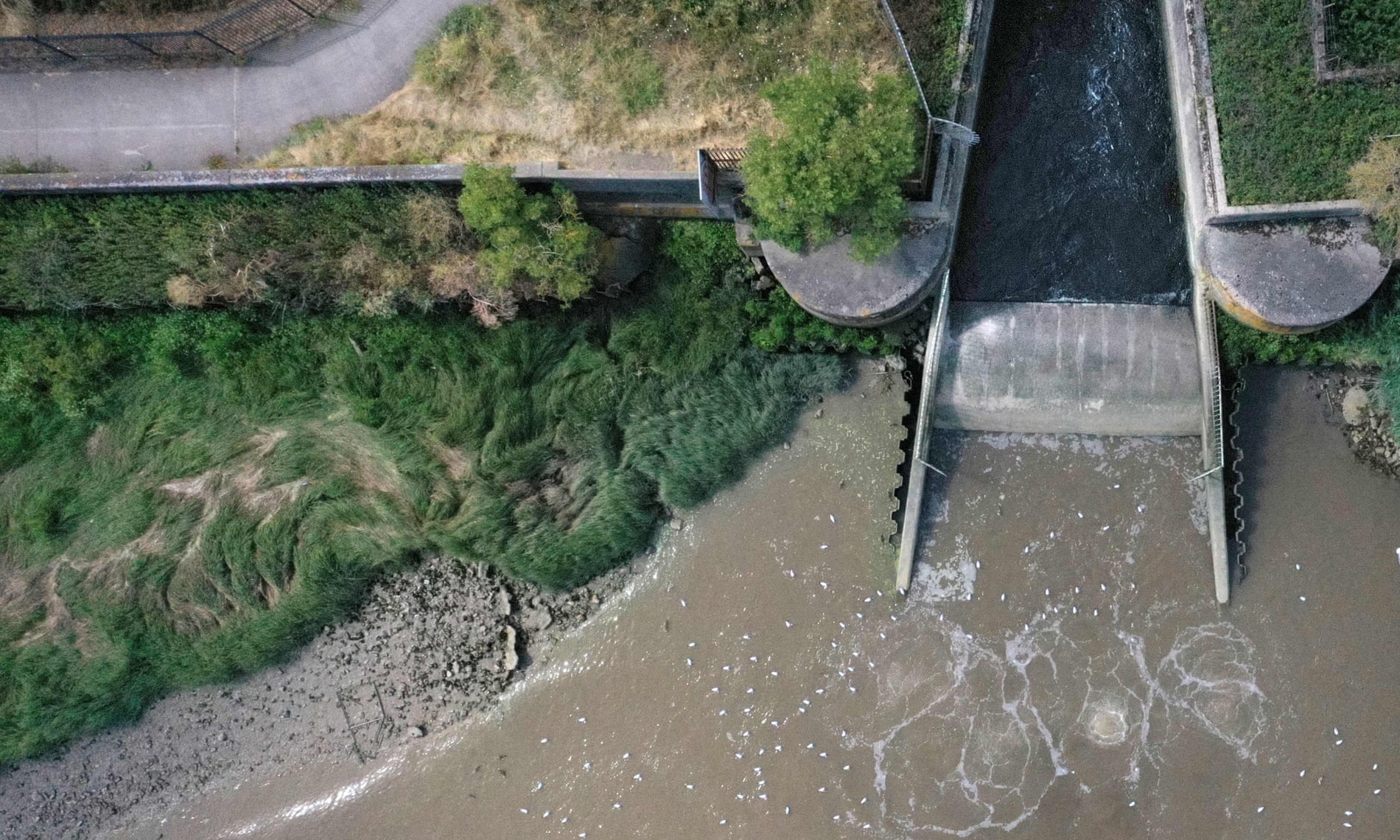
Raw sewage discharges are allowed to be released from storm overflows on the network only in exceptional circumstances, such as very heavy rain. Photograph: Ben Stansall/AFP/Getty Images
Exclusive: Environment Agency figures due out on Wednesday to reveal 129% increase in total discharges on previous 12 months
More than 4m hours of raw sewage discharges poured into rivers and seas last year, a 129% increase on the previous 12 months, new figures are expected to reveal on Wednesday.
Total discharges from the 14,000 storm overflows owned by English water companies that release untreated sewage into rivers and coastal waters increased by 59% to 477,972, making 2023 the worst year for sewage spills, according to an early estimate of the Environment Agency figures seen by the Guardian.
Senior industry sources were preparing for the government to turn its guns on water companies after the record year of discharges. The Environment Agency said it was setting up a whistleblowing hotline for people who work in the industry to report any activity that concerns them.
The heavy rainfall over the autumn and winter is likely to be blamed by the industry for the huge rise. Storm overflows are supposed to be used only in extreme weather but for many years they have been used routinely, discharging raw sewage even on dry days in some cases. The academic Peter Hammond has shown how water companies are routinely using storm overflow discharges in their water management.
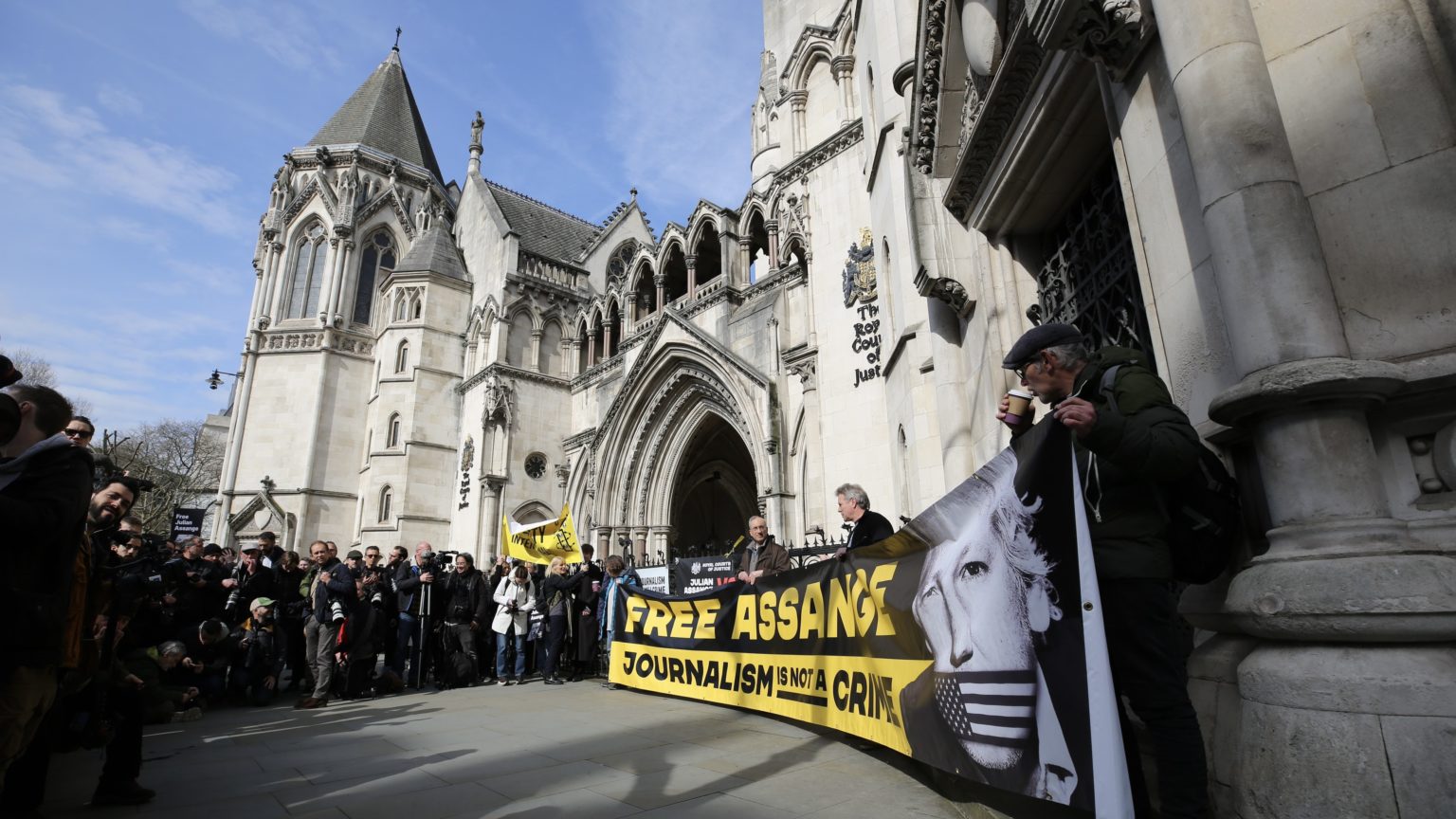
Protesters gathered outside the Royal Courts of Justice in London on Tuesday. Photo: Free Assange UK Campaign/X
The UK High Court has granted WikiLeaks founder Julian Assange provisional permission to appeal his extradition to the US, on grounds including the risk of the death penalty.
The UK High Court has granted provisional permission to journalist and WikiLeaks founder Julian Assange to appeal his extradition to the US. The ruling was handed down by judges Dame Victoria Sharp and Justice Jeremy Johnson in London on March 26, as supporters of Assange gathered outside the court to demand his freedom.
The US has sought to extradite Assange to prosecute him on 18 charges, 17 of which are under the draconian Espionage Act, for the publication of classified documents on WikiLeaks exposing war crimes and human rights abuses committed by US forces, including in Iraq and Afghanistan.
The extradition was approved by the UK Home Office in 2022, protracting an already difficult legal battle for the imprisoned journalist. Assange has been held at the Belmarsh high security prison for five years without a trial or conviction.
In its decision, the Court has granted Assange permission to appeal against his extradition, with the matter adjourned till May 20. However, the appeal will proceed only if the US and the UK are unable to provide the Court with assurances regarding Assange’s treatment following an extradition.
The US and the UK have until April 16 to file these assurances. This will also pave the way for further submissions to be made before a final decision is reached.
In the meantime, the temporary permission to appeal has been granted on three out of nine grounds including: a) that extradition may be “incompatible with the right of freedom of expression” under the European Convention on Human Rights; and b) that the applicant (Assange) might be “prejudiced on grounds of nationality” which is related to whether or not he will be protected under the First Amendment of the US Constitution given that Assange is not a citizen.
The third ground of appeal upheld by the Court for now is “inadequate speciality protection/death penalty protection”, which bars extradition under the UK’s 2003 Extradition Act.
In the application, Assange’s legal team noted that despite the fact that none of the charges leveled by the US as part of the extradition request carry the death penalty, the accusations made against him could lead to additional charges of aiding and abetting treason, which would be capital offenses.
They further highlighted statements made by US officials, including by Donald Trump, former president and potential Republican candidate for the upcoming US election, calling for the death penalty for Assange.
During the two-day “permission hearing” held in February ahead of the March 26 decision, the US prosecution admitted that there were no assurances that Assange would not be handed the death penalty.
The US now has three weeks to provide the Court with “satisfactory assurances” that Assange will be permitted to rely on the First Amendment (protecting free speech), that he will not be prejudiced at trial (including sentence) because of nationality (his status as non- US citizen), that he will be afford the same protections under the First Amendment as a US citizen, and that the death penalty will not be imposed.
This is not the first time that such proposals have been made in Assange’s case. In fact, despite a lower court acknowledging Assange’s risk of suicide in 2021, his extradition was approved based on “diplomatic assurances” given by the US.
These included that Assange would not be subject to brutal Special Administrative Measures (SAMs), that he would not be kept at the ADX Florence maximum security prison, and that he could serve a custodial sentence in Australia, his country of origin. However, these protections would not apply if Assange was deemed to have committed a “future act” that could necessitate SAMs.
The entirely unilateral nature of these assurances raised alarm, especially given that these actions would be at the discretion of US prison authorities and not subject to judicial review.
“The UK remains intent on extraditing Assange despite the grave risk that he will be subjected to torture or ill-treatment in the US,” Simon Crowther, Legal Adviser at Amnesty International, said in response to Tuesday’s ruling.
“While the US has allegedly assured the UK that it will not violate Assange’s rights, we know from past cases that such ‘guarantees’ are deeply flawed — and the diplomatic assurances so far in the Assange case are riddled with loopholes.”
Meanwhile, the Court dismissed critical grounds for appeal raised by Assange’s team, in particular that the extradition was for a political offense, and as such prohibited under the UK-US Extradition Treaty. Assange’s lawyers had argued in February that espionage was universally accepted as a political offense, given that it was an offense directed at the state.
“These were the most important revelations of criminal US state behavior in history,” Assange’s lawyer, Mark Summers, had told the Court regarding the materials published by WikiLeaks. This included the “Collateral Murder Video” in which a US Army Apache helicopter had killed 11 unarmed civilians in Baghdad in 2007.
Addressing the press outside the court, Assange’s wife, Stella, stated that the decision was “astounding”. She pointed out that though the Court had recognized the violation of Julian Assange’s rights, “what the Courts have done have done [is] to invite a political intervention from the United States to send a letter saying ‘it’s all okay’. Five years into this case, the US has managed to show the Court that their case remains an attack on press freedom, an attack on Julian’s life.”
“What the Courts have not agreed to look at is the evidence that the US has plotted to assassinate Julian, to kidnap him, because if it acknowledged that then of course he cannot be sent to the US.”
The Court astonishingly justified its refusal to admit this new evidence, of a plot by the US’ Central Intelligence Agency (CIA) to kidnap and assassinate Assange, stating that “on the face of the allegations…the contemplation of extreme measures against the applicant (whether poisoning for example or rendition) were a response to the fear that the applicant might flee to Russia”.
“The rationale for such conduct is removed if the applicant is extradited. Extradition would result in him being lawfully in the custody of the US authorities, and the reasons (if they can be called that) for rendition or kidnap or assassination then fall away”.
Meanwhile, Assange’s brother, Gabriel Shipton, reiterated that the fact that the Court had sought political assurances from the US revealed the political nature of the case itself.
Stella Assange added, “Julian is a political prisoner, he is a journalist, and he is being persecuted because he exposed the true cost of war in human lives. This case is a retribution, it is a signal to all of you, that if you expose the interests that are driving war they will come after you, they will put you in prison and they will try to kill you.”
“The Biden administration should not issue assurances, they should drop this shameful case that should have never been brought,” she said, calling people to pressure the US government and to support House Resolution 934.
The text, which is in the US Congress, states that “regular journalistic activities, including the obtainment and publication of information, are protected under the First Amendment and that the federal government should drop all charges against and attempts to extradite Julian Assange.”
“If Julian goes down for this, every serious journalist around the world is going to be slightly more cautious about exposing war crimes, corporate greed…We need the maximum pressure all across the US on the Biden administration, on the candidates in the forthcoming election, to say ‘Drop the charges against Julian Assange,’” MP and former Labor Party leader Jeremy Corbyn told Democracy Now.
If the UK High Court does not grant Assange the permission to appeal, he will have exhausted his options within the country’s legal system, and will have to approach the European Court of Human Rights (ECHR), immediately seeking an interim measure against the extradition under Rule 39 (“risk of irreparable harm”) pending a full hearing of the case. The ECHR’s verdict will be binding on the UK.
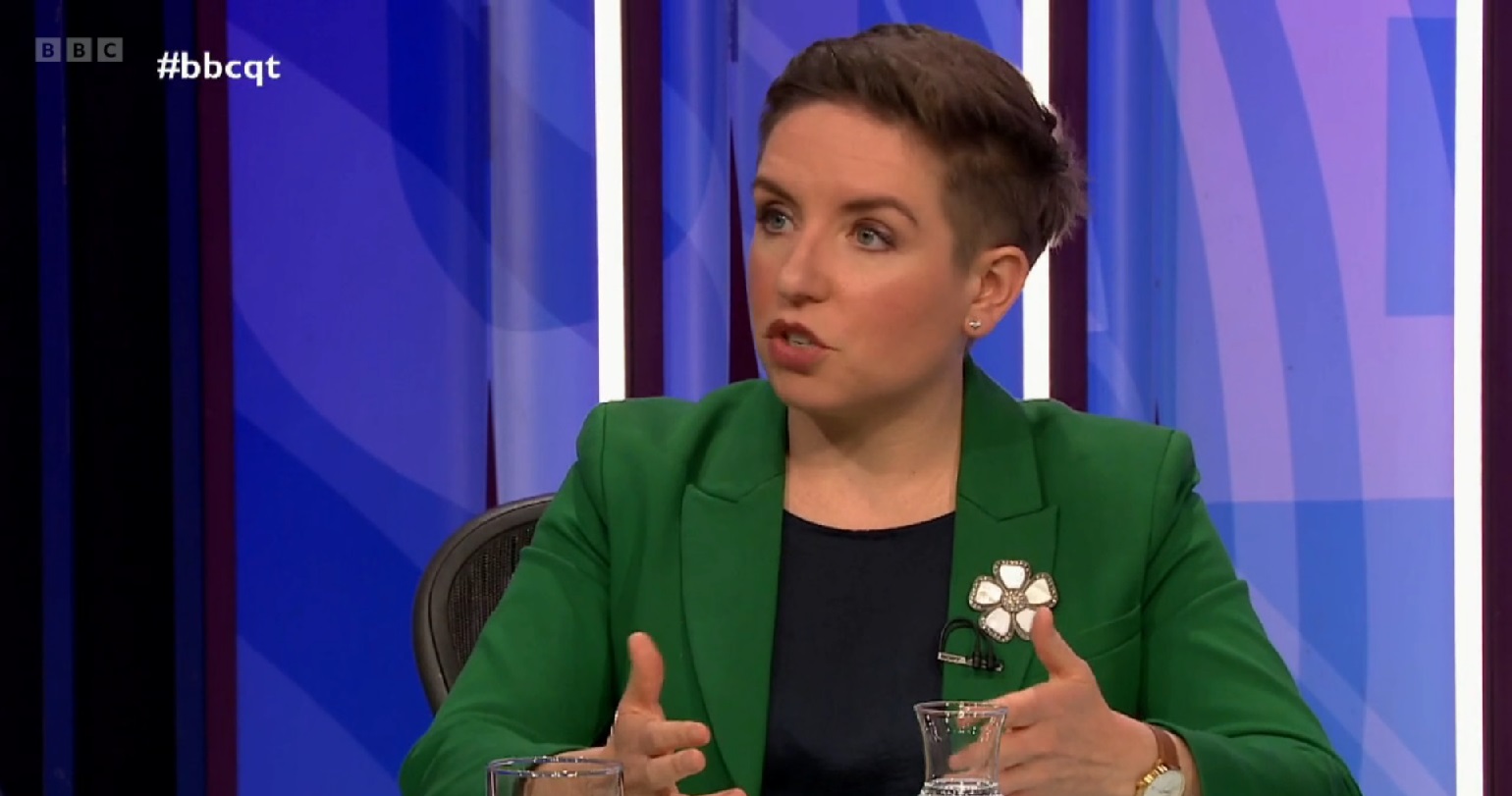
Image of the Green Party’s Carla Denyer on BBC Question Time.
Reacting to news that the UN Security Council has called for an immediate ceasefire in Gaza, without the US using its veto to block the resolution, co-leader of the Green Party Carla Denyer, said:
“The Green Party has been calling for a ceasefire since last October, so this vote is hugely welcome if long overdue. With Israel’s greatest ally the United States abstaining, the Netanyahu regime is more isolated than ever – and rightly so.
“This Security Council resolution comes too late for hundreds of thousands of people who have seen their families and friends killed, maimed, or seriously injured and their homes, hospitals and schools destroyed. Nonetheless, it ramps up international pressure on Israel to end its deadly assault on Gaza.
“However, Netanyahu is not listening – the attacks continue. The UK government must now further pressurise the Netanyahu regime by immediately suspending export licenses for arms to Israel. The Green Party also calls for further leverage through boycotts, divestment and sanctions. This means withdrawing all public money from funds with investments in Israel and suspending beneficial trade arrangements with the country.
“Only a full bilateral ceasefire and release of all hostages can stop more people dying. Israel must immediately stop blocking humanitarian aid to Gaza, where their blockade on aid is causing famine and intolerable suffering. And only a ceasefire can allow talks to begin on the long-term political solutions that will bring peace and security to everyone in the region.”
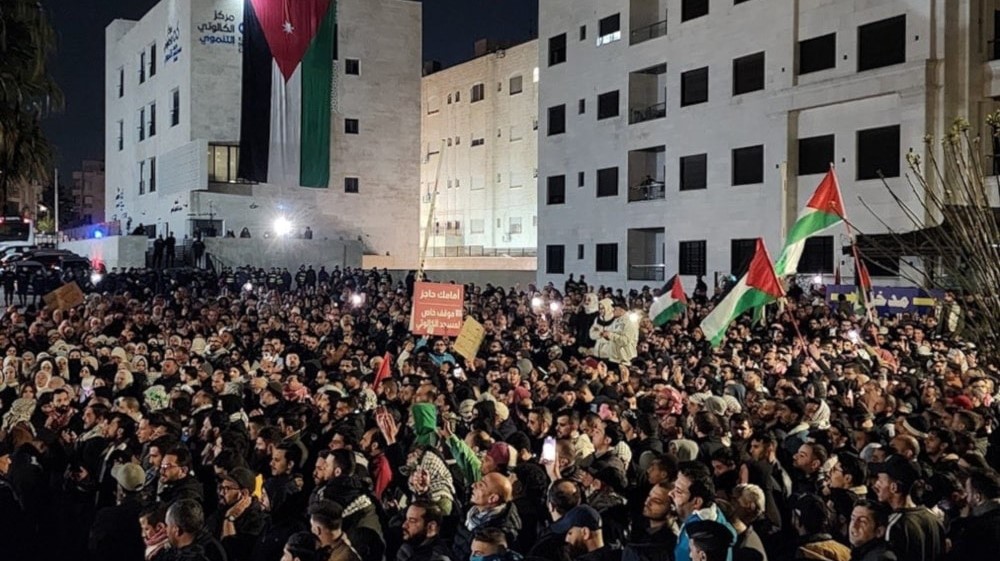
Protesters gather in Amman in Jordan demanding an immediate ceasefire in Gaza. Photo: Al Mayadeen
People took to the streets in a number of countries across West Asia and North Africa after the UN Security Council resolution calling for a ceasefire. However, Israel refused to heed the call and continued its attacks on Gaza on Tuesday
Large-scale protests broke out in different parts of West Asia and North Africa on Monday, March 25 in support of Palestine with people chanting slogans against the Israeli war in Gaza and demanding an immediate ceasefire. People took to the streets in a number of countries in the aftermath of the UN Security Council resolution that called for a ceasefire.
Jordanian security forces fired tear gas shells to disperse protesters who tried to storm the Israeli embassy in Amman. Thousands of these protestors chanted slogans in solidarity with the people in Gaza and in support of the Al-Aqsa mosque. Many of them carried Palestinian flags which they hoisted in nearby buildings.
Similar protests took place in other parts of the country. A day before, Jordanian forces had prevented a large group of people from marching to the Israeli embassy.
Protests were also organized in the Iraqi capital Baghdad and Cairo in Egypt as well on Monday where hundreds gathered to chant slogans in support of Palestine and demand an immediate ceasefire.
"El-Sisi is the enemy of God."
Iraqi women chant slogans decrying Egyptian President Abdel Fattah El-Sisi in front of the Egyptian Consulate in Baghdad in protest of the continued siege of Gaza and the closure of the crossings with Gaza, including the Rafah border crossing with… pic.twitter.com/yzfhi6C0Kw
Hundreds also gathered in Tangiers in Morocco to demonstrate against the continued Israeli genocide of Palestinians in Gaza.
Tens of thousands of Moroccos demonstrated last night in the city of Tangiers in Morocco in solidarity with the Palestinian people amid the ongoing Israeli genocide. pic.twitter.com/NbJXnNCb7u
Protests were also organized in the Nur Shams refugee camp in Tulkarem and in Ramallah in the occupied West Bank on Tuesday. Hundreds of Palestinians, defying Israeli dictates and ongoing attacks, took to the streets in the morning to call for a ceasefire.
The protests followed the UNSC resolution demanding an immediate ceasefire. The resolution was adopted after the US, which had blocked three similar previous resolutions, decided to abstain. All the other members of the Security Council supported the resolution.
The resolution called for an immediate ceasefire during the month of Ramadan and for working towards a permanent cessation of hostilities and the release of all hostages. It was welcomed by the Palestinian resistance group Hamas and most of the countries in the region.
Hamas reiterated its demand for a permanent ceasefire that would lead to the complete withdrawal of all Israeli forces from Gaza and the return of all Palestinians displaced due to the war over five months.
Nearly the entire population of Gaza, around 2.3 million, has been displaced due to the Israeli war which has killed more than 32,000 and wounded close to 74,000 Palestinians.
The Iranian foreign ministry welcomed the UNSC resolution, calling it a positive step and demanded its immediate implementation. It also demanded the lifting of all blockades on the supply of aid to Gaza and the opening of all border crossings to the besieged territory and immediate resumption of reconstruction.
Israel has however rejected the resolution. It carried out fresh attacks on Gaza on Tuesday, killing dozens of Palestinians.
The resolution accepted by the Security Council is binding on all members of the UN. However, only a fresh vote in the Security Council can decide the future course of action in case one particular party chooses not to implement it.