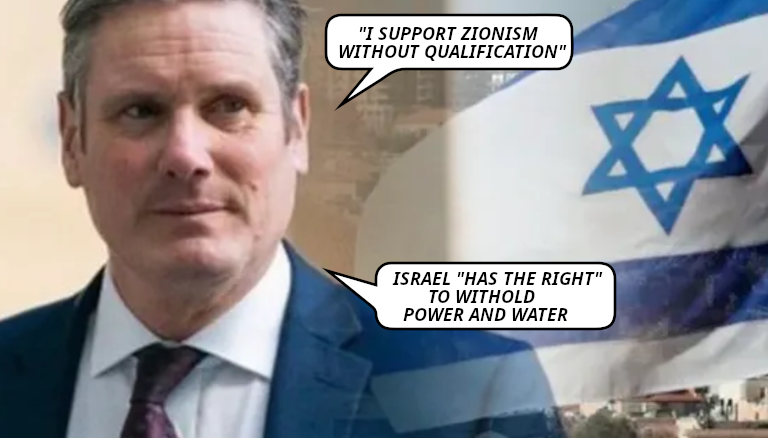
Starmer’s time at the CPS is under scrutiny. (Photo: Keir Starmer / Flickr)
The Crown Prosecution Service is refusing to release files on how Starmer blocked the arrest of former Israeli foreign minister Tzipi Livni over alleged war crimes during the brutal bombing of Gaza in 2008.
The coalition government changed UK law in 2011 to enable Israeli ministers accused of crimes to visit Britain without fear of prosecution.
Declassified asks the CPS to conduct an internal review into its decision to censor the Starmer emails.
In October 2011, Keir Starmer was asked by a human rights group and law firm to issue an arrest warrant for former Israeli foreign minister Tzipi Livni, who was visiting London, over alleged war crimes.
Starmer was then Director of Public Prosecutions (DPP) at the Crown Prosecution Service (CPS). But two days later, he blocked the application for Livni’s arrest, citing a Foreign Office decision to grant her visit “special mission” status.
Declassified recently submitted a freedom of information (FOI) request asking for all communications to and from Starmer’s office regarding the case.
These files could shine a crucial light on the discussions which led to Livni’s escape from prosecution.
However, the CPS has censored a number of key emails, claiming that the release of such information would prejudice the effective conduct of public affairs.
Starmer’s role in the Livni case requires closer inspection in light of the Labour party’s ongoing support for Israel’s brutal war on Gaza.
One of the redacted emails released to Declassified following our freedom of information request.
Tzipi Livni
Livni was the Israeli minister of foreign affairs between 2006 and 2009, and a member of Israel’s war cabinet during the brutal bombing of Gaza between December 2008 and January 2009, known as Operation Cast Lead.
According to a UN report, “numerous serious violations of international law… were committed by Israel during the military operations in Gaza”, which killed around 1,400 Palestinians, 333 of whom were children.
Those crimes included “the direct targeting and arbitrary killing of Palestinian civilians”, as well as a “deliberate and systematic policy… to target industrial sites and water installations”.
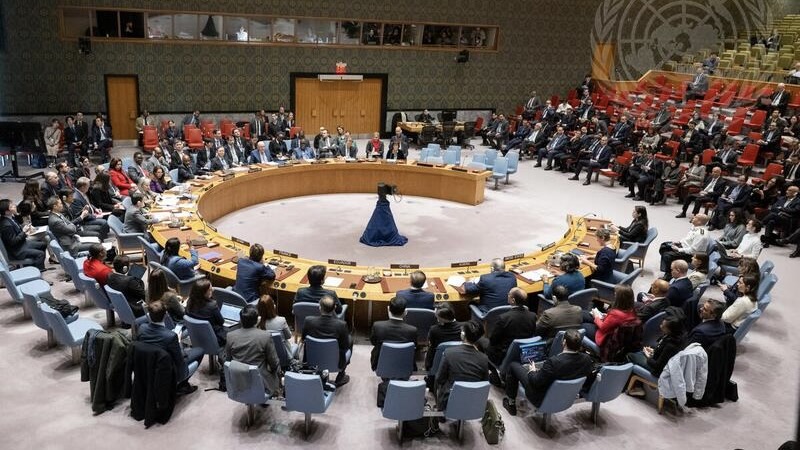
As Israel prepares for a ground invasion of Rafah, the US-authored resolution presented to the UN Security Council merely noted an “imperative” for an immediate ceasefire in Gaza. Algeria, Russia, and China rejected the resolution, stating that it had failed to deliver on the core demand for a ceasefire.
Russia and China vetoed a US-authored resolution in the United Nations Security Council (UNSC) on March 22 on the situation in Gaza. The text “determines the imperative for an immediate and sustained ceasefire” stopping short of an explicit call for a halt to Israel’s six-month long attack on besieged Gaza that has killed almost 32,000 Palestinians.
The US authored the resolution after vetoing three successive UNSC resolutions on Gaza, including a February 20 resolution presented by Algeria that had called for an immediate ceasefire.
Absent an explicit call for a ceasefire, the text presented by the US mentioned allowing for the delivery of essential humanitarian assistance, “alleviate humanitarian suffering and towards that end unequivocally supports ongoing international diplomatic efforts to secure such a cease-fire in connection [emphasis added] with the release of all remaining hostages,” according to a draft circulated in the news media on Thursday.
This unilateral demand for the release of Israeli hostages—without a mention of a reciprocal release of the thousands of Palestinians Israel has imprisoned and tortured— has been inserted by the US in UNSC discussions of a ceasefire. This is all while Israel has continued to bomb Gaza and rejected comprehensive ceasefire proposals presented by the Palestinian resistance. Friday’s vote in the Security Council was held amid ongoing negotiations in Qatar.
The US continued to make this link perhaps not “as firmly”, during the Council on Friday, with Ambassador Linda Thomas-Greenfield speaking of an “immediate and sustained ceasefire as part of a deal that leads to the release of all hostages being held by Hamas and other groups that will help us address the dire humanitarian crisis in Gaza”. She added that adopting the resolution would “put pressure on Hamas to accept the deal on the table”.
The US resolution received 11 votes in favor, and three votes against, with Algeria joining Russia and China who cast the deciding vetoes. Guyana was the sole abstention, reiterating the lack of a call for an immediate ceasefire.
US resolution a “hypocritical spectacle”
Addressing the Council ahead of the vote, Russian Ambassador Vassily Nebenzia accused the US of presenting a “hypocritical spectacle” wrapped up in a ceasefire, that the US had been trying to “sell a product” to the international community. He added that the language of an “imperative” was not enough to save the lives of the Palestinians and was not stipulated in the mandate of the UNSC, which is vested with a mechanism to “demand a ceasefire and where necessary, to compel compliance”.
“The American product is exceedingly politicized, the sole purpose of which is to help to play to the voters, to throw them a bone in the form of some kind of a mention of a ceasefire in Gaza” and would make the UNSC “instrument in the advancement of Washington’s destructive policy in the Middle East”, and “to ensure the impunity of Israel whose crimes in the draft are not even assessed.”
“The US draft contains an effective green light for Israel to mount a military operation in Rafah”, adding that the text’s authors had tried to make it that “nothing would prevent” Israel from “continuing their brutal cleansing of the south of the Gaza Strip”.
Algerian Ambassador Amar Bendjama stated that the adoption of the February ceasefire resolution could have saved thousands of lives, adding that the present resolution had fallen short “due to the absence of a clear demand for a ceasefire those who believe that the Israeli occupying power will choose to uphold its international legal obligation are mistaken, they must abandon this fiction”.
He stated that the US draft resolution had been circulated a month ago following which Algeria had made proposed edits to “achieve a more balanced and acceptable text”, however, finally, the draft fell short as “core concerns remained unaddressed”.
Addressing the Council on Friday, China’s Ambassador Zhang Jun explained the country’s veto, stating that despite the urgent need and demand for an immediate, unconditional, and sustained ceasefire, “the Council had dragged its feet and wasted too much time”.
He added that the US-authored draft had “always evaded and dodged the most central issue- that of a ceasefire. The final text remains ambiguous and does not call for an immediate ceasefire, nor does it even provide an answer to the question of realizing a ceasefire in the short-term”.
Zhang further stated that an immediate ceasefire was a “fundamental prerequisite” for “saving lives, expanding humanitarian access and preventing greater conflicts. The US draft on the contrary sets up preconditions for a ceasefire which is no different from giving a green light to continued killings which is unacceptable.”
He noted that the draft was “very imbalanced” particularly in regard to Israel’s plans to invade Rafah. “The draft does not clearly and unequivocally state its opposition which would send an utterly wrong signal and lead to severe consequences.”
His Algerian counterpart, Bendjama, had similarly stated that the text “does not convey a clear message of peace. It tacitly allows continuing civilian casualties and lacks clear safeguards to prevent further escalation. It is a laissez-passer to continue killing the Palestinian civilians. The emphasis on ‘measures to reduce civilian harm from ongoing and future operations’ implies a license for continuing bloodshed,” Bendjama added, highlighting Israel’s looming invasion of Rafah.
Rafah invasion still on the table despite international outcry
Israeli Prime Minister Benjamin Netanyahu has reiterated the Occupation’s plan to launch a ground invasion of Rafah in southern Gaza, where 1.5 million people forcibly displaced by Israeli attacks on other parts of Gaza are currently trapped.
While the US continues to make a display of its supposed efforts to halt the looming invasion, Netanyahu has declared that Israel is “rejecting” growing international pressure “in order to achieve the goals of the war”. Following a phone call with President Joe Biden, Netanyahu stated that he “made it as clear as possible” that there was no way around a ground incursion.
“We see no way to eliminate Hamas militarily without destroying these remaining battalions. We are determined to do this”, he said. Netanyahu reiterated this in a meeting with US Secretary of State Antony Blinken, saying on Friday, “I told him that I hope we will do it with the support of the US, but if we have to— we will do it alone”.
“A major military ground operation is not the way to do it”, Blinken told reporters, then going on to say, “We’re determined that Israel succeed in defending itself and becomes integrated into the region with its security.”
Meanwhile, the ten elected, non-permanent members (E-10) of the Security Council have drafted a separate resolution calling for an immediate humanitarian ceasefire for the Muslim holy month of Ramadan, “leading to a permanent sustainable ceasefire”.
It also demands “the immediate and unconditional release of all hostages”, without linking it to the ceasefire, and stresses the need to protect civilians in Gaza and provide humanitarian assistance. France has also stated that it will be drafting a separate resolution.
A vote on the E-10 text is reportedly expected to take place later on Friday or Saturday morning.
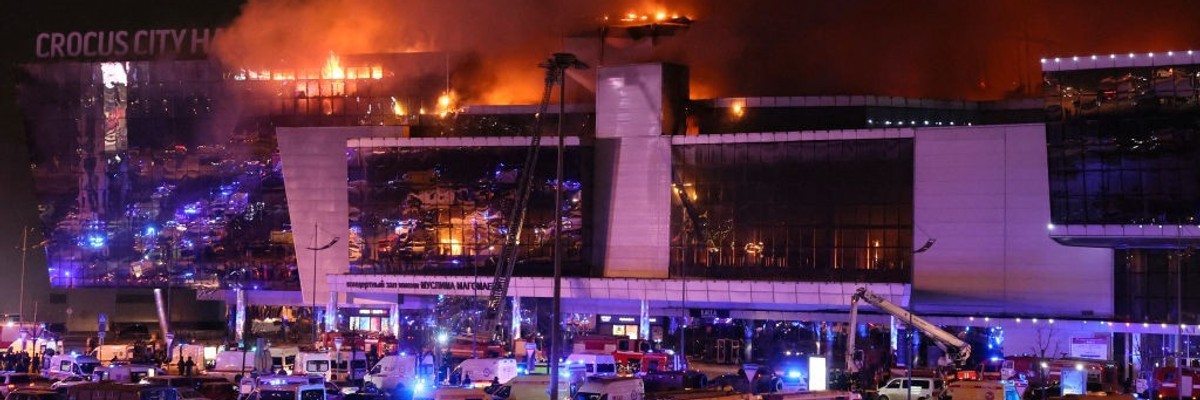
Emergency services vehicles are seen outside the burning Crocus City Hall following the shooting incident in Krasnogorsk, outside Moscow, on March 22, 2024. (Photo: Stringer/AFP via Getty Images.
While the attack comes over two years into Russia’s war on Ukraine, an adviser for the Ukrainian president said the neighboring nation “certainly has nothing to do with the shooting/explosions in the Crocus City Hall.”
UPDATE:
Russia’s Investigative Committee announced Saturday that the death toll has increased to 133 and said in a statement that “unfortunately, the number of victims could increase.”
Eleven people were detained, including four who were directly involved in the attack, according to a statement from the Russian Federal Security Service, or FSB.
EARLIER:
The Islamic State claimed responsibility for an attack in which at least dozens of people were killed and wounded when individuals reportedly armed with automatic weapons opened fire at Crocus City Hall, a concert venue in suburban Moscow, Russia.
“According to preliminary data, as a result of the terrorist attack at the Crocus City Hall building 40 people were killed and over 100 were injured,” Russia’s Federal Security Service (FSB) said in a statement reported by TASS.
Citing eyewitnesses, the Russian news agency reported that the group of unidentified men “armed with assault rifles went on a shooting spree in the lobby and then inside the concert hall just before a concert by the rock band Picnic.”
According to a journalist who was at Crocus City Hall during the attack, a grenade or an incendiary bomb was thrown after the shooting broke out and caused a fire.
“People in the hall were lying down on the floor to escape from the shooting, lying between 15 and 20 minutes, after which they began to crawl out. Many managed to get out,” the unnamed journalist was quoted as saying by RIA Novosti.
The attack comes on the heels of Russian President Vladimir Putin’s contested reelection and over two years into Russia’s invasion of Ukraine, which has received weapons support from around the world, including the United States.
In a lengthy social media post, Mykhailo Podolyak, an adviser to Ukrainian President Volodymyr Zelenskyy, said that “Ukraine certainly has nothing to do with the shooting/explosions in the Crocus City Hall.”
“There is not the slightest doubt that the events in the Moscow suburbs will contribute to a sharp increase in military propaganda, accelerated militarization, expanded mobilization, and, ultimately, the scaling up of the war,” Podolyak added. “And also to justify manifest genocidal strikes against the civilian population of Ukraine.”
According toThe Guardian, John Kirby, the White House national security spokesperson, told reporters that “there’s no indication at this time that Ukraine, or Ukrainians were involved in the shooting… We’re taking a look at it, but I would disabuse you at this early hour of any connection to Ukraine.”
Asked whether the attack signals cracks in Putin’s regime, Kirby said that “there are people in Moscow and in Russia that object to the way Mr. Putin is governing the country, but I don’t think we, at this early hour, can make a link between the shopping mall attack and political motivations. I think… we just need more time and we need to learn more information.”
At least 115 people have been killed and 145 wounded in Russia’s worst terror attack in years, as gunmen in combat fatigues opened fire and detonated explosives in a major concert hall on the outskirts of Moscow.
State news agency Ria on Saturday quoted a spokesperson for Russia’s Investigative Committee as saying the death toll could rise and that it was too early to say anything about the fate of the attackers.
Three children were among the dead, Ria cited the regional healthcare ministry as saying on Saturday. Authorities had earlier said five children were among the victims and that about 60 people were in serious condition.
Islamic State claimed responsibility for the attack late on Friday, in a post on Telegram in which the group claimed its gunmen had managed to escape afterwards. A US official said Washington had intelligence confirming Islamic State’s claim.
Photos showed Crocus City Hall engulfed in flames as videos emerged showing at least four gunmen opening fire with automatic weapons as panicked Russians fled for their lives.
dizzy: My sincere condolences to Russia and the victims of this BS terrorism BS attack. Hope that Russia has caught those responsible and that it doesn’t escalate to something much worse.
Over 100 Palestinians were killed and hundreds more wounded on February 29, when Israeli snipers opened fire on people approaching a convoy of trucks carrying desperately needed supplies of flour. The attack was quickly dubbed the flour massacre.
Corporate media reporting was contentious and confused, mired in accusations and conflicting details that filled the news hole, even as media downplayed the grave conditions in Gaza created by Israel’s engineered famine. With headlines layered in verbal opacity, the massacre prompted yet another egregious moment in media’s facilitation of Israel’s continuing genocide in Gaza.
Linguistic gymnastics
This New York Times headline (2/29/24) was described as “a haiku to avoid saying Israel massacres Palestinians that they’re deliberately starving in Gaza.”
On the day of the massacre, the New York Times (2/29/24) published this contrivance:
“As Hungry Gazans Crowd a Convoy, a Crush of Bodies, Israeli Gunshots and a Deadly Toll”
It was met with ridicule as it slid across online platforms. Assal Rad (Twitter, 3/1/24), author and research director at the Iranian American Council, called the piece of work “a haiku to avoid saying Israel massacres Palestinians that they’re deliberately starving in Gaza.”
Another Times headline (2/29/24) read, “Deaths of Gazans Hungry for Food Prompt Fresh Calls for Ceasefire.” Nima Shirazi, co-host of the podcast Citations Needed (Twitter, 3/1/24), noted that “the New York Times just can’t bring itself to write clear headlines when Israeli war crimes are involved.” Shirazi offered this revision: “Israel Slaughters Starving People as It Continues Committing Genocide.”
Professor Jason Hickel (Twitter, 2/29/24), along with Mint Press‘s Alan MacLeod (2/29/24), flagged the use of the neologism “food aid–related deaths” when it turned up in a Guardian headline (2/29/24): “Biden Says Gaza Food Aid–Related Deaths Complicate Ceasefire Talks.” MacLeod noted, “Virtually the entire Western media pretend they don’t know who just carried out a massacre of 100+ starving civilians.”
Linguistic gymnastics—a longstanding plague pervading Western media coverage of Palestine (FAIR.org, 8/22/23)—were so popular in news headlines and reporting that Caitlin Johnstone (Consortium News, 3/1/24) compiled a list of them, adding “chaotic incident” (CNN, 2/29/24) and “chaotic aid delivery turns deadly” (Washington Post, 2/29/24) to those already mentioned.
Sana Saeed, media critic for Al Jazeera, decoded the latter kind of construction for AJ+ (3/29/24), arguing that such passive language has been used “consistently to sanitize the violence that a powerful state is unleashing against civilian populations.”
As the genocide enters its sixth month, media analysts, investigative reporters and social media users have become adept at recognizing pro-Israeli contortions and patterns of language that justify Israel’s war on Gaza. This has become an essential aspect in exposing Israel’s genocide.
‘Anarchy rules in Gaza’
Economist (2/29/24): “As with many events in the war between Israel and Hamas, the facts are destined to remain fiercely contested.”
The Economist (2/29/24), under the headline, “A New Tragedy Shows Anarchy Rules in Gaza: A Shooting and Stampede Kill 122 and Injure Hundreds,” went into the worst pro-Israel spin, with reporting that seemed to blame Palestinians for their own murders. Parroting Israeli press directives, the piece claimed Palestinians were killed by “trampling” each other in their own “stampede.”
The piece was written in literary prose: “Death descended on a coastal road in Gaza,” the reporter (not present at the scene) wrote. Then “catastrophe befell an aid convoy,” as if it merely happened upon bad luck.
Then the writer made a prediction: “As with many events in the war between Israel and Hamas, the facts are destined to remain fiercely contested.” That’s likely to come true, especially when major media outlets abdicate their responsibility for evaluating claims.
Timeline of changing denials
Even in special “Verify” mode, the BBC (3/1/24) can’t bring itself to say in a headline who it was that killed Gazans.
Many other writers and journalists have documented the string of vacillating Israeli statements that help explain the contorted reporting. Al Jazeera reporter Willem Marx (Twitter, 3/1/24) traced a timeline of how the Israeli military changed its story over the course of the day.
The IDF began by claiming there had been trampling and pushing that led to injuries around the aid truck. Then, hungry Palestinians had “threatened their soldiers,” or “appeared in a threatening manner,” so the IDF shot at them. Later that day, Israeli officials claimed there were two separate incidents, one that involved trampling and the other that led to shooting. By the end of the day, they alleged only to have provided support to a humanitarian convoy, and that no shots were fired at all by the military.
When the BBC (3/1/24) verified that a video released by the Israeli military exhibited four unexplained breaks in the footage and was therefore invalid, the outlet still used the passive voice, referring in the headline to “Gazans Killed Around Aid Convoy.” One sentence of the detailed, confused article quoted Palestinian journalist Mahmoud Awadeyah: “Israelis purposefully fired at the men…. They were trying to get near the trucks that had the flour.” Earlier, however, Awadeyah was problematized when identified “as a journalist for Al Mayadeen, a Lebanon-based news station whose broadcasts are sympathetic to groups fighting Israel.”
Independent and international media
“Israel’s use of food as a weapon of war reaches new heights,” Mondoweiss (3/4/24) reported.
If we compare corporate outlets to independent media, in which reporting was based on ground sources, humanitarian actors and aid workers, we find very different content.
Al Jazeera reporter Ismail al-Ghoul (2/29/24), who was at the scene of the massacre, said that “after opening fire, Israeli tanks advanced and ran over many of the dead and injured bodies. It is a massacre, on top of the starvation threatening citizens in Gaza.”
EuroMed staff (2/29/24) on the scene confirmed that the Israeli military had fired on starving Palestinians. EuroMed’s findings were summarized in a videotape by Palestinian news agency Quds News Network and posted by the Palestine Information Center (3/4/24).
Mondoweiss (3/4/24) reported details of the massacre from eyewitness accounts. One survivor recounted how an Israeli checkpoint “split the crowd in two,” preventing those who had entered the checkpoint from passing back to the northern side. Then Israeli soldiers opened fire on the crowd. International observers visited the injured survivors at al-Shifa’ Hospital, “confirming that the majority of wounds from the hundreds of injured people were due to live ammunition.”
In context of famine
Middle East Eye (2/29/24) put IDF claims in the context of a Gaza “on the brink of famine as a result of the Israeli blockade.”
Reporting in the alternative press also placed the massacre within the context of the rapidly increasing famine in Gaza.
The headline for the Electronic Intifada (2/29/24) read, “Palestinians Seeking Food Aid Killed as Israel Starves Gaza.” The outlet said an “engineered famine has taken hold in Gaza, with people resorting to eating wild plants with little nutritional value and animal feed to survive.”
Middle East Eye’s reporting (2/29/24) included the dire condition Palestinians are currently facing: “Much of Gaza’s population is on the brink of famine as a result of the Israeli blockade, according to the UN and other humanitarian organizations.”
The day of the massacre, Democracy Now! (2/29/24) opened its broadcast with a clear statement and the relevant context: “Israel Kills 104 Palestinians Waiting for Food Aid as UN Expert Accuses Israel of Starving Gaza.” Its first guest, UN special rapporteur on the right to food Michael Fakhri, said, “Every single person in Gaza is hungry.” He accused Israel of the war crime of intentional starvation. He emphasized that famine in the modern context is a human-made catastrophe:
At this point I’m running out of words to be able to describe the horror of what’s happening and how vile the actions have been by Israel against the Palestinian civilians.
Common Dreams (3/3/24) reported on Israel’s obstruction of aid convoys, and cited UNICEF on the deaths of children who
died of starvation and dehydration at a hospital in northern Gaza as Israeli forces continue to obstruct and attack aid convoys, fueling desperation across the territory…. People are hungry, exhausted and traumatized. Many are clinging to life.
It concluded, “These tragic and horrific deaths are man-made, predictable and entirely preventable.”
In the days before the massacre, numerous outlets had been documenting the growing famine looming over Gaza. This is the material independent media made use of for contextualizing the massacre.
The New York Times, on the other hand, put the massacre into an entirely different context. A piece (3/2/24) headlined “Disastrous Convey Was Part of New Israeli Effort for More Aid in Gaza,” cited as confirmation “Western diplomats, who spoke on condition of anonymity.” It said that international aid groups “suspended operations” because of “rising lawlessness,” as well as Israel’s refusal to “greenlight aid trucks.” It blamed starving Gazans by claiming that aid convoys had been looted either by “civilians fearing starvation” or by “organized gangs.”
‘How is this not a bigger story?’
“How is this not a bigger story?” one observer asked of this Al Jazeera report (3/6/24).
As Common Dreams and Mondoweiss reported, the flour massacre was not the first time the IDF killed starving Palestinians, and it would not be the last. As Mondoweiss (3/4/24) put it: “In less than a week, Israel has committed several massacres against the hungry. On Sunday, March 3, Israel bombed an aid convoy, killing seven people.”
Quds News Network (3/2/24) reported that Israel targeted hungry civilians again at Al Rasheed Street in northern Gaza while they were waiting for humanitarian aid. And Quds (3/4/24) reposted Al Jazeera footage that captured the moments when Israel’s military opened fire at other hungry Gazans, this time at the Al Kuwait roundabout, as they looked for food aid.
Al Jazeera (3/6/24) continues to document the murders of Palestinians desperate for aid as they come under Israeli fire. On a longer videotape, a spokesperson for Human Rights Watch says these attacks violate ICJ orders:
The idea that these people are being killed as they scavenge for meager rations of food is just appalling, and is a reminder why there must be international immediate action to prevent further mass atrocities.
Following the Al Jazeera report, Assal Rad (Twitter, 3/6/24) expressed dismay:
Israeli attacks on Palestinians waiting for or attempting to get aid have repeatedly happened this week, yet there has been no media coverage since the massacre that killed over 100 people. Israel is attacking civilians it’s deliberately starving. How is this not a bigger story?
Normalizing starvation and massacres
The Floutist (11/16/23) addresses “the perversion of language that the defense of Israel’s violence requires.”
So just to be clear: Much like how Israel normalized attacking and destroying hospitals, and it was accepted by the international community, Israel is now normalizing shooting and killing the people it is starving as they seek food.
Media have failed to inform the US public on the horrific conditions experienced by starving civilians in Gaza. They blamed Palestinians for their own deaths, covering for the Israeli military as it carried out a massacre. They further dehumanized Palestinians by characterizing starving people as an unruly mob who trampled one another.
To paraphrase Patrick Lawrence (Floutist, 11/16/23) on the distortion of language in defense of Israel’s violence against Palestinians: It corrupts our public discourse, our public space, and altogether our ability to think clearly. This corruption is as vital as US bombs to the Israeli genocide against Palestine: Without these verbal distortions that justify, distract, deny and consume corporate information spaces, the genocide could not be carried out.
FAIR’s work is sustained by our generous contributors, who allow us to remain independent. Donate today to be a part of this important mission.