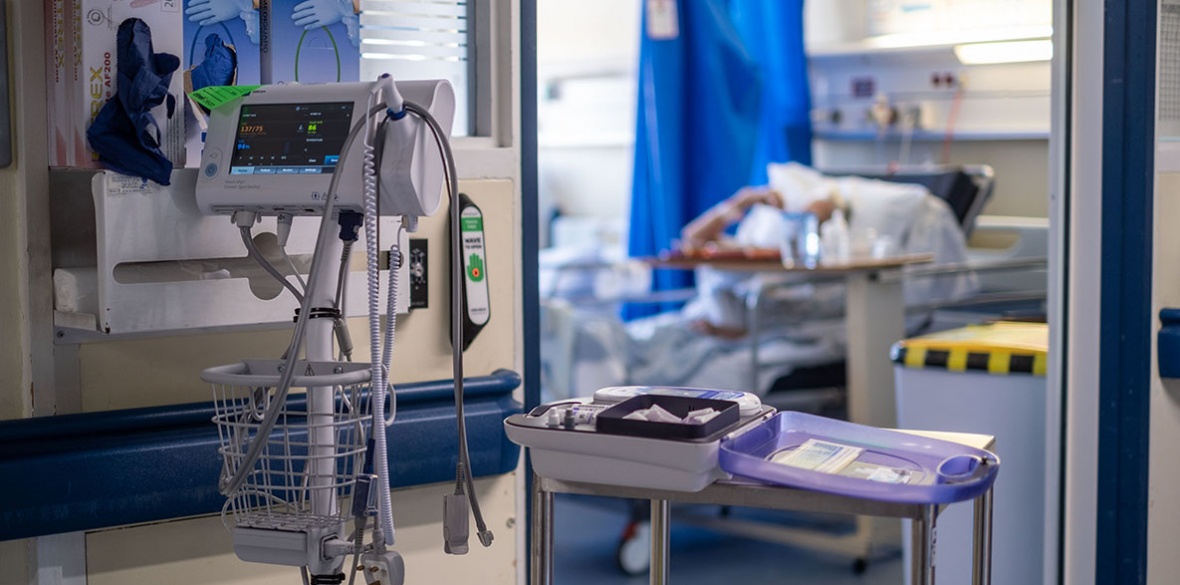
Medical equipment on a NHS hospital ward at Ealing Hospital in London, January 18, 2023
THE NHS needs a cash injection of around £8.5 billion a year over the next four years to improve the service, experts have said.
The figure is more than three times the £2.5bn promised in the Spring Budget.
A BMJ Commission on the Future of the NHS report said that amount, even alongside a £3.4bn investment over three years to improve productivity through digital transformation “certainly will not make up the significant shortfall that the NHS now faces.”
Nuffield Trust senior associate John Appleby and two colleagues warned annual spending on the NHS rose by just 1.2 per cent between 2010-20, compared to 6.2 per cent from 2000-10.
Labour is counting on the unpopularity of the Conservative Party to catapult it into power but in the absence of specific policies and failure to improve quality of life, electoral goodwill will quickly evaporate.
…
Labour and Conservatives have become slaves to arbitrary fiscal rules even though they have failed to deliver almost every target relating to economic growth, inflation, public debt, investment and more. Labour emphasises that it wants to reduce the government debt to GDP ratio in five years’ time. However, no rationale is presented for such a straitjacket. No assessment is made of the consequences of removing billions of pounds from the economy. No rationale as to why low debt to GDP ratio is an indicator of the prosperity of a nation and why this should take priority over investment or redistribution. Analogies with household budgets or maxed out credit cards are misleading as governments, especially those with global currencies such as the Pound Sterling, can create money to achieve desired social objectives and levy selective taxation to eliminate inflationary effects. But Labour is no student of the modern monetary theory.
…
Debt can be used to rebuild the economy even if Labour and Conservatives are hostile to it. The Post-Second World War boom was built upon direct public investment in new industries and social infrastructure. In 1946, public debt stood at over 270% of its GDP. This provided jobs and fuelled demand. It fuelled corporate investment as the state bought goods and services from the private sector. It laid foundations of emerging industries, such as biotechnology, information technology, aerospace and more specially as the private sector showed little appetite for long-term investment and risks. Within a generation, the public debt came down to 49% of GDP and I can’t recall our parents and grandparents fretting about the public debt.
Instead of a dynamic state, both Labour and Conservatives support further cuts in public spending even though that will reduce investment, slow economic growth, and inflict long-term damage. Too many public buildings and schools are crumbling away. The government response is that college spending per student aged 16–18 in 2024 will be 10% below 2010 levels, and about 23% below them for school sixth forms. Since 2010 local council funding has been cut by 23.3% in real terms, leading to degradation of public services and higher council tax on hard-pressed households. Hospitals in England have a waiting list of 7.6m appointments. None of this can be addressed by adherence to arbitrary fiscal rules.
There is a strong case for redistribution of income and wealth, but Hunt and Reeves ignore it even though higher disposable income for the less well-off has a greater multiplier effect. No amount of economic growth can be sustained unless people have good purchasing power to buy goods and services. Both parties reaffirm their faith in trickle-down economics which has seen wealth sucked upwards and prevent economic recovery. The UK has 171 billionaires with combined wealth of £684bn. The richest 1% of the population has more wealth than 70% of the population combined. The richest 10% of households hold 43% of all wealth, and the poorest 50% own just 9%.
The latest poll will do little to calm Tory nerves ahead of the general election, with a number of factions within the party looking at replacing Sunak.
A new poll shows just how much Tory support among the public has collapsed, as the party continues to trail the Labour Party and Tory MPs plot to remove Rishi Sunak.
The poll, carried out by YouGov for the Times, shows that the Tories are set to win just 36 seats at the General Election, handing Labour a comfortable 398 majority in the House of Commons.
It puts the Tories on just 19%, which is the same share the party received at their lowest ebb in the aftermath of Liz Truss’s mini-Budget. Meanwhile, the Labour Party is on 44% of the vote, while Reform UK received their highest ever poll rating at 15%.
Al Jazeera obtained footage of what it reported was an Israeli drone killing four Palestinians in Khan Younis, Gaza in February. (Photo: Al Jazeera/screenshot)
“There is no way they could have been considered combatants,” said one writer and analyst. “This is unreal.”
Adding to the mountain of evidence that Israel is engaged in a genocidal war on the Gaza Strip, Al Jazeera on Thursday aired footage of what the news outlet reported was an Israeli drone targeting four Palestinians in Khan Younis last month.
Those killed by the unmanned aerial vehicle in the rubble of the southern Gaza city appear to be unarmed teenagers or young men. According to a translation of the coverage, they were not identified in the reporting.
While Al Jazeera deemed footage “too graphic” to be included on its daily live blog covering the war, a clip of it quickly spread on social media, where critics of the Israel Defense Forces operation expressed outrage.
“OUTRAGEOUS even after months of outrages,” declared Palestinian American political analyst Yousef Munayyer. “This video shows an Israeli military drone literally stalking four unarmed civilians posing no threat and eliminating them one after the other!!!”
Tariq Kenney-Shawa, Al-Shabaka’s U.S. policy fellow, said: “This is among the worst footage I’ve seen. Not only were these boys clearly unarmed and present no threat whatsoever, but they were struck multiple times even after stumbling/crawling away. There is no way they could have been considered combatants. This is unreal.”
Note: The following video contains graphic images.
I don't know why, but the execution of the final young man, after killed the three he's with, hits even harder. Absolute depravity. https://t.co/OxRSRL4wH1
Assal Rad, an author with a Ph.D. in Middle East history, said: “Have we ever seen so many war crimes take place right before our eyes? Any country still providing weapons and aid to Israel is complicit in these crimes.”
Exiled American whistleblower Edward Snowden asserted that “everyone in the world needs to see this. Note that this footage permits no room for ‘it was a mistake,’ showing repeated, specifically targeted strikes on the unarmed and even wounded.”
“The sort of behavior the ICJ explicitly forbid in the genocide ruling against Israel,” added Snowden, referencing the International Court of Justice’s preliminary order in January for an ongoing case led by South Africa.
Since the ruling, rights groups around the world have accused Israel of ignoring the ICJ order by continuing to bomb and starve people across Gaza. The mounting casualties—at least 31,988 killed and 74,188 wounded—have elevated demands for the U.S. government to end arms transfers to Israel.
The United States gives its Middle East ally $3.8 billion in annual military aid and since the Israeli assault was launched in retaliation for a Hamas-led attack on October 7, the Biden administration has sought $14.3 billion more while bypassing Congress to send more weapons. U.S. President Joe Biden, Secretary of State Antony Blinken, and Secretary of Defense Lloyd Austin face a genocide complicity case in federal court.
While the Biden administration has repeatedly vetoed and opposed cease-fire resolutions at the United Nations Security Council and General Assembly, Nate Evans, a spokesperson for Linda Thomas-Greenfield, the U.S. ambassador to the U.N., confirmed Thursday that the United States plans to unveil a new one on Friday.
The resolution will “unequivocally support ongoing diplomatic efforts aimed at securing an immediate cease-fire in Gaza as part of a hostage deal, which would get hostages released and help enable a surge in humanitarian aid,” Evans told Al Jazeera. “This resolution is an opportunity for the council to speak with one voice to support the diplomacy happening on the ground and pressure Hamas to accept the deal on the table.”
Blinken said Thursday that “there’s a clear consensus around a number of shared priorities. First, the need for an immediate, sustained cease-fire, with the release of hostages. That would create space to surge more humanitarian assistance, to relieve the suffering of many people, and to build something more enduring.”
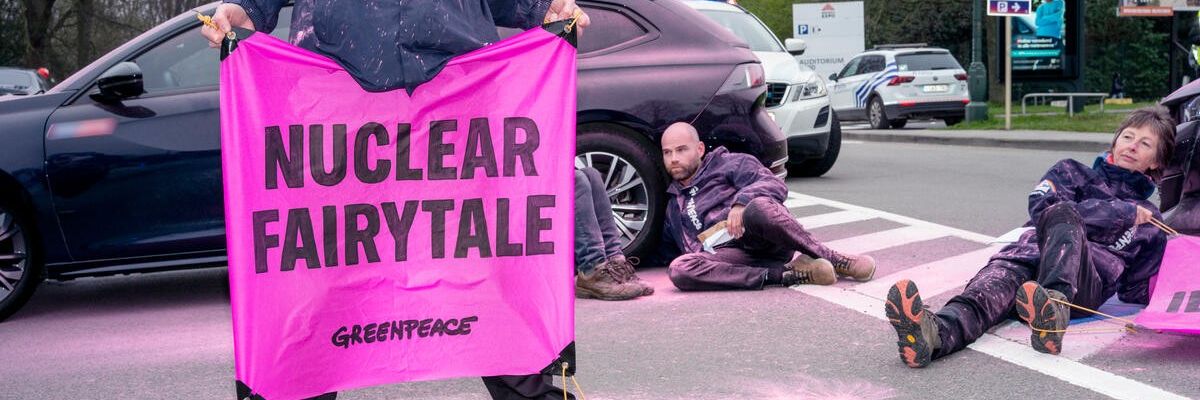
Greenpeace activists disrupt a pro-nuclear summit in Brussels on March 21, 2024. (Photo: Guillaume Chauvin/Greenpeace
“All the evidence shows that nuclear power is too slow to build, too expensive, and it remains highly polluting and dangerous,” one activist said.
An international coalition of environmental groups dropped banners and blockaded roads to protest the International Nuclear Energy Summit in Brussels on Thursday.
While the summit, hosted by the Belgian government and the International Atomic Energy Agency (IAEA), pushes nuclear energy as a replacement for fossil fuels, more than 600 climate action groups launched a declaration calling nuclear power plants a “distraction which slows down the energy transition.”
“We are in a climate emergency, so time is precious, and the governments here today are wasting it with nuclear energy fairy tales,” Greenpeace E.U. senior campaigner Lorelei Limousin said in a statement. “All the evidence shows that nuclear power is too slow to build, too expensive, and it remains highly polluting and dangerous.”
“The nuclear lobby camouflages itself beneath a climate-friendly facade, hoping to divert massive sums of money away from real climate solutions, at the expense of people and the planet.”
At the United Nations COP28 climate conference in the United Arab Emirates last year, more than 20 countries pledged to triple nuclear energy capacity by 2050. However, Greenpeace France calculated that achieving this would mean finishing 70 reactors each year between 2040 and 2050. This would be an unprecedented buildout in defiance of current trends: Between 2020 and 2023, 21 reactors were completed while 24 were shut down worldwide.
In the European Union specifically, many countries turned away from nuclear after 2011 in response to the Fukushima accident in Japan, according to Reuters. Germany shuttered its last three reactors for good in April 2023 following a successful anti-nuclear campaign there. In general, the nuclear share of the E.U. power mix dropped from 32.8% in 2000 to 22.8% in 2023, Greenpeace said.
Activists argue that nuclear still poses all the dangers the anti-nuclear movement has been warning about for decades and also cannot be ramped up quickly enough to prevent escalating climate extremes.
To reinforce this message, members of Greenpeace France blockaded the main roads to the Brussels summit using cars and bicycles. They also lit pink flares and threw pink powder as a motorcade of officials en route to the summit approached. The action succeeded in delaying the arrival of several delegations, Greenpeace E.U. said.
Other demonstrators dropped banners from the summit site at Brussels Expo reading, “Nuclear Fairy Tale,” while a group representing the 600 declaration signatories protested in front of an inflatable bouncy castle holding up a sign reading, “Nuclear fairy tales = climate crisis.”
The declaration was drafted by Climate Action Network Europe and signed by groups from at least 56 different countries and territories including Climate Action Network Canada, the David Suzuki Foundation, the Sierra Club, Food and Water Watch, CodePink, International Physicians for the Prevention of Nuclear War, and several 350.org, Fridays for Future, and Friends of the Earth affiliates.
“The nuclear lobby camouflages itself beneath a climate-friendly facade, hoping to divert massive sums of money away from real climate solutions, at the expense of people and the planet,” the declaration reads.
The signatories pointed out that, while the world must dramatically reduce greenhouse gas emissions by 2030 in order to limit global temperature rise to 1.5°C above preindustrial levels, it would take longer than this for any new nuclear plant to come online.
At the same time, it costs significantly more money to increase nuclear capacity than renewable options like wind and solar, they stressed. A new reactor requires almost four times the funds of a new wind power installation.
“Governments need to invest in proven climate solutions, such as home insulation, public transport, and renewable energy, rather than expensive experiments, like small modular reactors, which have no guarantees of actually delivering,” the declaration says.
It also points to safety risks across the nuclear lifecycle, from uranium mining to waste storage. And it adds that those dangers would only increase as temperatures rise.
“The climate crisis also increases the risks involved in nuclear power, as increased heatwaves, droughts, storms, and flooding all pose significant threats to the plants themselves and to the systems that aim to prevent nuclear accidents,” the signatories argued.
Instead, the declaration proposes that governments focus on achieving 100% renewable energy while also improving efficiency.
“What we demand is a just transition toward a safe, renewable, and affordable energy system that secures jobs and protects life on our planet,” the declaration concludes.