• ‘We Won’t Be Silenced,’ Says Greenpeace as Big Oil Threatens Libel Suit

    Original article by THOR BENSON republished from Common Dreams under Creative Commons (CC BY-NC-ND 3.0). 

    Greenpeace climate justice activists approaching Shell platform en route to major oilfield (Photo: Chris J Ratcliffe / Greenpeace)

    “It has become clear: Eni is trying to silence anyone who dares to speak up and denounce the company’s contribution to the fueling of the climate crisis,” says Chiara Campione of Greenpeace Italy.

    Greenpeace Italy revealed Wednesday that the Italian multinational energy company Eni is threatening a libel suit against it over reports the organization published about oil and gas companies.

    Greenpeace said the potential lawsuit is related to a report on temperature-related premature deaths that may be caused by emissions from oil and gas companies like Eni and a report on the concept of “climate homicide.”

    “We face yet another act of intimidation by Eni; it seems that threatening defamation lawsuits is the new sport which the company has decided to pursue most enthusiastically. But we won’t be silenced,” said Chiara Campione of Greenpeace Italy. “This new potential defamation lawsuit follows a similar case initiated by Eni against Greenpeace Italia only a few months ago.”

    Eni was given an opportunity to respond to the findings of the Greenpeace reports, but the group said Eni offered “no substantive rebuttal” and threatened legal action. The organization claimed other oil and gas companies mentioned in these reports have not threatened legal action.

    Greenpeace Italy and the climate advocacy group ReCommon are currently suing Eni over its alleged contributions to the climate crisis. The first hearing for that case occurred last month.

    “It has become clear: Eni is trying to silence anyone who dares to speak up and denounce the company’s contribution to the fueling of the climate crisis,” Campione said.

    The multinational oil giant Shell sued Greenpeace in November for alleged damages related to Greenpeace activists boarding one of the company’s oil platforms. Shell is trying to get as much as $8.6 million in damages, which Greenpeace says would greatly threaten its ability to campaign.

    The French multinational oil and gas company TotalEnergies is also suing Greenpeace France over a report that claimed it underestimated its 2019 greenhouse gas emissions.

    Greenpeace said Wednesday that these companies are trying to “stop Greenpeace and other organizations from denouncing the damage the fossil fuel industry is causing to people and the planet.”

    Original article by THOR BENSON republished from Common Dreams under Creative Commons (CC BY-NC-ND 3.0). 
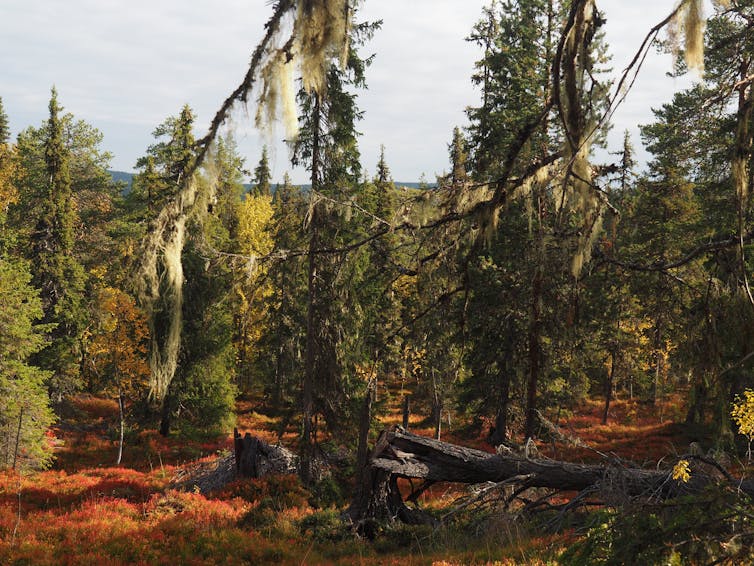
  • Sweden has vast ‘old growth’ forests – but they are being chopped down faster than the Amazon

    Swedish old-growth forest.
    Ulrika Ervander, Author provided

    Anders Ahlström, Lund University and Pep Canadell, CSIRO

    Most of Europe’s natural ecosystems have been lost over the centuries. However, a sizeable amount of natural old forest still exists, especially in the north. These “old-growth” forests are exceptionally valuable as they tend to host more species, store more carbon, and are more resilient to environmental change.

    Many of these forests are found in Sweden, part of the belt of boreal forests that circle the world through Canada, Scandinavia and Russia. But after researching these last relics of natural forest we have found they are being cleared rapidly – at a rate faster even than the Amazon rainforest.

    There is no direct monitoring of these forests, no thorough environmental impact assessments and most of the public don’t seem to be aware this is even happening. Other evidence suggests something similar is happening right across the world’s boreal forests.

    It can be tricky to know exactly how much old-growth forest there is, since the distinction might not always be clear. However, there is a clear difference between forests that have been “clear-cut” (entirely chopped down) sometime in the past and those that never have.

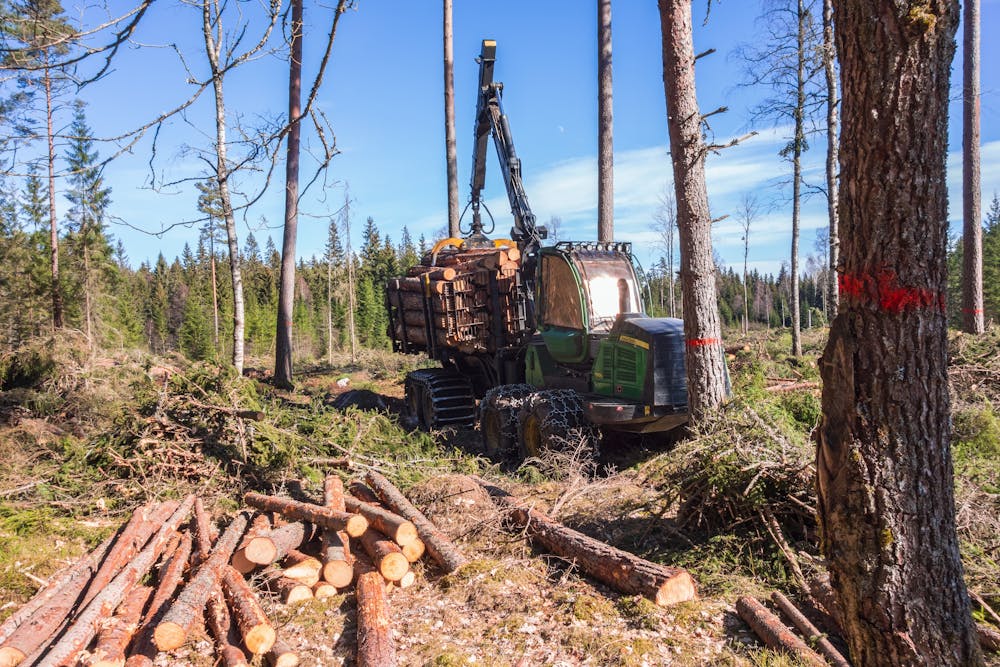
    Clear-cutting started appearing in Sweden in the early 1900s and has been the dominant type of forestry in the country since the 1950s. The uncut forests that predate this time have therefore most likely not been clear-cut and since they are old they can be classified as old-growth forests.

    Logging machine in forest
    Clear-cutting is still the main form of logging in Sweden.
    Lasse Johansson / shutterstock

    In our study, we looked specifically at forests in unprotected areas where the trees predated 1880 on average. That’s long before the large-scale adoption of clear-cutting in Sweden and means those forests have likely never been clear-cut.

    These unprotected old-growth forests constitute around 8% of the productive forest land in Sweden, that is, the area that is generally favourable for forestry (omitting forests close to the Scandinavian mountain range tree line). This amounts to about 1.8 million hectares of old-growth forest, more than the total wooded area in many European countries.

    This area of unprotected old-growth forest, with the remaining protected old-growth and primary forests, constitutes a large share of the last known ecosystems of “high naturalness” in the EU.

    What is happening to these old-growth forests?

    Between 2003 and 2019, 20% of all the clear-cut forest in Sweden was old-growth. This means a sizeable share of forest products, such as timber, paper and bioenergy, comes from old trees. The losses to unprotected old-growth forests amount to 1.4% per year, which means they will be lost completely by the 2070s if the trend continues.

    To put this in perspective, Sweden’s old-growth forests have been cleared six to seven times faster than the Brazilian Amazon forest between 2008 and 2023. (Of course, given the size of the Amazon, the total amount of cleared forest is much larger there).

    While our study, shockingly enough, appears to be the only of its kind across the boreal region, there is some research showing that old-growth forests are also harvested in Canada. Additional anecdotal evidence further suggests the unchecked loss of old-growth forests to forestry operations in other boreal regions .

    What’s next?

    The European Commission has drafted guidelines for all countries to map and protect all remaining old-growth and primary forests. This would be a good start.

    But ultimately, we’ll need a coordinated system to map and monitor the entire boreal forest simply to learn the rate at which it is being lost. This would also help us understand the implications for carbon storage, for other plants and animals that live in these forests, and the humans that use them.

    Unfortunately, this is a large and difficult task. Yet this might be one of our last chances to protect and recover large areas of natural forests. Logging old-growth forests now will delay their recovery for centuries. The Conversation

    Anders Ahlström, Associate Professor, Department of Physical Geography and Ecosystem Science, Lund University and Pep Canadell, Chief Research Scientist, CSIRO Environment; Executive Director, Global Carbon Project, CSIRO

    This article is republished from The Conversation under a Creative Commons license. Read the original article.

  • Diane Abbott accuses Tories AND Labour of ‘shocking’ racism in donor row

    https://www.independent.co.uk/news/uk/politics/diane-abbott-labour-tory-donor-racism-b2512086.html

    Diane Abbott has hit out at the Conservatives and Labour, accusing both parties of “shocking” racism in the Tory donor scandal.

    The MP, who sits as an independent and was dragged into the centre of the race row, turned her fire on Sir Keir Starmer and Rishi Sunak after the pair clashed over the issue at PMQs on Wednesday.

    Mr Sunak has refused to hand back a £10m donation from businessman Frank Hester after he allegedly said Ms Abbott made him “want to hate all Black women” and that she should be “shot”.

    Writing in The Independent, Britain’s longest-serving Black MP described his words as “outrageously racist and sexist” and added: “I am afraid long-term experience teaches me that the Tory party has long been a source of whipping up racism in this country, including directed at me personally.”

    Abbott has attacked Starmer and Labour over racism in the party (Getty)

    She also attacked Sir Keir and said: “The position of the current leadership of the Labour Party is disappointing, which seemed equally reluctant at the outset to call out either racism or sexism.

    “Instead, the entire focus was on the demand that the Tories give Hester back his money, which is surely not the primary point in this case.”

    Ms Abbott, who was a Labour MP for more than three decades until she was suspended last year, said her former party had initially failed to label Mr Hester’s alleged comments against her as racist and sexist.

    She went on to condemn the “shocking levels of racism and sexism from within the Labour Party, again much of it directed against me personally”.

    …

    https://www.independent.co.uk/news/uk/politics/diane-abbott-labour-tory-donor-racism-b2512086.html

  • The system won’t change, we have to change the system.

    dizzy: I’m speaking for myself only.

    Politics has failed to address the climate crisis in any meaningful way. Our contemporary politics which I regard as a plutocracy as opposed to a democracy – meaning that it serves a small elite of incredibly rich and powerful people – cannot address the climate crisis because it is serving the climate-destroying plutocrats. Since the system won’t change, we have to change the system. There’s no ifs or buts about this – climate records are getting broken month by month and in the summer it will be back to breaking climate records day by day. Our politics have absolutely failed to address this so we have to change our politics. It’s not a big deal – politicians need to start serving the electorate instead of the rich and powerful.

  • ‘That’s the Law’: Senators Say Biden Must End Arms Sales If Israel Keeps Blocking Aid

    Original article by JAKE JOHNSON republished from Common Dreams under Creative Commons (CC BY-NC-ND 3.0).
    U.S. President Joe Biden and Secretary of State Antony Blinken are pictured during a White House meeting on November 21, 2023 in Washington, D.C. 
    (Photo: Drew Angerer/Getty Images)

    “Federal law is clear, and, given the urgency of the crisis in Gaza, and the repeated refusal of Prime Minister Netanyahu to address U.S. concerns on this issue, immediate action is necessary.”

    A group of senators said Tuesday that under U.S. law, the Biden administration must cut off American military assistance to Israel unless the Netanyahu government immediately stops impeding aid deliveries to the Gaza Strip, where children are dying of starvation after months of incessant Israeli bombing and attacks on humanitarian convoys.

    “The severe humanitarian catastrophe unfolding in Gaza is nearly unprecedented in modern history,” the eight senators—led by Sens. Bernie Sanders (I-Vt.), Chris Van Hollen (D-Md.), and Jeff Merkley (D-Ore.)—wrote in a letter to U.S. President Joe Biden. “Your administration has repeatedly stated, and the United Nations and numerous aid organizations have confirmed, that Israel’s restrictions on humanitarian access, both at the border and within Gaza, are one of the primary causes of this humanitarian catastrophe.”

    The senators argued that the Israeli government’s systematic obstruction of aid deliveries violates U.S. law, pointing specifically to Section 620I of the Foreign Assistance Act of 1961. The law states that “no assistance shall be furnished… to any country when it is made known to the president that the government of such country prohibits or otherwise restricts, directly or indirectly, the transport or delivery of United States humanitarian assistance.”

    Biden administration officials have admitted that Israel is impeding aid deliveries to desperate Gazans. But when asked last week whether Israel’s actions amount to a “breach” of the Foreign Assistance Act, U.S. State Department spokesman Matthew Miller said he would “have to go back and look at the language of that text.”

    “It’s not something that I’ve spent a lot of time looking at,” he added.

    “The United States should not provide military assistance to any country that interferes with U.S. humanitarian assistance.”

    The senators wrote to Biden on Tuesday that “according to public reporting and your own statements, the Netanyahu government is in violation of this law.”

    “Given this reality, we urge you to make it clear to the Netanyahu government that failure to immediately and dramatically expand humanitarian access and facilitate safe aid deliveries throughout Gaza will lead to serious consequences, as specified under existing U.S. law,” the letter reads. “The United States should not provide military assistance to any country that interferes with U.S. humanitarian assistance.”

    “Federal law is clear,” the senators added, “and, given the urgency of the crisis in Gaza, and the repeated refusal of Prime Minister Netanyahu to address U.S. concerns on this issue, immediate action is necessary to secure a change in policy by his government.”

    The senators’ letter was made public hours after the head of the United Nations Relief and Works Agency for Palestine Refugees in the Near East (UNRWA) said Israel turned away a truck “loaded” with humanitarian aid because there were scissors in children’s medical aid kits—just one of many examples of Israel blocking the delivery of badly needed assistance.

    Israel has limited the flow of aid to Gaza for years, but its siege has become much more restrictive since October 7, when Israel began its latest assault on the Palestinian territory following a deadly Hamas-led attack.

    The U.S., by far Israel’s biggest arms supplier, has yet to impose any substantive consequences on the Netanyahu government for its mass killing of civilians or obstruction of humanitarian aid. The Biden administration has quietly approved more than 100 separate weapons sales to Israel since October.

    Instead of using its leverage to force Israel’s hand, the administration has resorted to airdropping aid into Gaza and planning the construction of a temporary port off the enclave’s coast—steps that aid groups say won’t be anywhere near enough to avert famine.

    Citing four unnamed U.S. officials, Politicoreported Monday that Biden “will consider conditioning military aid to Israel” if it launches a ground invasion of Rafah, a small city near the Egyptian border where more than half of Gaza’s population is sheltering.

    Brian Finucane, senior adviser for the U.S. program at the International Crisis Group, wrote in response to Politico‘s reporting that “U.S. law and policy already impose conditions on military aid to Israel as well as every other country.”

    “The Biden admin has just refused to enforce those conditions so far,” he added.

    Original article by JAKE JOHNSON republished from Common Dreams under Creative Commons (CC BY-NC-ND 3.0).