Ireland’s SDLP confirms full Washington boycott for St Patrick’s week in Gaza protest
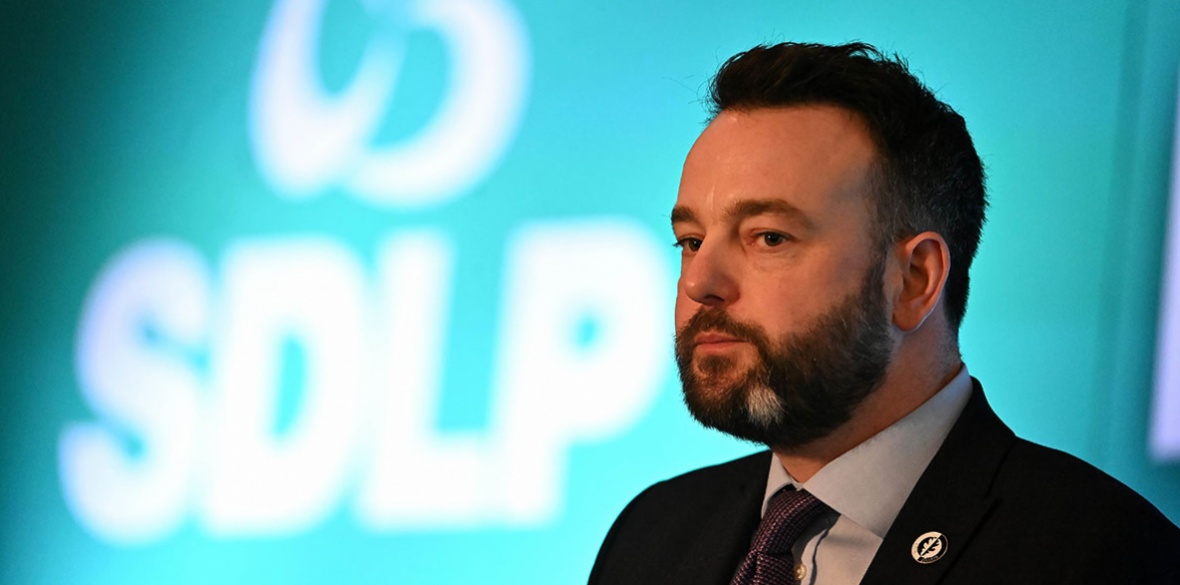
SDLP leader Colum Eastwood speaking during the Social Democrat and Labour Party (SDLP) spring conference at St. Columb’s Hall in Derry, March 25, 2023
THE Social Democratic and Labour Party (SDLP) has said it would not be sending any representatives to Washington DC for St Patrick’s Day due to the conflict in Gaza.
The party had already announced a boycott of celebratory St Patrick’s events at the White House, in protest against the situation in Palestine and the Biden administration’s support for Israel, but it was still planning to send a delegation to Washington to raise its concerns.
Announcing the plan in January, the party said its delegation would “engage with senior lawmakers, Irish Americans and Palestinian Americans to make the case for an end to violence.”
However, party leader Colum Eastwood has confirmed the party is no longer planning to send a delegation.
“The situation in Gaza has continued to deteriorate,” he said.
“More children have been killed, communities obliterated and thousands of people displaced as a result of this horrifying conflict. And now, during the holy month of Ramadan, we have clear warnings that starvation is being used as a weapon of war against the Palestinian people.
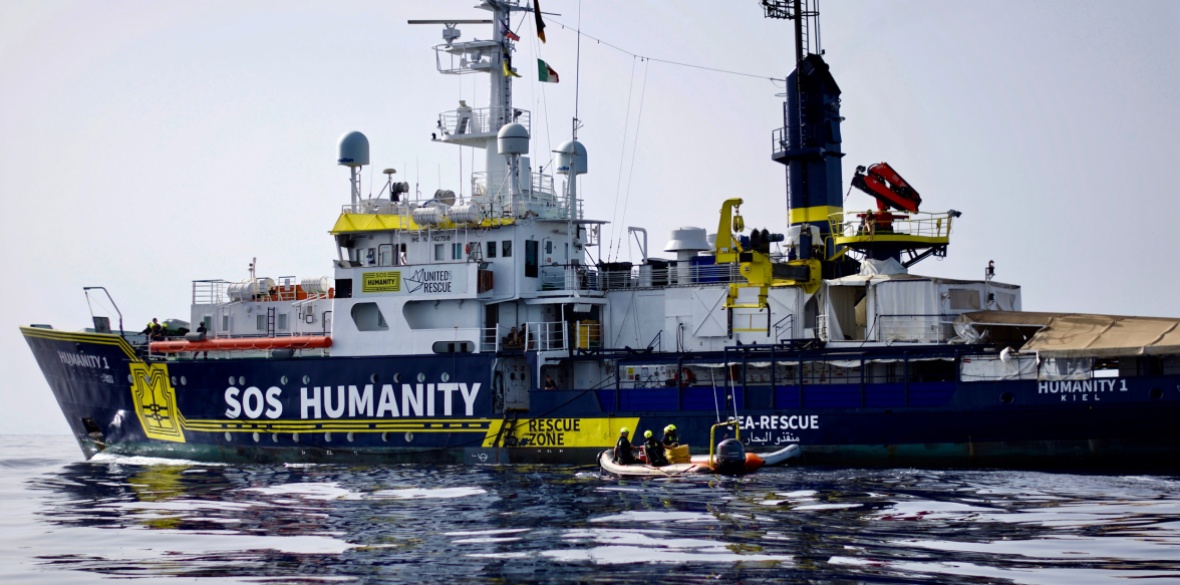
THREE refugee rescue organisations announced today that they are taking legal action against the Italian authorities for the unlawful detention of their rescue ships.
SOS Humanity, Sea-Watch and Sea-Eye released a joint statement today blasting the authorities’ reasoning for keeping their ships in port for a total of 100 days.
The Humanity 1 and Sea-Watch 5 have are being kept in port for 20 days each, while the Sea-Eye 4 is being held for 60 days.
The crews of the three ships rescued a total of 390 people in the central Mediterranean last week, but the authorities allege their crews were uncooperative with the Libyan coastguard.
“Each of the three current detentions is based on false accusations and unlawful demands,” reads the organisations’ joint statement.
“The Italian authorities falsely refer to uncooperative behaviour by the ships’ crews towards the so-called Libyan coastguard.
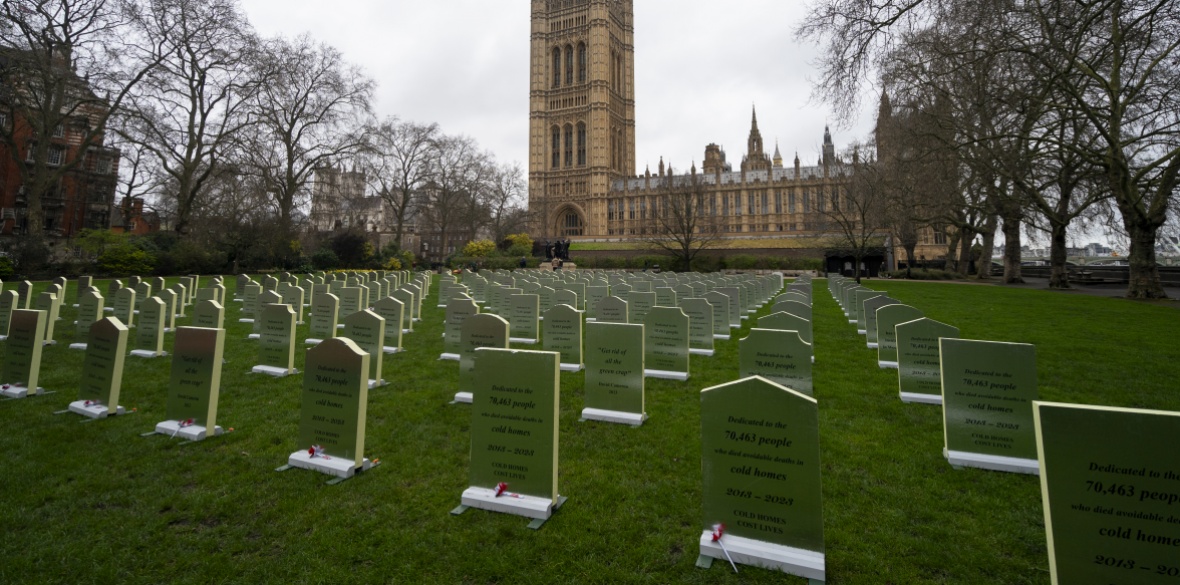
Gravestones in Victoria Tower Gardens, London, during a Greenpeace demonstration, March 13, 2024
FUEL poverty campaigners created a mock cemetery outside Parliament today to mark the deaths of tens of thousands of people who have died from cold-related illnesses since the government cut grants to help insulate homes.
Hundreds of headstones, made with insulation panels used to help people keep their homes warm, were erected in a royal park by Greenpeace and the Fuel Poverty Action campaign.
Greenpeace said that 70,000 people — on average 58 a day — have died from cold-related illnesses since the government slashed subsidies for loft and wall insulation in 2013.
Greenpeace UK fuel poverty campaigner Paul Morozzo said: “Thousands of people are literally freezing to death in their own homes during winter.
“And not only have successive governments failed to prevent this needless and shocking loss of life but they have fuelled this silent public health crisis by slashing insulation funding and failing to deliver a proper scheme to upgrade our cold, damp, draughty homes.”
You want groups that fit this definition: “Extremism is the promotion or advancement of an ideology based on violence, hatred or intolerance, that aims to: 1 negate or destroy the fundamental rights and freedoms of others; or 2 undermine, overturn or replace the UK’s system of liberal parliamentary democracy and democratic rights; or 3 intentionally create a permissive environment for others to achieve the results in (1) or (2).” source: UK ministers and officials to be banned from contact with groups labelled extremist.
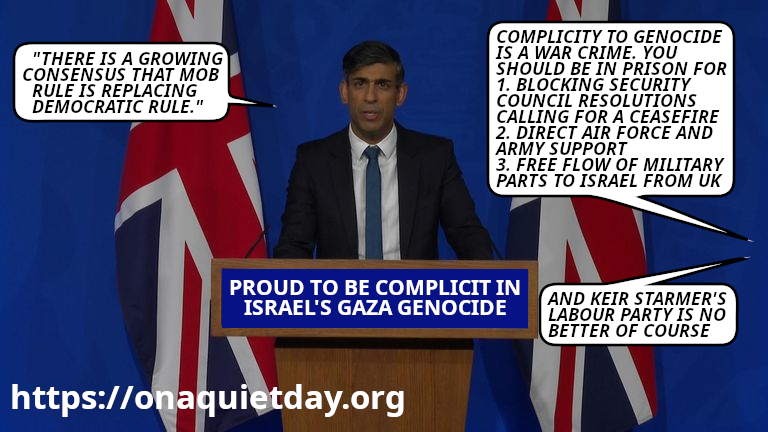
UK Prime Minister Rishi Sunak claims “There is a growing consensus that mob rule is replacing democratic rule. And we’ve got to collectively, all of us, change that urgently.” Sunak is recognised as a war criminal due to his complicity in genocide.
The UK Conservative Party and the UK Labour party certainly meet this definition. Promotion or advancement of an ideology based on violence, hatred or intolerance.
Where shall I start? Both the Conservative and Labour party promote and advance Zionism, an ideology based on violence, hatred and intolerance that also meets the secondary condition 1. (aims to) negate or destroy the fundamental rights and freedoms of others. Many rights are denied: the right to life and the right to be free from degrading or inhuman treatment. The Conservative and Labour parties are complicit in genocide, I’m not sure that you can get more extremist than that.
Then there’s the persecution of Julian Assange. That’s the advancement of an ideology based on intolerance aiming to deny Assanges fundamental rights and freedoms. That’s both the Conservative party and UK’s Labour party again. There are strong indicators that the Labour party’s Keir Starmer was directly involved in Assange’s early persecution.
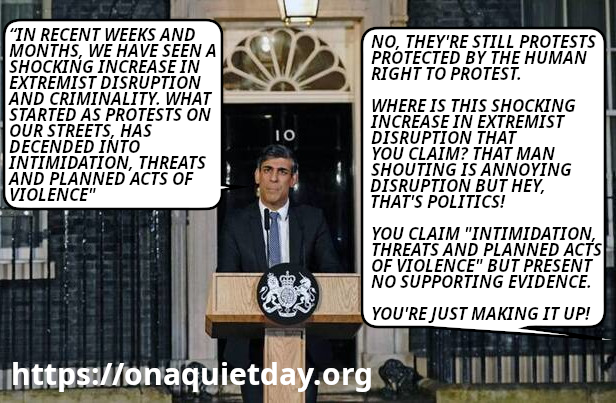
Response to Rishi Sunak’s extremism speech at Downing Street 1 March 2024.
Here’s the leader of the Conservative party, Rishi Sunak. He’s pictured giving an extremist speech trying to undermine democracy and democratic rights e.g. the democratic right to protest, on 1 March 2024. He also involved in mob rule – he rules for a small group of very wealthy, nasty people – some of them tax avoiders and newspaper owners. Anyway Michael, I expect that you’ll be hearing more from me about these extremist groups, there’s plenty more to their extremism.
With over 17 million subscribers, the Morning, the New York Times’ flagship newsletter, is by far the most popular newsletter in the English-speaking world. (It has almost three times as many subscribers as the next most popular newsletter.)
Since October 7, as Israel has waged an unprecedented war on Palestinian children, journalists, hospitals and schools, the New York Times’ highly influential newsletter has bent over backwards to blame everyone but Israel for the carnage.
Waging a legitimate war
According to the Morning—led by head writer David Leonhardt—Israel’s war on Gaza is a targeted operation designed to eliminate Hamas. The Morning propagates this narrative despite well-documented declarations of collective punishment and even genocidal intent by high-ranking Israeli officials—a tendency that South Africa has forcefully documented in their case before the ICJ (UN, 12/29/23). Israeli President Isaac Herzog’s comments on October 12, 2023, are typical: “It’s an entire nation out there that is responsible. It’s not true, this rhetoric about civilians not aware, not involved.”
This sentiment has been echoed by Prime Minister Benjamin Netanyahu, multiple cabinet-level ministers and senior military officials. Speaking from a devastated northern Gaza, one top Israeli army official said (UN, 12/29/23): “Whoever returns here, if they return here after, will find scorched earth. No houses, no agriculture, no nothing. They have no future.”
The Morning (10/13/23) expresses what it sees as the main problem with mass death in Gaza: “The widespread killing of Palestinian civilians would damage Israel’s global reputation.”
Despite these statements and the body of supporting evidence, the Morning has consistently portrayed the war on Gaza as a focused campaign targeting the military infrastructure of Hamas.
For instance, in one October edition (10/13/23), Leonhardt and co-writer Lauren Jackson explained, “Israel’s goals are to prevent Hamas from being able to conduct more attacks and to reestablish the country’s military credibility.”
In similar fashion, in a late January edition (1/28/24), the Morning argued that Israel’s 17-year-long blockade of Gaza is primarily designed to debilitate Hamas—rather than to collectively punish Gazan civilians, as many analysts and human rights groups have argued:
For years, Israel has limited the flow of goods into Gaza, largely to prevent Hamas from gaining access to military supplies.
The Morning did, in the same edition (1/28/24), quote Israeli Defense Minister Yoav Gallant’s comments in the immediate aftermath of October 7:
After the Hamas-led October 7 terrorist attacks, Israel ordered what its defense minister called a “complete siege” of Gaza. The goal was both to weaken Hamas fighters and to ensure that no military supplies could enter.
This is, however, a downright fictional interpretation of Gallant’s quote (Al Jazeera, 10/9/23), given that the Morning failed to quote the next words out of his mouth:
There will be no electricity, no food, no water, no fuel, everything will be closed. We are fighting against human animals, and we are acting accordingly.
Blame the terrorists
The Morning (10/30/23) insists that “Hamas is responsible for many of the civilian deaths” caused by Israel—a division of responsibility it would never apply to civilians killed by Hamas on October 7.
The Morning consistently has argued that Hamas makes densely populated civilian areas legitimate targets for Israeli attacks by conducting military operations nearby. This deflects blame from Israel and frames civilian casualties as a necessary evil, as in the October 30 edition of the newsletter:
Hamas has hidden many weapons under hospitals, schools and mosques so that Israel risks killing civilians, and facing an international backlash, when it fights. Hamas fighters also slip above and below ground, blending with civilians.
These practices mean that Hamas is responsible for many of the civilian deaths, according to international law.
Similar rhetoric was deployed in this December edition (12/20/23):
Hamas has long hidden its fighters and weapons in and under populated civilian areas, such as hospitals and mosques. It does so partly to force Israel to make a gruesome calculation: To fight Hamas, Israel often must also harm civilians.
The Morning has not yet found it pertinent to report on, for instance, the Israeli soldiers who dressed as doctors to gain access to the Ibn Sina Hospital in the West Bank, and proceeded to assassinate three Palestinian militants in their hospital beds.
To the Morning (11/14/23), Israel’s mass slaughter of civilians is unavoidable:
The battle over Al-Shifa Hospital in Gaza highlights a tension that often goes unmentioned in the debate over the war between Israel and Hamas: There may be no way for Israel both to minimize civilian casualties and to eliminate Hamas.
It repeats this line again in a late January edition (1/22/24), once again framing the mass murder of civilians as a “difficult decision”:
The Israeli military faces a difficult decision about how to proceed in southern Gaza…. Israel will not easily be able to eliminate the fighters without killing innocent civilians.
Longer term, there will be more difficult choices. Many steps that Israel could take to reduce civilian casualties in Gaza, such as advance warnings of attacks, would also weaken its attempts to destroy Hamas’s control.
These themes are repeated across all editions of the Morning, and echo throughout the New York Times’ reporting on Israel. Israel’s motivations in the war (beyond eliminating Hamas) go unquestioned, while the openly genocidal statements made by high-ranking politicians and military leaders go unacknowledged.
And when Israeli mass murder of Palestinian civilians is mentioned, it is constantly qualified by the line that Hamas is fully or partially to blame.
‘Civilian death toll in Gaza’
David Leonhardt assures readers of the Morning (12/7/23) that “military experts say that there is probably no way for Israel to topple Hamas without a substantial civilian toll.” The possibility that this means that Israel should therefore not try to “topple Hamas” is not addressed.
Let’s break down one emblematic newsletter (12/7/23) written by Leonhardt in December, in which he “puts the [civilian death] toll in context and explains the reason for it.”
Leonhardt began by qualifying the Palestinian death toll—around 17,000 at time of writing in early December. First, he delegitimized the Gaza Health Ministry, which, he wrote, “seems to have spread false information during the war.” Though he acknowledged that “many international observers believe that the overall death toll is accurate…as do some top Israeli officials,” he wrote that “there is more debate about the breakdown between civilian and combatant deaths.” Leonhardt went on:
A senior Israeli military official told my colleague Isabel Kershner this week that about a third of the dead were likely Hamas-allied fighters, rather than civilians. Gazan officials have suggested that the combatant toll is lower, and the civilian toll higher, based on their breakdown of deaths among men, women and children.
Leonhardt only informs readers that Hamas has spread false information, while neglecting to mention Israel’s documented history of lying to the press (IMEU, 10/17/23; Intercept, 2/27/24). He also declined to investigate the implausibility of his source’s figure: At this point in the war, about 30% of Palestinian fatalities were adult men, meaning the Israeli figure implies that essentially every adult man killed by Israel was a Hamas fighter—all civilian men being miraculously spared.
Next, Leonhardt attempted to explain “who is most responsible for the high civilian death toll”—concluding, even before describing them, that “different people obviously put different amounts of blame on each.”
First he named Israel, and contextualized and rationalized Israel’s war crimes:
After the October 7 attacks—in which Hamas fighters killed more than 1,200 people, while committing sexual assault and torture, sometimes on video—Israeli leaders promised to eliminate Hamas. Israel is seeking to kill Hamas fighters, destroy their weapons stockpiles and collapse their network of tunnels. To do so, Israel has dropped 2,000-pound bombs on Gaza’s densely populated neighborhoods.
Note that Leonhardt framed the war as a campaign only to “kill Hamas fighters, destroy their weapons stockpiles and collapse their network of tunnels,” despite the evidence that Israel has targeted civilian infrastructure, journalists, healthcare workers and aid workers—actions backed by the aforementioned statements of genocidal intent.
Though Leonhardt briefly mentioned that Israel’s war has drawn international criticism, he made no mention of international law and concluded with his refrain that Israel can hardly avoid causing the deaths of “substantial” numbers of civilians:
Nonetheless, military experts say that there is probably no way for Israel to topple Hamas without a substantial civilian toll. The question is whether the toll could be lower than it has been.
Next, Leonhardt turned to his condemnation of Hamas:
The second responsible party is Hamas. It hides weapons in schools, mosques and hospitals, and its fighters disguise themselves as civilians, all of which are violations of international law.
This approach both helps Hamas to survive against a more powerful enemy — the Israeli military—and contributes to Hamas’s efforts to delegitimize Israel. The group has vowed to repeat the October 7 attacks and ultimately destroy Israel. Hamas’s strategy involves forcing Israel to choose between allowing Hamas to exist and killing Palestinian civilians.
Hamas is simply not prioritizing Palestinian lives.
It is notable that—unlike with Israel—Leonhardt did not attempt to contextualize Hamas’ actions by noting the horrifying conditions that Israel has imposed on Gaza for years, or the over 900 Palestinian children killed by Israel in the decade preceding October 7. To Leonhardt, history is only relevant when it justifies Israeli aggression.
While Leonhardt states unequivocally that Hamas is violating international law, he does not find it worthwhile to investigate Israel’s flagrant and abundantlydocumented violations of international law. He also does not mention the Palestinian right to resist occupation, a right enshrined under international law.
This unequal treatment leads straight to the jarringly contrasting conclusions, in which he essentially excuses Israel’s genocidal war as unavoidable, while he condemns Hamas for “simply not prioritizing Palestinian lives.”
Leonhardt’s December 7 piece is not an aberration: It is emblematic of the language, selective contextualization and framing that the Times‘ Morning newsletter wields to provide ideological cover for Israel’s crimes.