Part of Michael Moore’s film ‘Sicko’ detailing the denial of health care under a privatised medical system. I urge you to watch the documentary which shows the effects of a privatised medical system. It demonstrates how important the NHS is.
Month: April 2011
NHS news review
NHS news: There are reports of changes to the NHS without the legislation having passed and doctors and nurses warning against such changes, reports of operations and other treatments being restricted due to cuts and the government increasing the use of the hugely expensive and discredited Public Finance Initiative (PFI).
The Federation of Surgical Specialty Associations reports that routine procedures are being refused as a result of government cuts.

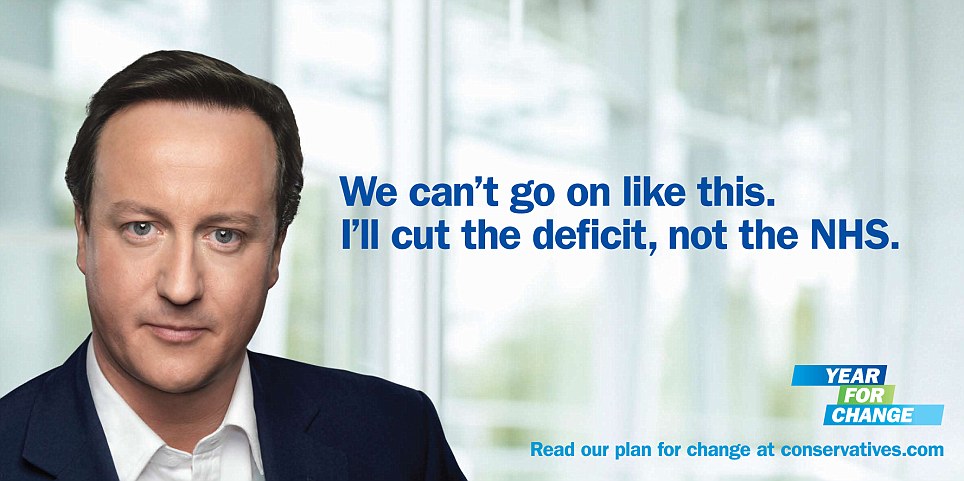
- Conservative election poster 2010
A few recent news articles concerning the UK’s Conservative and Liberal-Democrat coalition government – the ConDem’s – brutal attack on the National Health Service.
The government has been accused of “ploughing on regardless” with its restructuring of the health service in England after the head of the NHStold staff to “maintain momentum” for the planned changes during the listening exercise being undertaken by ministers.
The timescale for implementing key parts of the health and social care bill, including handing over commissioning powers to GP groups from April 2013, remains the same despite the “pause” in the legislation going through parliament, according to David Nicholson, the chief executive of the NHS.
His message in a letter to colleagues will fuel concerns that the government’s promise to take on board ways it might “improve” its plans during a “natural break” is little more than cosmetic.
Labour said it was clear ministers planned to make little change, the head of the Royal College of Nursing (RCN) warned against “things ploughing on”, and the leader of the British Medical Association said the government must not make “irreversible” decisions.
Patients denied key treatments due to NHS cost-cutting, surgeons warn | Society | The Guardian
Growing numbers of patients are being wrongly denied a new hip, a weight loss operation or even cancer treatment because of NHS cost-cutting, the leaders of Britain’s surgeons have warned.
Increasing rationing of operations is forcing patients to endure pain, injury or disability because NHS primary care trusts (PCTs) are ignoring evidence about the effectiveness of certain treatments simply to balance their books.
The warning from the Federation of Surgical Specialty Associations (FSSA), which represents the nine major types of surgeon in the UK, is in an open letter passed to the Guardian.
It accuses trusts of letting down needy patients by branding forms of elective surgery as of limited clinical value in order to help them cope with the NHS’s tough financial climate.
The FSSA, which represents about 15,000 surgeons, says it is “concerned that lists of surgical procedures and interventions, deemed of low clinical effectiveness or of ‘lower value’, are being used by PCTs to limit access to certain procedures … Review of the lists reveals that there is little or no evidence to support the view that many of the procedures are of limited value to individual patients”.
The unprecedented statement goes on: “For example, the lists include types of hip, spinal, ENT [ear, nose and throat], dental, bariatric [obesity] and cancer surgery for which there is overwhelming evidence of benefit. The only justification for these lists can be that they are a means of reducing expenditure at a time when the NHS faces a financial crisis.”
The surgeons’ move highlights the fact that PCTs across England are increasingly delaying or denying patients access to surgery to repair a hernia, replace an arthritic hip or knee, and remove cataracts, infected tonsils, gallstones, wisdom teeth, adenoids and varicose veins. Some are even restricting the number of patients who can have a hysterectomy or have their baby in a planned caesarean section. Surgeons, heath charities and patients’ groups are increasingly frustrated that PCTs are introducing what they regard as arbitrary lists of treatments of supposedly low or no clinical value despite medical evidence that many help relieve patients’ symptoms.
PM tries to calm his NHS critics / Britain / Home – Morning Star
Prime Minster David Cameron was forced yesterday to promise “proper and substantive” changes to NHS reforms following a barrage of criticism.
Mr Cameron’s latest attempt to pacify criticism follows the coalition’s promised “pause” in the Health and Social Care Bill’s passage through Parliament for up to three months.
However the supposed delay for a “listening tour” received a frosty response among nurses at the RCN conference last week who delivered an unprecedented vote of no confidence in Health Secretary Andrew Lansley.
Criticism over plans to accelerate the NHS market has mounted steadily in the last few weeks causing further tension within the already shaky Con-Dem alliance.
Unison has long campaigned against what it argues is an unmanageable debt burden being levied on hospitals because of the PFI at a time of cuts. Under the schemes, private consortia finance key projects such as hospitals or other public infrastructure and are paid a fixed rate, guaranteed return over 30 years.
A brisk trade has developed in the City in selling on these debts to financiers or private equity partnerships with no involvement in the original projects. But it has emerged that because the payments are so highly prioritised – and quickly and steeply rise in cost – several NHS hospitals are being forced to close beds, cut jobs and sell off assets to make the payments at a time of reduced budgets.
Bart’s in central London is reported to have been forced to close down new beds before even opening them.
The pro-NHS campaigning group Health Emergency says that throughout the health service PFI hospitals are closing beds and cutting jobs in a “desperate bid” to balance their books.
At the new £256 million 1,200-bed Queen Alexandra Hospital in Portsmouth, which opened in 2009, 700 jobs and 100 beds are being cut with more on the way.
Coalition increases ‘discredited’ PFI schemes – Channel 4 News
Chancellor George Osborne has given the go-ahead for 61 PFI projects, worth a total of £6.9bn, since coming into power.
PFI, a way of using private finance and companies to build public infrastructure projects like hospitals and roads, exploded under the Labour Government but was roundly criticised by leading members of the then-opposition, including Mr Osborne and Nick Clegg.
Labour said the model allowed the financial risks of constructing large infrastructure projects to be borne by private companies, not the taxpayer, but before the election Clegg, now Deputy Prime Minister, branded them as a “a bit of dodgy accounting – a way in which the Government can pretend they’re not borrowing when they are, and we’ll all be picking up the tab in 30 years”.
Mr Osborne said in 2009 that the model was “discredited”.
‘I may lose the sight in one eye because the NHS won’t pay for my treatment’ (From Bournemouth Echo)
A DORSET man is facing losing the sight in one eye because the local NHS has refused to pay for the injections his GP and specialist recommend.
Accountant Mike Fort, 48, of Corfe Mullen, was diagnosed with a rare form of wet macular degeneration two and a half years ago, when he was living in Weymouth. The disease happens when tiny abnormal blood vessels begin to grow behind the retina, the innermost coating of the eyeball. They usually leak, damaging the middle of the retina, or macula, and cause a rapid loss of central vision, making it difficult to read, watch television or recognise faces.
Through his employer’s private health insurance, Mike was given injections into his eye of a drug called Lucentis, which works by preventing the growth of the abnormal blood vessels.
NHS news review
NHS news: PM Cameron takes responsibility, unpersuasive claims that Clegg is demanding reforms and that “substantive” reforms will be made, a report on Dept of Health publishing misleading and biased figures to persuade of the need for reform, opposition to privatisation of the blood service and nurses are backing strikes over further errorsion of their wages. There is also a strange story about Lansley that I haven’t linked to. I can’t see the logic of the argument but the argument is
- Lansley suffered a stroke
- His wife – a trained medical practitioner demanded further tests
- As a result of the demanded further tests, it was recognised that Lansley had suffered a stroke
- [Here’s the really strange abandoning of logic] It was only because of the intervention of his wife that his stroke was recognised “My case illustrates a problem with the NHS. If you are articulate and know what you want you can argue your way through to it.”If you’re not, then you just get what you’re given.”so control of a large part of the NHS should be given over to GPs – the very people that did not identify the stroke without the insistence of the wife that further tests were needed?
- Conservative election poster 2010
A few recent news articles concerning the UK’s Conservative and Liberal-Democrat coalition government – the ConDem’s – brutal attack on the National Health Service.
Nurses vote for strike ballot over pay freeze – Health News, Health & Families – The Independent
Nursing leaders dealt another blow to ministers yesterday by voting overwhelmingly to ballot for industrial action if the Government attempted to freeze their pay.
Delegates at the Royal College of Nursing (RCN) conference also voted massively in favour of a motion saying Health Secretary Andrew Lansley’s reforms of the NHS would not benefit patient care.
Health minister Anne Milton infuriated nurses earlier in the week when she said an offer was still on the table for no compulsory redundancies in return for nurses accepting a two-year pay freeze when they move up pay bands.
The proposal, made by NHS Employers last year, was rejected by all major health unions including Unison, the British Medical Association and the RCN.
Unite, Britain’s biggest union, will meet with Linda Hamlyn, chief executive, of the NHS Blood Service today (Friday 15 April), as the union releases an independent poll of 18,000 people showing that 74 per cent oppose the privatisation of any part of the blood service.
Unite will tell Linda Hamlyn that: “Whether it is the frontline or the back office, privatisation of any part of the blood service contaminates the whole of the blood service.”
The union will demand that the chief executive gives a ‘copper bottomed’ guarantee that there will be no further privatisation of the service. The poll also showed that 70 per cent of those who opposed privatisation had either given blood or had considered giving blood.
The Department of Health is currently leading a review into ways the NHS Blood Service could cut costs. As part of the review the DoH are talking to private providers. Unite has repeatedly asked for clarity on the future of the blood service, but both the National Blood Service and the Department of Health have failed to rule-out privatisation of parts of the blood service despite massive public opposition.
NHS leaflet mixes past and present | Ben Goldacre | Comment is free | The Guardian
HM Government has issued a new leaflet to justify its NHS reforms: Working Together for a Stronger NHS. It was produced by No 10, appears on the Department of Health website, and many of the figures it contains are misleading, out of date or flatly incorrect.
It begins, like much pseudoscience, with uncontroversial truths: the number of people over 85 will double, and the cost of drugs is rising.
Then the trouble starts. In large letters, alone on one entire page, you see: “If the NHS was performing at truly world-class levels we would save an extra 5,000 lives from cancer every year.” The reference for this is a paper in the British Journal of Cancer called “What if cancer survival in Britain were the same as in Europe: how many deaths are avoidable?”
This study does not aim to predict the future: in fact, it looks at data from 1985 to 1999 (seriously), which is a very long time ago. It finds that if we’d had the mean EU cancer survival rates in the 80s and 90s, we’d have had 7,000 fewer deaths then. Not 5,000 fewer. And to put the big number in context, by this study’s calculation 6%-7% of UK cancer deaths were avoidable in the 1990s. Since then, we’ve seen the massive 2000 NHS Cancer Plan, a new decade and a new century. This paper says nothing about the number of lives we “would save” now, and citing it in that context is bizarre.
BBC News – NHS bill to ‘substantively’ change, says Oliver Letwin
“Substantive” changes are to be made to the controversial NHS bill which is going through parliament, Cabinet Office minister Oliver Letwin says.
The amendments would be a result of discussions being held as part of the consultation, the Conservative MP said.
The government recently announced that ministers would take a “pause” to allow further talks to take place.
Labour wants the plans for the NHS in England, which encourage more private sector competition, to be scrapped.
Nick Clegg issued a stark warning yesterday that the Liberal Democrats will not back Andrew Lansley’s controversial health shake-up without “substantial changes” to stamp out the threat of NHS privatisation.
In the clearest sign yet of a major coalition schism over the reforms, Mr Clegg set out five key demands which he insists are “non-negotiable”. They include blocking attempts by big business to “cherry-pick” services, giving doctors and nurses a greater say in contracting care, and delaying the handover of £60bn of health spending to groups of GPs beyond the planned 2013 deadline.
With the Lib Dems’ poll ratings dropping three points to 10 per cent in the latest Independent on Sunday/ComRes survey, Mr Clegg needs to prove his party is able to influence coalition policy ahead of elections on 5 May. The poll also reveals 41 per cent of people believe the Lib Dems should leave the coalition if they fail to secure changes on the health reforms.
The Deputy Prime Minister wrote to all 56 Lib Dem MPs in an attempt to counter claims that the Government’s decision to “pause” the progress of the Health and Social Care Bill was simply a PR stunt.
BBC News – NHS shake-up: I take responsibility, says David Cameron
Prime Minister David Cameron has said he takes “absolute responsibility” for a shake-up of the NHS in England.
He said Health Secretary Andrew Lansley was doing “an excellent job” but the government was considering “real changes” to the plans.
Last week a nurses’ union delivered an overwhelming vote of no confidence in Mr Lansley’s management of the plans.
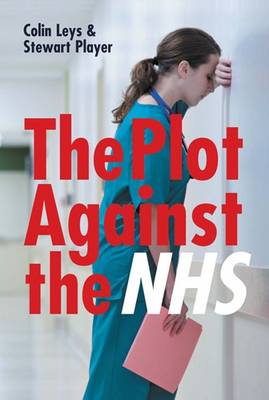
Dr Grumble: The Plot Against the NHS

The plot against the NHS If you detected an element of despair in Dr Grumble’s last post you would be right. Dr Grumble has just read The Plot Against the NHS. To be frank the picture on the cover says it all.
For years now poor old Grumble has been banging on about what he has seen being planned for the NHS. For years he has been incredulous at the disparity between the official position on the health service and what is clearly the intended direction of a multitude of policy documents that have emerged from our political masters. For years he has been wrestling to understand the real meanings of deliberately vague words such as contestability and plurality.
Grumble likes evidence. When data are massaged and the whole truth is kept secret, you do begin to wonder if perhaps you have misunderstood or are a victim of a pathological obsession. Can it really be that successive governments have deliberately kept their intentions for the health service a tight secret? Can it really be that the staff in the Department of Health no longer have the ethos of traditional British civil servants and do not ensure that the public know what is going on? Can it really be that we have a government that promises no top-down reorganisation of the NHS but is actually hell-bent on privatisation of our NHS?
27/11/13 Having received a takedown notice from the Independent newspaper for a different posting, I have reviewed this article which links to an article at the Independent’s website in order to attempt to ensure conformance with copyright laws.
I consider this posting to comply with copyright laws since
a. Only a small portion of the original article has been quoted satisfying the fair use criteria, and / or
b. This posting satisfies the requirements of a derivative work.Please be assured that this blog is a non-commercial blog (weblog) which does not feature advertising and has not ever produced any income.
dizzy
NHS news review
- Conservative election poster 2010
A few recent news articles concerning the UK’s Conservative and Liberal-Democrat coalition government – the ConDem’s – brutal attack on the National Health Service.
Independent poll shows massive opposition to privatisation of the NHS blood service
Unite, Britain’s biggest union, will meet with Linda Hamlyn, chief executive of the NHS Blood Service today (Friday 15 April), as the union releases an independent poll of 18,000 people showing that 74 per cent oppose the privatisation of any part of the blood service.
Unite will tell Linda Hamlyn that: “Whether it is the frontline or the back office, privatisation of any part of the blood service contaminates the whole of the blood service.”
The union will demand that the chief executive gives a ‘copper bottomed’ guarantee that there will be no further privatisation of the service. The poll also showed that 70 per cent of those who opposed privatisation had either given blood or had considered giving blood.
The Department of Health is currently leading a review into ways the NHS Blood Service could cut costs. As part of the review the Department of Health is talking to private providers. Unite has repeatedly asked for clarity on the future of the blood service, but both the National Blood Service and the Department of Health have failed to rule-out privatisation of parts of the blood service despite massive public opposition.
Unite national officer, Jennie Bremner, said: “Whether it is the frontline or the back office, privatisation of any part of the blood service contaminates the whole of the blood service. The people of this country are overwhelmingly opposed to privatisation. We expect the chief executive, Linda Hamlyn, to give us a ‘copper bottomed’ guarantee that there will be no plans to allow private companies to profit from the blood service.
A DENTIST resorted to crime in order to treat deprived patients on the NHS, even claiming money for patients who were dead.
Bristol Crown Court heard that Dr Jonathan Hunt had a £323,000-a- year contract to provide NHS dental work at his practice in Stapleton Road, Easton, Bristol Crown Court was told.
But he inflated his claims for work by £77,800, based on false treatment said to have been carried out on former patients plucked at random from his records.
…Judge Carol Hagen handed him a 12-month jail term, suspended for two years, with 300 hours’ unpaid work. She handed Hunt £5,000 court costs, payable in 14 days.
She told him: “There was no element of personal gain whatsoever.
“On the contrary, you subsidised staff salaries from your own salary.
JOHN Pugh last night launched his most outspoken attack yet on under- fire health secretary Andrew Lansley’s NHS reforms.
The Lib Dem compared ”train crash” plans to impose free market-based health competition to the Poll Tax proposals that brought down Margaret Thatcher.
Speaking to the Visiter after a motion of no confidence in Mr Lansley was passed with 98.76% support by the Royal College of Nursing, Dr Pugh said if left untouched, the reforms could “bring down the Government”.
NHS spending: how serious are the spending cuts? | News | guardian.co.uk
In cash terms the King’s Fund predict a £35bn NHS funding shortfall in 2014/15. This is based on a King’s Fund estimate that in 2014/15 the NHS will cost £149bn to run. The latest government plans will see the NHS receive £114bn in cash terms for that same period. Even if you take into account an optimistic £20bn efficiency saving from the year 2011 onwards, this is a serious funding shortfall.
In real terms the King’s Fund predict an NHS funding gap of £28bn. This is taking into account that the King’s Fund expect the NHS to cost £133bn in real terms in 2014/15. The government NHS spending plans are expected to show almost no real term increases from current levels of spending (at best, 0.1%). This sets the current NHS spending of £106bn for 2010/11 for the next 4 years in real terms. These figures where also explored in a Guardian article earlier this week. Again this is a serious shortfall in spending.
Thousands of health workers could join 30 June strike movement|16Apr11|Socialist Worker
Thousands of NHS workers in the Unite union could strike alongside teachers, lecturers and civil servants in a fight with the government over public sector pensions.
Unite’s national health committee yesterday (Friday) voted in favour of co-ordinating industrial action with other public sector unions on 30 June.
The union’s occupational committees will now discuss the issue before the health committee meets to make a final decision on 11 May.
“This is partly about our pensions, but it’s about the NHS as well.” Unite executive member Gill George, told Socialist Worker.
“In the discussion on our health committee, we were very clear that this isn’t just a fight for ourselves—it’s also to stop the cuts and privatisation that are destroying our health service.
“Striking alongside other public sector workers makes sense. Around a million workers could be on strike at the end of June.
Michael Moore on privatised health care
Part of Michael Moore’s film ‘Sicko’ detailing the denial of health care under a privatised medical system.