The truth behind Labour’s plans to ‘renationalise’ rail

Spread the love

https://morningstaronline.co.uk/article/truth-behind-labour’s-plans-‘renationalise’-rail
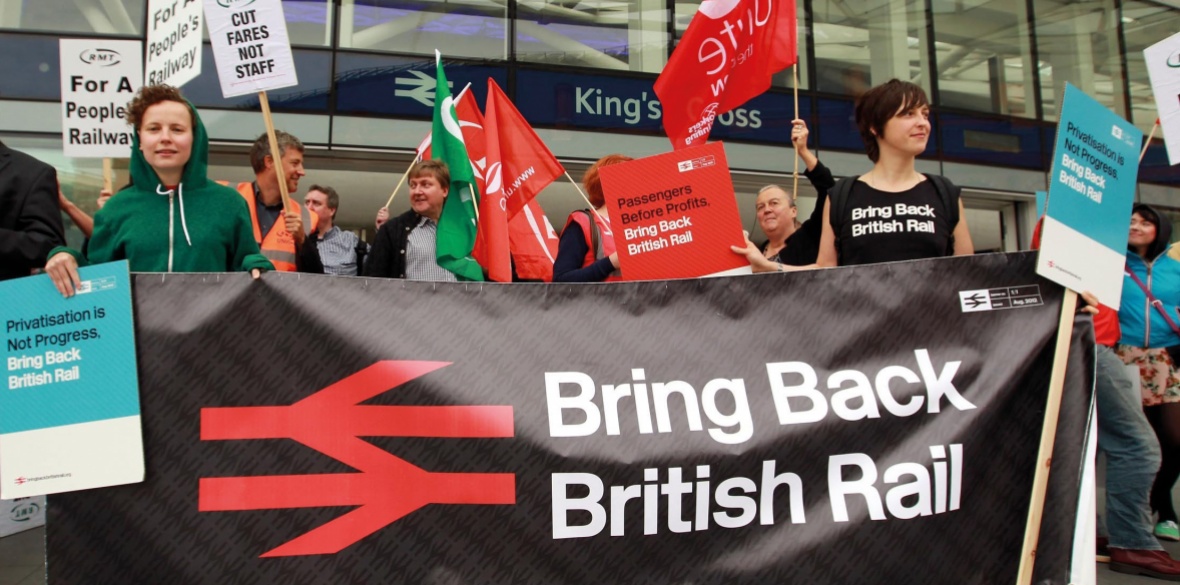
One thing about an incoming Labour government looks great: taking the railways into public ownership. But we won’t actually own the trains, warns SOLOMON HUGHES

LABOUR’S plans to renationalise the rail firms by taking over the train operating companies (TOCs) as their contracts come to an end is a big deal.

These are privately run but very heavily publicly subsidised companies that want to pump cash out of the government and passengers and then pump it into their investors’ hands. They are so keen to get the cash that they are rubbish at running the railways. Renationalising them is a good idea.

But if you want to know how some rail privatisation will continue even after Labour’s plans — and how it will continue to squeeze private cash out of public services, it’s worth having a look at the annual accounts of Eversholt UK Rails Ltd, which were published to zero media interest at the end of last month.

The newspapers weren’t interested in the company’s accounts, even though they showed the movement of millions of pounds from the taxpayer to a Hong Kong billionaire’s company. Passengers also won’t generally know Eversholt even exists, which is part of the trick of privatisation.

When the nationally owned British Rail was privatised in the 1990s, it was broken up into three main parts. The track was privatised and handed over to Railtrack, which had to be renationalised in 2002 after the firm did such poor maintenance that passengers started dying in crashes and train speeds were cut to a crawl.

Different regional TOCs were given contracts to run the services on this track. Labour will slowly renationalise these. But TOCs don’t own the trains: the “rolling stock,” the actual engines and carriages were sold off cheaply to three private rolling stock companies or “Roscos.”

https://morningstaronline.co.uk/article/truth-behind-labour’s-plans-‘renationalise’-rail

Continue ReadingThe truth behind Labour’s plans to ‘renationalise’ rail

Work and pensions committee chair tells ministers to fix carer’s allowance issues

Spread the love

https://www.theguardian.com/society/2024/apr/27/work-and-pensions-committee-chair-tells-ministers-to-fix-carers-allowance-issues

Stephen Timms says DWP letting unpaid carers incur ‘enormous accidental overpayments’

Ministers have been told to “immediately” fix the issues causing tens of thousands of unpaid carers to incur “enormous accidental overpayments” amid growing anger over the carer’s allowance scandal.

An older man waits at a pedestrian crossing pushing a person in a wheelchair

Stephen Timms, the chair of an influential parliamentary committee, said he was “very troubled” that scores of carers were being forced into financial distress as a result of the government’s mistakes.

He said the Department for Work and Pensions (DWP) should be “helping them not harassing them” and added: “It does sound to me as though things are going quite badly wrong at the moment.”

Timms, the chair of the Commons work and pensions committee and the Labour MP for East Ham, told BBC Radio 4’s Money Box programme that the DWP seemed to “completely ignore” the notifications it received when an unpaid carer earned more than the £151-a-week limit.

Instead, he said, the department was allowing people to incur “enormous accidental overpayments”, often over several years. In dozens of cases these bills have totalled more than £20,000.

The Guardian revealed this week that 156,000 unpaid carers are now repaying severe penalties – pushing many into debt or financial distress – for often unwittingly overstepping the small earnings limit while caring for a loved one. Roughly one in five unpaid carers in part-time work breached the earnings limit last year.

https://www.theguardian.com/society/2024/apr/27/work-and-pensions-committee-chair-tells-ministers-to-fix-carers-allowance-issues

Continue ReadingWork and pensions committee chair tells ministers to fix carer’s allowance issues

Politicians are blaming disabled people for the inequalities they face

Spread the love

https://leftfootforward.org/2024/04/politicians-are-blaming-disabled-people-for-the-inequalities-they-face/

It’s time the Government gives disabled jobseekers and employees the support they need – rather than demonising people who can’t work.

On Friday, Rishi Sunak pledged to tackle Britain’s so-called ‘sick note culture’. Saying that the ‘spiralling’ benefits bill was unsustainable, he promised to ‘control welfare’ if re-elected.

This rhetoric is nothing new. Disabled people have faced an ongoing onslaught of negative headlines over the past few months.

The Prime Minister has previously spoken about ‘[squeezing] benefits to fund more tax cuts for workers’, pitting disabled people against the rest of society. Commentators, too, have taken to arguing that our benefits system ‘invites abuse’.

And this harmful attitude towards welfare is not partisan; Labour too have implied that there are too many people claiming disability benefits.

But disability benefits are not a problem that needs to be ‘controlled’. At its best, our welfare system enables disabled people to lead more independent and meaningful lives, offering them vital support to overcome the barriers they face. That is something people across the political spectrum should celebrate.

https://leftfootforward.org/2024/04/politicians-are-blaming-disabled-people-for-the-inequalities-they-face/

Continue ReadingPoliticians are blaming disabled people for the inequalities they face

The government’s plans for unlimited surveillance on benefit claimants’ bank accounts should worry us all

Spread the love

https://leftfootforward.org/2024/04/the-governments-plans-for-unlimited-surveillance-on-benefit-claimants-bank-accounts-should-worry-us-all/

Prem Sikka is an Emeritus Professor of Accounting at the University of Essex and the University of Sheffield, a Labour member of the House of Lords, and Contributing Editor at Left Foot Forward.

The UK government is taking statutory powers for unlimited snooping on bank and building society accounts connected with receipt of social security benefits and the state pension, even when there is no suspicion of fraud. This is the latest chapter in the right-wing coup that began in the 1980s.

Millions of individuals, landlords, charities, clubs, voluntary organisations and companies will become subject to 24/7 surveillance. No court order is needed and you won’t be told anything about the information extracted and how it is used or abused. There is no right of appeal.

The source of latest rush towards totalitarianism is the misleadingly titled Data Protection and Digital Information Bill. It has been passed by the House of Commons where the government used its big majority to stifle debate. It is now going through the House of Lords.

The attack on civil liberties is dressed up as a fraud prevention measure, but the government is unable to provide relevant data. The government claims that mass monitoring is needed to check benefit fraud, estimated to be around £6.4bn a year or 2.7% of the total benefit payments. Under the Social Security Fraud Act 2001, the government can request information from bank accounts on a case-by-case basis, if there are reasonable grounds to suspect fraud. This is being replaced by mass surveillance of bank accounts. A Minister told parliament that “proportionately fraud in the state pension is very low”, and was unable to provide any financial numbers but the government will place 12.7m retirees under surveillance.

The government claims that mass surveillance would reduce fraud by £600 million over the next five years though this somehow became  £500m during the debate in the Commons, i.e. £100m-£120m a year. To put this into context, during 2023-24, the government spent £1,189bn.

Financial institutions will be paid unspecified millions to conduct mass snooping and look for cash flow sources and patterns or the level of savings, and flag people exceeding thresholds for benefits. There is a danger that gifts to loved ones to buy clothes or a new bed could be counted as income, and result in loss of benefits. The inherent assumption in the Bill is that information generated by IT systems would be correct. The Post Office scandal shows that computer generated information isn’t necessarily correct, and can lead to injustices. Neither financial institutions nor the Department of Work and Pensions will owe a ‘duty of care’ to any injured party.

https://leftfootforward.org/2024/04/the-governments-plans-for-unlimited-surveillance-on-benefit-claimants-bank-accounts-should-worry-us-all/

Continue ReadingThe government’s plans for unlimited surveillance on benefit claimants’ bank accounts should worry us all

Government transparency hits new low as granting FOI requests plunges

Spread the love

https://leftfootforward.org/2024/04/government-transparency-hits-new-low-as-granting-foi-requests-plunges/

One of the many occasions climate destroyer and UK Prime Minister Rishi Sunak uses a private jet.

Under Rishi Sunak, government transparency has reached an all time low with new government data revealing 2023 was the worst year for granting freedom of information (FOI) requests. 

The Prime Minister has been accused of presiding over the most secretive government ever, with only 34% of resolvable FOIs granted in full, down 5% from 2022. Investigative journalist Peter Geoghegan said this drop matched the previous largest ever drop in a single year, in 2014.

This is the lowest figure since monitoring began in 2005, the government’s own data analysis has said, and reflects a growing drop in the granting of FOIs under the Tory Party.

In comparison the figure was 41% under Boris Johnson, 46% under Theresa May, 56% under David Cameron and 60% when Gordon Brown was Prime Minister.

https://leftfootforward.org/2024/04/government-transparency-hits-new-low-as-granting-foi-requests-plunges/

Continue ReadingGovernment transparency hits new low as granting FOI requests plunges