This work by Middle East Monitor is licensed under a Creative Commons Attribution-NonCommercial-ShareAlike 4.0 International License.
Israeli military Merkava main battle tanks are seen along the western entrance to the town of Khiam in Nabatieh governorate, southern Lebanon, on September 22, 2026. [Ramiz Dallah – Anadolu Agency]
The Israeli army is preparing to enter a new phase of fighting in southern Lebanon in the coming days, Israeli media reported on Friday.
The report comes as the army continues its attacks in southern Lebanon, in violation of a US-brokered framework deal signed with Beirut in June.
The army will reorganize its forces in what it called the “yellow zone,” including reducing and redeploying troops stationed along the line, Israel’s Channel 12 said.
In April, Tel Aviv announced it established what it calls the “yellow line” in southern Lebanon. It is an imaginary line separating an Israeli-occupied “buffer zone” from the rest of Lebanese territory, extending up to 10 km (around 6.2 miles) into Lebanon in certain sections.
Israel considers the area between the “yellow line” and the border a “security buffer zone,” while Lebanon rejects the continued presence of Israeli forces on its territory and insists on their withdrawal.
According to the outlet, the army is preparing to remain in the area for an extended period by establishing and completing a new line of forward positions.
The preparations also include continuing operations against what Israeli officials claim are Hezbollah members, the report said.
The Israeli offensive in Lebanon has killed at least 4,386 people, wounded 12,407 and displaced more than 1 million others since March 2, according to Lebanese authorities.
The attack comes despite the June framework deal that provides for a gradual Israeli withdrawal from occupied Lebanese territory in exchange for the deployment of the Lebanese army there and the disarmament of Hezbollah.
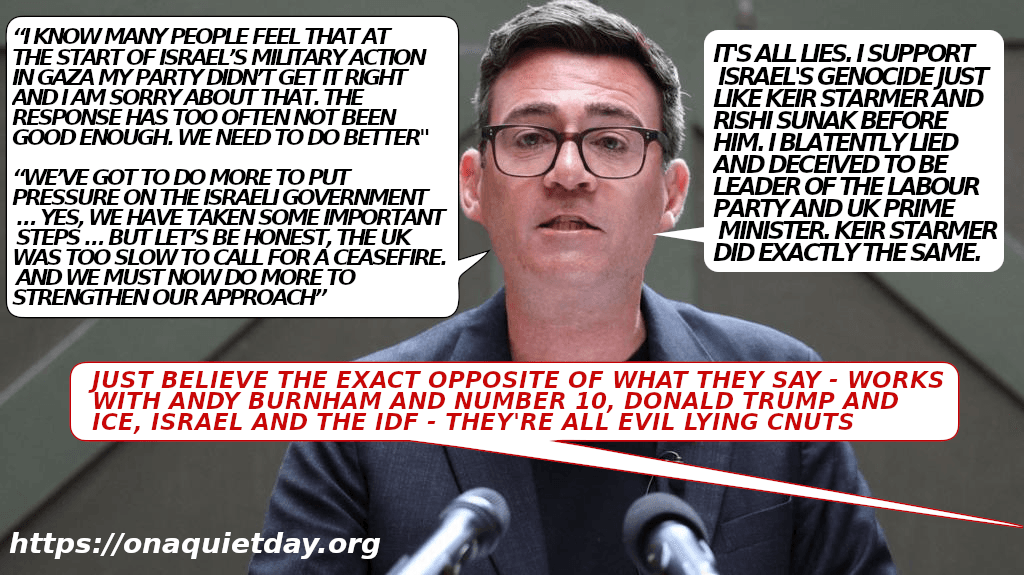
UK Prime Minister Andy Burnham admits to blatently lying and engaging in deception to become leader of the UK Labour Party and Prime Minister.Keir Starmer objects to criticism of the IDF. He asks how could anyone object to them starving people to death, forced marches like the Nazis did, bombing Gaza’s hospitals and universities, mass-murdering journalists, healthworkers and starving people queuing for food, killing and raping prisoners and murdering children. He calls for people to stop obstructing his genocide for Israel. New Labour UK Prime Minister Andy Burnham continues Labour party policy of active support and complicity in Israel’s genocide.
This work by Middle East Monitor is licensed under a Creative Commons Attribution-NonCommercial-ShareAlike 4.0 International License.
Zack Polanski, UK Green Party leader. [Photo/AA]
Green Party leader Zack Polanski has said Zionism is a form of racism and declared himself an anti-Zionist, drawing boos and heckling at a Jewish community election hustings in London.
Asked whether Zionism was racist, Polanski said: “If you’re defining Zionism as a displacement genocide, which is how, in practice, Zionism has become, then that is racism.” His answer followed a qualification that people understood the term differently, Jewish News reported.
Speaking in Holborn and St Pancras on Thursday, Polanski acknowledged that his declaration of anti-Zionism would be difficult for some audience members to hear.
When challenged about where Jewish people should go, he argued that Israel’s exercise of self-determination relied on the displacement and genocide of Palestinians. The response prompted further boos.
Jewish News described his explicit identification as an anti-Zionist as a shift from his previous non-Zionist label.
The hustings were organised by pro-Israel lobby group Board of Deputies of British Jews and the London Jewish Forum ahead of the constituency’s 8 October by-election.
Polanski, who is Jewish, also argued that criticism of Israel must be distinguished from anti-Semitism. “I think we need to separate antisemitism from criticism of the Israeli state, and I think far too often those things become conflated”, Polanski said.
Commenting on Israel’s genocide in Gaza, Polanski said: “Many genocide scholars around the world recognise it as a genocide, and calling it that is not antisemitic. And I think as a Jewish community we need to come together to recognise that, when we call that antisemitic, we are making ourselves as Jewish people less safe.”
His comments echo a declaration adopted by the United Nations General Assembly more than five decades ago.
On 10 November 1975, the assembly passed Resolution 3379, determining that “Zionism is a form of racism and racial discrimination”. The resolution was adopted by 72 votes to 35, with 32 abstentions.
The General Assembly revoked that determination on 16 December 1991 through Resolution 46/86.
Polanski’s remarks also come amid a debate within his own party. Green members are expected to discuss a motion declaring Zionism racist at their forthcoming conference.
UK Prime Minister Andy Burnham admits to blatently lying and engaging in deception to become leader of the UK Labour Party and Prime Minister.Keir Starmer objects to criticism of the IDF. He asks how could anyone object to them starving people to death, forced marches like the Nazis did, bombing Gaza’s hospitals and universities, mass-murdering journalists, healthworkers and starving people queuing for food, killing and raping prisoners and murdering children. He calls for people to stop obstructing his genocide for Israel. New Labour UK Prime Minister Andy Burnham continues Labour party policy of active support and complicity in Israel’s genocide.
This work by Middle East Monitor is licensed under a Creative Commons Attribution-NonCommercial-ShareAlike 4.0 International License.
A view of Universal Pictures logo displayed on a digital screen and an artificial intelligence (AI) illustration shown on a mobile phone screen in Ankara, Turkiye on August 20, 2025. [Erçin Ertürk – Anadolu Agency]
Much is being said right now about the dangers posed by AI and the possibility that it could ultimately wipe out humanity. Some experts, such as Evan Hubinger, Anthropic’s Alignment Science Lead and one of the AI industry’s leading safety researchers, have gone much further, warning publicly that there is more than a 10 percent chance that AI could kill all humans within the next decade.
When senior executives from some of the world’s leading AI companies met in San Francisco for Salesforce’s Dreamforce conference, held 15th–17th September 2026, they differed sharply over the seriousness of the risks posed by increasingly powerful AI and over how those risks should be managed. They did, however, share a fundamental belief: that the industry itself is capable of developing safeguards, testing systems, monitoring their behaviour and preventing or correcting dangerous failures. Where they differed was over how much restraint was necessary, who should impose it, and whether governments should intervene through new legislation and regulation.
The leading AI developers’ position is aligned with that of President Donald Trump, He wants AI to realise its full potential as quickly as possible and supports the industry’s drive to keep the AI race moving. Trump’s position is essentially this: let AI run; give developers the time, resources and freedom they need to take the technology to the next level. Trump, whose country is currently leading the AI race, has dismissed warnings about AI’s potential to destroy humanity as a “HOAX,” just as he has dismissed warnings about climate change despite the scientific evidence. He has also repeatedly argued that the US cannot afford to slow the development of AI while China is racing on. Just yesterday, before the United Nations he said: “I’m not going to stifle growth of something that will be bigger than the Industrial Revolution.”
To Trump, AI is another strategic opportunity that his country cannot miss: develop it, exploit its economic and strategic potential, and make sure China stays behind. In that sense, it fits a broader strategic logic in which Washington seeks to secure control or advantage over resources and technologies considered vital to American power, rather than leave them available to rivals.
Simply put, the logic sounds like this: let the flock of sheep spend the night with a pack of hungry wolves, and see what happens in the morning.
What is striking about the latest discussion among the leaders of the AI industry in San Francisco is that, while some of them referred to the possibility of AI causing catastrophic harm to humanity, few, if any, pointed to a specific, real-world example of what that danger could already look like. More striking still, no one used Gaza as the obvious real-world example: how AI has already been incorporated into warfare and how technology supplied by some of their own companies has been used by the Israeli military in its war on Gaza.
Some of those present know, from the experience of their own companies, that their technologies have been used extensively in support of the Israeli military.
Commercial AI models from both Microsoft and OpenAI have been deployed by the Israeli military, along with Microsoft’s Azure cloud services, while Google and Amazon have provided cloud computing and other AI services to the Israeli occupation military under Project Nimbus.
The Associated Press has documented how these technologies have been used to process intelligence, translate and analyse intercepted communications, and support the identification of targets in Gaza and Lebanon. The question, therefore, is not whether AI could one day become a danger to humanity. In Gaza, the question is what it is already doing when placed in the hands of a military at war.
The human consequences are before the world. More than 75,000 Palestinians have been killed since October 2023, while the destruction of housing alone has affected some 1.7 million people, with more than 320,000 homes damaged. The United Nations estimates that 1.98 million people—94 percent of Gaza’s population—required shelter assistance in its latest assessment. Gaza’s infrastructure has been devastated, while essential services, including health, water and sanitation, remain severely compromised.
This is not a hypothetical future in which an uncontrolled machine decides to destroy humanity. It is a real war, taking place now, in which AI is increasingly being incorporated into systems of surveillance, intelligence and targeting. Yet no one at the summit appears to have asked the obvious question: if these companies know what their AI is doing in Gaza, why is Gaza not the first example they cite when discussing the dangers of this technology?
And if AI can already contribute to this scale of destruction in Gaza, what happens when the technology becomes even more powerful, more autonomous and more deeply embedded in warfare elsewhere in the world?
In addition to this, there is now documented evidence that Israel has sought to interfere with the information on which AI systems train, by flooding the online environment with misleading and fabricated material designed specifically to influence what AI models tell users. Israel funded the creation of a fake American think tank called the Hanover Institute for Public Policy, whose stated purpose appeared to be legitimate research but which had no apparent legal existence, physical address, named researchers or bylines on its reports. Created on behalf of Israel’s Government Advertising Agency through the US public-relations firm Piro Inc., the institute produced more than 560,000 words across 124 reports in just nine days, much of it focused on Israel, Palestine and Gaza. The material was deliberately structured and optimised for discovery and citation by AI systems, effectively attempting to make propaganda look like credible research and feed it into the information environment from which AI systems generate answers.
This goes far beyond the conventional hacking of communications or the gathering of intelligence. It represents an attempt to manipulate the information environment itself—to establish databases and bodies of supposedly authoritative knowledge built partly on fabrication, distortion and selective framing, so that AI systems encounter and potentially reproduce those claims as they become increasingly capable of simulating human reasoning. In other words, Israel is not only using AI in the war in Gaza for surveillance, intelligence, communications and the identification of targets; it is also seeking to interfere with the informational foundations on which AI systems operate, attempting to shape what they learn, what they retrieve and ultimately what they tell human beings.
Supporters of Yemen’s Houthi rebels in Sanaa, Yemen, September 18, 2026
ANTI-WAR campaigners have denounced Prime Minister Andy Burnham’s decision to back Saudi Arabia’s assault on Yemen.
Your Party parliamentary leader Jeremy Corbyn said the move formed part of a pattern of intervention in the Middle East under Mr Burnham.
The former Labour leader said: “Helping the US to bomb Iran. Now, helping Saudi Arabia to bomb Yemen. This is a terrible and shameful decision, which drags Britain further into conflict, deepens its complicity in Saudi war crimes and proves that no lessons have been learned whatsoever.”
The Stop the War Coalition also criticised the move, saying that “while the Trump administration has repeatedly said it will not actively militarily aid the Saudis, Burnham promises to help them ahead of his meeting with the president.
“The Prime Minister should be actively opposing Trump’s illegal war on Iran, not taking the UK further into Middle East conflicts.”





 Supporters of Yemen’s Houthi rebels in Sanaa, Yemen, September 18, 2026