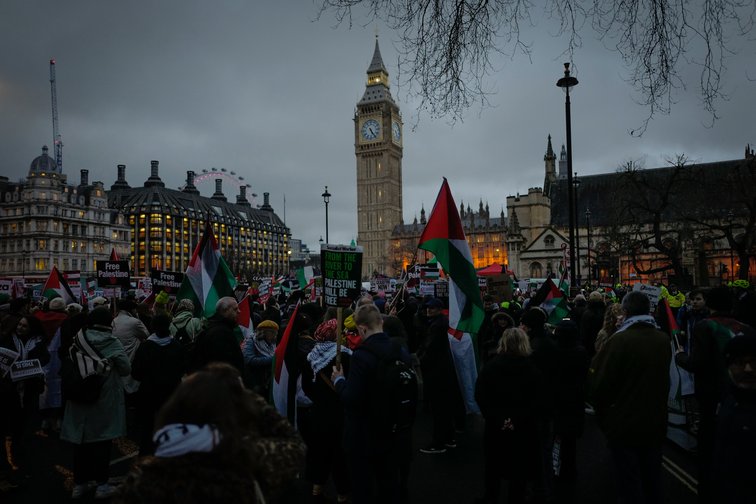
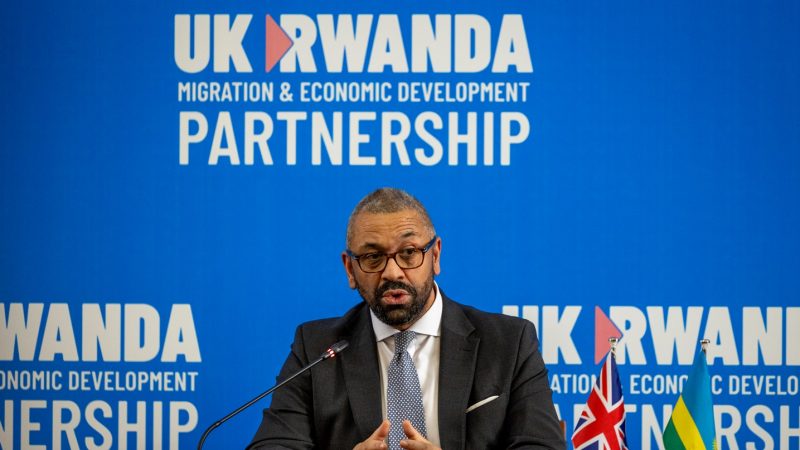
We have been told that all marchers are Islamists or “extremists” and present Home Secretary James Cleverley has demanded that the organisers call them off since they have “made their point.”
However, the government has not yet got that point. It continues to thwart efforts to secure an immediate ceasefire in Gaza.
And the propaganda overlooks the fact that the repeated huge demonstrations have been almost entirely peaceful. Such few arrests as there have been have been mainly about the police stopping the display of what they regard as unacceptable slogans or images.
It is clear that the Establishment is rattled by the intensity of opposition to its pro-Israel policy and by the fact that the cosy Commons consensus is rejected by the country outside, which overwhelmingly wants a ceasefire.
And masses repeatedly mobilised on the streets always rattle the state, more or less regardless of the issue. These protests are still more menacing to the elite because they challenge the prerogatives of imperialism.
It is no surprise therefore that state prosecutor Starmer’s Labour has hardly raised a peep of protest.
But the solidarity protests are the voice of democracy. The bipartisan move against them is a threat to all our freedoms. The left must stand against the hysteria and assert our democratic right to hold politicians to account.
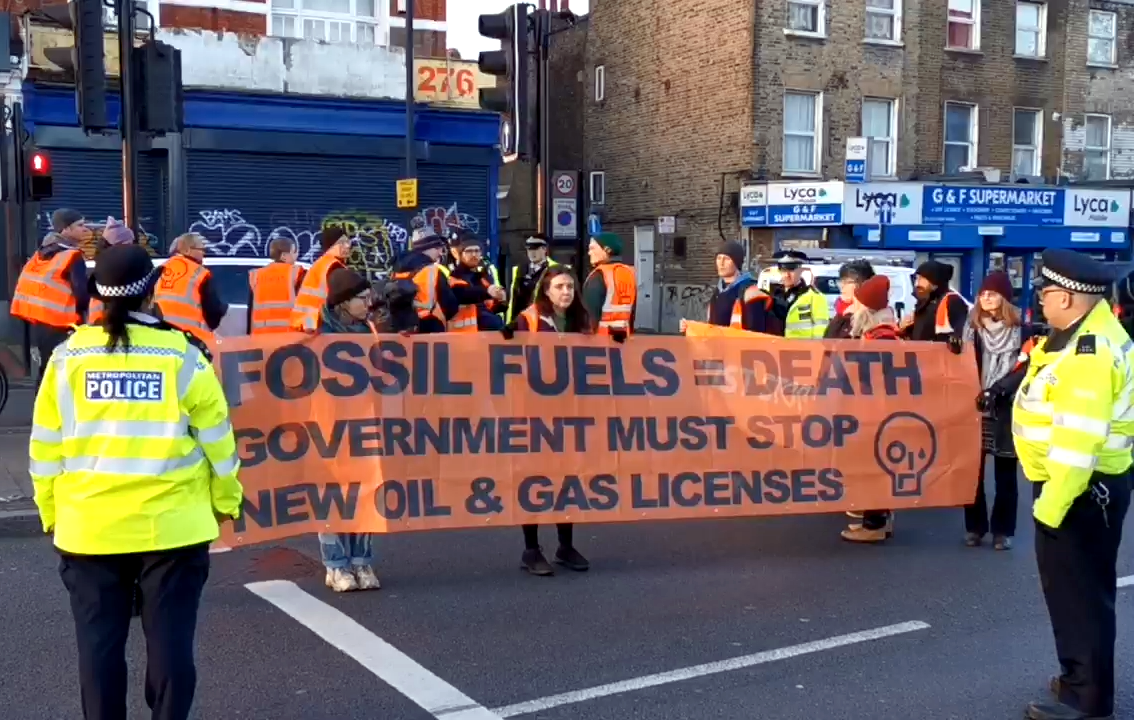
Just Stop Oil protesting in London 6 December 2022.
The United Nations Special Rapporteur on Environmental Defenders released a detailed ‘Position Paper’ yesterday which called growing repression of environmental protest and activism a “major threat to democracy and human rights”. He remarked:
“The repression that environmental activists who use peaceful civil disobedience are currently facing in Europe is a major threat to democracy and human rights. The environmental emergency that we are collectively facing, and that scientists have been documenting for decades, cannot be addressed if those raising the alarm and demanding action are criminalizedfor it. The only legitimate response to peaceful environmental activism and civil disobedience at this point is that the authorities, the media, and the public realize how essential it is for us all to listen to what environmental defenders have to say.”
The report names numerous actions and comments made by the UK Government over recent years as cause for concern for the state of democracy and civil rights. It lists an overview of “Harsh and disproportionate sentences and removal of defenses” that have been occurring in the judicial system.
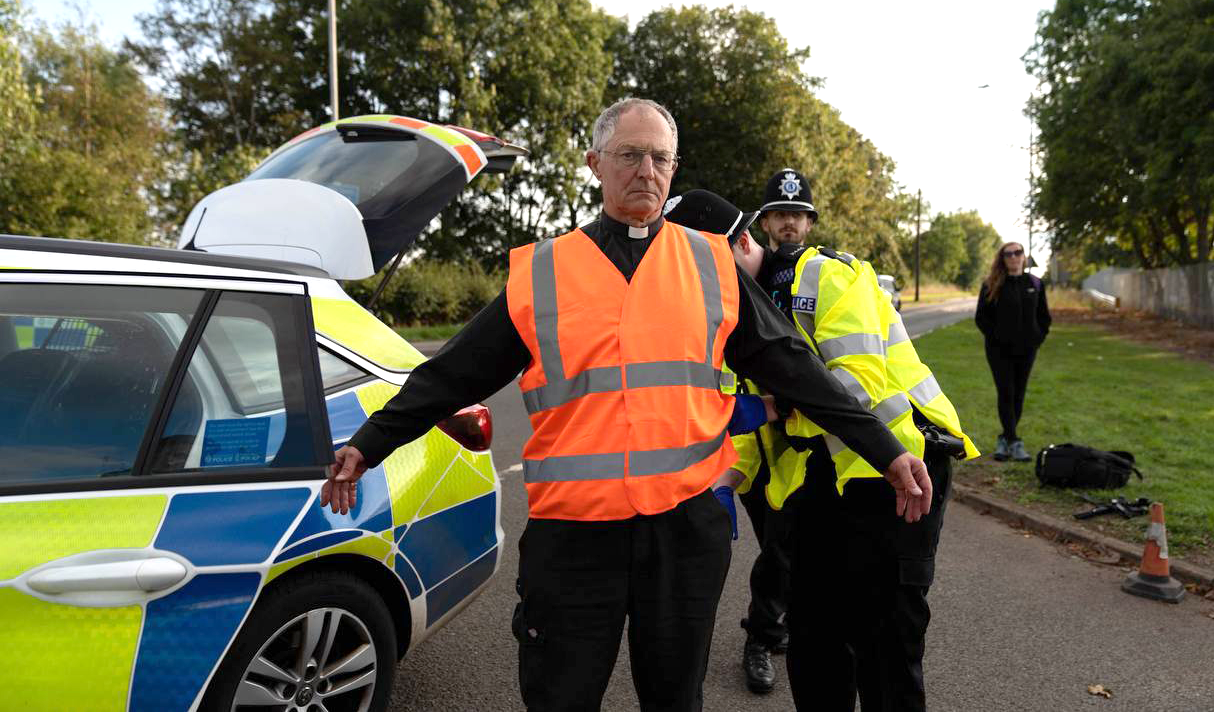
A Just Stop Oil participant getting arrested at Kingsbury oil terminal. A JSO / Vladamir Morozov image.
Recent legislations from the UK Government are described as “being used to stifle environmental protest”, such as the 2022 Police, Crime, Sentencing and Courts Act and 2023 Public Order Act – the factsheet of which mentions “Extinction Rebellion, Insulate Britain and Just Stop Oil” as leading factors.
A Just Stop Oil spokesperson said today:
“The main concern of policymakers should be on addressing this crisis and assisting the frontline victims of climate collapse – that’s the farmers in Wales whose crops are failing, or families in Ireland having to evacuate from their homes to escape flooding, or people in Bangladesh suffering under the threat of lethal wet-bulb temperatures.”
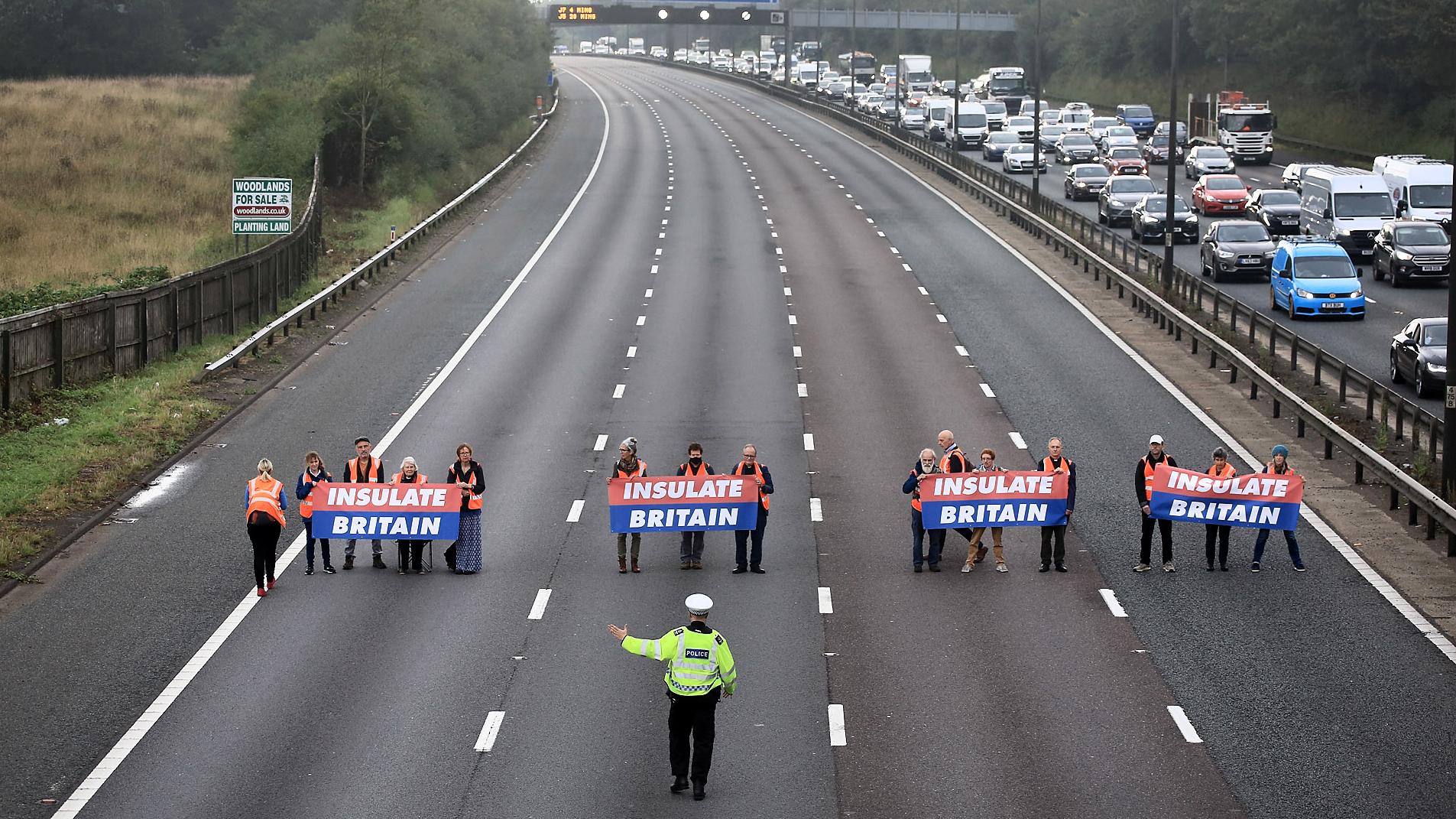
Image of an Insulate Britain roadblock September 2021
“However, the fact is that Western Governments are resorting to increasing authoritarianism to try to stop citizens from standing up to their leaders’ corrupt efforts to line their own pockets with oil money. It’s important to highlight this fact, and to note that this repression is failing as the people’s demand for real decarbonisation becomes too loud to ignore”.
As the world passes tipping points that threaten the breakdown of ordered civilization, world leaders, captured by the interests of oil lobbyists and big business, are failing to protect our communities. British citizens are sick of being led by liars and crooks. Until we stop Tory oil, supporters of Just Stop Oil will continue taking proportionate action to demand necessary change. Sign up for action at juststopoil.org.
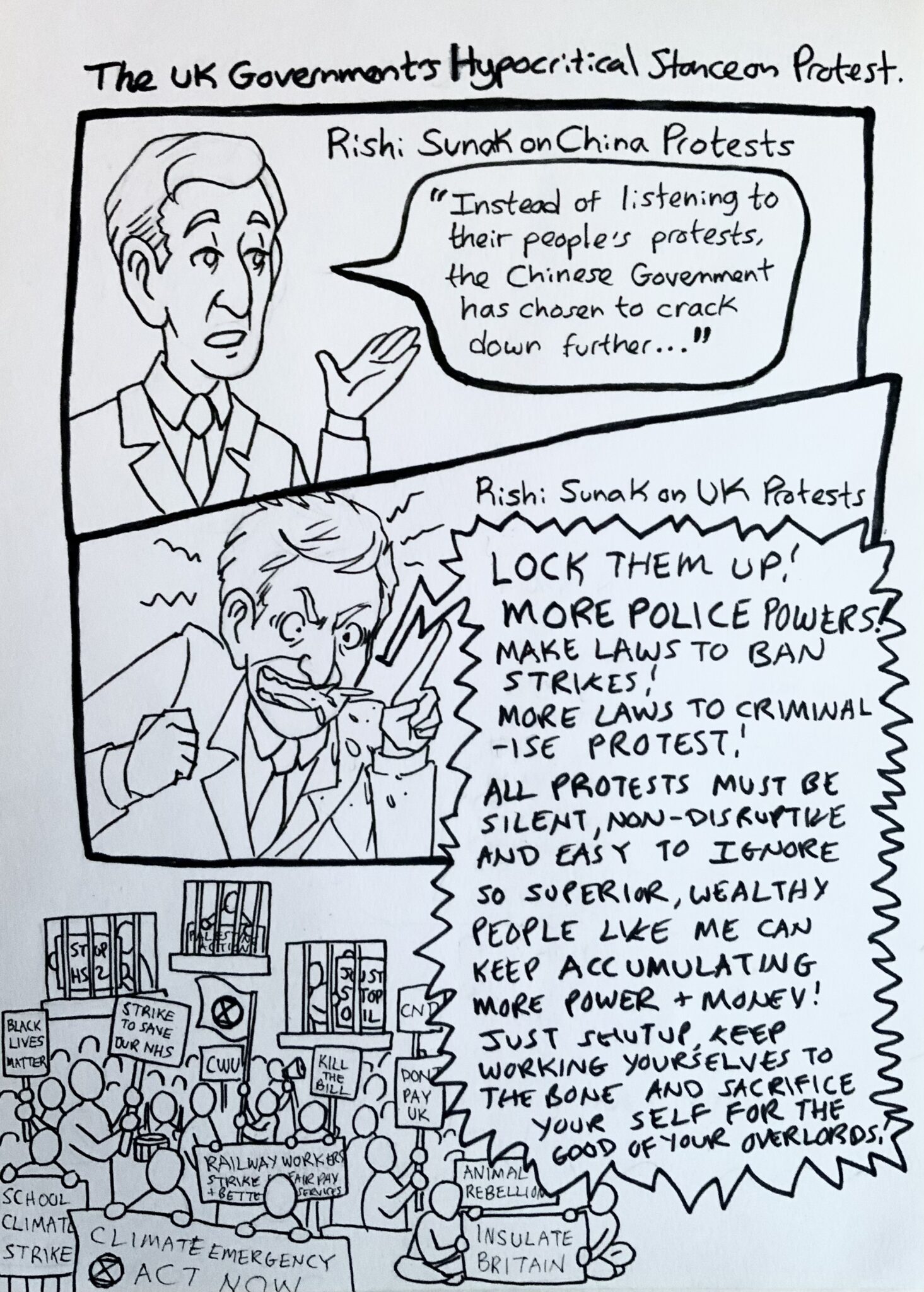
‘The Uk Government’s Hypocritical Stance on Protest’ by Mair Bain. Part of Just Stop Oil’s You May Find Yourself…
02 JUNE 2023 – 23 JUNE 2023 auction.
Protesters gather in Parliament Square, London, to call for a ceasefire in Gaza, 21 February 2024 | Alberto Pezzali/NurPhoto via Getty Images
Human rights group Liberty says spotlight on MPs’ safety has seen Tories ‘vilify’ Palestine marchers
Ahuman rights campaign group suing the government for forcing through anti-protest laws says people who go on Palestine marches are being “vilified” to “stoke division”.
Liberty is today challenging the home secretary, James Cleverly, in the High Court over a decision by his predecessor Suella Braverman to introduce new legislation targeting protesters that had already been rejected by Parliament.
The case comes in a week where protest rights are in the spotlight. Pro-Palestine marches are being labelled a threat to MPs and the Home Affairs Select Committee has called on the government to force organisers to give more notice.
Speaking to openDemocracy ahead of the hearing, Liberty director Akiko Hart said: “We’re seeing both our fundamental rights of protest being undermined, but also specific protests like the pro-Palestinian marches being vilified.”
Hart took aim at the “incredibly irresponsible rhetoric from senior politicians where protest is equated to intimidation and harassment”.
MPs’ safety fears were raised last week following chaos in the House of Commons over a symbolic vote on a ceasefire in Gaza. Though some MPs have reported an increase in abuse and threats, campaigners warn that peaceful protests are now being associated with terrorism in order to undermine them.
“There were legitimate concerns around MPs’ safety – obviously, two MPs have been murdered in the last ten years,” she said. “We need to take that very, very seriously. I would also say that it’s MPs who are racialised who are most at risk from harassment, and that’s what the evidence shows us.
“But to conflate harassment with protest, which is what’s happening this week, is really dangerous and irresponsible. There are laws in place to deal with harassment and abuse. That isn’t the same as legitimate protest.”
In its recommendations, the Home Affairs Select Committee said more notice was needed ahead of Palestine marches because the size and frequency of the protests is a burden on police resources. But according to the coalition organising the national Palestine marches, the measures would further limit the right to peaceful protest. Hart also said the current notice period of six days is enough for police to prepare for marches.
“Extending that will just restrict people’s ability to be able to make their voices heard. With this, as with any other issue, the point about protest is that it is not about whether or not you agree – it’s about our right to protest,” she explained.
Liberty was given the green light to sue Braverman in October after she used secondary legislation – which doesn’t get the same level of parliamentary scrutiny – to allow police to restrict or shut down any protest that could cause “more than minor disruption to the life of the community”.
“It shouldn’t be the case that you would have to take the home secretary to court with all the time and effort and energy and expertise that that involves,” said Hart. “The reason we are doing so is because of the then home secretary’s egregious act of circumventing Parliament.”
The government previously tried to insert the new powers into the Public Order Act 2023 in January last year, but was blocked by the Lords.
The point about protest is that it is not about whether or not you agree – it’s about our right to protest
Liberty believes a win “would be a powerful check against any future minister or government that intends to do the same thing”.
Hart told openDemocracy that there have already been clear examples of the impact of anti-protest laws that have come through the Police, Crime, Sentencing & Courts (‘Policing’) Act and the Public Order Act, which both give police more powers to restrict protests.
“There were anti-monarchy protesters who were arrested on the basis that the luggage straps that they were carrying were seen to be tools for locking-on, which was a new offence created under the Public Order Act, but they were carrying them to secure their placards.
“We’re also seeing it in sentencing. Last summer, the Court of Appeal upheld the sentences of the two protesters who scaled the Dartford crossing. And those sentences were two years and seven months, and three years – the harshest sentences ever handed down in modern times around protests around civil disobedience,” she said.
The trial against the home secretary is expected to run for two days at the Royal Courts of Justice in London. Hart told openDemocracy that while she and Liberty’s team of lawyers are feeling optimistic, “there’s a level of underlying exhaustion at how this government is conducting itself and responding to the protests that are happening”.
A Home Office spokesperson said: “The right to peaceful protest is fundamental; the right to disrupt the hard-working public is not.
“We have taken action to give police the powers they need to tackle criminal tactics used by protesters such as locking on and slow marching, as well as interfering with key national infrastructure.
“We work closely with the police to make sure they have the tools they need to tackle disorder and minimise disruption.”
The Tories and Labour competing over hardline immigration policies only helps to mainstream far-right ideas
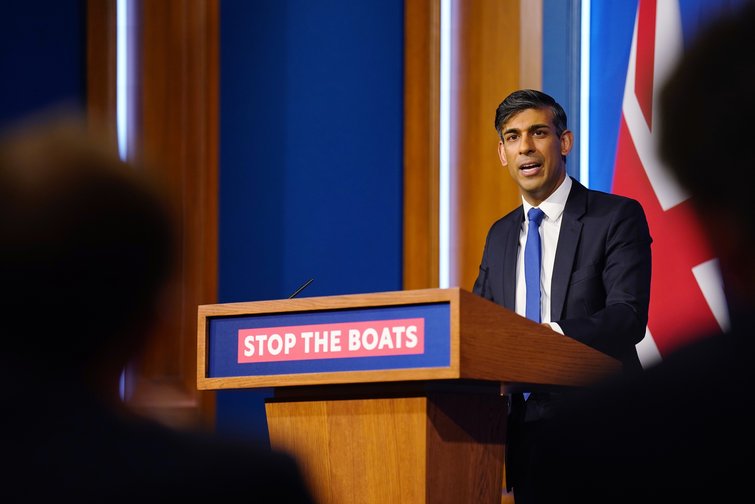
Rishi Sunak conducts a press conference in December 2023 | James Manning (WPA Pool)/Getty Images
Standing at a lectern with the familiar slogan, “STOP THE BOATS”, Rishi Sunak evoked the “will of the people” as the so-called Rwanda Bill made its fractious passage through the Commons last week.
The prime minister’s summoning of “the people” to push through an inhumane and unpopular policy smacks of the misuse of populism that we have come to associate with this government. The insistence that stopping people seeking asylum is “an urgent national issue” deliberately ignores that the priority issues for the British public remain the cost of living and the NHS.
We have seen both main political parties eagerly trading punches for the prize of who can appear most punitive on blocking people seeking asylum. Not only does this stale consensus manufacture a sense of crisis that is a distortion of public opinion, but it also pretends it has nothing to do with racism. And yet whether it’s warning about a “hurricane” or “invasion” of migrants and the failures of multiculturalism, or condemning Britain’s “immigration dependency”, the messaging relies on innuendo and euphemism that stoke racial tensions.
The Runnymede Trust, where I am the interim co-CEO, has today published a report warning of the dangers of this rotten politics that helps mainstream far-right, racist political ideas. Political debate on immigration, based on racialised ideas of who is welcome and who belongs, has become the norm. Whether directly or indirectly, historic and contemporary migration policies are predicated on the exclusion of people of colour. As exemplified by the Windrush scandal, this cheap politics has a high cost – and it is people of colour, regardless of their citizenship status, who bear the ugly consequences.
These toxic anti-migrant policies are coupled with a sustained assault on our democratic infrastructure. In 2022, the government passed the Elections Act, which made it a requirement that voters present ID at polling stations. There was strong opposition about the impact on people of colour. The first UK elections to use them – the May 2023 local elections – confirmed these fears. The Electoral Commission reported about 14,000 people were turned away, and that people of colour and disabled people were most likely to be impacted. The commission predicts 800,000 people could be blocked from voting at the next general election – an incredible price to pay when there were just six cases of voter fraud in 2019.
It’s not just legislation, but also through rhetoric that politicians have persistently attacked the right to protest. Indeed, former home secretary Suella Braverman labelled pro-Palestine marches “hate marches” and compared them with wicked vexation to Black Lives Matter protests – both causes which have high levels of support among communities of colour.
And dare I even mention the ‘culture war’ and the injuries it has inflicted on the strength of civil society? In recent years we have seen the vilification of organisations across the arts, heritage, charity sector and our higher education spaces. The targets have often been those that have dared to embark on progressive racial justice work, who have been demonised with the absurd inversion of the term ‘woke’.
The fact it is the likes of Braverman and her replacement James Cleverly – ministers of colour – who have designed and executed these policies, shows diversity at the top does not protect against racist impact, nor does it mean people in those positions won’t have divergent or indeed opposing political interests to those with whom they may share some points of affinity.
The politics of representation may prioritise superficial visibility, but we mustn’t forget people in positions of power have always designed and inflicted policies that have harmed those they are deemed to share some interest with.
As we prepare for the 2024 general election, we must act to stop the rot of our democracy. Pandering to far-right politics by creating a crisis around small boats and invoking the “will of the people” to implement punitive and racist policies while ignoring the needs of the very people they invoke is unacceptable. On every count, it is people of colour that lose.
Rishi Sunak has staked his political future on getting the Rwanda scheme off the ground. Under the proposals, asylum seekers who arrive in the UK other than through an existing asylum scheme would be deported to Rwanda where their claim would then be processed.
…
Polling from YouGov found that if Labour were to win the next election, 40% of voters would want Keir Starmer to scrap the plan. That compares to 34% who think it should be kept.
Asking a slightly different question, YouGov more recently found that just one in five voters think the Rwanda scheme should be pushed through in its current form. Again, 40% of the public think it should be scrapped altogether.