MORE THAN 50 activists plan to march from HMP Bronzefield in Ashford, Surrey, to the Royal Courts of Justice, Westminster, where 16 climate activists will appeal against their draconian prison sentences tomorrow [today].
The Just Stop Oil (JSO) activists were jailed for a combined 41 years for taking non-violent action to call for an end to reliance on fossil fuels.
The sentences include five years imposed on JSO founder Roger Hallam for organising a protest over Zoom, and two years given to Phoebe Plummer after she threw soup on glass covering Van Gogh’s Sunflowers.
Last year, then UN special rapporteur on environmental defenders Michel Forst condemned the use of legislation such as the Public Order Act and civil injunctions to criminalise peaceful protests.
When Mr Hallam and four others were jailed for organising a protest on the M25, Mr Forst described it as a dark day for “anyone concerned with the exercise of their fundamental freedoms” in Britain.
…
Steve Scott-Robson a 63-year-old father and educator joining the walk said: “I applaud loudly the spirit of these 16 activists, and I am grateful to them for their brave and defiant actions.
“It is an utter abomination that the country that has benefited from industrialisation first — and therefore longest — is the country in Europe that has the harshest legislation aimed at environmental activists.”
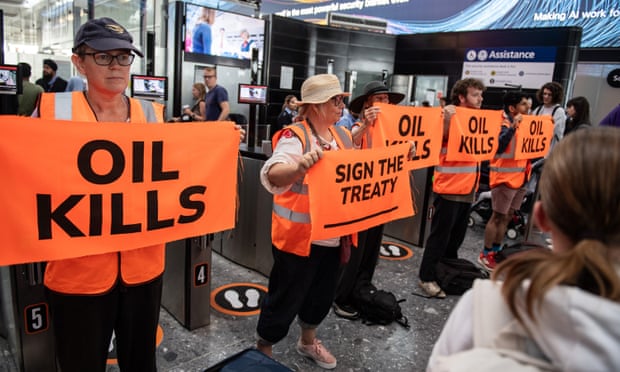
Just Stop Oil protesters at Heathrow airport. New powers granted to police have undermined free speech and peaceful assembly, the NGO says. Photograph: Guy Smallman/Getty Images
British director of Human Rights Watch attacks ‘dangerous hypocrisy’ of government
Britain’s crackdown on climate protest is setting “a dangerous precedent” around the world and undermining democratic rights, the UK director of Human Rights Watch has said.
Yasmine Ahmed accused the Labour government of hypocrisy over its claims to be committed to human rights and international law.
Ahmed said: “We’re at a stage where we’re talking about the … dangerous hypocrisy of what the UK government is saying and doing, and also the fact that the international community and the UN have [raised] and continue to raise the alarm about how this UK government responds to protest, and in particular climate protest.”
In the UK “laws criminalising protests undermine democratic rights”, the NGO says in its latest annual world report, published on Thursday, adding that in the past year “the UK continued to crack down on and criminalise climate protests”.
New powers granted to police by the Police, Crime, Sentencing and Courts Act 2022 and the Public Order Act 2023 have had the effect of undermining “free speech, peaceful assembly, and democratic rights in the UK”, the report says.
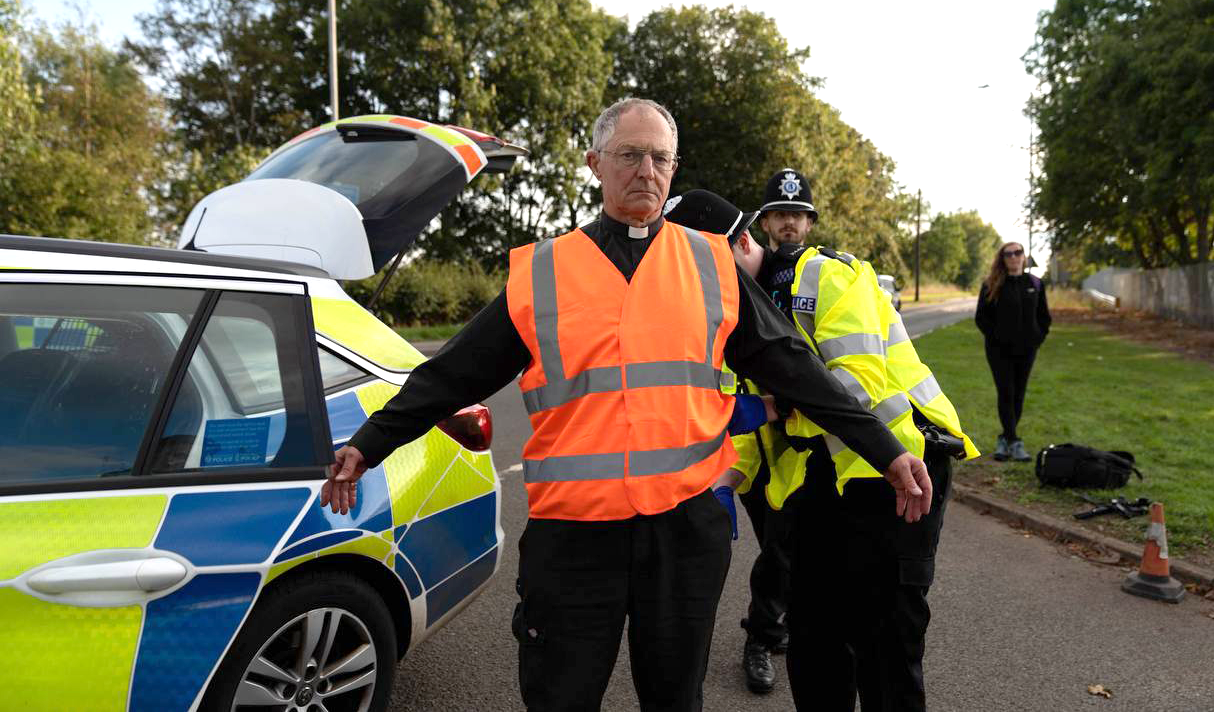
Just Stop Oil protesters with a police officer outside Westminster Abbey in central London after they spray painted “1.5 is dead” on the grave of Charles Darwin, in the north aisle of the nave of the Abbey, January 13, 2025
JUST STOP OIL activists painted the grave of British naturalist Charles Darwin today to demand an end to reliance on fossil fuels by 2030.
Two activists entered Westminster Abbey and sprayed “1.5 Is Dead” on the grave after it was confirmed that 2024 was the first year on record with a global average temperature exceeding 1.5°C above pre-industrial levels.
During the action, the supporters said: “We have passed the 1.5° threshold that was supposed to keep us safe
“Darwin would be turning in his grave to know we are in the midst of the sixth mass extinction.
“The government’s plans will take us to over 3 degrees of warming.
“This will destroy everything we love. World leaders must stop burning oil, gas and coal by 2030.”
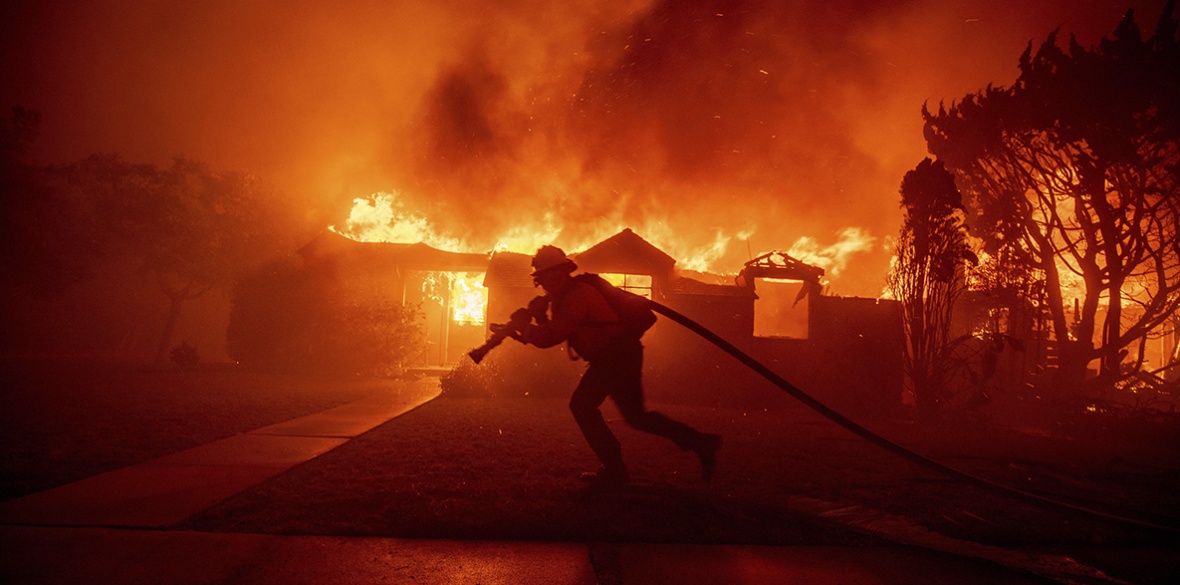
A firefighter battles the Palisades Fire as it burns a structure in the Pacific Palisades neighbourhood of Los Angeles, January 7, 2025
World’s wealthiest 1% have already burned through their share of the entire annual carbon limit, Oxfam warns
THE world’s wealthiest 1 per cent have already burned through their share of the entire annual carbon limit, a damning analysis of super-rich climate destruction has revealed.
A new study by charity Oxfam has analysed the “global carbon budget” — the amount of CO2 that can be emitted without exceeding the international target of limiting global warming to 1.5°C above pre-industrial levels.
Its findings showed that while the richest capitalists had already exceeded that limit in the first 10 days of 2025, it would take someone from the poorest half of the global population nearly three years to use up their share.
Inaction will continue to have deadly consequences, the charity said — and eight in 10 deaths from heat will occur in low and lower-middle-income countries.
Oxfam estimated that by 2050, emissions by the 1 per cent will cause crop losses that could have provided enough calories to feed at least 10 million people a year in eastern and southern Asia.
Emissions from the ultra-wealthy are also causing trillions in economic losses -– the impact on low and lower-middle-income countries over the past three decades has been three times greater than the total climate finance provided by wealthy nations.
…
A spokesperson for Just Stop Oil also issued a rallying call, saying: “We live within a system that serves the few over the many, and the rich are on course for destroying all our lives if they carry on unopposed. We must get organised and resist.
“We need a revolution in politics and economics, and we need to reclaim Parliament from the corporations and billionaires, whilst prioritising the interests of ordinary people.”
Climate and environmental protest is being criminalised and repressed around the world. The criminalisation of such protest has received a lot of attention in certain countries, including the UK and Australia. But there have not been any attempts to capture the global trend – until now.
We recently published a report, with three University of Bristol colleagues, which shows this repression is indeed a global trend – and that it is becoming more difficult around the world to stand up for climate justice.
This criminalisation and repression spans the global north and south, and includes more and less democratic countries. It does, however, take different forms.
Our report distinguishes between climate and environmental protest. The latter are campaigns against specific environmentally destructive projects – most commonly oil and gas extraction and pipelines, deforestation, dam building and mining. They take place all around the world.
Climate protests are aimed at mitigating climate change by decreasing carbon emissions, and tend to make bigger policy or political demands (“cut global emissions now” rather than “don’t build this power plant”). They often take place in urban areas and are more common in the global north.
The intensifying criminalisation and repression is taking four main forms.
1. Anti-protest laws are introduced
Anti-protest laws may give the police more powers to stop protest, introduce new criminal offences, increase sentence lengths for existing offences, or give policy impunity when harming protesters. In the 14 countries we looked at, we found 22 such pieces of legislation introduced since 2019.
2. Protest is criminalised through prosecution and courts
This can mean using laws against climate and environmental activists that were designed to be used against terrorism or organised crime. In Germany, members of Letzte Generation (Last Generation), a direct action group in the mould of Just Stop Oil, were charged in May 2024 with “forming a criminal organisation”. This section of the law is typically used against mafia organisations and had never been applied to a non-violent group.
Criminalising protest can also mean lowering the threshold for prosecution, preventing climate activists from mentioning climate change in court, and changing other court processes to make guilty verdicts more likely. Another example is injunctions that can be taken out by corporations against activists who protest against them.
3. Harsher policing
This stretches from stopping and searching to surveillance, arrests, violence, infiltration and threatening activists. The policing of activists is carried out not just by state actors like police and armed forces, but also private actors including private security, organised crime and corporations.
In Germany, regional police have been accused of collaborating with an energy giant (and its private fire brigade) to evict coal mine protesters, while private security was used extensively in policing anti-mining activists in Peru.
4. Killings and disappearances
Lastly, in the most extreme cases, environmental activists are murdered. This is an extension of the trend for harsher policing, as it typically follows threats by the same range of actors. We used data from the NGO Global Witness to show this is increasingly common in countries including Brazil, Philippines, Peru and India. In Brazil, most murders are carried out by organised crime groups while in Peru, it is the police force.
Protests are increasing
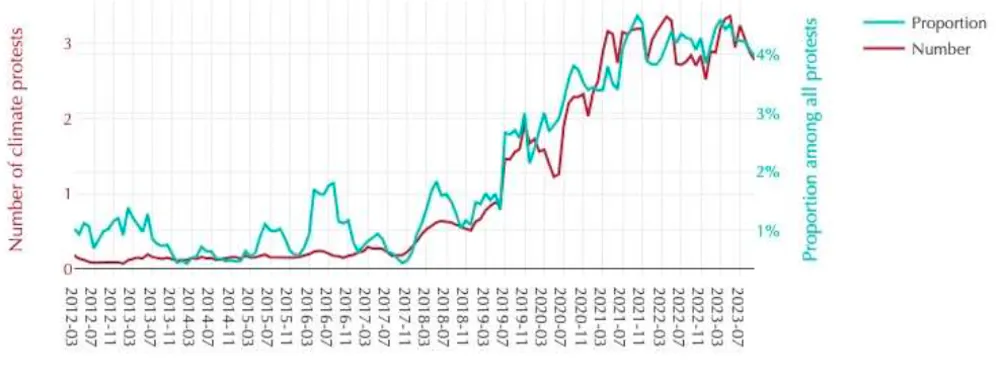
To look more closely at the global picture of climate and environmental protest – and the repression of it – we used the Armed Conflicts Location Event database. This showed us that climate protests increased dramatically in 2018-2019 and have not declined since. They make up on average about 4% of all protest in the 81 countries that had more than 1,000 protests recorded in the 2012-2023 period:
Climate protests increased sharply in the late 2010s in the 14 countries studied. (Data is smoothed over five months; number of protests is per country per month.) Berglund et al; Data: ACLED, CC BY-SA
This second graph shows that environmental protest has increased more gradually:
Environmental protests in the same 14 countries. Data: ACLED, CC BY-SA
We used this data to see what kind of repression activists face. By looking for keywords in the reporting of protest events, we found that on average 3% of climate and environmental protests face police violence, and 6.3% involve arrests. But behind these averages are large differences in the nature of protest and its policing.
A combination of the presence of protest groups like Extinction Rebellion, who often actively seek arrests, and police forces that are more likely to make arrests, mean countries such as Australia and the UK have very high levels of arrest. Some 20% of Australian climate and environmental protests involve arrests, against 17% in the UK – with the highest in the world being Canada on 27%.
Meanwhile, police violence is high in countries such as Peru (6.5%) and Uganda (4.4%). France stands out as a European country with relatively high levels of police violence (3.2%) and low levels of arrests (also 3.2%).
In summary, while criminalisation and repression does not look the same across the world, there are remarkable similarities. It is increasing in a lot of countries, it involves both state and corporate actors, and it takes many forms.
This repression is taking place in a context where states are not taking adequate action on climate change. By criminalising activists, states depoliticise them. This conceals the fact these activists are ultimately right about the state of the climate and environment – and the lack of positive government action in these areas.