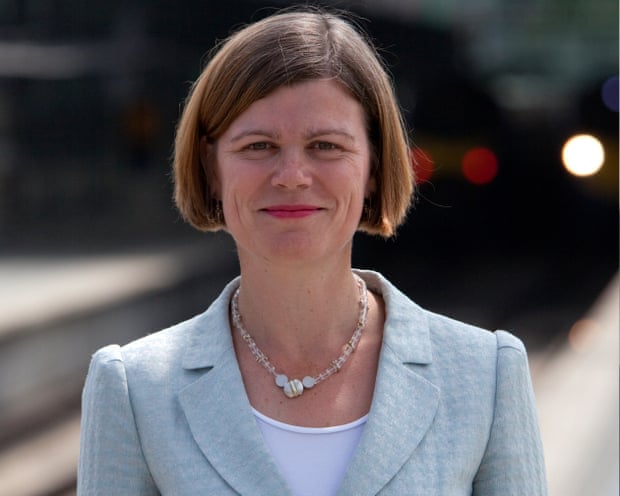
Nicola Shaw received remuneration from Kelda Holdings as well as Yorkshire Water. Photograph: Graham Turner/The Guardian
Company says extra payments relating to work for Kelda Holdings were covered by shareholders not billpayers
The boss of Yorkshire Water, one of Britain’s biggest water suppliers, has received £1.3m in previously undisclosed extra pay since 2023 via an offshore parent company, the Guardian can reveal.
Nicola Shaw received £660,000 from Yorkshire Water’s Jersey-registered parent company, Kelda Holdings, in the 2023-24 and the 2024-25 financial years. The size of the fees was not disclosed in the annual report of the regulated subsidiary, Yorkshire Water Services.
The utility company at first refused to detail the pay Kelda Holdings had awarded Shaw, saying the parent company was a “private entity registered in Jersey and subject to separate disclosure frameworks”. Only after the Guardian raised questions about the ability of MPs and bill payers to scrutinise the pay awarded did the company reveal the amount of the two payments.
…
Gary Carter, the national officer for GMB, a union representing water workers, said: “This is another case of water companies not listening to the outrage and concerns of the public over the payment of unjustifiable salaries.
“The fact that this salary is hidden and not transparent just further undermines the reputation of water companies. This sort of behaviour has got to end.”
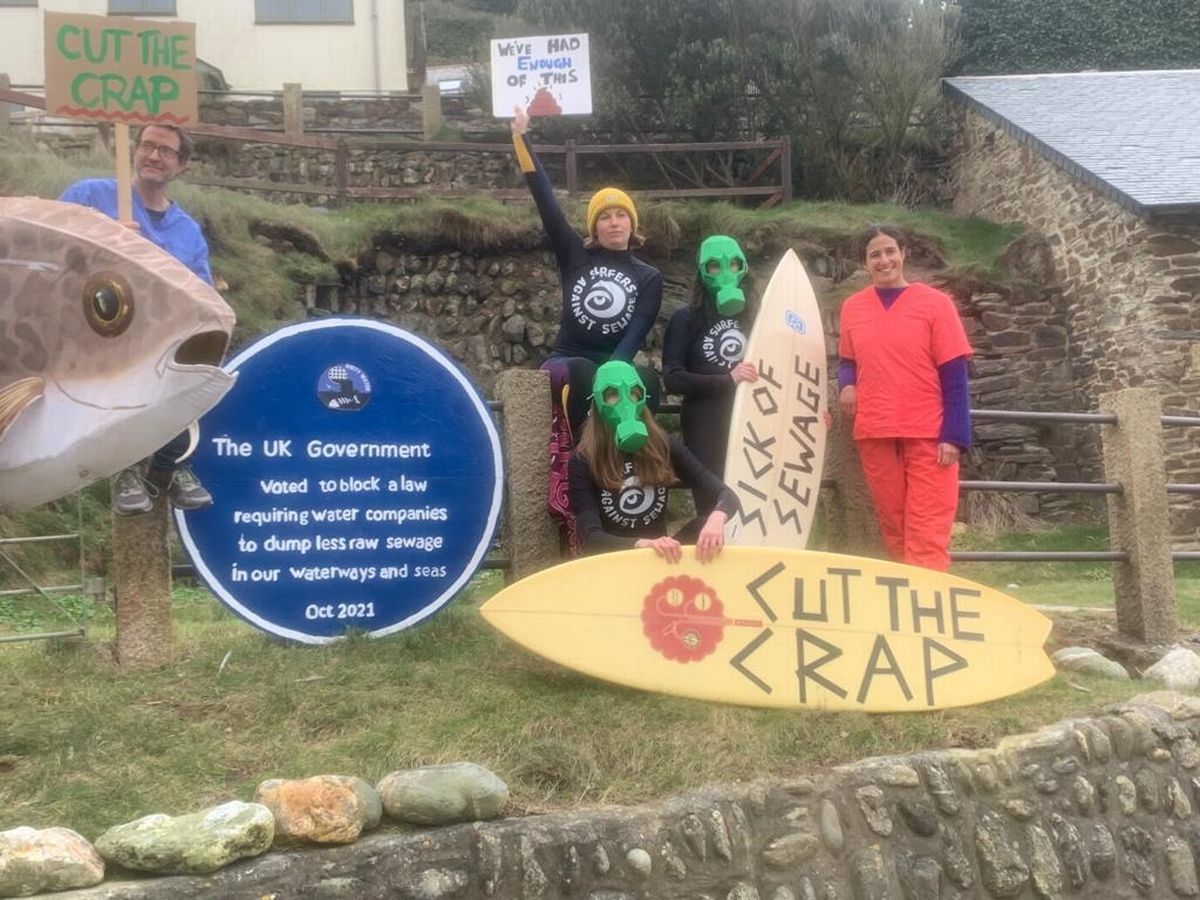
April 2023 Surfers Against Sewage and Extinction Rebellion protests in St Agnes, Perranporth, Truro and Charlestown which unveiled spoof Blue Plaques to the MPs and Conservative Government who allowed raw sewage to be dumped in the sea (Image: Surfers Against Sewage)
England’s privatised water industry may one day be considered a textbook case study of failed corporate responsibility, regulation and governance. The Cunliffe review, the recent report into England’s privatised water industry, concluded that the financial regulator, OfWat, needs to be disbanded and a new water regulator will be introduced.
For that to work effectively, better pollution monitoring and more clearly defined pollution incident criteria are essential. While politicians and water companies have claimed to be reducing pollution incidences, they might not strictly be tackling sources of pollution, so communications must be carefully scrutinised for disinformation.
The UK’s environment minister Steve Reed MP has described the water industry as “broken”. The public have rising water bills. Water companies owe over £60 billion in debts and have left the country with uncertain water security in the face of climate change.
The Environment Agency (EA) in England recently announced that serious pollution incidents in 2024 rose by 60% to 75 from 47 in the previous year. The EA classifies pollution incidents using a four-point scale called the common incident classification scheme. Trained EA officers consider the evidence reported via their incident hotline to assess its credibility and severity.
Get your news from actual experts, straight to your inbox.Sign up to our daily newsletter to receive all The Conversation UK’s latest coverage of news and research, from politics and business to the arts and sciences.
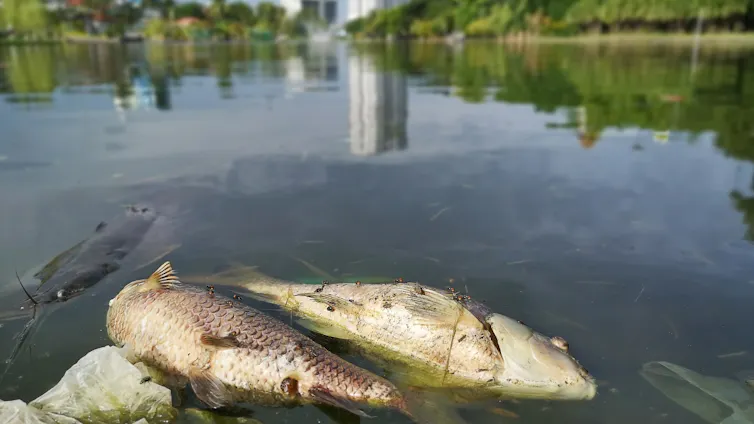
Category 1 is for major incidents, 2 for significant, 3 for minor incidents and 4 for no impact. Category 1 and 2 typically involve visible signs of dead fish floating. For salmon, if more than 10 adult or 100 young fish are dead, this is category 1. With fewer than ten adult and 100 young fish dead, it’s category 2.
No dead fish, no serious problem? The EA can also record damage on protected habitats as “pollution incidents” but these are harder to substantiate without investigative research that takes time and money.
Last year, more than 450,000 sewage discharges were recorded by event duration monitors. These are devices fitted to the end of overflow pipes that indicate when and for how long they have been discharging.
These discharges represent 3.6 million hours of untreated sewage going into our rivers and coasts. These contain chemical contaminants including pharmaceuticals, detergents and human pathogens. Only 75 incidents were recorded as serious or significant in 2024. Another 2,726 were classed as minor.
So lots of sewage discharges are not being classified as pollution incidents, despite containing pollutants. The EA advises its investigating officers to “record substantiated incidents that result in no environmental impact, or where the impact cannot be confirmed, as a category 4”.
The EA has been criticised for turning up late to 74% of category 1 and 2 pollution incidents and for being pressured to ignore low-level pollution – all claims that they have denied. However, they admit they are constrained by finances. Any new regulator must be adequately resourced and independent.
Pollution isn’t always classified as an official pollution incident. YueStock/Shutterstock
In their recent report into pollution incidences, the EA states that they respond to all category 1 and 2 (serious and significant) water industry incidents and will be increasing their attendance at category 3 (minor) incidents. They highlight that more inspections will identify more issues. This shows some acceptance that the more incidents they attend, the more would be substantiated or recorded appropriately.
Most sewage discharges would not have been reported to, or recorded by, the EA as pollution incidents because they were permitted discharges from combined stormwater overflows. Water companies are allowed to discharge untreated wastewater under exceptional rainfall or snowfall conditions to prevent sewage backing up through the pipes.
Extra water flow in rivers from rainfall is meant to dilute chemical contaminants in wastewater. However, some discharges can last days or weeks. The EA is currently investigating whether water companies have been breaching their permits and discharging untreated wastewater when there is low or even no rainfall.
What counts as pollution?
The UN classifies pollution as “presence of substances and energy (for example, light and heat) in environmental media (air, water, land) whose nature, location, or quantity produces undesirable environmental effects”. This definition differs markedly from the EA’s working definition of pollution incidents.
Many sewage discharges containing low concentrations of pollutants won’t kill fish but might still be harmful to fish larvae or small insects, for example.
However, the broad picture from EA data is that invertebrate communities at least are in a better state than they were three decades ago before wastewater treatment plants were upgraded following the EU’s Urban Wastewater Directive.
Some pollutants bioaccumulate through the food chain, so they become concentrated in top predators such as orcas. Some chemicals mimic reproductive hormones even in low concentrations and can feminise fish, for example. High levels of nutrients from agriculture and sewage in rivers can cause fungal diseases in seagrass meadows.
Other families of chemicals build up in wildlife and people, such as persistent “forever chemicals”, much of which comes from wastewater discharges. Continued discharges of antibiotics into waterways might not be classified as pollution incidents but still pose a substantial risk to human and ecosystem health through bacteria developing antibiotic resistance.
The government has just committed to cut sewage pollution by 50% by December 2029 based on 2024 data. But it’s not yet clear whether these involve cutting the frequency of discharges, the duration or both.
This data could also be manipulated so that a large number of small discharges can be consolidated into one official discharge event. Currently, the volume of discharges from stormwater overflows isn’t known. Without this vital data we can’t ascertain the risk posed by their contaminants.
A tanker pumps out excess sewage from the Lightlands Lane sewage pumping station in Cookham, Berskhire
CALLS to nationalise the water sector intensified yesterday after it emerged that serious pollution incidents in England jumped by 60 per cent last year.
The Environment Agency reported 75 major incidents that fell under categories one and two, which can severely harm the environment and human health.
Serious incidents doubled from 14 to 33 at crisis-hit Thames Water, the watchdog found.
Southern Water was responsible for 15 of the incidents and Yorkshire Water for 13.
Pollution incidents across all categories had increased by 29 per cent, with 2,801 recorded last year.
Thames Water recorded the most incidents again at 523, followed by Anglian Water (482) and United Utilities (376).
The rise was attributed to underinvestment in new infrastructure, poor asset maintenance and reduced resilience due to the impacts of climate change.
We Own It founder Cat Hobbs said the figures “are the latest indicator of a water sector in total chaos.
“The roots of this chaos extend all the way back to when Thatcher privatised water in the 1980s — effectively flogging the family silver for a quick buck.
“Since then, private shareholders have stuffed their pockets with gold, amassing £80 billion in payouts.
“They’ve killed our rivers and let the infrastructure crumble, while bill-payers pick up the tab.
“Recent research shows that the cost of public ownership could be close to zero. This solution could also save the public £3-5bn a year, making publicly owned water a source of income for the Treasury.”
An open letter to the Government, signed by a coalition of environmental and civil society groups
Dear Keir Starmer, Prime Minister and Steve Reed, Secretary of State for Environment and Rural Affairs,
We demand an urgent end to the sewage scandal through systemic transformation of the water industry – public and environmental good must be put before private profit.
A year ago, you began your premiership with a clear commitment to deliver on your election mandate to end the sewage pollution crisis and clean up our waters. On Monday, the Independent Water Commission is set to publish its final recommendations but it will fall fatally short if it fails to confront the root cause of the crisis: a system built towards serving private profit cannot deliver an end to sewage pollution.
Your election mandate has given you a once-in-a-generation opportunity to fix our broken water system. But this will take more than incremental change—it demands a decisive break from the failed model that has deluged our coastlines, rivers and lakes with sewage.
The need for a full system overhaul is painfully clear. Since privatisation in 1990, water companies have paid shareholders over £74 billion in dividends—while burdening the system with £69 billion in debt. Despite repeated promises to invest, shareholders have actually withdrawn more than they have put in, meanwhile essential infrastructure has been left to crumble. In 2024 alone, untreated sewage was dumped 565,383 times across England and Wales. It’s a 35-year tale of broken pipes, broken promises and a fundamentally broken system.
The consequences of inaction are shocking. Coastal economies and communities are being hammered. Rivers declared ecologically dead. Pollution poisoning our wildlife. Thousands of people are falling ill after swimming in raw sewage. Yet water bills will keep rising – to service debt, to fund dividends – and so it is the public who will continue to pay the price.
Enough is enough. You must act now. Rebuild a system that people can be proud of, not angry about. A system that serves the public and protects nature – not private profit. Anything less would be a betrayal of the promise you made to the electorate.
Yours,
Surfers Against Sewage
River Action
Greenpeace UK
WWF UK
GMB Union
Compass
Zero Hour
Friends of the Earth England, Wales and Northern Ireland
A tanker pumps out excess sewage from the Lightlands Lane sewage pumping station in Cookham, Berskhire, January 10, 2024
THAMES WATER’s debts have ballooned to £16.8 billion and it made a loss of £1.65bn in the year to March, the company revealed today, sparking fresh calls for renationalisation.
Appearing before the Commons environment committee, chief executive Chris Weston admitted that the company was “extremely stressed” and would take “at least a decade to turn around.”
Britain’s largest water supplier also revealed a sharp increase in pollution incidents over the past year.
Gary Carter, a national officer at water industry union GMB, said: “Thames Water is drowning under a mountain of debt.
“Hiking customer bills has led to a rise in operating profit, money that should go on investment but is being swallowed up by monstrous loans needed to keep the company afloat.
“While Thames lurches from crisis to crisis, the solution is clear: it must be taken back into public ownership, with workers’ terms, conditions and pensions protected.”


 A tanker pumps out excess sewage from the Lightlands Lane sewage pumping station in Cookham, Berskhire