Home Secretary Suella Braverman is to question the Metropolitan Police commissioner about the force’s response to incidents during a pro-Palestinian protest in London.
A video posted online appeared to show a man chanting “jihad” during a rally by an Islamist group on Saturday.
The Met said no offences were identified in the clip of the protest, which was separate to the main march.
But the home secretary wants an explanation from Sir Mark Rowley.
The meeting between Ms Braverman and the Met Police chief was already in the diary to discuss the ongoing protests and combating anti-Semitism.
But a source close to the home secretary said she would use it to question Sir Mark for his views on his force’s response to Saturday’s incident.
Conditions at a processing centre for asylum seekers who arrive on the Kent coast in small boats have been called unacceptable in a report from a watchdog that monitors the centre.
Representatives from the Independent Monitoring Boards (IMB) made a total of 85 visits in 2022 to three Home Office processing centres for small boat arrivals – Manston, Western Jet Foil and Kent Intake Unit – for its 2022 annual report into short-term holding facilities on the Kent coast. All three centres hit the headlines last year due to a variety of scandals and serious incidents.
…
The report adds: “At Manston detained individuals were accommodated in marquees which we would describe as at best basic, at worst unsanitary and unacceptable.”
Western Jet Foil in Dover was subjected to a firebombing attack last November by Andrew Leak, 66, who police said was motivated by extreme rightwing terrorist ideology.
Kent Intake Unit, also in Dover, where lone child asylum seekers and families are processed after arriving on small boats, became embroiled in a row in July of this year after the immigration minister, Robert Jenrick, was reported to have asked for cheerful cartoon murals for children to be painted over because they were “too welcoming”.
The conflict in the Middle East has led British political actors to try and redefine what is ‘acceptable speech’
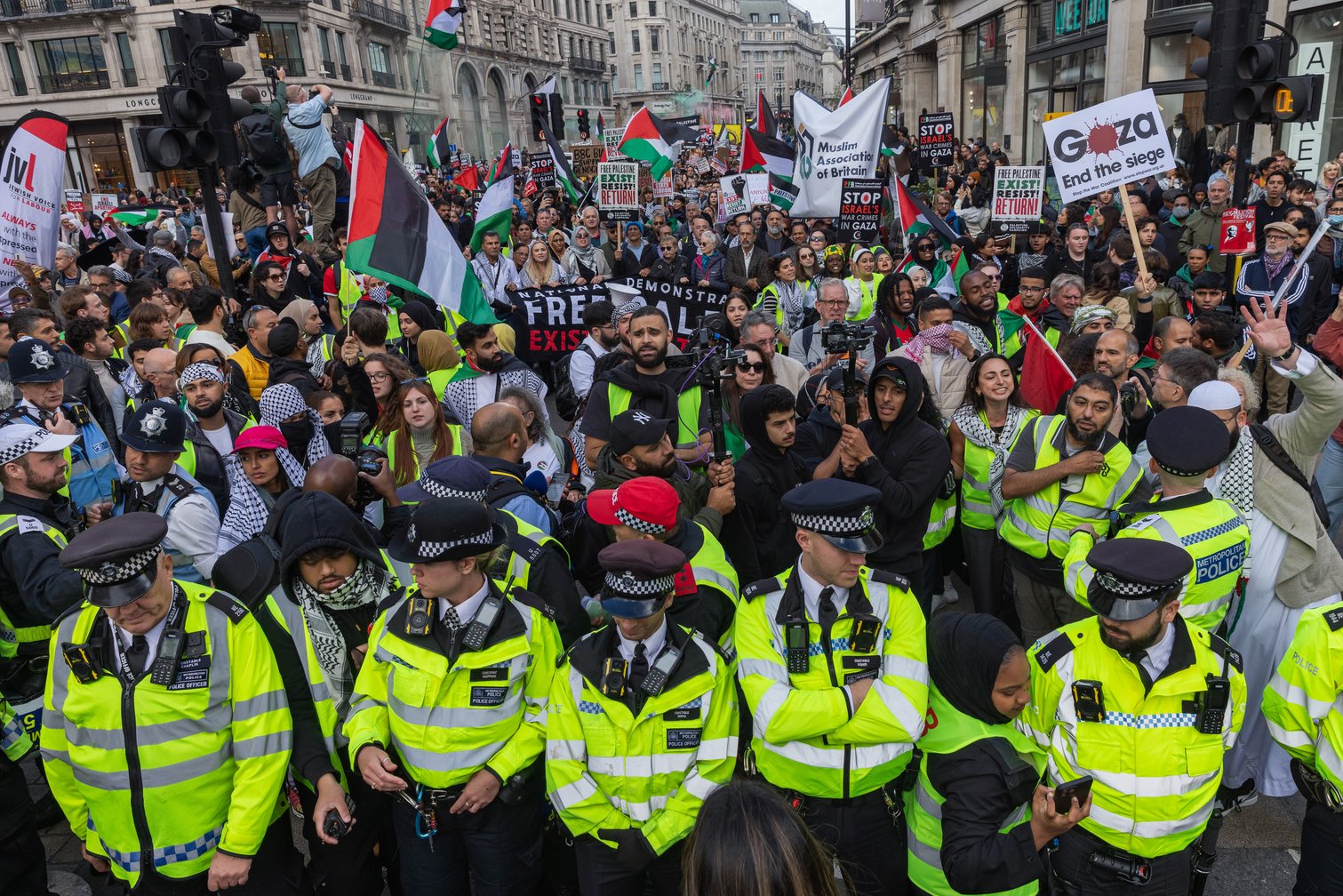
Police and protesters at the March for Palestine in London on Saturday | Mark Kerrison/In Pictures via Getty Images
As a humanitarian crisis unfolds in the Middle East, the UK government and its backers in the media have sought to marginalise and silence dissenting voices by targeting protest movements showing solidarity with the Palestinian cause.
Hundreds of people in Israel were killed, just over a week ago, in a brutal attack by Hamas. In response, Israel has moved swiftly against Hamas and the Palestinian population living in the Gaza strip. It has cut off their electricity and prevented the entry of food, water and medical supplies as it commences a devastating bombardment of homes and civilian infrastructure, leaving hundreds dead.
The reaction to these unfolding events in Britain has been one of shock and anger. Amongst the political class, a closing of the ranks has occurred, shoring up support for Israel as it strikes against the Palestinian population. And as part of this, political actors have sought to demarcate new boundaries on what is acceptable speech in the UK.
Foreign secretary James Cleverly on Tuesday urged pro-Palestinian protesters to stay at home. And home secretary Suella Braverman wrote to police chiefs asking them to take action against acts of protest that – in whose eyes it was not clear – might indicate support for Hamas.
She singled out the waving of the Palestinian flag in particular as being illegitimate “when intended to glorify acts of terrorism”, and asked that the police “consider whether chants such as: ‘From the river to the sea, Palestine will be free’ should be understood as an expression of violent desire to see Israel erased from the world” and therefore a “racially aggravated” crime.
The Telegraph has also reported that Robert Jenrick, the immigration minister, has commissioned officials in the Home Office to consider how they could revoke visas and expel foreign students who “praise Hamas”.
There are undoubtedly circumstances in which the use of particular chants or imagery could be inflammatory or even threatening. But the purpose of these statements is not to protect British communities (that much is clear from Braverman’s failure to issue a similar letter warning against attacks on Muslim or pro-Palestinian groups). The purpose is rather to intimidate would-be protestors and delegitimise criticism of Israel by aligning it with criminality.
The government’s views on acts of protest are mirrored by the official opposition: a diktat sent out by Labour Party general secretary David Evans warned members, councillors and MPs against attending pro-Palestine demonstrations. Labour has gone further still by also forbidding debate on Israel-Palestine in local party branches – a censorship not even attempted by Tony Blair during the lead-up to the Iraq war.
The results of Braverman’s provocation can already be seen. On Wednesday, Greater Manchester Police arrested four people for breaching the peace “during events… marking the Hamas-Israel conflict”, later de-arresting three of them. A video taken at the scene of the arrest and posted online shows a young man being led into a police van, a Palestine flag wrapped around his shoulders, as concerned onlookers shout at officers: “He has done nothing wrong,” and: “Freedom of speech.”
The Metropolitan Police Service itself appears to have ruled out any crackdown on people waving the Palestinian flag. But on Thursday night, the Palestinian Literature Festival was forced to cancel a book launch for Jewish American journalist Nathan Thrall’s latest book ‘A Day in the Life of Abed Salama: A Palestine Story,’ “after the Metropolitan Police Service contacted the host organisation and asked that it be cancelled ‘due to security concerns’.”
And at London’s ‘March for Palestine’ demonstration on Saturday, legal observers from Black Protest Legal Support witnessed the police make arrests of protesters who had refused to remove the ‘keffiyeh’ – a chequered black and white scarf that is symbolic of Palestinian nationalism and is traditionally worn around the head. In a statement, the Met Police confirmed four arrests for failing to remove face coverings that concealed the arrestee’s identity – at least one person has been subsequently charged, whilst others have been referred to youth offending teams.
These events (and the statements that preceded them) should be of concern not just to advocates of the Palestinian cause, but to anyone concerned about the erosion of democratic norms: here is the government using the murder of Israeli civilians abroad to attack free speech and the right to protest here in the UK.
One lawyer who spoke to openDemocracy this week linked Braverman’s crackdown on Palestinian flag-waving to the Public Order Act. That piece of legislation (which received royal assent in May 2023) was intended to break the backs of the climate movement, making it far easier for police forces to deem acts of protest illegal and criminalise those in attendance or organisers, for even minor disruption.
And last year, the Met Police used the spectre of Covid to target and criminalise those protesting against police brutality at a vigil for Sarah Everard, who was murdered by police officer Wayne Couzens.
Each crisis – climate, Covid, war – is seized upon by the state, government and media, as an opportunity to stifle dissent and curtail free speech. And it is through this framing that we can understand the response of the political and media establishment in the UK to Israel-Palestine: not simply as solidarity with the Israeli people but as an opportunity to attack our rights.
Attacks on freedom of speech relating to Palestine are not new. Palestinians in Britain have long experienced marginalisation and silencing, especially when giving voice to views on the “Palestinian experience of colonialism”.
This has been seen in particular within academia, which has become a battleground over acceptable speech on Israel-Palestine. In British schools, pupils have been sanctioned for expressing vocal support for Palestine, including with detentions and suspensions. Fear about reprisals, including referrals to the government anti-extremism programme Prevent, has been described as having a ‘chilling effect’ on engagement of students with the topic of Palestine.
This is part of a broader effort by the UK Home Office to identify protest movements and left-wing struggles as being outside of acceptable debate, with recent changes to the training on Prevent categorising “socialism” and “anti-fascism” under the heading “terrorist ideologies”. This process of delegitimisation is often backed by the media. In recent days attacks on free speech on Palestine have intensified.
On Wednesday, a report in the Times was published that “identified a dozen academics at Oxbridge and Russell Group universities who have posted statements appearing to justify the weekend’s attacks on Israel”. In one case, an academic had simply called for solidarity with the Palestinian struggle.
Much of the right-wing press has also chosen this moment to campaign for the BBC to refer to Hamas as a terrorist organisation, a term the BBC says does not meet impartiality rules – with the front page headline of Thursday’s Daily Mail eschewing proclamations on the outbreak of war and instead asking: “The King Calls Them Terrorists, Why Can’t The BBC?”. Defence secretary Grant Shapps also criticised the BBC on Radio 4 over the decision in a combative interview. The prominence this demand has been given raises questions about the priorities of the British press at such a high stakes moment.
Gaza is already partially reduced to rubble by Israeli airstrikes. More than two million people are experiencing total siege, bombardment and the removal of all basic human rights. Chemical weapons have now been confirmed as being in play and preparations are underway for a ground offensive by Israeli troops, with the 1.1 million Palestinians living in the most populated area of Gaza given 24 hours to move further south. This will almost certainly mean further atrocities.
The government and opposition both stand steadfastly behind Israel. Number 10 has said the UK will send surveillance aircraft and two Royal Navy ships to the eastern Mediterranean in plans “to support Israel”. The foreign secretary, James Cleverly, has himself travelled to Israel to “underline UK’s unwavering solidarity in the face of terror”. And both the leader of the opposition, Keir Starmer, and his shadow attorney general, Emily Thornberry, have refused to criticise Israel’s actions in Gaza or describe the “collective punishment” of civilians as a war crime.
This shocking complicity must be loudly challenged. Yet, as with the arrival of any shocking event, the political class moves quickly to turn the dial down ever further on legitimate speech.
If a ceasefire does arrive, without dissenting voices, the missing context – the dislocation of Palestinians in 1948, the occupation of the West Bank since 1967 and the 16-year blockade of Gaza – will continue not to be heard. As long as this silencing act continues, both the Palestinian and Israeli people will continue to suffer.
The home secretary ripped up the rule book by forcing through new police powers. So Liberty is taking her to court
Home secretary Suella Braverman is being sued by Liberty for forcing through anti-protest law in the Public Order Act
The home secretary confirmed just how little this government cares about the UK’s long-established democratic systems when in June she overrode Parliament to sneak in even more anti-protest powers that had already been voted down months earlier.
What she did is unlawful, and the High Court has just given us permission to take her to court.
A year ago, people were asked how much they trust the UK government – and the results were stark. Just one in three said they had faith in those in power and only one in five trusted political parties.
In the 12 months since then the government has continued to dismantle our rights and make it harder for all of us to hold it to account. The cruel and inhumane Illegal Migration Act is making it harder for people to seek refuge, voter ID has created barriers to voting, and anti-strike legislation and a raft of new anti-protest laws are stopping people from standing up for their rights. It is getting harder and harder for ordinary people to keep this government – and future governments – in check.
On 14 June, secondary legislation – a way to bring a new law in without having to create a whole new bill – was signed, changing the threshold in the Public Order Act for police intervention at a protest. Whereas before police could only get involved if protests caused ‘serious disruption’ to the community, now they can step in when they deem there to be ‘more than minor disruption’. The change gives the police almost unlimited powers to shut down protests due to the vagueness of the new language.
Liberty is taking the home secretary to court for ‘unlawfully’ passing legislation Parliament had already rejected
Image of Home Secretary Suella ‘Sue-Ellen’ Braverman
A human rights campaign group is taking Suella Braverman to court for “unlawfully” forcing draconian anti-protest legislation through Parliament, openDemocracy can reveal.
In June, Braverman used secondary legislation – which is subject to less parliamentary scrutiny – to allow police to restrict or shut down any protest that they believe could cause “more than minor disruption to the life of the community”.
A cross-party parliamentary committee said this is the first time secondary legislation has been used to make changes to the law that have already been rejected by Parliament. Akiko Hart, interim director of Liberty, which launched initial legal action in June, described the move as “the latest power grab from this government”.
The government previously tried to insert the new powers into the Public Order Act 2023 in January, but was blocked by the Lords. Liberty’s lawyer, Katy Watts, accused Braverman of “sneak[ing] in new legislation via the back door, despite not having the power to do so”.
Hart said: “We all want to live in a society where our government respects the rules – but the home secretary has deliberately done the opposite. The home secretary’s actions have enabled the government to circumvent the will of Parliament.”
She continued: “This is just the latest power grab from this government, which has shown it is determined to erode the ways people can hold it to account, whether that’s in Parliament or on the streets. The home secretary’s actions give the police almost unlimited powers to stop any protest the government doesn’t agree with – and the way she has done it is unlawful.”
The home secretary has long called for more police powers to tackle peaceful methods of protests by climate activists, such as road blocking, ‘locking on’, and slow marching, which she said “bring misery and chaos to the law-abiding majority”.
One supporter of Insulate Britain previously told openDemocracy that protest is “our only legitimate means to achieve the changes needed within the time frame we have”.
Another of the group’s supporters said that the criminalisation of protest – in particular, of environmental protest – “is an example of attempting to shoot the messenger” and that elected politicians “obviously don’t really care about protecting people’s democratic rights”.
Watts, Liberty’s lawyer leading the case, said Braverman’s circumventing of the Lords’ rejection is “a flagrant breach of the separation of powers that exist in our constitution”.
She added: “The wording of the government’s new law is so vague that anything deemed by police to cause ‘more than a minor’ disturbance could have restrictions imposed upon it. This same rule was democratically rejected earlier this year, yet the home secretary has gone ahead and introduced it through other means regardless.
“It’s really important the government respects the law and that the home secretary’s decision is reversed immediately.”
Liberty has also claimed the new legislation was not consulted on fairly. It has accused the government of only consulting parties it knew would support the amendments, such as the police.