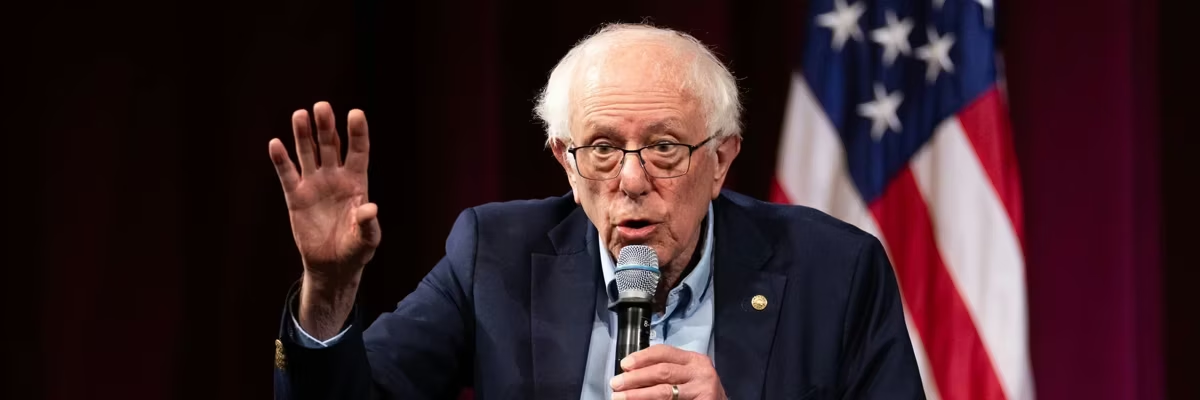
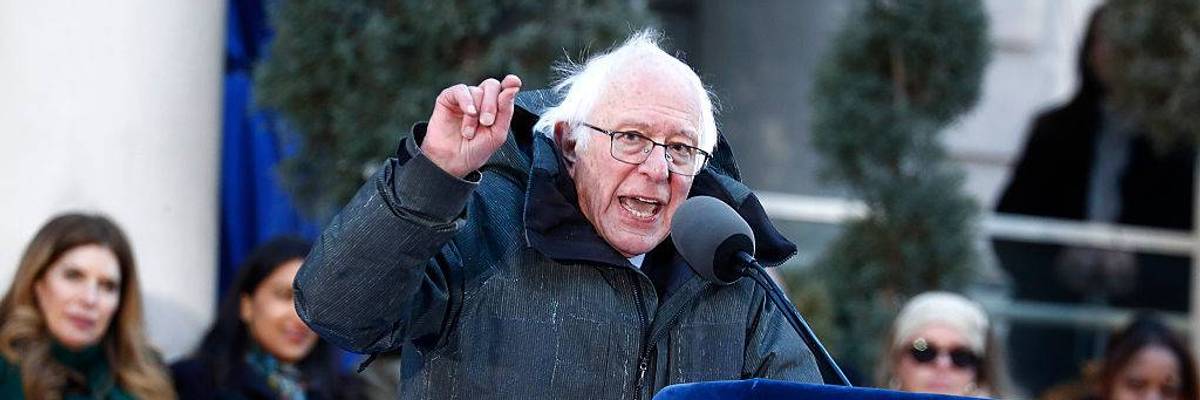
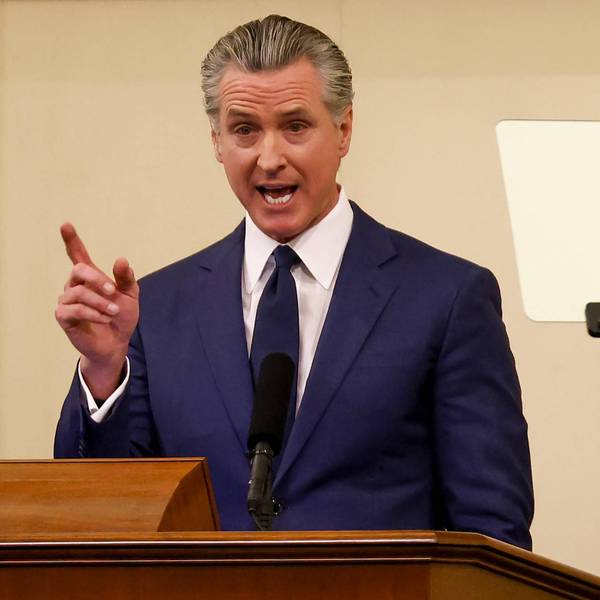
Sen. Bernie Sanders (I-Vt.)speaks during New York City Mayor Zohran Mamdani’s ceremonial inauguration at City Hall on January 1, 2026 in New York City(Photo by John Lamparski/Getty Images)
“Billionaires can’t be allowed to buy elections.”
After flirting last year with forming his own political party, far-right billionaire Elon Musk is funding Republican political candidates once again.
Axiosreported on Monday that Musk recently made a massive $10 million donation to bolster Nate Morris, a MAGA candidate who is vying to replace retiring US Sen. Mitch McConnell (R-Ky.).
Axios described the massive donation, the largest Musk has ever given to a Senate candidate, as “the biggest sign yet that Musk plans to spend big in the 2026 midterms, giving Republicans a formidable weapon in the expensive battle to keep their congressional majorities.”
Sen. Bernie Sanders (I-Vt.) reacted with disgust to the news, and said that Musk’s enormous donation was indicative of a broken campaign finance system.
“Are we really living in a democracy when the richest man on earth can spend as much as he wants to elect his candidates?” Sanders asked in a social media post.
“The most important thing our nation can do is end Citizens Unitedand move to public funding of elections,” he added, referring to the 2010 Supreme Court decision that cleared the way for unlimited spending on elections by corporations. “Billionaires can’t be allowed to buy elections.”
Democratic Maine State Auditor Matt Dunlap, currently running to represent Maine’s second congressional district, also denounced Musk for throwing his weight around to buy politicians.
“Billionaires buy our elections, rig the tax code, and undermine our democracy,” wrote Dunlap. “Working people deserve a government that works for them—not for billionaires like Elon Musk.”
Musk is no stranger to spending big to help elect Republicans, having spent more than $250 million in 2024 to help secure President Donald Trump’s victory.
However, his riches are no guarantee of a GOP win. Last year, for example, Musk spent millions to elect former Wisconsin Attorney General Brad Schimel to a seat on the Wisconsin Supreme Court, only to wind up losing the race by 10 points.
Elon Musk urges you to be a Fascist like him, says that you can ignore facts and reality then.Orcas discuss Donald Trump and the killer apes’ concept of democracy. Front Orca warns that Trump is crashing his country’s economy and that everything he does he does for the fantastically wealthy.Donald Fuhrump says that Amerikkka doesn’t bother with crimes or charges anymore, not being 100% Amerikkkan and opposing his real estate intentions is enough.
Elon Musk urges you to be a Fascist like him, says that you can ignore facts and reality then.Donald Fuhrump says that Amerikkka doesn’t bother with crimes or charges anymore, not being 100% Amerikkkan and opposing his real estate intentions is enough.Orcas discuss how Trump was re-elected and him being an obviously insane, xenophobic Fascist.
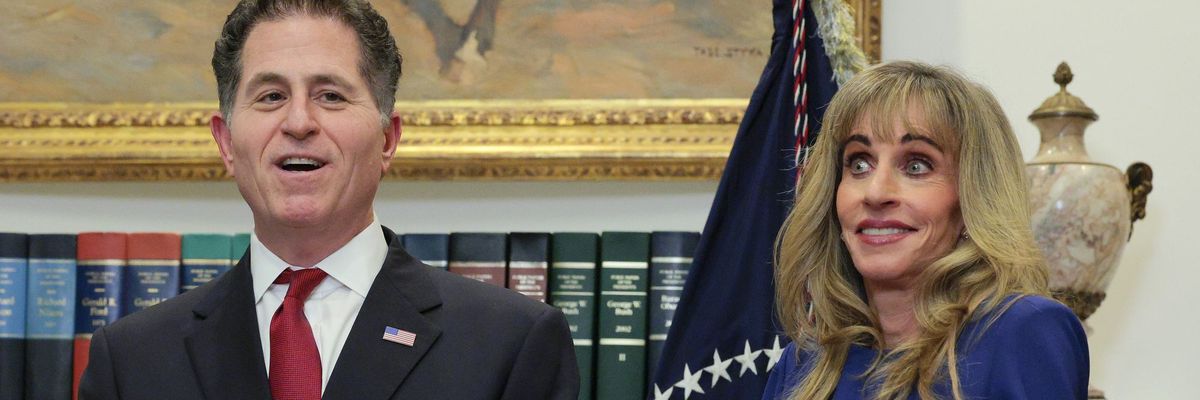
Tech billionaires Susan Dell and Michael Dell speak as US President Donald Trump makes an announcement about “Trump accounts” in the Roosevelt Room at the White House on December 02, 2025 in Washington, DC. (Photo by Chip Somodevilla/Getty Images)
New annual report on “ambitions” of billionaires by wealth management giant UBS shows just 2,919 individuals have a combined wealth of $15.8 trillion.
A new assessment by the international wealth management giant UBS this week shows that the number of billionaires in the world has reached new heights and that the acceleration of inherited wealth represents a new chapter for the ultra-rich in the 21st Century.
The latest UBS Billionaire Ambitions Report, unveiled Thursday, details how just 2,919 individual billionaires have a combined wealth of $15.8 trillion. The number of billionaires in the world is up nearly 9 percent from the previous year. In the United States—where nearly a third of those on the list reside—924 billionaires hold a collective $6.9 trillion in wealth.
The assessment by UBS—which surveyed its own billionaire clients as part of the survey, now its eleventh edition—emphasizes a surge of inherited wealth among the billionaire class. According to the report:
In 2025, 91 heirs (64 of them male and 27 female) inherited a record USD 297.8 billion. That’s 36% more than in 2024, despite fewer people inheriting overall. Globally, inheritance bolstered the number of multigenerational billionaires, with some 860 multi-generational billionaires now overseeing total assets of USD 4.7 trillion. That’s up from 805 with USD 4.2 trillion in 2024.
Across the world, multi-generational billionaires are slowly extending down the generations, with the number of second-generation billionaires growing by 4.6% in the 2025 report, the number of third generation by 12.3%, and the number of fourth generation and beyond by 10%.
The growing number of billionaires, including a rapidly increasing share who inherited their wealth rather than generating it themselves, says UBS, “heralds a new era” for the ultra-rich as “the great wealth transfer is intensifying as heirs inherit more than ever before.
The coming decades, the report notes, “will see growing numbers of billionaires and centi-millionaires as the Great Wealth Transfer continues to accelerate. Billionaires are estimated to transfer approximately USD 6.9 trillion of wealth globally by 2040, with at least USD 5.9 trillion set to be passed to children—either directly or indirectly through spouses.”
Of the $6.9 trillion currently held by US billionaires, the report estimates that $2.8 trillion of that wealth will be passed down to heirs over the next 15 years.
“The world has more billionaires than ever because of a system that’s broken for workers and rigged for the wealthy and CEOs who already make 285 times what workers do,” said the AFL-CIO in response to the report.
The union federation says that organized workers winning better collective bargaining is the first step needed to “level the playing field” for working people, while others see the surging fortunes of the ultra-wealthy as just more evidence that taxing the rich must remain at the top of the economic and political agenda both at the national level and internationally.
While millions of families struggle to put food on the table Elon Musk, Jeff Bezos & Mark Zuckerberg own more wealth than the bottom HALF of Americans.
That’s what oligarchy is about. That’s what a rigged economy is about.
With the UBS report showing that 91 of the new billionaires created this year arrived at their financial status through inheritance, Hal Singer, economics professor at the University of Utah, said, “That’s 91 additional reasons for a wealth tax.”
Orcas discuss Donald Trump and the killer apes’ concept of democracy. Front Orca warns that Trump is crashing his country’s economy and that everything he does he does for the fantastically wealthy.
The construction site of an Amazon data center in Salem Township, Pa., on Oct. 10. Credit: Jason Ardan/Citizens’ Voice via Getty Images
It’s not a novel observation to say that supporters of President Donald Trump and supporters of U.S. Sen. Bernie Sanders find common ground on many issues. They often share a skepticism of entrenched power and a desire to dismantle systems that they think have ceased to serve everyday people.
In Indiana, this agreement includes a distrust of data centers.
“The MAGA crowd and the Bernie bros have both figured out that they’ve been getting duped,” said Kerwin Olson, executive director of Citizens Action Coalition, an Indianapolis-based consumer and environmental advocacy nonprofit. “It was data centers that really brought it all together.”
Olson’s organization is running a campaign to persuade Indiana lawmakers to place a moratorium on new data centers and to redesign electricity rates to protect residential consumers from rate increases related to data center development.
He has received an emphatic response, with groups from the left, right and in-between booking him for speaking engagements and offering their assistance.
Election results last week confirm a similar dynamic in much of the country. Democrats won races for governor in New Jersey and Virginia and for two open seats on the Georgia Public Service Commission, campaigns in which data centers and rising electricity costs were issues. Media outlets noted this pattern, including in an insightful report from Jael Holzman of Heatmap and a look ahead to next year’s elections from Marc Levy and Jesse Bedayn of the Associated Press.
While much of the discussion is about data centers, the underlying issues are broader, touching on the power of tech companies. For people who live near proposed data centers, there is an additional sense of powerlessness, which Inside Climate News has documented across the country, including the backlash to a plan for a huge data center in Bessemer, Alabama.
“It’s about big tech,” Olson said. “To steal Bernie’s words, [it’s about] these big tech oligarchs that are calling all the shots at every single level of government right now.”
I also see some similarities with local opposition to large wind and solar projects, a subject I’ve written a lot aboutover theyears. A common theme is that residents feel frustrated when powerful companies want to make changes that would alter local landscapes.
Olson said he agrees that there is some overlap between opposition to data centers and large renewable energy development, but he views the latter as more of a rural phenomenon, while concern about data centers is rising almost everywhere.
Google scrapped its plans for a large data center in Indianapolis in September amid local backlash. In northwest Indiana, residents in the small city of Hobart have organized to oppose two data centers, raising concerns about the projects’ electricity and water consumption.
It’s notable that the opposition tends to highlight concerns about high electricity bills, but doesn’t talk as much about data centers’ negative climate impacts. Indiana can see the ramifications as officials push to delay the retirement of coal-fired power plants so the state can meet an expected surge in electricity demand, driven, in part, by data centers.
Political candidates can harness this mounting opposition and data center companies will need to devote more resources to engaging with the public.
Vivek Shastry, a senior research associate at Columbia University’s Center on Global Energy Policy, told me that it’s important for the AI and data center industries to find ways to provide local benefits to host communities and to minimize any negative effects on household electricity costs.
He touched on these subjects in a recent blog post, co-written with his colleague Diana Hernández. When I read this, my first thought was, “Wait, there are local benefits?”
He explained that there are opportunities in terms of energy and money. He pointed to examples in Denmark and Finland of data centers harnessing their waste heat to contribute to district heating systems for local communities.
Beyond that—which I think would be a challenge to do in the United States—he said AI and data center developers can make community benefits part of their proposals. This could mean working with local leaders to find ways to address local needs through philanthropy.
“To the extent that there is a partnership with communities, and there are these pathways to enable tangible co-benefits,” he said.
The opposite can also be true, with local communities feeling like they are bearing the burden of a data center with few, if any, benefits.
Shastry’s larger point is that government officials and corporate leaders need to make sure that development does not harm the most vulnerable consumers by driving up costs of water and electricity. To do otherwise would feed into consumer unrest.
“It’s important to get those processes and protections right early on, because the pace of this growth is such that once you lock into certain kinds of rates and other pathways, it then becomes harder to reverse,” Shastry said.
Voters are already getting upset about electricity rate increases that they blame on data centers, even though the AI industry is in its infancy. The negative effects, if left to fester, could get much worse.
Elon Musk urges you to be a Fascist like him, says that you can ignore facts and reality then.Donald Trump urges you to be a Climate Science denier like him. He says that he makes millions and millions for destroying the planet, Burn, Baby, Burn and Flood, Baby, Flood.Nigel Farage urges you to ignore facts and reality and be a climate science denier like him and his Deputy Richard Tice. He says that Reform UK has received £Millions and £Millions from the fossil fuel industry to promote climate denial and destroy the planet.
Sen. Bernie Sanders (I-Vt.) speaks about Rep. Alexandria Ocasio-Cortez’s (D-NY) rise and political future on “The Axios Show” on October 23, 2023. (Photo: Axios/screenshot)
In addition to Rep. Alexandria Ocasio-Cortez, said the senator, “you’ve got a lot of great young people right now in the Progressive Caucus in the House… And that gives me a lot of optimism about our political future.”
Despite the Trump administration’s increasing assaults on immigrant communities, the political left, and the rule of law, US Sen. Bernie Sanders on Thursday said he is optimistic “about our political future” when he looks at progressive leaders including Rep. Alexandria Ocasio-Cortez.
In excerpts of the latest episode of “The Axios Show” by the news outlet Axios, which is set to be released in full on Friday, Sanders (I-Vt.) weighed in on the recent news that Ocasio-Cortez (D-NY) is considering a presidential run in 2028.
When host Alex Thompson asked him whether Ocasio-Cortez would be a “formidable” candidate, Sanders replied, “I think she would.”
He added that a number of other Democratic elected officials would also be good candidates, and said the congresswoman’s future political moves are “her decision to make.” Ocasio-Cortez has also been named as a potential challenger to Senate Minority Leader Chuck Schumer (D-NY) in 2026.
Sanders spoke about Ocasio-Cortez’s ability to connect with voters she meets in person.
“I’ve been out on the streets with her, people come up, and how she responds to people is so incredibly genuine and open,” he said. “It’s just something that’s a gift that she has. It’s a quality that she has, she’s a great speaker out there.”
While progressive electoral successes like Ocasio-Cortez’s have often been dismissed by centrist Democrats and Republicans who claim left-wing candidates don’t have appeal outside of deep-blue urban areas like New York City, the congresswoman—who’s often called by her nickname, AOC—has received warm receptions in conservative, rural parts of the country, including when speaking to crowds of thousands with Sanders on his Fighting Oligarchy Tour this year.
“She comes from the working class, she was a kid who was cleaning houses with her mother,” he said. “She knows what it’s like not to have any money and she’s going out, fighting for working families all over this country.”
“I do want to say, it’s not just Alexandria,” he said. “You’ve got a lot of great young people right now in the Progressive Caucus in the House…I mean literally dozens… And that gives me a lot of optimism about our political future.”
Sanders also spoke about Maine Democratic Senate candidate Graham Platner, who is running a campaign focused on lifting up the working class in the primary against multiple candidates, including Gov. Janet Mills, as the party aims to unseat Sen. Susan Collins (R-Maine).
Platner has been the subject of controversy in recent days over deleted Reddit posts he wrote in the past and a tattoo that resembled a Nazi symbol—one that he got while serving in the military and that didn’t prevent him from being approved to reenlist. He announced Wednesday that he had gotten the tattoo covered with another image, before continuing his campaign with a town hall where he spoke to hundreds of Maine voters.
When Thompson asked Sanders about Platner’s controversies, he answered that he is “not overly impressed by a squad of media running around saying, ‘What do you think about the tattoo on Graham Platner’s chest?’”
“Between you and me, there might be one or two more important issues,” he said before speaking about the progressive oyster farmer’s impressive campaign rallies and the “dark period” he went through in the past.
“He went through some very difficult experiences in the military,” said Sanders. “Seeing his friends killed… He went to the VA and by the way, he says they rebuilt his life. He went into a dark period in his life. I suspect that Graham Platner is not the only American to have gone through a dark period.”
“The guy that I saw up on the stage in Portland, Maine, rather a brilliant guy,” said the senator. “Really a strong fighter for the working class, very articulate, very smart and what he said is, ‘Yeah, I went through a dark period and said stupid things. I am not the person that I was back then.’”
“And I think as a nation,” he added, “especially given the fact that we have a president who was convicted of 34 felonies, maybe we have to do a little bit of forgiveness.”
📺 EXCLUSIVE: On the latest episode of The Axios Show, @SenSanders defends Maine Democratic Senate candidate Graham Platner, saying there might be "one or two more important issues" than the Marine veteran's tattoos.
Front Orca supports AOC, urges her to kick some ass.Orcas discuss how Trump was re-elected and him being an obviously insane, xenophobic Fascist.Orcas discuss Donald Trump and the killer apes’ concept of democracy. Front Orca warns that Trump is crashing his country’s economy and that everything he does he does for the fantastically wealthy.