Bank accused of ‘trying to have it both ways’ with coal policy that allows financing for huge polluters
Barclays helped raise nearly $2bn for companies running highly polluting coal-fired power plants in the US, exposing an “enormous loophole” in its climate policy.
As part of its strategy to reach net zero, the bank has committed to stop financing companies that make more than half their revenues from coal-fired power.
Last year, however, Barclays helped raise $1.7bn for coal-fired power companies that appear to exceed that threshold, the Bureau of Investigative Journalism and ITV News can reveal.
Among these deals were two $400m loans for Monongahela Power, which generates 95% of its electricity from burning coal at two huge plants in West Virginia. The company only sells electricity that it generates itself, suggesting that the vast majority of its revenues are from coal-fired power.
Barclays, however, said its policy only prohibits financing for companies that make more than 50% of revenues specifically from generating coal-fired power; and that TBIJ’s calculations did not account for these companies’ revenues from transmitting and distributing that power.
Barclays was Europe’s biggest lender to the coal power industry last yearAndrea Domeniconi / Alamy
Seth Feaster, an analyst at the Institute for Energy Economics and Financial Analysis (IEEFA) think tank, said: “The bank is trying to have it both ways: a public-facing coal policy that sounds like it will no longer support coal-heavy companies, but the technicality [regarding transmission and distribution revenue] has rendered that policy largely meaningless.
“The bank has created an enormous loophole that appears to allow it to largely continue doing business as usual with coal-friendly utilities.”
Natasha Landell-Mills, head of stewardship at the asset manager Sarasin & Partners, which holds Barclays debt, said the bank’s position appeared to be “somewhat disingenuous”.
“In the end, what matters is that coal-fired power falls in keeping with ensuring a safe climate. As investors, we would expect all related activities that enable coal-fired power to be captured and, if they are not, would hope to see the board urgently address this loophole.” She said this was not just a question of how Barclays is run and its reputation, but that continuing to fund high emitters was also financially risky for long-term investors.
The news comes amid a storm of protest against the bank, which was revealed in May to be Europe’s biggest funder of fossil fuels.
It is also Europe’s biggest lender to the coal power industry, taking part in $75bn worth of deals for companies active in the sector last year.
Bold pledges
Under pressure from its customers and investors, Barclays has made increasingly bold climate promises. It tightened its coal policy in 2022 and said financing the sector not only poses a threat to the planet but could represent a bad lending decision. Yet a number of companies it funded last year appear to be making most of their money from coal-fired power.
In addition to the Monongahela Power deals, Barclays helped raise $400m for Kentucky Utilities, which in 2022 generated almost three quarters of its electricity from burning coal. This suggests more than half its revenues were from coal-fired power.
Barclays also helped raise a $500m loan for Louisville Gas & Electric, which generated 83% of its power from coal in 2022. It makes some revenues from selling gas but calculations based on company and government data suggest its revenue share from coal was more than 50%.
Mill Creek power plant, a coal-fired stations owned by Louisville Gas and ElectricWilliam Alden / Creative Commons
Neither company appears to be transitioning to renewable power and their owner, PPL Corporation, said it expects they will use coal and natural gas as their predominant fuels “for the foreseeable future”.
Monongahela Power is investing millions to keep its two West Virginia plants running until 2035 and 2040, despite scientists warning that developed countries must end power generation from coal by 2030. The company aims to build 50MW of solar generation, but that represents less than 2% of its current coal-fired power capacity.
Barclays told TBIJ the deals complied with its policy “based on publicly disclosed information and our due diligence”. It said its policy does not have a loophole and that its methodology is robust. “An ambition to be net zero by 2050 does not require an immediate exit from financing coal,” the bank said. “Barclays is financing an energy sector in transition, providing finance to meet current energy needs and also financing the scaling of clean energy”.
PPL, which owns utilities in Kentucky, Rhode Island and Pennsylvania, said it had set a clear goal to achieve net-zero carbon emissions by 2050 and was transitioning to a cleaner energy mix across the group. It added that it had received approval from the authorities to retire 600MW of coal-fired power generation in Kentucky by 2027. This, however, represents less than 15% of its remaining coal capacity.
Monongahela Power did not respond to TBIJ’s request for comment.
Deadly coal plants
Coal-fired power plants are responsible for more than 40% of global CO2 emissions from energy. At Cop28 UN climate talks in Dubai last year, all countries agreed that accelerating the transition from coal to renewables was essential in order to avert catastrophic climate change.
Coal is also a major source of toxic air pollution. In the US alone, more than 3,800 people die from soot released by coal-fired power plants every year, according to a report by Sierra Club, a US NGO. While many European banks have distanced themselves from the industry, Barclays has retained strong links with US coal-fired power companies.
The boom in fracked gas and plunging cost of renewables has changed the landscape for power generation in the US. Seth Feaster at IEEFA said: “[Coal-fired power] companies are going to start struggling because they can’t sell their power in competitive environments.
“Investing in coal is very risky because most of [these coal plants] are losing money. They’re not going to be around for very long and if something breaks, they tend to shut down early because they can be very costly to repair.”
Bob Ward from the Grantham Research Institute on Climate Change said: “The coal industry in the United States is failing, it’s on its way out … there’s no excuse for propping up the American coal industry.” He described the distinction Barclays made between the generation, transmission and distribution of electricity from coal in its policy as “semantics”.
“What consumers and investors will be expecting is that Barclays are complying with the spirit of their declarations, and not just a technicality,” Ward said. “If you are generating most of your income from burning coal and then distributing the electricity results, then that’s the coal. That’s the coal industry. You’re damaging the climate. And that is what Barclays said they would stop.”
Last month, the organisers of the Wimbledon tennis championships faced calls to drop Barclays as a sponsor over its ties to fossil fuels and defence companies supplying Israel. Barclays addressed criticism of its defence funding, saying it trades in shares on behalf of clients. “Whilst we provide financial services to these companies, we are not making investments for Barclays.”
Live Nation also dropped the bank as a sponsor for various music festivals – including Download, Latitude and Isle of Wight – after protests from bands and fans.
Steff Wright, chairman of the Gusto Group, said his construction and manufacturing business is moving away from banking with Barclays. “As a company that’s working towards a green future, we need to look at our supply chain and who else is on that journey with us.
“We’d encourage all businesses to move away from them, to put pressure on them to rethink their strategy.”
Reporters: Josephine Moulds Environment editor: Robert Soutar Impact producer: Grace Murray Deputy editors: Chrissie Giles and Katie Mark Editor: Franz Wild Production editor: Alex Hess Fact checker: Somesh Jha
This reporting is funded by the Sunrise Project. None of our funders have any influence over our editorial decisions or output.
Susan Avery, the first climate scientist on ExxonMobil’s board, is stepping down. Credit: Tess Abbot/WHOItn(CC BY-SA 4.0).
Advocates had hoped Susan Avery’s nomination would be a turning-point moment for the company’s climate approach. It wasn’t.
This story was published in partnership with ExxonKnews
When Susan Avery was first nominated to ExxonMobil’s board in 2017 after pressure from shareholder advocates to bring on a climate scientist, many hoped that her expertise could help steer the oil major in a new direction. Avery — a physicist and atmospheric scientist — had spoken during her extensive career of the need to “get off fossil fuels as much as possible.”
More than seven years later, Avery is set to exit her role as chair of Exxon’s Environment, Safety, and Public Policy Committee with those hopes seemingly dashed. Evidence continues to mount that the oil giant is still spreading climate disinformation to delay action on fossil fuels, and it recently sued shareholders who proposed that it pursue emissions cuts.
Avery’s decision not to stand for re-election to the board was “for reasons unrelated to the company,” according to a February filing with the U.S. Securities and Exchange Commission. Avery, 74, is just shy of Exxon’s mandatory retirement age, though that was not cited in the filing — directors can run for re-election until they’re 75.
The end of her tenure has reignited debate about the role of a scientist on the board of a major oil company with a legacy of spreading science denial and ignoring internal expertise.
“People wanted to give her an opportunity to change things from within, and I think there was an expectation that she would take that responsibility seriously,” said Kathy Mulvey, accountability campaign director for the Union of Concerned Scientists, a nonprofit advocacy organization that supported Avery’s nomination at the time. But Avery’s ability or willingness to change the company “certainly has not borne out in reality,” Mulvey said.
Avery’s selection came after a shareholder proposal requested that Exxon nominate someone with a “high level of climate change expertise” for its board. The company’s unusual lawsuit against other shareholders could chill further attempts to sway its business model that way. Avery’s last day will be May 29, overlapping with the company’s annual shareholder meeting, where a growing number of outraged shareholder groups and state pension funds now plan to vote against prominent members of the board, including CEO Darren Woods.
With climate lawsuits against the company moving closer to trial, a growing number of states exploring legislation to make companies like Exxon pay for climate damages, and tensions with investors so high, “serving on ExxonMobil’s board is a high-stakes poker game,” Mulvey said. As Avery closes out her tenure with more than $3.8 million in compensation and stock value from the company, Mulvey said, “it’s not surprising” if Avery “decided to cash in her chips and go home.”
Neither Avery nor Exxon responded to requests for an interview.
Business as Usual During Avery’s Tenure
Avery, the former president of the Woods Hole Oceanographic Institution in Massachusetts and professor emeritus at the University of Colorado Boulder, was brought onto the board during Woods’ first month as CEO. “Avery’s leadership experience in multiple academic and scientific organizations, coupled with her breadth of scientific and research expertise, reinforce the corporation’s long-standing technical and scientific foundation,” the company said as it announced her appointment.
At the time, Exxon was battling subpoenas from attorneys general in New York and Massachusetts, both investigating the company for concealing its knowledge about the dangers of burning fossil fuels. The oil giant was just beginning to experience the fallout of early revelations about its historic climate deception; the tip of that iceberg was unearthed by Inside Climate News, the Los Angeles Times, and Columbia Journalism School in 2015.
Behind the scenes, Exxon was taking a far less amenable tone in response to criticism of its climate approach.
“Kill the story,” Exxon media relations manager Alan Jeffers told Reuters’ Houston bureau chief in a 2016 email, responding to a request for comment on a Center for Media and Democracy press release accusing the American Legislative Exchange Council of abusing its nonprofit status by lobbying against climate action on behalf of Exxon.
In the years to follow, Exxon would become the target of lawsuits from state and local governments alleging the company defrauded consumers, lawmakers, and the public in order to delay climate action and protect its oil and gas profits. Evidence shows the oil giant continued to spread anti-science disinformation and internally strategize to manipulate the public’s understanding of its role in the climate crisis well into Avery’s time on the board.
A congressional report released last month following a years-long investigation found that Exxon and other oil majors’ campaigns of deception “evolved from denying climate science to spreading disinformation and perpetuating doublespeak.” Avery is mentioned in more than a dozen of the documents that members of Congress obtained from Exxon — but they’re almost entirely redacted.
The investigation found that while Exxon publicly touted its support for the Paris Agreement “since its adoption in 2015,” executives privately admitted that the company did not actually intend to meet the agreement’s goals. The oil giant’s plans are far afield from allowing it to hit those targets, according to a March analysis by think tank Carbon Tracker, which placed Exxon among the five lowest-ranking companies on its scorecard. Exxon’s climate pledges don’t align with its actions, according to one peer-reviewed study, and are “misleading at best, dishonest at worst,” according to Carly Phillips, a research scientist at the Union of Concerned Scientists.
During Avery’s tenure, the company also used advertising firms and funded partnerships with academic institutions to lend credibility to its climate pledges and promotion of “low-carbon solutions” like algae biofuels, which the company abandoned after spending millions advertising that as a climate fix. And Exxon worked to shift blame for its role in the climate crisis to consumers, according to a study of the company’s public communications by climate disinformation experts Naomi Oreskes and Geoffrey Supran.
“The people who are generating those emissions need to be aware of and pay the price for generating those emissions,” Exxon’s Woods said in a recent Fortune interview.
A November report from the International Energy Agency found that oil and gas companies account for less than 1% of clean energy investment globally. “‘When the energy world changes, so will we’ is not an adequate response to the immense challenges at hand,” the report concludes.
But Exxon has vastly expanded its investments in fossil fuels, more than doubling its oil production in the Permian Basin after sealing a $60 billion deal to acquire Pioneer Natural Resources last year. Exxon and two other oil companies told Guyana that they plan to spend more than $12.9 billion on an offshore oil project there, the country said last summer. The company’s 2023 Global Outlook predicts an increase in methane gas use of more than 20% by midcentury.
In a 2021 hearing as part of a House Oversight Committee investigation, Woods refused to pledge that the company would stop funding disinformation and lobbying against climate action.
‘Like a Cancer Doctor on the Board of a Tobacco Company’
The same committee asked Avery to testify at a later hearing, but she never did. Instead, Avery appeared to use her expertise and position to lend credibility to Exxon’s claims of climate leadership.
“I’m proud to work on key issues related to climate risk at ExxonMobil,” she said in Exxon’s 2023 “Advancing Climate Solutions” report. “With my experience as an atmospheric scientist and a leader at a global research organization, I am committed to helping to advise the Board on public issues of significance. … The members of the [Environment, Safety and Public Policy] Committee are united in our commitment to position ExxonMobil as an industry leader in pursuing sustainable solutions that improve quality of life and meet society’s evolving needs.”
Sarah Myhre, another climate scientist and program director for climate advocacy and democracy reform at the Glaser Progress Foundation, contends that Avery compromised her scientific integrity to “performatively greenwash one of the most horrifically damaging, nefarious, and fraudulent corporations that has ever existed.”
“It’s like a cancer doctor on the board of a tobacco company [promoting] tobacco as a health product, something that is helping people live healthier, more vibrant lives. They’re taking all of their scientific bona fides and accreditation, and they’re using it for this outcome, which ultimately protects the tobacco company [as it] continues to kill people or damage their lives irrevocably,” Myhre said.
Michael Mann, a climate scientist who was subject to years of attacks from climate denialists funded by Exxon, described Avery’s service to the company as a “betrayal.”
Avery’s decision “comes across as entirely transactional: climate scientist lends their imprimatur to the world’s largest publicly-traded fossil fuel company, under fire for their history of promoting disinformation and delay tactics, for seven years, and gets 4 million dollars in return,” Mann said in an email. “What is there that doesn’t look bad here?”
Silencing Dissent at Exxon
What’s not known is whether Avery ever advised Exxon to change course. The company has a history of concealing the warnings of its own scientists and retaliating against whistleblowers — even recently.
“The ability of a board member to move a company forward partially depends on the multiple stakeholder voices that the company is hearing and whether they’re willing to listen to them,” said Timothy Smith, senior policy advisor at Interfaith Center on Corporate Responsibility, an organization that coordinates the work of shareholder groups.
Exxon’s lawsuit against two shareholder groups, filed in January, came in response to the shareholders’ proposal asking the company to limit its Scope 3 emissions, which arise from the use of its products and make up about 85% of its total greenhouse gas emissions. (Exxon’s “net zero” ambitions and emissions reduction plans don’t account for Scope 3 emissions at all.)
Shareholder resolutions such as these are intended for a vote by a company’s stockholders. When firms want to keep proposals off the ballot, the established process is to appeal to the Securities and Exchange Commission. Exxon, which sued instead, claimed the groups were driven by an “extreme agenda” that is “calculated to diminish the company’s existing business.”
That claim was “really duplicitous because they know full well that this same agenda has been raised with them by other investors over the decade,” said Smith, arguing that the company has “become more confrontational and defensive rather than be a leader in this space.”
The shareholders, Arjuna Capital and Follow This, withdrew their proposal. But Exxon continued with its lawsuit, defending the decision in its 2024 proxy statement and arguing that the “proposal process is being abused by those who treat shareholder democracy as a venue for activism.” A judge ruled Wednesday that the case can proceed against one of the shareholders, U.S.-based Arjuna Capital, but not the Netherlands-based Follow This.
Mulvey, of the Union of Concerned Scientists, said Exxon would rather battle its own investors than consider transparency about or a change to its fossil fuel business.
“Not only do they continue to fight back against mandatory climate disclosure and public policies that would hold them accountable, but it is also trying to undermine the notion that those who own the company should have a say over its direction,” she said.
Tensions could come to a head at Exxon’s annual shareholder meeting as Avery steps aside. Shareholder advocacy groups like Majority Action have urged other investors to vote against the company’s entire board of directors, which CalPERS, America’s largest pension fund, has announced it will do. The Illinois State Treasurer and California State Treasurer have made similar recommendations to their state pension funds, and the New York state pension fund plans to vote against all but two of the board members.
“The [International Energy Agency] has laid out a plan to transform our energy system in line with the 1.5°C pathway. We’re at a critical juncture of how this is going to occur — and Exxon appears to be hellbent on foreclosing on that urgent and necessary discussion,” said Majority Action’s senior research analyst, Bryant Sewell. “These directors have to be held accountable.”
The collapse of the Greenland ice sheet, shown here, is one of five tipping points that could be triggered by current levels of warming. (Photo: Patrick Robert/Corbis)
“Averting this crisis—and doing so equitably—must be the core goal of COP28 and ongoing global cooperation,” one expert said.
An earlier version of this article said the sea levels could rise by 656 feet by 2100 if the Antarctic ice sheet started to melt. It has been corrected to reflect the fact that they would rise by 6.6 feet.
Current levels of global heating from the burning of fossil fuels and the destruction of nature risk triggering five tipping points that could throw Earth’s systems further out of balance, with three more at risk of toppling in the next decade.
The Global Tipping Points Report, released Wednesday at the United Nations Climate Change Conference (COP28) in the United Arab Emirates, argues that policymakers have delayed climate action long enough that “linear incremental change” will no longer be enough to protect ecosystems and communities from the worst impacts of the climate crisis. However, world leaders can still choose to take advantage of positive tipping points to drive transformative change.
“The existence of tipping points means that ‘business as usual’ is now over,” the report authors wrote. “Rapid changes to nature and society are occurring, and more are coming.”
“Crossing these thresholds may trigger fundamental and sometimes abrupt changes that could irreversibly determine the fate of essential parts of our Earth system for the coming hundreds or thousands of years.”
The report defines a “tipping point” as “occurring when change in part of a system becomes self-perpetuating beyond a threshold, leading to substantial, widespread, frequently abrupt and often irreversible impact.” A group of more than 200 researchers assessed 26 different potential tipping points in Earth’s systems that could be triggered by the climate crisis.
“Tipping points in the Earth system pose threats of a magnitude never faced by humanity,” report leader Tim Lenton of Exeter’s Global Systems Institutesaid in a statement. “They can trigger devastating domino effects, including the loss of whole ecosystems and capacity to grow staple crops, with societal impacts including mass displacement, political instability, and financial collapse.”
Thank you to everyone involved in producing the first Global Tipping Points Report. We have worked with over 200 authors from over 25 institutions globally. Explore this informative, sobering & inspiring report – https://t.co/49ojesUceQpic.twitter.com/OESQpk26ix
Because current emissions trajectories put the world on track for 1.5°C of warming, this is likely to trigger five tipping points, the report authors found. Those tipping points are the melting of the Greenland and Antarctic ice sheets, the mass die-off of warm-water coral reefs, the thawing of Arctic permafrost, and the collapse of the North Atlantic Subpolar Gyre circulation.
The melting of just the Antarctic ice sheet, for example, could raise global sea levels by 6.6 feet by 2100, Carbon Brief reported, meaning 480 million people would face yearly coastal flooding. Three more tipping points could be triggered in the 2030s if temperatures rise past 1.5°C. These include the mass death of seagrass meadows, mangroves, and boreal forests, according to The Guardian.
“Crossing these thresholds may trigger fundamental and sometimes abrupt changes that could irreversibly determine the fate of essential parts of our Earth system for the coming hundreds or thousands of years,” co-author Sina Loriani of the Potsdam Institute for Climate Impact Research told The Guardian.
Contributor Manjana Milkoreit of the University of Oslo said in a statement that “our global governance system is inadequate to deal with the coming threats and implement the solutions urgently required.”
But that doesn’t mean the report authors believe that hope is lost. Rather, they see it as a call to ambitious action at the current U.N. climate talks and beyond.
“Averting this crisis—and doing so equitably—must be the core goal of COP28 and ongoing global cooperation,” Milkoreit said.
One way to do this is to take advantage of positive tipping points.
“Concerted actions can create the enabling conditions for triggering rapid and large-scale transformation,” the report authors wrote. “Human history is flush with examples of abrupt social and technological change. Recent examples include the exponential increases in renewable electricity, the global reach of environmental justice movements, and the accelerating rollout of electric vehicles.”
The report authors made six recommendations based on their findings:
Immediately phasing out fossil fuels and emissions from land use changes like deforestation;
Strengthening plans for adaptation and loss and damage in the face of inevitable tipping points;
Taking tipping points into account in Paris agreement mechanisms like the global stocktake and national climate pledges;
Collaborating to trigger positive tipping points;
Organizing a global summit on tipping points; and
Increasing research on tipping points, including through a special report by the Intergovernmental Panel on Climate Change.
“Now is the moment to unleash a cascade of positive tipping points to ensure a safe, just, and sustainable future for humanity,” Lenton said.
The buildings and steaming cooling towers of a coal-fired power plant behind a landscape park in Germany. Frank Bienewald / LightRocket via Getty Images
… Carbon offsets are in theory a way to cancel out greenhouse gas emissions by funding an activity that will remove a supposedly equal amount of carbon dioxide from the atmosphere or prevent an equal amount of carbon pollution. They can be purchased by everyone from major companies pursuing net-zero emissions goals to individuals looking to compensate for high-carbon activities like flying. Typically, an institution or individual will purchase a certain amount of carbon credits, with one credit usually standing in for one metric ton of carbon dioxide — or what is typically emitted by driving 2,513 miles in a gas car — removed from the atmosphere. (That’s roughly the distance between San Francisco and Atlanta). Whoever buys the carbon credit is essentially buying the right to count the emissions reduction as theirs even if it’s being performed by a tree-planting or renewable energy project on the other side of the globe.
…
Quick Facts
One carbon credit usually equals one metric ton of carbon dioxide supposedly removed from the atmosphere, or the equivalent of driving 2,513 miles in a gas-powered car.
The voluntary carbon market quadrupled in value between 2020 and 2021 to reach nearly $2 billion.
The average tree absorbs 20 pounds of carbon dioxide each year during the first 20 years of its life.
Only four percent of carbon offset projects actively remove carbon dioxide from the atmosphere, as opposed to preventing additional emissions.
More than 170 climate, environmental and Indigenous rights groups signed an open letter opposing carbon offsets.
At least 52 percent of carbon-offset generating wind projects in India would have been built anyway.
California’s forest carbon offsets program likely overestimated its emissions reductions by at least 80 percent.
A Ryanair program to offer passengers €1 carbon offsets only actually offset the company’s emissions by 0.01 percent.
Sixty-six percent of highly-polluting companies studied relied on carbon offsets to meet their net zero targets.
There are only around 500 million hectares of land available for tree-planting carbon offset projects and Shell wants to claim 10 percent of it.
…
They’re a Scam: One of the main criticisms of carbon offsets is that many projects don’t really do what they say they are going to do, namely, prevent additional emissions. A major ProPublica report published in 2019 reviewed 20 years of forest-preservation-based offset projects and found that “In case after case […] carbon credits hadn’t offset the amount of pollution they were supposed to, or they had brought gains that were quickly reversed or that couldn’t be accurately measured to begin with.” A 2021 study of wind farms in India found that at least 52 percent of the projects used to back offsets would have been constructed regardless and that therefore the selling of the offsets to polluting industries actually increased emissions. Two studies of California’s forest carbon offsets program found that it overestimated its emissions reductions by at least 80 percent. The dubious nature of many carbon-offset projects leads to charges of greenwashing, because fossil fuel or airline companies can use their purchasing of offsets to market themselves as being more sustainable than they really are. For example, a Ryanair program to charge its customers €1 to offset their flight only lowered the company’s emissions by 0.01 percent.
…
They’re a Distraction From Reducing Emissions: Even if every carbon offset project worked exactly as advertised, however, it wouldn’t be an effective tool for fighting climate change. That’s because the climate crisis is caused by pumping greenhouse gas emissions into the atmosphere and will only be halted if emissions actually stop as well. Yet a 2021 study looking at net-zero pledges from the sectors responsible for 64 percent of greenhouse gas emissions found that 66 percent of them relied on carbon offsets. Oil, gas and mining companies were especially dependent on offsets for their net zero plans.
…
What everyone in the climate space can agree on is that the emphasis needs to move away from purchasing offsets and towards actually reducing fossil fuel emissions. At their best, offsets could be a stop-gap measure to fund beneficial projects and counteract emissions that there is not yet a technologically feasible way to reduce directly. At their worst, carbon offsets risk giving polluters an easy way to greenwash their image while continuing business as usual, actually increasing emissions through miscounting and reproducing the injustices underlying the climate crisis. Given that the current system tips more towards the latter than the former, it’s important for governments, companies and individuals to focus on not putting greenhouse gas emissions in the atmosphere in the first place.
Sometimes realisation comes in a blinding flash. Blurred outlines snap into shape and suddenly it all makes sense. Underneath such revelations is typically a much slower-dawning process. Doubts at the back of the mind grow. The sense of confusion that things cannot be made to fit together increases until something clicks. Or perhaps snaps.
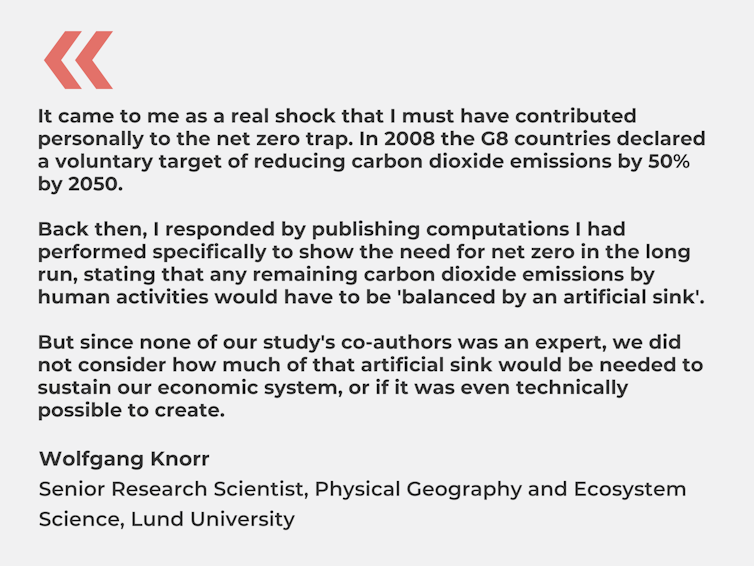
Collectively we three authors of this article must have spent more than 80 years thinking about climate change. Why has it taken us so long to speak out about the obvious dangers of the concept of net zero? In our defence, the premise of net zero is deceptively simple – and we admit that it deceived us.
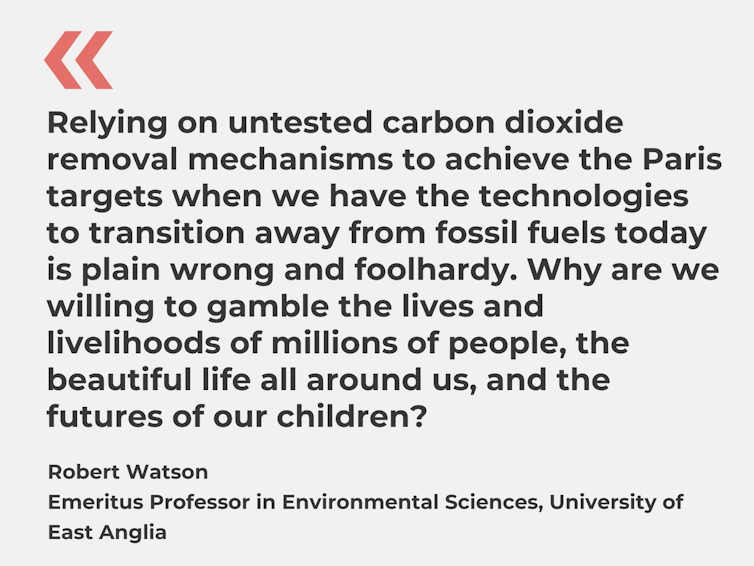
The threats of climate change are the direct result of there being too much carbon dioxide in the atmosphere. So it follows that we must stop emitting more and even remove some of it. This idea is central to the world’s current plan to avoid catastrophe. In fact, there are many suggestions as to how to actually do this, from mass tree planting, to high tech direct air capture devices that suck out carbon dioxide from the air.
The current consensus is that if we deploy these and other so-called “carbon dioxide removal” techniques at the same time as reducing our burning of fossil fuels, we can more rapidly halt global warming. Hopefully around the middle of this century we will achieve “net zero”. This is the point at which any residual emissions of greenhouse gases are balanced by technologies removing them from the atmosphere.
This is a great idea, in principle. Unfortunately, in practice it helps perpetuate a belief in technological salvation and diminishes the sense of urgency surrounding the need to curb emissions now.
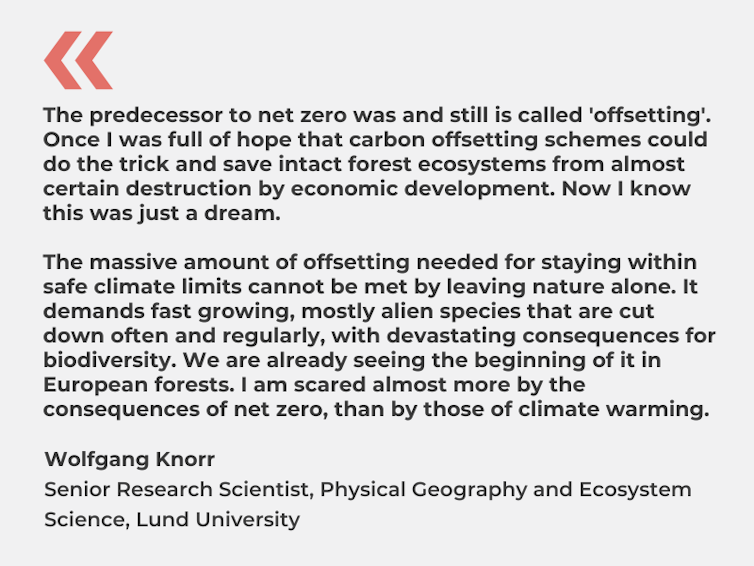
We have arrived at the painful realisation that the idea of net zero has licensed a recklessly cavalier “burn now, pay later” approach which has seen carbon emissions continue to soar. It has also hastened the destruction of the natural world by increasing deforestation today, and greatly increases the risk of further devastation in the future.
To understand how this has happened, how humanity has gambled its civilisation on no more than promises of future solutions, we must return to the late 1980s, when climate change broke out onto the international stage.
Steps towards net zero
On June 22 1988, James Hansen was the administrator of Nasa’s Goddard Institute for Space Studies, a prestigious appointment but someone largely unknown outside of academia.
By the afternoon of the 23rd he was well on the way to becoming the world’s most famous climate scientist. This was as a direct result of his testimony to the US congress, when he forensically presented the evidence that the Earth’s climate was warming and that humans were the primary cause: “The greenhouse effect has been detected, and it is changing our climate now.”
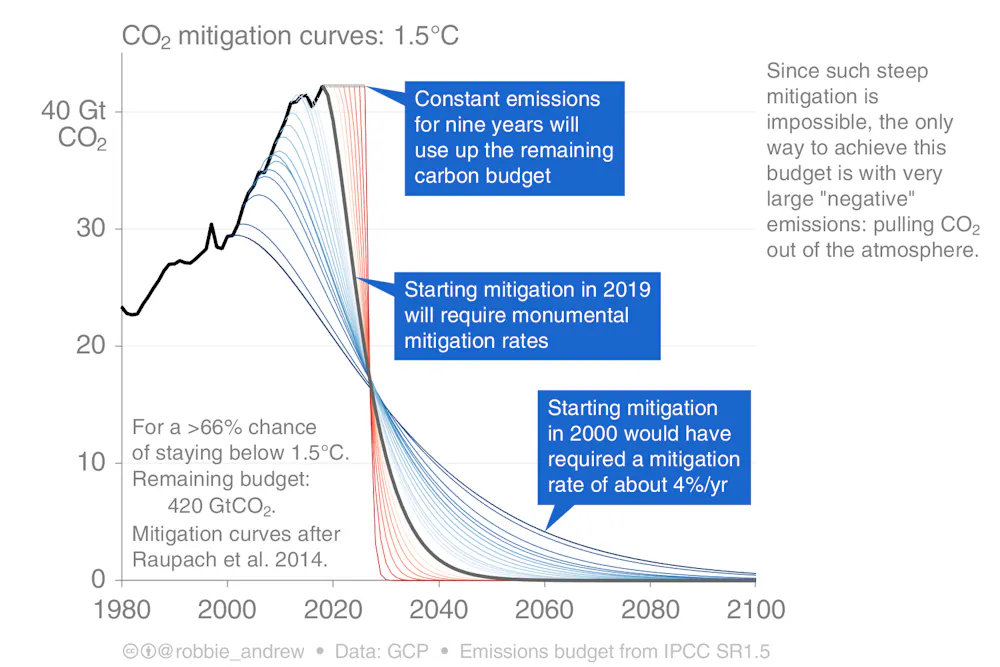
If we had acted on Hansen’s testimony at the time, we would have been able to decarbonise our societies at a rate of around 2% a year in order to give us about a two-in-three chance of limiting warming to no more than 1.5°C. It would have been a huge challenge, but the main task at that time would have been to simply stop the accelerating use of fossil fuels while fairly sharing out future emissions.
Four years later, there were glimmers of hope that this would be possible. During the 1992 Earth Summit in Rio, all nations agreed to stabilise concentrations of greenhouse gases to ensure that they did not produce dangerous interference with the climate. The 1997 Kyoto Summit attempted to start to put that goal into practice. But as the years passed, the initial task of keeping us safe became increasingly harder given the continual increase in fossil fuel use.
It was around that time that the first computer models linking greenhouse gas emissions to impacts on different sectors of the economy were developed. These hybrid climate-economic models are known as Integrated Assessment Models. They allowed modellers to link economic activity to the climate by, for example, exploring how changes in investments and technology could lead to changes in greenhouse gas emissions.
They seemed like a miracle: you could try out policies on a computer screen before implementing them, saving humanity costly experimentation. They rapidly emerged to become key guidance for climate policy. A primacy they maintain to this day.
Unfortunately, they also removed the need for deep critical thinking. Such models represent society as a web of idealised, emotionless buyers and sellers and thus ignore complex social and political realities, or even the impacts of climate change itself. Their implicit promise is that market-based approaches will always work. This meant that discussions about policies were limited to those most convenient to politicians: incremental changes to legislation and taxes.
This story is a collaboration between Conversation Insights and Apple News editors
The Insights team generates long-form journalism and is working with academics from different backgrounds who have been engaged in projects to tackle societal and scientific challenges.
Around the time they were first developed, efforts were being made to secure US action on the climate by allowing it to count carbon sinks of the country’s forests. The US argued that if it managed its forests well, it would be able to store a large amount of carbon in trees and soil which should be subtracted from its obligations to limit the burning of coal, oil and gas. In the end, the US largely got its way. Ironically, the concessions were all in vain, since the US senate never ratified the agreement.
Forests such as this one in Maine, US, were suddenly counted in the carbon budget as an incentive for the US to join the Kyoto Agreement. Inbound Horizons/Shutterstock
Postulating a future with more trees could in effect offset the burning of coal, oil and gas now. As models could easily churn out numbers that saw atmospheric carbon dioxide go as low as one wanted, ever more sophisticated scenarios could be explored which reduced the perceived urgency to reduce fossil fuel use. By including carbon sinks in climate-economic models, a Pandora’s box had been opened.
It’s here we find the genesis of today’s net zero policies.
That said, most attention in the mid-1990s was focused on increasing energy efficiency and energy switching (such as the UK’s move from coal to gas) and the potential of nuclear energy to deliver large amounts of carbon-free electricity. The hope was that such innovations would quickly reverse increases in fossil fuel emissions.
But by around the turn of the new millennium it was clear that such hopes were unfounded. Given their core assumption of incremental change, it was becoming more and more difficult for economic-climate models to find viable pathways to avoid dangerous climate change. In response, the models began to include more and more examples of carbon capture and storage, a technology that could remove the carbon dioxide from coal-fired power stations and then store the captured carbon deep underground indefinitely.
This had been shown to be possible in principle: compressed carbon dioxide had been separated from fossil gas and then injected underground in a number of projects since the 1970s. These Enhanced Oil Recovery schemes were designed to force gases into oil wells in order to push oil towards drilling rigs and so allow more to be recovered – oil that would later be burnt, releasing even more carbon dioxide into the atmosphere.
Carbon capture and storage offered the twist that instead of using the carbon dioxide to extract more oil, the gas would instead be left underground and removed from the atmosphere. This promised breakthrough technology would allow climate friendly coal and so the continued use of this fossil fuel. But long before the world would witness any such schemes, the hypothetical process had been included in climate-economic models. In the end, the mere prospect of carbon capture and storage gave policy makers a way out of making the much needed cuts to greenhouse gas emissions.
The rise of net zero
When the international climate change community convened in Copenhagen in 2009 it was clear that carbon capture and storage was not going to be sufficient for two reasons.
First, it still did not exist. There were no carbon capture and storage facilities in operation on any coal fired power station and no prospect the technology was going to have any impact on rising emissions from increased coal use in the foreseeable future.
The biggest barrier to implementation was essentially cost. The motivation to burn vast amounts of coal is to generate relatively cheap electricity. Retrofitting carbon scrubbers on existing power stations, building the infrastructure to pipe captured carbon, and developing suitable geological storage sites required huge sums of money. Consequently the only application of carbon capture in actual operation then – and now – is to use the trapped gas in enhanced oil recovery schemes. Beyond a single demonstrator, there has never been any capture of carbon dioxide from a coal fired power station chimney with that captured carbon then being stored underground.
Just as important, by 2009 it was becoming increasingly clear that it would not be possible to make even the gradual reductions that policy makers demanded. That was the case even if carbon capture and storage was up and running. The amount of carbon dioxide that was being pumped into the air each year meant humanity was rapidly running out of time.
With hopes for a solution to the climate crisis fading again, another magic bullet was required. A technology was needed not only to slow down the increasing concentrations of carbon dioxide in the atmosphere, but actually reverse it. In response, the climate-economic modelling community – already able to include plant-based carbon sinks and geological carbon storage in their models – increasingly adopted the “solution” of combining the two.
So it was that Bioenergy Carbon Capture and Storage, or BECCS, rapidly emerged as the new saviour technology. By burning “replaceable” biomass such as wood, crops, and agricultural waste instead of coal in power stations, and then capturing the carbon dioxide from the power station chimney and storing it underground, BECCS could produce electricity at the same time as removing carbon dioxide from the atmosphere. That’s because as biomass such as trees grow, they suck in carbon dioxide from the atmosphere. By planting trees and other bioenergy crops and storing carbon dioxide released when they are burnt, more carbon could be removed from the atmosphere.
With this new solution in hand the international community regrouped from repeated failures to mount another attempt at reining in our dangerous interference with the climate. The scene was set for the crucial 2015 climate conference in Paris.
A Parisian false dawn
As its general secretary brought the 21st United Nations conference on climate change to an end, a great roar issued from the crowd. People leaped to their feet, strangers embraced, tears welled up in eyes bloodshot from lack of sleep.
The emotions on display on December 13, 2015 were not just for the cameras. After weeks of gruelling high-level negotiations in Paris a breakthrough had finally been achieved. Against all expectations, after decades of false starts and failures, the international community had finally agreed to do what it took to limit global warming to well below 2°C, preferably to 1.5°C, compared to pre-industrial levels.
The Paris Agreement was a stunning victory for those most at risk from climate change. Rich industrialised nations will be increasingly impacted as global temperatures rise. But it’s the low lying island states such as the Maldives and the Marshall Islands that are at imminent existential risk. As a later UN special report made clear, if the Paris Agreement was unable to limit global warming to 1.5°C, the number of lives lost to more intense storms, fires, heatwaves, famines and floods would significantly increase.
But dig a little deeper and you could find another emotion lurking within delegates on December 13. Doubt. We struggle to name any climate scientist who at that time thought the Paris Agreement was feasible. We have since been told by some scientists that the Paris Agreement was “of course important for climate justice but unworkable” and “a complete shock, no one thought limiting to 1.5°C was possible”. Rather than being able to limit warming to 1.5°C, a senior academic involved in the IPCC concluded we were heading beyond 3°C by the end of this century.
Instead of confront our doubts, we scientists decided to construct ever more elaborate fantasy worlds in which we would be safe. The price to pay for our cowardice: having to keep our mouths shut about the ever growing absurdity of the required planetary-scale carbon dioxide removal.
Taking centre stage was BECCS because at the time this was the only way climate-economic models could find scenarios that would be consistent with the Paris Agreement. Rather than stabilise, global emissions of carbon dioxide had increased some 60% since 1992.
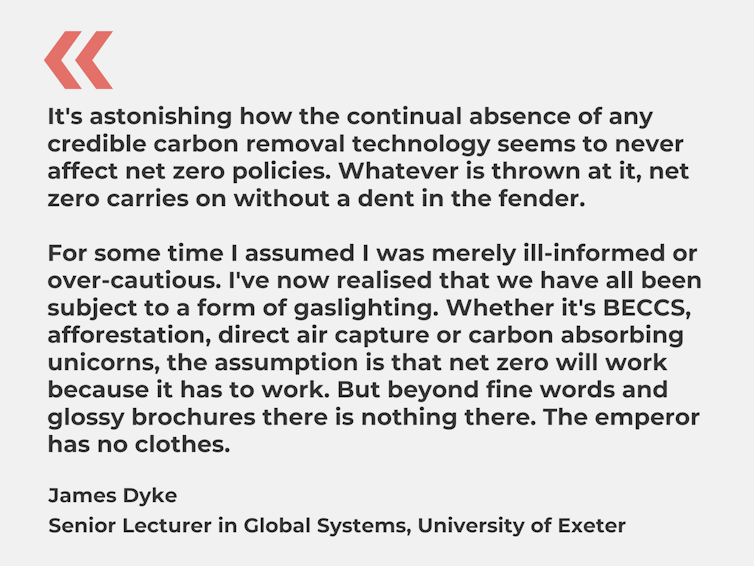
Alas, BECCS, just like all the previous solutions, was too good to be true.
Across the scenarios produced by the Intergovernmental Panel on Climate Change (IPCC) with a 66% or better chance of limiting temperature increase to 1.5°C, BECCS would need to remove 12 billion tonnes of carbon dioxide each year. BECCS at this scale would require massive planting schemes for trees and bioenergy crops.
The Earth certainly needs more trees. Humanity has cut down some three trillion since we first started farming some 13,000 years ago. But rather than allow ecosystems to recover from human impacts and forests to regrow, BECCS generally refers to dedicated industrial-scale plantations regularly harvested for bioenergy rather than carbon stored away in forest trunks, roots and soils.
Currently, the two most efficient biofuels are sugarcane for bioethanol and palm oil for biodiesel – both grown in the tropics. Endless rows of such fast growing monoculture trees or other bioenergy crops harvested at frequent intervals devastate biodiversity.
It has been estimated that BECCS would demand between 0.4 and 1.2 billion hectares of land. That’s 25% to 80% of all the land currently under cultivation. How will that be achieved at the same time as feeding 8-10 billion people around the middle of the century or without destroying native vegetation and biodiversity?
Growing billions of trees would consume vast amounts of water – in some places where people are already thirsty. Increasing forest cover in higher latitudes can have an overall warming effect because replacing grassland or fields with forests means the land surface becomes darker. This darker land absorbs more energy from the Sun and so temperatures rise. Focusing on developing vast plantations in poorer tropical nations comes with real risks of people being driven off their lands.
And it is often forgotten that trees and the land in general already soak up and store away vast amounts of carbon through what is called the natural terrestrial carbon sink. Interfering with it could both disrupt the sink and lead to double accounting.
As these impacts are becoming better understood, the sense of optimism around BECCS has diminished.
Pipe dreams
Given the dawning realisation of how difficult Paris would be in the light of ever rising emissions and limited potential of BECCS, a new buzzword emerged in policy circles: the “overshoot scenario”. Temperatures would be allowed to go beyond 1.5°C in the near term, but then be brought down with a range of carbon dioxide removal by the end of the century. This means that net zero actually means carbon negative. Within a few decades, we will need to transform our civilisation from one that currently pumps out 40 billion tons of carbon dioxide into the atmosphere each year, to one that produces a net removal of tens of billions.
Mass tree planting, for bioenergy or as an attempt at offsetting, had been the latest attempt to stall cuts in fossil fuel use. But the ever-increasing need for carbon removal was calling for more. This is why the idea of direct air capture, now being touted by some as the most promising technology out there, has taken hold. It is generally more benign to ecosystems because it requires significantly less land to operate than BECCS, including the land needed to power them using wind or solar panels.
Unfortunately, it is widely believed that direct air capture, because of its exorbitant costs and energy demand, if it ever becomes feasible to be deployed at scale, will not be able to compete with BECCS with its voracious appetite for prime agricultural land.
It should now be getting clear where the journey is heading. As the mirage of each magical technical solution disappears, another equally unworkable alternative pops up to take its place. The next is already on the horizon – and it’s even more ghastly. Once we realise net zero will not happen in time or even at all, geoengineering – the deliberate and large scale intervention in the Earth’s climate system – will probably be invoked as the solution to limit temperature increases.
One of the most researched geoengineering ideas is solar radiation management – the injection of millions of tons of sulphuric acid into the stratosphere that will reflect some of the Sun’s energy away from the Earth. It is a wild idea, but some academics and politicians are deadly serious, despite significant risks. The US National Academies of Sciences, for example, has recommended allocating up to US$200 million over the next five years to explore how geoengineering could be deployed and regulated. Funding and research in this area is sure to significantly increase.
Difficult truths
In principle there is nothing wrong or dangerous about carbon dioxide removal proposals. In fact developing ways of reducing concentrations of carbon dioxide can feel tremendously exciting. You are using science and engineering to save humanity from disaster. What you are doing is important. There is also the realisation that carbon removal will be needed to mop up some of the emissions from sectors such as aviation and cement production. So there will be some small role for a number of different carbon dioxide removal approaches.
The problems come when it is assumed that these can be deployed at vast scale. This effectively serves as a blank cheque for the continued burning of fossil fuels and the acceleration of habitat destruction.
Carbon reduction technologies and geoengineering should be seen as a sort of ejector seat that could propel humanity away from rapid and catastrophic environmental change. Just like an ejector seat in a jet aircraft, it should only be used as the very last resort. However, policymakers and businesses appear to be entirely serious about deploying highly speculative technologies as a way to land our civilisation at a sustainable destination. In fact, these are no more than fairy tales.
‘There is no Planet B’: children in Birmingham, UK, protest against the climate crisis. Callum Shaw/Unsplash, FAL
The only way to keep humanity safe is the immediate and sustained radical cuts to greenhouse gas emissions in a socially just way.
Academics typically see themselves as servants to society. Indeed, many are employed as civil servants. Those working at the climate science and policy interface desperately wrestle with an increasingly difficult problem. Similarly, those that champion net zero as a way of breaking through barriers holding back effective action on the climate also work with the very best of intentions.
The tragedy is that their collective efforts were never able to mount an effective challenge to a climate policy process that would only allow a narrow range of scenarios to be explored.
Most academics feel distinctly uncomfortable stepping over the invisible line that separates their day job from wider social and political concerns. There are genuine fears that being seen as advocates for or against particular issues could threaten their perceived independence. Scientists are one of the most trusted professions. Trust is very hard to build and easy to destroy.
But there is another invisible line, the one that separates maintaining academic integrity and self-censorship. As scientists, we are taught to be sceptical, to subject hypotheses to rigorous tests and interrogation. But when it comes to perhaps the greatest challenge humanity faces, we often show a dangerous lack of critical analysis.
In private, scientists express significant scepticism about the Paris Agreement, BECCS, offsetting, geoengineering and net zero. Apart from some notable exceptions, in public we quietly go about our work, apply for funding, publish papers and teach. The path to disastrous climate change is paved with feasibility studies and impact assessments.
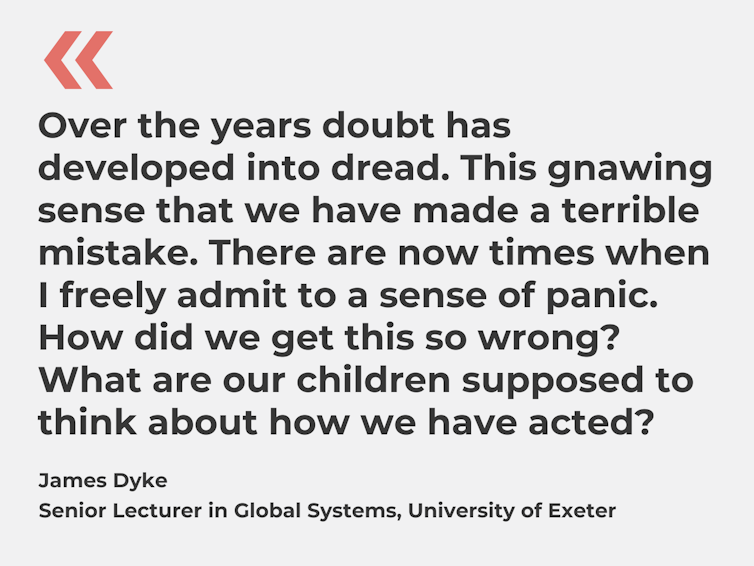
Rather than acknowledge the seriousness of our situation, we instead continue to participate in the fantasy of net zero. What will we do when reality bites? What will we say to our friends and loved ones about our failure to speak out now?
The time has come to voice our fears and be honest with wider society. Current net zero policies will not keep warming to within 1.5°C because they were never intended to. They were and still are driven by a need to protect business as usual, not the climate. If we want to keep people safe then large and sustained cuts to carbon emissions need to happen now. That is the very simple acid test that must be applied to all climate policies. The time for wishful thinking is over.
To hear about new Insights articles, join the hundreds of thousands of people who value The Conversation’s evidence-based news. Subscribe to our newsletter.