Trump’s NOAA Will Stop Tracking Costliest Climate Disasters

Spread the love

Original article by Julia Conley republished from Common Dreams under Creative Commons (CC BY-NC-ND 3.0). 

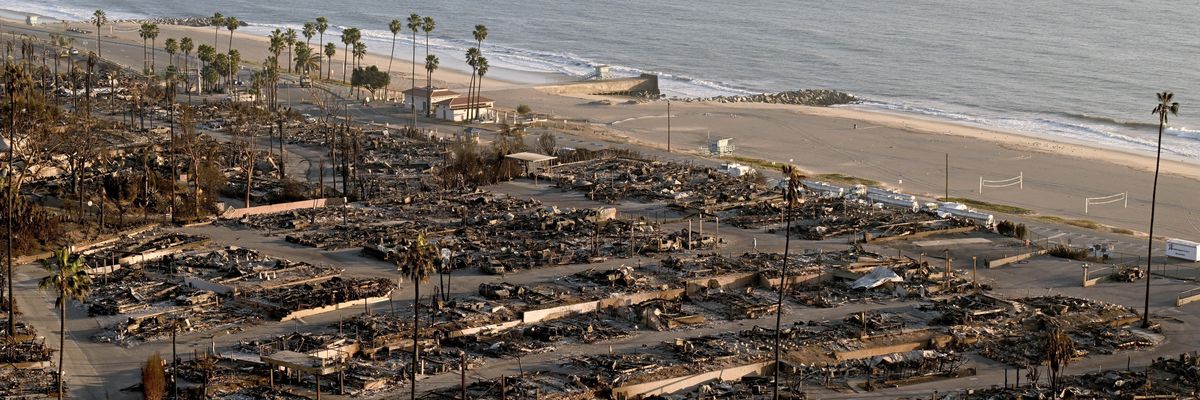
Damaged structures and homes are seen after the Palisades fire in the Pacific Palisades neighborhood of Los Angeles on January 11, 2025.
 (Photo: Axelle/Bauer-Griffin/GC Images)

“Their philosophy is, if we ignore it, it’s not a problem,” said one meteorologist.

On the heels of the news that higher-than-average temperatures continued globally in April, one of the United States’ top science agencies announced Thursday that it will no longer update a database that tracks climate disasters that cause billions of dollars in damage.

As of Thursday, the Billion Dollar Weather and Climate Disasters database on the National Oceanic and Atmospheric Administration’s (NOAA) website was replaced with a message saying there have been no such events in 2025 through April 8.

That flies in the face of an analysis by the National Centers for Environmental Information, which has maintained the database and said before it was taken down that six to eight billion-dollar climate disasters have happened so far this year, including the wildfires that devastated parts of Los Angeles in January and caused an estimated $150 billion in damage.

The World Weather Attribution said in late January that planetary heating, fueled by greenhouse gas emissions, caused weather conditions in Southern California that made the fires 35% more likely.

Hundreds of people have been laid off from NOAA in recent weeks as the so-called Department of Government Efficiency, led by billionaire tech CEO Elon Musk, has pushed to slash government spending, and those who have lost their jobs include scientists who helped maintain the database.

NOAA spokesperson Kim Doster told The Washington Post that in addition to staff changes, “evolving priorities” were also partially behind the retiring of the database, which will now show disasters that occurred only between 1980-2024.

Between 2020-24, the number of billion-dollar disasters averaged 23 per year, compared to just a few per year in the 1980s.

“This Trump administration move is the dumbest magic trick possible: covering their eyes and pretending the problem will go away if they just stop counting the costs. Households across the country already have to count these costs at their kitchen table as they budget for higher insurance costs and home repairs. Families and retirees dipping into their savings or going bankrupt to recover from wildfires and hurricanes know what disasters cost,” said Carly Fabian, senior insurance policy advocate with Public Citizen’s Climate Program. “Hiding the national tallies will only undermine our ability to prepare and respond to the climate crisis. Deleting the data will exacerbate the devastating delays in acting to slow climate change, and the impacts it is having on property insurance and housing costs.”

NOAA’s “evolving priorities” have also included decommissioning other datasets, including one tracking marine environments and one tracking ocean currents.

Without NOAA’s Billion Dollar Weather and Climate Disasters database, Jeremy Porter, co-founder of the climate risk financial modeling firm First Street, told CNN that “replicating or extending damage trend analyses, especially at regional scales or across hazard types, is nearly impossible without significant funding or institutional access to commercial catastrophe models.”

“What makes this resource uniquely valuable is not just its standardized methodology across decades, but the fact that it draws from proprietary and nonpublic data sources (such as reinsurance loss estimates, localized government reports, and private claims databases) that are otherwise inaccessible to most researchers,” he said.

Chris Gloninger, a meteorologist who resigned from an Iowa news station after receiving threats for his frank, science-based coverage of climate disasters, said the retiring of the database suggests the Trump administration is “okay with spending billions of dollars on disasters.”

“Every dollar that we spend on mitigation or adaptation saves $13 in recovery costs,” said Gloninger. “But their philosophy is, if we ignore it, it’s not a problem.”

Original article by Julia Conley republished from Common Dreams under Creative Commons (CC BY-NC-ND 3.0). 

Elon Musk urges you to be a Fascist like him, says that you can ignore facts and reality then.
Neo-Fascist Climate Science Denier Donald Trump says Burn, Baby, Burn.
Orcas discuss how Trump was re-elected and him being an insane, xenophobic Fascist.

Continue ReadingTrump’s NOAA Will Stop Tracking Costliest Climate Disasters

Critics Warn Trump ‘Flatly Illegal’ Firings at NOAA Will ‘Cost Lives’

Spread the love

Original article by Brett Wilkins republished from Common Dreams under Creative Commons (CC BY-NC-ND 3.0). 

U.S. Sen. Chris Van Hollen (D-Md.) speaks at Ritchie Coliseum on the campus of the University of Maryland on June 24, 2024 in College Park, Maryland. (Photo: Kevin Dietsch/Getty Images)

“Today’s mass layoffs of NOAA staff signals a grim new reality: one where career federal scientists will be recklessly discarded,” said one campaigner.

Critics on Thursday decried the Trump administration’s firing of National Oceanic and Atmospheric Administration staffers, part of Elon Musk’s Department of Government Efficiency’s plan to eviscerate the federal government.

Following the playbook of Project 2025, a blueprint for gutting the federal government, the Commerce Department this week fired hundreds of NOAA staffers, many of them specialized climate scientists and weather forecasters.

In addition to issuing weather watches and warnings, NOAA monitors and studies the planet’s climate.

We’re mobilizing scientists to protect NOAA and we need you too. Get involved:

Union of Concerned Scientists (@ucsusa.bsky.social) 2025-02-26T21:02:13.322Z

U.S. Sen. Chris Van Hollen’s (D-Md.) office said in a statement that the senator stressed that the firings “would be plainly unlawful and pointed to the Merit Service Protection Board’s decision yesterday that stayed the terminations of multiple federal employees on probationary status.”

“I take this opportunity to remind the department of its legal obligation to notify the Senate and House Committees on Appropriations regarding the large-scale termination of employees,” the senator added. Specifically, Section 505 of Title V, Division C of Public Law 118–42—a provision of the American Relief Act, 2025 (Public Law 118–158)—states, in part:

None of the funds provided under this act, or provided under previous appropriations acts to the agencies funded by this act that remain available for obligation or expenditure in fiscal year 2024… shall be available for obligation or expenditure through a reprogramming of funds that… reduces by 10% funding for any program, project, or activity, or numbers of personnel by 10%; or…results from any general savings, including savings from a reduction in personnel, which would result in a change in existing programs, projects, or activities as approved by Congress; unless the House and Senate Committees on Appropriations are notified 15 days in advance of such reprogramming of funds.

“Other agencies in my subcommittee’s jurisdiction have cited ‘ poor performance‘ to move forward with drastic layoffs,” Van Hollen added. “This has been exposed as a lie. Many terminated probationary employees have already come forward with evidence of recent glowing performance reviews, laying bare the flimsy pretext of these firings as gross misrepresentations of fact. The department must not become a purveyor of such lies and must comply with its legal obligations.”

Juan Declet-Barreto, senior social scientist for climate vulnerability in the Climate and Energy Program at Union of Concerned Scientists, said in a statement that “today’s mass layoffs of NOAA staff signals a grim new reality: one where career federal scientists will be recklessly discarded, and the lifesaving science they do will be significantly undermined.”

“When testifying under oath, Howard Lutnick assured congressional members that if confirmed as commerce secretary, NOAA wouldn’t be dismantled under his watch—a promise that was broken today,” Declet-Barreto added. “It seems either Lutnick willingly lied to Congress and the American people or that he has caved in record-breaking time to the destructive agenda of the Trump-Musk regime.”

Oceana U.S. vice president Beth Lowell said that “our oceans have become political carnage, but the real victims are hardworking Americans—the people you care about—and our future generations.”

“These are American jobs that warn us about severe weather, protect our most vulnerable marine life like whales and turtles, ensure abundant fisheries, and maintain a healthy ocean for those whose livelihoods depend on it,” Lowell added. “We’re calling on Congress to save NOAA from these disastrous cuts, while also protecting American jobs, communities, and the oceans.”

More than 2,000 scientists have signed a letter to members of Congress and the Commerce Secretary urging protection of NOAA.

Original article by Brett Wilkins republished from Common Dreams under Creative Commons (CC BY-NC-ND 3.0). 

Neo-Fascist Climate Science Denier Donald Trump says Burn, Baby, Burn.
Elon Musk urges you to be a Fascist like him, says that you can ignore facts and reality then.

Continue ReadingCritics Warn Trump ‘Flatly Illegal’ Firings at NOAA Will ‘Cost Lives’

Arctic Tundra Has Turned From ‘Carbon Sink to Carbon Source’ in Dangerous Flip: NOAA

Spread the love

Original article by Julia Conley republished from Common Dreams under Creative Commons (CC BY-NC-ND 3.0).
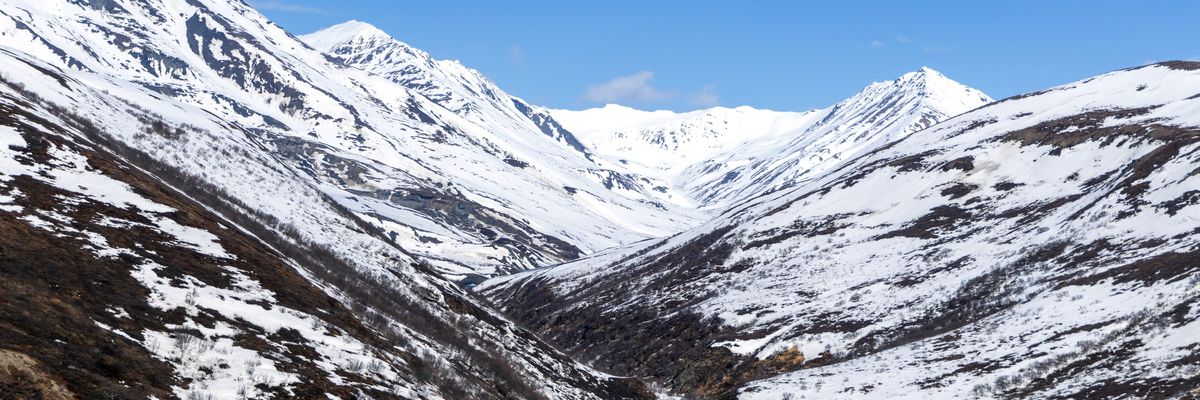
A view of Brooks Range as seen from the Dalton Highway on May 10, 2024 in North Slope Borough, Alaska. (Photo: Lance King/Getty Images)

“This is yet one more sign, predicted by scientists, of the consequences of inadequately reducing fossil fuel pollution,” said one scientist.

Permafrost in the Arctic has stored carbon dioxide for millennia, but the annual Arctic Report Card released by the National Oceanic and Atmospheric Administration reveals a concerning shift linked to planetary heating and a rising number of wildfires in the icy region: The tundra is now emitting more carbon than it is storing.

The report card revealed that over the last year, the tundra’s temperature rose to its second-highest level on record, causing the frozen soil to melt.

The melting of the permafrost activates microbes in the soil which decompose the trapped carbon, causing it to be released into the atmosphere as planet-heating carbon dioxide and methane.

The release of fossil fuels from the permafrost is also being caused by increased Arctic wildfires, which have emitted an average of 207 million tons of carbon per year since 2003.

“Our observations now show that the Arctic tundra, which is experiencing warming and increased wildfire, is now emitting more carbon than it stores, which will worsen climate change impacts,” said Rick Spinrad, administrator of NOAA. “This is yet one more sign, predicted by scientists, of the consequences of inadequately reducing fossil fuel pollution.”

Sue Natali, a scientist at the Woodwell Climate Research Center in Massachusetts and one of 97 international scientists who contributed to the Arctic Report Card, told NPR that 1.5 trillion tons of carbon are still being stored in the tundra—suggesting that the continued warming of the permafrost could make it a huge source of planet-heating greenhouse gas emissions.

Along with the “Arctic tundra transformation from carbon sink to carbon source,” NOAA reported declines in caribou herds and increasing winter precipitation.

The report card showed that the autumn of 2023 and summer of 2024 saw the second- and third-warmest temperatures on record across the Arctic, and a heatwave in August 2024 set an all-time record for daily temperatures in several communities in northern Alaska and Canada.

The last nine years have been the nine warmest on record in the Arctic region.

“Many of the Arctic’s vital signs that we track are either setting or flirting with record-high or record-low values nearly every year,” said Gerald (J.J.) Frost, a senior scientist with Alaska Biological Research, Inc. and a veteran Arctic Report Card author. “This is an indication that recent extreme years are the result of long-term, persistent changes, and not the result of variability in the climate system.”

Brenda Ekwurzel, a climate scientist at the Union of Concerned Scientists, emphasized that the continuous release of fossil fuel emissions from oil and gas extraction and other pollution has caused the Arctic to warm at a faster rate than the Earth as a whole over the past 11 years.

“These combined changes are contributing to worsening wildfires and thawing permafrost to an extent so historic that it caused the Arctic to be a net carbon source after millennia serving as a net carbon storage region,” said Ekwurzel. “If this becomes a consistent trend, it will further increase climate change globally.”

The Arctic Report Card was released weeks before President-elect Donald Trump is set to take office. Trump has pledged to slash climate regulations introduced by the Biden administration and to increase oil and gas production. He has mused that sea-level rise will create “more oceanfront property” and has called the climate crisis a “hoax,” while his nominee for energy secretary, Chris Wright, the CEO of the fracking company Liberty Energy, has claimed that climate warming is good for the planet.

“These sobering impacts in the Arctic are one more manifestation of how policymakers in the United States and around the world are continuing to prioritize the profits of fossil fuel polluters over the well-being of people and the planet and putting the goals of the Paris climate agreement in peril,” said Ekwurzel. “All countries, but especially wealthy, high-emitting nations, need to drastically reduce heat-trapping emissions at a rapid pace in accord with the latest science and aid in efforts of climate-vulnerable communities to prepare for what’s to come and help lower-resourced countries working to decrease emissions too.”

Original article by Julia Conley republished from Common Dreams under Creative Commons (CC BY-NC-ND 3.0).

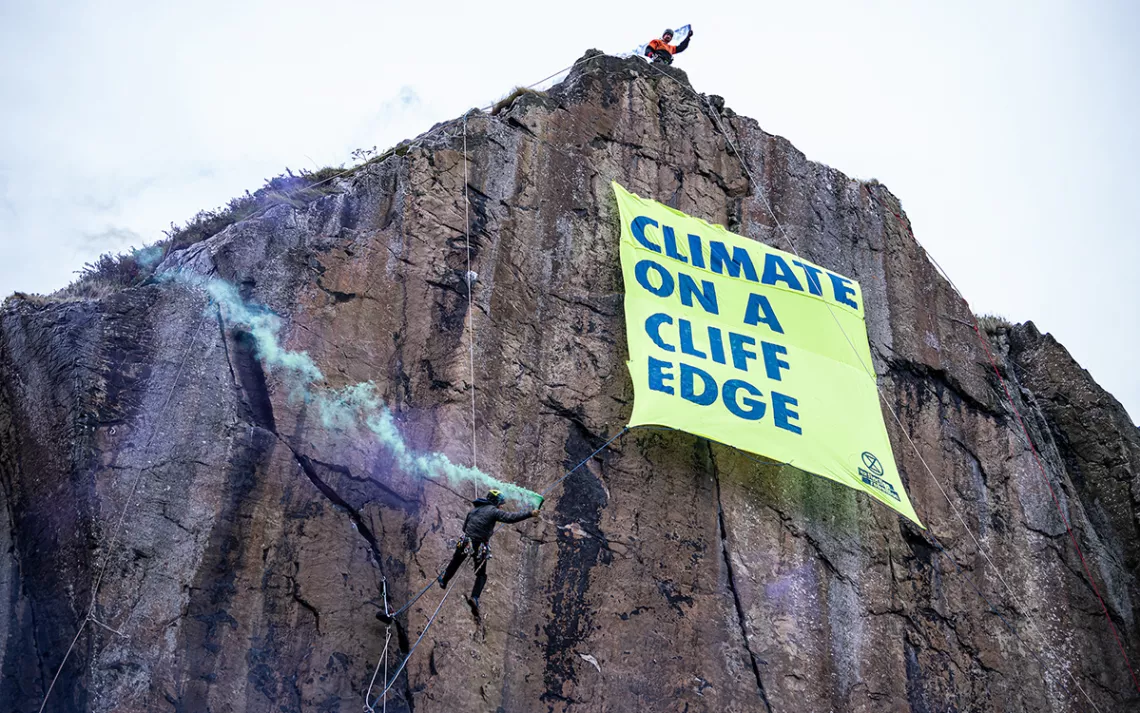
Experienced climbers scale a rock face near the historic Dumbarton castle in Glasgow, releasing a banner that reads “Climate on a Cliff Edge.” One activist, dressed as a globe, symbolically looms near the edge, while another plays the bagpipes on the shores below. | Photo courtesy of Extinction Rebellion and Mark Richards
Continue ReadingArctic Tundra Has Turned From ‘Carbon Sink to Carbon Source’ in Dangerous Flip: NOAA

Fossil Fuel Industry Propaganda Blamed as Record Heat Scorches Planet

Spread the love

Original article by JESSICA CORBETT republished from Common Dreams under Creative Commons (CC BY-NC-ND 3.0). 

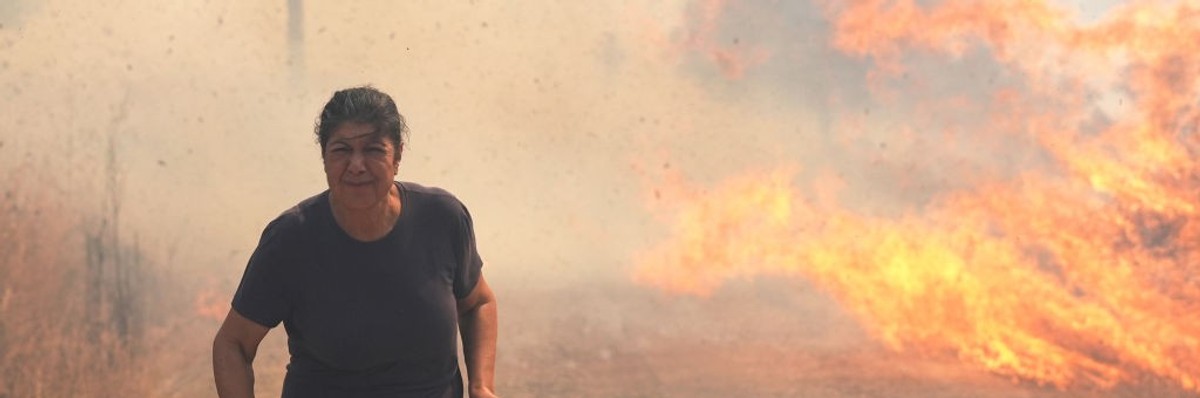
Civilians flee a forest fire that broke out close to residential areas at Cesmealti in Urla district of Izmir, Turkey on July 31, 2024. (Photo: Mahmut Serdar Alakus/Anadolu via Getty Images)

“We need to tackle the root cause and get serious about reducing record levels of greenhouse gas emissions,” said the head of the World Meteorological Organization.

As scientists around the world on Thursday released new data about recent record-smashing heat, one United Nations adviser placed blame for the lack of ambitious climate action on the fossil fuel industry’s decadeslong disinformation efforts.

“There is this prevailing narrative—and a lot of it is being pushed by the fossil fuel industry and their enablers—that climate action is too difficult, it’s too expensive,” Selwin Hart, a special adviser to the U.N. Secretary-General António Guterres and assistant secretary-general of the Climate Action Team, told The Guardian‘s Fiona Harvey.

“It is absolutely critical that leaders, and all of us, push back and explain to people the value of climate action, but also the consequences of climate inaction,” said Hart, former executive director of the Caribbean at the Inter-American Development Bank and Barbados’ ambassador to the United States and the Organization of American States.

Investigations by academicsjournalists, and lawmakers as well as ongoing legal battles have exposed how Big Oil not only has heated and polluted the planet but also knew about the devastating impacts of fossil fuels decades ago and opted to spread lies so shareholders could make massive profits—which they continue to rake in today.

“Climate appears to be dropping down the list of priorities of leaders,” Hart said, pointing to polling that shows people around the world want a rapid transition to clean energy. “But we really need leaders now to deliver maximum ambition. And we need maximum cooperation. Unfortunately, we are not seeing that at the moment.”

According to The Guardian:

[Hart] warned that the consequences of inaction were being felt in rich countries as well as poor. In the U.S., many thousands of people are finding it increasingly impossible to insure their homes, as extreme weather worsens. “This is directly due to the climate crisis, and directly due to the use of fossil fuels,” he said. “Ordinary people are having to pay the price of a climate crisis while the fossil fuel industry continues to reap excess profits and still receives massive government subsidies.”

Yet the world has never been better equipped to tackle climate breakdown, Hart added. “Renewables are the cheapest they’ve ever been, the pace of the energy transition is accelerating,” he said.

Hart’s comments came as the European Union’s Copernicus Climate Change Service (C3S) announced that last month “was the second-warmest July globally in our data record, with an average ERA5 surface air temperature of 16.91ºC,” or 62.44ºF.

From June 2023 to June 2024, each month was the hottest on record, according to C3S. Samantha Burgess, the agency’s deputy director, noted that now, “the streak of record-breaking months has come to an end, but only by a whisker.”

“Globally, July 2024 was almost as warm as July 2023, the hottest month on record,” Burgess stressed. “July 2024 saw the two hottest days on record. The overall context hasn’t changed, our climate continues to warm. The devastating effects of climate change started well before 2023 and will continue until global greenhouse gas emissions reach net-zero.”

The U.N.’s World Meteorological Organization (WMO) said Thursday that the new C3S data “underlines the urgency of the Call to Action on Extreme Heat” issued by Guterres last month, shortly after July 22 became the hottest day ever recorded.

“Widespread, intense, and extended heatwaves have hit every continent in the past year,” said WMO Secretary-General Celeste Saulo in a statement. “At least 10 countries have recorded daily temperatures of more than 50ºC in more than one location. This is becoming too hot to handle.”

Saulo highlighted that “Death Valley in California registered a record average monthly temperature of 42.5ºC (108.5ºF)—possibly a new record observed for anywhere in the world. Even the remote frozen ice sheets of Antarctica have been feeling the heat.”

“The WMO community is committed to responding to the U.N. secretary-general’s Call to Action with better heat-health early warnings and action plans,” she pledged. “Recent estimates produced by WMO and the World Health Organization indicate that the global scale-up of heat-health warning systems for 57 countries alone has the potential to save an estimated 98,000 lives per year. This is one of the priorities of the Early Warnings for All initiative.”

“Climate adaptation alone is not enough,” she added. “We need to tackle the root cause and get serious about reducing record levels of greenhouse gas emissions.”

C3S wasn’t alone in releasing new data on Thursday; the U.S. National Oceanic and Atmospheric Administration (NOAA) also shared some key points for the country’s climate in July, with the full report set to be released on Tuesday.

NOAA’s top takeaways were:

  • The average temperature of the contiguous U.S. in July was 75.7ºF, 2.1ºF above average, ranking 11th warmest in the 130-year record.
  • The Park Fire is the fourth-largest wildfire in California history as of August 6; beginning on July 24, it burned approximately 401,000 acres and destroyed over 560 structures.
  • On July 15, a derecho that spawned 32 tornadoes broke the Chicago-area record for most tornadoes in a day.
  • On July 1, Beryl became the earliest Category 5 hurricane and the second Category 5 on record during the month of July in the Atlantic Ocean.
  • Alaska had its wettest July on record.
  • Four new billion-dollar weather and climate disasters were confirmed in July. The year-to-date total currently stands at 19 disasters.

Other major events in July included California’s Thompson Fire, which forced over 13,000 people to evacuate, and Washington, D.C. enduring 101ºF on July 17, tying a record for the longest streak of temperatures above 100ºF. NOAA also found that “for the January-July period, the average contiguous U.S. temperature was 54.5ºF, 3.2ºF above average, ranking second-warmest on record.”

Original article by JESSICA CORBETT republished from Common Dreams under Creative Commons (CC BY-NC-ND 3.0). 

Continue ReadingFossil Fuel Industry Propaganda Blamed as Record Heat Scorches Planet

Extreme Heat Expected to Impact Millions of Americans Again This Summer

Spread the love

Original article by JULIA CONLEY republished from Common Dreams under Creative Commons (CC BY-NC-ND 3.0). 
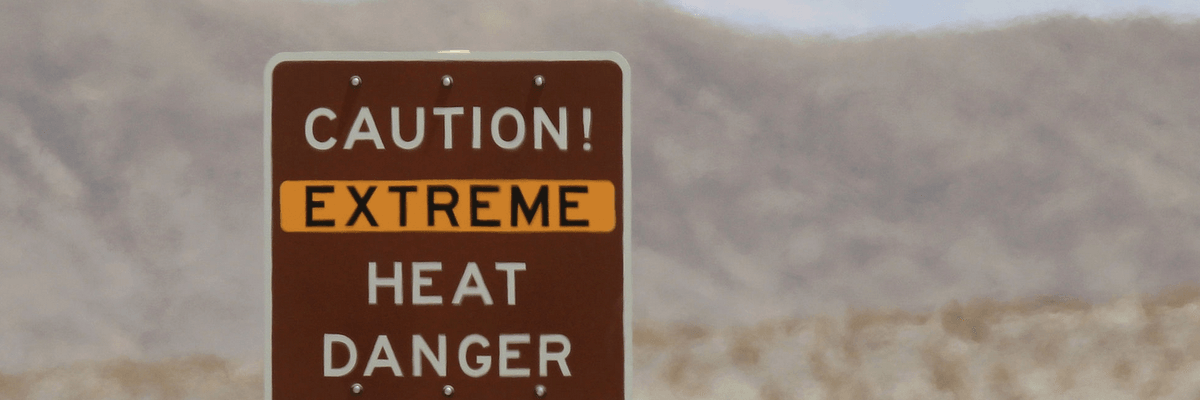
Heat waves rise near a heat danger warning sign in Death Valley National Park, California.
 (Photo: David McNew/Getty Images)

“These are not your grandparents’ heatwaves,” said one meteorologist.

Millions of people in the United States are facing the high likelihood of extreme heat in the coming weeks, with northern states that frequently have relatively temperate summers among those where higher-than-average temperatures are expected this summer, according to federal data.

As The Guardian reported Monday, the National Oceanic and Atmospheric Administration’s (NOAA) new predictions for the summer months state that most of New Mexico and Utah have a 60%-70% chance of hotter-than-normal weather, along with parts of Arizona, Texas, and Colorado.

Houston and the surrounding area has already experienced spiking temperatures that were tied to a heat dome that was positioned over Mexico for several weeks. The high atmospheric pressure drove record-breaking heat across Mexico and in Texas, as well as a powerful storm earlier this month that killed at least seven people and left hundreds of thousands of people in the Houston area without power.

NOAA’s Heat Risk tool showed that on Monday, a significant stretch of southern Texas was experiencing an “extreme” level of heat, defined as including “little to no overnight relief” and affecting the health and safety of “anyone without effective cooling and/or adequate hydration.”

The new tool takes into consideration whether the heat is unusual for the time of the year, whether residents get relief with cooler temperatures in the evenings, and whether temperatures pose an elevated risk of health impacts like heat stroke or heat exhaustion.

NOAA found that the entire Northeast, from Maine to New Jersey and Pennsylvania, has a 40%-50% chance of having above-average temperatures from June through August.

“We can expect another dangerous hot summer season, with daily records already being broken in parts of Texas and Florida,” Kristy Dahl, climate scientist for the Climate and Energy program at the Union of Concerned Scientists, told The Guardian. “As we warm the planet, we are going to see climate disasters pile up and compound against each other because of the lack of resilience in our infrastructure and government systems.”

The predictions come days after the consumer advocacy group Public Citizen released a reportScorched States, about state laws that protect outdoor workers from extreme heat—and those that don’t.

As many as 2,000 U.S. workers die every year from laboring in extreme heat, said Public Citizen, even though “every workplace illness, injury, and fatality caused by heat stress is avoidable, and relatively simple preventative measures—water, shade, and breaks—have proven extremely effective at protecting workers.”

The Occupational Safety and Health Administration’s forthcoming heat standard rules are not expected to be finalized until at least 2026, but states including Washington, Colorado, and Minnesota have issued their own labor laws to protect workers from heat-related injuries.

The Guardian pointed out that the extreme heat expected this summer will likely take hold as the Earth transitions away from El Niño—the natural phenomenon that causes ocean temperatures to rise—and toward La Niña.

“As we transition to La Niña, it still looks to be a potentially record-breaking year. That clearly suggests to me that the anthropogenic signal is there,” James Marshall Shepherd, director of the University of Georgia’s atmospheric sciences program, told The Guardian. “I am also worried about the ocean temperatures, which are very warm, particularly as we approach the Atlantic hurricane season.”

“Attribution studies are pretty decisive that heatwaves will continue to be more intense and frequent” as the planet warms, Shepherd said. “These are not your grandparents’ heatwaves.”

Last year, scientists found that neither the hot and dry conditions that led to destructive wildfires in Canada, nor extreme heatwaves that took hold in Europe and North America, would have been as likely to occur without the planetary heating that’s been linked to continued fossil fuel extraction.

Original article by JULIA CONLEY republished from Common Dreams under Creative Commons (CC BY-NC-ND 3.0). 
Continue ReadingExtreme Heat Expected to Impact Millions of Americans Again This Summer