Children prosecuted as adult ‘smugglers’ in UK, Italy, Greece

Spread the love

Original article by Frey Lindsay republished from Open Democracy under a Creative Commons Attribution-NonCommercial 4.0 International licence

Protestors hold a banner outside Canterbury Crown Court to demonstrate against the conviction and sentencing of teenager Ibrahim Bah in February 2024
 | Andrew Aitchison/In pictures/Getty Images. All rights reserved

Governments are locking teenagers up in a bid to catch smugglers – and failing vulnerable kids in the process

In December 2022, an inflatable dingy carrying dozens of people across the English Channel capsized. At least four people died. Ibrahima Bah, a teenager from Senegal, was identified by authorities as steering the dinghy and was arrested.

One of the people who died was Ibrahima’s friend. Neither of the friends had money, so Ibrahima initially agreed to steer the boat in exchange for their passage. He tried to back out when he saw the condition of the boat, but the adults organising the passage forced him to continue.

In February 2024, Bah was sentenced to almost ten years in prison for manslaughter by four counts of gross negligence, and for violating immigration rules. Despite Bah saving other passengers’ lives on the journey, mainstream headlines slammed him as a guilty ‘boat pilot’ and described him, wrongly, as an adult man.

Bah is one of dozens of children who have been charged for immigration offences across the UK and Europe. Most of those children are Black teenage boys travelling alone. Most of them were seeking safety and protection.

Accused children and their lawyers have spoken to openDemocracy from Greece, Italy and the UK about these huge miscarriages of justice.

They tell a story of racist and outdated age assessments, a lack of access to legal support and translators, bureaucratic mistakes, biased prosecutors and a fundamental lack of support.

“A dark place”

When he arrived in the UK, Bah didn’t know exactly how old he was. He was given an age assessment and declared to be over 18. Only later did a birth certificate emerge, showing that he was a minor. The courts rejected it and relied on the age assessment instead.

“I think Ibrahima struggles to understand, as do we, how he can possibly be held accountable for those people’s deaths,” says Maddie Harris of Humans for Rights Network, an organisation supporting people subjected to hostile border regimes.

Since June 2022, Humans for Rights Network has identified at least 23 minors prosecuted as adults for immigration offences. All of them are Black Africans, the majority Sudanese or South Sudanese.

“The reality of the child’s experience versus what they are accused of – they’re just not the same thing at all,” said Harris.

Most if not all children travelling irregularly go through a lot on their way to the UK. For more and more children, part of their transit now also includes getting coerced into steering the boats by those arranging the passage, often through violence, threats, or because they cannot afford the fare. Once they’re in the UK, they struggle to understand how the legal system can then paint them as criminals.

“They told me, ‘you are under arrest because you arrived in the UK without a visa,’” said Ameen (a pseudonym), one of those prosecuted children. “A couple of minutes later, they said, ‘you have to go to prison for a couple of days, and then you will go to court.’”

The next three days in the police station were the “darkest days” of his life, Ameen said. “One room, with nothing. A dark place. Nobody talks to you, nobody answers you. Stress. Words are not enough to explain those days. They were bad days, the worst that I have ever had in my life.”

Ameen went on to spend six months in an adult prison.

UK age assessments are “highly subjective”

Child asylum seekers get caught up in this system because of the way authorities determine their ages.

“When people arrive, they have the opportunity to state their age, usually by putting their finger on a number on a piece of paper,” said Vicky Taylor, a researcher at Oxford University and lead author of the 2024 report No Such Thing as Justice Here.

If a child is recognised as under 18, they are put in the care of the local authority. If they say they are a minor but are suspected of being older, they are subjected to further assessment.

“These initial inquiries have been shown to be unreliable,” said Taylor. “People are often in a confused state, having just landed in the UK after a long, dangerous and traumatic journey. They are not offered legal advice, interpreting or support.”

Age assessments tend to have three stages, according to Taylor. First, the young person is asked to recount their own personal timeline – when they left their home country, for instance, or the last birthday they can remember.

“Obviously it can be difficult [to assess] when people are from cultures in which birthdays are not celebrated or marked in the same way,” said Taylor. “Trauma also greatly affects young people’s ability to tell their story in a way that is legible to authorities.”

The second check is physical appearance. Assessors look at the potential child to see if they have beard lines, or to check how hairy their hands are, or how far back their hair line is. These are racialised markers, said Taylor.

Third, a person’s demeanour is assessed – how they engage with officials, react to questioning, and how they carry themselves.

All these checks “are highly subjective,” said Taylor, “and very difficult to ascertain within a ten-to-40-minute assessment.” Children travelling alone, as well as those who have been through difficult and traumatic experiences, are also less likely to present in ways that are obviously child-like.

It’s estimated that over 1,300 children were wrongly assessed as adults by the Home Office from January 2022 to June 2023

Many children who went through this process say they did not understand what they were asked. And for those who came away with a new age assigned to them, the number was often arbitrary.

Age assessments have been widely criticised by rights groups and researchers. An inquiry by the Independent Chief Inspector of Borders and Immigration between 2021 and 2022 described age assessments as “perfunctory” and noted that concerns had been raised at various times about the process.

“[Children’s] experiences include not being provided with the correct interpreter, being called liars and facing inappropriate comments about their physical appearance,” said Labour MP Andrew Western in the House of Commons. “This is unacceptable, and the reason it is so worrying is that the stakes are so high.”

Earlier this year, Refugee Council, Humans for Rights Network and the Helen Bamber Foundation reported that over 1,300 children had been wrongly assessed as adults by the Home Office from January 2022 to June 2023. The charities reported that children as young as 14 were forced to share rooms with unrelated adults, with no safeguards in place, and that children felt “unsafe, scared, and traumatised” by their experiences.

According to Harris, these figures are likely to be an undercount, since not all local authorities responded to requests for information, and some children continue to be prosecuted as adults.

“It’s a sort of conveyor belt,” said Harris. “They continue to prosecute children without adequately resolving their ages.”

Children branded as ‘traffickers’ in Italy

This is not just a problem in the UK. Italy is also taking child migrants to court, said Cinzia Pecoraro, a lawyer in Sicily. Similarly to Britain, outdated and racialised age markers are partly to blame.

Some of the methods Italian authorities use to measure people’s ages date back to the 1950s. One method uses X-rays to examine bone structure, based on samples of an Anglo-Saxon population. Its margin of error is between six months and two years, according to Pecoraro.

The moment I was arrested as a trafficker I was worried, because they accused me of something I didn’t do

Pecoraro represented one child from West Africa who was identified as steering the dinghy he arrived in.

“The moment I was arrested as a trafficker I was worried, because they accused me of something I didn’t do,” said Ola (a pseudonym) over text message.

Ola was originally identified as underage, but the Italian authorities intervened and subjected him to a flawed age assessment. He was moved to adult prison as a result.

“I felt sick, because they gave me an age that is not my age,” Ola said. “I felt it was racism.”

Ola spent a year in adult prison until Pecoraro was assigned to his case. “I realised that this was a child,” she said. “It was obvious.” She eventually got hold of a birth certificate, and after multiple delays his case was sent back to a minors’ court.

Ola is an adult now and the case is still pending. Despite being tried as a minor, he still faces serious consequences for allegedly steering the dinghy. “It’s been nine years,” Ola said. “Let’s hope to finish it soon so I can feel calm, because every moment I think about it.”

Pecoraro is confident Ola will be acquitted, but said he is lucky she was assigned to his case. She has a lot of experience defending minors in his position. “You need a proper defence,” she said. “Without it, they get convicted.”

These convictions are not happening in a political vacuum. The government of Georgia Meloni – who rose to power on the back of anti-immigrant rhetoric – has aggressively sought to reduce numbers of people arriving in Italy.

More and more people have been criminalised for the crime of ‘facilitation’ across the EU, allowed under the soon-to-be-expanded Facilitation Directive. And in Italy, Pecoraro says prosecutors seemed determined to continue.

“It’s common knowledge these journeys do not have a formal crew or driver. They are only passengers, forced to steer the boat,” she said. “This is [well] known, but prosecutors don’t want to surrender.”

Kids caught up in Greece’s hostile system

Thousands of people are likewise in prison in Greece for the crime of ‘facilitation’, with at least one or two people arrested per dinghy arriving. As a result, racialised people serving time for ‘smuggling’ related offences comprise the second largest prison population in the whole of Greece.

Sometimes just being seen by authorities at the rear of a boat is enough for a person to be identified as ‘driving’. Kani (a pseudonym), a young person from an African country, was 19 when he arrived in Greece. He was arrested after being falsely identified for driving the dinghy.

M. E., now 16, is awaiting trial and faces a possible 4,670-year sentence for ‘smuggling’

“I didn’t touch the steering wheel, and I have no idea about driving or anything else,” wrote Kani in a text message. “They took me to prison after that. I had no idea why they took me in the first place. I didn’t even realise that the matter was this serious. I didn’t understand anything. I said to myself, ‘what is happening’? I was literally terrified.”

In 2023, H. E.*, an Egyptian fisherman, was sentenced to 280 years in prison for piloting a dinghy from Libya to Crete. Unable to pay for himself and his teenage son, he had agreed to steer. His son, M. E.*, now 16, is awaiting his own trial and faces a possible 4,670-year sentence for ‘smuggling’.

In reality, M. E. won’t serve a sentence of this length – even if he could live that long. Maria Flouraki, the teenager’s lawyer, said he’ll likely be released before a decade is up. While Greek courts regularly hand out decades or even centuries-long sentences for smuggling cases, sentences are generally capped at 20-25 years, with options for early release.

The crime of ‘facilitation’ – legalese for smuggling – comes from the 2002 EU Facilitation Directive, and is interpreted very widely by Greek authorities. In this case, the child providing his father support while he steered the boat – helping pass out food and water, for instance – was enough to make him legally complicit.

Flouraki said M. E. could not understand why he was accused of being a smuggler. “He was just a kid following his father. He had no other option.”

She is hopeful he will be acquitted once in front of a judge, as is generally the case for minors. Flouraki’s client is not being prosecuted as an adult, but children are sometimes identified and charged as adults.

Dimitris Choulis is a lawyer on the Greek island of Samos. Many of the minors he works with have spent months in adult prison before being released. “To be honest, it’s always been like this,” said Choulis.

One of Choulis’s clients is a child currently locked up in an adult prison. Choulis says he has the birth certificate, and hopes it will help him to get his client out of adult prison and into the minors’ system soon.

Choulis does not believe Greece is deliberately trying to criminalise children. Rather, he thinks that children are getting caught up in a system beset with structural failures. But, he said, such problems could be avoided if the system gave children more time and support.

“They don’t give them the opportunity, and these [children] don’t know what they have to say,” said Choulis. “They are [hearing] a strange language, in a strange country, and they’re in handcuffs. They don’t know what to say, and they haven’t seen a lawyer.”

Whether children are locked up because of embedded racism in age assessments, overzealous prosecutors or bureaucratic errors, the result is the same.

Children are paying the price because the UK and EU governments are more intent on securing their borders than safeguarding the rights of people seeking asylum, said Vicky Taylor. “States are willing to override their obligations to children because they’re preoccupied with the performance of security.”

*Full names have been withheld to protect their identities

Original article by Frey Lindsay republished from Open Democracy under a Creative Commons Attribution-NonCommercial 4.0 International licence

Continue ReadingChildren prosecuted as adult ‘smugglers’ in UK, Italy, Greece

Trump Spokesperson Affirms Day 1 Plans for Nation’s ‘Largest Mass Deportation Operation’

Spread the love

Original article by Olivia Rosane republished from Common Dreams under Creative Commons (CC BY-NC-ND 3.0). 

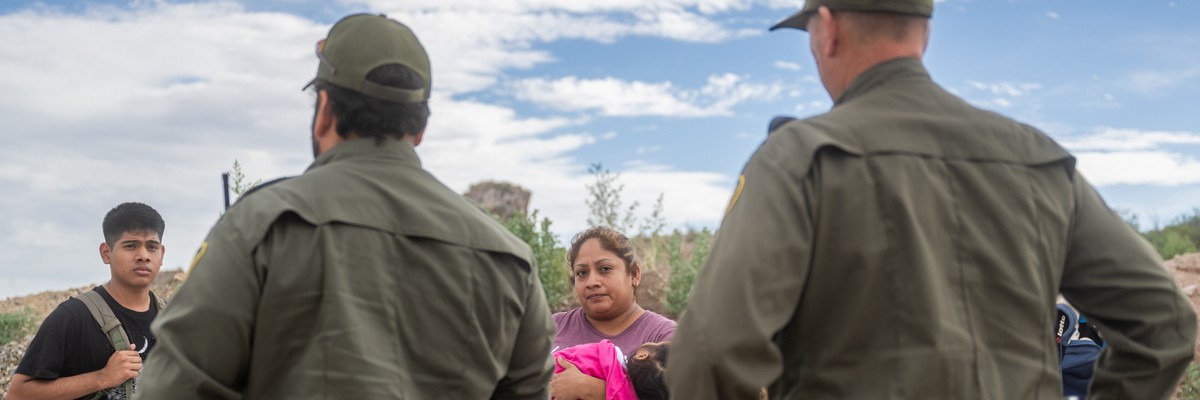
A Mexican migrant holds her daughter while being apprehended by U.S. Customs and Border protection officers after crossing over into the U.S. on June 26, 2024 in Ruby, Arizona. (Photo: Brandon Bell/Getty Images)

“As always, we will go to court to challenge illegal policies, but it is equally essential that the public push back, as it did with family separation,” one rights advocate said.

President-elect Donald Trump is set to begin his promised mass deportation of undocumented immigrants as soon as he takes office on January 20, 2025, even as rights groups are mobilizing to stop him.

Trump national press secretary Karoline Leavitt told Fox News Wednesday morning that “the American people delivered a resounding victory for President Trump.”

“It gives him a mandate to govern as he campaigned, to deliver on the promises that he made, which include, on Day 1, launching the largest mass deportation operation of illegal immigrants that Kamala Harris has allowed into this country,” Leavitt said.

“We have a simple message for President-elect Trump or his deputies if they decide to make good on their despicable plans: We will see you in court.”

Trump has pledged to conduct the largest deportation in U.S. history, with running mate and now Vice President-elect JD Vance promising 1 million deportations each year. The plan would likely rely on mobilizing federal agencies, the military, diplomats, and Republican-led states while using federal funds to pressure uncooperative states and cities into complying.

The stocks of private prison companies like GEOGroup and Core Civic rose significantly after Trump’s win, and private contractors had already been discussing ahead of the election how to build enough detention space to accommodate Trump’s plans.

A study released by the American Immigration Council in October found that a massive, one-time deportation program of the estimated 13.3 million migrants in the country without legal status would cost the government at least $315 billion while a 1-million-a-year approach would cost $88 billion a year for a total of $967.9 billion. It would also shrink the nation’s gross domestic product by between 4.2 and 6.8%, not to mention the massive human cost to immigrant families, as around 5.1 million children who are U.S. citizens live with an undocumented family member.

The council also warned that such a program would likely threaten the well-being of all immigrants and increase vigilantism and hate crimes.

“As bad as the first Trump administration was for immigrants, we anticipate it will be much worse this time and are particularly concerned about the use of the military to round up immigrants,” Lee Gelernt, a lawyer with the American Civil Liberties Union who fought the first Trump administration on family separation and other policies, told The Washington Post. “As always, we will go to court to challenge illegal policies, but it is equally essential that the public push back, as it did with family separation.”

Exit polls show that 56% of U.S. voters favor offering immigrants already in the U.S. a pathway to citizenship, while Data for Progress found that survey respondents did not favor deportation for 7 out of 9 categories of people who might be caught up in a mass deportation scheme.

The ACLU has urged cities and states to take steps to protect their undocumented residents ahead of January 20.

“They should prepare for mass deportations because those will wreak havoc on the communities,” Noreen Shah, director of government affairs at the ACLU’s equality division, told Newsweek. “It will mean kids who go to school and their parents are gone and not there to pick them up at the end of the day.”

In particular, legal groups are gearing up for Trump to potentially evoke the Alien Enemies Act of 1798, which authorizes the country to deport noncitizens of a hostile nation. It has only been used three times, most recently to detain Japanese Americans during World War II.

“Many fear that a second Trump administration would seek to use this law to justify indefinite detention and remove people from the country swiftly and without judicial review,” Shah told Reuters.

The Brennan Center for Justice has called on Congress to repeal the act.

“This law was shameful and dangerous back when it was created 200 years ago,” the center’s Marcelo Agudo wrote in October. “It’s even more so today. It must be repealed or overturned.”

Several other organizations pledged to continue defending immigrants and refugees after Trump declared victory.

“We have a simple message for President-elect Trump or his deputies if they decide to make good on their despicable plans: We will see you in court,” Karen Tumlin, founder and director of Justice Action Center, said in a statement. “And, we have a message of love to immigrant communities, we see you, we are you, and we will stand with you.”

Calling Trump’s win “one of the most dangerous moments in our country’s history, National Immigration Law Center president Kica Matos said the organization had led a “movement-wide effort to plan for this moment.”

“Trump and his allies told us what he plans to do: mass deportations, ending birthright citizenship, ending the right to public education for immigrant children, internment camps, and using the military to hunt down immigrants. We should take him at his word,” Matos said.

She continued: “One thing is certain: we cannot and will not retreat. For more than 40 years, NILC has been steadfast in our fight to defend the rights of low-income immigrants and their loved ones. We successfully fought Donald Trump before, and we will do it again.”

The American Immigrant Lawyers Association (AILA) pledged to continue working for its clients.

“If implemented, the anti-immigrant policies avowed by candidate Trump will inflict lasting damage to the American economy, communities, and character,” AILA Executive Director Benjamin Johnson said in a statement. “AILA and its more than 16,000 members will continue to defend the Constitution and stand against laws and policies that violate due process, undermine civil rights, or denigrate the contributions of immigrants. Our future prosperity depends on not giving up. We must stand together and work towards a brighter future.”

Refugees International also promised to continue with its “shared commitment to rights and refuge for people forced from their homes.”

“Amid historic levels of global displacement, the incoming Trump administration plans to enact an anti-refugee, anti-asylum agenda that will endanger millions of people—both those threatened by crises overseas and those who have been welcomed as neighbors into communities across the United States,” the group’s president, Jeremy Konyndyk, said in a message to supporters. “Yet we hold on to hope, even as we are clear-eyed about the daunting struggles ahead.”

Knowndyk added: “As we do under any presidential administration, we will work tirelessly with all of you to defend and advance the rights, protection, and well-being of all people forced to flee their homes.”

United We Dream, the largest U.S. organization led by immigrant youth, committed to building the “largest pro-immigrant movement this country has ever seen.”

“Immigrant young people of United We Dream declare ourselves hopeful and clear eyed about the fight ahead,” said the group’s executive director Greisa Martínez Rosas. “With Trump pledging to carry out the largest deportation effort in our country’s history—activating the military to raid our communities, schools, hospitals, and more in order to round up our people into concentration camps—young, Black, brown, and queer leaders who have been at the vanguard of our movement and of creating meaningful change are ready move mountains to protect our communities.”

Original article by Olivia Rosane republished from Common Dreams under Creative Commons (CC BY-NC-ND 3.0). 

Continue ReadingTrump Spokesperson Affirms Day 1 Plans for Nation’s ‘Largest Mass Deportation Operation’

Caught in the net: how migration became a criminal offence

Spread the love

Original article by Vicky Taylor Melissa Pawson republished from Open Democracy under a Creative Commons Attribution-NonCommercial 4.0 International licence

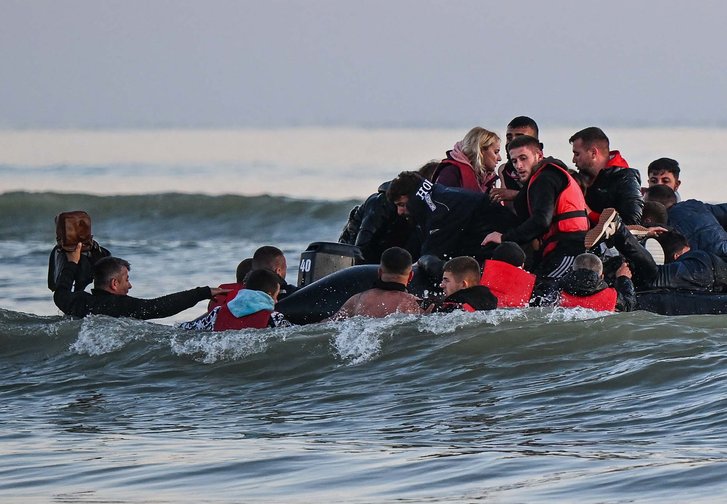
People board an inflatable dinghy in an attempt to cross the Channel from France to the UK in July 2022
 | Denis Charlet/AFP/Getty Images. All rights reserved

New series: UK and EU governments are targeting people crossing borders in the name of ‘counter-smuggling’

On 1 June 2019, Samyar Bani boarded a small dinghy with five other people. Looking out at the expanse of the English Channel, he said he felt afraid, but knew he had to continue. Just a few miles more and he would be in the UK. At that point, he never expected to still be journeying, still seeking safety, two years after fleeing persecution in his hometown of Shiraz, Iran.

Bani and his companions had purchased the dinghy together to avoid smugglers’ fees. He hoped the boat would keep them safe as they crossed the water, because he didn’t know how to swim. It was a dangerous last step, he knew that. But, given the limits of the UK’s resettlement routes and the tightness of its visa regimes, he saw this as his best chance for reaching sanctuary.

Bani hoped he’d be welcomed on the other side of the Channel, and that his request for asylum would be accepted. He had no idea that placing his hand on the tiller of the boat would land him in prison, cause him to plead his case before a jury at trial, and tie him up in an appeal process for two and a half years.

He never expected to lose contact with his wife and daughter, or for them to spend three years mourning the death of their husband and father. He never expected to have his picture put online, or to be branded as a ‘dangerous people smuggler’.

All of this happened to Bani because he helped to buy a boat, and helped to steer it to safety.

A new normal has crept in. Over the last few decades, crossing borders without permission – sometimes called ‘irregular migration’ – has become a criminal offence in many countries. Among those prosecuted are people in search of asylum, fleeing war and persecution.

These migrants and refugees, as well as solidarity actors like rescue workers, are also increasingly at risk of being labelled as ‘smugglers’ for the purposes of prosecution.

Governments are widening the nets of who they consider criminal as they respond to calls from the far-right to crack down on immigration. In doing so, states justify measures which racially profile, control and contain people on the move. These measures have been shown to make no tangible difference to immigration numbers, and instead cause immense harm to the very people they purport to protect.

In this new series, 12 authors do a deep dive into the criminalisation of migration and solidarity in the UK and Europe. Some of the contributors to this series have been accused of espionage, people smuggling, and facilitating ‘illegal entry/ arrival’. Some were crossing borders, and others were acting in solidarity with those crossing borders. Contributors also include policy experts and journalists working to expose those injustices.

Over the next two weeks, we’ll examine the hidden corners of global anti-migration structures set up in the name of ‘anti-smuggling’. We’ll be looking at: the detention of rescue workers in Italy; the imprisonment of children under ‘smuggling’ charges in the UK; the repeal of EU-enforced smuggling laws in Niger; how the EU is putting pressure on migrants’ rights groups in North Africa; the lucrative policing contracts in the ‘digital fight’ against smuggling; and the far-reaching influence of anti-mafia and counter-terror policies on counter-smuggling.

Widening the definition of ‘smuggling’

People fleeing wars, occupations or persecution often have no choice but to travel without documents or visas. Many must leave quickly and under dangerous circumstances, and in any case most countries of destination don’t make any practical legal routes available to them.

In recognition of these circumstances, refugees are protected from “penalties on account of their illegal entry or presence” by the 1951 Refugee Convention, which the UK and all EU countries are party to. But their protected status has, in recent years, been eroded by anti-immigration and counter-smuggling policies. What used to be considered ‘irregular’ movement for asylum has increasingly been redefined as ‘illegal’.

Many countries, for example, now target the people steering the boats carrying people on the move – people like Samyar Bani – regardless of whether they were involved further in ‘smuggling’ activities or not. Organisations and researchers have documented this practice in GreeceItalySpainIndonesia, and, most recently, in the UK.

Soon after people started arriving in the UK in ‘small boats’ in greater numbers in late 2018, the Conservative government began to arrest, charge, and convict those identified as steering the dinghies. These arrests were accompanied by media briefings labelling the people arrested as ‘smugglers’ responsible for crossings.

Yet even those tasked with identifying the ‘smugglers’ questioned the logic. Border Force officers told inspectors, “there were no organised crime group members onboard the boats, although one of the migrants might have agreed with the facilitators to act as a ‘chaperone’ for a reduced fee.”

A series of successful appeals in 2021 overturned these early convictions. Lawyers argued that people intending to arrive at ports and claim asylum are not guilty of the offence of ‘illegal entry’, since they are simply arriving irregularly, and then entering as an ‘asylum seeker’.

The legislation effectively made all irregular arrival, even for the purposes of claiming asylum, a criminal offence in the UK

In response, the UK government used the 2022 Nationality and Borders Act to expand the criminal offences that can be applied against people crossing borders irregularly. This legislation introduced a new offence of ‘illegal arrival’ and increased the maximum sentence to four years imprisonment. For the crime of ‘facilitation’ – in other words, assisting arrival or ‘smuggling’ – the maximum sentence was increased to life in prison.

This legislation effectively made all irregular arrival, even for the purposes of claiming asylum, a criminal offence in the UK.

Across Europe, states are also working on expanding the definition of ‘smuggling’ to increase the number of prosecutions. Member states can currently charge people for offences relating to crossing borders, or for defending the rights of those crossing borders through the EU’s 2002 Facilitation Directive.

Just like in the UK, the directive has allowed states to prosecute people for steering boats even if no other evidence of ‘smuggling’ activities is presented. In 2021, a Greek court sentenced M. Hanad Abdi to 142 years in prison for “transporting” 33 people to the country. The decision was made despite Abdi having been forced “at gunpoint” to helm the boat, and despite him saving 31 of his co-passengers’ lives on the way.

His lawyers appealed the sentence, and it was reduced to eight years in 2023. Responding to the decision, Abdi’s lawyer, Alexandros Georgoulis wrote: “The law is completely obsolete. We now know that smugglers no longer approach the Greek coast to avoid arrest, and let the migrants guide the boats on their own.”

And yet, the European Commission is seeking to strengthen its powers even further through a new, expanded facilitation directive. This is despite migrants’ rights groups and the UN Special Rapporteur on Human Rights Defenders raising concerns about the implications this will have.

The new EU directive is likely to “dramatically increase” the criminalisation of migration and solidarity in Europe, according to migrants’ rights organisation PICUM. It will introduce longer prison sentences, broaden provisions for criminalising NGO workers, and continue to allow smuggling charges to be brought against people simply for crossing borders with their children.

Hundreds already serving sentences

As the UK and EU expand the legislation which allows them to criminalise those crossing borders or those standing in solidarity with them, hundreds are already caught in the web of the system.

According to PICUM, 117 people were subject to criminal proceedings for their solidarity work with people crossing borders in Europe, and 76 people were charged for crossing borders in 2023. Most of them faced charges of migrant smuggling or facilitation of entry, transit or stay, allowed under the 2002 EU directive. These numbers are most likely an undercount, since charges across the entire bloc are hard to track.

In the UK, 189 people were arrested for their ‘illegal arrival’ in dinghies in 2022, 109 of them for their role in steering the boats. In 2023, 244 people were charged for ‘illegal arrival’, 86 of whom were alleged to have steered the boat. The latest data obtained from the Home Office indicated that 38 people were charged with ‘illegal arrival’ for steering dinghies in the first six months of 2024.

Those branded as ‘smugglers’ are made convenient scapegoats for the real, unaddressed failures of UK and EU governments

The vast majority of these people were crossing borders to seek sanctuary and a better life. Some were victims of trafficking and torture. And at least 22 of those charged in the UK are age disputed, meaning that they were charged as an adult despite stating their age as under 18.

In courts across Europe and the UK, those arrested often explain how they drove the boats under duress, or because they could not otherwise afford the passage. Individuals – some of them teenagers like Ibrahima Bah or the El Hiblu 3 – explain how they were only seeking a place of safety.

Yet they have been declared ‘smugglers’ and labelled as solely responsible for any harms that occurred at sea. This placement of blame entirely obscures the structural responsibility of states who close alternative routes to safety while continuing to invest in border security infrastructure.

And Europe isn’t only criminalising people on its own shores. Years of policies to offshore its border control, for example to countries on the other side of the Mediterranean, have resulted in people being targeted for migrating or for solidarity work before they even reach European soil.

EU countries have handed billions to Turkey, Libya, Tunisia, Egypt, Mauritania and Morocco in deals to control and curb migration. Many of those deals hand funds to authoritarian regimes – and, in Libya’s case, facilitate human rights abuses on and off its shores.

Erosion of rights for everyone

Criminalisation policies cause immense harm to people. NGO workers are targeted for supporting people on the move and are forced to uproot their work and their lives. People migrating are forced to take even more dangerous routes to evade arrests, through deserts and in unseaworthy boats – and if they do make it to safety, they face spending years or decades in prison.

All the while, those branded as ‘smugglers’ are made convenient scapegoats for the real, unaddressed failures of UK and EU governments: soaring poverty and homelessness, declining public services, a rising cost of living and crises in the healthcare systems.

Experts have long called for safe routes to be made available to people seeking sanctuary. But governments seem intent to plough on with harmful criminalisation policies instead, all the while increasing the risks people are forced to take at borders.

Since being released from prison, Samyar Bani has been granted leave to remain in the UK. The scars of his experiences are far from healed: he still suffers flashbacks from his time in prison, is still struggling to get a job due to his criminal record, and has had his application to bring his wife and daughter to the UK rejected.

But he’s not giving up on building a life in safety. He’s working on his English so he can go back to work, and he’s appealing the decision on his family reunification application. “Humans need life,” said Bani at the end of our interview together. “My country wasn’t safe for me, so I came to the UK.”

He paused. “Police understand who a smuggler is, and they don’t sit in the boat. They just do this so they can close the border to refugees.”

Original article by Vicky Taylor Melissa Pawson republished from Open Democracy under a Creative Commons Attribution-NonCommercial 4.0 International licence

Continue ReadingCaught in the net: how migration became a criminal offence

Starmer apes Tory rhetoric by claiming migration is security threat equivalent to terrorism

Spread the love

https://morningstaronline.co.uk/article/starmer-apes-tory-rhetoric-by-claiming-migration-is-security-threat-equivalent-to-terrorism

Prime Minister Sir Keir Starmer giving a speech during the Interpol General Assembly, at the Scottish Event Campus (SEC) in Glasgow, November 4, 2024

ILLEGAL migration is a security threat equivalent to terrorism, the Prime Minister said today as he aped Tory rhetoric.

Pouring cash and hardline language at the problem, Sir Keir Starmer announced an extra £75 million to police Britain’s borders.

Speaking at the global policing organisation Interpol’s conference in Glasgow, Sir Keir said that “people smuggling should be viewed as a global security threat similar to terrorism.”

The new Border Security Command Labour is establishing would “treat people smugglers like terrorists,” he pledged.

Government presentation of the question appeared inflammatory, as the Downing Street press release for the Prime Minister’s speech headlined “national security threat.”

Public and Commercial Services (PCS) union general secretary Fran Heathcote said: “While we welcome the government’s commitment to tackle people smugglers, the best way to deal with deaths in the Channel is to adopt our Safe Passage policy that would create a safe and legal route for refugees to come to the UK and here begin their asylum claim.”

Small boat crossings are presently on the rise, with more than 27,500 people having made the dangerous passage across the Channel so far this year, more than in the same period in 2023.

https://morningstaronline.co.uk/article/starmer-apes-tory-rhetoric-by-claiming-migration-is-security-threat-equivalent-to-terrorism

Continue ReadingStarmer apes Tory rhetoric by claiming migration is security threat equivalent to terrorism

Anti-racists outnumber far-right protesters in Glasgow

Spread the love

https://morningstaronline.co.uk/article/anti-racists-outnumber-far-right-protesters-in-glasgow

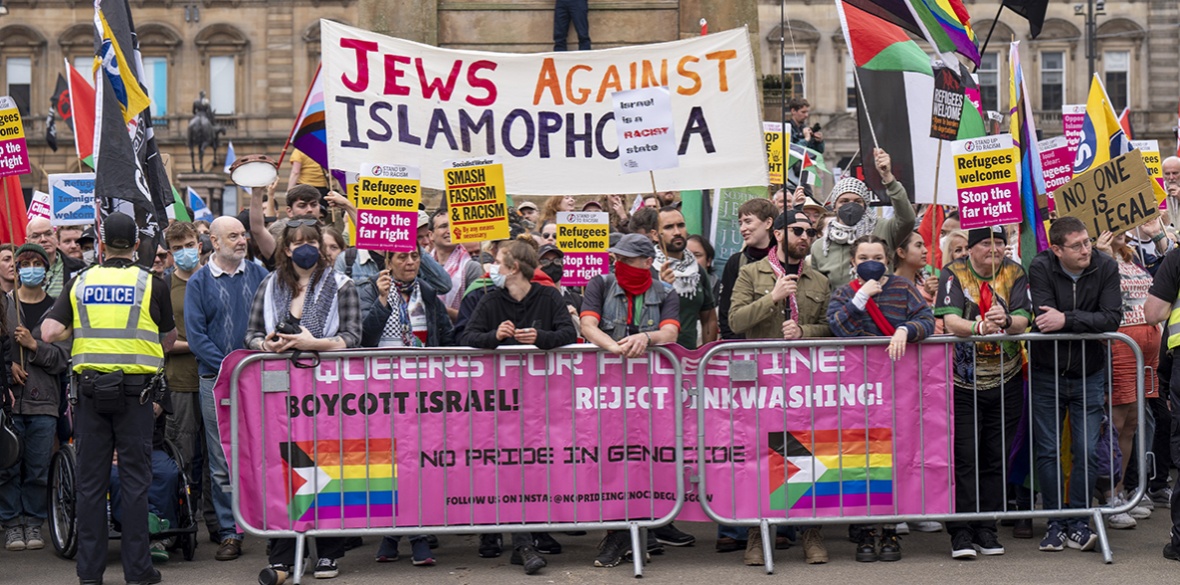
Activists from Stand Up To Racism Scotland gather in Glasgow’s George Square, in a counterprotest to a far-right rally, September 7, 2024

MORE than 5,000 people rallied in Glasgow’s George Square on Saturday in solidarity with the migrants and refugees increasingly targeted by the far right.

The demonstration came together to counter a call by racist grifter Stephen Yaxley-Lennon — known as Tommy Robinson — for an anti-immigration rabble to assemble in the city; Yaxley-Lennon was nowhere to be seen as his fans faced the humiliation of being outnumbered 15 to one.

To the west of the square, the rally organised by Stand Up to Racism (SUTR), backed by the STUC, and attended by thousands of trade unionists and community activists, heard from a host of speakers from trade unions as well as those with first-hand experience facing racism and building solidarity in their communities.

To the east, at the cenotaph, members of the fascist Patriotic Alternative did their best to rouse their mob, with renditions of Rule Britannia and barely audible hate-filled speeches alternating with the launching of abuse and bottles at anti-fascists.

Eventually escorted from the square by Police Scotland, some of their number went on to attack the nearby McChuills, a bar associated with refugee solidarity, resulting in two arrests.

But Police Scotland were criticised for “kettling” anti-fascist Celtic ultras the Green Brigade for several hours, preventing them from joining the SUTR rally.

One witness told the Star: “I don’t even support their club but this is a pointless provocation: the Green Brigade have done nothing to justify this, but they’re used to getting singled out.”

https://morningstaronline.co.uk/article/anti-racists-outnumber-far-right-protesters-in-glasgow

Continue ReadingAnti-racists outnumber far-right protesters in Glasgow